Tag: best practices

  • CloudBolt Commits to Applying AI to FinOps

    CloudBolt Commits to Applying AI to FinOps

    CloudBolt Software today revealed it plans to infuse artificial intelligence (AI) into the financial operations (FinOps) capabilities it provides via its IT management platform over the coming year.

    Kyle Campos, chief product and technology officer for CloudBolt, said given the inherent complexity of modern IT environments, there is a need to apply machine learning algorithms and other forms of AI to enable IT organizations to apply policies in real-time to reduce costs. That capability is especially critical in cloud computing environments where services are often invoked by developers with little to no oversight, he noted.

    FinOps is a discipline that promotes a shared responsibility for an organization’s cloud computing infrastructure and costs. Rather than having disparate procurement teams working in silos to identify and approve costs, business, financial and IT leaders establish policies and best practices for usage that are programmatically enforced. The FinOps Foundation, an arm of the Linux Foundation, has been defining a set of FinOps best practices, but many organizations still lack the discipline required to implement them. One of the major reasons organizations lack this discipline is that many of them have been allowing application developers to provision cloud resources themselves. It’s not until the bill comes due at the end of the month that finance teams realize there is an issue when there is a sudden spike in costs.

    Rather than deploying a separate platform to manage FinOps, CloudBolt is making a case for integrating a framework for managing FinOps within the same platform IT teams use to manage those IT environments. That approach makes it possible to apply FinOps policies in a way that ensures best practices for controlling costs are implemented without creating yet another silo within an IT organization, said Campos.

    Running application workloads in the cloud is fundamentally different than running them in an on-premises IT environment where costs are largely fixed. Not many developers have much of an appreciation for the additional storage and cybersecurity expenses that are generated every time a new workload is added. As a result, many organizations lack visibility into the total cost of cloud computing until the monthly bill arrives. By then, it’s too late for IT teams to have any impact on the outcome.

    In the face of ongoing economic uncertainty, more organizations are clearly moving to reduce cloud computing costs more aggressively. In an ideal world, IT teams would be able to instantly see what impact any change to an IT environment will have on costs as part of any scenario planning exercise, said Campos.

    While most organizations would like to reduce their cloud costs, it’s just as important to ensure that the bills being incurred are predictable. Finance teams don’t appreciate surprises, no matter how important an application may be. IT leaders are now being held more accountable than ever to make sure cloud computing costs meet expectations from one month to the next. The challenge now is finding a way to inject controls in IT environments long after applications have already been deployed.

  • 5 Serverless Challenges of DevOps Teams and How to Overcome Them

    5 Serverless Challenges of DevOps Teams and How to Overcome Them

    Serverless is a cloud computing execution model where the cloud provider dynamically manages the allocation of machine resources. The term ‘serverless’ might be somewhat misleading as it doesn’t mean servers are not involved. Instead, it means that developers no longer have to think about servers, even though they’re running on them.

    The idea is to abstract the infrastructure away so that developers can focus solely on the code. Functions, the units of code, are triggered by a variety of events, including HTTP requests, database events, queuing services, monitoring alerts, file uploads, scheduled events (cron jobs), and user sign-ups or in-app activities.

    The Importance of Serverless for DevOps Teams

    Serverless computing brings a paradigm shift in how applications are built, deployed and managed, directly impacting DevOps teams. The core advantage of serverless for these teams is the significant reduction in operational overhead. With serverless, the cloud provider takes responsibility for running the server, ensuring its reliability, and scaling the infrastructure. This frees DevOps teams from the routine tasks of server provisioning, maintenance, and patching, allowing them to focus more on optimizing the application’s code and business logic.

    However, this shift also demands a change in mindset and approach. DevOps teams must adapt to a more granular, event-driven architecture that serverless promotes. They need to design systems thinking about individual functions and how they interact, instead of traditional monolithic applications or even microservices. This requires a deeper understanding of the cloud environment and its services, as serverless functions are often tightly integrated with other cloud services like databases, message queues, and API gateways.

    Moreover, serverless computing introduces new challenges in areas like security, monitoring, and cost management. For instance, the ephemeral nature of serverless functions can make traditional monitoring approaches less effective, and the dynamic scaling can lead to unpredictable costs. DevOps teams need to develop new strategies and adopt specialized tools to address these challenges. Despite these issues, the benefits of serverless – in terms of agility, scalability, and potential cost savings – make it an increasingly essential tool in the DevOps arsenal, particularly for organizations looking to innovate and deploy rapidly in a cloud-centric world.

    5 Serverless Challenges of DevOps Teams and How to Overcome Them

    1. Complexity of Monitoring in Serverless

    A main challenge in the serverless world is the complexity of monitoring. Unlike traditional architectures where you can monitor physical or virtual servers, in serverless, you need to monitor individual functions. This can be tricky as you may have hundreds or even thousands of functions running simultaneously.

    To effectively monitor serverless architectures, you need to go beyond traditional methods. You need tools that can provide insights at the function level, such as AWS CloudWatch or Azure Monitor. These tools allow you to monitor metrics like execution time, error rates, and invocation counts for each of your functions.

    But monitoring is not just about gathering metrics. It’s also about understanding the relationships between your functions and other components of your system. For this, you need distributed tracing tools like AWS X-Ray or OpenTelemetry, which can provide a detailed view of how requests flow through your system.

    2. Managing Lambda Cold Starts

    One of the most common serverless challenges that DevOps teams face is cold starts. A “cold start” refers to the delay that occurs when a function is invoked after being idle for a while. This delay can significantly impact the performance of your applications, especially those that rely on real-time processing.

    The first step to managing Lambda cold starts is understanding what triggers them. Typically, a cold start happens when a new instance of your function is created, which can be due to several reasons, such as an increase in traffic, the deployment of a new version of your function or after a function has been idle for too long.

    To overcome this challenge, there are several strategies you can employ. First, you can use provisioned concurrency, a feature offered by AWS Lambda that allows you to keep a specified number of function instances warm and ready to respond to invocations. Another strategy is to design your applications to be resilient to cold starts by implementing retry logic or using asynchronous invocation when possible.

    3. Security Concerns in Serverless Architectures

    Security is a top concern for any DevOps team. In serverless architectures, you have less control over the underlying infrastructure, making it more difficult to ensure the security of your applications.

    The first step to securing your serverless applications is understanding the shared responsibility model. In a serverless environment, the cloud provider is responsible for securing the infrastructure, while you are responsible for securing your code and configurations. This means you need to pay extra attention to things like input validation, error handling and secure configuration practices.

    Another key aspect of serverless security is managing permissions. Each of your functions should have the least privileges necessary to perform its task. This can be achieved by using identity and access management (IAM) services provided by your cloud provider.

    4. Managing Third-Party Dependencies

    Managing third-party dependencies is another challenge that DevOps teams often face in serverless architectures. These dependencies can introduce vulnerabilities into your applications, affect the performance of your functions, and even increase the cost of your serverless deployments.

    The key to managing third-party dependencies is to minimize their use. Only use dependencies that are necessary for your application and regularly review them to ensure they are still needed. You should also keep your dependencies up-to-date to benefit from the latest security patches and improvements.

    When using third-party dependencies, it’s also important to understand their impact on your functions. You can use tools like AWS X-Ray or Google Cloud Trace to monitor how these dependencies affect the performance of your functions.

    5. Cost Management and Optimization

    While serverless can be cost-effective, it’s easy to rack up high bills if you’re not careful. This is because in serverless, you pay for every invocation of your functions, even if they result in errors.

    To manage costs in serverless, you need to monitor your usage closely. Tools like AWS Cost Explorer or Google Cloud Billing can provide insights into your spending and help you identify areas for optimization.

    You can also optimize costs by designing efficient functions. This means writing code that executes quickly and efficiently, minimizing the use of third-party dependencies, and managing the concurrency of your functions.

    In conclusion, while serverless technologies offer many benefits, they also present unique challenges for DevOps teams. By understanding these challenges and employing the right strategies, you can effectively manage and overcome them, ensuring the successful delivery of your serverless applications.

  • Swimm Adds Generative AI Chat Tool for Documentation

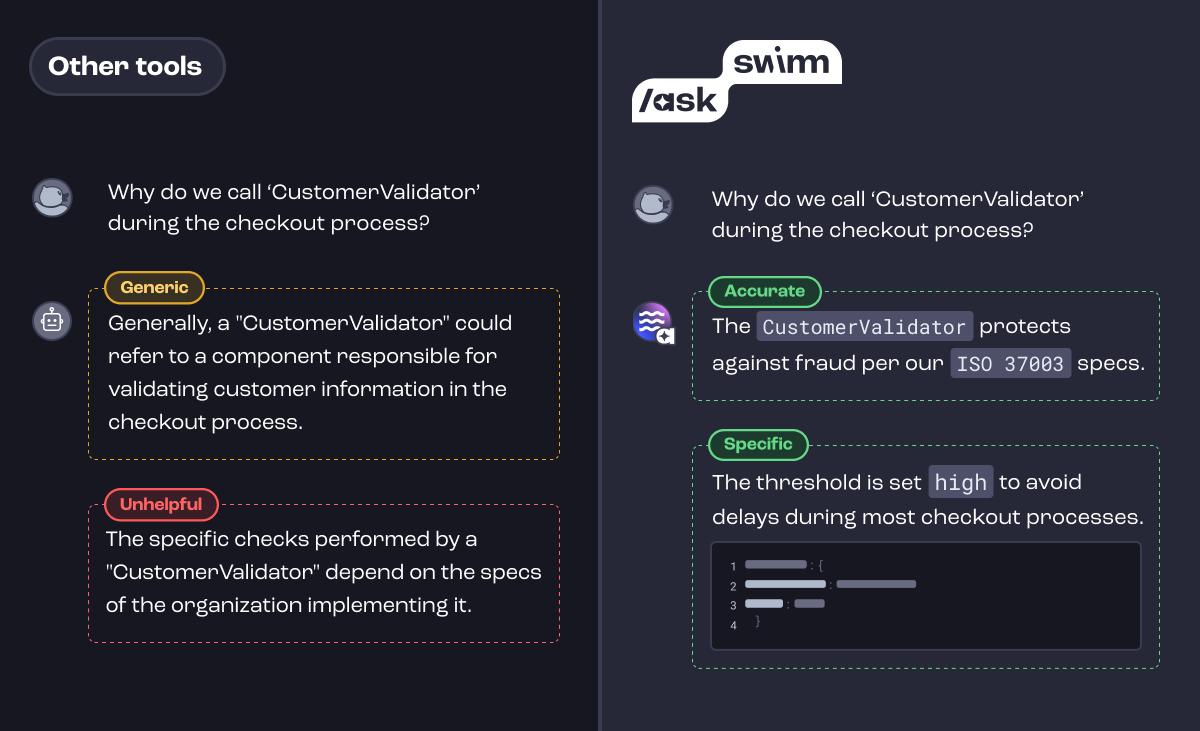
    Swimm today announced it has added a chat tool that enables developers to use natural language to surface insights into code.

    Company CEO Oren Toledano said the /ask Swimm tool makes it simpler to launch queries that enable developers to better understand how code was constructed.

    The /ask Swimm tool aggregates documentation along with other related data to surface factors that are not evident in the code itself, such as documentation of business decisions, product design considerations and decisions concerning why specific architectural choices were made. It automatically captures and updates code-related knowledge to provide a continuous feedback loop as code, documentation, files and repositories are created and updated to provide deeper insights into code that goes beyond what might have been actually documented.

    The overall goal is to provide a mechanism that enables developers to understand how and why code was constructed within the context of an integrated development environment (IDE), said Toledano.

    Swimm has previously made available a platform that uses generative AI platform to create a static analysis of documentation. That capability should make it simpler for organizations to track documentation at a time when generative AI platforms such as ChatGPT are exponentially increasing the amount of code being written. In theory, those platforms should be able to also create documentation for that code, but there will still be a need for tools to track and analyze it.

    In the longer term, Swimm plans to continue to extend its usage of generative AI to provide deeper levels of insights across entire applications and software ecosystems to address that challenge, noted Toledano.

    In the short term, however, it’s clear that AI is making developers more productive than ever. In fact, the volume of code being generated might soon overwhelm existing DevOps pipelines and workflows. Most DevOps teams will need to revamp those workflows as the pace at which more applications than ever are being developed and deployed faster than ever.

    It’s still early days as far as generative AI adoption is concerned, but it’s clear many developers are already using it to write code. How much of that code makes it into a production environment is difficult to determine, but a lot of that code is going to be of varying quality. A general-purpose AI platform such as ChatGPT was trained using code collected from all across the web. The code generated by these platforms is only as good as the examples used to train it, all of which were created by human developers who may have made mistakes, such as including code that has known vulnerabilities.

    Regardless of whether code was generated by a machine or a human, the probability that documentation will need to be analyzed as part of a code review process is always high. The challenge and the opportunity is to determine the best way to apply AI to a longstanding challenge that is now being exacerbated by the existence of AI tools that, with each passing day, are only becoming more accessible to developers.

  • The Differences Between DevOps, DevSecOps and SRE

    The Differences Between DevOps, DevSecOps and SRE

    DevOps, DevSecOps and SRE are all quickly gaining traction within the tech world due to their effectiveness and promise of reliability for companies. Each framework provides various levels of safety and scalability—DevOps is agile, DevSecOps prioritizes security above all else and SRE focuses on performance optimization. Together, these are changing how software gets deployed from conception to production. We’ll break down each one in detail.

    What is DevOps?

    DevOps is a set of practices that combines software development and IT operations, which aims to shorten the software development life cycle (SDLC).

    DevOps bridges the gap between those two areas by bringing together different people–developers, operators, testers and system engineers–who are responsible for different parts of the software delivery process, from planning to deployment into production environments.

    A core tenet of DevOps is to automate manual processes within each stage of the SDLC, eliminating much of the redundant work that used to take weeks or even months. This automation significantly drives down costs, as well as reduces problems posed by human error when running manual tasks.

    The following are some of the core tenets of DevOps:

    1. Collaboration
    2. Quality and reliability
    3. Automation
    4. Scalability
    5. Security

    What is DevSecOps?

    DevSecOps (or DevOps security) is an emerging field within the DevOps practice that focuses on strengthening software security within the development and operations process.

    These three distinct groups often have different priorities when it comes to building software applications. Developers are focused on speed-to-market objectives from their employers or clients, operations focus on reliability and scalability, while security teams prioritize safety from malicious actors or data breaches. At the same time, with DevSecOps, these goals become united under one umbrella: Build fast and reliable applications with built-in protection against attacks.

    DevSecOps focuses on implementing security as code—or automating many routine tasks involved with identity management, like user authentication and authorization. To ensure that security is properly integrated into your DevOps pipelines, below are some key DevSecOps practices:

    1. Automate security processes whenever possible
    2. Encourage continuous testing
    3. Prioritize remediation over detection
    4. Create a culture around secure coding principles

    What is SRE?

    SRE stands for site reliability engineering. The basic idea behind SRE practices is that software engineers should be responsible for both the development as well as the reliability of their product as a whole. This means having an understanding of not only how users will interact with the application or service but also how it interacts with other services in its operating environment, such as databases, firewalls, cloud environments, etc.

    To maintain uptime while meeting these requirements, SRE applies various techniques like automation and continuous deployment processes to ensure high availability.

    A key goal of site reliability engineering is service-level objectives (SLOs), which measure how consistently a service meets its goals over a given period of time—such as how often it’s available, how quickly it responds to requests made by users or customers—and establishing goals around those SLOs. Achieving objectives like these helps organizations build customer trust in their products and services since it ensures that they have stable and reliable day-to-day operations.

    Here are some of the most important SRE principles:
    1. Automation
    2. Proactive monitoring
    3. Fault tolerance
    4. Measurement and analysis
    5. Service-level objectives (SLOs)

    DevOps Vs. DevSecOps Vs. SRE

    The differences between DevOps, DevSecOps and SRE can be summed up in three main areas: Scope, roles and objectives.

    DevOps focuses on improving the speed of releasing software by automating processes and optimizing collaboration between development and operations teams. This helps organizations create a continuous delivery pipeline to quickly deploy code into production with minimal risk. As such, it is typically focused on development or operations activities and has become synonymous with agile methodologies such as continuous integration/continuous delivery (CI/CD).

    DevSecOps expands upon these concepts to include security considerations from the very beginning of a project’s life cycle instead of tacking them on after the fact. By shifting security left in the process–meaning bringing security earlier into the design phase–teams are able to reduce risk early on while achieving faster results overall through continuous feedback loops.

    As part of this shift left process, DevSecOps practitioners focus heavily on automating security compliance activities as part of their job function rather than waiting until after deployment has occurred.

    Meanwhile, SRE focuses more broadly on keeping the user experience consistent across various products an organization offers by responding to customer needs quickly while creating automation processes that allow common tasks to be repeated without manual intervention from engineers or developers.

    Then there is also platform engineering, which is a closely related yet distinct discipline with its own unique responsibilities. While both DevOps and platform engineering involve automation and working with the infrastructure that supports software development, there are some key differences between them.

    Platform engineering can be defined as a practice that involves developing a standardized platform on which all applications will run. Platform engineers build the underlying infrastructure to support applications, including servers, databases, virtualization layers and networking components using standardized toolsets. An important task for this field is designing an application’s architecture in such a way that allows it to scale easily with increased demand or usage levels. Additionally, they create self-service tools that enable developers on their team to quickly spin up new environments without requiring outside assistance.

    Wrapping Up

    In conclusion, while all three approaches have similar goals–ensuring reliability, speeding up the software delivery process and securing user data–they do so using different strategies:

    ● DevOps favors automation.
    ● DevSecOps puts focus on proactive security measures.
    ● SRE prioritizes optimization, reliability and scalability.

    Each one can contribute significantly when appropriately implemented into any organization’s workflow, depending upon its own specific needs.