Tag: Backstage

  • Is Backstage the Right Internal Developer Portal for You?

    Is Backstage the Right Internal Developer Portal for You?

    There has never been a better time to be a software developer. There is a language and framework to solve virtually any challenges we encounter. New tools, architectural patterns and methodologies like DevOps and Agile have changed how we work, architect our applications and organize ourselves. This has enabled teams to be nimbler than ever before. But this has all come with a hidden cost: Sprawling complexity.

    Sprawl is a complex web of disparate tools, languages and frameworks used across an organization’s projects. While this diversity allows for specialized solutions tailored to specific problems, it creates a labyrinth of interdependencies and varied skill requirements. This complexity often results in developers constantly navigating through a maze of tools, leading to inefficiencies and a steep learning curve for new team members. As organizations adopt more tools and technologies, the cohesive understanding of the entire software ecosystem diminishes. There are two areas in particular where this pain is felt acutely.

    The first area sprawl acutely impacts is the ability to find essential knowledge about systems, which becomes fragmented across tools and resources as sprawl increases. This fragmentation leads to longer incident response times and makes it more difficult for newly hired engineers to ramp up. Knowledge fragmentation also makes it considerably harder for enterprises to measure and manage initiatives to achieve high standards for security and reliability, as well as track migrations to new architectures like containers or clouds.

    Sprawl also impacts frequently occurring tasks for developers, such as managing “day two operations” like changing environment variables, adding secrets or modifying a replica count, or creating something new like a microservice or an environment. Given the complexity required to create and operate infrastructure, many organizations have invested in creating automations via infrastructure-as-code and CI/CD systems; however, these automations are often difficult for developers to discover and use. As a result, developers often file tickets with ops teams to complete these tasks, creating a process bottleneck that slows development velocity while burdening ops teams with mundane, repetitive tasks. This is commonly referred to as TicketOps.

    All of this has made the developer experience worse than ever. Developers report high levels of cognitive overload and burnout, which can cause unwanted developer attrition and reduced overall productivity. But it doesn’t have to be this way!

    Introducing Backstage

    In the early days of the cloud, only a handful of enterprises with lofty valuations could afford to solve these challenges by dedicating 50 – 100 engineers to build internal tooling designed to address the challenges of sprawl. Everyone else was left to suffer with subpar developer experiences or partial solutions like stale spreadsheets, manual processes and information that were often out of sync with the underlying system.

    Just as the pain was becoming unbearable for most enterprises, Spotify donated the tooling it created to address these challenges internally to the Cloud Native Computing Foundation. As a free, customizable, open-source project focused on these pain points, Backstage quickly captured the attention of enterprises worldwide.

    Over 2,000 enterprises have tried Backstage, making the project a tremendous success by promoting a vision for how internal developer portals can alleviate the pain of sprawl. However, a surprising number of enterprises struggle to adopt Backstage. In an interview with the head of engineering for Backstage, it was revealed many companies that have deployed Backstage have achieved only ~10% adoption rates, which is typically equivalent to a proof of concept. Understand why enterprises have struggled to succeed and decide if Backstage is right for you.

    Deciding if Backstage is Right for You

    Here are key questions to help guide your decision.

    Are You Ready to Build a New Product?
    Backstage is a framework to build an internal developer portal, but it is not an off-the-shelf tool or a solution. Many adopters have not understood what this means, at least at first.

    As a framework to build a tool, Backstage requires dedicated product and engineering resources to configure, customize and maintain. It is not uncommon for organizations to require four to six or more fully dedicated resources to succeed with Backstage. The engineers you dedicate to building this framework into a product will need to be skilled in TypeScript and React, and willing to work with an open source community and product.

    Getting up and running with Backstage involves more than 70 steps. It is not intuitive and can result in months of work before you can demonstrate value. Some of the steps and associated time commitments are obvious, such as deploying your instance of Backstage. Other steps may not be obvious to new adopters.

    For example, Backstage has historically relied on open-source plugins to enable organizations to connect their tools. The open-source nature of these plugins has been a key selling point of Backstage; however, the plugins have uneven quality and depth and can require additional customization to enable basic functionality like search. In another example, tuning the Backstage data model to your organization is so difficult that many adopters abandon hope and work with the default data model. Upgrading versions and plugins and the effort required to keep the data in Backstage synced with your system contribute to the engineering resource load required to succeed.

    The advantage of Backstage is the infinite customization you can accomplish thanks to its open-source code base. You can change anything you want if you write and maintain it. This includes adding custom data sources, customizing the data model, extending plugin functionality and having the UI reflect your corporate brand identity. Again, the trade-off is time and complexity relative to your alternatives. For instance, configure8 and Port offer the flexibility to tailor the portal’s data model to the contours of your organization and process any custom data source for use throughout the porta. Several vendors can support custom logos and color schemes in the portal’s UI (or you can build a more tailored UI on top of their APIs).

    Does it Support Your Scenarios of Interest?
    Internal developer portals as a product category have evolved well beyond their microservice catalog roots. If you are considering Backstage, it is important to ensure it offers functionality that addresses the needs of your enterprise’s stakeholders.

    For example, many organizations leverage functionality called Scorecards to define and measure teams’ compliance with reliability standards, security and architecture. Open source Backstage has a version of this functionality, but it is not intuitive and has a fairly high difficulty level (i.e., writing code, writing data collectors, etc.). The commercial vendor community typically all offer Scorecards. Adopters should consider the breadth and depth of information that can be checked, the ease of creating new scorecards, and the quality of the developer workflow and UI when evaluating Scorecards.

    In another example, Backstage enables users to scaffold new services via the Cookiecutter open-source package. Why take a principled dependency on a code generation solution instead of an open approach that enables you to use the best tool for the job? There is a robust landscape of available solutions to generate code and orchestrate workflows. Having a flexible way to directly integrate these reduces complexity.

    Backstage also offers functionality that enables developers to see the cloud costs of the code they operate. Upon closer inspection, adopters find this module only enables high-level aggregations of costs over a fixed timeframe. To truly provide developers with the knowledge and functionality they need to improve costs, consider closed-source vendors that offer more granular insights and actions, such as drilling in beyond aggregate costs at the microservice level to see the per resource cost drivers, an individual resource’s cost drivers, config settings and blast radius and weave in self-serve actions so developers can safely make changes where appropriate and permitted.

    The resource and environment catalog is another area to consider. Is it necessary to have the environments and resources that power them automatically mapped to each service? Do you want a centralized catalog of your resources across clouds and data centers that you can sort and filter using various keys? Backstage can support some of these scenarios, but not without significant work and at present, the connection to this data is brittle and manual versus automatic. This stands in contrast to certain closed-source vendors, such as configure8 which has extensive functionality.

    In a prior section, we discussed the importance of data model flexibility. This is an important evaluation criterion for organizations that want the flexibility to push in and present any data source, to customize the schema of the catalog, and finally to insert custom keys for results filtration and analysis (i.e., does this resource touch personally identifiable information; show me results related to a line of business, etc.). Ensure you understand whether you are poised to succeed in tailoring Backstage’s data model, which has stymied many adopters, and that any commercial vendor you evaluate can easily support customizations.

    Another consideration is Backstage’s TechDocs, and whether you want to adopt TechDocs for your entire enterprise or allow teams to use best-of-breed solutions. Whereas Backstage locks you into TechDocs (which can also make a future migration to a new portal solution more difficult once end-user behavior becomes entrenched), commercial vendors generally support open and flexible approaches that enable integration with any documentation solution.

    Also, ensure Backstage meets your information security needs. For example, most organizations desire a robust role-based access control model so developers only see permitted services, scorecards and actions in the UI, via search and the API. Backstage does not offer this functionality in the open-source edition. There is a framework to work with permissions included in Backstage but to get real value out of it, you need to budget to license a closed-source RBAC solution from Spotify or build it yourself.

    Finally, evaluate the pace of innovation you desire from your internal developer solution. Closed source vendors, two in particular, have demonstrated an extremely rapid pace of innovation, launching many industry firsts. Compare this to the pace of innovation in the open source community as internal developer portals are sticky once installed and tend to be long-term relationships.

    Are You Prepared for Success?
    Achieving broad internal adoption of an internal developer portal requires more than getting a portal configured, it requires solving the pain points that matter to your organization, demonstrating success, making the organization aware of that success, and creating a feedback loop to overcome challenges. To accomplish this, you must be aware of best practices, create content and forums to engage the organization, and ultimately adopt a product-oriented approach to ensure your platform engineering effort succeeds.

    Success in this area often combines budgeting and access to best practices.

    The Backstage community is vibrant and active, and you can pick up best practices by engaging with community members. But for enterprises and internal champions who need to succeed in driving the adoption of a new internal developer portal, you may wish to consider alternatives to community support.

    This can be accomplished via multiple methods. Consulting firms and individual practitioners specialize in this area and can coach you. Organizations above a certain size often invest in dedicated product management resources to own this function. Finally, certain vendors like configure8 focus on delivering success versus a tool (or framework to build a tool like Backstage) by providing consultative best practices, content and other value-adds packaged with their software to ensure you achieve robust adoption levels.

    Finally, to the extent your scenarios of interest involve self-serve actions to alleviate TicketOps, ensure that you have budgeted the appropriate engineering investment to develop the golden paths or blueprints that are vended inside an internal developer portal. Certain vendors like configure8 offer a solutions layer that creates custom golden paths for you. However you procure golden paths, you must balance your investment to ensure you get a great “razor” and all of the “razor blades” you will need to support the unique needs of your various internal customers.

    Do You Understand Your Total Cost of Ownership and Alternatives?
    One of the considerations of Backstage is understanding its total cost of ownership versus its best alternative.

    While Backstage is open source and free, we have noted that a meaningful engineering investment is required for installation, customization, maintenance, internal support and product management. Quantify the fully loaded cost (i.e., salary, taxes, benefits, facility charges, etc.) of each human resource required to succeed with Backstage.

    We have noted there may be licensing costs from Spotify for any essential features you do not wish to build yourself. There will be internal hosting costs and budgeting for any consulting costs.

    Several enterprises who have evaluated Backstage now realize the total cost of ownership of alternative vendors is much lower and more predictable. Leading vendors offer robust alternatives for catalog and scorecarding, self-serve actions, and collaborative cost management, and two vendors have evolved to provide compelling functionality and high degrees of flexibility. The key is finding a vendor who balances overall functionality and flexibility with ease of use, speed to value, and enterprise-grade support. This is where configure8 has struck a unique balance in addition to a lower cost of ownership relative to Backstage.

    Finally, any return on investment analysis must capture the opportunity costs. Here are some common examples:

    • Time to market trade-offs. Setting up Backstage for your proof of concept can take over a month, getting to a first releasable version can take 3-6 months, and full adoption can take 6-12 months. During this time, you may generate no or minimal business value. Specialist vendors can deliver success faster. The incremental business value you can generate with a specialist vendor versus Backstage related to ‘speed to value’ represents an opportunity cost you need to quantify.
    • Foregone features: Scenarios like Scorecards or RBAC that are important to your organization and you will have to pay for or forgo, you need to factor these incremental costs (or the cost of not having these features) into your analysis.
    • Opportunity cost of internal engineering resources: How many engineers are required to support Backstage over and above what’s needed to succeed with a specialist vendor? What business value could these incremental engineers have generated by instead supporting the unique value your enterprise brings to its customers versus an internal tool in a world of compelling alternatives? This becomes another cost of owning Backstage you need to compare v. the cost of buying a solution from a vendor.

    Understanding the direct and opportunity costs of your best alternatives will help you put your budget to work in the most efficient way and aid in your internal discussions with finance and other stakeholders.

    Carefully Consider Any Clones

    Given the initial popularity of Backstage, it is not surprising to see clones emerge built on Backstage. A clone is a vendor who has taken Backstage source code and added some feature crust on top, often a security wrapper, hosting and maintenance, light UI customizations, and potentially filling in a functionality gap like Scorecards. This approach can alleviate some of the burdens of open source Backstage in exchange for licensing costs you incur, it is important to understand if the clone is the best fit for your unique needs given the highly competitive vendor landscape that is now available. An easy way to think about it might be comparing Jenkins versus hosted Jenkins versus Jenkins with a vendor security wrapper relative to what enterprises get with Azure DevOps and GitHub Actions.

    Final Thoughts

    Building an internal developer portal from an open-source framework can be rewarding for organizations that can achieve value from extensive customization that is impossible elsewhere. For many organizations, however, it is important to properly scope the effort required to succeed with Backstage and compare it to your alternatives in the vendor community. While Backstage does offer certain advantages, DevEx and platform teams are increasingly finding greater success more quickly and at a lower total cost of ownership via specialist vendors like configure8.

  • Roadie Adds Scorecard Tool to Backstage SaaS Platform

    Roadie Adds Scorecard Tool to Backstage SaaS Platform

    Roadie today made generally available a tool that automatically tracks and reports how software development teams are performing against engineering standards defined by a DevOps team. The Tech Insights tool is an addition to Roadie’s implementation of the open source Backstage developer portal and is delivered via a software-as-a-service (SaaS) platform.

    Roadie CEO David Tuite said Tech Insights is a proprietary tool that Roadie developed as an extension to its platform. Tech Insights provides scorecards that track software assets in the Backstage catalog and ensure they are meeting predefined quality and compliance targets.

    Tech Insights comes with built-in, pre-defined data sources; alternatively, DevOps teams can define them using external application programming interfaces (APIs) or files in a repository. A rule known as a Check can then be created to validate whether a project complies with the engineering standards defined by the DevOps team. Each DevOps team can create an unlimited number of scorecards.

    In addition, teams can create prompts and notifications to warn engineers when they are about to make a change that will violate an engineering standard. DevOps teams can also employ gamification techniques to show teams how their performance compares to others.

    While Roadie is now adding its first proprietary tool to the platform, Tuite said the company remains committed to enabling organizations to migrate their instance of Backstage to another environment should they ever deem it necessary, he added.

    Originally developed by Spotify, Backstage makes it possible to create and manage a catalog of blueprints that developers can readily consume rather than requiring them to repeatedly build these capabilities themselves. The goal is to create scaffolds that developers can consistently reuse across multiple application development projects.

    Spotify has since donated Backstage to the Cloud Native Computing Foundation (CNCF). However, Backstage currently requires a significant amount of DevOps expertise to set up and maintain, an issue that Roadie is addressing by making it available as a SaaS platform that can be accessed by any application development team, said Tuite.

    The concept of a self-service portal through which developers can address their own needs may not be new, but as an open source project, Backstage is lowering the cost of improving overall developer productivity. At the same time, many organizations are now embracing platform engineering as a means of centralizing the management of DevOps.

    Ultimately, every minute developers spend on tasks other than writing code is one less minute they are spending writing the business logic that drives an application. Measuring developer productivity is, of course, an inexact science. No one knows for sure when inspiration might strike, but if developers are busy maintaining code that they created to provision infrastructure, it’s less likely they’ll be struck by a flash of brilliant insight that improves and application. The easier it is to spin up a development environment, the more likely that inspiration will one day turn into code that runs in an actual production environment.

  • Red Hat Unveils Developer Hub to Boost Dev Productivity

    Red Hat Unveils Developer Hub to Boost Dev Productivity

    At its Red Hat Summit conference today, Red Hat unveiled its Red Hat Developer Hub, a developer portal that provides access to an opinionated set of development tools based on the open source Backstage project.

    The portal pulls together a set of curated tools and resources so that developers encounter less friction and avoid the complexity of numerous optional tools that span disparate vendors. The goal is to increase developer productivity while reducing the volume of optional tools and information that must be sifted through to actually deliver production code.

    Red Hat Developer Hub aims to streamline the development process and allow organizations to maximize existing resources and developer skills while reducing sprawl, said Chris Wright, CTO and SVP for global engineering at Red Hat. This will help organizations maintain application development velocity and drive a consistent user experience for developers based on tools and skills they’re already familiar with, Wright told attendees.

    Rather than building and maintaining their own internal developer portal, Red Hat is making a case for using Developer Hub to deliver a platform approach to addressing the complexity and sprawl DevOps teams face. Red Hat Developer Hub is, in essence, an opinionated and optimized version of Backstage that aims to deliver improved developer experiences across environments, including Kubernetes and container application platforms such as Red Hat OpenShift.

    Developer Hub will offer a single pane of glass to view all available developer tools and resources, developer self-service capabilities and security and compliance guardrails for cloud-native application development that comply with enterprise-wide best practices, according to the company.

    Additionally, Red Hat Developer Hub includes a set of ‘golden path’ templates—pre-defined, pre-architected and supported templates for further accelerating application development.

    The developer hub is based on the Cloud Native Computing Foundation (CNCF) incubating open source project Backstage, originally developed by Spotify and donated to the CNCF in 2020. Backstage is now being advanced by contributions from multiple vendors, including Red Hat.

    Backstage has been gaining traction in cloud-native application environments that are especially challenging to develop using multiple tools. There’s a lot more focus on developer productivity, which Backstage addresses by creating a catalog of blueprints that developers can readily consume rather than requiring them to build these capabilities themselves multiple times over. The goal is to create scaffolds that developers can consistently reuse across multiple application development projects.

    Red Hat has also developed Red Hat Plug-ins for Backstage, a bundle of six plug-ins that integrate various key systems into Backstage, helping to extend the project’s functionality, ensure a consistent user experience and improve workflow efficiency. The plugins can be used across all Backstage installations, providing even more flexibility for developers across platforms and Kubernetes distributions and include:

    • Application Topology for Kubernetes, which enables developers to visualize real-time status of application and infrastructure workloads deployed to any Kubernetes target, including Red Hat OpenShift, with greater consistency.
    • Multi-Cluster View with Open Cluster Manager (OCM), which provides a view into clusters from Open Cluster Manager’s MultiClusterHub and MultiCluster Engine in Backstage.
    • Container Image Registry for Quay, which improves the integration and speed of interactions with Quay registries by providing a view into container image details. This includes security vulnerabilities (CVEs) associated with deployed images.
    • Pipelines with Tekton, which gives users a view into the details of all Tekton pipeline runs and their respective statuses across all services.
    • Authentication and Authorization with Keycloak, which enables platform engineers to load users and groups from Keycloak into Backstage, allowing the use of multiple authentication providers to be applied to Backstage entities.
    • GitOps with Argo CD, which helps track the health and status of the Argo CD status for services within Backstage.

    Red Hat said additional plugins are in the works. Red Hat Developer Hub will be generally available later this year, but Red Hat is offering a ‘test drive’ through the upstream IDP project Janus.


  • Spotify Adds More Plugins for Backstage Developer Portal

    Spotify Adds More Plugins for Backstage Developer Portal

    Spotify this week added additional plugins for its open source Backstage platform that is used to build developer portals. The new plugins make it simpler to address role-based access and access Insights, a tool from Spotify that tracks Backstage usage trends.

    In addition, Spotify is also enhancing a Soundcheck plugin for Backstage that is used to visualize and track development of software components. Forthcoming capabilities include a no-code interface that makes it possible to programmatically create checks of code without writing any code.

    DevOps teams will also be able to view, export and understand how teams and components are doing compared to established best practices and monitor trends, graphs and historical views, and receive notifications when levels change.

    Finally, Spotify is committing to adding additional integrations with third-party tools and platforms such as Snyk, Sonarqube and the open source Argo continuous delivery (CD) platform.

    There are now five plugins available via a Spotify Plugins for Backstage subscription service, and Spotify said more are planned.

    Meg Watson, a group product manager at Spotify, said Backstage has been gaining traction in cloud-native application environments that are especially challenging to develop using multiple tools. Because of Backstage, developers are not only more productive but turnover has also been reduced because developers are provided with a better experience, she noted.

    There’s a lot more focus than ever on developer productivity, which Backstage addresses by creating a catalog of blueprints that developers can readily consume rather than requiring them to build these capabilities themselves multiple times over. The goal is to create scaffolds that developers can consistently reuse across multiple application development projects.

    Backstage was donated to the Cloud Native Computing Foundation (CNCF) and is now being advanced by contributions from multiple vendors. Much of that focus is on lowering the barrier of adoption for the platform, said Watson. Specifically, Spotify is working on a QuickStart for Backstage edition of the platform that is simpler to install, she said.

    In general, Spotify is trying to strike a balance between centralizing the management of DevOps workflows and the need to enable developers to define workflows that are natural to them versus ones that have been imposed on them, added Watson.

    It’s not clear to what degree Backstage will help fuel the adoption of a shift toward platform engineering to centralize the management of DevOps tools and platforms. The concept of a portal through which developers can self-service their own needs may not be new, but as an open source project, Backstage has made it simpler for many organizations to achieve that goal.

    Just about every DevOps team is now being asked to find ways to help improve developer productivity at a time when many organizations are trying to do more with fewer resources. Regardless of the motivation, however, it’s apparent that DevOps workflows are continuing to evolve and mature.

    In the meantime, DevOps teams would be well-advised to eliminate as many bottlenecks as possible before they negatively impact developer productivity.

  • Critical Vulnerability Discovered in Open Source Backstage Platform

    Critical Vulnerability Discovered in Open Source Backstage Platform

    Oxeye today disclosed that it has discovered a critical vulnerability in the open source Backstage software used to build developer portals. Backstage was originally created by Spotify.

    A 1.5.1 update to the Backstage platform remediated a sandbox escape vulnerability that can occur via a third-party Scaffolder plug-in that could be used to conduct unauthenticated remote code execution (RCE).

    Oxeye CTO Ron Vider said Oxeye worked with Spotify to responsibly disclose the issue and enabled a patch to be created prior to the disclosure of the vulnerability, which Spotify gave a 9.8 out of 10 severity rating.

    Backstage is now being advanced under the auspices of the Cloud Native Computing Foundation (CNCF), but is already widely used by organizations such as American Airlines, Netflix, Splunk, Fidelity Investments, Epic Games and Palo Alto Networks, as well as by Spotify.

    The vulnerability is another example of a potential template-based attack through which run shell commands can be manipulated to inject malware into an application development environment.

    In general, separating the logic from the presentation layer as much as possible can greatly reduce exposure to the most dangerous template-based attacks.

    Vider said Oxyeye is focusing its vulnerability research on cloud-native platforms such as Backstage that are generally being used to build modern applications based on a microservices architecture. It’s not clear to what degree organizations have transitioned away from more monolithic approaches to building applications, but it’s clear that a much larger percentage of applications are now being constructed using microservices.

    Cybercriminals, of course, are targeting these platforms as part of a sustained effort to compromise software supply chains in the hope that the malware they inject will find its way into multiple downstream applications. Those attacks, in turn, are convincing more organizations to embrace DevSecOps best practices to better ensure the integrity of their software supply chains. The challenge is many of those attacks are being aimed at open source software projects that don’t always have enough resources to quickly develop a patch in the event a zero-day vulnerability is disclosed.

    While it’s impossible to know the extent to which cybercriminals are already exploiting vulnerabilities in DevOps platforms, the level of cybersecurity scrutiny being applied has dramatically increased in the wake of a series of high-profile breaches. The Biden administration has even gone so far as to issue an executive order requiring federal agencies to better secure their software supply chains. As a result, DevOps teams should expect there to be a lot more DevOps platform vulnerability disclosures in the months ahead, and that those vulnerabilities will require immediate patching.

    Like it or not, software supply chains are going to become more secure. The only thing left to be determined is the level of pain that will be experienced as more vulnerabilities are discovered in the DevOps platforms that were used to construct them.

  • Solving the Speed Paradox With Open Source PaaS

    Solving the Speed Paradox With Open Source PaaS

    The number of DevOps tools keeps growing, as does the number of cloud resources and options to manage those resources. On EC2 alone, AWS offers nearly 400 instance types across storage, networking and operating systems. Complicating this further is that users can choose from machines located in 24 regions and 77 availability zones.

    This proliferation is driving a ‘speed paradox’ wherein the faster you grow the more fragmented and complex your ecosystem becomes which, in turn, slows everything down. Most DevOps teams struggle to keep up with the demand for more environments from developers.

    The Speed Paradox

    The Rise of the Internal Developer Platform (IDP)

    One intriguing solution to the speed paradox is the internal developer platform (IDP). As its name suggests, an IDP provides a single place where developers can find all the resources needed to run their environments. An IDP allows developers to speed development processes by offering improvements in:

    • Efficiency – Simplifying access to development and testing infrastructure through a self-service experience;
    • Consistency – Providing a consistent way to consume infrastructure resources across teams; and
    • Visibility – Providing a single place to see all the pipelines, workflows and states associated with each environment.

    Gartner sums it nicely: “Product teams often struggle due to disparate tools and disjointed workflows as they accelerate digital transformation. Software engineering leaders leading platform teams must establish internal, self-service developer portals to enable consistency and scale cloud, agile and DevOps initiatives.”

    Lessons From the ‘PaaS-t’

    The idea of a developer platform isn’t new. Previous-generation PaaS—Google App Engine, Heroku Cloud Foundry, for instance—provided a simple interface to write applications by abstracting cloud resources. But early PaaS failed, perhaps mostly due to the long tail of developer needs. Back in 2013, I observed: 

    “Every Access project will eventually fail because, while 80% of what the user wants is fast and easy to create and the next 10% is possible with difficulty, ultimately the last 10% is impossible because you can’t get far enough underneath the built-in abstractions and users always want 100% of what they want.”

    You can sum up the failures of early PaaS in three points:

    • Too opinionated: It is hard (impossible?) to control the way the platforms run their infrastructure resources. You’re dependent on the platform vendor for customization.
    • Limited to simple web applications and language choices: Modern SaaS applications are complex and include backend services that don’t fit that architecture.
    • Maturity: Early PaaS attempted to abstract cloud when it was a young, moving target.

    What’s Changed?

    With early PaaS, we traded simplicity for flexibility. Finding the right balance between the two is the heart of the challenge. Kubernetes and Docker, as well as IaC tools like Terraform, Cloud Formation and Azure ARM are a great substrate: They provide a consistent framework to manage applications across a wide range of infrastructure resources among clouds. Maturity and adoption of these tools reduces barriers to build a developer platform. This opens the opportunity to create a custom platform for each organization, allowing teams to control how their platform fits into their organization’s environments. It also offers balance between simplicity and flexibility, because each organization can choose where to draw the line—and even redraw that line without being dependent on an external vendor.

    The next-generation platform 

    Enter Backstage

    Backstage is an open source IDP project led by Spotify. Its three main parts are:

    • Service Definition—Based on the Kubernetes template format, it provides a service descriptor that fits into a range of services: monitoring, CI/CD and Git repositories
    • Backstage service catalog—Basically a web application with a database backend providing a single point of access to manage resources
    • Integrated tooling via plugins —A marketplace of integrated resources

    Here’s how an IDP based on Backstage can look:

    An example of an internal development platform based on backstage

    We can use Backstage to organize all development services and resources such as our squad KPI, the development pipeline, API and Git repositories, all in one place.

    Turning Backstage Into a Full-Blown PaaS

    One of the missing pieces in Backstage is infrastructure provisioning. Adding it turns Backstage into something closer to a full-blown PaaS. Cloudify provides a remote execution engine that integrates with a variety of infrastructure resources and allows users to organize them into a self-service development or production environment. The integration of Cloudify into Backstage includes synchronizing the development environments into the Backstage service catalog and allowing self-provisioning of those services through the Backstage portal or through GitOps.

    Integrating Cloudify as a remote execution engine to Backstage 

    You can watch a demo or get more information on the integration from the Cloudify Backstage Git repo.

    The End of ‘Growth At Any Cost’

    Last year, Sarah Wang and Marti Cassado analyzed the impact of cloud spending on hypergrowth companies. As tech companies trade away efficiency in pursuit of velocity, they face a non-sustainable growth model where cloud costs surpass 50% of total revenue. Wang and Cassado’s analysis illustrates how this condition directly impacts a company’s profitability—and valuation.

    In today’s market upheaval, it’s even easier to see how a “growth at any cost” policy is unsustainable. Today, DevOps teams have to find ways to support growth while controlling costs. This forces organizations to better control how development teams use cloud infrastructure. 

    IDPs can become a major tool in this effort. Unsurprisingly they’re becoming the next hot DevOps trend. Backstage provides a great framework and ecosystem to shorten the time a team needs to build its own internal platform and Cloudify provides the open, remote execution engine with a single place to organize infrastructure resources into a self-service environment. The integration turns Backstage into a full-blown PaaS.

    The current Cloudify-Backstage integration is only an MVP release. Next, we’ll deepen the integration, providing more monitoring within the Backstage portal. Here, you can find more information on our open source contribution to Backstage and offer feedback.

    An Open Source Solution to the Speed Paradox 

    The “speed paradox”—where the faster you grow the more fragmented and complex your ecosystem becomes, which in turn slows everything down—need not grind our DevOps agility goals into the ground. By using open source Cloudify integrated into the Backstage project, DevOps teams can avoid becoming the new bottleneck in software development agility goals. 


  • Spotify Adds Custom Deployment Templates to Service Catalog Project

    Spotify Adds Custom Deployment Templates to Service Catalog Project

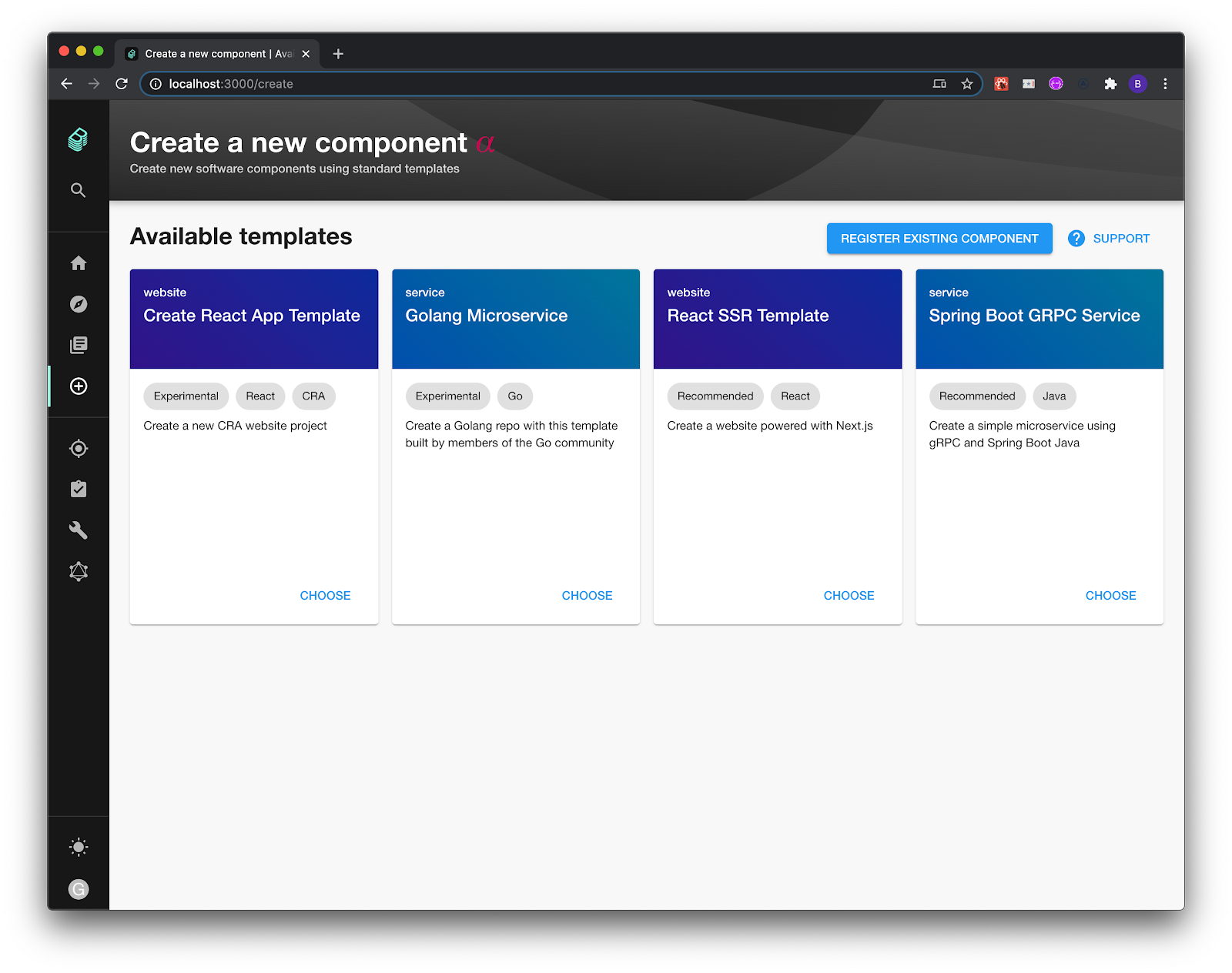
    Spotify has entered the next phase of the open source Backstage catalog project by adding support for templates through which the process of deploying software components now can be automated.

    Backstage was developed by Spotify to create an open source catalog through which DevOps teams could build portals through which developer tools are centrally managed.

    Stefan Ålund, platform developer experience product lead for Spotify, said the goal is to bring some order to what otherwise would be a chaotic IT environment. By standardizing the tools made available to developers, Backstage enables IT organizations to develop more consistent workflow processes, he noted.

    Ålund said DevOps teams via custom templates can automate those workflows to the point where a microservice, website or other software component can be deployed via a single click. That approach also serves to encourage reuse of both developer tools and the modules those tools were used to create, he said.

    In some instances, those templates will eliminate the need to depend on site reliability engineers (SREs) to deploy the same code over and over, he added.

    Spotify is currently proposing to make Backstage a sandbox-level project that would be further developed under the auspices of the Cloud Native Computing Foundation (CNCF).

    In the meantime, Alund said Spotify will continue to refine a service catalog that has been widely employed across DevOps teams for the past four years on top of a core instance of the open source Jenkins continuous integration/continuous deployment (CI/CD) platform.

    It’s not clear how DevOps-mature an organization must be to realize the need for a catalog through which modules of code could more easily be reused. In some cases, the transition to microservices may inevitably force the issue. Rather than having developers potentially reinventing the microservices wheel, a portal would make it easier to discover what software assets already exist and deploy them automatically.

    A catalog also provides the added benefit of making it easier to track the provenance of a project as well as who currently has operational responsibility for it within the context of a larger software supply chain enabled by best DevOps practices, Alund noted.

    Regardless of the level of DevOps maturity inside an organization, the need for a catalog to track services quickly becomes apparent as the number of microservices developed increases. It’s said that every company is now a software company. If software is to be managed as a digital business asset, then it’s critical for organizations to determine what modules of code they have and then determine which modules are the most valuable to the organization.

    Only then can every company that aspires to be a provider of software that happens to manufacture something or provide a service be managed like a true software company. Anything short of that goal is just a mere statement of aspiration.