Tag: AWS Summit

  • AWS Advances DevOps Agenda at Summit Event

    AWS Advances DevOps Agenda at Summit Event

    Amazon Web Services (AWS) has added services to its cloud platform designed to automate the creation of virtual private clouds (VPCs) and made available additional tools to build applications and integrate external data.

    Speaking at the AWS Summit event, CTO Werner Vogels said these latest services are part of an ongoing effort to automate DevOps processes to the point at which developers will need to write only the code for business logic that runs on top of the AWS public cloud.

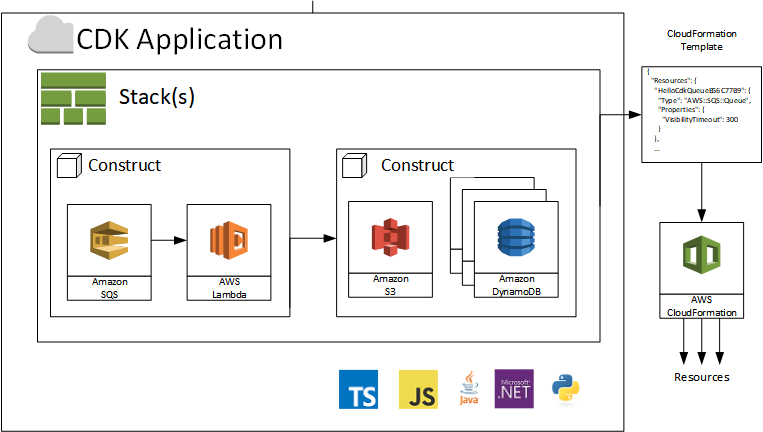
    One of the latest tools the company is making available in pursuit of that goal is AWS Cloud Development Kit (CDK), a software development framework for defining cloud infrastructure in code as constructs and provisioning it through AWS CloudFormation. AWS CDK currently supports TypeScript, JavaScript and Python with support for C#/.NET and Java available in preview. That capability will eliminate the need to write low-level code using a different tool just to spin up a VPC on AWS, Vogels said.

    AWS CDK also allows organizations to design and compose their own custom components for managing infrastructure alongside their application code.
    The cloud services provider also announced AWS EventBridge, a programmable event bus for integrating data on AWS with data residing in software-as-a-service (SaaS) applications on any platform based on a serverless computing framework, and the general availability of AWS Toolkit for Visual Studio Code, a plug-in for the Microsoft integrated development environment (IDE) that makes it easier to build, debug and deploy code on AWS.

    Finally, the company announced that Amazon CloudWatch Container Insights is now available in preview. This offering provides access to automated dashboards summarizing the performance and health of their Amazon Elastic Container Service (ECS) and Fargate clusters by tasks. Those offerings come on the heels of AWS Fluent Bit, a tool for container logging being made generally available earlier this week.

    Vogels stressed that the way applications are built is now fundamentally different in the age of the cloud. Developers are making greater use of containers and serverless computing frameworks. The challenge with containers is that in the absence of a cloud service provider to manage the environment, the complexity of the underlying middleware and infrastructure conspires to reduce the amount of time developers spend on writing actual application code, he said.

    To address that issue, AWS is investing more in container and Kubernetes services as well as in on-demand serverless computing services such as AWS EventBridge that don’t require organizations to pay for idle processes, Vogels explained.

    In general, Vogels said AWS continues to advocate for the elimination of separate IT operations and cybersecurity teams in favor of a more unified approach leveraging automated services provided by AWS that ensure, for example, the entire continuous integration/continuous deployment (CI/CD) platform is secure. However, while the number of organizations embracing best DevOps and DevSecOps processes continues to increase steadily, it’s much less clear how many of them will standardize those processes on a single cloud platform at a time when reliance on multiple clouds also continues to increase steadily.

    — Mike Vizard

  • AWS Extends DevOps Ambitions via Managed Services

    AWS Extends DevOps Ambitions via Managed Services

    Amazon Web Services (AWS) is signaling its increased interest in providing managed services spanning multiple aspects of DevOps with the launch of service that promises to make it easier to set up development projects.

    At a recent AWS Summit conference in San Francisco, CTO Werner Vogels described AWS CodeStar as a means for building pipelines using templates that span more than 90 different AWS services. The templates currently support five different programming environments: JavaScript, Java, Python, Ruby and PHP.

    CodeStar automates configuration of a continuous delivery pipeline for each project using CodeCommit, CodeBuild, CodePipeline and CodeDeploy, as well as providing integration with Atlassian JIRA Software for tracking issues via the CodeStar console. There also is a preconfigured project management dashboard for tracking activities such as code commits, build results and deployment activity.

    Over the past couple of years, AWS has expanded the number of managed services it provides considerably, including databases and now various classes of machine- and deep-learning algorithms exposed as a service. In most of those cases, it is replacing a task that previously was performed by IT operations staff with an automated service. That may appeal to IT organizations that have standardized completely on AWS. But in a multi-cloud world where elements of applications are deployed both on-premises and across multiple public cloud services, it remains to be seen the degree to which organizations will want to employ managed services that only automate AWS processes.

    One thing’s for certain: DevOps processes across multiple computing environments are becoming more automated. As microservices architectures become more widely employed, many organizations in the months and years ahead will become a lot more comfortable mixing and matching various cloud services as they see fit. Within that context, automation of DevOps processes will need to be multiplatform almost by definition. As a set of services exposed via application programming interfaces (APIs), it may very well turn out that the automated managed services provided by AWS can be programmatically invoked by other DevOps management frameworks.

    Of course, there are plenty of organizations that, for now at least, have standardized on AWS. DevOps delivered as a managed service by AWS clearly has some appeal for those organizations. But as cloud computing continues to mature, the number of organizations employing only one cloud service is expected to decline.

    While the battle of control of the cloud has been mainly focused on developers, more attention now is being paid to how application development pipelines get managed in the age of the cloud. Each IT organization will have a unique set of processes and requirements for managing those pipelines. In fact, the issue going forward will be to what degree can cloud service providers (CSP) adapt to those processes versus making the IT organization adapt to the CSP.

    In the meantime, IT organizations would be well-advised to establish the roles and functions they need to manage those automated pipelines sooner than later.

    — Mike Vizard