
Tag: AWS re:Invent

  • LaunchDarkly Previews Generative AI Testing Tool for Feature Management

    LaunchDarkly Previews Generative AI Testing Tool for Feature Management

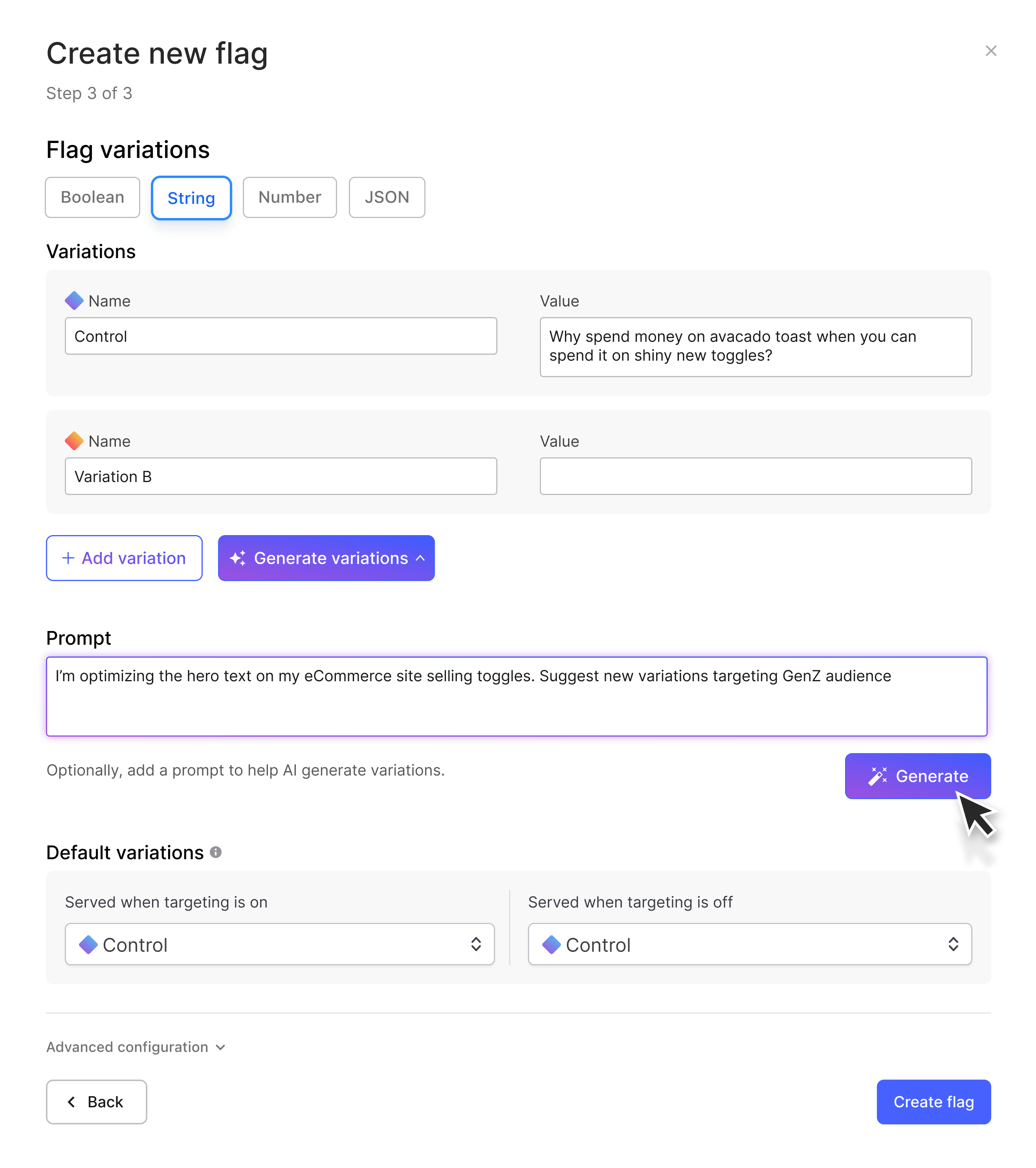
    At the AWS re:Invent 2023 conference, LaunchDarkly today previewed an ability to leverage generative artificial intelligence (AI) capabilities to create experiments for its feature management platform.

    Based on the Bedrock foundational large language models (LLMs) made available via AWS, this extension to the company’s Product Experimentation platform promises to make it simpler to use historical data to create a wider range of offerings that might be made available within an application.

    LaunchDarkly is making a case for a SaaS platform that can be used to centrally manage features across multiple workflows and platforms.

    Robert Neal, director of engineering for LaunchDarkly, said the company is now extending its testing capabilities using a managed Bedrock service provided by AWS that will enable leveraging generative AI to define a testing hypothesis more easily. That should also make it possible to involve more stakeholders in an iterative testing process within the context of a set of well-defined guardrails, he added.
    As more organizations start to deliver different tiers of digital services at varying price points, there is a clear need to be able to restrict access to those digital services. Application development teams have been employing feature management since the 1970s to isolate the development of various components into a branch that can be worked on and tested without impacting the primary build the application is based on.

    Feature management enables development teams to experiment with adding new capabilities in a way that doesn’t disrupt the application. When a project is completed, that branch is then usually merged into the primary build or can be deployed as a microservice that might be invoked via an application programming interface (API) by other modules with the application or another external application.

    At the core of that capability are what are known as feature flags, also known as feature toggles or feature switches, that make it possible to dynamically turn services on or off based on who is accessing them. Rather than being limited to the application development process, those feature flags are now being employed in production environments to enable the continuous delivery of multiple types of digital services to various classes of users of an application. A feature flag management platform enables an organization to keep track of all the flags being employed to keep the overall application environment consistent.

    It’s still early days in terms of understanding the extent to which generative AI can be applied to DevOps workflows, but it’s clear many of the manual processes that conspire to slow down the pace at which applications are built and deployed are going to be either reduced or outright eliminated. Each DevOps team will naturally need to determine for itself to what degree DevOps workflows can be automated using AI, but the overall pace at which applications can be built and deployed is going to clearly accelerate. The challenge now will be finding ways to keep pace with a rate of application development that is about to exponentially increase.

  • Couchbase Adds Columnar Database to DBaaS Environment

    Couchbase Adds Columnar Database to DBaaS Environment

    At the AWS re:Invent 2023 conference today, Couchbase, Inc. announced it added a columnar database based on the JSON file format to its database-as-a-service (DBaaS) portfolio to enable organizations to build real-time analytics applications.

    Scott Anderson, senior vice president for product management and business operations at Couchbase, said the Capella columnar database is designed to be integrated with the company’s JSON-based document database via a database change protocol (DCP) that Couchbase has embedded within its DBaaS environment.

    Deployed on cloud services from Amazon Web Services (AWS), the overall goal is to reduce the level of friction that IT teams would otherwise encounter when integrating a document database with a columnar database optimized to process analytics using columns rather than the rows typically associated with a relational database.

    That approach gives IT teams the ability to use a schemaless database architecture that provides an alternative to employing disparate databases that would need to be deployed and then integrated using extract, transform and load (ETL) processes to move data from one database to the other, noted Anderson.

    Capella columnar also uses the same SQL++ language as the company’s document database to streamline queries in addition to supporting Capella iQ, a copilot based on generative artificial intelligence (AI) that enables queries to be crafted in natural language.

    In addition, Capella columnar provides connectors to move data from Amazon DynamoDB, Amazon DocumentDB, Amazon Relational Database Service (Amazon RDS) and other data sources deployed on the AWS cloud.

    In the longer term, Couchbase is also planning to add vector capabilities to its DBaaS environment to make it simpler to securely extend generative AI models, said Anderson.

    In general, document databases have been widely adopted because they provide developers with an alternative to legacy database platforms that they can download and deploy themselves. The Capella DBaaS platform further simplifies that process via a managed service through which Couchbase assumes operational responsibility for managing databases. The columnar database extends that capability using a columnar database that can drive analytics capabilities to deliver a more personalized application experience, noted Anderson.

    It’s not clear to what degree organizations will ultimately wind up relying on as-a-service platforms, but since the start of the COVID-19 pandemic, the shift to this approach to consuming IT resources has increased significantly. As a result, the way internal IT teams are organized is shifting as lower-level tasks are either automated or handled by an external IT team that works for a vendor.

    Regardless of how databases are managed, however, there remains a need to integrate the data operations (DataOps) processes used to manage them with the DevOps workflows used to build modern applications. Each organization will need to determine how much economic sense it makes for them to manage that data versus relying on an external services provider. The challenge when relying on an external service provider is, as always, integrating that service into an existing IT environment.