Tag: automation

  • Atomist Advances Developer Productivity

    Atomist Advances Developer Productivity

    Atomist is extending the reach of an automated approach to managing software delivery out to the local machines developers work on every day.

    Company founder and CEO Rod Johnson said with its Software Delivery Machine (SDM) project, Atomist seeks to eliminate much of the complexity developers currently must navigate as they build code, including making changes that require updates to dependencies across projects.

    That capability makes it easier to keep multiple development projects consistent and up to date automatically, Johnson said.

    Atomist is applying many of the concepts Johnson used to create the widely employed Spring framework as an alternative to Java Enterprise Edition (J2EE), which is now being developed under the auspices of Pivotal Software, a unit of Dell Technologies. Atomist created a domain model for software delivery based on an API server and GraphQL, an open source data query and manipulation language.

    This approach eliminates the need to work within the construct of more cumbersome framework based on, for example, YAML files, Johnson said. Rather, Atomist is making use of code to develop an alternative framework that is optimized around a more familiar API construct, which frees developers to extend the SDM in any direction that best reflects how they want to work.

    Atomist currently provides a service based on SDM to large enterprises that have aggressively embraced DevOps. Johnson said that service enables organizations to allow developers a maximum amount of flexibility within the context of policies that can be defined by an IT operations team. The local instance of SDM is intended as an open source tool for increasing individual developer productivity.

    Most organizations are becoming increasingly obsessesed with developer productivity at a time when companies recognize how dependent they are on software to differentiate themselves. The rate at which new and existing applications are being rolled out and updated has expanded considerably. For developers face to rise to that challenge, many of them embraced microservices that make it easier to add and replace new functionality using Docker containers. Those microservices, however, create a massive number of dependencies across different code bases that must be tracked. SDM can be employed to not only spin up containers images and Kubernetes clusters, but also update all the interdependent microservices spanning multiple clusters.

    Asking developers to keep track of and manually update all those dependencies involving multiple projects is not the best use of their time, Johnson said. Real DevOps progress will be achieved only when organizations provide tools that make it easier for developers to do the right thing in a way that doesn’t try to impose an inflexible framework.

    Most of the processes that organizations rely on to build code today are not nearly as automated as they should be. In fact, DevOps adoption arguably would be much further along than it is today if it didn’t require so much manual effort.

    — Mike Vizard

  • Atlassian Acquires OpsGenie to Automate Incident Management

    Atlassian Acquires OpsGenie to Automate Incident Management

    Atlassian this week announced its plans to acquire OpsGenie as part of an effort to apply DevOps principles to incident management. The announcement was made at the Altassian Summit Europe 2018 conference.

    Atlassian plans to integrate OpsGenie, which provides incident alerting and communications software, with its Jira service desk software to enable organizations to automate responses to a major incident such as a site outage using a Jira Ops incident management command center unveiled this week.

    Jens Schumacher, head of software teams for Atlassian, said that while most organizations today have processes in place to respond to minor incidents, very few have incident management processes in place to deal with significant catastrophic events. OpsGenie already has been adopted by more than 3,000 customers to enable organizations to put together a set of structure processes to recover as quickly as possible.

    Schumacher said a more structured approach to recovery is now required because so much more of a modern organization’s ability to drive revenue is tied to the availability of IT. Whenever there is a significant amount of downtime, the urgency attached to recovery process is now much greater. The combination of OpsGenie and Jira, available now via an early access program, makes it possible to predefine a structured set of workflow processes to be followed in the event of an emergency, he said, adding that by defining those processes within a common framework, IT organizations also will be able to significantly reduce the number of point products they need to navigate during a crisis.

    The combination of the two products will also aid in applying forensics to discover the root cause of any outage, Schumacher said.

    Incident management within IT environments over the last few years has been evolving into a science. There are several dedicated incident management platforms that mange everything from who needs to be alerted in what order to providing detailed instructions bringing applications back online. The challenge many organizations wrestle with today is that all the silos of IT make it difficult to approach incident management comprehensively.

    But as it becomes easier for finance officers to draw a straight line between IT downtime and lost revenues, interest in more structured approaches to recovery is on the rise. In fact, regardless of whether the root cause of an issue is a cybersecurity breach or a geological event, the recovery process is usually consistent. Incident management platforms provide the means to capture those processes in a way that creates institutional memory. Access to those best practices is often critical, because organizations can never be sure which members of the IT staff will be available during a crisis. If the one person who knows how to provision a storage system is unavailable, there should be enough information in an incident management system to enable another member of the IT team to accomplish that task.

    As is often the case when it comes to IT, the tools at hand only enables the battle to be joined. It’s the quality of the processes attached to those tools that decides whether the battle will be won or lost.

    — Mike Vizard

  • Education in the Age of Automation

    Education in the Age of Automation

    Automation is changing the nature of education and the ways people learn. More schools are using online learning to supplement in-class activities. In fact, some schools are completely online. Distributed computing on the internet and the automation that drives it makes this possible.

    Everything changes when the formal education process becomes embedded in the internet. Courseware delivery becomes asynchronous; people learn what they want, when they want to. Test administration becomes more about the efficient acquisition of data and evaluation thereof. Human-to-human interaction as a basis for a meaningful educational experience becomes optional. Today, it’s entirely possible to learn all you need to know to make a good living in the modern world without ever needing to sit in a classroom or interact with a human directly. Let’s face it: You can do a lot of learning from YouTube.

    As a result, more people are beginning to question the conventional wisdom of spending four years and thousands of dollars to get a bachelor’s degree—particularly now that companies including IBM, Google and Apple no longer require one to get hired.

    Coincidentally, as companies eliminate the college degree requirement for new hires, we’re seeing significant growth in technical bootcamps. One study reports that this year, 20,000 students will complete a course of study at a coding boot camp and be “job ready.” Considering that the number of students who graduated with a computer science degree from a typical college in 2017 numbered about 93,000, there’s a good case to be made that boot camps are siphoning off a number of students that otherwise would be headed to academia.

    Going to boot camp instead of college is an upward trend: The study projects that the number of boot camps are expected to grow 20 percent this year. The career path for a technical professional does not necessarily involve going college. Going to a boot camp for a year—if not less—will suffice.

    Is this a problem? I’m not sure. On the plus side, I am reminded of the scene in the film, “Good Will Hunting,” when Matt Damon’s character Will Hunting, a genius with a photographic memory who walked the halls of MIT working as a janitor, makes the profound remark:

    “… you dropped a hundred and fifty grand on a f****** education you coulda got for a dollar fifty in late charges at the public library.”

    There’s a good argument to be made that when it comes to getting a good paying job, the $15,000 median price tag for attending a coding boot camp has a better much better ROI than spending  ~$200,000, the cost of a four-year degree from MIT.

    But then, I am reminded of Aldous Huxley.

    In his book, “Brave New World,” people are grown in test tubes according to a specific formulas, the result of which is a biological caste system. Those in the Epsilon caste are grown to be 3 feet tall and abhor the outdoors. Their job is to work their way underneath the machines on the factory floor to do simple maintenance. Deltas, the next caste up in the hierarchy, do the menial chores—janitors, for example. Gammas are the bookkeepers and data entry clerks. Then you get to the higher levels, Alphas and Beta. Betas are technicians who do very sophisticated jobs, such as mixing dangerous chemical together. One mishap can result in an explosion, killing all. Finally, at the top of hierarchy are the Alphas. Alphas possess advanced analytical skills and a broad knowledge base. They are able to plan and strategize. They have a high degree of creativity. Their role is to run the society.

    Thus, I have a concern about the increasing role of technology and  automation education, and the emergence of tech-focused boot camps as the prime post-secondary educational experience for many.

    As more of those entering the workforce forgo a formal college education, we run the risk of creating a society in which most of the technical workforce is Betas. They’re able to do highly complex tasks, yet have no idea why they’re doing them.

    Let me be specific. Let’s talk about Kubernetes: It takes a lot of knowledge and experience to be good at getting Kubernetes to work. It’s a complex, evolving technology that you need to keep your eye on. Companies are spending a good deal of money making sure their IT staff are competent with Kubernetes—as well they should be. One little misstep can result in the digital equivalent of a chemical explosion. Yet, I wonder how many of those “working Kubernetes” are thinking about the bigger picture—for example, the purpose and value of the enterprise using Kubernetes. Are these engineers questioning if the technology they’re working is doing good or harm?

    Or, let’s turn the dials down a bit and ask a question that’s less loaded philosophically. How many of those working Kubernetes today wonder if an alternative orchestration technology such as Docker Swarm might be a better choice to meet the need at hand. Or are they so concerned with getting Kubernetes to run that they don’t have the bandwidth to think about anything else? Do they just defer such critical thinking to “the system architects”?

    Critical thinking, although an acquired skill, is not one that’s new on the cognitive landscape. It’s been taught for thousands of years, since the time Socrates sat under an olive tree asking simple questions that forced his students to transform their assumptions and allusions into thoughts based on reason and reflection.

    Developing the ability to think critically traditionally has been one the aims of a college education. The romantic ideal is that college is the place where students are exposed to a variety of ideas from a variety of viewpoints. The hope is that such exposure, along with instruction aimed at developing one’s ability to engage in higher-order thinking, will create graduates who will contribute to making a better-functioning, more prosperous and more humane society.

    But, that’s the traditional perception of college. The reality is changing. Maybe college is just the place you go to get the skills required to get a good job. If that’s the case, given that a college education is becoming less affordable to more people, maybe the boot camp approach is best. Yet, there is a risk.

    A good while back when I was considering enrolling in a doctoral program, I attended a required orientation at Harvard University. I sat in an auditorium composed of about 50 aspiring doctoral students. One of the department heads on stage said the following, “The objective of our doctoral programs is simple. We want to train you to run the world.”

    Yep, that’s right. And, I can say with a good deal of confidence that this objective is the same today—to create thinkers who have the skills and knowledge necessary to run the world. The Alphas, if you will.

    So, we’re at a crossroads. Automation is a liberating force in education in that it makes infinite knowledge available to anyone who wants it at a fraction of a cost of a traditional college education. All that’s required is the time and desire to take advantage of the opportunity at hand. However, if the result of such education is a workforce in which the concern of most is to ensure that the technology works and does not blow up, then the risk we run is that bigger decisions will be made by those who had the time and money for an increasingly elite education. In other words, as more people spend time focused on turning the dials and setting the levels to make the technology go, a very small minority actually will be determining the purpose and direction of the machine the technology supports.

    Still, the fact is, most of us need to make a buck to survive. This means being good at getting the tech to work. Yet, we will do well to understand that there is a Big Picture and if don’t pay attention to it, someone else who has been educated to run the world will.

    — Bob Reselman

  • DevOps Chat: The Impact of Automation on DevOps and Society, with Bob Reselman

    DevOps Chat: The Impact of Automation on DevOps and Society, with Bob Reselman

    Those of you who have been reading devopsy.kinsta.cloud for a few years are familiar with the RoelBob cartoons, which have a prominent spot on the home page. RoelBob’s creator, Bob Reselman, is also a technologist and creator of other forms of media. Lately, he’s been writing a series of articles about the impact of automation on society as a whole—not just DevOps.

    Bob is a really smart guy and a great interview, as well. Even if you don’t agree with this thoughts on automation, it’s worth giving what he says a listen.

    As usual, the streaming audio is immediately below, followed by the transcript of our conversation.

    Alan Shimel: Hey, everyone, it’s Alan Shimel, and you’re listening to another DevOps Chat. Got a really great DevOps Chat for y’all today. I’m joined by a good friend of mine, a frequent contributor, one of the team at devopsy.kinsta.cloud—none other than Bob Reselman, creator of the RoelBob cartoons, Bright Ideas TV, the creative force and brains behind Shimmy Tunes, as well as a writer in his own right, not only at devopsy.kinsta.cloud, but at a lot of the leading tech companies out there today.

    So, Bob—welcome!

    Bob Reselman: Oh, thanks for having me, Alan.

    Shimel: You know, I hope I didn’t embarrass you at the log-on, but you know, you’re something of a Renaissance man, right?

    Reselman: [Laughter] Right.

    Shimel: I was reading a little bit of your life history, your life story, Bob.

    Reselman: Oh, yeah. Well, I came to tech late. I came to tech in my early 30s, and the reason I got into it is because somebody told me that I could actually compose music on a computer.

    Shimel: [Laughter]

    Reselman: No, it sounds funny, but if you’re a composer—and I don’t mean—

    Shimel: Like in the MIDI days. I hear you, dude. I know people like that.

    Reselman: Yeah, back in the MIDI days, and you know, if you had a string quartet or even something larger, like an octet, to actually hear that going on, to hear it was very hard. You had to go out and either hire a quartet to play or just be really good at imagining, or be able to sit at a piano and be able to pay some stuff. And I’m not the world’s best pianist, so this medium, this technology really opened up a world to me.

    And then one day I’m sitting around and I’m starting to play with this, and I’m writing it, you know, my string quartet and stuff. I said, “You know, I think I could probably do something with programming.” And so, I did. I actually, I learned to program, and I’m one of those people that came in through the back door. Eventually, I ended up at Gateway, at that time, Gateway 2000, and I—

    Shimel: [Cross talk] cows, we remember it.

    Reselman: Yeah, the cows, yeah. I moved from Boston, Massachusetts to Sioux City, Iowa, which was a complete cultural transformation for me. But every day, I went into the future, this big, big building where we were making computers. I learned a lot, and we can talk about that, too.

    And at Gateway, I was really doing a lot of stuff I shouldn’t have been doing, but I did ‘em, anyway. And I mean that, I just, I sort of had to battle my way into technology. And they were very supportive, and I just learned a lot about some real, hardcore tech, working for that company, and for that, I’m ever grateful.

    And so, that was around ’98. Around 2000, I decided to move on, and I had started doing Big 6 consulting, went into Big 6 consulting. I went into New York and I worked in the financial industry for a while, and then I got good at it. Along the way, back around 1995, I published my first book about DB programming, and Wygant has been very good to me. I still get those royalty checks every month. I can’t complain. That’s how I got here—that’s how I got here, you know? And here I am today.

    Shimel: So, Bob, over the last couple years—I mean, look, we’ve been doing, so, devopsy.kinsta.cloud has been around four years. You’ve probably been doing writing and RoelBob stuff for, what, three years, two and a half years—something like that?

    Reselman: I think three. We’ve been together for a while, Alan. It’s been, you know, the “Casablanca” of technology, what can I say? We’re on the runway, walking into the fog, right? [Laughter]

    Shimel: [Laughter] Round up the usual suspects.

    Reselman: There are no usual suspects. [Laughter]

    Shimel: But Bob, you know, certainly with the advent of DevOps and a heavy emphasis on automation, but also, it’s not all DevOps, it’s the world we live in, as you’re fond of saying.

    Reselman: Mm-hmm, mm-hmm.

    Shimel: You know, automation and the specter of increased automation over the—you know, not only near term, but long term—is really, it’s a scary thing. It’s scary for me as a parent with teenaged boys in terms of what are they gonna do, but it’s scary for a lot of people, people in the workforce today. And it’s something that you have really given a lot of thought to, you’ve written extensively about it, and that’s what I wanna talk to you about today.

    Reselman: Mm-hmm. Well, I’m happy you do, because I do think it’s important, and I think it’s going to have a growing impact. A lot of people—within technology, we can sort of ________. We’re in the middle of it, and we’re pretty adept at adapting—I don’t know if that’s a real term, but we pick up stuff pretty quickly, and we’re good at getting new stuff onto our fingers very quickly.

    But there’s a whole segment of the culture that has problems with it, to be honest. And, you know, let me be direct. Let me be direct, here. My father, he was a cab driver. He was a cab driver, and when I look at what Uber and Lyft are doing to the cab industry in New York City, it’s pretty amazing. I mean, his first medallion, I think, cost him—I’m making these up, I don’t have the actual data, but I think he paid $250,000.00 for his first medallion. And back then, that was a lot of money. But there were only a set amount of taxicabs on the street, and so, there was a high volume, it was a good investment. Today, because of the ride sharing, share services the value of medallions is dropping dramatically. And that’s just one impact of automation.

    Uber and Lyft could not exist without, I wanna say, two fundamental technologies coming on. First of all, credit cards. The other one is GPS, and the third is cell phones. And you mix all three of those together, and anybody can really be a driver. Why? Because you can pick up qualified customers and bill them without having to worry about being paid. GPS will pretty much tell you where to go, and cell phones provide the mapping technology to get there—all of it highly automated.

    Now, what’s interesting to me is that I wonder about the actual Uber and Lyft drivers now as that automation extends. For example, I take Lyft. I take Lyft all the time, and I’m more of a ride sharer than I am a car owner. And I’m sitting in the back of a car, and I had to go to an appointment, and I started reading a book. And I noticed that we were going in the wrong direction. We were going in the wrong direction. I said to the driver, I said, “You know, we really are going in the wrong direction,” and her response was, “Well, this is where the map is telling me to go.”

    Now, what is relevant here is, how far are we really—what is the purpose of that driver, other than to be an interpreter of map data and to manipulate the technology accordingly? And that’s not that far from robotics, and people—

    Shimel: No, it’s not. And actually, I mean, Bob, Uber and Lyft’s end game is to go autonomous, obviously, right?

    Reselman: Right.

    Shimel: And take the driver out of it altogether. But the interesting thing, I’ve had, specifically around Uber and Lyft, but they’re really poster childs for this, right?

    Reselman: Mm-hmm.

    Shimel: When we start thinking about the future of autonomous vehicles, we start thinking about, what really is—what is the disruption in Uber? You mentioned three key technologies, but is Uber really a technology disruption company, or is Uber a company that, what it disrupted was, by taking advantage of all of the excess vehicles and time that drivers have and putting that to good use? And so, was that the true disruption there, or was it the technology that was the disruption, and part and parcel with that technology is the automation?

    Reselman: Right. I think the disruption—it’s the aggregation of the technology which is the disruptor. Now, what is being disrupted? I think there’s a fundamental social disruption going on. The rules of existing as an employee or a wage earner or a value creator in society is changing. And Uber’s talent in terms of transportation—because it’s everywhere, you see everybody getting into those Uber cars. But that’s really inconsequential compared to the larger impacts of transportation.

    So, for example, container shipping is, Swedes Burkett just released a thorough—and again, people can write me and I’ll give them the exact data, because I don’t have it in front of me—but I believe it’s called the Burkett, and that’s a large container ship that’s completely robotic. So, imagine how much containers get shipped on the open seas that have crews. Now, those crews will go away.

    The same as with trucking. Trucking is really low hanging fruit. There are 3,000,000 truck drivers, and Uber is active in the trucking—automated trucking industry. So, they’re looking to automate that, and that’s gonna have a disruption.

    I wrote—the last article I wrote for you all was called “Coming Apart in the Age of Automation,” and the unintended impact here is that we really are creating a bifurcated society in which one class has, can master the technology or becomes the merit class, and the other class is just sort of hanging on. And it’s a sad thing to say, but it is true. And, as we look around current events, we can see that more and more.

    Now, the good news here is that we’re in a—we are in a good position. And what I mean by that is that, if we go back and we look at the history of technology, particularly around the advent of mass production in consumer technology, which is really the automobile. The automobile really was a game changer, because it was intended to be a consumer product once Henry Ford figured out how to do the assembly part. And because it became a consumer product, it really lifted the whole middle class. It became—if you were coming off a farm in Georgia, you could go to Detroit, and without having to learn a whole lot of new skills, become a wage earner in a factory.

    That’s good. Nobody really understood the impact of the internal combustion engine back in 1900 or 1910, that in 100 years, this would have a significant impact. And what I hope we’ve learned along the way is that technology does have an impact, along with sociological and economic. And we can start planning for that accordingly. Sadly, what I’m not hearing is that planning. People hear—the argument is, technology, yes, will always displace people. There are no more people picking up the horse dung on the streets of New York. Those people went to work in factories, et cetera, et cetera. In other words, technology destroys jobs, but it creates more jobs.

    But we’re not hearing any sort of ancillary planning of what the downside might look like, and if there is a downside—which there might very well be—how we’re going to address that.

    Shimel: Yep. I—you know, Bob, maybe I’m cynical in my old age. [Laughter] I—unfortunately, planning is not our long suit, right? We live in a financial world where we live quarter to quarter, week by week, you know? A bad quarter can cost a CEO their job and lose trillions or billions—not trillions, but billions of dollars of market capitalization.

    Reselman: Mm-hmm.

    Shimel: The fact of the matter is, if you believe the media, most people in our age group, Bob, have not put away enough money for retirement.

    Reselman: Mm-hmm, mm-hmm.

    Shimel: We don’t believe in science or truth, [Laughter] and so we can’t even plan around what to do about climate change. Why should this be any different?

    Reselman: Well, I don’t know if I agree with your assessment completely.

    Shimel: Okay.

    Reselman: Because I just got through reading a book by Harari about, it’s an assessment of current conditions and future. And people forget that famine and people dying of starvation even 50 to 60 years ago was a common day event. A lot of people in China starved to death. That really did happen. People in Ireland, in 1840 when the potato famine came along, they starved to death. You didn’t have enough food, and you died. Death due to starvation is still around, but it’s not commonplace—nowhere near the condition that it used to be.

    The other thing is, when we look at warfare—yes, there are wars going on and there are mutual wars, but there hasn’t been a war on the scale of World War II since World War II. So, there’s stuff going on that sorta gets hidden behind all the—what would we say—the fascination with the bad stuff.

    The other thing to think about in terms of us as technologists is that planning is still part of the industrial fabric. What do I mean by that? It takes five years to design and manufacture a car. I learned this when I worked at Edmonds. Pretty much, if you start looking at model years, the big model changes are in the fifth year. Pretty much, if you came out with a Car A—in year one, you’ll have A, then year two, what used to be options become standard and then more options become standard. And then, by year five, you have enough research in place and enough retooling of factories in place to create a new vehicle and put it on the market itself.

    So, industry does have the ability to plan. I mean, just look—I mean, if we look at SpaceX, bringing that rocket back and just being able to send a rocket up, you know, one of those cylinder rockets, right, that you used to imagine from the ‘50s goes up? And we used to just blow ‘em up and leave them in space. Now, we can actually bring them down and allow that piece of pipe with rocket fuel in it to land safely on land. That’s pretty amazing. You can’t plan that in three months. That takes years and years and years of planning.

    So, we have the ability to plan. The question is, in terms of our social imperatives, and that becomes a real question. So, why—what’s stopping people from saving? Why are people afraid? Why is fear so high now? And then also, going back to jobs as, we’ll call them no-skill jobs, start being eliminated from the landscape because grunt work is always the easiest to replace; thinking work is harder. Then, what do we do about that?

    And there are people out there offering solutions, but they are pretty dramatic, and there’s two, and they’re dramatic, and to even start contemplating that really requires a lot of courage.

    The first one is, is that there’s a good case to be made that we are at the end of the consumer based economy. Again, let’s go back to Ford. You know, an automobile for everybody changed everything. And when you look at it, you know, how many cars can Bill Gates drive? Well, if indeed, he had 365 cars in his garage, he could drive a different one every day. The fact is, he probably doesn’t, and he probably takes an Uber. So, really, in the future, you know, we’re all gonna be sharing cars.

    So, this notion of ________, and I didn’t do a good job explaining it. In other words, what I’m saying is that, for a lot of people, having devices and technology is what makes the economy run. Everybody needs a cell phone. Having mass distribution of cell phones makes the economy run. Having mass distribution of food makes the economy run. Mass distribution, mass distribution, mass distribution.

    Well, at some point now, what’s happening is, we can produce as much as we like. Production is no longer a problem. Two hundred years ago, production was a problem. The factories couldn’t make the stuff fast enough. Now, the factories can. So, now we have infinite production, which means we have infinite consumption, which means we have a problem with too much plastic in the water, and too much carbon monoxide in the air.

    Shimel: Bob, I’m gonna butt in here, if you don’t mind.

    Reselman: Okay.

    Shimel: So, I just got back from China last month.

    Reselman: Okay.

    Shimel: There’s a real problem there, right? Because this is—they’re living it, right? And, you know, we look at the world’s steel market and tariffs and all that stuff, a lot of it is being driven by—China has built over capacity in terms of what they can actually use and even sell at a decent margin in terms of steel.

    Reselman: Mm-hmm.

    Shimel: But not just steel, they are producing solar panels, cellular phones. They just—in other words, they are the kings of this, “Hey, we’ll produce as much as we possibly can produce because we’re gonna, if we’re not gonna consume it, we’re gonna sell it in the world market, and if we can’t make a profit on it, well, we’re not capitalists, anyway, right?”

    But an interesting dichotomy that I saw there was that they still are manually labor intensive in certain things. So, their streets are pretty clean in the cities, and the streets are clean because, on every street, there’s a cadre of people walking around with bamboo poles and palm fronds, kinda thing—literally sweeping the streets. And they sweep it into a pile and then some other person comes by and they have all these uniforms. And it comes by on a machine, like a Zamboni machine excepts it a vacuum, and sucks up what that people sweep.

    Reselman: Mm-hmm.

    Shimel: It’s almost like busy work to me, but what was fascinating to me is that, on one end, I took the bullet train from Shanghai to Beijing, right, and 300 and something kilometers an hour. And all I could see out the window, Bob, were endless cranes and towers going up, right? Not just a building, but cities and towns being built one after the next, and all built around factories. They’re like old factory towns, they kinda looked like, right?

    Reselman: Mm-hmm, mm-hmm.

    Shimel: So, they got the infinite capacity to build things, but I really question the infinite capacity to pay for things, to consume these things.

    Reselman: Right. Well, you hit it on the head. It’s the notion of payment. That’s sort of like, it’s like an assumption that we might have to start questioning, which leads into the second point that I was gonna bring up. You read my mind, Alan—and do my a favor, when you’re reading my mind, please clean up after yourself.

    Shimel: [Laughter] Okay.

    Reselman: Right, so the first point is, we have to start examining the role of consumption as a driver of an economy. We just gotta start looking at that. That’s a big question with incredible ramifications.

    The second one becomes this notion of paying for stuff in order to get what you want. And to—let me share a real life funny. My wife has decided that she needs—she wants to get rid of a chair we never use. It’s a nice leather chair that we never, ever use, and we paid, I think, $600—whatever it was, it was too much. I’m not a decorator, but she paid it, and now she’s saying, “I wanna sell it for $200.”

    And so, she puts the ad out on Craigslist and nobody’s biting, nobody’s biting. Why isn’t anybody biting? Because my suspicion is, it’s a good price for a $600 chair, but they can get ‘em for free. They can get probably an equal chair for free. And, if you look at the cell phone, I mean, we’re giving away cell phones. We’re giving it all away, we really are.

    And so, this notion of, what you’re saying is, how are people gonna pay for it? Probably they’re not. Either one of two things are gonna happen. Either the buildings are gonna be left unoccupied and it’s gonna be, there’s a downward recession—or the alternative is to blast credit into the economy to create money and to have that money become a purchasing agent. Is there wealth created? Is there value created? I don’t know about that. I don’t know about that. But are there transactions created? Yes.

    So, I’m being long-winded by saying that it might be coming time to start looking at a serious examination of universal basic income. And let’s just sprinkle the fairy dust for a moment, and let’s sprinkle the fairy dust and say that we’ve just—everything is great, everybody’s just calmed down. They understand that automation is great and if we let machines have their way, the machines can do just about everything now. And every week, you know, you get a check in the mail that allows you to go down to the grocery store or, better yet, interact with Amazon Prime, and the drone shows up with your food. And you go to your TV set and there’s your streaming TV. And some people decide they wanna be philosophers ________, so there are brain surgeons, and other people just decide they wanna sit around and play video games all day.

    There’s our future, right? Is that so bad? Is that so bad? And people say, “Well, how will we innovate? How will we go forward?” And my question—and I don’t have an answer for this—is, I wonder if somebody who gets into something like brain surgery for the money or curing disease for the money? Maybe the recognition, we don’t know. But the notion of universal basic income, if you take away the moral reservations about—what would they call it? The moral risk, right, becomes buyable.

    The sad thing is, is that any—the experiments that are being ________ aren’t real world. And what do I mean by that? They tried in Canada to ________. And I forget the details; I’ll mail it to your listeners if they want it. They’re running UBI on $1,000 a month. The test group got $1,000 a month. Well, gee, I mean, can you really live on $1,000 a month? That’s one thing. Whereas, if you go to another country that has universal basic income, and the poster child is Cyprus. Cyprus gives every citizen 500 Euros a month. The reason it’s relevant here is that a rent of an apartment in Cyprus is only 520 Euros a month. So, 500 Euros a month becomes, between—with two people, 1,000 Euros a month becomes a viable amount and a reasonable standard of living.

    That’s where UBI needs to be. We need to be starting to talk about UBI numbers in the area of $40,000, $50,000, $60,000 a year per family, and then we have to deal with the ramifications. And the ramifications really aren’t so much economic as they are social. What happens when you move the social structures that work bonds? In other words, what happens when a whole society no longer has to get up in the morning and go to work? What happens then?

    And that becomes the danger point, because most people have no idea.

    Shimel: Huh. Excellent. I think—yeah. I don’t disagree with you, there.

    Reselman: Well, again, I’m not looking for conflict or disagreement. This is a great discussion, but for our listeners out there, the point is—we are in technology. We are the people that write the scripts. There are other people that do the automation. We are the people that are making the robots. We’re doing all this. And we’re in a good position now, because unlike Henry Ford, who really didn’t think it through with regard to what an automobile would do over a period of 100 years, whereas one of the engineers at Sony did in terms of television. A friend of mine’s wife’s father worked at Sony, and he raised a question to one of his engineers back in—I think it was in the ‘80s. And he said, “You know, we’re selling a lot of Trinitrons. What are we gonna do when these all come back?” At least he posed the question.

    So, if anything, for the listeners out there that I hope they consider is, what do we do when we’ve become very good at all this? What do we do when we’ve created a framework and a fabric of automation where—and labor almost becomes unnecessary? What do we do, then? And what are the ideas behind that? And that’s where I wish there was more conversation, at the least. And not be on, “There will always be more jobs” or the fantastic stuff, but real, concrete, well researched conversation.

    Shimel: Excellent. Bob, I’d love to continue this conversation, but we are so way over our time. [Laughter]

    Reselman: Oh, I’m sorry, I’m sorry.

    Shimel: That’s okay! We’re gonna need to pick it up on another DevOps Chat.

    Reselman: Okay.

    Shimel: Which is great. I bet next month, we’ll do it again.

    Reselman: Sure, sure. Yeah. I’ll do that. I’ll make the coffee. The dog’s been very good here, he’s been very quiet. He understands that he’s being recorded, so.

    Shimel: Otherwise we’ll automate him out of a job. [Laughter]

    Reselman: Yeah. [Laughter]

    Shimel: Anyway, Bob Reselman—RoelBob, author, futurist, commenting on the state of the world today—thanks for being our guest on this DevOps Chat. We’ll continue this conversation on another DevOps Chat soon, but for now, this is Alan Shimel, and you’ve just listened to a DevOps Chat. Have a great day, everyone.

    — Alan Shimel

  • 4 Ways to Tackle Common Test Automation Pitfalls

    4 Ways to Tackle Common Test Automation Pitfalls

    The demand for higher-quality products and new features delivered at breakneck speeds has the average engineer struggling just to stay afloat. With demands rising but resources not always following suit, engineering teams are embracing automation as a key testing option.

    According to a report by advisory firm KPMG, test automation increased by 85 percent from 2015 to 2017 across all industries. Automation is one way to address this accelerated development schedule, but it can also introduce other problems. To ensure that doesn’t happen, there are four common pitfalls that engineering teams need to look out for.

    Problem No. 1: Right Job, Wrong Tools

    It’s tough to build a shed with a spatula and a sewing needle. Likewise, you can’t build a successful test automation suite if the tools used don’t fit your company’s testing strategy.

    The solution: Pick the right framework for your suite.

    The first question you need to ask yourself is: Should you build or buy your test automation framework? The answer likely depends on how mature your testing structure is. Smaller teams new to the technology typically are best-served starting with an off-the-shelf enterprise solution. This approach makes it easier to get up and running quickly, while having the support to handle software bugs along the way.

    Larger, more mature testing teams may have more to gain from an open source automation framework. This cost-effective approach provides flexibility and customization, but often requires advanced technical expertise and the luxury of time to build such a solution.

    Problem No. 2: Living Fast, Dying Young

    Many automation projects never make it off the ground because teams move too fast and automate too much, too soon. Inserting automation into the delivery pipeline prematurely will cause workflow and build issues more often than not.

    The solution: Build test automation into your pipeline incrementally.

    It may be tempting to run full speed as soon as you are set up, but the truth is you need to take your time for developers to build confidence in the testing process. Once that confidence is established and you’re receiving valuable feedback, you will have the full team’s support as you continue to scale your automation strategy.

    Problem No. 3: Automation Without Documentation

    Automation can make testing easy. Sometimes too easy, to the point where engineers will simply kick back a failed test without looking into the reason it failed in the first place. Oftentimes, these failures are the result of an outdated testing script or an issue with the test environment, and not with the code at all.

    The solution: Triage automation test results just like manual bugs.

    Instituting an intermediary triage stage will save your engineering team time in the long run. There’s no need to treat your processes for automation results any different than you would bugs found manually. Having access to materials such as activity logs and screenshots will only help to strengthen and speed the triage process.

    Problem No. 4: Setting and Forgetting

    Automation makes testing quicker and easier. That’s why you invested in it in the first place, right? Unfortunately, there is more to such solutions than just plugging them in and letting them run.

    The solution: Take maintenance into account when building your framework.

    Many teams are surprised by the maintenance required to keep test automation suites running smoothly and effectively. They shouldn’t be. Solutions need to be updated continually to address user interface changes, new operating systems and browsers, and automation library changes. The maintenance of third-party dependencies also needs to be considered before automation is used for production test runs.

    Maintaining your automation suite is a continuous process. Make sure you have enough testing resources—either in-house, outsourced, crowdtesting or a combination of all three—to ensure your efforts don’t go to waste.

    Measure Twice, Implement Once

    Make no mistake, automation is more than a quick fix. If you are going to spend the time and money necessary to build a successful strategy, you should make sure to set yourself up with a solid foundation. A framework that is thrown together within days but falls apart in hours will only serve to make automation seem like an unpalatable solution within your testing department. Having the right partners in place and the right solution from the start will help automation become a reality in your company, and can bring the promises of speed and flexibility to life.

    — Drew Horn

  • Hardware in the Age of Automation

    Hardware in the Age of Automation

    There’s a joke making its way around the internet that goes like this:

    Q: How do DevOps engineers change a lightbulb?
    A: They don’t. It’s a hardware problem.

    The trend to abstract hardware away from the day-to-day work of most IT personnel continues. We in DevOps have given it a name: infrastructure as code. Hardware has been pushed so far back into the recesses of IT that I’ll wager good money to say that today most folks working in information technology have never seen the inside of a data center, and fewer have done something as labor-intensive as run cable wire over a rack of servers. For many, hardware is but a concept that’s made real every month by a bill from Amazon, Azure or Google Cloud.

    But hardware is real and it does matter, a lot. If you don’t think so, look at your cellphone. That little piece of hardware had changed just about everything about how the world works today. The cellphone has made possible not only Tinder, Twitter, Instagram, Uber, Lyft and a multitude of startups that will never see an IPO or private equity buyout, but it also has brought earth-shaking events such as the Arab Spring, Brexit and SpaceX landings into the palms of viewers worldwide.

    Hardware counts and it’s going to count more in the coming years. Those working on the forefront of innovation understand that special hardware is, and will continue to be, a critical factor in the development of increasingly complex software. We’re already seeing the ability to choose specific hardware configurations available on cloud providers such as AWS. For example, the g3.16xlarge EC2 instance type is backed by both CPU and GPU chips. This is only the tip of the iceberg.

    According to Jacob Smith, senior vice president at Packet:

    “People ask what’s next. Well, this stuff [GPUs] is an example of what’s next. It’s not just really expensive stuff, but really specialized stuff. Whenever you start to do something that’s really big and really important, which are a lot of the things we’re doing on the internet and in the world, whether it’s bioinformatics or cars driving themselves, those require really big workloads. There’s a lot of data, a lot of processing and you just can’t do it with generic hardware. The reason that hardware is the next innovation layer is because of all the software you guys have been writing to make software portable and deployable around the world in minutes, now the software wants to touch on the new kinds of hardware. And I think that embracing this is the next wave.”

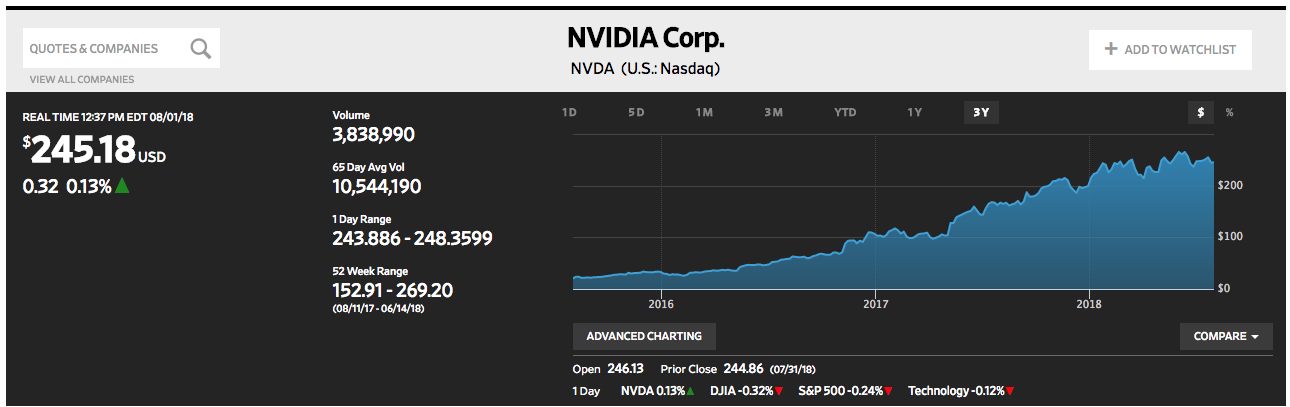
    Packet, and companies like it, are looking forward to a time when computing platforms will move beyond the generic to the specialized. We’re already seeing the trend play out: The value of the stock of Nvidia, a major GPU manufacturer, has gone up 10x in the last three years. (See Figure 1.)

    Nvidia stock has grown 10x in value in over the last three years. (The Wall Street Journal)

    Also, the projected demand for specialized chips is attracting a lot of venture capital (VC) money that’s funding startups such as Cerebras, Wave Computing and Graphcore. Even Google is getting into the specialized hardware business with Tensor Processing Units (TPU). Hardware is indeed becoming very cool again.

    So, what does all of this have to do with automation?

    Automation is a processor-intensive undertaking. And, as AI weaves itself more into the fabric of day-to-day data processing and machine learning, we’re going to see more demand for specialized hardware to handle the activity. In a way, that’s not new; we’ve had specialized hardware for a while now. TV remote controls have been around well before Bluetooth came on the scene. What is new is the degree of intelligence at play in these new devices. All my old-style TV remote control had to do was change the channel when I clicked the button. Today, my remote control recognizes my voice and helps me find a show of interest. It’s a big leap from an operation that responds to a button-click to one that uses voice recognition and inferential lookups.

    As Packet’s Smith pointed out above, as the complexity of software grows, so, too, will the need for special hardware to drive it. The new trend will be to wrap hardware around software. Thus, I have no trouble imagining a new type of hardware that is designed to handle a very particular process—gene editing, for example. Imagine ingesting a pill that is really a nanodevice that contains the intelligence to travel your body and physically alter your genetic makeup. It’s not that far-fetched an idea. Making the idea a reality isn’t so much about the software, it’s the hardware. We don’t have the nanotechnology—yet. Hence, the opportunity.

    Right now, most automation activity is run on generic chips housed in remote data centers around the world. A lot of the work we’re doing is still commodity: Spinning up Kubernetes clusters, facial recognition under Tensorflow, discovering security vulnerabilities using Macie, for example. Yet, as artificial intelligence (AI) becomes more commonplace, the use cases for which AI is appropriate will grow. This growth will require new types of specialized hardware. Engineers will imagine the software and then design the hardware to make it run. We’ll come to a point, which is not that far away, where innovation will be as Smith describes. It will indeed be about wrapping hardware around software. As a result, we’ll go from the “Internet of Things” to the “Internet of Really, Really Smart Things, from the Microscopic to the Gargantuan.” The implications will be profound.

    — Bob Reselman

  • Thinking About the Future in the Age of Automation

    Thinking About the Future in the Age of Automation

    Let’s do a thought experiment.

    Let’s imagine a world in which almost all the work required to sustain human life on the planet is performed by intelligent machines. Think about it: All the crops get planted, raised and harvested by robots. Same for livestock. Machines make all the clothing and build all the houses. People and things get transported by driverless vehicles on the ground, over the oceans and in the sky.

    Food gets delivered by an AI-controlled fulfillment service that brings groceries right to the front door. Refrigerators and storage cabinets are smart enough to request replenishment when supplies run low. Packaging and containers are IoT devices that integrate easily with refrigerators and storage cabinets. Everything is communicating everywhere all the time.

    Power sources are installed and maintained by robotic intelligence, some of which are supervised by a small cadre of humans. Power is delivered by AI, too. Most power is supplied by solar and nuclear energy. Given the high energy yield-to-weight ratio that fossil fuel and biofuel provide, internal combustion engines still power most aircraft.

    Humans login to online schools where the curriculum is designed by AI. Lessons are delivered by AI, too, and the teaching AI is equipped with nice, supportive voices. Each lesson is custom designed to the needs and ability of the learner. Progress is monitored minutely and reported back to interested, authorized parties at regular intervals—mom, dad and the university. Some school systems provide community centers where children and teenagers congregate to learn and practice basic social skills.

    Everybody’s DNA is registered in the cloud. Medical services are provided online. People are connected directly to a diagnostic cloud via a variety of fitness devices and smart apparel that constantly monitor the patient’s body, including but not limited to heart rate, blood pressure, lung capacity, daily calorie burn and current body fat index. The devices are smart enough to get blood samples painlessly on demand and then do perfunctory analysis in real time. More complex procedures are administered at a medical center staffed by robots expert in a given procedure, from administering a colonoscopy to resetting a broken bone or performing a liver transplant. A few highly educated, highly trained humans staff the medical centers to handle edge cases beyond the capability of current AI/robotic technology.

    Economic productivity is almost completely separated from human labor. Intelligent robotics continue to be the most efficient way to fuel the economy. Human purchasing power is determined by a combination of market-driven forces and social support systems. Those few who have the motivation and skills required to participate in the workforce are compensated for their activities. Such work requires a high degree of education, intelligence and creativity to do the inquiry, analysis and synthesis needed to provide economic value. Their compensation is quite luxurious. Those who are not in the workforce are provided with the purchasing power necessary to acquire the goods and services that are needed for a comfortable life. People who have inherited wealth live a life of luxury, too, for as long as they can manipulate their purchasing power to maintain or increase their wealth. Some wealth is still so immense that it’s inexhaustible.

    Crime exists in varying degrees, going up and down at predictable levels. All human activity is observable in the public space. Most humans allow parts of their private space to be monitored in exchange for some type of compensation.

    Policing data is analyzed continuously to improve crime prediction models. Humans perform law enforcement activities with the help of robotic assistants. The robots confront armed assailants. The humans supervise. Transgressions such as moving violations and drunk driving are rare, as most transportation is driverless. Violent crime still occurs—always has, always will. Persons exhibiting extreme criminal behavior are isolated in prisons that are run by robots who are supervised by well-compensated humans. Administering justice is still a human activity, as is politics.

    Warfare continues, but with fewer humans acting as belligerents. Warring states as well as non-state actors assault each other using physical robots that serve as an extension of the combatant. Cyberweaponry is powered by bots, but most weapons are controlled by a human operator. One human can control hundreds of weapons. Some weapons are self-directing, using artificial intelligence that can interpret predefined assault plans and act accordingly.

    Governing policy is created by artificial intelligence under the supervision of human oversight. AI creates legislation based on information gathered from data streams. One stream is data provided by analyzing the behavior and condition of the population. The other stream is polling data. Humans increase their purchasing power by participating in frequent polls administered by government agencies. The authenticity of polling data is verified directly against the DNA of the contributor.

    The daily activities of most people are to consume content from the internet and play interactive games either with other humans, AI endpoints or a combination of both. Also, most people use shared assets for amusement; for example, riding a motorcycle or skiing at a resort. Some of the shared assets are owned by individuals. Most are owned by multinational corporations.

    Movies are still popular. Some movie scripts are created by humans with AI assistants. Most movies are produced by pure AI, according to deep analysis of the past viewing behavior of a wide variety of audiences. Movies that are custom-designed according to the profile of the particular viewer and produced on demand continue to grow in popularity. Most of the actors in the movies are human emulations designed by AI.

    Sports such as baseball, football, soccer and basketball struggle for fans as spectatorship grows in the online gaming sector. Online gambling is still popular, as is the lottery. However, participants cannot use standard purchasing power to gamble. Rather, a special recreation token, considered an extreme luxury item, is used. Lottery tickets are available for free—one per person for a monthly drawing. The winner is compensated luxuriously.

    The Stuff of Science Fiction? Not Anymore

    If you’ve gotten to this point—and I hope you have—you might be thinking that the fully automated world I describe above is pure fantasy, a pipe dream, science fiction. It might be, but let’s go through the items.

    First, in terms of agriculture, in 1790 90 percent of the U.S. population was made up of farmers. Today, the number is around 2 percent, yet production far surpasses 1790 levels. How? Automation.

    As far as robots making clothing, check out the Jaeger Rapier Weaving Machine: It makes cloth in 45-foot widths. Also, check out the video from the Wall Street Journal that describes using robots to replace garment workers in Bangladesh.

    In terms of transportation, it’s not a question of if driverless vehicles will dominate the roadways of the world. Rather, it’s when. Also, IEEE is reporting that crewless container ships are on the horizon. Norway’s Yarla Birkeland is already here.

    Flying is already highly automated. Other than takeoff and landing, human crews serve more as a safety backup in case something goes wrong in flight. In the military, attack drones are still manned by remote human crews. But, again, the humans are there more for fail safety than operational purposes. Flying may never become a solely automated undertaking, but keep in mind that it takes only two humans to operate an Airbus a380, which can seat 850 passengers.

    Amazon and Walmart are already in the food delivery business. Right now, it’s a safe bet to assume that a human is doing the delivery. But, given the dramatic improvement in delivery robots, how long will it be until that whole process is run by a machine? Also, LG makes a smart refrigerator that provides many of the food provisioning services described above.

    Oh yeah, did I mention that China is presently collecting DNA samples, fingerprints, iris scans and blood types of all residents in Xinjiang between the age of 12 and 65? We’re talking millions of people. Granted, China is not a poster child for respecting the privacy of the individual. But, let’s say that here in the United States there was an offer to give anybody an ancestry report for free in exchange for a DNA sample—or, if “free” proved to have little motivational value, the offer was for $100. People sell their blood for a lot less.

    Robotic surgery is real. Right now the robot is an assistant to the human. But, as we’ve seen with the progression of other technologies, allowing surgical robots to have increasing degrees of autonomy is only a matter of time.

    In case you’re wondering about the real future of warfare, according to an article on the BBC’s website, “As early as 2005 the New York Times reported the Pentagon’s plans to replace soldiers with autonomous robots.” Interested in a high-powered robotic machine gun that can hit a target 1.5 miles away in the dead of night? Check out the Super aEgis II, manufactured by DoDAAM.

    I could go on and on, but I won’t, tl;dr and all that. Still, given the current rate of technical achievement, when you look at any of the scenes I described above, it’s not difficult to suppose that everything I imagined is very possible. From where I sit, we’re just not that far away from the endgame: AI and robots replacing most human labor in the economic sphere.

    So, what’s the missing link? What’s it going to take to make sure that, as human labor is replaced and never to return, purchasing power is still maintained? The first step, of course, is to have some reasonable articulation of what that path to a positive outcome can look like. Fortunately, there’s a good deal of thinking going on about the topic. I’ll share a reading/viewing list at the end of this article.

    But. more importantly, it seems as if no one in government is really talking about the inevitability of the dominance of AI and robotics or the consequences thereof. The powers that be are frightfully ignorant about what’s to come. I have yet to hear the words, “We need to start anticipating the consequences of a highly automated society,” come from the mouth of anyone in government. This needs to change.

    It’s a serious issue. Today, the impact has been felt mostly factory workers, here in the United States and worldwide. When it really hits, when all professions are subject to replacement—which some estimate to be within the next five years—the shock will be overwhelming. Then, unless government “gets it,” the best recourse is to own a lot of stock in pharmaceutical and cannabis companies, because most people will need to be anesthetized to their environment to tolerate the social and economic breakdown on the horizon. Or, we can start planning to work toward a future in which ubiquitous automation provides not only a luxurious life for a few but a comfortable life for the rest of the population.

    As for me, I wish we were planning.

    Read and Listen to  More:

    Book: “Rise of the Robots,” by Martin Ford

    Book: “The War on Normal People,” by Andrew Yang

    Video: “Humans Need Not Apply”

    Video: “Obsolete by 2030”

    Podcast: “Andrew Yang and Sam Harris Discuss Universal Basic Income“

    — Bob Reselman

  • CA Technologies Looks to Shift Automation Left

    CA Technologies Looks to Shift Automation Left

    CA Technologies, at its recent CA Automation Summit, advanced its case for leveraging automation to create a software development factory via an update to the CA Automic One automation platform that adds automation-as-code functionality.

    Gwyn Clay, vice president of product management for the Automation Business Unit at CA Technologies, said the latest release of CA Automic One make is simpler to “left shift” automation artifacts by making it possible for developers to embed those artifacts within application code versus having to wait for a DevOps teams to run them out of band.

    The latest version of CA Automic One also now includes version control and lifecycle management for automation artifacts that enables automation objects such as jobs, workflows and scripts to be promoted from development to production as part of an integrated DevOps process, said Clay.

    CA Technologies also revealed it is embedding intelligence into workflows enabled by CA Automic One, which enables dynamic runtime estimations that can predict potential issues within certain paths in the workflow execution.

    Other new capabilities added to the automation platform include support for PostgreSQL databases, as well as new integrations with CA Workload Automation, CA Continuous Delivery Director and CA Jarvis analytics software delivered as a cloud service.

    CA Technologies has been on a multi-year campaign to embed automation across the entire DevOps processes. With this latest release, that campaign effort is being extended to developers themselves. Clay said the rise of digital business transformation—much of which is being driven by cloud-native applications built with technologies such as Docker containers, Kubernetes orchestration software and serverless computing frameworks—is finally forcing the automation issue in the enterprise. Not only are applications being built faster than ever, but the complexity of those applications has increased exponentially. And yet, the size of the overall IT staff has remained stagnant. Without some form of automation being embedded within the applications itself modern software development practices becomes difficult to sustain, she said.

    Clay noted that most organizations are not yet at the point where they are deconstructing monolithic applications into a set of microservices. But it’s already clear most new applications will be built on a microservices architecture. CA Automic One represents an opportunity to apply automation across both legacy monolithic applications in addition to embedding artifacts directly within new applications, she noted.

    It’s not clear the impact the ability to embed automation artifacts will have on how enterprise IT is managed going forward. IT operations teams still will need to be able to set policies and constraints concerning the level of automation a developer might be able to invoke. Most developers don’t have much regard for the need to share limited infrastructure resources with other applications. But as the ability to infuse automaton into almost every application becomes pervasive, the locus of power within enterprise IT organizations will continue to shift to the left. The challenge now is determining the best way to strike a balance between all the competing factions looking to control who gets to automate what exactly when.

    — Mike Vizard

  • Leveraging Automation for Your Business

    Leveraging Automation for Your Business

    Artificial intelligence (AI) has the capability to change the way we work, the way we manage, and the way we conduct research. As automation processes improve, businesses increasingly are looking for ways to leverage the new technology to help with their own goals.

    There are certain risks posed by the advancement of artificial intelligence, and the automated applications AI creates are in contrast to the many benefits using automation may bring about. The rewards of automation, when managed properly, are the relief of burdensome activities such as mundane tasks and other minutiae, improved productivity and increased participation.

    Consequences of adopting automation for your purposes must be thoroughly thought out to leverage it to the best of your ability.

    Automation, once used for only a few specialized tasks, now can be used for data mining, marketing, medical research and building financial models. These are just a few of the applications the technology can be used for, and it’s far from a comprehensive list. The details of automation are specific to the industry that employs it, the organization that manages it and the managers who oversee its implementation.

    Why should you consider using automation to help achieve your business goals? Quite simply because utilizing it properly could result in a more efficient, more effective workforce and could even create job opportunities. By freeing up mental resources and enhancing the capabilities of your workforce, your organization will be able to operate at its peak efficiency and efficacy.

    “Machines can attend to vastly more information and more complex processes than human beings, and try out more drugs or vaccines than we can in the lab,” Pedro Domingos, a professor of computer science at the University of Washington told National Geographic. “Machine learning is used to discover drugs by simulating the process on a computer, which takes a fraction of the time and cost.”

    After you begin analyzing where your organization needs help, you can start the process of using automation that makes sense for you. Your business may need help with routine marketing tasks, creating models for the data metrics you bring in. Or, perhaps you need help organizing large amounts of information related to research and development of a product you’re about to roll out. Whatever the application, there are automated applications made to benefit your business.

    “Faced with a constant onslaught of data, we needed a new type of system that learns and adapts, and we now have that with AI,” Arvind Krishna, head of research at IBM, said in a recent blog post. “What was deemed impossible a few years ago is not only becoming possible, it’s very quickly becoming necessary and expected.”

    With automation, you can achieve things you may not have thought possible before. As Krishna makes clear in the quote above, the capabilities of leveraging automation are untested and virtually limitless.

    To truly leverage automation, you’ll need to manage the results of its implementation and have your team perform synthesize and arrive at conclusions through critical thinking and social cooperation—skills yet unmastered by even the most powerful artificial intelligence. Pairing automation with skilled social thinking will result in a highly productive and effective organization. This can result in some ancillary benefits such as increased cooperativeness between team members.

    For companies interested in rapid growth, automation can help propel your processes. From manufacturing to marketing, automation can help boost your efforts in research, analysis and production. Automating repetitive tasks can help free up workers allowing them to work on more complex and pressing problems within the company. In addition, workers learn new skills through the adoption of automation and managers can more effectively understand how to manage complexity within your organization.

    However you decide to use automation, it’s important to do a thorough and objective analysis of your organization. Where can you improve? Where do you need help? How can we empower workers to better perform? How do we measure performance? These are key questions that can help guide your analysis of your organization and well as your adoption of domain-specific automation applications.

    — Anthony Coggine

  • GitLab Moves to Automate DevOps

    GitLab Moves to Automate DevOps

    GitLab is looking to eliminate the pain of setting up and maintaining DevOps processes by making available an option that automates DevOps processes end to end using a prescriptive approach defined by GitLab.

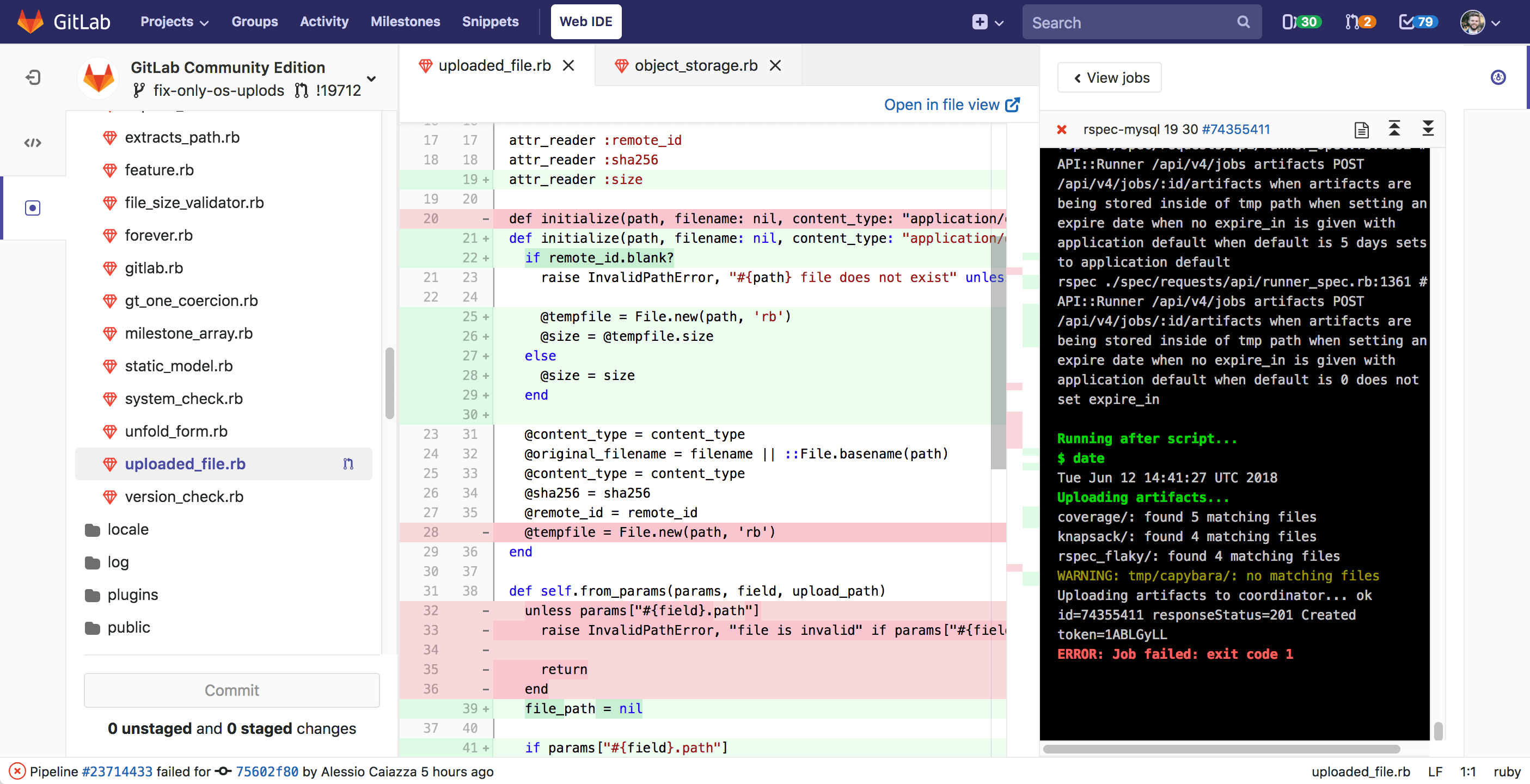
    The latest version of GitLab includes an Auto DevOps option that organizations can employ to automate the building, testing, code-quality scanning, security scanning, license scanning, packaging, performance testing, deploying and monitoring their applications.

    GitLab CEO Sid Sijbrandij said the company is now able to make this service available because GitLab 11.0 can now be deployed as a set of more integrated applications running on top of a cluster based on Kubernetes container orchestration software. That support for Kubernetes also makes it easier to deploy GitLab 11.0 in a public cloud or on-premises environment as needed. To facilitate that process, GitLab now includes templates that simplify the spinning up of Kubernetes clusters as needed, Sijbrandij said.

    To further its support for Kubernetes, GitLab also decided to start deploying the software it makes available as a cloud service on Google Cloud Platform. Previously, GitLab had been committed to Microsoft Azure. Microsoft recently announced plans to acquire GitHub.

    GitLab is all in favor of automating DevOps processes, but doesn’t think organizations should be forced to move everything into a public cloud to achieve that goal, explained Sijbrandij. Organizations can still elect to construct their own DevOps processes using GitLab as they best see fit.

    But as interest in DevOps continues to rise, more organizations now would prefer to rely on a set of best practices that are defined to make them much easier to consume, he said.

    GitLab 11.0 also adds security scanning capabilities for application built using .Net and Scala programming language in addition to existing support for C, C++, Java, Python, Ruby on Rails, Go and PHP.

    In general, Sijbrandij noted that organizations that embrace DevOps usually find themselves trying to manage various islands of automation with mixed success. Auto DevOps is intended to provide a more comprehensive approach that eliminates the friction that often exists between those various islands of automation. Sijbrandij acknowledged that a prescriptive approach may not appeal to every IT organization, but as traditional enterprise IT organizations start to embrace DevOps, many of them prefer a more platform-centric approach that’s easier to both set up and maintain, simply because they lack internal DevOps expertise.

    Sijbrandij also noted that as DevOps gains more traction in the enterprise, many of the decisions about what platforms to employ will be driven from the top down. Today, most acquisitions of DevOps tools and practices are driven from the bottom up, which accounts for why there are already so many silos of automation, he said.

    Over time many organizations will conclude that the opinionated approach enabled by Auto DevOps will free developers to spend more time on writing code instead of on managing the infrastructure employed to create it, Sijbrandij said. Most traditional enterprise IT organizations today are at least aware they should be employing DevOps practices, they just know exactly what such an effort fully entails.

    Thanks to advances in automation, many IT leaders may never know or care what specific DevOps processes are in place. After all, what most of them are primarily interested in how fast the next set of application code is going to be delivered.

    — Mike Vizard