Tag: Atlassian Jira

  • Atlassian Extends Automation Framework’s Reach

    Atlassian Extends Automation Framework’s Reach

    Atlassian this week extended its namesake automation framework to include its Confluence collaboration software. In addition, it’s now possible to automatically create bi-directional branches in Bitbucket, GitHub or GitLab platforms from within the company’s Jira project management application.

    At the same time, it’s now possible to automatically generate feature flags from within Jira through integration with the feature management platform created by LaunchDarkly and automate alert and incident responses stemming from the Amazon Web Services (AWS) cloud.

    Dilani Kahawala, head of product for the automation platform at Atlassian, said these extensions to the Atlassian Automation framework are part of a larger ongoing effort to remove the silos within software engineering teams and the rest of the business.

    DevOps teams, for example, will now be able to expand the number of those automated actions being taken because change requests can be automatically created. Atlassian estimated that IT teams will spend 25% less time managing change requests and save 115 hours per month.

    To save more time, templates that automatically create Wiki pages in Confluence can be spun up at the completion of every sprint.

    Since it first launched for Jira in 2020, Atlassian claims more than 10 billion automated actions have been executed across the Atlassian platform.

    Kahawala said as more organizations realize how dependent they are on software to drive revenue, the need to close the divide between software engineering teams becomes much more pressing. She noted that changes to the timetable for one project can have a cascading effect across the entire business. At a time when organizations are counting on digital business transformation initiatives to remain competitive, the speed at which organizations share updates across silos is critical, said Kahawala.

    At the same time, organizations are also striving to become more productive in an uncertain global economy. Automating rote tasks makes it possible for development teams to spend more time writing code, added Kahawala.

    Less clear right now is whether businesses can absorb the pace of change that is enabled by modern software development. Historically, business leaders complained that their dependency on IT was holding the business back because it took too long for IT teams to implement changes. Today, however, many organizations routinely deliver code updates to mission-critical applications daily. While not every delivery may involve a major new update, it’s apparent that the pace of innovation is now occurring at speeds many organizations find challenging to absorb.

    As organizations continue to adopt best DevOps practices, the pace of innovation is only going to accelerate further. The challenge—and the opportunity—is to ruthlessly eliminate as many manual tasks as possible to accelerate the pace of innovation. After all, software engineering pros have better ways to spend their time than manually creating yet another branch in a continuous integration/continuous delivery (CI/CD) platform or, worse yet, reenter data into a project management application.


    Join the makers of Jira for a brand-new (free) Agile & DevOps event. Atlassian Presents: Unleash is designed to help your team collaborate from discovery to delivery to running great software. Get first access and “cheat codes” to the newest Jira Software features and products from Atlassian; network with peers, industry experts, and Atlassian product leaders; and solve real-life challenges around your Jira and toolchain configuration and workflow. Live in Berlin or digitally on February 9. Register for free.

  • Atlassian Extends Jira’s Reach Into DevOps Workflows

    Atlassian Extends Jira’s Reach Into DevOps Workflows

    Atlassian today added a range of capabilities to its Jira project management application that make it easier to manage software development projects, including a toolchain page that simplifies tool discovery for any given project.

    In addition, Atlassian is including a Discover tab on that page that makes it possible to track activities and set priorities by providing more context around the goals for any given project.

    Atlassian said it also plans to add scope change insights later this month and, in the first quarter of 2023, auto-detection of stuck issues will be added to an existing ability to predict when application development projects will be completed.

    The company has also added a pull request activities feed to the Code tab in Jira to make it easier to compare and contrast issues, identify anomalies and discover opportunities to move work forward along with a Code insights view for tracking branch, commit, pull request and deploy activities.

    The Releases tab in Jira now surfaces feature flag status alongside development, build and deployment statuses. There’s also an ability to automatically generate release notes in the Confluence wiki application provided by Atlassian. Finally, in 2023, Atlassian is committing to making available a dark mode option for running Jira that some DevOps teams prefer.

    Suzie Prince, head of product for DevOps at Atlassian, said all these Jira updates are extensions of an Open DevOps initiative the company launched earlier this year that integrated Jira with a wide range of DevOps tools. The goal is to make it simpler for DevOps teams to track project progress without necessarily having to deploy, for example, a separate analytics application. As part of that effort, Atlassian also revealed Jira has been integrated with Compass, an extensible catalog launched earlier this year for tracking software components and is available in beta.

    In effect, Atlassian is making a case for Jira to become a software development project tracking hub by automatically pulling data from various other DevOps tools. Rather than requiring a project manager to send multiple requests for updates to individual developers and manually enter data, Jira’s integrations with various tools can both pull relevant data and apply analytics in a way that makes it simpler to identify issues that are adversely impacting deadlines.

    Those insights can then be shared more easily with both development teams and other stakeholders in the business that have a vested interest in making sure project deadlines are met. It can also make it simpler for application development teams to justify the need for additional resources.

    Project management is, of course, one of those thankless tasks that doesn’t always get the appreciation it deserves. However, as it becomes easier to automatically collect data about the status of any given project, the task itself should become less intrusive. Hopefully, as those tasks become more automated, the friction that often exists between application development teams and project managers will also subside.

  • Atlassian Aims to Improve Collaboration With DevOps Teams

    Atlassian Aims to Improve Collaboration With DevOps Teams

    At an Atlassian Presents: WorkLife event today, Atlassian furthered its efforts to integrate the tools technology and business professionals use to manage processes.

    Erika Trautman, general manager and vice president of product for Work Management for All at Atlassian, said that as organizations increasingly rely on digital processes to engage customers, partners and employees, the need to facilitate collaboration across a diverse set of knowledge workers is becoming more pressing.

    As part of that effort, Atlassian is now making generally available a Smart Links capability within the Atlassian platform. Smart Links can be used to integrate both Atlassian applications such as Trello and Jira as well as third-party applications. That capability is now critical because there has been a Cambrian explosion of adoption of software-as-a-service (SaaS) applications that all need to be integrated into a common set of workflows, noted Trautman. Otherwise, each SaaS application environment becomes yet another walled garden that prevents any meaningful collaboration, she added.

    In addition, the company announced that Atlas, a directory that tracks projects and simplifies communications across teams using disparate applications, will become generally available next month. DevOps teams, for example, will be able to synchronize Jira events with projects being tracked via the Atlas platform.

    Atlassian has also streamlined the tools it provides to reduce the number of steps required to administer its applications and onboard new users.

    Finally, the company also has launched Atlassian Together, a single subscription offering through which organizations can license its Trello, Confluence, Atlas and Jira Work Management applications delivered via the cloud. An enterprise organization with more than 5,000 users can now, for example, license those applications for $11 per user.

    Atlassian is making a concerted effort to enable organizations to more easily collaborate at a time when they have become more dependent on software than ever, noted Trautman. In many cases, businesses are now trying to adjust to the rapid rate at which software is being delivered thanks to the adoption of DevOps best practices, she noted.

    As such, there is a greater need for integration between tools such as Jira that development teams use to manage projects and a wide range of tools used by knowledge workers residing in various departments, said Trautman. In effect, Atlassian is trying to enable organizations to reduce the “collaboration tax” they incur as workflows span multiple silos, she added.

    In fact, in many cases, organizations are struggling to keep pace with how agile software development teams have become. The irony is that not too long ago business executives routinely complained about how long it took IT organizations to adjust as business conditions changed. Now, many businesses are rolling out additional digital capabilities via software updates that can be made multiple times a month.

    The rate at which organizations will collaborate across departments will naturally vary, but the days when each department was a fiefdom unto itself are coming to an end. The challenge and opportunity may now be determining how modern organizations should be structured once it becomes easier to collaborate.

  • Atlassian Delivers on Forge App Dev Platform Promise

    Atlassian Delivers on Forge App Dev Platform Promise

    Atlassian this week made available a Forge platform for building applications that complements its existing portfolio.

    Mike Tria, head of platform engineering for Atlassian, said Forge is intended to provide an application development environment to both IT organizations and third-party partners. It provides developers with access to an integrated Atlassian DevOps toolchain to accelerate testing, deployment, debugging and to capture log data, added Tria. Forge also presents developers with a command line interface through which they can be onboarded to the Atlassian cloud where Forge runs to access documentation and application samples. It uses OAuth 2.0 to ensure applications deployed on the Atlassian cloud only access data they have permission to access.

    The overall goal is to provide developers with a more modern application development environment as an alternative to the application development platform the company previously made available.

    Once an application is built, developers can then publish their applications on the Atlassian Marketplace as free or commercial offerings. There are already more than 3,500 Forge apps that were created during a beta process that began late last year. Forge will soon be extended to the rest of the Atlassian portfolio, noted Tria.

    Forge is intended to complement an Open DevOps initiative launched earlier this month that tightens integration between the Jira project tracking and management tools provided by Atlassian and a wide range of other tools commonly employed by DevOps teams. The goal is to not only make it easier to correlate issues that are listed in Jira with artifacts found in various software platforms, but also to collect data from DevOps tools to automatically update Jira.

    That data will then be employed to inform key performance indicators (KPIs), based on graphs that Atlassian provides within Jira, to keep track of value streams. Rather than having to acquire a separate value stream management (VSM) platform to track software development progress, the insights needed to understand the impact of, for example, a delay to one project becomes a dividend of using Jira.

    Like most providers of software-as-a-service (SaaS) applications, Atlassian has been making available a platform for building applications on top of the same platform it employs to build its own applications. Atlassian claims there are more than 1,200 partners building applications in addition to internal IT that teams that have built custom extensions to its applications. Atlassian has already shown a proclivity for acquiring independent software vendors (ISVs) that build applications on its platform. As part of the overall Forge initiative, Tria said Atlassian will be working more closely to identify the white space that won’t be addressed by the Atlassian product roadmap at some future date.

    In the meantime, independent software vendors and internal IT teams will need to determine to what degree they will prefer to stand up their own application development environment versus opting to be dependent on Atlassian. In theory at least, applications built on Forge should be more tightly integrated with the rest of the Atlassian portfolio. The only potential downside is, of course, any potential conflict that might emerge with a provider of an application development platform that also happens to sell application software.

  • JFrog Tightens Integration with Cloud Edition of Jira

    JFrog Tightens Integration with Cloud Edition of Jira

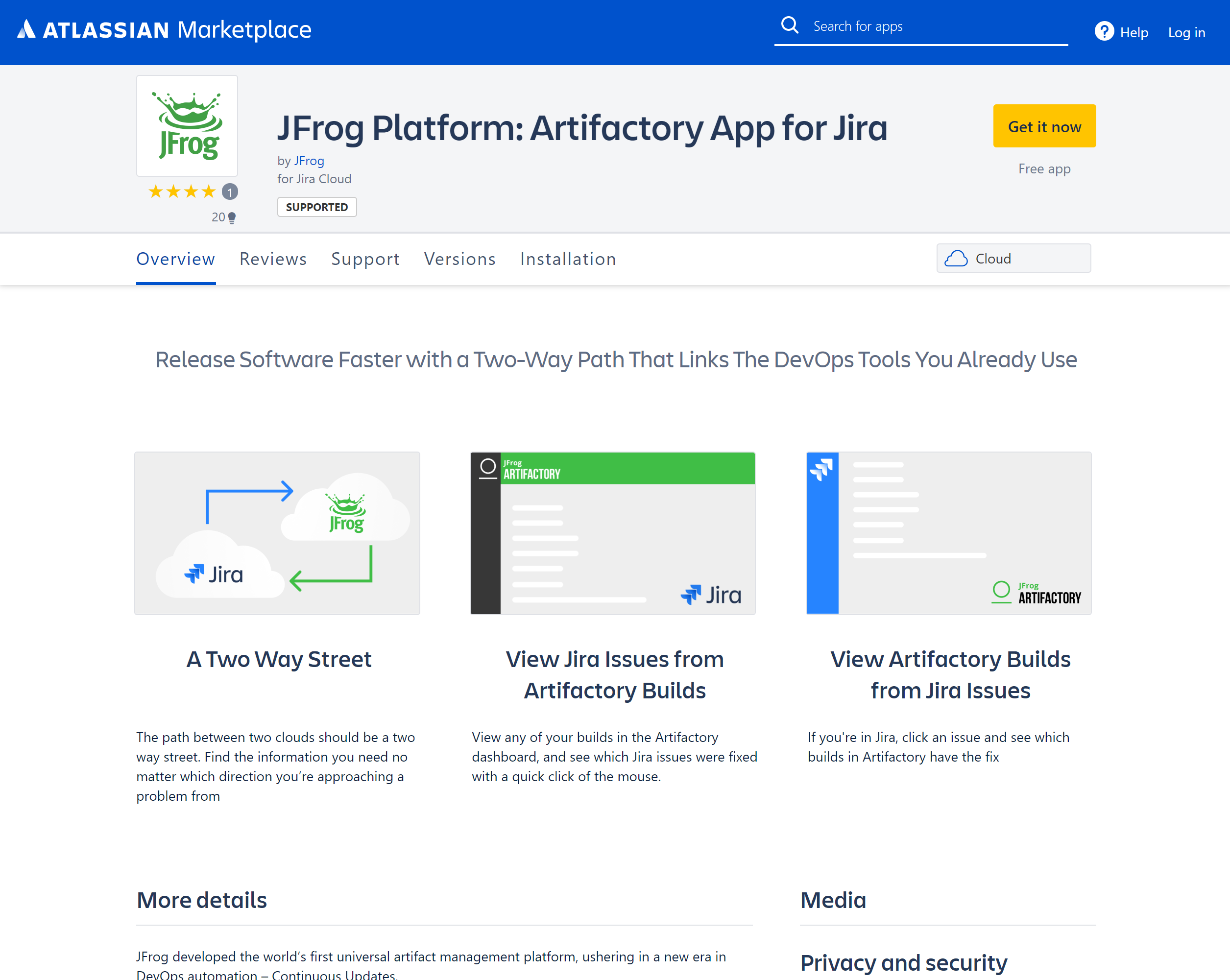
    JFrog this week announced that its DevOps platform, delivered as a software-as-a-service (SaaS), can now be integrated with the Jira project tracking and management application, delivered as a cloud service, from Atlassian.

    Casey O’Mara, vice president of worldwide business development for JFrog, said this bidirectional integration makes it possible to link a Jira issue, such as a bug fix, to the binary or build residing in the JFrog Artifactory repository that is part of the JFrog DevOps Platform.

    Available via an application that can be downloaded from the Atlassian Marketplace, this integration extends an existing alliance between the two companies, said O’Mara. There is, for example, already an integration between Atlassian Bitbucket Cloud for continuous integration and JFrog Artifactory repository.

    Creating a link with a Jira issue will make it easier to collaborate by, for example, making it easier to understand why a specific version of an artifact, such as a container image, was created, added O’Mara.

    Artifactory is already able to collect issue key messages from Git that logged alongside builds. The Artifactory dashboard for build information displays a link to each of the referenced Jira issues in the Issues tab. Now, users of Jira can link to the builds in Artifactory.

    Jira remains the dominant project tracking and management application for software development. As more organizations appreciate the degree to which they now depend on software, O’Mara noted the number of stakeholders in an organization using Jira is starting to increase, as application development schedules are tracked more closely. Atlassian is now making Jira more accessible as a cloud service to help foster that increased adoption, noted O’Mara.

    Atlassian is now making a case for transitioning its customer base to the cloud. In the third quarter of this year, it plans to discontinue new server license sales in addition to increasing prices for on-premises products. Ironically, the company reported preliminary results for its most recent third quarter that indicate revenues of between $566 million to $572 million. That’s $85 million more than originally forecasted, because demand for on-premises products has increased in anticipation of their unavailability later this year.

    In general, both Atlassian and JFrog are strong proponents of a best-of-breed approach to DevOps. JFrog, in its most recent quarter, reported $42.7 million in revenue, representing a 39% gain. Cloud revenue in that quarter grew 69% to $9.8 million, representing 23% of total revenue.

    It’s unclear at what rate organizations are shifting to the cloud. The number of workloads moving into the cloud has certainly accelerated in the wake of the economic downturn brought on by the COVID-19 pandemic. However, the bulk of data continues to reside in on-premises environments, and many organizations, because of performance, security and compliance concerns, don’t have any immediate plans to migrate all their applications to the cloud.

    Regardless of where DevOps platforms reside, there will always be a need to integrate them. It just may be easier to achieve that goal when all the tools that make up that workflow are running in the cloud.

  • Anaxi Enhances Development Intelligence Tool, Helps Maintain Delivery Schedules with Added Support for Atlassian Jira

    App provides greater reporting and analysis capabilities

    SAN FRANCISCO, November 15, 2018 — Anaxi, maker of software that helps engineering organizations gain control over the development process, announced today its iPhone app has added support for Atlassian Jira Server and Cloud versions to its current support for Github,  giving engineers and managers increased visibility and intelligence on their software development projects and processes.

    “By aggregating data from different tools, we’re able to provide metrics that provide a holistic view of the development process — not piece parts,” said Marc Verstaen, co-founder and CEO of Anaxi. “Now, for the first time, there is a system of record for software engineering to better control the process and keep development schedules on track.”

    Anaxi’s app now integrates data from both GitHub and Jira, the leaders in code versioning and issue tracking, respectively. The company intends to expand the number of tools it supports in the coming months.

    The Anaxi software development intelligence app analytics include productivity reports on individual, as well as team performance, providing more transparency and delivering actionable insights.

    Currently, Anaxi offers a free version of its app for the iPhone that is available on iTunes. The company is planning to make available in the coming weeks a beta version of its web app followed by an Android version. The company’s plans include a paid version for users who want premium reporting and communication features.

    The newly added capabilities for the Anaxi free app on the iPhone include the following.

    • Issue and Pull Request Metrics

    Users can look into their pull request and issue data to better understand how their projects are evolving. Users can use any filtering and sorting options to surface the items of interest to them and save them as new reports for quick access. Also, Anaxi created an evaluation of complexity for pull requests, as an additional consideration for users in terms of assessing which pull requests to review first.

    • Productivity Metrics

    Analysis of project commits provides metrics on individual and team productivity, including a breakdown of the effort in terms of code added and removed, refactoring, code churn, and more on a weekly basis.

    • Project Management

    From their iPhone, users can edit their issues and pull requests. All edits are synchronized back to their GitHub and Jira projects.

    • Data Confidentiality

    To protect the need for confidentiality and access to users’ GitHub and Jira accounts,  the Anaxi app is designed to connect directly to the users’ Github repositories and/or Jira projects. Then, the app builds the reports using the data, which remains secure and inaccessible, even from Anaxi itself.

    For more information go to www.anaxi.com/features.

    About Anaxi

    Co-founded by Marc Verstaen (previously executive vice president of product development at Docker) and John Lafleur (previously CEO at CodinGame) in December 2017, Anaxi is the system of record for software engineering organizations that need to facilitate decision processes. Anaxi will open a new data-driven era to engineering organizations, empowering them to better allocate their development time and resources.