Tag: ARM

  • Google FLoC is Dead | Meta AI Supercomputer Lives | ARM Deal is Dead

    Google FLoC is Dead | Meta AI Supercomputer Lives | ARM Deal is Dead

    Welcome to The Long View—where we peruse the news of the week and strip it to the essentials. Let’s work out what really matters.

    This week: Google’s FLoC proposal is dead, Meta/Facebook is buying RSC—a huge AI supercomputer, and Arm “will IPO” instead of selling to Nvidia.

    1. Forget ‘Federated Learning of Cohorts’—Long Live ‘Topics’

    First up this week: Google bows to the inevitable. Third-party cookies will soon go away, because people are fed up with being tracked. But Google’s FLoC proposal wasn’t the answer.

    Analysis: FLoC is a flop

    Google doesn’t want to invade your privacy. But Google does want to sell well-targeted ads. The key difference between FLoC and Topics is that FLoC buckets were automatically generated—and hence opaque, risking overlap with “protected categories”—e.g., race or gender. But the topic classifications in the Topics API are curated and have user-visible, descriptive names.

    Frederic Lardinois: Google kills off FLoC, replaces it with Topics

    Google’s controversial project for replacing cookies for interest-based advertising … is dead. In its place, Google today announced a new proposal. … Your browser will learn about your interests as you move around the web.
    …
    When you hit upon a site that supports the Topics API for ad purposes, the browser will share three topics you are interested in. … The site can then share this with its advertising partners to decide which ads to show you. … Users will be able to review and remove topics from their lists [or] turn off the entire Topics API.
    …
    It’ll remain to be seen if other browser vendors will be interested in adding the Topics API. [But] they all quickly turned a cold shoulder to FLoC. … The plan is to start trialing the Topics API at the end of this quarter.


    A minor tweak and rename? “Yes and no,” equivocates mananaysiempre:

    Yes, it still amounts to building user-tracking functionality into user agents. No, it’s not the same approach.
    …
    FLoC was doing unsupervised clustering of users, whereas Topics allocates users into predetermined clusters. This makes it potentially more transparent and also seems designed to work around the “protected categories” objection.


    But Google has a long way to go to convince garett_spencley:

    I’m glad FLoC is being ditched, but as an end-user I’m still not asking for this Topics nonsense. It doesn’t solve any problem that I have. It solves problems that the advertising industry has.
    …
    I’ll choose to use browsers that don’t support this.


    2. Machine Learning at Metaverse Scale is Expensive

    Zuckerberg’s new toy is RSC: A $400 million Nvidia-based AI supercomputer. And that’s just Phase One.

    Analysis: 3.8×10¹⁸ integer operations per second is … a lot

    If you rely on Open Compute Project systems for your DevOps, know that it’s no longer the bee’s knees over at Hacker Way. Meta/Facebook is investing eye-watering sums into a custom configuration of off-the-shelf hardware.

    Timothy Prickett Morgan: Meta Buys, Rather Than Builds And Opens, Its Massive AI Supercomputer

    If you thought it took a lot of compute and storage to build Facebook’s social network, you ain’t seen nothing yet. … To build the Metaverse … is going to take an absolutely enormous amount of supercomputing power.
    …
    But what is a surprise, given Facebook’s more than decade long focus on … opening up its hardware designs through the Open Compute Project, is that the … Research Super Computer [RSC] system is built from … commercially available … servers, storage, and switches. [It] probably comes down to … working a deal with some vendors who want the Facebook publicity and are willing to work the price and the parts availability.
    …
    [So Meta bought] 760 DGX A100 systems from Nvidia—which each … have a pair of AMD “Rome” 64-core Epyc 7742 processors … 1 TB of main memory … eight A100 GPU accelerators [and] eight 200 Gb/sec HDR InfiniBand controllers—all-flash storage from Pure Storage, and … caching servers from Penguin Computing. … At list price this machine would cost around $400 million … Phase one of the RSC machine is rated at 59 petaFLOPS … (FP64), and 118.6 petaFLOPS FP64 using the Tensor Core matrix engines. … With INT8 processing on the Tensor Cores, which is needed for AI inference, the phase one machine is rated at 3.79 exaOPS.


    How much??? It doesn’t seem like news to kleiba:

    I used to work at a university where my professor had been in automatic speech recognition for a long time, but basically gave up on that line of research about 10 years ago because he figured that universities simply cannot compete budget wise with the big industry players. I suppose the same will soon be true for most ML-related areas of research sooner or later.
    …
    Already, a substantial amount of research innovation in [Natural Language Processing] and [Computer Vision] has been coming from big companies in recent years. Of course there is a discussion to be had about what that means for society at large.


    But 3.79 exoOPS? That’s the way the wind is blowing, according to sungazer:

    Give it 15 or so years—this level of computation will be on your desktop. If desktops still exist.
    …
    Or desks.


    3. Arm Bid: No Legs

    Speaking of Nvidia, as I’ve said before, the Arm merger really shouldn’t go through. And it’s looking less and less likely. ARM chips are an increasing fixture in the data center—especially those that value “performance per Watt.”

    Analysis: ARM M&A DOA—IPO PDQ

    A veritable hornets’ nest of Bloomberg journalists have put their names to an anonymously-sourced report. The story argues that the proposed Nvidia buyout of Arm from SoftBank Group is dead. Next stop: IPO.

    Ian King, Giles Turner, Peter Elstrom, Dina Bass, David McLaughlin, Ruth David and Dinesh Nair: Nvidia Quietly Prepares to Abandon … Arm Bid

    According to people familiar with the matter … Nvidia … doesn’t expect the transaction to close. … SoftBank, meanwhile, is stepping up preparations for an Arm initial public offering.
    …
    If Nvidia manages to get the deal over the line, it would be a massive coup. … But it will be an uphill fight. … The world’s biggest tech companies rely on Arm technology, and they fear they could lose unfettered access under Nvidia.
    …
    Within SoftBank, there are factions. [And] the ordeal has created divisions within Nvidia. … “We remain hopeful that the transaction will be approved,” a SoftBank spokesperson said in an emailed statement.


    Post-Brexit Britain would no doubt like to keep Arm independent. Here’s simonh:

    Arm has I think ⅔ of its employees in the UK—mainly Cambridge—and they’re expanding the campus there. The Semiconductor Physics Group at the Cavendish Laboratory at the University is at the cutting edge globally with 18 PhD projects currently.
    …
    Guess where scads of Arm’s top scientists are recruited from? Arm and the University are joined at the hip. That company’s not going anywhere.


    More broadly, it’s good news, thinks hatchet:

    Hopefully this means NVIDIA will focus on RISC-V instead. This will be good for everyone.


    The Moral of the Story: Zeal should not outrun discretion.


    You have been reading The Long View by Richi Jennings. You can contact him at @RiCHi or tlv@richi.uk.

    Image: Reed Geiger (via Unsplash)

  • AWS Outage Outrage | Rusty Linux | ARM Latest

    AWS Outage Outrage | Rusty Linux | ARM Latest

    Welcome to The Long View—where we peruse the news of the week and strip it to the essentials. Let’s work out what really matters.

    This week: Amazon Web Services falls on its face, Linux’s move to Rust takes the next step, and the FTC stabs another fatal wound in the horrible Arm/Nvidia deal.

    AWS us-east-1 Breaks the Internet

    First up this week: Amazon Web Services’ outage on Tuesday sent scads of DevOps teams scrambling. But what was the cause?

    Analysis: DNS DDoS?

    While we still don’t officially know, there is some chatter to speculate on. Could it be that AWS’s DNS infrastructure is vulnerable to DNS reflection attacks?

    Hello. It’s Dave Lee: From angry Adele fans to broken robot vacuums

    It started early on Tuesday morning. Robot vacuums ceased sucking, Wi-Fi cameras stopped watching and eager Tinder daters were left unable to “swipe right.”
    …
    Within Amazon itself … the unthinkable occurred: grounded delivery drivers were unable to load packages and deliver to customers’ doorsteps, just as the peak Christmas season begins to step up. … Drivers at multiple facilities across the country were sent home … some dreading whatever workload may await.
    …
    An outage at Amazon Web Services … had rippled through the online economy, crippling services used by millions of people. … An “impairment of several network devices” in … US-EAST-1 was the “root cause” of the disruption, Amazon said.


    I was wondering what DevOps’ers learned? Enter Max Rozen:

    AWS took approximately an hour to update their status page to indicate anything was happening. … While our infrastructure is hosted across 20 AWS regions, a single point of failure was hosted in us-east-1.
    …
    What we learned: … I learned the saying, “Friends don’t let friends deploy in us-east-1.” As a result, we’ll be moving some things over to us-east-2 to start with. Secondly, we’ll be adding redundancy and the ability to failover to another AWS region.


    Getting inside the business, here are Eugene Kim and Katherine Long, to go over everything:

    Even inside AWS … information on the outage remained sketchy [and] rumors spread among staff. One AWS employee speculated that the outage was caused by an “orchestrated DNS attack,” while another employee downplayed those concerns.
    …
    According to a screenshot of an internal AWS communique … ”firewalls are being overwhelmed.” … A separate internal note said … the network issue “specifically impacted” Amazon’s internal DNS servers.


    Linux Officially Gets Rust Code

    The Rust language has taken the next step toward being part of Linux kernel development. Some “drivers and other non-core kernel programs” written in Rust can now be PR’ed. But there’s still no plan to go further.

    Analysis: Still needs lubrication

    Rust is much better than C for writing memory-safe code, and coding provable implementations. However, bootstrapping the toolchain is still stupidly hard.

    Steven J. Vaughan-Nichols: Linux is getting more Rust in it by the day

    It wasn’t that long ago that the very idea that another language besides C would be used in the Linux kernel would have been laughed at. [But] this has been coming for several years now. … Why? Because it’s much safer than C, especially at handling memory errors.
    …
    The next “patch series [adds] support for Rust as a second language to the Linux kernel.” … While he’s encouraging a slow but steady approach to introducing Rust into Linux, [Linus Torvalds] has also said that using Rust interfaces for drivers and other non-core kernel programs makes sense. [But] no one’s going to rewrite the kernel’s 25 million lines of C in Rust.
    …
    The Rust code proposed for the kernel now relies on the stable Rust compiler rather than the beta compilers. … As Linux kernel and lead Rust on Linux, developer Miguel Ojeda, put it, “By upgrading the compiler, we have been able to take off the list a few unstable features we were using.”


    How is it “safer than C”? ssokolow shares this fascinating insight:

    Rust tries to encourage that through good API design which allows it to be proven at compile time that the invariants will be upheld, thus avoiding the need to choose between safety and performance. My favourite example … is “the typestate pattern” which lets you teach the Rust compiler to prove correct traversal of any state machine.
    …
    A more mundane example would be the iterator APIs: No need for bounds checking if the iterator looks up the length once at the beginning and the APIs prevent you from wandering out of each entry it hands you. … Rust programs tend to run faster than their C and C++ counterparts because the developers feel comfortable introducing and maintaining more aggressive optimizations.


    “And then a miracle occurs,” quips @dave_universetf:

    I’m intrigued [but] I can’t help but feel sorry for the people doing bootstrapping work. C is hard enough to bootstrap, but Rust is a whole new level of pain.
    …
    Rust is literally not source bootstrappable. [The compiler] that works right now is Rust 1.39. So then you have to compile 18 more Rust compilers to get up to the current version.


    Nvidia’s ARM Woes Continue

    As I’ve said before, this deal really shouldn’t go through. Ownership of the ARM ISA and the core designs would be a huge strategic stick to beat Nvidia’s competition with. ARM chips are an increasing fixture in the datacenter—especially those that value “performance per Watt.”

    Analysis: Stick a fork in it

    Nvidia’s attempt to buy Arm from SoftBank is suffering death by a thousand cuts. And the latest wound comes from the FTC’s Higonokami knife.

    Paul Thurrott: FTC Sues to Block Sale of Arm to Nvidia

    The U.S. Federal Trade Commission … sued to block Nvidia’s $40 billion acquisition of … Arm, citing competitive concerns. … Nvidia announced its intention to purchase Arm from Softbank for about $40 billion, over one year ago, in September 2020. But the deal fell under immediate criticism from the major industry players that rely on Arm’s … designs, and the UK government announced … it would “intervene” for national security reasons.
    …
    Now, it may not happen at all. “We will continue to work to demonstrate that this transaction will benefit the industry and promote competition,” Nvidia said.


    Explain like I’m 5? Here’s swillden:

    ARM has a non-trivial and increasing share in the data center. … ARM is much, much bigger than phones … Arm is an important competitor to Intel and AMD. … Arm licensing IP to Qualcom, nVidia, Mediatek, Unisoc, Samsung, Apple, Google, etc., has been great for many areas of technology.
    …
    Arm acting as a common … designer for a bunch of different chip vendors has been extremely good for … progress in CPU/SoC design. … It would be really unfortunate if a lot of the industry were to shift back to x86, eliminating all of the competition on hardware features that we get from the many ARM chipmakers.


    But what of SoftBank? Ian King runs the numbers:

    Wall Street analysts are all but calling the deal dead. … According to Citibank analysts, the chances of the Nvidia purchase closing are now just 5%.
    …
    The company faces the prospect of losing a jackpot of roughly $74 billion. … Other suitors are unlikely to match such an offer. … So SoftBank’s best alternative may well be an initial public offering for the Arm business—but that is likely to value the company at … $19.8 billion—only about 27% the value of the … Nvidia deal.


    The Moral of the Story: It’s no secret that the both of us are running out of time


    You have been reading The Long View by Richi Jennings. You can contact him at @RiCHi or tlv@richi.uk. (It’s so typical of me to talk about myself—I’m sorry.)

    Image: Ləman Şirinzadə (via Unsplash)

  • AWS re:Invent Roundup: Private 5G | Graviton3 ARM Chips | DevOps Guru++

    AWS re:Invent Roundup: Private 5G | Graviton3 ARM Chips | DevOps Guru++

    Welcome to The Long View—where we peruse the news of the week and strip it to the essentials. Let’s work out what really matters.

    This week: Three things that caught my eye from Amazon Web Services’ re:Invent 2021 conference: Private 5G, Graviton3 chips, and something called DevOps Guru for RDS (yes, really).

    Private NRaaS vs. Wi-Fi

    First up this week: AWS Private 5G is a new turnkey service, offering local private cellular data infrastructure, for places where Wi-Fi just doesn’t cut it. Despite the name, it offers a 4G/LTE fallback to 5G/NR. Because it’s AWS, the hardware is free—you just pay for usage.

    Analysis: Combine with an Outpost for a sharper edge

    Wi-Fi is unreliable and low powered. 5G over the 3.5 GHz “citizens’ band” seems like a great alternative (just don’t tell the lunatic fringe of the anti-5G brigade).

    And, of course, AWS makes it easy to buy—Amazon ships you all the private radio gubbins for “free” and just bills you based on capacity and usage. It’s automatically configured and remotely maintained. You just take your internet connection and plug it in.

    Aisha Malik: Amazon launches preview of new AWS Private 5G managed service

    “AWS Private 5G” … is a new service that aims to make it easy to deploy and manage your own private network. … AWS CEO Adam Selipsky said that with AWS Private 5G, you can set up and scale a private mobile network in days instead of months.
    …
    There are no upfront fees or per-device costs: … Customers pay only for the network capacity and throughput they request. [It] scales capacity on-demand.
    …
    AWS Private 5G is available in preview in the United States.


    And this is better than Wi-Fi how, exactly? Ballu counts the ways:

    Industrial area coverage: Where you need 50 Wi-Fi radio units, you can provide service with 3–4 p4G/p5G radios.
    …
    Hazardous areas: Where you can’t provide the networking at all the corners or areas, one p5G radio blast area (esp with beam technology) can.
    …
    Packet loss: Less packet loss compared to Wi-Fi (believe me, it’s a big deal in the Industrial world)
    …
    Compatibility: What’s a negative for 5G modems (not many devices are available), is positive to some extent. Once investment is made with 5G modems, the devices can be on the road too.


    Unsurprisingly, Brian Roemmele feels vindicated:

    Precisely as I wrote about in 2017 to great ridicule from an analyst at a famous VC firm: Amazon is becoming a phone company.
    …
    From the Sidewalk Network to the Kuiper satellite system to local 5G. The network is no longer just “dumb pipes.”


    Graviton3: AWS ARM SoC is PDQ

    Graviton3 is the latest version of Amazon’s ARM server chip. It looks like it’s based on a 5nm process implementing the latest ARMv9 ISA. AWS is making the usual claims about it being much faster than the previous generation, but it also has new security features.

    Analysis: Cool chips

    AWS is deadly serious about low-power, high-performance compute. Amazon is just one licensee that would be distressed to have Nvidia owning Arm.

    As I said last week—and the week before that—ARM chips are an increasing fixture in the datacenter, especially ones that value “performance per Watt.” Other IaaS providers might bleat about how they’re reducing the energy used to cool their data centers, but surely it’s a better plan to start with less waste heat.

    Maria Deutscher: AWS debuts new compute-intensive and AI instances powered by custom chips

    AWS’ new Amazon EC2 C7g instances target compute-intensive workloads such as analytics tools and scientific modeling software. The C7g series is based on the AWS Graviton3 chip, the third iteration of the cloud giant’s internally-designed processor.
    …
    Companies that plan to use C7g instances for machine learning workloads can expect an up to threefold performance jump in AI performance. The speed jump is partly the result of the processor’s support for bfloat16, a specialized data format [that] enables applications to process floating point numbers faster and using less memory than FP32, the data format historically used for the task.
    …
    For cryptographic tasks, Graviton3 delivers as much as double the performance of the Graviton2. … The chip introduces a feature called pointer authentication to reduce the risk of cyberattacks.


    Tim Anderson has been sifting through the re:Invent announcements:

    Top of the list perhaps is Graviton3, the next generation of AWS’s homemade [ARM] server processors. These chips will be used in new C7g instances previewed offering DDR5 memory (50 percent more bandwidth than DDR4) and up to 25 per cent better compute performance compared to instances powered by Graviton2.
    …
    Adam Selipsky gave his first Re:Invent keynote as AWS CEO. [He] said Graviton uses “up to 60 per cent less energy.” … Graviton matters because it is among those leading a charge to get more [ARM] microprocessors into data center and cloud infrastructure, and because if it’s more energy and cost efficient to operate, it’s critical to Amazon’s bottom line, sorry, today’s environmental concerns.


    And is that pointer-authentication feature useful? Yes, very, says spijdar:

    Very useful. … If the performance is good, this is a nice extra layer that makes return-oriented programming more difficult. Combined with NX bits, it really raises the difficulty in developing/using many types of exploits (it’s not impossible to bypass … but there’s no perfect security).


    DevOps Guru Adds RDS Support

    DevOps Guru for RDS is the latest upgrade for AWS’s oddly-named smart monitoring features.

    Analysis: Silly name; useful tool

    Laplace and Gauss were right: Your DevOps team aren’t all rockstars. “Average” ops staff are in the majority. So extending AWS’s monitoring automation to your database instances should be a positive step.

    But that branding: Can anyone take it seriously?

    Stephanie Condon: AWS brings more automation to database management

    The new Amazon DevOps Guru for RDS automatically can find and fix database issues … helping developers using Aurora detect, diagnose and resolve database performance issues. [It] can help remediate a range of issues, such as over-utilization of host resources, database bottlenecks, or misbehavior of SQL queries.
    …
    Last year, AWS introduced DevOps Guru, a service that uses machine learning to automatically detect and alert customers of application issues. … Amazon DevOps Guru for RDS builds on that
    …
    Users can view [issues] in the DevOps Guru console or via notifications from Amazon EventBridge or Amazon Simple Notification Service (SNS).


    Sounds interesting, says u/random_dent:

    I thought the DevOps Guru for RDS sounded interesting. You need to enable performance metrics first, which have their own charges, but it still looks not too expensive, plus three months free-tier, so we may try it out.

    We’ve had some odd issues with RDS performance that are too inconsistent to lock down. It would be interesting to see if this could give us some insight.


    But that name! Here’s Thomas LaRock—@SQLRockstar:

    I’m old enough to remember when DevOps Guru for RDS was just called “database performance monitoring.”


    And @shmick is young enough to say it like this:

    such a cringe name


    The Moral of the Story: Misfortune tests the sincerity of friends


    You have been reading The Long View by Richi Jennings. You can contact him at @RiCHi or tlv@richi.uk.

    Image: Andrew Svk (via Unsplash)

  • WTH? We Wanna WFH | DoD Dual-Sources JWCC | More Nvidia ARM Woes

    WTH? We Wanna WFH | DoD Dual-Sources JWCC | More Nvidia ARM Woes

    Welcome to The Long View—where we peruse the news of the week and strip it to the essentials. Let’s work out what really matters.

    This week: Working from home is de rigueur, JEDI redux, and more about Nvidia/Arm.

    Survey Says: Devs Stay Out of Office

    First up this week: GitHub’s annual survey of developers has some fascinating data on the workplace (ahem) “new normal.” The pandemic has radically changed devs’ expectations of where they can do their jobs.

    Analysis: WFH is SOP

    As with other roles, Dev people want to continue to work from home. But does this pose a threat to your DevOps culture? Make sure you can do Ops with equal flexibility.

    Paul Krill: Dev productivity is back to pre-pandemic levels

    GitHub’s “2021 State of the Octoverse” research … sees signs that work rhythm is returning to pre-pandemic levels. GitHub also found that 46 percent of developers who worked co-located with teammates now expect to work fully remotely or in a hybrid environment.
    …
    Based on data culled from more than four million repositories and surveys of more than 12,000 developers … JavaScript and Python remain the top languages, followed by Java and TypeScript. [And] GitHub found that development team performance can increase as much as 87 percent when reusing code and as much as 43 percent when using … CI/CD.


    Zeroing in on the WFH angle, it’s Richard Speed:

    Respondents who were in the office either full or part-time dropped from 42 percent before the pandemic to a mere 10.7 percent now. … That’s a lot of empty desks.
    …
    Fans of the ctrl-c, ctrl-v combo will be delighted to note that GitHub found that when code reuse was made “frictionless” at work, developer’s performance increased by up to 87 percent. … It’s all splendid stuff.


    But beware of statistical fallacies, thinks Henrik Ingo—@h_ingo:

    #WorkFromHome may have been more common than anyone realized. [But] is the population of GitHub users/respondents somehow skewed toward pioneers/early adopters? … This might be a case of correlation is not causation.


    Defense Dept. Orders New Clouds

    The DoD issued its latest cloud contract opportunity notice, with the snappy title of “Joint Warfighting Cloud Capability” (JWCC). Reading between the lines of the notice, it all sounds very DevOps-cum-Agile.

    The Pentagon has backed away from its previous insistence on a single supplier, and now wants at least two cloud providers.

    Analysis: JEDI redux, because AWS wants a do-over

    JWCC is the follow-on from the aborted JEDI procurement. Amazon Web Services was “disappointed” to have been passed over in favor of Microsoft. Now it appears the DoD wants them to share.

    What can you learn from such a multi-vendor DevOps strategy?

    Jordan Novet: Pentagon asks Amazon, Google, Microsoft and Oracle for bids

    Amazon and Microsoft were the finalists for a single Joint Enterprise Defense Infrastructure. … Microsoft won it in 2019, Amazon filed a protest and the Pentagon canceled the contract in July.
    …
    The new effort [is] known as Joint Warfighting Cloud Capability. … JWCC differs from JEDI because it allows the Pentagon to rely on multiple cloud providers.
    …
    The U.S. General Services Administration … said only two U.S. cloud infrastructure providers, Amazon and Microsoft, appear able to comply with all of the Pentagon’s requirements. … The value of the new contracts is not known, but the Defense Department estimates it could run into the multiple billions of dollars.


    In summary, heed this Anonymous Coward:

    Competing suppliers will try harder than one non-competing supplier. The DoD has had a lot of problems with One-Ring-to-rule-them-all systems like the F-35. … JEDI would have been the same.
    …
    Smaller steps with upgrades while testing/using offers better returns. Done right they can get a better deal by making the companies compete against each other in making sure the products are actually useful.


    But look carefully at the DoD contract opportunity, says bustinbrains:

    They’ll all get contracts. Then DoD will simply use the one that they actually like the best. No one can complain because it’s open-ended with no guarantees.


    Arm/Nvidia Deal on FTC’s Radar

    Last week, we talked about Nvidia’s goal to acquire Arm Ltd from SoftBank, and the regulatory challenges it poses—notably in the UK, home of the chip architect. After we went to press, the other shoe dropped.

    Analysis: Just Give Up Already

    As we said last week, Nvidia can’t be allowed to do this. Not only are ARM chips found in 99% of smartphones, but they’re an increasing fixture in the datacenter—especially places that value “performance per Watt.”

    Richard Waters: What’s next for the tumultuous takeover of Arm?

    Nvidia’s acquisition of UK chip design company Arm from SoftBank has provoked serious opposition on both sides of the Atlantic. … The US Federal Trade Commission had its own worries. China, meanwhile, is waiting in the wings.
    …
    The deal has shone a spotlight on the unique position Arm plays in the chip industry. [Nvidia] offered a guarantee that it won’t block any other companies from licensing Arm’s designs. The offer has fallen on deaf ears, with both the EU and UK ruling it inadequate. … Post-Brexit politics have also come into play.
    …
    At what point might Nvidia and SoftBank call it a day? … A stock market listing [is] the most likely alternative, with the UK a favoured venue.


    How’s it viewed from the inside? Here’s a hint from fivemack:

    I was at ARM when Softbank bought them; it came as a surprise to everybody, because we were absolutely confident that we were unbuyable because anyone interested in us would want to use differential licensing as a weapon against their competitors, and we … were confident that regulators wouldn’t accept that.
    …
    Lots of people went home with a year’s pay check in free money. And not a few people … went home with a decade’s pay check in free money.


    More and more DevOps workloads are running on ARM silicon. Here’s Biophoton:

    The low power expertise of ARM has to be an advantage in the data centre (DC) market. … Plus Linux is available on ARM so architectural lock-in of Intel could be eroded in the DC market.


    The Moral of the Story: You are known by the company you keep


    You have been reading The Long View by Richi Jennings. You can contact him at @RiCHi or tlv@richi.uk.

    Image: Lukas Mann (via Unsplash)

  • Nvidia/ARM Wavering | Google Outage Outrage | Backblaze IPO on Fire

    Nvidia/ARM Wavering | Google Outage Outrage | Backblaze IPO on Fire

    Welcome to The Long View—where we peruse the news of the week and strip it to the essentials. Let’s work out what really matters.

    Nvidia Can’t be Allowed to Buy Arm

    First up this week: Nvidia’s faltering attempt to buy Arm: Regulators around the world are alarmed by the idea. And now the UK—the legal home of the company—has taken the next step, which could nix the deal.

    Analysis: RISCy home for ARM

    This matters because ownership of the ARM ISA and the core designs would be a huge strategic stick to beat Nvidia’s competition with. Arm doesn’t make chips—it licenses technology to Nvidia and many of its competitors—AMD, Apple, Broadcom, Samsung and Qualcomm, to name but five. So this deal really shouldn’t go through, regardless of Nvidia’s fluffy PR reassurances.

    ARM chips aren’t just found in 99% of smartphones, but are an increasing fixture in the datacenter—especially where “performance per Watt” is important. They’re even found in exascale iron, including the Riken Fugaku, the world’s fastest supercomputer.

    Helen Thomas: Nvidia faces tough Arm wrestle

    It is one thing for a regulator to give your deal a thorough going-over. It is another for it to imply publicly that your assurances [aren’t] credible. … Nvidia got both from the UK’s Competition and Markets Authority. … The CMA’s full phase 1 report doesn’t make for easy reading.
    …
    The transaction, which was announced in September 2020, is bogged down in regulatory reviews around the world: … Arm’s “neutral” business model has always made it a difficult acquisition. … Arm licenses its designs to other chipmakers, providing scope to restrict rivals’ access.
    …
    Arm was a political talking point in 2016, when its sale to SoftBank … was waved through with embarrassing ease. There is now a much more muscular political take on UK national security concerns with a particular focus on tech.


    But if it’s owned by a Japanese company, why is the UK getting involved? Glad you asked—Aighearach answers:

    What did they buy? Shares of a UK company. … Then it is a UK company! … Buying shares is buying ownership, but it doesn’t move the company to another jurisdiction.
    …
    This blathering about “sold to a Japanese firm” is getting old.


    Nvidia claims, “The transaction will … boost competition and innovation.” Falmari finds that hilarious:

    Did Nvidia’s spokesperson previously work as a stand-up comedian? Because as jokes go, “boost competition” is a whopper. [Do you think] that’s what a company like Nvidia wants—to boost the competition?


    Google Cloud Outage has Ripple Effect

    Google’s load balancers all went offline for two hours on Tuesday. Aside from the knock-on Google Cloud failures, DevOps tools such as BigCommerce, Datadog, Deno, Discord, Egnyte, Evernote, Linear, Netlify and Toggl were reported to be affected. But perhaps the worst impact was felt by the poor, unfortunate users of Pokémon GO.

    Analysis: Paralysis

    In theory, putting all your eggs in one basket is okay—so long as that basket can reliably stop your eggs smashing on the pavement. But this isn’t the first time we’ve seen Google Cloud issues such as this; I can’t imagine it’s the last.

    Steven J. Vaughan-Nichols: Google glitch triggers major internet outage

    The result? Many of us have seen 404 errors when trying to get to some of our favorite web pages. … There appears to be more major sites having problems than not.
    …
    The specific problem seems to be with the GCP load balancers. These, working with Google’s Cloud Delivery Network (CDN) [are] designed to stop website failures and Distributed Denial of Service (DDoS) attacks by putting your website behind a single anycast IP.


    Are you feeling a touch of déjà vu? jeffbee, too:

    This is a sort of repetitive outage for Google. They’ve wiped out the GSLB configs before.

    A year ago there was also that big outage where they blanked out the whole Gmail delivery config and started rejecting all mail. … Config safety is not their strong suit.


    The #3 IaaS provider won’t get to #2 if it keeps this up. Here’s u/totopapa:

    I’m trying to convince my company to switch from AWS to GCP but an outage like this one is definitely a showstopper.


    Backblaze IPO Burns Brightly

    Backblaze is now NAS:BLZE. In its first week, the stock jumped 60%.

    Backblaze is well known for its tiny-margin consumer backup product and its open-source “storage pod” hardware—but is less well known for its DevOps-focused “B2” cloud storage service.

    Analysis: Can it Avoid Death-by-Packrats?

    Backblaze is trying to grow this newer DevOps business, without losing its classic consumer chops. But many of its former competitors have essentially dumped their “unlimited” offerings—it’s the old tragedy-of-the-commons problem.

    Jordan Novet: Backblaze [goes] public on small valuation and minimal funding

    In an era of blockbuster market debuts preceded by astronomical private financing rounds, Backblaze … a cloud service for backing up data … is a throwback to a time when sub-billion-dollar companies routinely went public to raise capital and build their profile … to win the trust of customers.
    …
    Backblaze shares climbed 24% in their debut on Thursday and another 12% on Friday, lifting the price to $22.31 and giving the company a market cap of around $650 million. … By the standards of its peers, Backblaze is a micro-cap.
    …
    One of Backblaze’s competitors is Amazon, the world’s fourth most valuable U.S. company. … Backblaze currently stores two exabytes of data — that’s 2 million terabytes — and has a half-million paying customers.


    Donovan Jones: Backblaze Targets $100 Million IPO

    The firm provides cloud-based storage services to small businesses and individuals worldwide. BLZE has grown revenue and gross profit impressively through the 2020 pandemic period and the IPO appears fairly valued, so is worth a close look.
    …
    The firm’s financials show strong revenue and gross profit growth. … The firm’s dollar-based net revenue retention rate for 2020 was 114%—a solid result. … The market opportunity for providing cloud-based storage services to small businesses and individuals is large and expected to grow at a material rate. … As for valuation, compared to partial competitor Dropbox, management is seeking the same Enterprise Value/Revenue multiple. [However] the combined revenue growth rate and EBITDA percentage rate … was 3% as of June 30, 2021, so the firm needs improvement in this regard.


    But there’s a long way to go, opines John Kozubik (aka rsync):

    Of the ~500,000 customers, 70,000 are B2 customers and 430,000 are “backup” customers—which are flat-rate “unlimited” users. … Roughly 85% of the user-base are paying $7/mo for “unlimited backup.”
    …
    These flat-rate users are very fickle and price-sensitive. … Roughly 85% of the user-base are paying $7/mo for “unlimited backup.” … It’s a fools errand to pursue this market and I assume the pivot to B2 was to build something more sustainable with a much higher price and usage ceiling.


    The Moral of the Story: Success is a journey, not a destination


    You have been reading The Long View by Richi Jennings. You can contact him at @RiCHi or tlv@richi.uk.

    Image: Kristin Wilson (via Unsplash)

  • Energy Efficiency and the Data Center

    Energy Efficiency and the Data Center

    The IT industry has historically been a leader in the ongoing race to reduce CO2 emissions. Reducing emissions is good for the environment and for the corporate bottom line. The data center is well-known as a voracious data consumer. But the data center consumption findings keep pace with the trend. Even in the face of remarkable growth in data center capacity and performance, their energy consumption has increased only a few percentage points since the 2010s. This almost-flat rate of energy consumption is primarily the result of the shift to cloud computing as well as the shift to solar and wind energy, where it makes sense.

    Investments in renewable energy sources have helped tamp down criticism over the overall IT carbon footprint. Knowing that it takes a tremendous amount of energy to power a data center, owners and operators are always looking for ways to improve efficiency and reduce carbon expenditure. Today, there are newer and better ways for organizations to deliver the performance to properly power modern applications while keeping in mind the energy efficiency and carbon reduction the world requires.

    Minimizing Energy Use and CO2 Production

    How did we get here? Decades of semiconductor process miniaturization in concurrence with living out Moore’s Law has culminated in ongoing improvements in performance, storage capacity and device density. Today’s mobile phones are a great example of that ongoing progress. A secondary factor in the mobile phone revolution is a processor architecture optimized for efficiency and flexibility. This ARM architecture has been used to power almost all devices since the first iPhone. Over the years, ARM has also become a realistic platform for servers; often a better choice than an x86 system.

    Energy efficiency is one area where ARM systems win out over conventional server architecture. But it was not until recently that ARM processors could deliver the required performance for the data center. Today’s systems, based on Armv8 designs, have brought into play x86-class capabilities in a more energy-efficient way. The advent of the ARM-based AWS Graviton processors, which by some estimates have already captured 20% of the instance share on AWS, demonstrates that ARM can run production workloads while delivering what AWS calls “up to 40% better price performance over comparable current-generation x86-based instances for a wide variety of workloads.”

    To illustrate the impact on carbon production when a data center shifts from x86-based architecture to ARM servers, an analysis of the top elements contributing to data center energy use was undertaken. The energy savings was calculated and translated to reduced CO2 emissions based on the fuel mix used to power the electric grid in various locations. The results prove that an ARM-powered data center reduces CO2 production by 74%, equivalent to almost half a million barrels of oil.

    Power Consumption Reduced by Efficient Servers

    The premise is simple—innovative server design significantly reduces data center energy use. In this model, a server’s power draw and physical size are key factors. The energy needed for other data center subsystems was extrapolated by using ratios derived from experience and validated by estimates from other data center operators.

    Data center energy use can be divided into five categories of equipment and infrastructure: Servers, network communications, power supplies, conversion and UPS, cooling systems and storage. Servers and cooling comprise about 75% of the total.
    The calculations were based on the energy used by a medium-sized data center with 750 racks of conventional 1U servers (42 servers/rack; around 31,500 in total). Assumptions used included servers comprising two-thirds of the floor space and that the equipment space accounts for 65% of the total, translating to a 62,000 square-foot data center. For comparison, facilities operated by the major cloud vendors can be a million square feet or more. Knowing server power consumption and the ratios for the equipment categories, algebra can be used to calculate the energy consumption for each.

    The data center in this hypothetical example has, as we said, 31,500 servers. Using the 912.5W power draw of a Dell R640 as typical of 1U x86 servers, the total server usage in the ARM data center would be 251,795 MWh/year. Using this formula, the amount of energy saved by using ARM servers can be calculated. Each server requires about one-quarter the electricity of a standard server. In the formula, the assumption is that the ARM server installation would require half the equipment racks (375 instead of 750) and 52% of the power-per-system, comprising a data center using only 26% as much electricity (152,409 MWh/year) as one based on x86 systems.

    The math shows that switching one medium-sized data center to ARM servers can produce annual savings equivalent to 45,459 fewer cars on the road or 486,749 fewer barrels of oil used.

    The value in CO2 reduction is widely understood for preserving the environment. It is also advantageous from an economic standpoint. In fact, there are many technical and economic reasons to adopt energy-efficient ARM-powered servers in the next-generation cloud data center.


    To hear more about cloud-native topics, join the Cloud Native Computing Foundation and the cloud-native community at KubeCon+CloudNativeCon North America 2021 – October 11-15, 2021

  • Oracle and Allies Launch ARM-Based Cloud Service

    Oracle and Allies Launch ARM-Based Cloud Service

    Oracle announced today it will make available for the first time ARM-based processors on the Oracle Cloud Infrastructure (OCI) that will also be supported as targets for deploying applications using GitHub, GitLab or Jenkins platforms. The latest Oracle service is based on processors from Ampere Computing.

    The company also revealed today it has joined the Continuous Delivery Foundation (CDF), an arm of the Linux Foundation that oversees the development of open source DevOps platforms and tools such as Jenkins and Spinnaker.

    Matt Leonard, vice president of compute for OCI, said the OCI Ampere A1 Compute provides an alternative to existing support for the x86-based processors that Oracle provides. That service will be offered at a cost of one cent per core hour with virtual machine sizes ranging from one to 80 OCPUs configured with one to 64 GB of memory per core or as a bare-metal service with 160 core and 1 TB of memory. Pricing per GB of RAM per hour is $0.0015. At that price point, Leonard said Oracle is now offering the lowest price per core of any cloud service provider.

    The growing availability of ARM-based processors is starting to have an impact on cloud economics at a time when organizations are significantly increasing the number of applications being built and deployed on public clouds. Many of those organizations, to reduce overall costs, are now actively evaluating ARM-based services, noted Leonard.

    To help jumpstart application development on the platform, Oracle is providing organizations with three classes of OCI Ampere A1 Compute services. An Oracle Cloud Free Tier gives developers $300 in free credits for 30 days. The Always Free ARM option gives developers four A1 cores and 24 GB memory, while an ARM Accelerator option provides open source developers, independent software vendors (ISV) partners, customers and universities with ARM-based development projects that need additional resources beyond what the Oracle Cloud Free Tier provides with credits for a 12-month period.

    Oracle Linux, Java, MySQL, GraalVM and the Oracle Container Engine for Kubernetes (OKE) service are also all available on the OCI Ampere A1 Compute along with integrations with DevOps platforms from GitHub, GitLab and/or Jenkins. Other vendors providing support for OCI Ampere A1 Compute include SUSE, Datadog, OnSpecta, NGINX and Genymobile.

    Oracle has also made available an Oracle Linux Cloud Developer image that enables DevOps teams to install, configure and launch a development environment via an OCI console that includes OCI client tools, utilities and common programming languages such as Java, GraalVM, Python, PHP, Node.js, Go and C/C++.

    Finally, each Ampere core is single threaded by design with its own 64 KB L1 I-cache, 64 KB L1 D-cache and a huge one MB L2 D-cache to eliminate any ‘noisy neighbor’ issues that IT organizations might otherwise encounter.

    Oracle is clearly betting that ARM-based processors will present the company with an opportunity to gain share at the expense of larger infrastructure-as-a-service (IaaS) rivals such as Amazon Web Services (AWS) and Microsoft Azure. It’s not clear to what degree IT teams might employ a different cloud service just to access ARM-based processors. However, in a world where IT teams now routinely employ multiple clouds, as far as Oracle is concerned, the playing field has never been more level.

  • CircleCI Previews Support for Arm Platforms

    CircleCI Previews Support for Arm Platforms

    CircleCI today previewed the ability to deploy applications on platforms based on Arm processors in a forthcoming release of its namesake continuous integration/continuous delivery (CI/CD) platform.

    Tom Trahan, vice president of business development for CircleCI, said that Arm processors are rapidly being embraced by DevOps teams seeking to take advantage of the price/performance advantages they currently have over conventional x86 processors. Amazon Web Services (AWS), for example, makes available an AWS Graviton2 service based on 64-bit Arm Neoverse processors that it claims provides a 40% advantage in overall price/performance.

    The Arm community, meanwhile, has adopted many of the libraries employed on x86 platforms, Trahan noted, which is making it simpler to automate the deployment of applications on Arm-based platforms using a CI/CD platform.

    It’s not clear how quickly developers are building applications for Arm processors. Historically, Arm processors can be found in a wide range of embedded systems typically deployed at the network edge. However, cloud services based on Arm processors are also becoming more widely available, and it’s only a matter of time before more Arm-based platforms are deployed in on-premises IT environments.

    Arm itself is also in the process of being acquired by Nvidia, which envisions running machine learning algorithms, and other classed of advanced workloads, on both Arm processors and graphics processing units (GPUs). Many of the early efforts to build processors optimized for running AI workloads at the network edge are based on Arm processors.

    The addition of Arm platforms to any IT environment will naturally create some management challenges for DevOps teams. In some cases, developers may even decide to build applications using, for example, the latest generation of machines from Apple, that are based on Arm processors, to streamline the application development and deployment process. In other cases, however, applications that are intended to be deployed on Arm processors might still be built on x86 systems.

    Regardless of approach, the arrival of more Arm-based platforms in the enterprise doesn’t mean other classes of processors are going to fade away. Rather, from a processor perspective, IT environments are about to become a lot more diverse as more workloads are deployed on a wider range of processors. It may be quite a while before Arm-based platforms usurp x86-based systems that still dominate the IT landscape. However, during any turbulent economic time, the number of organizations inclined to reduce the total cost of IT by embracing new platforms always increases.

    Fortunately, as more IT infrastructure is managed as code, the easier it becomes to switch platforms. There may even come a day when the decisions about which platform to employ and when is completely automated by machine learning algorithms trained to maximize IT infrastructure efficiency to the fullest extent possible.

    In the meantime, DevOps teams should expect, to one degree or another, to revisit their workflows processes in the months ahead. Not only are more workloads being pushed out to edge computing platforms where Arm processors are commonly found, those Arm processors will soon find their way into the rest of the extended enterprise.

  • Chef Adds Support for Arm Graviton 2 Processors on AWS Cloud

    Chef Adds Support for Arm Graviton 2 Processors on AWS Cloud

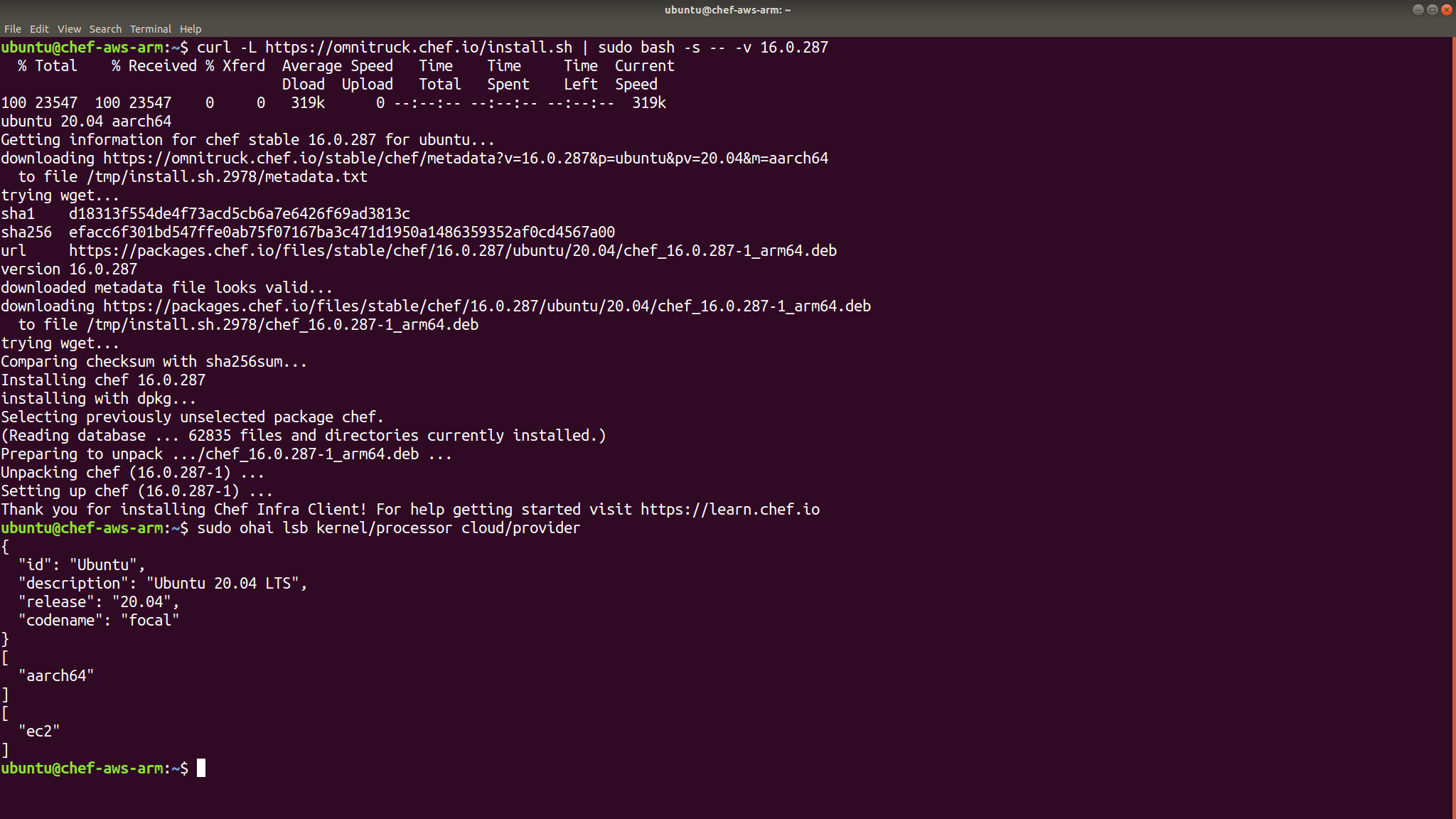
    Chef announced this week that its offerings for managing and testing infrastructure as code now support Graviton 2 processors from Arm on the Amazon Web Services (AWS) cloud.

    AWS this week announced the availability of an M6g instance of processors on its public cloud. Based on a 64-bit Arm Neoverse N1 architecture, the M6g processors were jointly designed by Arm and Annapurna Labs, a unit of Amazon.

    According to AWS, during a preview program platforms such as Honeycomb consumed 30% fewer instances on M6g than the widely employed AWS C5 instances. Treasure Data, a provider of data analytics software, reported a 30% performance increase while seeing a 20% cost reduction compared to similarly sized M5 instances. The Amazon ElastiCache service team found that M6g instances deliver up to 50% throughput improvement over M5 instances on Redis.

    In addition, AWS this week revealed it also plans to add compute-optimized C6g instances and memory-optimized R6g instances based on 64-bit Arm processors.

    The Arm processors in the cloud are expected to provide a foundation for building hybrid internet of things (IoT) applications spanning AWS cloud services and instances of Arm processors that are widely employed in embedded systems. Previously, AWS launched an AWS Greengrass initiative through which it encourages developers to build and deploy cloud-enabled IoT applications on edge computing platforms.

    Vikram Ghosh, vice president of business development for Chef, said DevOps teams can now automate the provisioning of Arm processors using the same Chef tools they employ to provision instances on other types of processors running on the AWS cloud.

    It won’t be long before 64-bit instances of Arm processors start showing up on other cloud computing platforms, noted Ghosh. In fact, between the rise of Arm processors alongside graphical processor units (GPUs) the types of processors readily available in the cloud have never been more diverse, which Ghosh said is driving increased demand for tools to manage infrastructure as code.

    It’s still early days as far as adoption of best DevOps practices to build and deploy IoT applications is concerned. However, the highly distributed nature of IoT applications—which in many cases will need to be updated frequently—lend themselves to being managed more efficiently using DevOps processes. In most cases, these IoT applications represent “greenfield” applications where there is no legacy process in place that potentially would create a culture clash.

    Forecasting demand for edge computing applications in the wake of the COVID-19 pandemic is difficult. However, the general expectation remains that more application code will be moving closer to the point where it is being consumed, especially when 5G wireless networking services become more available. In fact, many of those applications are being built now in anticipation of those networking services being able to connect edge computing applications with backend cloud resources.

    Once those applications are built, the next big challenge will be finding a way to secure and continuously update them. In the meantime, however, the number of edge computing applications being built today in the cloud for edge computing platforms based on Arm processors is about to increase substantially.