Tag: appsec

  • Helping Developers Win in the Shift-Left Revolution

    Helping Developers Win in the Shift-Left Revolution

    The shift-left revolution is upon us. Just because it’s a cliche, doesn’t mean it’s not true. As software development organizations continue to implement DevOps culture, processes, and tools, developers are adopting the practice of testing and ensuring the security of their applications as early as possible in the DevOps pipeline.

    This is quite a change from the traditional waterfall method. There, developers dealt with the design and creation of a product or application and security professionals came in after they were finished, to review and test security, flagging any possible issues and sending them back to the software teams to figure it out.

    This fundamental change in the way companies are addressing application security affects many of the moving parts in a software outfit. It requires a new set of processes, practices and tools all to be implemented, all while keeping up with today’s fast-paced release cycles.

    To gain an understanding and insight on how developers are handling this hefty challenge, we polled more than 600 developers in software organizations and asked them about how security figures into their day-to-day tasks and processes, and the tools that help them to address their evolving roles.

    Developers: Owning Their Shift Left

    The first thing that we wanted to learn is whether developers are on board with the shift-left approach that most organizations have adopted for security testing. Our findings showed that, for the most part, developers are taking ownership of the day-to-day operational responsibility for AppSec in their organizations, playing a more significant role on this front to secure their products.

    When asked who owns the day-to-day operational responsibility for AppSec in their organizations, 23% answered that developers own those responsibilities, 21% said DevOps, 28% said software development team leaders owned it and only 29% said security teams in their organizations are the owners.

    developers shift-left chart 1The fact that a whopping 71% of developers put the ownership of AppSec squarely on the shoulders of software development and DevOps folks means that developers are very much on board with the shift-left movement and have taken on the new security tasks that come along with that.

    Breaking it down, we also found that in smaller organizations, more developers and DevOps professionals feel that they own their AppSec responsibilities, while those percentages go down with larger organizations. This can be explained by the fact that often smaller companies have less specialization, requiring developers to branch out of their professional comfort zone. Smaller organizations also tend to allow developers more freedom and flexibility to define their own processes.

    developers shift-left chart 2Do these responses mean that in addition to their focus on innovation, functionality and quality, developers have also added security into their considerations when they are in the process of creating and building projects?

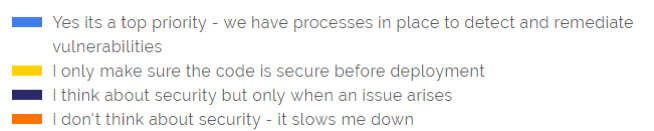
    The answer would appear to be yes, according to 58% of developers in our survey, with an additional 39% saying that security figures into their consideration when issues arise (14%) or that they validate security before deployment (25%). Only 3% of developers said that security is none of their concern since it slows them down.

    Are you taking security into consideration when developing software?

    developers shift-left chart 3

    While their responses show that there is still a ways to go before security is completely baked into development processes, it’s clear that most developers are already in the right direction, making security a priority within their tight schedules.

    The AppSec Process: Who’s On First?

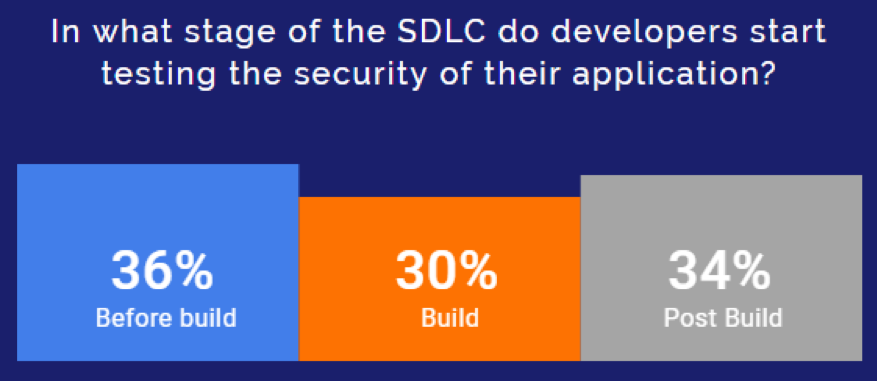
    How does making security a top priority or at least a consideration figure into the different phases in the DevOps pipeline? Practically, where is it being applied? We asked developers at which phase in the software development life cycle (SDLC) they started testing their AppSec.

    Their answers showed once again that developers are taking on security where it traditionally was not a part of their workflow. In fact, many replied that they are integrating security testing tools as early as the pre-build stage, with 36% of the respondents saying that they are testing in their IDE and repositories.

    developers shift-left chart 4Survey results also showed that along with the DevOps processes, they are also adopting tools that help them to shift security further left. 68% of developers report using at least one AppSec technology such as SAST, DAST, SCA, IAST or RASP. All of these automated solutions help security teams and developers detect potential security issues in their products, providing software teams with visibility and control over their AppSec.

    A Question of Remediation

    Until now, survey results show that developers have taken their place on the front lines of AppSec and the shift-left revolution, arming themselves with an impressive collection of automated detection tools. However, these solutions are creating a new set of issues that should worry stakeholders.

    It appears that the much-needed security testing tools are threatening to bury development teams under a mountain of alerts, which they are now required to research and remediate while keeping up with their deadlines. It’s impossible for developers to keep up with all of the security alerts in their inbox, especially considering that many AppSec tools were developed for security teams and focused on widespread coverage (detecting all potential issues), rather than accuracy and prioritization.

    This poses quite a challenge for developers, who say that they are spending a substantial chunk of their very valuable time dealing with remediation-related tasks. A full 42% of the respondents reported that they spend between two and 12 hours each month on these tasks, while another 33% said that they spend 12 to 36 monthly hours on them.

    In light of these time-heavy statistics, it is clear that developers need new technologies and practices that will allow them to prioritize security without slowing down the development life cycle and costing them so many valuable work hours.

    Helping Developers Win the Race to Remediation

    The survey results showed that developers today are required to take the lead when it comes to application security, but need more backup to do so. Detection tools can take developers part of the way, but to empower them through to remediation, organizations must provide them with developer-focused solutions that can help them to close the loop from detection to remediation.

    Once developers are alerted to a newly detected security vulnerability in their project, they need to validate it, assess its impact, research remediation options and perform the remediation path chosen. Currently, these are all time-consuming manual processes that require a level of skill and proficiency.

    With developers poised to face security head-on, organizations expecting them to fully address AppSec need to provide them with the tools that will easily integrate into their native environments and help them take vulnerability management one step further, enabling them to prioritize security alerts so that they can get to the most burning issues first and even automate their remediation process.

    — Ayala Goldstein

  • DevOps Chat: The New Security Breed with Veracode’s Mark Curphey

    DevOps Chat: The New Security Breed with Veracode’s Mark Curphey

    DevSecOps has changed the way developers approach security in their application development cycle. But it’s also been the source of confusion, as some developers grapple with understanding how DevSecOps is different from application security. Mark Curphey, VP of strategy at CA Veracode, is clued in to the differences, which he discusses in this DevOps Chat.

    As usual, the streaming audio is immediately below, followed by the transcript of our conversation.

    Alan Shimel: Hey, everyone. It’s Alan Shimel, devopsy.kinsta.cloud, Security Boulevard, and you’re here for another DevOps Chat. Today’s DevOps Chat is all about DevSecOps, AppSec, what’s happening on the front lines. I’m joined by an old friend of mine, Mark Curphey. Mark is currently VP of strategy at CA Veracode. Hey, Mark, welcome to DevOps Chat.

    Mark Curphey: Thanks, Alan. Great to talk to you again.

    Shimel: All right. So Mark, let’s start off with this. I know you’ve fairly recently joined Veracode. Give our audience a little bit of your background and how you came to be where you are.

    Curphey: Yeah, sure. So misspent youth, went back to university late, did a master’s degree in information security, and wound up working for a bunch of banks in the city of London. Moved here to the states in 2000, then ran software security for Charles Schwab. So Microsoft were creating the SDLs. You know, sort of Gates had sent out the famous memo and I was doing the same for an online service basically at Charles Schwab. So that’s where I started. Then at OWASP, which some people sort of associate my name with, which is the Open Web Application Security Project.

    And since then I’ve worked at Microsoft around the security tools team and then I think with MSDN, the Microsoft Developer Network. I more recently created a startup called SourceClear which was focused on helping developers use open source code safely in the modern DevOps world. We were acquired by Veracode about five months ago. So I’m now the VP of strategy at Veracode helping the Veracode platform and how we really sort of work with DevOps and the new way of doing things.

    Shimel: Fair. Okay, so Mark, let’s start off with this though, and I think there’s some confusion out there with both security people as well as non-security people in terms of what’s the difference between AppSec and DevSecOps? Is one really just synonymous with the other? Is DevSecOps another name for AppSec? I don’t think it is. What do you think and how do you define the differences between them?

    Curphey: Well, certainly every vendor’s got a DevSecOps product these days, right? So it’s easy why people are getting confused. I mean I think the reality is the way you have to do AppSec in a DevOps world is fundamentally different to the way we’ve done it before. It used to be about educating developers, writing policies that people had to read, human processes to do final check off, things like threat modeling, you know, all of these sort of things. They kind of worked okay in a waterfall world were kind of modified a bit to work in an agile world. But, you know, DevOps is changing the game completely. So we’re in a world of automation, and, you know, the modern ways that we have to secure it are fundamentally different. So for me DevSecOps is about how do you apply security in this modern, you know, DevOps world and that’s predominantly focused around, you know, automation. What can you automate and, you know, how can we put automation in those pipelines that are happening so that security happens inline as code is created and it’s moved through the pipelines?

    Shimel: Fair enough. We talked pipelines. We talk left to right, Mark. You know, and Veracode is probably one of the leaders in this space when we talk about DevSecOps and shifting left and working. But I think what people want to know is really how does the security person or the security team work with the development team? It’s easy to say, but what does it really –

    Curphey: Sure.

    Shimel: What does it really mean?

    Curphey: Yeah. I mean, look, I think there’s a new breed of security people which is exciting to see. Like the old world that used to be the development team and then there were the security team. There were kind of the two separate teams. The security team needed to sort of bless things before they went into production, but we get appointed a data center and whatever. These days what you see is it’s all about velocity.

    So, you know, there are security people that are embedded into the security teams and they’re kind of acting like consultants and helping the dev team do security as and when it’s needed and make the right decisions without slowing things down. So instead of it sort of being this procedural thing where they were required to go through whatever a control grate, they’re just tired of the flow. That’s exciting to see because I think we’re seeing a paradigm shift of how that happens.

    Shimel: Yep, I think we are seeing a paradigm shift in this. So here’s going to be a question you’re going to say, “Alan, you’re crazy,” but Mark, does it make a difference? Is it definitively improving our security here?

    Curphey: Yeah. First, Alan, I’m never gonna call you crazy, but that’s good to know, I think.

    Shimel: I figured you would.

    Curphey: No, but look, I mean like, for sure, like think about like we all know what happened with Equifax, right? Like biggest data breach in history, result of open source that was insecure and hadn’t been updated. That problem is solvable and it’s solvable at scale in a pipeline. So what we were doing at SourceClear – I don’t want to turn into a product pitch in any sense, but we were basically trying to close the loop of this library is out of date, issue the pull request, figure out if it’s going to break things, and if so, update it. And the developers loved that, not because they’re fixing security but they’re fixing the dependency hell problem.

    So we’ve not been able to do that before because, you know, we hadn’t been injected directly in the pipelines. So these are opportunities that really make a difference and companies that implement these tools like us and there are others around, totally can avoid the whole Equifax thing. It’s not a case of like no one got notified or no one knew. Like it happens automatically in the pipeline. So there are great opportunities to do things like that.

    And I think moving forward we can also look at things like are people using dangerous APIs? Are they calling, you know, external services that we don’t want them to call? Like to a large extent the pipeline has become the new firewall and it’s a place where we can put controls, inspect the traffic, and decide what we want to allow and what we don’t want to allow which is a great place to be.

    Shimel: I agree. I agree there. So Mark, I guess where I wanted to go next with this is a lot – again, I’m a man who lives with a foot in each world, right? I spend a lot of time with my security friends and colleagues that I’ve known for years and years and years, but as part of devopsy.kinsta.cloud I’m out speaking to developers an awful lot, right?

    Curphey: Mm-hmm.

    Shimel: And some of the questions that I hear from both sides is, okay, you can’t serve two masters, there can’t be two people in charge. How does the day-to-day of this flow? You know what I’m saying?

    Curphey: Yeah, no, for sure. I mean look, the reality is in all organizations the digital transformation and everything else happens that it’s all about value creation and the value is created by developers. So they’ve been empowered to choose their tools. They’ve been empowered to figure out which process allows them to innovate faster and all those things. With that we’ve seen the rise of the cloud and everything else. So it can’t be an us or them scenario. It’s how do you support those developers on their mission to change things and create this digital transformation? So the old ways, you still see it but you still see the old school of security people saying no and stopping people; but those battles are not going to be won. It’s about how do we help people move forward at the right rate.

    I mean I kind of equate it like someone was saying the other day, like similar to autonomous cars, like you’re not going to stop them. Like figure out how to make them work properly, safely, and securely. But if you don’t like it, you’re not going to stop that, have that technology happening and being created so you’ve got to embrace it. That I think is the philosophy that is going to win out the day.

    Shimel: Fair enough. I don’t disagree with you there, Mark. Let’s talk a little bit about what you see near term and maybe a little bit longer term in developments here that, you know, our listeners, you know, could fundamentally change their day to day. Where do you think we’re heading?

    Curphey: Yeah, sure. So, you know, I think machine learning and artificial intelligence and big data were sort of touted and, you know, the hype cycle kick off and, yeah, people didn’t always deliver on that. But there are exciting things happening in that which allow us at scale and at speed to do things that we couldn’t do before. So a good example of that is in the security world most of the vulnerabilities no longer exist in the CV system open source code. They just can’t keep up with the scale. We’re releasing thousands of libraries. In the DevOps world, developers find things, fix them, push them out. They don’t go back to monitor and publish these vulnerabilities, etc.

    But the great news is, you know, there are big data systems, machine learning that can process that data and we can identify those things at scale. Those same kind of techniques have been applied by Google and the Android App Stores and things like that. So that application of like that modern tech I think has great opportunities for us to do things which we’ve not been able to do before, and you’ve certainly seen some of the big vulnerabilities that have been released have been a result of that stuff coming out.

    Shimel: Got it. Got it. I just had my phone ringing there. I apologize. Mark, let’s, if I can and if you’re not too shy about it, I doubt you will be, let’s talk specifically a little bit about Veracode.

    Curphey: Yes.

    Shimel: You know, you’ve been there five months. What do you see? What gets you excited there in the morning?

    Curphey: Yeah. We had loads of places to sort of land. We came to the conclusion that people wanted to have less tools than more. So they wanted to buy a suite. When you look around, what the Veracode guys had done is built sort of best-in-class SAST and it started working on software composition analysis. We had best-in-class software composition analysis. So it made sense from that perspective.

    Also as you know, the heritage of the company, you know, it isn’t a fly-by-night company. It’s Chris Wysopal and Christien Rioux, right? These guys were in the loft, right? So that legendary around the place. So the company has this real DNA about it around security. So for me it’s kind of this exciting security DNA in the company embracing the way we build modern software. So that’s what attracted us to join forces. We’ve been extremely excited since. A lot of exciting things happening that for sure will start to come out of it at the other side no doubt.

    Shimel: I agree with you. I actually have Chris on a panel we’re doing on DevSecOps next week. I’m really excited to have Chris as well as Dave Duncan from CA, I think is on the panel with us.

    Curphey: Right. Right.

    Shimel: So Mark, you know, running out of time here, but I wanted to talk a little bit more about, you know, you came into Veracode, as you said, about five months ago via the acquisition. There’s a lot of people out there seeing a lot of buying and selling, M&A kind of stuff going on in especially around DevSecOps and DevOps related companies. I mean obviously a rising tide lifts all boats and there’s consolidation going on, but is there anything else at play that you’re seeing that’s kind of driving this stuff?

    Curphey: Well, I mean, you know, in the place that you look on the horizon is actually where the dev tools are going. So you know, if we look at companies like AWS, it’s not really just a hosting platform. It’s a full tool suite, right, of everything from machine learning libraries in the cloud to real-time databases and things. Google and Azure are building the same. As we start to think about like what is a next generation of developer look like, they’re likely to use an IDE and a browser. It’s not going to run on a desktop anymore. And you know, co-changes happen and everything happens up in the cloud. So I think there are a lot of exciting things happening there and how do you integrate security into that world for sure. So that’s a lot of the stuff that I’m focused on. Then you can get scaled I think.

    Shimel: Got it. Got it. Mark, you know, I appreciate you talking to us today. I think we’re about out of time. But for people who want to get more information on what’s going on, veracode.com obviously, correct?

    Curphey: Yeah, veracode.com is an excellent, well-trafficked blog with Wysopal and various other people and myself contributing to it which is great and we’re out speaking at conferences and talking about some of the both current work and sort of some of the futuristic stuff as well. So love to engage with the community and the industry for sure.

    Shimel: Perfect. All right. Hey, Mark Curphey, VP of Strategy, CA Veracode. Thanks for being our guest in this episode of DevOps Chat and we look forward to having you on again soon.

    Curphey: Yeah, great, Alan, thanks a lot. Great to reconnect and look forward to doing so the next time.

    Shimel: Okay.

    Curphey: Take care.

    Shimel: This is Alan Shimel for devopsy.kinsta.cloud. You’ve just listened to another DevOps Chat.

    — Alan Shimel

  • DevOps Chat: ASRTM for DevOps with Rohit Sethi, Security Compass

    DevOps Chat: ASRTM for DevOps with Rohit Sethi, Security Compass

    In this DevOps/Security Boulevard Chat we speak with Rohit Sethi, COO of Security Compass about ASRTM, which stands for Application Security Requirements and Threat Management. Gartner has recently released a hype cycle on ASRTM, with Security Compass and its SD Elements offering named a leader in the market. Rohit gives us a good background and foundation on ASRTM and why it is important for both DevOps and security teams.

    As usual, the streaming audio is immediately below, followed by a transcript of our conversation.

    Audio

    Transcript

    [su_pullquote align=”right”][su_custom_gallery source=”media: 119457″ target=”blank” width=”200″ height=”200″]Rohit Sethi
    Rohit Sethi joined Security Compass as the second full-time employee. As COO, Rohit is responsible for setting and achieving corporate objectives, company alignment and driving strategy to execution. Previous to this role, he managed the SD Elements team. Rohit specializes in building security into software, working with several large companies in different organizations. Rohit has appeared as a security expert on television outlets as such as Bloomberg, CNBC, FoxNews, and several others. He has also spoken at numerous industry conferences s and/or written articles on major websites such as CNN.com, the Huffington Post and InfoQ.[/su_pullquote]

    Alan Shimel: Hey, everyone. This is Alan Shimel for Security Boulevard Security Chat, and this will also be appearing on devopsy.kinsta.cloud under DevOps Chat. So two chats for the price of one, though it’s one chat. Welcome, and we have a great guest lined up for today. I have Rohit Sethi—and I mispronounced that. I think it’s actually Rohit Sethi. But in any event, you can correct me. Rohit, welcome.

    Rohit Sethi: Thank you.


    Related Content:

    How Developers Can Take a More Proactive Approach to Security

    DevOps Chat: Aqua Security Seeks To Secure Containers


    Shimel: Just for the record, say your name correctly.

    Sethi: Rohit Sethi.

    Shimel: Rohit? Okay. Rohit, you know, as my mom used to say, “Call me anything you want, but not late for dinner.”

    Sethi: [Laughter]

    Shimel: Welcome to Security Boulevard Security Chat and thanks for joining us. So you are the COO of Security Compass, correct?

    Sethi: Correct.

    Shimel: And there’s probably people in our audience who maybe are not familiar with Security Compass. So why don’t we start there. Can you give us a little bit of background on Security Compass?

    Sethi: Sure. We are a firm that is specializing on software security. And we have three main offerings around that. So we have an advisory practice that does penetration testing, and code reviews, and threat modeling, but also helping people build up their secure software program. And especially more recently building up their dev sec ops program and building security into their DevOps pipeline.

    Shimel: Mm-hmm.

    Sethi: We have a training practice, which is specialized in training developers. We’ve partnered with ISC-Squared and we offer a certificate or batch program on secure development for software developers. And then we have a product called SD Elements, which is an application security requirements and threat management. I know that’s a mouthful. And what we’re going to talk about today is a platform that helps people build security and compliance to some extent into their software development process, and particularly for agile and dev ops processes.

    Shimel: Excellent. Now, so a couple of things that we want to talk about relate. And one of them is recently Gartner’s come out with another magic quadrant or a new magic quadrant where they’re kind of lumping together what I personally always thought of was two distinct areas. And they’re calling it – and I’m going to mess this up. Why don’t you help me? AR –

    Sethi: ASRTM.

    Shimel: ASRTM. Why don’t you tell our audience what that stands for?

    Sethi: Yeah. ASRTM is application security requirements and threat management. And it’s not quite a magic quadrant yet, but it’s on the hype cycle.

    Shimel: Hype cycle. You’re right.

    Sethi: Okay. So they’re identifying it as a sort of an emerging category for people to start paying attention to.

    Shimel: Yep. And so for our audience and for me, talk to me. How did the nexus here between them?

    Sethi: eah. So you can think of [Laughter] anything in this category as being tooling that helps you to build security into the onset of development. Most of the tools that exist in the application security category today are some form of static analysis, dynamic analysis, interactive application, security testing. So really all different kinds of testing looking for security defects, or blocking the tax in real time. Right? So real-time application security protection or web application firewalls.

    And many people their entire budget is on testing and sort of blocking attacks. But really very little focus on building security from the start, except for perhaps in training. So everything in this tool category is essentially some kind of product that will help you to systematically and in kind of a scalable way build security in so that you don’t get those defects when you do your testing. And perhaps more importantly, to prevent defects that perhaps those automated tools are just incapable of finding.

    Shimel: Got it. Got it. Got it. Got it. And so I think we’ve laid the foundation, if you will, Rohit. Let’s jump into a little bit of how this relates to dev ops and what we call dev sec ops. So why –

    Sethi: Yeah.

    Shimel: Go ahead. Why don’t you take a lead on that?

    Sethi: Yeah. For sure. So DevOps is a phenomenon that it’s not just for sort of fast-moving organizations. Even some of the slower or I guess you’d say larger companies are starting to embrace DevOps, as you know. And it’s becoming really quickly sort of a mainstream philosophy. And there’s just really rapid pace of change of tooling that people are looking at – and not just tooling, but processes, to be able to accommodate continuous integration and continuous delivery in all of the mentality changes and processes that have to change to allow that to happen.

    Now, when we think about the traditional secure software development life cycle, there’s a lot of activities that we’ve typically suggested in the security community about following a secure SDLC, that really kind of incongruent with this idea of either having really fast sprints or no sprint, no iterations, just being able to take one ticket at a time, build it, and deploy it. So the idea of doing like an architectural analysis, or a one-week or two-weeks threat model, these things are sort of thrown out the door when the pace of development is too fast to keep up with it.

    And so that kind of opens up the need for automation. Now, there’s sort of a trend, and I would call it, I would label it a dangerous trend, that people are looking to 100 percent automated solutions to sort of take away the security problem. Right? So you’ll see sometimes people will put together presentations on DevSecOps and they’ll say static analysis is sort of your way to handle secure coding. And then perhaps some penetration testing on a periodic basis and you’ve kind of checked off the box for secure development. But the reality is that, in fact, security is a lot more complex than that.

    Static analysis tools and dynamic analysis tools have their strengths, but they also have significant gaps. We actually put together a white paper that talks about the missing parts of what scanners can’t find, false negative gap. And one of the interesting things is if you look at sort of CC plus plus development for a second, one of the most pervasive vulnerabilities is buffer overflows. This is the thing that caused Heartbleed and WannaCry and pet. Yeah. It’s sort of the underlying root cause there was some memory management issue.

    And if you were to take some of the best practice in terms of highly automated scanning solutions and put them all together, they’d still be able to find less than half of all buffer overflow vulnerabilities. Yet, this is what a lot of the industry is converging on as good enough from a software security perspective.

    So not everybody looks at it that way, and there’s a lot of people who realize that there’s a gap here that we need to do more than just scanning. It is an essential part of the solution, but we need to be able to identify what are all of the relevant threats to an application development, and how do we actually build mitigating controls rather than fixing the vulnerability after the fact? So prevention instead of detection.

    And that’s really where the ASRTM category fits in. It allows you to define what those controls are and build them into the software development process. Not only, in fact, from a security perspective, but also like compliance control, some of the GDPR issues that will come up there.

    You have to kind of build data protection by design and default. You need a system, a systematic way to identify these as essentially requirements that go into your backlog, right, and that you can track whether or not they’ve been tested. And that’s quite different than the approach that people have typically taken to finding vulnerabilities after the fact and fixing them.

    Shimel: Mm-hmm. So Rohit, our audience, especially from devopsy.kinsta.cloud, of course, is extremely savvy to the whole DevOps and DevSecOps terminology and kind of what’s happening. One of the issues that we see with this, though, is so many of our security solutions are geared for security professionals.

    Sethi: Yeah.

    Shimel: Where so much of the real responsibility for secure coding and secure apps lies with the developers.

    Sethi: Yes.

    Shimel: Right?

    Sethi: Yeah.

    Shimel: And to that no one – you know what? I’ve never met a developer, Rohit, who raises his hand and says, “I want to develop insecure code.” Or, “I want to have an insecure application.” They all want security, obviously.

    Sethi: Yeah.

    Shimel: But they may not have the expertise. They may not have the support. They may not have the time, frankly, to do it right.

    Sethi: Yeah.

    Shimel: So how does like a Security Compass type of solution help not only the security guy, but the developer, as well?

    Sethi: Yeah. Excellent question. So the way that the work flow in an ASRTM solution works – and I’ll talk specifically to ST Elements, which is our product. But we’re not the only product that does this. Is that somebody in a product team – so we have a lot of clients that use it this way. It’s sort of a self-service model.

    So let’s say like a project manager. And so you mentioned developer, but I would extend that to the entire development team, right? Product owners, product managers, scrum masters, etc., right, who are involved with building software. So you take sort of a lead, whether that’s product manager, project manager, product owner, scrum master, lead developer. And they fill out a questionnaire that’s kind of like a base online ramp up of that software they’re building. So they’ll answer like a multiple-choice questionnaire.

    And then based on the results of that questionnaire, they’ll get a defined set of prescriptive controls that are essentially security user stories, right, that you need to build into your software. And then what they’ll do is they’ll integrate it into gira, or Microsoft Team Foundation server, or whatever it is that the development team is using to manage their backlog. And then the product owner is then responsible for grooming it, just like they do feature or functional stories. Right?

    So now what we’re doing is we’re taking the backlog, which is sort of the de facto list of work that needs to be done, and we’re putting non-functional requirements alongside the functional requirements, which allows the development team to take control of when they’re going to implement security work or security features, as opposed to just reacting to a security defect that’s found later on. So basically you’re turning unplanned work into planned work. So that’s the first thing that you do to sort of empower the development team.

    The other, of course, is that when you take a look at these requirements and these controls, you actually start to bake training into it. So someone might get a control that talks about how to implement a secure password reset. Right? So this is a feature in the system that is the kind of thing that you really can’t find with an automated scanner, but that could lead to significant risk if it’s done incorrectly.

    So you can actually have a Gira ticket that talks about the correct way to implement secure password reset, and you can have an actual embedded training module so somebody could actually learn about well what are the ways that people exploit password reset at the time that they implement the control. So it’s what we call just-in-time training. We think it’s a really important and powerful concept, especially as it relates to fast-moving development.

    Shimel: Absolutely. So Rohit, I’ve always wanted to ask this question, then. And that is it’s incredibly difficult, then, as a Security Compass, let’s say –

    Sethi: Yeah.

    Shimel: To, I mean, number one as a salesperson to, who do I sell to? Who has the budget? Who is my technical stakeholder?

    Sethi: Yeah.

    Shimel: Who is making decisions? But beyond, you know, pity, no one’s going to play hard to the flowers for the sales team. [Laughter] But beyond that, as a solutions provider, serving two masters here.

    Sethi: Yes. Yes.

    Shimel: How?

    Sethi: You know it – go ahead. Sorry.

    Shimel: No, no. I was going to say how does that – I just, it’s gotta be really hard.

    Sethi: It is hard. I wouldn’t say that it’s easy at all. But I think that it’s critical work. Like our vision as a company is a world where you can trust technology. And we really think that if we don’t do security right, that that vision will not be realized. People will be afraid of technology to some extent. We won’t be able to exploit the possibilities that technology affords us because we’re afraid of vulnerable technology.

    And really, when you think about the root cause of most of the security incidents, sometimes it’s an insecure web application, but sometimes it’s a vulnerability in your desktop or operating system, or like a browser component or something. But so often it’s a secure coding issue. And so much of the sort of cybersecurity budget and infrastructure is based on the fact that well, let’s just take for granted that the software is insecure, and let’s find ways to mitigate the risk.

    And of course we’ll never get 100 percent secure code. But we really think that there’s a huge gap between what we can feasibly do, right, versus what’s being done in industry today. And so that motivates us. And I think often when we start to talk about the data, we talk about and when we’re talking to the chief information and security officer, or the chief information officer, we talk about a visibility gap that they have, right?

    Which is that right now the way that most companies work is they have a GRC solutions and sort of a policy departments to talk about what their high-level information security policy is. And then they may have some automated solutions to help enable that policy. But there’s sort of a gap between this high-level policy and then what are the specific things that an IT team needs to do to make sure that that policy is being followed and being able to track that?

    And that’s really, I think, at the heart of what an ASRTM solution provides is the ability to take this policy, turn it into procedure, turn it into something you can track, and ensure consistency, right? Because you can’t rely 100 percent on sort of automated scanners to catch everything. So you need to have this sort of translation there. And we find that that works pretty well. People are receptive to that need.

    And then, in fact, it’s not just application security, but it also involves infrastructure security, hardening servers, and that sort of thing, bender security, bender risk management, cloud security, how secure your cloud applications, and how do you know what to test against? So just like a variety of needs are met by adopting a program, really, that allows you to define your security controls at the granular level that your DevOps teams can implement them and you can track that.

    Shimel: Fair. Fair enough. So what does the future hold here, then?

    Sethi: Well, my hope is that we realize that vision, right? We get to a point – what I would like to see, for me success in the long term is that when we find that there’s a vulnerability that’s exploited in the wild that that vulnerability never creeps into code again. Right? Like if we know how to mitigate it, then it’s mitigated forever. And we’re so far away from that reality right now. Right? Like a lot of the real-world exploits are traced down to what is the root cause? It’s a secure coding issue that we’ve known for 15 or 20 years, in some cases.

    And that’s just not good enough. So we’d like to get to a place where the only hacks that occur are really novel. Right? Like we’ve never seen anything like this before. And some really profound security researcher has found a security issue that they’ve spent a significant amount of time understanding that specific domain. Right? But not sequel injection. Right? Not parameter manipulation. Not things that we’ve known for years. And that’s really, I think, where we want to go. And I think that inevitably that’s the direction that the industry is going to move towards.

    Shimel: Agree. Agree. Rohit, when we started, I told you the time goes quick. And we are coming up on our 15-minute window. But let me give the listeners – we want to find out more about Security Compass. Where can they find out more?

    Sethi: Well, of course, you have, you know, SecurityCompass.com talks quite a bit about what our offerings are. You can feel free to e-mail us, info@SecurityCompass.com. I’m personally on Twitter so you can follow me. Just @RKSETHI. We have a LinkedIn page for Security Compass, as well. So lots of different ways you can interact with us.

    And like I said, we offer training. So a lot of people who are, just want to learn more about application security, we have courses that you can just sort of enroll yourself. And we’ll be releasing more of those in the near-term future, as well.

    Shimel: Got it. All right. So Rohit Sethi, thanks very much for being our guest on this episode of Security Boulevard Security Chat, as well as DevOps Chat. And we look forward to hearing more about Security Compass in the coming months. Thanks for being our guest today.

    Sethi: Thank you for the opportunity. Appreciate it.

    Shimel: All righty. Rohit Sethi, Security Compass here on Security Boulevard. This is Alan Shimel, and we’ll see you soon on another DevOps or Security Boulevard Chat.

    — Alan Shimel

  • Case Study: Pearson Weaves ThreadFix into AppSec, Part 2

    Case Study: Pearson Weaves ThreadFix into AppSec, Part 2

    In part one, we discussed how education content publisher Pearson applied ThreadFix to its AppSec request workflow needs. Here’s the rest of the story.

    The ThreadFix Implementation

    Senior software security engineer Matt Tesauro added ThreadFix to Pearson’s workflow in the following steps:

    1. Using FPM, Tesauro created a Debian Linux package internally to deploy the ThreadFix Tomcat Package (ThreadFix also offers its own Debian package for this).
    2. Tesauro hooked ThreadFix into each of Pearson’s toolsets using the tool scanner file formats ThreadFix understands.
    3. Using the importers built into ThreadFix, Tesauro connected it to the Checkmarx, Veracode, BurpSuite, ZAP, WhiteHat, AppScan and Qualys testing tools Pearson uses.
    4. To make that happen, Tesauro pointed ThreadFix to an API.
    5. Tesauro then set up an API key.
    6. The system was then set to fetch the test results.
    7. If necessary, Tesauro wrote glue code to upload the results to ThreadFix.

    Pearson used ThreadFix to normalize and de-dupe what had proceeded from manual assessments, dynamic scans on applications and static code analyses of source code, directing those outputs into ThreadFix. “So if a static tool and a dynamic tool both found the same cross-site scripting issue, we fed those into ThreadFix, which de-duped those and gave us just one issue to report so that we didn’t bury two teams with fixing the same single coding error,” says Tesauro.

    “ThreadFix became the one source of knowledge for all of the output of our team, which for us is the security vulnerabilities we find in the applications that we either created, bought or had a third party create,” says Tesauro. That enabled Pearson’s AppSec team to feed tickets into JIRA of backlogs from development teams, which made it easier to produce metrics and do reporting. ThreadFix made it easier to feed data into governance, risk, and compliance tools such as RSA Archer. “That enables visibility into work in progress and workflow and into areas of the business that affect AppSec’s work,” Tesauro notes.

    Additional Capabilities with ThreadFix

    Tesauro eventually expanded ThreadFix to other departments beyond AppSec to benefit from its capabilities and the metrics it could produce regarding app progress.

    Tesauro notes a point between the “Bag of Holding” and ThreadFix in the AppSec pipeline that required some work. He used a StackStorm orchestration and layered ChatOps on top to enable new developer capabilities at that point in the process.

    “Now you can go into our private channel and use HipChat to ask the system, for example, to set up Checkmarx for a particular application in a particular business unit. You give it the URL pointer to that unit’s Git repository and off the system goes, setting up the application profile in the Bag of Holding and in ThreadFix and then talking to Checkmarx to set up weekly scans of the code that sits on the master branch. It set that all up in a minute,” says Tesauro.

    HigherEd was the first additional group inside Pearson to benefit from ThreadFix metrics. One such metric was a 44 percent decrease in time-to-fix after adding a JIRA integration into the mix, according to Tesauro. “Once we started producing those numbers, we had a lot of other business units ask, ‘Hey, why does HigherEd get these great time-to-fix numbers? We want them too for our apps.’ It was a great way to get buy-in,” says Tesauro.

    Further Results

    AppSec saw a 5x increase in throughput for the request workflow and went from 44 application assessments in 2014 to fewer than 200 in 2015, Tesauro notes.

    “In 2015, we lost two and a half people and still sped up the process,” he says.

  • Case Study: Pearson Weaves ThreadFix into AppSec, Part 1

    Case Study: Pearson Weaves ThreadFix into AppSec, Part 1

    Pearson is a publisher of education industry content to meet the needs of teachers and students from kindergarten/early learning through higher education and continuing education (for professionals). The company uses a mix of software, from legacy third-party software and “classic ASP apps that are on life support to auto-scaling systems on Amazon,” says Matt Tesauro, senior software security engineer at Pearson. “It’s a very diverse development environment.” Which meant it was no easy task keeping it secure.

    Pearson Before DevOps

    Prior to adopting DevOps, Pearson was bogged down by manual processes, especially in application security. “People sent requests buried in email or, if you were lucky, in a Google spreadsheet. There were very few clear lines and hand-offs between the different activities that were the responsibility of the AppSec group,” explains Tesauro. It was a very manual, custom approach in terms of request handling: someone would respond to a request with an activity, which would require a report that was then emailed.

    At the time, Pearson had no single, well-established methodology or workflow for these activities. There was no particular look and feel or design for creating dynamic, manual or static assessments. There was no list of inputs into the process or outputs to expect at the end of the process. “At best, everything flowed in an ad hoc fashion,” says Tesauro.

    Then, about two years ago, Tesauro and a senior-level peer at Pearson attempted to prioritize those apps the company most needed to assess for security and related issues. They had hoped and planned it would be about 10 apps, to keep the number and the workload manageable. For political reasons, they were able to settle on no fewer than 64 apps that needed appraisal. “We ended up being able to assess only 44 out of the 64 top apps. There are 2,000 and some-odd apps at Pearson, in rough numbers. Just the scale told us we were going to fail in the long run,” says Tesauro.

    Ramping Up to Change

    To resolve this app assessment challenge, Tesauro looked to institute DevOps and Build Pipeline approaches to lay the groundwork for eventually integrating security into the various development teams at Pearson. “I made equivalents of DevOps and Build Pipeline approaches for how we did work in the AppSec program at Pearson,” says Tesauro. These included standard methods of input and intake of service requests similar to how the business produces software development targets for a DevOps shop to hit. That’s when Pearson began to work on instituting and leveraging ThreadFix.

    “ThreadFix was one of the first two parts of that pipeline,” he says. The other part of the AppSec pipeline solution was what Tesauro calls the “Bag of Holding,” a mechanism and repository for tracking all the team-to-team interactions and work assignments. That feeds into ThreadFix.

    During that time, and for about the first half of 2015, Tesauro and a teammate automated a number of manual steps by creating code to perform the “mindless work” so developers could concentrate on their core business instead. “Now when the static code analysis tool Checkmarx finishes its analysis, it generates a report, washes the directory and pushes the report into ThreadFix,” says Tesauro. He also automated a number of other test applications and tools.

    Stay tuned for part two of this case study, coming soon.

  • The Myth of DevOps as a Catalyst to improve Security?

    The Myth of DevOps as a Catalyst to improve Security?

    Few topics within DevOps discussions elicit more controversy than the relationship between DevOps and information security. Do DevOps practices help to improve security, or do most organizations simply automate and bring their existing bad internal processes along into DevOps? With this topic in mind, I recently had an engaging conversion with Adam Muntner on this and more, and thought it would also be of interest to devopsy.kinsta.cloud readers.

    Adam Muntner is a Security engineer at Mozilla and the creator of FuzzDB, an open-content licensed attack and discovery pattern database of test cases for software security testing and research. He has 20 years of experience at security governance and management, technical assessment, research, and consulting with a focus on secure software development. The opinions expressed are his, not his employer’s.

    Here is our recent conversation on DevOps and security, edited for brevity and clarity.

    devopsy.kinsta.cloud You’ve taken issue with some of the claims that DevOps can help to improve security. For example, my writing, “several years into enterprise DevOps deployments, what we are actually learning is that unifying development and operations teams through DevOps efforts does not create the wild west environments feared,” in my post DevOps Security Comes of Age. Another was from this Q&A with Gene Kim where he said that high performers are able to conduct more frequent code deployments complete their deployments from code committed to running in production more quickly, that they enjoyed twice the change success rate, and that outages were fixed 12 times more quickly.

    I had used these findings to support DevOps as helping to improve security outcomes. You took issue with these statements. Why?

    Muntner: I’m not opposed to DevOps or packaged deployment, rather I’m for taking a holistic view of benefit and risk from an informed perspective. The thing to keep in mind is that the security of an application environment is inherited – it’s the aggregate result of all its component pieces.

    When system architectures are so complex that using opaque, componentized, pre-built pieces in an application environment becomes the norm, how do you know what’s in them? How much attackable surface area is being inherited?

    Gene Kim is a smart guy and chose his words carefully with regard to security. Gene said,

    “The first one is the high performers were massively outperforming their non-high performing peers. Thirty times more frequent code deployments. They were able to complete the deployments from code committed to running a production 8,000 times faster. In other words they could do a deployment measured in minutes or hours. Whereas low performers it took them weeks, months, or quarters. Furthermore, they actually had better outcomes. Twice the change success rate and when they caused outages they could fix it 12 times faster. There were 4,200 that completely responded and it just showed that you could be more agile and reliable at the same time. I think if we just connect some dots, they’re also going to be more secure, they’re probably going to have a faster find fix cycle time. We didn’t actually test that but, if that were true it would mirror what we found in the previous benchmarking work I had done.”

    The old engineering maxim of “good, cheap, fast” has not been obsoleted by DevOps. Deploying code 8,000 times more quickly is not a measure of risk reduction. It might help get fixes out faster, but that doesn’t tell the whole story.

    Gene said, when they caused outages they could fix it 12 times faster,” but how many of the outages are the result of faster deployment cycles? What does it mean to fix an outage 12 times faster than if the outage had never occurred due to a different development practice? Fixing outages quickly is good, that’s what is seen. It doesn’t take into account the unseen – newly introduced weaknesses that aren’t being tested or measured for.

    How much of what was measured resulted from the ex-Devops security practices of organizations measured and resultant outcomes? What does “better outcome” mean, and is that even objectively quantifiable across different organizations or even situations in the same organization? Are we confusing correlation and causation? Every organization is different. The metrics are being held up as quantitative proof but it’s not certain that they are measuring what they purport to.

    Consider this scenario: Operations staff are incentivized through the salary review/bonus process to maintain uptime. Despite working in the test environment, the latest code push to production broke your application. DevOps reinstalls the Docker and the problem is still there. What now? Go back to the old version that ran without crashing but (possibly unknown to your operations team) contains a known vulnerability in some library that is static-compiled into a binary?

    devopsy.kinsta.cloud: What about the argument that DevOps helps to reduce code bloat from legacy environments goes a long way to reducing both technical and security debt?

    Muntner: Reducing bloat might be one of a number of goal of a devops team, but devops practices are just as likely to increase code bloat, opacity, and attackable surface. Security is not an inherent property of DevOps practices. For example, the perception that software which can only be installed through prebuilt packages increases simplicity only creates the dangerous illusion of simplicity.

    Relying on these opaque components increases code bloat in unpredictable and unknown ways, potentially decreasing security posture. If there even is a threat model (usually not, they’re hard and time-consuming to produce, thus expensive) then a popular software package like Hadoop probably won’t more than a box in a threat model, when in reality it’s an aggregation of many components and n-th order subcomponents, each with their own attackable surface area, depending on configuration. If it’s being installed as part of a prebuilt environment, there are many possible security consequences and none of these are addressed or measured in any of the types of tests or metrics that have been described.

    Performing thousands of tests sounds good, but what if tens of thousands of tests are necessary? Or a completely different testing methodology and toolset? Where are will the false negatives be based on the limitations of the existing set of tests? And most important, do the metrics support the claim?

    There are many categories of attacks that these tests aren’t able to identify: Logic flaws are one. Different components of a system understanding the same piece of (malicious or spurious) data to mean different things, another. Sometimes the problem isn’t a bug, it’s architectural deficiency. If it’s deeply layered inside a component of your system that uses its own non standard build system, you probably won’t find it. Software tests are for known, expected code execution paths and interactions, it’s much harder to identify all possible execution paths and orders of operations.

    DevOps: But all of those flaws can be found later in production, when they exist. It is not as if those manually tests are being done away with.

    Muntner: Typically, security audits and assessments are time-boxed. It’s often hard to assess an entire large application inside the time box, let alone all the many opaque components. And then there is the question of pen testers relying on commercial automated tools where even the tests the tools are performing and the included test cases are opaque. Ultimately, they are a snapshot of the security posture at a point in time, given the limitations of the tester(s), tools, methodology, time, and ability of the organization to efficiently consume and triage testing results and lessons learned. Given the rapid release cycles implied by Devops and Agile development, the results can go stale fast.

    Adding unknown layers of dependencies and libraries stretches those already-thin review hours even thinner. Security resources are scarce and expensive. Organizations with mature application security assurance programs only apply those resources to the most critical applications. Outside consultants reviewing one application could cost $20,000 or more.

    Automation is very critical but automated tests have big limitations and often miss configuration management details. Most important, not all vulnerabilities get found. If the automated tools don’t test for it and the pentester didn’t find it within their testing window, it’s still there. Good penetration testers are always finding bugs that weren’t found during previously time-boxed assessments. And so are malicious actors.

    devopsy.kinsta.cloud: All of these possible conditions exist in enterprises now. And certainly, automating bad practices could more rapidly propagate a mess, or thinking it through and automating the right things could improve real outcomes. So why can’t this prove to produce more resilient code and architecture than current methods?

    Muntner: Thinking security testing through and automating as much as possible will yield results, but that can happen with or without devops. I’m not saying devops is invalid, rather that it alone is not responsible for good outcomes. Thinking that an approach delivers more than it really does is only a false sense of security, arguably worse than awareness of insufficient security.

    Secure systems and software development practices like command-safe APIs, network-layer features in TLS, HTTP layer features like CSP, improvements in application and protocol layer firewalls, developers learning to do proper encoding for the appropriate output context, automated testing with tools like OWASP ZAP or commercial equivalents as appropriate for the type of application are all high-impact but have nothing to do with devops.

    devopsy.kinsta.cloud: Security should be part of the flow, an integral
 part of QA, security and functional testing.


    Muntner: Security isn’t a state, it’s a process. It’s a verb, not a noun. Security ‘what’ should be part of the workflow? Security activities and tests, personnel, all of the above? Should a security organization report to the business management and governance side of management, or the technical side? And why is DevOps better for security maturity than separation of duties?
    DevOps is the approach we take at Mozilla, but the IT and product organizations at Mozilla are full of exceptionally talented people who would do a good job with security using any development process.
    devopsy.kinsta.cloud: Depends on the organization, I’m sure, but if an organization is going to move to DevOps than DevOps needs to be part of the processes.

    Muntner: DevOps can be good or bad but DevOps doesn’t have much to do with security in and of itself, except for some of its popularly misunderstood practices, and then maybe not always in the ways people expect. Standardizing is good unless you standardize on terrible things.

    devopsy.kinsta.cloud: That’s certainly a risk. For many companies they are implementing DevOps regardless, so it’s a matter for security working toward the best way to integrate themselves and their processes.

    Muntner: IT is a business support function. Security is a business risk analysis function. If you standardize and integrate things without understanding threat, risk and security posture, what have you done? Ultimately the decisions are business decisions. Unfortunately, they are frequently made from the perspective of insufficient knowledge.

    There is nothing inherent to DevOps that solves these problems and DevOps comes with its own potential pitfalls.
 The problem is external to what DevOps can deliver.


For organizations that want to better understand the maturity of security in their Software Development Lifecycle, OWASP OpenSAMM is a good place to start. It helps organizations understand security maturity means for them specifically and incrementally advance towards their desired posture.

  • Build security into your app development

    Build security into your app development

    Integrate security testing into your dev process now or else face cyber-attacks later

    The way we develop software has been radically transformed in the last few years. Agility and speed are vital components for any company that wants to compete in the market. In order to achieve that it has proven necessary to break down barriers. The idea of separate silos with developers, operations, testers, and management working in isolation, sometimes even in opposition, is dated and flawed.

    We’ve accepted the logic of bringing development and operations together with the DevOps movement. The recognition that testing is required earlier in the process has come. Now it’s time to apply the same logic to security. It’s time to bring InfoSec into the fold.

    The security threat

    Trends like cloud computing, big data, SaaS, and the BYOD end of the mobile revolution have created new opportunities for increased efficiency and productivity, but they also represent unique challenges for security. Sensitive data, financial information, and intellectual property are all exposed to risk when security is a secondary concern.

    The issues that splashed back from the waterfall model for testing apply to security as well. Only passing applications through the QA process at the end of production, when time pressures to release were the greatest and it was too late to make significant changes, resulted in fixes being more expensive and software quality suffered.

    If we don’t integrate security testing into the development process and make it part of the software development lifecycle now, then we run the risk of encountering exactly the same problem. We waste time retro-fitting functionality that should have been there in the first place, and we all know the pain of securing a hybrid system with legacy software that wasn’t designed with modern security threats in mind.

    How to address security in software development

    Automation for testing has enabled developers to move towards a continuous delivery system where new features can be rolled into live software as they are created. How do we ensure that security is maintained?

    • Secure programming education is required to make sure developers are limiting and testing inputs, storing minimum data and encrypting, compartmentalizing the system, questioning requirements that may introduce security risks for little gain, limiting privileges, and analyzing and auditing the code.
    • IAST (Interactive Application Security Testing) allows you to combine elements of static and dynamic techniques to run automated tests continuously on the software under development and see how it copes with malicious traffic. Since IAST monitors data inside the application it can pinpoint issues that might arise from real-world attacks, enable a useful assessment of the impact, and make it easier to remediate.
    • Security analysts are needed to properly configure your tools and interpret the results. You can buy the best security tools in the world, but you have to know how to leverage them and act on the data. An external analysis can provide real insights that will boost application security.
    • OWASP (The Open Web Application Security Project) is a great community where you can find innovative solutions to modern software security challenges. It can help you understand secure development standards and it’s packed with invaluable resources and advice from experts around the globe.

    Bringing InfoSec on-board from the outset will help you build security considerations like this into your development pipeline. It will save time and money in the long term.

    Ongoing research and modelling

    It’s important to model potential threats and test for them, but you must be aware that new threats evolve and emerge all the time. Dedicated InfoSec employees will continually research and explore the new trends and risks in the security industry. Opening a direct line between DevOps and InfoSec enables them to pass along that wisdom and fold it into the mix when it’s relatively cheap and easy to do.

    The security testing in your development pipeline is no more static than any other element. It has to be continually reviewed and modernized to ensure it continues to deliver results. Continuous real-time monitoring will deliver the oversight you need.

    Building for the future

    There’s no question that cyber-attacks will come, but if you prepare properly you can detect and nullify them with minimal effort. When considering the investment now, you must factor in the cost of lost confidence, post-mortem forensic investigation, and significant redevelopment to close any gaps in your defenses in the event of a future breach.

    Once you have built solid foundations for security in your application development they will benefit every project going forward. Taking a long term view makes financial sense and results in better quality software.


    About the Author

    MichelleDrolet_BlackcropMichelle Drolet is founder of Towerwall, a data security services provider in Framingham, MA with clients such as Smith & Wesson, Middlesex Savings Bank, Brown University and SMBs.  You may reach her at michelled@towerwall.com.