Tag: application performance

  • Vercel Optimizes Apps Based on React Framework

    Vercel Optimizes Apps Based on React Framework

    Vercel, during its online Next.JS Conf event, announced an update to its open source reactive programming framework that adds support for automatic image optimization along with access to continuous Web Vitals analytics.

    Company CEO Guillermo Rauch said Next.js 10 also adds support for internationalized routing and automatic language detection and quick-start e-commerce capabilities.

    Pioneered by Facebook, reactive programming frameworks are gaining traction as the need to build more interactive applications to drive digital business transformation and other initiatives becomes more critical. Vercel makes it easier to build those applications via a managed serverless cloud environment.

    Image optimization becomes a problem for websites because over time successful waves of application updates conspire to slow performance. Next.js 10 gives developers a replacement for legacy HTML and browser image stacks, which support only one image size and type. Developers can automatically replace legacy HTML image tags with image components based on React that load in a progressive fashion, said Rauch.

    E-commerce applications are especially “ripe for revolution,” he said—as organizations increase their dependency on online interactions in the wake of the COVID-19 pandemic, they are discovering their existing applications are not only slow but also not especially engaging. The more satisfied customers are with an application experience, the more likely they will return to that website, Rauch noted.

    Vercel’s open source Next.js Commerce platform using Node.js 10 adds automation along with a data layer and reusable data primitives developed by BigCommerce to modernize e-commerce applications. Vercel is also in the process of testing a video platform built in Node.js that will be made available as an open source platform.

    Finally, a Next.js Analytics module provides continuous feedback to help developers better understand how their site or application performs. Page rankings on the Google search engine site are now being influenced much more by Google Web Vitals scores, Rauch said, and the analytics module is designed to identify First Input Delay and Cumulative Layout Shift issues that adversely impact the performance of React-based applications.

    Ultimately, the goal is to deliver a new generation of web and mobile applications. Organizations employing Node.js include Apple, Twitch, TikTok, Lululemon, Target, Lyft and Hulu. Companies such as Airbnb, Hashicorp, Washington Post and TripAdvisor also deploy their front-ends on the Vercel cloud platform.

    It may take a while before every company has modernized their web and mobile application portfolios, but at this juncture, it’s now a matter of when rather than if. Organizations that depend on legacy HTML approaches to building and deploying these applications will find that over time, the use of their applications—and, by extension, websites—will decline. At a time when organizations are more dependent than ever on web and mobile applications to remain relevant to customers, interactive applications may soon be nothing less than a matter of survival.

  • Survey Uncovers Issues Even With Advanced IT Teams

    Survey Uncovers Issues Even With Advanced IT Teams

    Even in the best of times, IT teams struggle with myriad issues related to managing their application environments

    A survey of 1,000 C-level executives at software-as-a-service (SaaS) application providers finds that while the bulk of respondents are “highly confident” or “confident” that their cloud applications were running efficiently (91%), many also are still concerned about staying within budget (65%), maximizing resources (62%) and maintaining uptime.

    Results of the survey conducted by Opsani, a provider of tools for optimizing cloud applications based on machine learning algorithms, suggest that even the most advanced IT organizations are finding it challenging to optimize application performance within the constraints of their IT budgets.

    Amir Sharif, vice president of marketing for Opsani, said most SaaS providers have already optimized complex application environments to the greatest extent possible by a team of humans no matter how mature their DevOps processes. The next level of optimization requires artificial intelligence (AI) capabilities that can discover, correlate and analyze real-time events and dependencies at levels of scale no human can match, he said.

    Within the most advanced IT teams, all the tasks that can be automated easily have already been completed, added Sharif. As IT environments become more complex, optimizing the IT environment requires platforms capable of instantly implementing policies and procedures defined by the IT team. That shift doesn’t eliminate the need for a DevOps team, but rather a shift in their role to define the policies that need to be automated, he said.

    The Opsani survey finds 43% of respondents update software daily and 37% release new software weekly. Only 15% said they conduct hourly sprints. The top concerns among respondents are employees wasting time on mundane tasks (54%), followed by finding talent (47%) and legacy processes that don’t reflect today’s technology landscape (43%).

    When asked how often their organizations optimized their application stack, 82% said they do so regularly, with 81% reporting their organizations already make use of AI tools for faster decision-making.

    When asked about service level objectives and performance goals, respondents cited transactions per second as their top metric (63%), followed by latency (47%), dollar per transaction (43%). IOPS and throughput tied for fourth (34%).

    Sharif said resistance to AI in general is declining in most IT organizations given the level of complexity faced. A 10-tier microservices application and a backend database developed by Google has more than 75 quintillion configuration permutations that must be adjusted. The average IT team might never attempt to deploy something that complex, but even comparatively simple microservices-based applications can have millions of configuration permutations that can adversely impact performance and security.

    Of course, most C-level executives are likely to think highly of their organization’s IT capabilities. The rank and file, however, make assessments that are a little less rosy. The challenge is, not many IT teams have a lot of insight into how well anyone else is doing. It may be cold comfort to see that even advanced IT teams are struggling with issues.

    However, most teams that are driving revenue-generating applications for an organization will have access to more advanced IT tools a lot sooner than the average enterprise.

  • Catchpoint Acquires Webpagetest.org Service

    Catchpoint Acquires Webpagetest.org Service

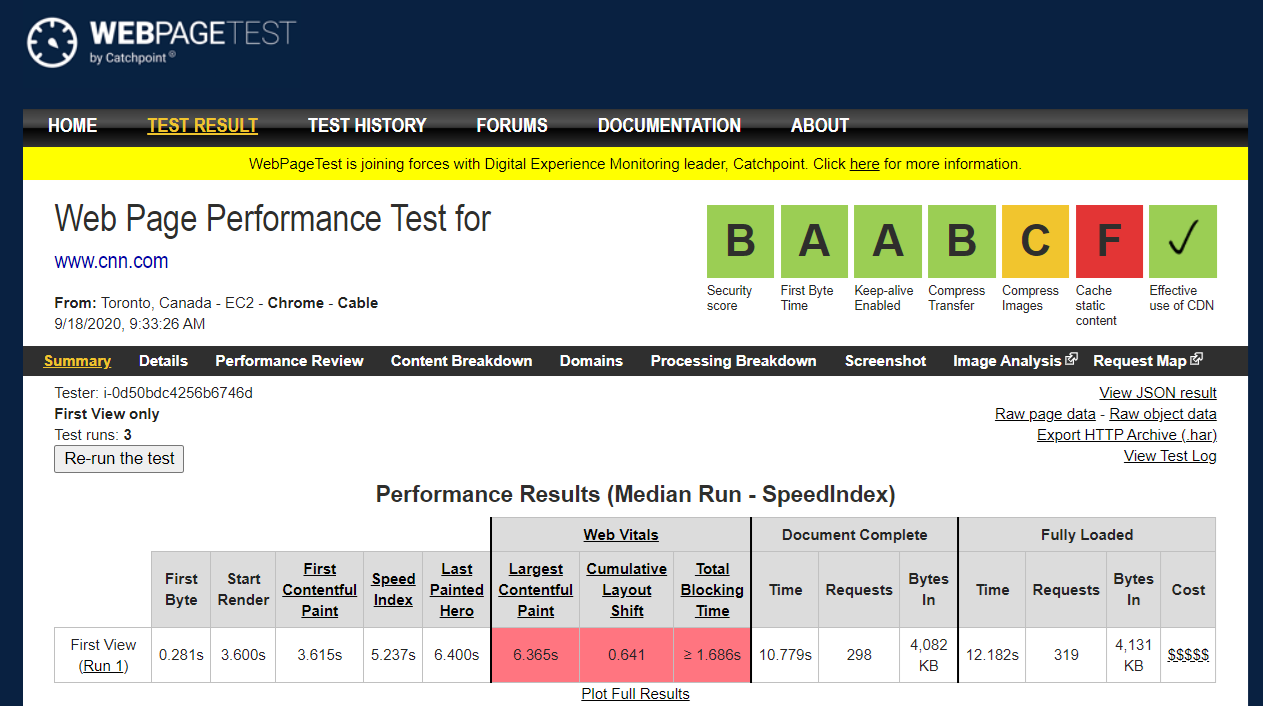
    Catchpoint this week announced it has acquired Webpagetest.org as part of an effort to expand use of the open source web performance testing service.

    Led by Patrick Meenan, the Webpagetest service is already relied on by more than 1 million users per month to instantly run tests of websites and applications from various locations, which are surfaced via a detailed audit that can be shared with developers.

    Meenan has been personally supporting Webpagetest as a side project while working for a series of IT organizations and vendors starting with America Online (AOL). Now, with Catchpoint’s acquisition of Webpagetest.org, he will have a staff of contributors as a full-time employee.

    Catchpoint CEO Mehdi Daoudi said the company will also incorporate Webpagetest into the tools it provides for monitoring digital experiences. The most appealing aspect of the Webpagetest service is that, rather than focusing on individual backend platforms, it tracks the actual performance that users experience across multiple types of browsers.

    Daoudi said that as organizations accelerate the rate at which they are building and deploying digital business applications in the wake of the COVID-19 pandemic, there’s now more focus on web application performance than ever. The experience any user has when accessing these applications now impacts everything from their willingness to complete a transaction to their perception of the corporate brand, he noted.

    In fact, a recent survey of 200 CIOs and 200 work-from-home managers conducted in July by ReRez Research on behalf of Catchpoint finds application performance is at the top of the list of concerns (66%), followed by network reliability, work-from-home technologies and security, at 63% each. Application performance is at the top of that list because both online revenue and employee productivity are now increasingly directly impacted by the overall application experience, said Daoudi.

    There’s never been a shortage of tools for testing application performance. The issue is how those tools are often employed, he noted. Too many IT organizations are monitoring individual application components rather than the actual user experience.

    Organizations that focus on end user experience in the age of digital business will, in time, separate themselves from rivals that merely make applications available online. A zealous appreciation for application performance needs to be ingrained in the culture of the organization for it to ultimately succeed, Daoudi said, noting that every employee, not just the DevOps teams, needs to be aware of the impact application performance has on the business.

    That challenge is as IT environments become more complex and distributed, ensuring application performance becomes more challenging than ever. Cloud-native applications based on microservices may be easier to deploy and manage, but the dependencies between all those microservices can conspire in ways that degrade application performance over time. Determining the root cause of intermittent application performance issues can take weeks. The maddening thing is, many of the fixes required to address that issue once it’s discovered can be deployed in minutes.

    Performance tools that surface those issues sooner than later are invaluable in a digital age, where time now quite literally is money.

  • Instana Discovers Root Cause of a Microservices Crash

    Instana Discovers Root Cause of a Microservices Crash

    Instana has added an automated process crash and root cause detection capability to its namesake application performance management (APM) platform optimized for microservices.

    Microservices prevent application outages by automatically rerouting application traffic in the event any microservice becomes unavailable. The overall performance of an application will degrade gracefully instead of allowing the entire applications to crash—assuming, of course, there is no single point of failure. However, the performance of the overall application will generally stay suboptimal until the microservice that failed is discovered and updated.

    Chris Farrell, technical director and APM strategist at Instana, said in the absence of an APM platform that can automatically detect when a specific process has crashed, a DevOps team can spend a significant amount of time and effort looking for the root cause. That can be especially frustrating when it turns out the microservice itself only takes a few minutes to repair, he said.

    The Abnormal Process Termination Detection capability is available at no additional charge in the agent software Instana provides for both the software-as-a-service (SaaS) and on-premises editions of its platform. Instana claims it is the first provider of an APM platform to provide this capability.

    Farrell said containers deployed on Kubernetes clusters coupled with serverless computing frameworks based on functions are driving the next wave of cloud-native applications. The inherent complexity of those applications requires a different approach to APM based on real-time analytics and distributed tracing capabilities, he said, adding relying on log data and sampling is no longer sufficient.

    When integrated with a third-party incident management system, it then becomes possible for extended IT teams to proactively resolve many application performance issues before most end users ever notice, he said.

    IT organizations are embracing microservices at scale because they need to build applications faster that are both more flexible and resilient. The challenge they encounter is microservices-based applications can become unwieldy to manage. Dependencies between microservices can create a maze of connections that can be difficult to monitor and maintain. It’s inevitable at some point one or more microservices may become unavailable because of, for example, an application programming interface (API) that has been updated or hardware failure.

    Regardless of the root cause, the sudden loss of a microservice should not result in catastrophic application failure. It can, however, adversely impact the end user experience. Most DevOps teams are committed to resolving such issues before they trigger a set of potential cascading problems that result in time being wasted in “war rooms” to diagnose the root cause of a problem. At a time when most DevOps teams are working remotely, there’s naturally a real incentive to reduce the number of virtual meetings DevOps team members might be called upon to attend. Most IT organizations are already struggling to manage complex IT environments at a time when organizations are trying to limit headcount in the wake of the economic downturn brought on by the COVID-19 pandemic.

    Of course, an APM platform isn’t going to eliminate the need for every meeting. It could, however, make the ones that members of the DevOps do need to attend a lot more pleasant for all concerned.

  • Build Better CX Across the Entire User Journey with AIOps

    Build Better CX Across the Entire User Journey with AIOps

    Ready or not, digital experiences are now the gateway to customers and the standard-bearer of a company’s brand. Yet, as apps become more distributed, more intelligent and more real-time, they continue to run on infrastructure that resides within on-prem data centers as well as multiple public clouds. This complexity is underscored by gaps across IT teams, leaving businesses, developers and operations teams working in silos without a single source of truth, exposing risks that can inflict not only severe damage to an application’s performance and reliability, but also eventually exposing the entire business. 

    For IT teams, understanding their applications is key. Not only are they the backbone of any organization, but they also hold invaluable data on customers and their decision-making habits. Having complete visibility is critical in today’s multi-cloud and hybrid cloud world.

    When IT teams are able to work quickly and intelligently, they consistently deliver a strong customer experience–avoiding the risk of creating opportunities for customer disengagement and abandonment. Recent research shows that nearly 84% of respondents said they have experienced problems with digital services. As a result, 40% reported switching suppliers due to a poor digital experience and 63% have actively tried to discourage others from using a service or brand if they have a bad digital experience.

    What’s the way forward and how can these existing silos be eradicated? 

    How to Build Better CX

    IT teams are faced with a conundrum–they’ve been asked to manage app complexity while simultaneously navigating operational silos that make collaboration, data exchange and problem resolution incredibly challenging. The way forward lies in a collaborative approach across traditionally siloed teams that leverages artificial intelligence (AI) and machine learning to uncover hidden bottlenecks and resolve issues before they can impact the end-user.

    Transformational CIOs need their teams–across app and infrastructure owners–to speak a common language rooted in what’s important to the application performance, user experience and the business impact. They need infrastructure decisions in service of the application, which will ultimately drive business performance. They also need application teams to be able to go deeper and quickly identify underlying infrastructure that may be contributing to poor application performance. 

    In order for true collaboration to take place, the first step is to increase visibility across the IT organization by providing a common view of correlated data across domains that provides contextualized insights to better collaborate and create a superior digital experience.  

    For application teams, this means gaining insight into the users’ most transited application journeys, helping to clearly identify application bottlenecks and abandonment and to triage efficiently. For the infrastructure teams, improved visibility means having insight into infrastructure constraints impacting app performance so that teams can correlate the user experience to any underlying infrastructure in real-time. Through this increased visibility and context, application and infrastructure teams can clearly identify respective action items and move swiftly to resolve the right issues, at exactly the right time.

    This notion of fill stack visibility and correlated insights that drive action is a mindset commonly referred to as AIOps.

    Enter AIOps

    While it may be true that the emergence of today’s modern application and infrastructure environments has provided the speed and flexibility professionals demand, the numerous services have unleashed a deluge of data on the enterprise IT environment. Automating tasks has helped teams to free up some bandwidth for operations and planning, yet automation alone is no match for today’s increasingly complex environments. What’s needed is a strategy focused on reducing the burden of mounting IT operations responsibilities, and surfacing the insights that matter most so that businesses can take the right action.

    So, what are forward-thinking IT professionals doing to stay ahead of the curve? 

    Many are applying an AIOps approach to the challenge of environment complexities. AIOps leverages advances in machine learning and AI to proactively resolve problems that arise in the application and infrastructure environment. This is so powerful because using AI to identify potential challenges doesn’t just help IT professionals get ahead of problems, it helps companies avoid revenue-impacting outages that jeopardize the customer experience, the business and the brand. What’s more, an AIOps strategy can provide:

    • Intelligent alerting that can be trusted to indicate an emerging issue. By ingesting data, AIOps platforms and technology can play a pivotal role in not just automating existing IT tasks, but identifying and managing new ones based on potential problems detected.
    • Automated root cause analysis and business impact assessment. With the help of AIOps technology, this can be achieved, providing increased agility in the face of potential service disruptions or threats, and without additional drain on resources.
    • Automated remediation for common issues. With an AIOps platform, it’s easy to not only automate remediation for known issues, but unknown issues, too. That’s because it can ingest data and also provide more intelligent insights as a result of it.

    The path forward is clear. Digital businesses are not only the future but they are today’s norm. Any IT leader looking to succeed needs to rethink their overall approach and embrace a future that includes complete visibility of their technology and application stack, and also a strategic approach that keeps their teams operating one step ahead of the curve.

    — Whitney Satin

  • DevOps Chats: App Attention Index and The Era of Digital Reflex, with AppDynamics

    DevOps Chats: App Attention Index and The Era of Digital Reflex, with AppDynamics

    Application performance company AppDynamics (acquired by Cisco in 2017) recently released its 2019 edition of the App Attention Index Report. The 2019 report is subtitled The Era of Digital Reflex. Joining me on this episode of DevOps Chats is Steve Long, AppDynamics regional CTO and technology strategy.

    Digital connections are a near-constant. Interacting with our world through digital apps and transactions are omnipresent: making a restaurant reservation using OpenTable, making payments using an app or our smartphone digital wallet and checking our smartphones to plan and move through our day. Thus the name of the report, The Era of Digital Reflex.

    In addition to insights from the report, Steve and I talk about measuring the customer’s experience, tying performance back to the desired business outcoming, strategies for finding problems and reducing the time it takes to fix problems. Join us on this compelling discussion about application performance, customer experience and business outcomes.

    As usual, the streaming audio is immediately below, followed by the transcript of our conversation.

    Transcript

    Mitch Ashley: Hi everyone, this is Mitch Ashley with devopsy.kinsta.cloud, and you’re listening to another DevOps Chat podcast. Today I’m joined by Steve Long. He’s regional CTO and technology strategy with AppDynamics. Today we’re going to be talking about the 2019 edition of the App Attention Index Report findings, The Era of Digital Reflex. Whoa, that sounds heavy. Steve, welcome to DevOps Chat.

     Steve Long: Thanks for having me today, Mitch. It’s a pleasure to be here today.

    Ashley: Sorry, I kind of put on my ‘60s accent. “Whoa, man, heavy.” Would you start out be introducing yourself? Tell us a little bit about what you do and of course, in case somebody doesn’t know what AppDynamics does and what AppDynamics is about.

    Long: Yeah, sure, absolutely. So I’ll go back a little bit in time. I was a vice-president of technology operations for a media company and then my last job before joining AppDynamics, I was a chief information officer for a financial tech company, a large banking services company. And I joined AppDynamics because–for two reasons. One was finding problems in the sea of–no longer a needle in the haystack–it’s a needle in a needle stack, at this point. With all of the complexities happening, it changed my career. And when Cisco and AppD joined and that merger took place, I couldn’t think of, you know, two companies that I would love to be part of, that when they joined–you know, after I left being a chief information officer to come and help drive technology strategy for AppDynamics.

    So AppDynamics is a application performance management company that back in the dawn of the day I became one of their first 30 customers, about nine years ago, and really attaching to the run time and basically looking and analyzing your application performance. If the application is the north star of your business and typically how businesses are driving revenue and transactions, we’re at the forefront and the heart of that, to be able to tap into that and give an MRI to what’s happening in your cloud, your data centers and what’s happening with the complex technology running in the business.

    So that’s a little bit about AppDynamics. We’re an application performance company and part of Cisco, and driving businesses to really see into what’s happening in their technology ecosystems.

    Ashley: Excellent. Well you share something with me, and that is both the kind of end consumer of technology like this is a CIO but also a tech person in the product, the tech vendor. So that’s fantastic. I enjoy sharing that with you. Now tell us a little bit about the App Attention Index Report and what that’s about–what it measures, what kind of information that it discloses for us.

    Long: Yeah, so “The Era of Digital Reflex” is the title, but at the core we’ve really entered into really consumers saying they use digital services almost like you would a human, like an extension of your body, like a reflex. And today we’re doing that almost automatically or unconsciously. And that shift in consumers–like if you look past five years ago, we had to proactively do that. Now, with something in the palm of your hand, you don’t realize it, but now you’re relying on digital services like every day and it’s really helping you get your jobs done and your life duties, and you’re taking decisive actions by it being a reflex.

    And it’s kind of a wake-up call for the industry and businesses, because at this point we’re looking at the performance of these applications being application loyalty and it’s taken over to be the new brand loyalty. So if businesses really want to stay competitive, they really have to have a really flawless experience for their users. Otherwise it impacts their brand loyalty and their application loyalty and other things. So that’s the heart of the report at a high level.

    Ashley: Makes total sense. I mean, you’re talking about our digital world and our connection to it. It’s not only true today, but it’s even more so–every day there’s a new function we do on our phones, on our computers, on our TVs, on whatever device is connected to some cloud somewhere. It’s almost all a digital transaction.

    Long: Yeah, absolutely.

    Ashley: So tell us a little bit about this year’s report–what some of the findings were. What would be some of the most interesting things that came out of it?

    Long: I’d like to actually use an example that I have personally, and it’s based on the report. So I actually had a lunch with colleagues, a friend and a customer last week, and it was about six of us. And I said, “Hey, just out of curiosity, how many applications have you guys used today?” And to a one, they looked at their phone and all kind of raised their heads back up and one rattled 13, one 17, one 12, one 19. I was like, “How did you do that?” And they were like, “Well we tend to close out our applications at the end of the day and it’s 2 p.m. and I counted up from the last application used to now.” And I was blown away. And so I did the same thing and went back to the last one that I hadn’t closed and counted and I was at all 11 at that point in time, at 2 p.m. And I thought to myself, “Wow, okay.”

    And then I asked–the secondary question was, “Well, did any of those give you any problems? And I’m relating back to the app index, because if it had a problem, what did you do?” and the first example that came back was, “I had a reservation at a restaurant last night and I had to go close one and go to the other because it didn’t have my reservation, so I ended up having–for every application that I have, I have a competitor.” And if it’s really sticky, maybe like banking or something else, maybe they don’t, but they’ve got a few ride shares, a few travel apps, a few restaurant apps. And it’s really that wake-up call, because the metric that comes out of the report is about 55% of the people can’t go without their mobile device for up to four hours.

    I did that today before this, just to see if I could do it. And right before I got on here I had to give up, because I needed to see if I had a notification or a text or something that I had missed. And so personally it is that reflex, that extension. It’s what we do now unconsciously.

    Ashley: I think I’d rather hold my breath than try to live without my digital–

    Long: No doubt. No doubt.

    Ashley: So when you count the number of applications that people are using, do you count like, for example, on your phone you can look to see, how much battery time did you consume with different applications is another way to measure effectively kind of usage. How do you look at it?

    Long: Well I mean, it’s habitual. So we just looked at ones that were open. But I mean, if I go back and look at my day, my alarm goes up and I pick up my phone. And the first thing I did there was, “Now that I have my phone in my hand, I’m going to look at an application.” My schedule, maybe my e-mail, maybe a text. And we’re basically saying now that the first thing we do is not talk to humans; it’s to look at our apps. And nowadays–you know, if I go back five or six years, my house is now fully connected. So I’m looking at my security camera and any events, I’m looking at my thermostat. Did I leave my air conditioning or heat on? Is my car charged? You know, and do I need to set the thermostat in there? Is it 100 degrees out and do I need to put the AC on before I get in my car? And all of a sudden I’ve got energy usage tools.

    So these applications can be anything from a browser-based service, but they’re there to help you with your life. And then as you get to work it becomes even more–more of a need, with reminders and you know, calendaring and everything going on in your work world and sharing documents and collaboration. And that’s why at 2 o’clock you can hit somebody who’s had 20 and in a day they can be hitting 30 to 50. So it’s pretty amazing what these digital services are doing and how intrinsic they are to our daily lives.

    Ashley: Well it’s amazing, because one of the things–I’m guessing I’m probably not part of your report–but occasionally I’ll look to see how many connected devices or IP addresses have been allocated in my home. And it has gone from a dozen to two dozen to over 70 in a year and a half.

    Long: Wow.

    Ashley: And that’s just as I kind of went to a connected home. And every one of those is not just talking to stuff in the home. It’s talking to the cloud, you know, for the temperature management, for the door locks, for the security system, whatever–it’s all talking to something, if not me or one of my family members through an app on the phone or browser.

    Long: And think about when they don’t work and they can’t talk to that cloud or digital service. And since it’s an extension of your human interactions, now you can have expectations that are super high that you just had a disruption, and it can impact your mood. It can cause frustration. It can do things that you don’t even know are happening. And that’s why we call it–you know, it’s a reflex now. It’s intrinsic, it’s unconscious and it can cause strife in our lives when it doesn’t work.

    Ashley: That’s a really good point, because we always think about networks as end consumers as speed, but the reliability has also gone up significantly, and it’s going to have to increase in reliability moving forward, because that’s–it’s a reflex, it’s a dependency, it’s an expectation, it’s a customer satisfaction measure, right? Of what that experience is like.

    Long: Yeah, and I think the expectation just a few years ago was much lower, and every year that goes by–I think three quarters of the people we queried–that their expectations had gone up. And it’s growing and growing, and the tolerance levels now have also become more important, and these services are just more important because they’re prompting a higher demand and better experiences, so that businesses can help you with your daily lives. And so the  net of it all is we’re hungry for very positive digital experiences, and we’re willing to pay for that and have them be more personalized and know who you are and kind of know what you want, and that’s a huge differentiator between businesses competing with each other.

    Ashley: Interesting. As you looked at this data, were there different ways that you slice and dice, segmented–you know, home versus business or mobile versus browser or any of those kind of ways of looking at the information, to gather some interesting facts?

    Long: Yeah, we did. We have a crosscut of that. Mainly though looking at the consumer base side and how it interacts with the businesses and how the expectations of the consumer are there and need to be met and exceeded. The experiences need to grow. I know in our daily interactions from AppD, we look at e-commerce companies and banking and a number of different online services, and it’s pretty clear that the performance, the loyalties are pretty clean cut when you have a performing app versus a non-performing app. And the impact it has on the consumer. And so those can transcend almost every industry. It’s almost industry-less, where the application performance wins.

    You know, every hundred milliseconds of latency–you know, that causes some level of distress, and when you start to get into situations where something might take 10 seconds, in industry A that might be acceptable because it’s a longer-term type of transaction. But in industry B, which may be more of a real-time field, like I need a ride or I need a stock trade or I need something like that, 10 seconds is unacceptable. And if you’re not able to measure that and have application performance, you can’t dissect what your problem is because ultimately it’s your business transaction which leads to your experience–a journey that you’re going through, your business journey–and at the end of that rainbow is the actual business outcome that you’re looking for. And whether that’s a sale or moving money or buying a ticket or a new shirt, that’s the key, is having that business outcome.

    And the more we tie application performance to that business outcome, we’re better off as a business. At AppDynamics we look at all of the way to the edge, to the browser, to the device, to the data centers, to the cloud, but we also tack into that the ability to look at money or what the business KPI that’s being impacted. Because if you have a seasonal event like an inventory level dropping or a loss of money or you’re making more money because of a promotion, wouldn’t you want to know that your performance or your lack of performance–what the impact is to businesses?

    Ashley: It’s interesting too, because it wasn’t very long ago–I mean, maybe just a few years ago–where we’re almost solely reliant on things like an NPS measurement or call times–things that we do in the call center. And outside of that, you know, one person tells five people when they have a bad experience and you don’t really know those kinds of things. But now, in this age of data for everything, you know, the last time somebody used my Lyft app, “Oh, it was poor performance. We haven’t seen them in three weeks.” Maybe they went to Uber. I may not know that, but I know what their last–there’s data there to mine and to go after, where some of the telemetry information about performance could indicate some symptom that might’ve led to a consumer change in behavior.

    Long: Yeah, and it’s no longer–we talk about expectations and not meeting them, but the downside is that is your reputation risk. I mean, if you get an issue reported to you from internal or you know, somebody inside, that’s one thing, versus it being reported to your call center–that’s another thing–versus somebody switching to a competitor and posting it on a social media site. Now you’re not only worried about stock price and revenue risk; you’re talking about reputation risk. And that reputation risk really does tie back into those expectations not being met, at whatever level it is. So reputation and how, you know, media out there is picking up on that and promoting that when it’s negative–for a reason, because it’s a shared experience.

    Ashley: This may be a bit of an impossible question, so I recognize that up front. Is it possible to measure what customers’ expectations are? Is it too big of a moving target? Is it too many variables? Or is it something we can get a handle on? How do you address that?

    Long: Well, I firmly believe we can. And say that coming from the customer side of AppDynamics, but also–you know, businesses know their business, their KPIs, what outcomes they’re looking for. And if you don’t measure it, you can’t really make change in a positive way. So we see digital transformation–Agile–you know, we’re seeing BizDevOps–those are all things to really move businesses to become more efficient, drive the right decisions around the right business outcomes they’re looking for. And you know, I always say you do have to focus on the application performance. Being a past CIO, I tried to put myself in the customer’s shoes. I mean, if you don’t have a robust way to look at application performance then you don’t have that safeguard or those guardrails that you can put up to make sure that, you know, number one, your mission-critical applications are working, but number two, it’s the user experience. And being able to measure that and seeing that all the way from the edge to your cloud services.

    And the dependencies. I mean, think about it, the number of SaaS providers, cloud providers, third-party data that you’re touching just to execute a login on any application site, it could span hundreds of transactions. And if any one of those little things go wrong, you’re not focusing on application performance or you can’t measure it, and it could have a negative user experience.

    Ashley: Very good point. Because there are very few, maybe if any, closed ecosystems, to throw the “ecosystem” word in there. You really are reliant on a lot of other providers to come together to deliver that overall experience, that service, that functionality.

    Long: Yeah, and that’s how you get your business outcomes. So I do think that it’s achievable and you know, that performance and correlating it to the business performance and the business outcome–that’s really the objective companies are setting, and why they’re moving to APM and companies that are expanding out to give them business metrics on top of APM and consumer metrics on top of APM. Because it’s that trifecta. And if you think about it, there’s lots of ways you can look at logs or network flow data, but at the application, since it’s the central north star of the business, it’s the most granular and contextual data that you can get to see whether or not your business is performing. So that when you have that granular and contextual data down to the line of code maybe not performing, you’re able to look at the two most important metrics to any company, which is finding and fixing problems and reducing the time it takes to get to solutions on either side of that. So the faster you find them and fix them–whether it’s a ten-second issue that you can automate out of your system, or if it turns out to be a ten-hour outage, those are radical, you know, separations that we see in companies by just implementing the right tool set, the right performance measurements and really driving their businesses to reduce those risks in any company.

    Ashley: Okay. Maybe one last thing to kind of touch on–were there any other interesting findings, notable things? Maybe kind of a small little quirk thing that was “Wow, we didn’t expect to see that,” any other things to glean from the report?

    Long: No, I think we’ve covered it. At a high level I always suggest, put yourself in the consumer’s shoes. Really have a robust way to look at performance, and tie that back to the business outcomes. Because ultimately the business teams have a really hard time understanding IT and engineering, but the IT teams actually can make that leap. They can tend to look at the business challenges and situations, take that complex technology of all the ecosystems and translate that into showing the business what’s actually happening under the covers in a meaningful way. And that’s the basis of the report, is that the expectations are rising, the issues are out there. Finding them and fixing them, and really, put yourself in the consumer’s shoes, because it’s only going to grow, the dependency. And the flawless application wins.

    Ashley: Great. How do folks get a hold of this? How do they get to The Era of Digital Reflex report?

    Long: It’s posted on our AppDynamics website. It’s AppDynamics.com, and you can go ahead and get it there, and we’d be happy to share that.

    Ashley: Excellent. For you to download, I assume?

    Long: Yep, sure is.

    Ashley: Nice. Okay, well excellent. Thank you so much, Steve. Appreciate you being on DevOps Chat with us.

    Long: Thanks, Mitch. It was a pleasure, and I appreciate the invite.

    Ashley: Absolutely. I want to thank my guest today, Steve Long, regional CTO with AppDynamics. And of course we want to thank you, our listeners. We appreciate the time that you spend listening to us and ____ some feedback that you give. This is Mitch Ashley with devopsy.kinsta.cloud. Have a great day, and be careful out there.

    — Mitchell Ashley

  • Achieving Application Health Through Integrated APM

    Achieving Application Health Through Integrated APM

    Performance and availability mean everything to application users at both the enterprise and consumer level. Think about how much we rely on technology for our everyday communication—when Slack suffered from an outage this summer, it affected thousands of business professionals across the globe who use Slack to communicate, organize tasks and share information. In a sense, we are only as efficient and effective as the technology we use.

    With this in mind, it’s clear achieving and maintaining application health is paramount to overall business success. In part one of this series, we explored how creating and maintaining a healthy app involves not only ensuring it’s performing well via lifecycle APM, but also making sure it’s available when needed—making a log management solution that monitors availability, enables proactivity and reacts quickly to overcome problems is crucial.

    In order to help ensure a healthy application, we must first consider a few defining characteristics.

    Understanding a Healthy Application

    Even for humans, health is more than just being alive—if we’re not performing optimally, we’re not having the best experience possible. Optimum health for an app or website doesn’t mean it’s just up, but that it’s also performing in the way the market demands. For this, organizations need to implement an integrated APM solution to ensure top performance and continuous availability.

    However, achieving application health is easier said than done. Issues that arise for teams working in silos can lead to digital war rooms and blame storming. Organizational structure can get in the way of disparate teams working together to achieve performance and availability. How can organizations overcome this issue?

    Optimizing Performance and Availability

    As we know, each piece of the APM puzzle must be incorporated to achieve full-stack visibility and ultimately top performance: user experience, metrics, traces and logs. Following a few key best practices can help achieve overall application health.

    • Early Adoption: Implement application performance and logging tooling as early in the application development lifecycle as possible. Without integrating these tools from the beginning, organizations run the risk of having errors in availability and performance when they deploy the app. This is because one of the key benefits of a full-stack APM solution is the ability to analyze the performance characteristics of the application code and logic itself. If an application isn’t properly written, it can be so inefficient that no amount of resource in production can assure appropriate service delivery.
      Another critical benefit of early lifecycle APM adoption is the knowledge it delivers about app performance can be reviewed with business stakeholders to ensure complete alignment against shared goals—before going live in full production.
    • Integrated Solution: As mentioned above, the biggest challenge to achieving availability and performance is typically organizational structure. For most organizations of a reasonable size, separate teams monitor performance and availability; in some cases there may even be multiple teams monitoring performance and availability, specifically aligned with the individual technologies (e.g. compute, storage, network, web, cloud, etc.) underpinning each application. To get around the obstacles this creates, it’s key to have an integrated solution where every team is looking at the same set of information—the so called single pane of glass. The ability to share information proactively with management across teams is paramount to overall success and avoiding digital war rooms, or at least minimizing time spent in them.
    • Implement High-Value and Appropriately Priced Solutions: Powerful, easy-to-use solutions that will achieve integrated application performance and availability management for any type of organization operating either on-premises and/or cloud-based applications are key. Traditional APM solutions were either so complex to deploy or so expensive that ubiquitous adoption was not operationally or fiscally possible—depriving much of the organization and its applications the benefits of APM by restricting its application to only the most important subset. As a result, quick-to-value and affordable solutions are needed to enable tech pros who may be working in the organizational performance silo to get running quickly and show success to the organization.

    Conclusion

    Although apps serve their own unique purpose—whether that’s for consumer use enabling us to watch TV and movies on-the-go or at the business level to streamline work and communication—they’re all connected by a universal need: performance and availability. Companies must therefore prioritize application health, and in turn creating and delivering an exceptional user experience.

    — David Wagner

  • Catchpoint Expands Network Monitoring Service Reach

    Catchpoint Expands Network Monitoring Service Reach

    Catchpoint has expanded the number of locations worldwide from which it is gathering telemetry data for its networking monitoring service to more than 825 sites.

    Drit Suljoti, chief product officer for Catchpoint, said as applications continue to become more distributed, the worlds of DevOps and network operations (NetOps) converge. DevOps teams need more visibility into how network latency issues anywhere in the world are impacting the digital experiences of their end users, said Suljoti.

    The Catchpoint monitoring service now extends to 200 cities worldwide, including 140 nodes in mainland China. In addition to monitoring critical backbone locations, Catchpoint has placed nodes in 133 public cloud locations and is now offering a free and seamless migration for companies looking to adopt a next-generation digital experience management (DEM) platform in place of Gomez and Keynote services from Dynatrace that recently were retired, said Suljoti.

    In much the same way DevOps teams rely on a variety of tools to monitor applications, they also need access to a service that continuously monitors the networks on which those applications depend, Suljoti said. That requirement has become more critical as the number of latency-sensitive applications such as those based on microservices increases, noted Suljoti. As organizations depend on those applications to drive a variety of digital business processes, visibility into how the network is impacting the application experience of end users can easily degrade, he added.

    Most organizations already have tools to monitor network performance within their own data center. However, creating the monitoring framework required to identify network performance issues across a global wide area network (WAN) would be cost-prohibitive for most organizations. When it comes to deploying applications that span multiple WANs, most DevOps teams are essentially blind.

    It’s still not clear within many organizations who is responsible for monitoring WAN services. Historically, NetOps teams have held this responsibility. However, Suljoti said that as DevOps processes continue to expand and mature, there is a more collaborative approach emerging that incorporates network monitoring tools within testing frameworks that organizations create within the context of a continuous integration/continuous deployment (CI/CD) process.

    In the meantime, pressure on existing WAN networks will only increase. In the absence of 5G services, the number of applications competing for access to bandwidth increases. Many organizations have no idea whether network service providers are really meeting the commitments they agreed to as part of the service level agreement (SLA) provided. As more application performance issues get traced back to the underlying network, frustration with the quality of network services is only going to mount. Before they can call network service providers to account, DevOps teams will need access to analytics that clearly show service level commitments are not being met.

    Of course, that may only elicit an apology from the network service provider. At the very least, however, DevOps teams will be able to make a much more informed decision concerning how they want to route application traffic going forward.

    — Mike Vizard

  • Continuous Reliability: How QA and SREs Can Improve Their CI/CD Workflow

    Continuous Reliability: How QA and SREs Can Improve Their CI/CD Workflow

    A key challenge in maintaining and accelerating the speed of software delivery is balancing the rate of change with the reliability of your software. With the move toward an increasingly automated workflow, as well as teams of dozens to hundreds of engineers introducing changes at a high frequency, the ability to identify the issues that will have a severe impact early on becomes critical.

    This challenge poses many questions: With so many errors, will spending my precious time to resolve a particular issue be really worth it? How do I detect severe issues in code or infrastructure that could be impactful ahead of time? Once a release has been moved forward, how can I know how well it’s doing–should it be fully deployed, hotfixed or even rolled back?

    That’s why we need our CI/CD workflow to work both ways, helping us upgrade and improve our application as well as allowing us to learn and adapt according to how it performs with our users. Enter continuous reliability.

    A Feedback Loop Between Everyone

    Code quality gates and contextual feedback loops are the CI/CD building blocks that define the emerging practice of continuous reliability. The current and most common feedback loop is between dev and QA teams, and it’s usually the backbone of every good development cycle. However, feedback loops are relevant to the whole development cycle, and they don’t end with QA/dev deploying and testing elements in staging environments.

    As we all know, production tends to display unexpected and surprise-oriented behavior, some might even say that issues and bugs appear out of thin air. That’s why QA and SRE teams need accurate answers as to the actual quality of releases. They need to identify when critical anomalies move from staging and production, and ideally have the ability to gate them before they harm the application, workflow or customers.

    Defining the Anomalies That Matter

    Anomaly detection is critical to continuous reliability. In most applications, error and performance anomalies can be mapped into three core types:

    1. New defects: the introduction of new errors into a system, usually a result of code changes.
    2. Increasing Errors: an increase in the relative volume (i.e. as compared to throughput) of certain errors, usually as a result of a code or infrastructure change.
    3. Slowdowns: a decrease in the response time of critical parts of the application due to inefficient code or improper provisioning or configuration of infrastructure.

    The introduction of any of these can lead to CPU, GC and IO increases. As such, it is not only imperative that QA and SRE teams gate them from moving into production, but also to prioritize and assign severities that help tackle the most important issues.

    However, detecting anomalies in large-scale systems can be nearly impossible due to a high noise-to-signal ratio, and we’re often left to rely on our users and customers to alert us when something goes wrong. That’s why there’s a need for an objective measure to quantify the quality of a release—one that lies in being able to converge machine learning and critical code-level data to automatically gate bad releases from moving up the chain.

    Continuous Reliability Through Quality Gates

    Once we have an understanding as to what should count as an anomaly within our application, the next step is setting a quality gate to help us identify, understand and hopefully stop bad code from being promoted to production.

    Taking the three core type of anomalies—new issues, regressions and slowdowns—we can evaluate four core quality gates that our code should pass before being promoted:

    1. Error Volume: The normalized error rate of an application, based on calls into the code, should never increase between releases.
    2. Unique Error Count: The number of unique error counts, especially in key applications, should not increase between releases.
    3. New Errors: New errors of a critical type or occurring at a high rate should block a release.
    4. Increasing Errors and Slowdowns: Severe regressions and slowdowns should block a release.

    These four gates can help you define a benchmark that is powerful and broadly applicable to complex environments, but also isn’t complex to the point that it remains an academic exercise. They will help you understand whether your code is ready to be deployed to your pre-production or production environment, and help reduce or even eliminate errors, issues, slowdowns and anomalies within your application.

    — Tal Weiss

  • Beware the Blind Spot in Performance Testing for DevOps

    Beware the Blind Spot in Performance Testing for DevOps

    According to Forrester, 64 percent of businesses are dissatisfied with the time it takes to release new features for customers. Brand loyalty has given way to customer loyalty; to drive it, organizations must focus on customers and their experiences using their products and services.  As a result, organizations of all sizes need to make customer experience their highest priority.

    To many business leaders, the speed of rolling out new updates is the most important part of satisfying customer expectations, maintaining customer loyalty and staying ahead of the competition. At the same time, user expectations for fast and reliable digital experiences across platforms continue to increase. As a result, development teams are pushing out service updates faster than ever before while trying to minimize any degradation of the experience as they move at a quickened pace.

    But with heightened and persistent focus on rollout speed, it is easy to forget that the overall user digital experience is critical to maintaining customer loyalty. Businesses must integrate their focus on performance testing with their DevOps workflows to make sure speedy product rollouts don’t come at the expense of customer experience. So how should businesses ensure strong delivery processes to both improve customer experiences and drive efficiency in the application development and delivery pipeline?

    Performance Starts with Constant Measurement in Unit Testing

    DevOps, as does Agile, breaks down testing into smaller chunks. Each new rollout has an iterative impact on the application or website. Whether good or bad, the results stack up. Customers may demand certain new features, but user experience will suffer if each update that meets that demand slows down the application more and more over time.

    Testing these units is very important and setting performance SLAs per unit per build is the first step to a performance culture. Organizations with a mature performance culture will turn back code if it doesn’t meet their performance SLA, keeping it from ever reaching QA.

    This is Not an Either/Or — It is an And 

    DevOps teams are very good at rolling out rapid iterations of products and features, but without careful consideration, the pace of those updates can build momentum for digital experience failure. There are false positives in DevOps testing. With unit tests constantly passing, it’s easy to lose sight of the bigger picture. It’s not the fault of the DevOps engineers or QA; they are working within an established process that is designed to sniff out errors on a per-build basis. But what happens when you put it all together? Organizations start to forget about end-to-end testing and can see failures when the application is stressed by heavy demand, when it really matters during critical business events like Black Friday, live sporting/news events, product launches, or changes in financial markets. Teams implementing DevOps-style testing must remember to test all the “units” working together end to end. This needs to be part of the DevOps workflow but is often being forgotten.

    What You Can’t See Can Hurt You

    Testing for performance in the development lab can help mitigate some of these performance issues before they get out in the wild. But it’s overly optimistic to think that you’ll catch everything. Delivery teams need to constantly maintain visibility in the real-world use of their applications with real-time real user monitoring to alert them of any degradation in the experience during or just following a release. A quick response can help mitigate a larger detrimental impact to the business, and the fidelity of real-user data gives assurance there aren’t any blind spots so you can fail fast, and shorten time to resolution. The web is a wild place, and users have sneaky ways of finding their way into and through your app that you may not foresee when building your test plan. You can use this real user data that you’ve collected while monitoring to create more realistic test plans that will truly replicate real-world browsing behavior.

    This data can also inform the development team about the impact of design decisions on performance in each new update. They can prioritize which parts of the site or app to fix based on what would be most impactful to the business and weigh that against plans to build out new features aimed to enhance functionality. The key factor is an understanding of the business impact of performance and using that to guide and prioritize development resources to achieve the best possible results.

    Adopting a methodology to monitor, optimize and validate ongoing enhancements to your application can help with the continuous improvement of user experiences and give your development efforts a customer focus. DevOps teams have a responsibility to the user experience and should consider how it correlates to business impact. Faster time to market is important, but as important is making sure the customer experience continuously improves as well. Uniting cloud delivery with DevOps workflows and keeping performance in mind will put your business on the path to ensuring both faster rollouts and superior user experiences.

    — Anthony Larkin