Tag: application modernization

  • A Guide to Sustainable Application Modernization

    A Guide to Sustainable Application Modernization

    Sustainable development is a blueprint for societal growth that is applied around the world to balance the needs of the present while optimizing for the future. Sustainability consists of three pillars — economic, environmental and social — that must work together to meet this goal. The complexities of digital transformation and application modernization can benefit from applying a sustainability lens to this challenge that not only includes the technical benefits of cloud computing but, more broadly, the three P’s of sustainability: Profit, people and planet. Application modernization will benefit the business in measurable ways, but can also affect unexpected positive cultural and green initiative benefits.

    Sustainable Application Modernization: What is it?

    Sustainability initiatives have always had to take a holistic approach that combines human, ecological and economic health and vitality. Sustainable application modernization is no different in that business leaders are dealing with finite resources (budget, staff and time) that must be applied now to align with longer-term priorities and their associated consequences. The main goal of application modernization is to transform an enterprise’s monolithic applications into modern architectures that can more fully take advantage of cloud-native services such as containers, microservices, serverless and a range of DevOps methodologies. These technical capabilities lead to a number of high-value cloud benefits including scalability, elasticity and engineering agility. Too many modernization strategies and business plans stop there and this is a mistake. By undervaluing the sustainability benefits that include economic, environmental and people upsides, technology business leaders are not accounting for some of the most important benefits of modernization.

    Breaking down the modernization problem along the three pillars of sustainability helps define sustainable application modernization:

    • Economic sustainability: The business benefits of modernization must account for releasing more features and fixes more frequently, less downtime, lower technical debt and higher rates of innovation.

    • Environmental sustainability: A modern architecture is more resource efficient, scales at a much finer level than a monolith, and is able to take advantage of cloud data centers that offer the “greater efficiency of aggregated compute resources.” These cloud-native architectures enable more intelligent application orchestration and resource allocation usage based on demand, need, cost, seasonality and performance.

    • Social sustainability: Besides the ongoing challenge of recruiting and retaining talent for maintaining a monolith, the resulting development team structure is a direct reflection of the architecture itself and this is most often monolithic, too. A more domain-centric approach using modern technologies creates leaner, more focused team topologies that can also operate effectively in remote work structures.

    The broader benefits and impacts of effective application modernization align directly to metrics associated with elite performers in DevOps research reports that track four key performance categories: Frequency of application deployments, application feature lead time, change failure rates and time to recovery. This long-standing and annual research report from DevOps research and assessment (DORA) metrics also now reaches beyond the business and technical dimensions into the performance, culture, people, burnout and team impacts of these modern best practices.

    Application Modernization is Not Just an IT Problem

    Most application modernization projects never fully get off the ground because technology leaders look at modernization as just an IT problem. The business cases for these projects focus on technical benefits or simple cloud migration and lift-and-shift infrastructure cost improvements. A sustainable application development methodology opens up this calculus to the three dimensions of sustainability: Economic, environmental and social.

    Much as everyone from developing countries to the richest nations in the world view sustainability initiatives along these lines—balancing economic growth, environmental health and the vitality of their citizenship—application modernization projects can be a catalyst to major improvements that drive profit, maximize efficiency while improving company culture, retention and team growth.

    Sustainable Application Modernization: Three Steps to Get Started

    The enthusiasm for application modernization is high, but organizational precendent and a history of failed efforts stop most projects before they get started. These three steps can set you on a sustainable path going forward.

    • Start with a data-driven plan: A monolithic application architecture requires a quantitative understanding of the technical debt you are carrying at an architectural level; the move to a cloud-native architecture unlocks the business, environmental, and cultural benefits discussed above. Thus, it’s critical to assess your application estate from an architectural perspective to calculate the complexity and risk associated with your applications, prioritize which applications to modernize and extract ROI benefits related to the modernization effort.
    • Build a broad coalition across the pillars: A sustainable application modernization plan works across three pillars that span different roles, functions, and initiatives in an organization. This strategy creates both an opportunity and a need to recruit outside the technology team to the business and product owners that can validate and then promote the economic upside. Next, pull in green initiatives and corporate sustainability representation that can quantify and promote the environmental benefits further. Finally, HR, training and project management experts will understand and align with the people-side of modernization to create more agile, happier and efficient teams.
    • Create a continuous modernization culture: This approach is designed to maximize short-term benefits while optimizing for the future. It’s critical to look at this as an ongoing, continuous best practice that becomes ingrained at both a technical and cultural level. Most modernization strategies have resulted in one-off projects that, even if completed, may quickly devolve back to bloated monoliths due to a lack of cultural and organizational commitment to take these practices forward and iterate across all applications in the future.

    Sustainable application modernization methodologies can change the course of application development inside an organization and provide a catalyst toward a thriving future that pushes the technology forward and can maximize the value to the business, environment and company culture.

  • Orgs Struggle to Get App Modernization Right

    Orgs Struggle to Get App Modernization Right

    A survey published today found 93% of IT leader respondents admitted that application modernization efforts are either extremely or somewhat challenging.

    The survey, which polled 150 IT leaders at organizations with at least 1,000 employees, was conducted by Asperitas, an IT services provider. The survey found the primary issues respondents identified were identifying the right tools and technologies (30%) followed by finding staff with the right experience (20%), choosing the right external partner (18%), getting users trained on new systems (17%) and securing the support of management (11%).

    More than three-quarters of respondents (78%) said the top priority for organizations taking on application modernization should be “getting it right.”

    The definition of application modernization is, like many things, in the eye of the beholder. One-third of respondents defined modernization as the use of cloud-based infrastructure while 32% said it was moving legacy systems to the cloud. Another 22% defined it as using cloud-based tools.

    More than half of respondents (54%) said employing microservices meant that they were modernizing, while 59% said the use of any cloud-native services indicates as much.

    Scott Wheeler, practice lead at Asperitas, said that while there are a lot of definitions of application modernization, it’s clear that the lift-and-shift era of moving applications to the cloud is coming to an end. Organizations are instead preferring to build and deploy applications using a wide range of cloud-native platforms and platform-as-a-service (PaaS) environments they don’t have to manage.

    The challenge is many of these applications are being built and deployed on multiple clouds. More than a quarter (27%) said the biggest multi-cloud challenge was securing applications, followed closely by integration with on-premises systems and other cloud platforms (26%). Another 20% identified ensuring portability between platforms as the biggest challenge.

    A total of 80% also noted upskilling of internal staff and making improvements to antiquated processes were extremely important to application modernization. In fact, one of the major issues that organizations still need to address is the degree to which “bad DevOps” practices are being applied to modern application environments, said Wheeler. Much of that issue stems from the simple fact that many IT teams still don’t know how to effectively manage cloud computing platforms, he added.

    Well over a third (36%) said that a key application modernization best practice was giving yourself ample time to complete the project while an equal percentage identified avoiding shortcuts, distractions and/or partners that over-promise. Another 34% said the most important lesson was choosing the best tool for the job, while nearly a quarter (24%) identified waiting too long to modernize a system that’s clearly in need of modernization.

    A full 100% of respondents said application modernization was very or somewhat important to their business, with 45% reporting the applications they had chosen to modernize were critical. A little more than a quarter (28%) also noted modernization has enabled them to innovate faster and scale more rapidly, while 25% said it could improve end user productivity and 11% said it might make their company more attractive to employees and customers.

    Regardless of the motivation for modernizing applications, just about every organization is engaged in these efforts to varying degrees. The issue doesn’t seem to be the willingness to start these projects as much as it is making sure they are completed quickly enough to be relevant to the business.

  • ERP Modernization: How Devs Can Help Companies Innovate 

    ERP Modernization: How Devs Can Help Companies Innovate 

    In this post-pandemic world, large enterprises are looking to streamline and improve business processes within a storm of marketplace constraints. Companies in asset-heavy industries such as oil and gas, energy, retail, or distribution and logistics have especially been working to reconfigure their supply chain processes to better manage inventory and operations. The focus in the market has shifted from supply chain optimization to supply chain resiliency, creating efficiencies that will help them best survive current delays and rising costs. 

    Breaking Barriers and Addressing the Talent Shortage

    The question is not simply whether companies need to modernize their business applications to increase efficiency and lower costs, but how to accomplish a necessary modernization in the midst of barriers like rising costs, supply chain disruptions and a severe shortage of developer talent. Developers and DevOps teams need to find ways to do more with less.

    The reimagining of business processes is an excellent strategy to reduce overhead and allow companies to become nimbler and more efficient, consequently helping them preserve or improve marketshare. Many large enterprises work in environments that use enterprise resource planning (ERP) software; systems that, over the years, have been subject to ongoing upgrades, patches and redesigns by developers and IT managers. This creates technical debt, which makes it difficult for many of these large-scale companies to migrate their business applications to cloud-based systems.

    Many of these ERP-based companies are facing pressure to update to more modern, cloud-based versions of their ERP platforms. But they must run a gauntlet to modernize their legacy applications. In a sense, companies that maintain these complex ERP-based systems find the environments are like “golden handcuffs.” They have become so complicated over time that they restrain IT departments’ innovation efforts, hindering their ability to create supply chain resiliency when it is most needed.

    To make matters more difficult, the current market is facing a global shortage of human resources required to get the job of digital transformation and application modernization done, including skilled ERP developers—especially those skilled in more antiquated languages like ABAP. Incoming developer talent is often trained in more contemporary languages like Java, Steampunk and Python. These graduates have their pick of opportunities and gravitate to companies that already work in these newer programming environments. 

    ERP migrations can be hampered by complex, customized systems developed by high-priced, silo-skilled programmers. Many enterprise leaders have a great desire to break out of these restrictions and modernize legacy applications with greater speed and at lower cost, and they need to do so with minimal downtime and disruption. 

    Leverage Low-Code Solutions to Modernize

    In a 2022 report on application development strategies, industry analyst Deepa Salem interviewed enterprise companies that used sophisticated SAP-based ERP solutions about their approach to software modernization strategies. More than 80% of respondents said they planned to upgrade their business applications in conjunction with a major migration of their ERP software platform to the latest, cloud-based version. 

    This tactic of implementing a new applications strategy in coordination with a major refresh is not surprising and presents an opportunity for developers to help these companies “clean house,” reducing the technical debt of their legacy environments at this well-timed juncture.  

    As an analogy, think about how people typically move to a new residence. Homeowners sift through their accumulated possessions and identify what’s no longer needed. They pack what is still valuable and essential. A low-code application process can help clean up existing ERP environments prior to migration, reducing complexity and long-accumulated technical debt while leveraging the system’s unique business intelligence. The tribal knowledge inherent in any legacy system is critical to retaining market differentiation. 

    With so much at stake, IT departments and developers should give serious consideration to using pre-built, customizable business applications, efficiently and rapidly created through a low-code development process. Deployment-ready solutions can help developers move forward with modernization projects that have been hampered or shelved due to a lack of talent to implement those jobs. They can accomplish more with less.

    With the right approach, ERP-based environments can be reconfigured to quickly establish more agile, streamlined and cost-effective business applications. Developers have a unique opportunity to help enterprises keep what sets them apart from the competition and surrender what no longer serves them. In this climate, this is not a nicety for enterprise customers. It’s about resilience—and even survival.

  • Survey Reveals High Cost of Application Modernization

    Survey Reveals High Cost of Application Modernization

    A survey of 250 software developers and architects in the U.S. found nearly three-quarters of respondents (74%) reported that the average cost of an application modernization project is nearly $1.5 million, with 79% noting that at least one of these projects has failed.

    Conducted by Wakefield Research on behalf of vFunction, a provider of a platform that automatically converts monolithic applications into microservices, the survey polled developers and architects at organizations with 5,000 or more employees that have been in business for at least 15 years and are maintaining Java applications. The survey found that the primary reasons application modernization projects failed were expectations not being set correctly (43%) and the need for organizational structural changes (37%).

    Despite the cost and inherent risks, however, the survey also found a full 92% of respondents planned to or are currently modernizing applications. Nearly two-thirds (62%) said having the right resources and tools is the key to application modernization success.

    Well over half of the respondents (58%) also noted that, on average, it takes 16 months to complete these projects, with more than a quarter (27%) noting it takes two years or more. Not surprisingly, a full 97% said they expected someone in their organization would push back on a proposed project.

    Application modernization, of course, is something of a catch-all phrase that can involve everything from providing applications with a web frontend to lifting-and-shifting them into the cloud or completely refactoring them to run natively on a cloud platform.

    vFunction CEO Moti Rafalin said that regardless of the scope of the initiative, most organizations should first pick these projects based on what makes the most sense for the business. Once identified, it then becomes critical for IT teams to have a deliberate strategy in place to achieve that goal given the high cost of failure, he added.

    Organizations would also be well-advised to determine how job roles will evolve, because one of the biggest inhibitors to application modernization is concern over how any job might be impacted, noted Rafalin.

    It’s not clear how quickly organizations are opting to modernize existing applications versus replacing them outright. However, as more organizations opt to run applications in the cloud, the level of interest in using microservices to build applications has risen sharply. The goal is to employ microservices to make applications both more resilient and secure. The tradeoff is that microservices-based applications tend to have lots of dependencies that make them more challenging to manage and secure.

    Regardless of approach, it’s more a question of when an application will be modernized or retired versus if. The level of technical debt that accrues over time for each application eventually becomes unsustainable. The issue, of course, is that most organizations don’t have the resources required to modernize every application at once, so it may take a decade or more to work through an entire application portfolio—even as that portfolio continues to grow. In fact, as technologies continue to evolve, it may turn out that application modernization is not a task to be completed as much as it is a permanent state of IT affairs.

  • vFunction Tool Uses AI to Help Convert Monolithic Java Apps

    vFunction Tool Uses AI to Help Convert Monolithic Java Apps

    vFunction today added the ability to employ artificial intelligence (AI) to automatically assess the level of effort required to convert a monolithic Java application into a set of microservices.

    Bob Quillin, chief ecosystem officer for vFunction, said the goal is to make it simpler for IT teams to more effectively employ the company’s vFunction Application Transformation Engine by using a vFunction Assessment Hub that assesses the level of technical debt involved.

    Legacy monolithic Java applications tend to have a lot of technical debt and dependencies that make them a challenge to convert into microservices, he noted. Most simpler Java applications have either already been converted or are in process, Quillin added.

    The vFunction Assessment Hub enables IT teams to better predict the outcome of refactoring a Java application to better prioritize which Java application should be converted first based on, for example, the level of scalability that can be achieved, said Quillin. Current assessment approaches involve a lot of manual effort and which typically requires organizations to hire external contractors to perform, he added.

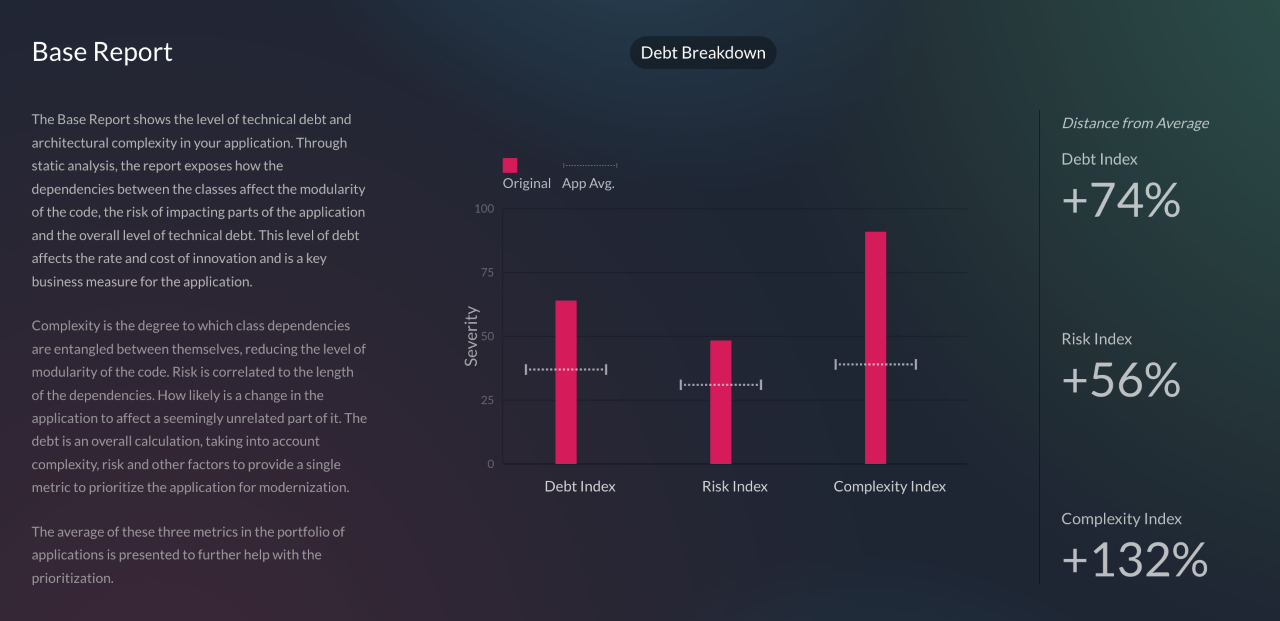
    An AI-based approach reduces the total cost of creating a business case and constructing a roadmap for modernizing existing Java applications, said Quillin. The vFunction Assessment Hub measures application complexity based on code modularity and dependency entanglements and then assesses the level of risk changes might have on the stability of the application based on the depth and length of the dependency chains. It then surfaces benchmarks for debt, risk and complexity in addition to identifying aging frameworks that could create security risks and licensing issues.

    Thus far most organizations have been content to lift and shift Java applications into the cloud without modernizing them. The application simply now runs on infrastructure that is managed by an external cloud service provider. That approach does little to improve the scalability of a monolithic Java application, noted Quillin. The goal should be to convert that Java application into a set of microservices that run natively in the cloud, he added.

    The vFunction Assessment Hub is already being used within a Java Refactoring Service for the Azure cloud provided by Microsoft that is based on agent software to analyze code and the vFunction Application Transformation Engine.

    In general, organizations are embracing microservices to build applications that are both more scable and resilient. In the event a microservice becomes unavailable, requests for services are rerouted to another microservice to make sure the application degrades gracefully, rather than simply crashing altogether. The challenge, of course, is that the dependencies that can exist between hundreds of microservices can be more challenging to manage over time than those of the monolithic application being replaced.

    It’s not likely that microservices-based applications will entirely replace monolithic applications any time soon, but the bulk of new applications are being built on top of a microservices-based framework. As such, many DevOps teams are now managing a broad mix of monolithic and microservices-based applications across IT environments that become increasingly more complex to manage with each passing day.

  • Survey Shows Increased Focus on Modernizing IT, Retiring Apps

    Survey Shows Increased Focus on Modernizing IT, Retiring Apps

    A survey of 140 enterprise architects and IT leaders published today suggested that, while moving applications to the cloud remains a priority, more attention is being paid to reducing technical debt by retiring applications.

    Conducted by LeanIX, a provider of a platform for managing enterprise architecture and managing value stream management (VSM), the survey found 40% of respondents identified reducing technical debt created by legacy applications and modernizing legacy systems as their top IT priorities. A full 96% said their company has at least one project planned for this year aimed at reducing technical debt with more than half (52%) noting that retiring IT applications is the primary means they will employ to reduce technical debt.

    Nearly 60% considered migrating applications to the cloud to be a high priority, as well. However, less than a quarter of respondents (24%) identified cloud initiatives as a top IT priority. The second most important cloud initiative, identified by 41% of respondents, is to increase the number of SaaS applications being employed.

    Regardless of the approach to the cloud, nearly three-quarters (73%) of respondents said enterprise architects should form a closer connection with software development teams, with an almost equal percentage agreeing on the importance of tracking the business impact of software development.

    However, only 16% of those surveyed considered the evolution and improvement of their security posture a top priority, even though more than two-thirds considered security initiatives—such as improving risk assessment capabilities and adopting more zero-trust IT offerings—as important or highly important.

    Dominik Rose, vice president of product management for LeanIX, said enterprise architects—or someone within IT who assumes responsibility for enterprise architecture—are trying to minimize disruptions to the business as IT environments continue to expand and evolve. The challenge they encounter is there is usually a divide between software development teams and the rest of the business. The size of that divide will vary by organization; in general, though, digital business transformation initiatives should help bridge the gap—assuming enterprise architects can establish and maintain close connections with software development teams, noted Rose.

    LeanIX is making a case for an enterprise architecture management (EAM) platform that provides visibility into IT environments. The company also makes a VSM offering available on top of that platform that provides visibility into software delivery processes. The number of organizations that have adopted VSM platforms remains relatively small, but as organizations depend more on software to drive digital processes, the need for senior business and IT leaders to have more visibility into software delivery schedules is expected to increase.

    In the meantime, it remains to be seen just how aligned DevOps teams are with the strategic goals of the business. The ability to build and deploy software faster does not automatically equate to gaining a deeper understanding of the needs of the business. In fact, there may come a day when software is built and deployed faster than most organizations can effectively absorb unless they have some equivalent of a VSM platform in place.

  • Survey Finds Widespread Adoption of DevOps in Mainframe Sites

    Survey Finds Widespread Adoption of DevOps in Mainframe Sites

    A survey of IT leaders by the market research firm Global Surveyz found a full 100% of respondents are modernizing their mainframe applications, but the reasons behind and approaches to achieving that goal vary widely.

    The research was conducted on behalf of Model9, a provider of tools for migrating mainframe data, and polled 100 companies that have more than 1,500 employees or more and use mainframes. Nearly three-quarters of respondents (73%) are embracing DevOps best practices to manage mainframe infrastructure, with 61% modernizing their mainframe applications. Just under half (46%) also noted they were outsourcing the management of those operations.

    However, the survey also found that unlocking the business value of stored data and accelerating innovation are among the top 2022 objectives for 42% and 36% of respondents, respectively. Data protection (89%), cybersecurity and resilience (76%) and cost optimization (52%) are the top priorities.

    Tamar Milstein, chief marketing officer for Model9, said that the continued focus on block-and-tackle mainframe management issues suggests there may be a disconnect between IT teams managing these platforms and senior business executives that are looking to drive digital business transformation initiatives.

    Nevertheless, a full 91% of respondents said the mainframe still holds the most critical applications for their business, with 62% reporting more than half of their core business applications on these platforms. The use of cloud computing platforms alongside mainframes is also widespread. A total of 61% have a hybrid multi-cloud computing environment already in place. Only slightly over one-third (35%) are using a single cloud to augment their mainframe. Nearly half (48%) are replicating data to the cloud. However, just over half (51%) are storing more than 50% of their data off the cloud.

    Model9 is making a case for modernizing these environments by making it easier for mainframe applications to access data stored on less expensive platforms to house data. That approach provides all the benefits of the cloud without having to incur the risks and costs of attempting to migrate an entire mainframe application to the cloud, said Milstein.

    Regardless of the approach organizations take toward application modernization, the survey made it apparent just how widespread the adoption of DevOps best practices in mainframe environments is. Many of those organizations are using DevOps practices to add application programming interfaces (APIs) to legacy mainframe applications to make the data residing in those applications more accessible. That approach reduces the technical debt that organizations might otherwise incur as they build and deploy applications on other platforms that might provide similar capabilities to an existing mainframe application.

    While there are plenty of organizations that have migrated away from mainframes, there remains a large base of IT teams still running applications on these platforms. Achieving the same level of transaction processing capabilities enabled by a mainframe in a cloud computing environment isn’t yet feasible. There are, of course, organizations that decided they would no longer like to operate a data center at all, but there’s still a substantial number of organizations that will continue to operate mainframes well into the rest of this century.

  • Building a Reliable App Installation Experience With MSIX

    Building a Reliable App Installation Experience With MSIX

    Simple, safe, reliable software installs and uninstalls are always best, but getting there isn’t easy. Applications break each other—or even the operating system itself.

    MSIX, Microsoft’s packaging format, is the newest replacement for the decades-old Microsoft Software Installer (MSI) and setup exe installer technologies. MSIX is gaining acceptance and wider adoption because of the benefits it delivers: security, ease of use and reliability in application installations. 

    MSIX provides a new, modern runtime environment intended to protect both your application(s) and end user systems. Enterprise users prefer the MSIX format because it provides the most appropriate framework to modernize applications; simultaneously reducing IT departments’ workloads when preparing application package(s) for delivery to hundreds or thousands of end users.

    As developers who build Windows desktop applications embrace the concept of running code in an MSIX container, understanding certain key concepts can streamline and strengthen their application installation experience.

    Why MSIX?

    Running code in an MSIX container can solve common problems encountered by developers coming from non-containerized deployments. This includes products built and delivered as a Win32, .Net Framework or Universal Windows Platform (UWP) packages—or when starting a new project from scratch. 

    In addition to providing clean installation and uninstall processes, MSIX enables enterprise customization in independent packages via modification packages. It also supports the ability to deploy applications through enterprise tools (e.g., Microsoft Endpoint manager) or to the cloud (Azure Virtual Desktop, MSIX app attach).

    Value for Developers and IT Pros

    MSIX improves upon the more restrictive model of UWP while still running in a container. It allows developers to code in their preferred way (e.g., unmanaged code using Windows Forms, calling the Win32APIs or managed code using XAML and .NET framework versions of the APIs). 

    Some tactics must be changed to run inside the MSIX container, however. In addition to minimizing work, it facilitates building modern IT ecosystems, deploying apps and updates faster and more frequently and modernizing applications into the new world of containerized packages.

    MSIX also supports deploying applications via enterprise tools (e.g., Microsoft Endpoint Manager) or even to the cloud.

    Value for Users

    By delivering a more streamlined installation experience for users, MSIX offers benefits to customer and end users, including: 

    • Guaranteed clean installs: This prevents time wasted on installs, uninstalls, reinstalls or issues that occur with other installed applications.
    • Isolation between applications except when isolation isn’t desired.
    • Greater security to protect the customer and the application.
    • Improved features including automatic updates, differential updates and disk space optimization—without having to customize code or the packaging process.
    • Single-instance storage; automatic block-level deduplication for any file in any installed package.
    • Fewer support calls: This cuts down on annoyances, delays and expenses for all involved.

    Elements of a Successful MSIX Project

    MSIX projects require a different approach than what many developers are accustomed to. To provide customers with the best package file(s) possible, consider the following elements as part of the project. Doing so will strengthen additional project activities, project setup, testing and debugging and supported schemas.

    1. Digital signing: Secure installations of MSIX packages are provided by installing the application to the app container and enforcing the app packages with digital signatures (with a valid code signing certificate). Only trusted apps are installed, enforcing the integrity of the package and its container after deployment.
    2. Package components: An MSIX package includes files that are essentially a set of ingredients—some generated directly (e.g., image files for the start menu) and some created as part of the build process (e.g., output by other vendor tooling). Ingredient files—including root and virtual file system (VFS) folders—will be passed to the MakeAppX command to generate the package.
    3. An efficient MSIX build process: Custom modifications are sometimes needed for a package, such as when PSF is appropriate for handling a few unexpected scenarios; this requires repackaging extracted contents back into the MSIX package. Whether or not such modifications are required, an efficient build process is always necessary. Building an MSIX/APPX package manually is possible without any packaging tools, with documentation provided by Microsoft. Alternatively, tools such as InstallShield can automate the process.
    4. MSIX bundles: .msixbundle installation ensures that only packages applicable to a device’s architecture are installed. An MSIX bundle targets different system architectures, language-specific assets, varying image-scale assets or resources applicable to specific devices.
    5. Modification packages: MSIX supports the creation of modification packages intended to modify or extend existing packages. These allow customers to create customized configurations for your package or enclose a plug-in.
    6. Shared package containers: When working closely with two separate packages, each with its own start menu and other entry points, a shared package container may be appropriate. This additional XML file may be installed on the end user’s computer to tell the OS that the packages should share a single container rather than be isolated from one another.
    7. AppInstaller (XML) file: While MSIX and bundle files are generally directly installed into the operating system, the OS facilitates installation and management of updates automatically. Microsoft now makes this functionality available for packages delivered externally by using an AppInstaller XML file to perform the installation, telling the OS where to find the current msix file, where to look for updated AppInstaller files and the configuration of updated settings for the package.
    8. MSIX core: MSIX Core is built for older Windows versions that don’t natively support MSIX. This enables installation of MSIX apps on previous versions of Windows (as long as the apps are built to work on those versions of Windows).
    9. Basic AppXManifest structure: Last but not least, the most important file in an MSIX package is the AppXManifest file, an XML file that defines how the application will integrate with the OS for access by the end user, including the application model used that impacts runtime container features. Understanding the structure and element tags (package, properties, resources, dependency capabilities, applications/application element tags) of the AppXManifest early on will help ensure appropriate project setup.

    While MSIX continues to evolve, so can your projects. The end results will be application packages that not only streamline work for IT departments but also reduce headaches for end users.

  • Microservices Adoption and the Software Supply Chain

    Microservices Adoption and the Software Supply Chain

    Software development is undergoing industrialization, with more and more software rapidly assembled out of components and an emphasis on building automation around software validation and release processes.

    Modern cloud-native software is no longer a monolithic application living in a single repo with the majority of its dependencies self-contained. It is integrated from third-party components provided by vendors, cloud providers and open source software (OSS) components, with as much as 90% of code coming from such dependencies. This allows developers to build applications much faster but makes maintenance much harder as it is no longer entirely under their control. If the third-party vendor makes a change to their API, developers are on the hook to update their applications before they break. 

    Each microservice interacts with hundreds of other microservices and each is built and released independently, making it hard to understand how to coordinate API changes across them. For example, if you want to make an API change to a microservice, what impact will this have on the consumers in the organization? Who will need to coordinate the change? When it was all within the same repository and released all at once, it was much easier to make such changes.

    The Changing Nature of Technical Debt

    What we continue to call technical debt is really the activities that are related to tending to and upgrading our software when third-party components are evolving or have common vulnerabilities and exposures (CVEs) and need to be upgraded.

    These are tedious, repetitive tasks that usually fall to the most experienced engineers as they require technical expertise to do correctly. Such activities can paralyze engineering organizations and are a tremendous burden on engineers; that often leads to burnout. Up to 30% of engineering time is spent on technical debt. The perception that somehow developers were responsible for accruing this technical debt and are doing something wrong that prevents them from keeping up is hugely demoralizing and demotivating. 

    However, if we reframe technical debt as software supply chain management and stop blaming engineering for it, we can make maintenance more predictable and consistent. By taking steps like inventorying third-party components and determining how pervasive they are in the application (frameworks take more effort to maintain than a third-party API that you just call from one part of the application), an organization can arrive at a maintenance estimate. 

    These activities are highly repetitive across organizations, as everyone is integrating some subset of the same third-party components to create business value. This high level of repeatability points us to automation. 

    Specialized Developer Tools for Software Maintenance Don’t Exist

    When developers write code, their hands often lag behind their thoughts. They think much faster than they are able to type the code. You often hear developers finishing a tedious task and complaining, “My fingers hurt.” When their IDE can autocomplete syntax, it helps reduce this lag to minutes.

    When a major framework version is released, developers contemplate the codebase. Maybe they need to change this type to that, reorder some method arguments or change dependencies. The types of changes they need to make are enumerable and must be made almost immediately; again, the ability to implement them lags far behind their recognition of the problem. Often, this type of lag can represent months or years of work when dealing with a large codebase. Accumulate enough of this lag and the codebase can grind to a halt.

    That lag kills the joy in development for most senior developers and leads to burnout. Upgrades/migrations amplify that lag by orders of magnitude.

    However, there are few (if any) tools that focus on helping developers automate these remediations/upgrades/migrations. The IDE’s focus is rightly on helping developers write new code and maintain their own code, but code maintenance needs to be coordinated across multiple places across the codebase, within the same repository or across the repository boundaries. Often, developers have a pattern they want to change in their repository, but the IDE only suggests this as an improvement in their current location (one file). Other times, changes need to be coordinated across repository boundaries if developers want to change APIs and their consumers. That’s why this technology needs to exist outside of the IDE.

    OpenRewrite

    OpenRewrite is an open source project that offers semantic analysis and refactoring of code as standalone operations so that everyone can use and contribute over time; composing more and more refactoring operations that make whole framework migrations possible. It is integrated with build tooling and can be plugged into different workflows, from CI integrations to mass refactoring of multiple microservices/repositories. Similar to an IDE or other developer tools, OpenRewrite manipulates an abstract syntax tree (AST) representation of code, but this AST has special characteristics that allow it to transform this AST and generate code back to the standard text representation. 

    The OpenRewrite AST is produced by guiding the compiler through the first two phases of compilation to generate compiler type-attributed AST. This is then mapped to the OpenRewrite AST, preserving formatting and breaking cycles in the AST. The three unique characteristics of OpenRewrite AST are:

    • Type aware, allowing 100% correct semantic code analysis and transformation.
    • Style-preserving, so transformations produced are idiomatic within the projects they are applied to. So, the same transformation applied to multiple projects will potentially look different.
    • Serializable, allowing to output the AST from the build and operate on it outside of the build en masse.

    OpenRewrite ASTs is full of metadata about code. Visualizing the code itself as a highly connected tree of various vertices and edges, we can start to get an idea of the density of this representation. Syntactic elements alone are blue, type attribution is yellow and formatting information is red. If we were to just represent syntactic elements, the tree might look something like this.

    Adding type attribution and formatting, the tree looks quite a bit denser.

    A spanning tree of the data involved in this AST can be laid out in three-dimensional hyperbolic space and then projected onto the unit sphere similar to the way that two-dimensional space can be projected onto a disk—the famous Poincaré disk model. This three-dimensional approach was pioneered by Tamara Munzner at Stanford.

    Every edge that isn’t part of the spanning tree is rendered as a lighter gray, and, as you can see, it is dense! In fact, to make this layout more tractable, we’ve omitted in this view an additional 600,000 vertices representing type information that make the syntax itself seem tiny.

    OpenRewrite calls a single code search or transformation operation a recipe. It provides a number of building block recipes such as find method, change method, find transitive dependency, upgrade or exclude dependency. These recipes, in turn, can be composed into more complex recipes by grouping them together into a composite recipe. When the building blocks are not enough, a recipe can be written as a program in the same language as the code we want to transform, allowing us to encapsulate complex logic with the full expressiveness of the language already familiar to developers. We don’t need to learn a new DSL or programming language.

    These building blocks abstract away many of the details to ensure that edits that we make to source code obey the original style of the project. This is possible for even complex changes like this automated migration from Spring Boot 1.x @ConditionalOnBean to Spring Boot 2.x AnyNestedCondition looks idiomatically consistent in the context of the project that it is inserted into:

    It is important to note that OpenRewrite is not a replacement for an IDE. With software now composed of so many independent components, we need to start to remediate and manage it using new approaches that go beyond single lines of code to looking across entire code repositories.


    Olga Kundzich, co-founder of Moderne, co-authored this article.

  • Are ERP-Centric Enterprises Being Left Behind?

    Are ERP-Centric Enterprises Being Left Behind?

    Many large enterprise companies are rife with departments that depend on customized ERP software applications. These systems accommodate vital business tasks ranging from inventory management to ordering capabilities to accounting programs to CRM platforms—all of which were custom-built to fit the enterprise’s specific needs and meet the KPIs of each unique organization. These applications tend to sustain grades, patches and reworks, sometimes resulting in multiple redesigns over the course of decades, and these often are not properly documented. To make matters worse, these ERP software systems also tend to be written in outdated programming languages such as ABAP for SAP and PL/SQL for Oracle, making them a challenge to update.

    For example, 91% of respondents in a recent ASUG survey of 110 SAP companies said they use custom code, and 41% of those applications were created at least six years ago. The majority of these companies said that the existence of these custom code environments has become a hindrance to digital transformation and is holding back innovation.

    These conditions create the bloated and overly complex legacy environments that are now commonplace in the enterprise market. Widespread, customized core business systems have made digital transformation particularly daunting for enterprise companies. They require significant developer resources, excessive time commitment and ample expense to strip down and redesign these custom systems for the cloud. 

    A Lack of Developers—and of Developer Interest

    U.S. Department of Labor statistics from December 2020 indicated that there will be a shortage of 40 million skilled workers worldwide, amplifying these issues further. That figure is predicted to grow to 85.2 million by 2030. What’s more, new developers entering the marketplace gravitate to more contemporary programming languages such as JavaScript and Python, as opposed to wanting to revamp archaic code used in most ERP solutions, such as ABAP.

    For this reason, large enterprise companies in a range of verticals are lagging behind when it comes to upgrading mission-critical software applications to the cloud or to a more modern architecture. These organizations are well aware they stand to gain significant productivity benefits from digitally transforming their systems so that, for example, inventory data can be accessed via a mobile device or shared from anywhere on a cloud-based platform. Yet these large organizations are stalled in their efforts to modernize. Some companies have gone as far as to scrap their current systems and start reprogramming their software applications from scratch—a hugely expensive, lengthy and laborious endeavor that’s also full of risk. 

    Leveraging Low-Code to Simplify Enterprise IT Environments

    One method that has shown progress in unraveling these overwrought environments is to apply automation through low-code integration. Ideally, an effective low-code development solution will automatically convert existing business processes to modern, cloud-native applications, allowing the organization to maintain the business logic it has built into those applications over the years, while drastically reducing the time commitment, costs and potential disruption associated with traditional, long-form integration. In SAP environments, for example, using a low-code rapid application development solution can separate the application layer from the core SAP system, automating a large portion of the migration while preserving a “clean” SAP core.

    With many organizations under pressure to keep budgets under control in what continues to be an uncertain economy, these large-scale companies are looking for ways to modernize their operations on a more controlled schedule. When enterprises use low-code solutions—and furthermore, don’t have to search for developers of these more archaic languages—they’re free to approach digital transformation in a far more incremental and cost-effective way.

    For instance, the 12 million users of SAP’s solutions are being compelled to upgrade to the modernized version of its product, S/4HANA. Yet the American SAP User Group (ASUG) research shows that only 33% of these organizations have taken on the challenge so far despite the looming end-of-life of the current prevalent version. This is because lacking a low-code development solution, companies are being pressured to convert and rebuild all their business processes in one fell swoop. Few organizations have the resources to absorb such a drastic and risk-prone undertaking. 

    A rapid application development program acts as a bridge for companies that are looking to modernize their businesses, allowing them to upgrade their applications incrementally, according to their own schedules. Low-code can be a catalyst for technical debt-ridden enterprises, allowing them to simplify complicated legacy environments and get down to the business of innovating their systems.