
Tag: application development life cycle

  • DevSecOps: Rethinking and Reengineering Cloud Security

    DevSecOps: Rethinking and Reengineering Cloud Security

    Organizations are embracing the cloud to modernize legacy applications, create more resilient business infrastructures and to support remote work. In fact, Deloitte’s “TMT Predictions 2021: Cloud Migration Trends and Forecast” report suggests that, spurred by this growth, cloud revenues will likely continue to remain above 30% through 2025. While cloud migration is predisposed to embrace an agile development methodology enabled with DevOps, many organizations still leave themselves open to risk when modernizing and migrating applications to the cloud by neglecting to embed security into their development operating model, architectural design and processes.

    When migrating to the cloud to modernize applications, DevOps and DevSecOps, as an architecture process, can enable organizations to rethink and rearchitect the security model with a “security by design” approach. If done right, organizations stand to create more secure and agile applications that balance the need for continuous releases in an evolving threat landscape with building customer trust.

    DevSecOps Requires a New Operating Model

    DevOps is a demonstrated approach to achieving better value, sooner, from IT programs and is seeing new developments in an increasingly distributed work environment. Previously, organizations may have relied on a shift-and-adopt strategy for incremental cloud replatforming. But, today’s rapidly shifting business strategies demand fast reaction time and resilient solutions, as well as flexible and agile solutions supported by DevSecOps to help development and security move at the same pace as the business.

    Importantly, DevSecOps requires an integrated team of cross-skilled cloud and cybersecurity specialists working under a shared operating model. A modernization and migration center of excellence (CoE), often led by the digital transformation leader, can help bring together cloud and cyber specialists from across the business with external cloud service providers via a shared responsibility model. Through collaboration, cross-teaming, cross-skilling and a shared operating model across cloud developer and security functions, organizations can achieve better outcomes.

    Embracing “Security by Design”

    DevSecOps, then, is about more than moving existing security processes earlier into the development process. It is about elevating, embedding and evolving your organization’s risk response, as well as rethinking and rearchitecting the way applications are designed with security as a guiding factor in the architectural decisions. Secure by design means setting up a whole DevSecOps capability to make sure security is embedded early on in application architecture design and then further safeguarded through strategies like segmentation, zero trust and attack surface management.

    Before the migration begins, DevSecOps would have developers and security specialists considering data flows, functional requirements and work streams related to workload protection, secure landing zones, operating model, network segmentation, access/controls to be implemented in a zero trust environment, attack surface management and more. An organization, for example, might use microservices to segment application access for internal versus external users to achieve enhanced security through system design.

    DevSecOps Requires Process Innovation

    DevOps and DevSecOps bring the security and application teams together with shared processes and communication to quickly, securely and efficiently roll out products from concept to production at pace. During the pandemic, teams have pushed their use of communication and collaboration tools to better support distributed teams, including the use of ChatOps, to enable real-time knowledge sharing and knowledge management, increased DevOps automation through incorporation of cloud artificial intelligence (AI)/machine learning (ML) services and reimagining traditional roles to embrace more of an IT-as-a-service operating model.

    DevSecOps

    As DevOps continues to shift left beyond DevSecOps to embrace operations, governance, and customer support, developers will need to work on increasingly integrated teams. These foundational communication leading practices can be valuable as a model for agile working across functions.

    Rethinking Cloud Security and Development

    DevSecOps can help support cloud migration and agile development programs that require speed and resilience by rethinking the development operating model, architecture approach and collaborative processes to improve security and compliance and enhance customer trust. Security specialists must understand the demands placed on developers for fast migration and continuous releases and developers need to work with cyber professionals collaboratively to make applications designed to be secure and resilient. A security-by-design approach to cloud cyber collaboration can help organizations to rethink and re-engineer their DevSecOps approach. Security specialists should also work toward making their services easily consumable in the DevOps process to enable frictionless security.


    Vikram Kunchala, Deloitte’s Cyber Cloud leader and Principal, Deloitte & Touche LLP, and Amod Bavare, Deloitte’s Global Cloud Migration and Modernization leader and Principal, Deloitte Consulting LLP contributed to this article.
  • Understanding the App Development Life Cycle

    Understanding the App Development Life Cycle

    More and more businesses nowadays are shifting to mobile. And that’s absolutely reasonable choice:

    • More than 50 percent of digital media consumption accounts for mobile apps;
    • Ninety percent of the time smartphone users spend on their mobiles goes to mobile apps;
    • A typical user has about 30 apps installed on his mobile and spends more than 35 hours a month using them;
    • Forty-two percent of the mobile purchases were completed from mobile apps;
    • Eighty-five percent of consumers prefer native mobile apps over a mobile website.

    When deciding on developing a mobile app, it’s important to picture the entire range of stages and procedures to go through.

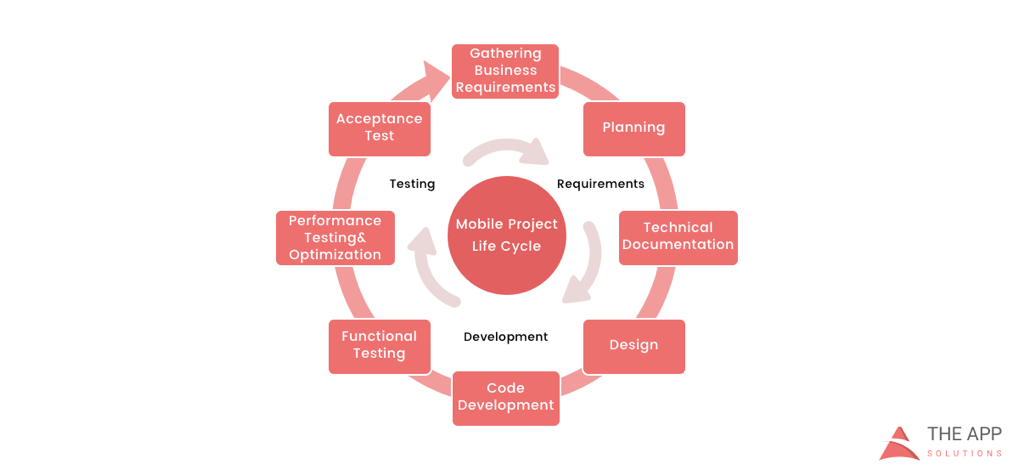
    According to the mobile app projects approach by The App Solutions, here is the life cycle of a typical development project, no matter the complexity:

    1. Planning stage (project manager, marketer, and business analyst are involved) – carrying out the business analysis and crafting mobile strategy.
    2. Technical documentation (covered by the technical writer) – describing all tech requirements and details.
    3. Prototyping (usually made by a UX/UI designer) – creating the sketch, wireframes, prototype and final app skins upon approval.
    4. Development (performed by the developers) – front-end and back-end segments of coding.
    5. Quality Assurance (usually performed continuously after each agile sprint is completed; followed by bug fixing) – testing tech requirements, device compatibility, interface, security aspects, etc.
    6. Publishing & Maintenance (covered by DevOps) – publishing to the app store, updates releases, infrastructure, and entire app maintenance.

    Planning stage

    When creating a mobile app, it is crucial to take time to go through the necessary research and planning steps.

    Business analysis:

    • Idea evaluation – a preliminary stage, when experts investigate the idea, correct it, give their advice and create a rough logics for it.
    • Competition analysis – study of activities of other players in the market.
    • SWOT-analysis – evaluation of strengths and weaknesses of the product, insights into opportunities and other aspects.
    • ROI calculation – assessment of the future app market performance help realize the real value and adjust budget accordingly.
    • Requirements scope – summing up requirements for the future product at all levels.

    Mobile strategy:

    • Market research – this study shows the overall situation on the market to help adjust the concept of the product to current demand.
    • Defining user personas – understanding who is your target audience is crucial in crafting advertising approach.
    • Technologies & tools assessment – study of specific tools required for the industry and select a set of technologies to meet the objectives of the project.
    • Complex promotion strategy – a step-by-step action plan for acquisition and retaining users.

    Technical documentation:

    Also known as a technical specification or a software documentation, this paper is a complex manual of your product, outlining requirements, business logic and leading your specialists through all stages of the project:

    • Makes your software universally understandable.
    • Provides flexibility for future changes.
    • Adds value to your app by providing a clear manual.
    • Helps to keep control of your own product.
    • Allows reusing existing parts of the developed application.

    Prototyping:

    Prototyping is a process of defining a concept in visual terms and evaluating how the app might develop to correct a misconception.

    • Creating a sketch – the draft version of your app on paper that sets up the main logic, number of screens and the way they interact with each other.
    • Creating wireframes – provides the visualization of the draft structure.
    • Creating a clickable prototype – helps to find out and analyze all possible use cases, discover logical breaks and technical inconsistencies in the original idea.
    • Designing app skins – collecting all wireframes and put them together to get the final design.

    Code Development:

    This segment usually consists of two main parts:

    • Front-end development – client-side development, creating a presentation layer of the software for a direct user interaction with it.
    • Back-end development – a server/database part of development, connecting a front-end part of the mobile app with the data access layer.

    Quality Assurance:

    In the agile development, it’s usually a continuous process following every sprint of development:

    • Compatibility testing – running the app on different devices and screen sizes.
    • Interface testing – checking the navigation, menu and buttons performance.
    • Device compatibility testing – checking how the app looks and performs on various screen sizes.
    • Low-level resources testing – examination of the app in conditions of low battery, slow internet connection, etc.
    • Security testing – provides quality assurance of users data safety.
    • Beta testing – giving users access to the app to get feedback.

    Publishing & Maintenance:

    • Publishing of the app and following updated versions to a chosen app store.
    • Infrastructure support – either you have admin panel to post on or cloud service attached, you’ll need to make sure it functions fully.
    • App store optimization – helping your app move onto the tops of search lists and this way gain more users.

    Making the Most of Your App Development Project

    Here are a few tips for getting the most out of your own app development project:

    • Mind what’s trendy + study the market and your target audience. It is a crucial preliminary stage that will impact literally every side of the project and every decision to make.
    • Specify as particularly as possible the product you expect to see at the end of the project. Defining the smallest features and functions of the software at the planning and prototyping points of the project will help find areas to save money on the actual development.
    • Negotiate your idea with various development teams (study the profile of the app development company and find evidence for their credibility, debate the best price). Make sure they hear you and understand what you mean—simply put, that you’re on the same page.

    About the Author / Charlie Shabe

    Charlie Shabe is a professional Digital Marketing Strategist. He has over 20 years Digital Marketing experience in helping global organizations use the Internet to drive their online visibility and generate leads. In addition to his PR and online marketing experience, Charlie is an expert in writing. Connect with him on Facebook and Twitter.