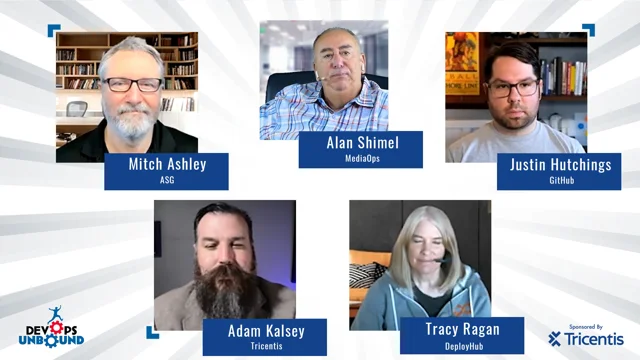
Every app development need seems to ultimately fall to developers to fulfill. Build in security. Shift testing left. Provide users cooler, more customized experiences at cloud speed and scale. And do it all faster, of course. How do we accommodate the rising expectations without burning out developers? What can other team members do to lighten the load and allow developers to focus on the creative work they require to thrive? In this episode of DevOps Unbound, hosts Alan Shimel and Mitchell Ashley are joined by panelists Adam Kalsey of Tricentis, Tracy Ragan of DeployHub and Justin Hutchings of GitHub to talk about unburdening developers. The video is below, followed by the transcript.
Alan Shimel: Hey, everyone. Welcome to another episode of “DevOps Unbound,” sponsored by our friends at Tricentis. We have a good, nice topic I want to talk to today, and you know, I refer to it as the straw on the camel’s back, but it’s about the ever-increasing load that developers seem to be taking on with technologies and frameworks such as DevOps and Agile and so forth that we’re seeing out here. And we’ve got a great panel to explore this. Let me introduce you to them before we go any further.
Let me first of all introduce you to my friend Justin Hutchings. Justin is with GitHub and he’s gonna tell you a little bit about himself. Justin, welcome.
Justin Hutchings: Thanks, Alan. Yeah, I’m Justin Hutchings. I’m a director of product here at GitHub. I work on some of our security features for developers, you know, whether that’s things like static analysis, security testing, or supply chain kind of features for developers in opensource and the enterprise. Glad to be here.
Shimel: Nice to have you here, Justin. Welcome. Secondly, she’s a frequent guest here on “DevOps Unbound” and other MediaOps videos, my friend Tracy Ragan, CEO of DeployHub. Tracy, welcome, maybe a little bit about DeployHub and you for the audience.
Tracy Ragan: Absolutely. Thank you, Alan, and thank you, Tricentis, for having these and always welcoming me on these panels. I like doing them. So yeah, I’m Tracy Ragan, CEO of DeployHub. DeployHub is a hub of metadata for deploying and configuring microservices. So we do automated configuration management so you know what your blast radius looks like for a microservice before you deploy. I’m also on the board of the CD Foundation, and you might see me oftentimes evangelizing around microservice usage.
Shimel: Yes, we do. And then – welcome, Tracy. And then last but not least as a panel member today is Adam Kalsey. Is that pronounced right, Adam?
Adam Kalsey: It is, absolutely, yes.
Shimel: And Adam’s with Tricentis, but why don’t you tell us a little bit, Adam?
Kalsey: Yeah, so I lead developer relations at Tricentis, and we make software to help people make better software, to test it and make sure they have higher-quality software. And my role is to help make developers more awesome by helping them make better software.
Shimel: Thank you and welcome. And then last but certainly not least is my cohost for “DevOps Unbound,” Mitch Ashley, CEO of Accelerated Strategies Group, CTO here at MediaOps. Mitchell, welcome. Great to have you on.
Mitch Ashley: Always good to be here, and having been part of many development teams, I’m excited to talk about this great topic.
Shimel: Great. Let’s dive into it, guys. You know, when I started devopsy.kinsta.cloud about eight years ago, there was this constant push and pull. Was DevOps too developer-centric? It was all about the developers, the ops said. This DevOps thing is just – it’s all about the developers; we’re not getting our fair share. And you spoke to developers and it was, “You know what? DevOps is too ops-centric. It’s not about the ops. It can’t be everything ops. It’s got to be about developers.” And so there was this, you know, friction about was it too developer-centric or not.
Over the years, though, what I’ve seen is an increasing amount of responsibility seems to have shifted left, as we say, right? And we shift left, and when we shift it left, we’re primarily – we’re shifting it to the developers. So things like testing, for instance, right, have become – developers are probably more involved in testing, or at least kicking off testing and this stuff, than they ever were. Security – certainly the whole rise of the DevSecOps movement has been about shifting security left, and in fact many of the most successful security companies in the DevSecOps space have become successful by making security tools for developers. We’re making testing tools for developers. We’re making tools to look at your blast radius for microservices for developers. Developers are deploying, right, as part of their DevOps focus.
When is enough? When do we break the developers’ back? Not to mention the developers are the highest-paid people in the food chain, right? So by giving them everything, are we giving them nothing, right? Are we stunting their productivity? Adam, being that you’re the new guy here and you actually are in charge of developer relations at Tricentis, we’re gonna ask you to kick it off. Are we putting too much on the backs of our developers?
Kalsey: I don’t think so. I think that the promise here is that we make things easier for the developers. I mean, sure, you have more tasks. There’s more things that you’re responsible for. But the overall effort and the amount of work that has to be done ends up shrinking. If you don’t find out about a bug in your software or a security problem or such until you’re in production and customers are using it, now all of a sudden you’ve got way more work to do. It’s harder. It’s more expensive. It’s more difficult. There’s more involved in doing that. And so by moving a lot of these things forward, we’re letting the developers be more proactive in taking care of them. We’re helping them get things fixed sooner. We’re reducing the amount of toil that developers have to do. Yes, there’s more upfront work, but that long-term toil starts to fade away and disappear.
Shimel: Fair enough. I don’t know if you – you know, I don’t know if I’ve ever heard someone say developers are – you know, it’s making it easier or less for them. Justin, what do you think?
Hutchings: You know, I’ve talked to a lot of companies that are the early stages of their DevOps transformation, and I think one of the most common mistakes that these companies make is they fail to recognize that adopting DevOps requires both technical changes as well as cultural changes. You can’t just get rid of the testers and say engineering owns tests and expect the same velocity. You’ve got to build out the infrastructure to support that, you have to do the training, and you also have to recognize your throughput is going to be less while you’re paying down that sort of debt on getting that infrastructure and getting the automation and getting all of those things.
Companies that fail at the DevOps transformation, they go through sort of the motions without understanding the culture and talking about it. You know, years ago when I worked at Microsoft, the Windows team sort of famously had a one-to-one ratio between engineers and – software development engineers and test. These were folks that wrote test automation. And there was a big layoff, thousands of testers got laid off, and they said, “We don’t need them anymore. We have observability tools. This will be great.” And that was the most naïve statement I had ever heard, and it took a year for the organization to fully rebound, to figure out what the right set of responsibilities were for engineering, and how to support those folks effectively on it.
Shimel: Fair. Tracy, in your roles, both at DeployHub and CDF, you’re dealing with both constituencies here, right, the traditional DevOps teams. But let’s face it: You’ve got dev and you’ve got ops in there, and you deal with both. What’s your take from the battlefront?
Ragan: Oh, my goodness. I could write like a 20-page blog on this. I guess that wouldn’t be a blog. It would be a research project. [Laughter]
Shimel: Or a book.
[Crosstalk]
Ragan: Yes! So I think that in my discussions with folks over the last six months, eight months, I am seeing a lot of SREs really stressed out. So I don’t know if it’s the development teams that are really taking the brunt of this, but if we think about our history and how we got here, we’ve always had somebody really important on a development team who always worked in hand with the operations side of the house to find out what happened, to help with the deployments. Even if they’re sitting there watching the operation first and hit the button, they’re the person that’s always taken this responsibility. And I think the DevOps movement was an effort to push more operations tasks to that trusted partner on the development team, and now that role has turned into an SRE.
I would say five years ago we wouldn’t have seen this kind of stress, but because we’re going through this massive tsunami moving from monolithic to microservices, and we’re in a transition phase, we are putting a lot – what I see is we’re putting a lot more stress on the SRE role. Developers are going to the SRE, operations are going to the SRE, and the SRE is just trying to keep up with the underlying technology that’s wobbling and moving. You know, they’re trying to figure out how to stand up environments easier. They’re trying to implement Terraform or Rancher. They’re doing everything that they can right now to try to keep up, but they may be underwater for a bit longer.
So when we think about where the stress point is right now, I think that developers have pretty much automated a lot. You know, we have tools like Tricentis to really improve the testing, but now we’re int his weird phase where we have these SREs that are trying to straddle both worlds. And they’re struggling.
Shimel: Justin, you know, in your role there – and, guys, I don’t mean to call. If you want to say something, feel free to obviously jump on. But, Justin, I’m wondering – you know, GitHub has sort of a unique view with this.
Hutchings: We’ve been trying to push folks towards more automation, more DevOps, you know, DevSecOps with all the security features we have. You know, again I think culture is the key. I look at anytime you have an unfunded mandate, you know, it’s gonna fail. A lot of times organizations will say we’re going to microservices or they’ll say we’re gonna adopt all these security tools, and then they don’t think about how that actually gets done and they don’t recognize the sort of pain and training and all of the things that have to happen to get folks there.
You know, and I think there’s been a lot of advancement here. You look at the state of observability. You look at the state of CI/CD. Things are getting better, but I think, you know, we in the industry that sort of work int his space sometimes paint such a rosy picture that our customers aren’t prepared for the hardness of the journey that lies in front of them. And they’re looking at how do I get to the magical garden of DevSecOps, and the magic garden is there, but it is not a free entry, you know?
Ashley: You know, Justin, to what you were saying, I think along with culture, part of is a role change that’s happening across the whole organization, right? A couple things are happening. We’re doing not just automation that the developers are doing, clearly SREs. Other test automation, infrastructure as code, you know, those are all development that’s happening to support those. It doesn’t say that every person is an expert developer, but there’s some development, scripting, other kinds of skills that come with it.
So I don’t know if we’re so much loading it on the developer as much as we’re elevating our level of automation and kind of interconnected of the process, and we’re helping people evolve and growing their strengths – let’s put it that way – to also include some software development, or more closely working with people that can. I think that’s part of that cultural change, too.
[Crosstalk]
Kalsey: One of the things that’s actually happening there is as things become more development-centric and, oh, now it’s Toad and now it’s – the teams are making exactly the wrong lesson out of this and they’re learning the wrong thing out of it. You know, one of the things that Justin said earlier is, “Well, we got rid of all the software testers because the developers are doing the testing now,” and that’s one of the dumbest things that you can do as an organization, is say, “Well, now that my developers can do this, let’s get rid of all the experts.” And instead of saying, “What is the new role of this expert and how does their role change?” whether, okay, now they learn to code so that they can expose more of this as code, or do they become consultants to the developers and help them do this right and help them understand how to do this right? Could I remove a lot of those pieces of toil and a lot of that extra stuff from them and let them focus on the things that they’re good at – writing the code, building the code, thinking through the problems – and let me focus on the things that I’m good at – thinking about the infrastructure, designing the infrastructure, designing test plans, thinking about the non-happy path?
And so companies – I talk to companies all the time that say, “Well, we’ve moved – all our developers are doing the testing now, so we got rid of our QA department!” And that is – that’s just frankly dumb. Don’t do that.
Ragan: I think it was an outcome of the Agile movement, right? Because we started preaching this idea of bringing everybody into the same room together to do these tasks. So we broke up our testing departments and we spread them out across all of the teams, as well as some of the operations, which is how the SRE title came about. So, you know, first we siloed and then we tried not to silo. But ultimately it is how do you come up with a strong automation standard across the organization? And how are you gonna implement it? If there’s a testing team that has a group of people and each one is assigned to an application team, or if you have a siloed testing team and a siloed operation team, ultimately we’re still pushing the same product through the lifecycle. So how well do we do that? And maybe Agile confused things for us for a while and kind of broke things up and disrupted what we were doing. So now the task is how do we move forward with where we’re at to make it continue to be easier to get things across the pipeline?
And I have to say that one of the biggest challenges I hear from people is that continuous integration works well; continuous delivery from dev, test, through prod doesn’t work so well.
Hutchings: Yeah, and I think, you know, what you hit on there, Tracy, is really important because, you know, when you have an organization where the engineers are the only thing and engineers are undifferentiated and treated as some sort of fungible resource, I think things fall apart. You know, what I’ve seen in successful organizations is they have some subject matter experts, whether that’s SRE or a data team or an infra team, that are building out things that make the rest of the organization able to scale. And that’s a really good, healthy blend where you’ve got experts that you can lean on, but then engineers are empowered to do sort of the last-mile delivery there.
Kalsey: Yeah. When a company says they’re gonna create a cross-functional team and then they eliminate most of the functions, that’s a problem. I mean, you don’t say I’m gonna have a cross-functional team, so we’re going to bring product managers and designers in and, oh, by – now we just don’t need product managers and designers. So why do we do that with operations, with testing, with all of these other things that are important for software creation? You know, eliminating those and just saying, “Well, the developers will do it,” of course that makes for a lot more work for the developer. The way that this needs to work is keep those cross-functional teams and change their role and bring them further – bring them earlier into the developer cycle. Have them involved in design. Have them involved in figuring out what the product is going to do and how it’s going to do it, not just let’s get rid of them. The options aren’t they happen at the very end of the process or we don’t have them at all. It’s let’s bring them up further along in this process.
Shimel: You know, part of it, though – and I don’t know if anyone wants to admit it – is that there’s sort of this bias that everyone else on the IT team aspires to be a developer ’cause that is the ultimate kind of thing. So, for instance, it was this way certainly in testing, that being a tester was a waystation on the way to being a full-blown developer, right? Or maybe a developer who wasn’t that good, well, he could do testing, right, and that testing in and of itself wasn’t a “profession.” It was really just like a junior developer did testing. And, you know, security people, well, they were always the rebels, right? Half of them didn’t have formal training. But you know, operations, the SRE folks, right, how much of a developer heritage or pedigree is there in what you need to be able to do from an SRE perspective? And so when we put together these “cross-functional” teams, it’s almost with the idea that, well, you’re all gonna be developers now, right? You’re gonna reach your lifelong ambition by being in this DevOps team as part of a developer. And we lose out on the professional tester, on the professional SRE, on the professional security person, right, in this rush to all be developers. What do you think about this?
Ashley: Well, I think we did this to ourselves in the DevOps movement. You know, I remember when I first wrote my first article on devopsy.kinsta.cloud about what is DevOps and I was sort of grappling with it myself, the mantra was, “We don’t need operations, we don’t need test, we just need developers. Code or developers writing code will eat the world.” And it wasn’t outsiders that said that; we said that, or subsets of us said that. And I think we recognized after we got into it, no, as Adam points out, those are exceptional skills. Frankly some of the worst testers I’ve worked with were developers. They were terrible at testing their own stuff. They were great developers, right? But some of it is elevating maybe too much the role of the developer to be the rockstar beyond the platform, if you will – and there are fantastic developers. I don’t mean there aren’t. But there are amazing, amazing test people.
And so let me put it to you this way. When I was running product development at StillSecure with you, who did I listen to? The testers. I listened to them and I asked them, “What problems are we finding?” and I could tell if we were ready to ship, not just by the numbers but by their opinion. And that’s why I really relied on, because they saw it from a different perspective than a developer does. So that’s my opinion about it. Now feel free to disagree. Anybody can take me on and say I’m full of baloney.
Hutchings: So I was gonna say, Mitch, you know, have folks heard the story about – what is it – the IBM Black Team that they developed back in the ’80s for testing where they – basically testing was a sort of poorly-regarded function in the organization? And they ended up creating sort of a hit squad that famously would go and just destroy people’s code. And they created a culture around that, and they created sort of an ethos of that being a special place to work. And I think that’s something we need to find with our developers. Like, if we only celebrate the developers that make the shiny features, we’re not gonna be in a good state. We’ve got to celebrate the developers that can destroy other people’s code with tests or can build something that scales really well or that build great observability things. Like, it can’t all be how many features did you ship; it has to be how much you contributed to the whole.
Ragan: Yeah, and I – you know, I think, Justin, that the cultural discussion is one that any team that’s going through this experience right now that we’re describing, that the developers do feel burdened in some way, they should be looking at how they have built that team. And kind of each role should be a specialist role, and they all have to be an equal role. And if you don’t have that, you really haven’t created an Agile team and that team’s not gonna become a high-performance computing team, because it is about equality on the team and the ability for every single person to stand up – tester, the SRE, the junior developer – and be able to communicate problems as they see them in an equitable way and not feel that they are being judged.
And I have learned that from working in an opensource community. I’m really amazed how well the opensource communities work together, ’cause you have people with all kinds of different backgrounds, and it fascinates me to see how much they can accomplish and how well they accomplish it when they’re not all working for the same company and they’re there because they want to be. So how do you create that opensource kind of nurturing culture within a particular team if it’s built especially around Agile, where we’ve taken operations and testing and developers and, you know, other specialists and put them on the team – documentation, requirements gathering – and how do you make it an equal team? That I think is the challenge to keep the burden off of the developers’ backs.
Shimel: You know, and that – paradoxically, that’s also the big attraction to like cloud-native communities, to these opensource communities, because I think people recognize the – and I don’t mean it in a bad way – the kumbaya kind of spirit that these opensource communities foster. GitHub, quite frankly, Justin, right, if you look at the history of GitHub, that’s probably been one of the huge drivers of 52 or whatever it is million accounts on GitHub, is that sense of community, right? How do you build that sense of community interdisciplinary across your teams within an organization? Adam, you know, though the role says DevRel, it’s really TeamRel, right? And you know, it’s got to be part of your mantra there, part of your job description, isn’t it?
Kalsey: Yeah. One of the things that is interesting about when you look at opensource is the person who wrote the documentation is a hero, because nobody wanted to write the documentation. The person who wrote the tests is a hero because, wow, they’re writing the tests, and that was a lot of work and I didn’t want to do that amount of work. But then when we go into a company we say, “Well, we’re gonna hire a couple of QA people to do the testing because they’re cheaper than the developers.” And, well, yeah, maybe if you’re hiring bad QA people they’re cheaper than the developers, but if you’re hiring good testers, they’re as expensive or more expensive than the developers.
And so in the opensource world we look at it and we go, “These people are peers and equals,” and then we come into a company and we say, “They’re second-class citizens, and we’re gonna hire a couple of tech writers ’cause they’re a lot cheaper than having the developers write the documentation, or we’re gonna hire some testers, or we’re gonna hire some ops people ’cause the person to watch the dashboard is way cheaper than having a developer do it.” And we’ve seen it happen with the SRE role where, when we elevate that and that becomes part of the development team, the other – SREs are expensive and hard to find. That same sort of thing I think needs to happen in other roles on a development team in order for them to stop being that second-class – and also to stop having developers be the ones that have to do all of this work. If you look at it and say, “Well, the test writer or the doc writer is a cheaper person and we’ll just hire a couple of them,” it’s more likely to fall on the developer to do the hard work than to hire the good people and have them do the hard work.
Shimel: Fair enough. Mitch, what do you think on that?
Ashley: You know, it’s a really good point, and I think part of what you’re saying, Adam, is it’s a specialty. You think differently to be a fantastic tester, not just testing but the whole test strategy and how to do all the different kinds of testing that’s involved, and then of course how do you automate that and do you do that yourself? Do you work with part of the dev team to do that? Same thing for SRE, right? It takes a different – someone who thinks about it differently. And it’s sort of that cognitive diversity of teams that we value from a diversity standpoint. We value that also because those roles also require specialty skills. You know, someone who’s designing – and, Tracy, you could explain this better than I could, but someone who’s designing a cloud-native architecture and thinking about the microservices and what’s gonna constitute a microservice, how we’re gonna communicate between them and how we’re gonna secure them, that’s a different kind of thinker than how do I break all that stuff. That’s really nice that you did that, but watch how fast I can break that. That’s fun, and that’s where people really enjoy working together. But I think that’s part of where you’re elevating, too, Adam, is you’ve got to value all the skills, and they may be expensive, they may be not quite as much, but they’re needed. They’re part of the process.
Shimel: Interesting. You know, Justin, we’re talking about testers. We’re talking about SREs. We’re talking about developers. Once again, no one’s talking security. Are we just sentenced to be forever the outsiders here? What’s it gonna take?
Hutchings: Most of the security people that I talk to take that as a challenge, you know? We obviously want developers to go and embrace security as part of, you know, their everyday job descriptions, but folks in AppSec and especially in the security research community, they’ve always felt like kind of scrappy outsiders that are going to shine a light on things that other people didn’t notice. And so I think even when we have very security-minded, security-motivated engineering teams, security is a discipline that’s got to stand apart, because we want to have that sort of trusted auditor role or that, you know, lookout for – whether it’s bug bounty reports or stack analysis findings that no one looked at. Like, someone’s got to be watching those, ’cause developers, especially in the world of microservices, they might work on a thing, finish it, and then go somewhere else. But the security world changes all the time. If you walk away from that microservice and all of a sudden we learn about a new category of security problems and no one’s watching it, well, that’s a problem now. And so security has a really special role in terms of being the stewards of all the things, even when they’re not directly accountable for the functionality of it. And I think that’s a special thing that we should celebrate.
Shimel: Okay, we’re special. But you know, as special as we are, yet we’re still seeing security tools for developers, right? That is a bona fide trend in our industry, and at the same time we’re also seeing – when we talk about the load on developers, we’re still seeing an extreme need for more security people, right? We just can’t produce enough qualified security folks, it seems. If that’s the facts, right, there’s no getting around it. What else is there to do but put this load on the developers? How else do we deal with it, automation? I don’t know.
Hutchings: You’re absolutely right, and I think the key for tool spenders like GitHub is to figure out how to give developers enough information that they can be successful but not overwhelm them, because security tools, you know, there’s a risk of false positives. If you give them too many, they will ignore them. And so, like, as a tool vendor, I have to be extremely careful to make sure that I don’t burn out developers on the things I think are important, ’cause they might not find them as important as I do.
Kalsey: The other thing those vendors have to do is make less work, eliminate work for the developer, not cause more, not give them more things to pay attention to, more work to do, more administration to do, but look for ways that you can remove that work through the tools.
Ragan: Yeah, so we have a challenge facing us when it comes to automation right now, and the challenge has to do with these imperative pipelines that we’ve been running for the last ten years. Sometimes you have a Jenkinsfile that is pretty complicated, and we’ve been running them, we copy them, and we use them. It’s imperative.
The problem with it is because it’s imperative. We are seeing a shift now to moving away from these imperative pipelines to where it’s more declarative and event-driven, which means that it should be easier then to take these older – if you had a purely declarative pipeline based on events, think about how easy it would be to say, “Okay, we’ve decided on this set of security requirements to add to sort of the workflow steps for the testing workflow, for the development workflow, and we’re gonna plug those events in.” The reason why we don’t do that now is because it’s too hard. [Laughter] It’s just hard, because we have to take these old imperative pipelines and try to modernize them. And without having that declarative framework, these kinds of tools, even adding continuous testing, even adding continuous deployments all the way to production, it’s hard and it takes a lot of work, and you have to change the tires as you’re going down the freeway in an imperative model. The faster we can get to an event-driven process in our CD pipeline where we can declare them and we can automatically generate what we need to do in a workflow, the sooner we’ll be alleviating some of the pain that the developers might be seeing, the sooner we can bring in better testing, the sooner we can bring in the DevSecOps conversation, and in our case automated configuration management.
This has always been a problem for any of the tools in the CD pipeline to start being plugged in, because the imperative pipelines that we are dealing with on a daily basis, nobody wants to touch them. So we’re gonna have to disrupt that first, and when that gets disrupted and people start moving to something more declarative, we are gonna see an increase in adding all of this kind of automation into the CD pipeline.
Ashley: I’m curious, Tracy. Is it the complexity of the pipelines that – the way they’re defined, is that why people don’t watch to touch them, or –
Ragan: It’s the number.
Ashley: The number, okay.
Ragan: You’ve got – literally I’ve seen people with thousands and thousands of workflows ’cause they’re running one for every single application version. And to look in that and say, “Oh, we’re gonna change all of these,” because it’s not templated so you can’t just change it in one place and it’s just gonna trickle down, because they’re all these very statically scripted processes. And for whatever reason on the distributed side of the house – when I say distributed, I’m talking about everything except the mainframe – we have relied on heavily scripted processes, and we’ve scripted ourselves into a box that we cannot – we’re not Agile. We cannot easily update these pipelines to include security in them.
We talk about it at the CD Foundation often, trying to elevate security as a first-class citizen in the CD pipeline. But that means that everybody’s got to start updating all those CD pipelines, and they’re not templated. They’re all statically scripted so you have to address one at a time. And as I think Justin might’ve said, you’ve got to plan to pay for that. So we’re in a box, we’re in a corner, and we have to somehow get ourselves out of that corner in order to alleviate these kinds of problems. And being Agile at the CD pipeline level means that we’re gonna have to dump these imperative processes.
Hutchings: And I think you’re exactly right there, Tracy. One of the challenges we also see with security is this desire to start slow so that you don’t overwhelm people with too much, and if you don’t have a centralized control plane that everyone pulls from, you know, as you start to introduce these security tools, you can’t dial up the difficult level as you go. You have to hit those distributed CI pipelines every single time you want to go and update the difficulty, and that’s not tenable. I mean, you know, there are services out there – I think GitHub with Actions is doing a pretty okay job with allowing some centralized management, but it’s a spot that we all have to invest in because, you know, that control plane for specialists like security to go and help inject things is just not as mature as it needs to be.
Ragan: And the CD Foundation has started an events working group to start having this discussion. Right now they’re talking about just vocabulary, but I believe that will grow into a bigger project in the future so that we can start thinking about how you can have that event-driven process so that you can dial it as you need to, right, as oppose to having them statically scripted in all of these imperative pipeline processes.
Shimel: So, guys, we’re running low on time. Just one other topic I wanted to bring up. You know, in looking at this problem, though, I’m reminded of when I read The Goal, right, which is kind of the book upon which Gene Kim based his Phoenix Project on. The Goal is about more manufacturing; The Phoenix Project was IT. But really it talks about bottlenecks, resource constraints. And the story of The Goal – and I forgot if it was the first rule, the second rule, whatever it was – is as soon as you fix one or get rid of one problem, the next problem down the line shows itself that maybe you didn’t see because the problem in front of it was hiding it camouflaging it. In trying to make life easier for our developers or take the strain off of that point, are we really just going through this goal process of discovering the next bottleneck? And maybe that’s what – maybe that’s the secret to life. Life is just about going from one bottleneck to the next, right, and discovering what’s downstream from there. There’s something Zen about that. But is that what we are sentenced to for sure, or is there a way out of that?
Kalsey: I like to say that when designing large-scale distributed systems you can’t remove your scalability or your failover problems; you just move them to a different part of the stack. And we do that a lot with development teams as well, is we don’t remove the problem; we just move it to a different part of the process and move it around.
I think one of the ways out of that is one of the tenets of Agile is let the teams make the decisions. Hand them the problem and let them decide how to organize, how to do these things, how to make stuff work. You know, if management is pushing down on development and saying, “You’re now going to be the testers,” of course we’re causing more work and more problems and more things for them, and they’re going to become the bottleneck. But if we let the teams figure out – they’re the ones close to the work, doing the work. Let them make the decisions about how we’re gonna do this and what they need to make it happen.
Shimel: Fair enough. All right –
Hutchings: Yeah, I was gonna say I like the term incrementally correct. You know, Alan, your thinking about bottlenecks is absolutely true. I don’t think there’s ever a world where we will get to 100 percent panacea, but we can hope to get a little bit better all the time, and that’s the journey that we’re all on, right?
Ragan: And failing fast.
Shimel: _____ continuous improvement, and failing fast – like get to know –
Ragan: And allow your developers to fail and not – or your testers or your security. It’s okay to fail, because then you learn what you need to do. Failing fast is part of the learning process.
Shimel: Fantastic. All right, guys, we are out of time. I want to thank all three of you for joining Mitchell and I on this episode of ” DevOps Unbound.” Thanks to Tricentis for sponsoring ” DevOps Unbound,” as always. We will be back in – not next week, the week after with a new, fresh episode, as well as check out – we’ll have a new ” DevOps Unbound Roundtable” open to the public for questions, and you can find out about that at DevOpsUnbound.com or on our Digital Anarchist site or devopsy.kinsta.cloud frankly. Look under – it’ll be under webinars and you’ll find the Roundtable there.
Until then, though, Tracy Ragan, as always, it’s a pleasure to have you on. You bring such enlightenment to the whole discussion. Thank you.
Ragan: Thank you, Alan.
Shimel: Thank you. Justin, again, always nice to have you on one of our panels and discussions here. Many thanks for coming. And, Adam, thank you and good luck in – you know, I know you’re relatively new in your position there at Tricentis but it looks like they made a hell of a hire. Good luck, and come back and visit us again.
Kalsey: Would love to. Thanks a lot.
Shimel: All right. Mitch, you want to take us home?
Ashley: I just wanted to thank our panel as well, and I love the incremental progress idea, and it’s always getting outside perspectives sometimes, too, that’s helpful. So I think we’re here to help each other in this process and not one of us has the answers.
Shimel: Right on. All right, this Alan Shimel for “DevOps Unbound.” We’ll see you on the next show. Bye-bye, everyone.
[Outro music playing]





 In addition, Mendix has enhanced Mendix Assist, the
 Hussein Badakhchani is a Distinguished Technologist and author with over 20 years of professional experience in financial services technology. Having worked for institutions such as the Bankers Automated Clearing System (BACS), Deutsche Bank and VocaLink – MasterCard, Hussein has a proven track record of delivery in some of the most competitive global capital markets. As a trusted academic, practitioner and adviser, Hussein also provides critical analysis of technology to executive and investment decision makers in government, banking, financial, commercial and defense sectors. He is the author of “NoDev NoOps NoIT,” principles governing the ideology, methodology and praxeology of informed IT decision-making. Connect with him on