Tag: Amazon Web Services

  • AWS Advances DevOps Agenda at Summit Event

    AWS Advances DevOps Agenda at Summit Event

    Amazon Web Services (AWS) has added services to its cloud platform designed to automate the creation of virtual private clouds (VPCs) and made available additional tools to build applications and integrate external data.

    Speaking at the AWS Summit event, CTO Werner Vogels said these latest services are part of an ongoing effort to automate DevOps processes to the point at which developers will need to write only the code for business logic that runs on top of the AWS public cloud.

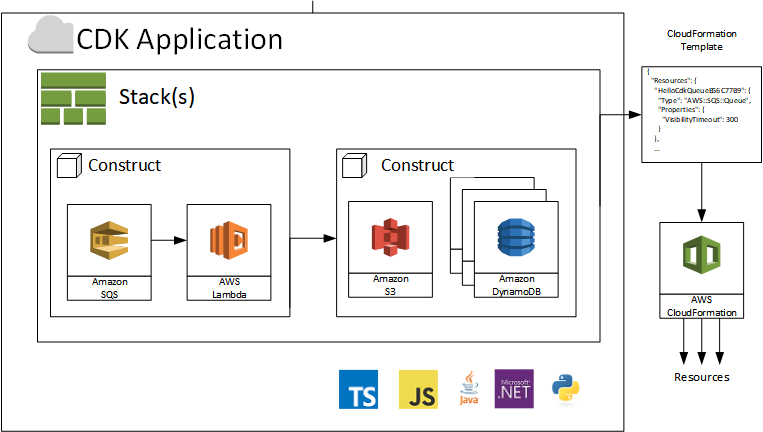
    One of the latest tools the company is making available in pursuit of that goal is AWS Cloud Development Kit (CDK), a software development framework for defining cloud infrastructure in code as constructs and provisioning it through AWS CloudFormation. AWS CDK currently supports TypeScript, JavaScript and Python with support for C#/.NET and Java available in preview. That capability will eliminate the need to write low-level code using a different tool just to spin up a VPC on AWS, Vogels said.

    AWS CDK also allows organizations to design and compose their own custom components for managing infrastructure alongside their application code.

    The cloud services provider also announced AWS EventBridge, a programmable event bus for integrating data on AWS with data residing in software-as-a-service (SaaS) applications on any platform based on a serverless computing framework, and the general availability of AWS Toolkit for Visual Studio Code, a plug-in for the Microsoft integrated development environment (IDE) that makes it easier to build, debug and deploy code on AWS.

    Finally, the company announced that Amazon CloudWatch Container Insights is now available in preview. This offering provides access to automated dashboards summarizing the performance and health of their Amazon Elastic Container Service (ECS) and Fargate clusters by tasks. Those offerings come on the heels of AWS Fluent Bit, a tool for container logging being made generally available earlier this week.

    Vogels stressed that the way applications are built is now fundamentally different in the age of the cloud. Developers are making greater use of containers and serverless computing frameworks. The challenge with containers is that in the absence of a cloud service provider to manage the environment, the complexity of the underlying middleware and infrastructure conspires to reduce the amount of time developers spend on writing actual application code, he said.

    To address that issue, AWS is investing more in container and Kubernetes services as well as in on-demand serverless computing services such as AWS EventBridge that don’t require organizations to pay for idle processes, Vogels explained.

    In general, Vogels said AWS continues to advocate for the elimination of separate IT operations and cybersecurity teams in favor of a more unified approach leveraging automated services provided by AWS that ensure, for example, the entire continuous integration/continuous deployment (CI/CD) platform is secure. However, while the number of organizations embracing best DevOps and DevSecOps processes continues to increase steadily, it’s much less clear how many of them will standardize those processes on a single cloud platform at a time when reliance on multiple clouds also continues to increase steadily.

    — Mike Vizard

  • RDX Eases Oracle Database Migration to PostgreSQL on AWS

    RDX Eases Oracle Database Migration to PostgreSQL on AWS

    RDX this week launched a set of tools designed to make it easier to convert applications running on an Oracle database to Amazon Aurora, an instance of an open source PostgreSQL database running on the Amazon Web Service (AWS) cloud that is compatible with Oracle databases.

    Announced at the AWS Summit event in Washington D.C., the clckwrk Refactoring Service for Oracle promises to reduce the amount of manual effort associated with refactoring applications for the Amazon Aurora platform by automating as much as 60% of the database schema conversion process.

    James Ball, chief strategy officer for RDX, said in addition to reducing costs, many organizations want to shift applications to open source databases in the cloud to further their DevOps ambitions. Each time an application needs to scale, an organization will incur additional Oracle licensing fees. In contrast, an open source database enables DevOps teams to scale database instances as required automatically, he said.

    AWS has been making a concerted effort to convince customers to give up proprietary databases in favor of open source databases running on its cloud platform. That competitive pressure is a driving force behind new alliances that previously would have been considered unimaginable. Oracle, for example, recently partnered with Microsoft to promote the integration of the Oracle Cloud platform with the Microsoft Azure cloud. Oracle would prefer its database run on its cloud, but through the alliance is signaling its willingness to work with Microsoft to deploy Oracle database on Azure, a cloud platform that is the leading industry alternative to AWS. Microsoft, of course, has its proprietary database to adopt in the form of Microsoft SQL Server.

    Ball said RDX not only provides tools to accelerate the conversion to Amazon Aurora, but it also provides managed services for customers that want to outsource the management of Amazon Aurora to RDX.

    It takes most organizations several months to migrate a legacy application on to a public cloud. AWS has a vested interested in helping accelerate that process whenever possible. But many organizations that have embraced best DevOps practices find their efforts are hampered by reliance on proprietary databases. In fact, one of the reasons so many developers tend to favor open source databases is to avoid all the headaches associated with getting approvals for new database licenses.

    It’s unclear to what degree the rise of DevOps in the enterprise will ultimately shift database allegiances. Oracle is trying to maintain as much control as possible by making its databases available as a managed service that eliminates some of the purchasing overhead associated with spinning up new instances. However, the cost of an Oracle database license is still buried in the cost of the managed service.

    Not every organization is looking to transition away from a proprietary database, but there is now enough momentum around the “open source first” movement to make it worthwhile to build tools that automate the refactoring of legacy databases not just to reduce costs, but also to make IT a lot more agile.

    — Mike Vizard

  • AWS re:Invent 2018 Product Launches: An Overview

    AWS re:Invent 2018 Product Launches: An Overview

    AWS re:Invent is always rich in product launches. Some products are entirely new, while others are updates or enhancements to existing tools. The 2018 event was no exception. In case you missed it, here’s a drive-thru on some of the best products—and one important statement—from this year’s show.

    AWS Marketplace for Containers

    Announced at the Global Partner Summit keynote, the AWS Marketplace for Containers is the next logical step in the Marketplace ecosystem. Vendors will now be able to offer container solutions for their products, just as they do with AWS EC2 AMIs. The big takeaway here is just how important containerization is and how much of a growth we see in the implementation of containerized products and serverless architectures in general. Along with the big announcements around AWS Lambda, this solidifies the push in the industry to adopt serverless models for applications.

    AWS Marketplace – Private Marketplace

    The AWS Marketplace has added the Private Marketplace to its feature set. You can now have your own marketplace that’s shared across your AWS organizations. This is neat and all, but I think what’s even more interesting is what it hints at in the background. It seems to me that to have a well-established marketplace at all, your organization needs to begin its journey on the DevOps trail. This news shows that a good deployment pipeline is really the best way to handle a project, for both external and internal customers.

    Firecracker

    This looks really cool. Firecracker is a virtualization tool that is built specifically for micro VMs and function-based services such as Lambda or Fargate. It runs on bare metal … wait, what? I thought we’re trying to move away from our own hosted servers? That’s true. However, consider all the new IoT products and features that were announced at the conference and you’ll see there’s still a lot of bare metal, both in use and in development. I don’t think Firecracker is meant solely for large server farm-type setups, but quite possibly for items in the IoT space. The serverless/microservice architecture is a strong one, and this allows that to happen in the IoT space. In fact, I’m currently working on installing it onto my kids’ Minecraft microcomputer.

    Andy Jassy Says What?

    In the fireside chat with AWS CEO Andy Jassy in the partner keynote, there were several things I found interesting. But one comment stood out from the rest:

    I hear enterprises, all the time, wanting help thinking about how they can innovate at a faster clip. And, you know, it’s funny, a lot of the enterprise EBCs I get to be involved in … I’d say roughly half the content of those are enterprises asking me about our offering and how we think about our business and what we have planned in the future, but a good chunk of every one of those conversations are enterprises trying to learn how we move quickly and how we invent quickly, and I think that enterprises realize that in this day and age if you are not reinventing fast and iterating quickly on behalf of your customers, it’s really difficult to be competitive. And so I think they want help from you in how to invent faster. Now, part of that is being able to operate on top of the cloud and operate on top of a platform like AWS that has so many services that you can stitch together however you see fit. Some of it also is, how do people think about DevOps? How do people think about organizing their teams? You know … what are the right constraints that you have but that still allow people to move quickly.

    He said DevOps! Apparently, larger companies that are looking to change don’t just want fancy tools and new technology. They also need help getting better at effecting change. That’s absolutely outside the wheelhouse of AWS, and clearly a call-to-action for the partner community.

    — Lars Cromley

  • AWS Finally Embraces On-Premises IT

    AWS Finally Embraces On-Premises IT

    Amazon Web Services (AWS) announced this week it will make available instances of its IT infrastructure available in on-premises IT environments, which it will then manage on behalf of customers. The announcement was made at its AWS re:Invent 2018 conference.

    AWS CEO Andy Jassy said AWS Outposts platforms, scheduled to be available in 2019, will come in two flavors: one will run the same stack of software AWS uses to manage its public cloud, while the other will be based on the software stack VMware currently makes available on the AWS cloud.

    VMware announced it will make available a managed service of its own for AWS Outposts based on its entire platform stack, in addition to making its management and networking software in the form of VMware Cloud Foundation available on instance of AWS EC2. That move represents a significant expansion of the VMware approach to hybrid cloud computing because AWS EC2 is based on the open source Kernel-based virtual machine (KVM) rather than the VMware hypervisor.

    Regardless of path chosen, each Outposts platform will function as an extension of the Amazon Virtual Private Cloud (VPC) service, with connectivity being provided via the closest AWS Region located to that on-premises platform. Both Amazon VPC and AWS Outposts will be tied into the AWS Control Tower service to create a common management plane.

    After years of making the case for moving all workloads into the public cloud, Jassy admitted this week that there are instances when performance and compliance concerns will result in some workloads never moving to the public cloud. In response to demand from customers who want to be able to deploy and manage the same infrastructure on-premises as they have in the cloud, Jassy said AWS is now committing to making racks of systems available via an AWS managed service.

    The challenge DevOps teams will now face is determining the degree to which they will want to integrate their DevOps processes with managed services provided by AWS, VMware or any number of third-party service providers. In some cases, DevOps teams may simply decide that additional layer of management adds to much complexity. In other cases, the decision might lean more toward allocating more resources to application development, as IT operations spanning hybrid clouds become more of an automated service provided by an external vendor.

    Heading into 2019, it appears the specious debate over public clouds versus on-premises IT environments is coming to an end. Not only will there be workloads running in both environments for the foreseeable future, but a recent study conducted by International Data Corp. (IDC) notes that 80 percent of IT organizations surveyed have repatriated workloads back into on-premises IT environments from public clouds. To make matters even more complex, a whole new generation of so-called cloud-native applications based on microservices enabled by containers running on Kubernetes clusters is adding even more complexity to IT environments.

    The goal, of course, is to make modern businesses more agile. The irony is that achieving that goal appears to requires paradoxically making IT environments more complex than ever.

    — Mike Vizard

  • Mphasis Acquires Stelligent, the DevOps Automation Services Specialist in the Amazon Web Services (AWS) Ecosystem

    • Mphasis Stelligent boosts Mphasis’ end-to-end capabilities in public cloud with a focus on DevOps and Containerization; further augmenting its managed services capabilities
    • Mphasis Stelligent combines best-in-class DevOps and DevSecOps solutions on Amazon Web Services (AWS) and delivery at scale with customer-centric digital transformation and hyper-personalization to enterprise clients

     New York / Bangalore, November 8, 2018

    Mphasis (BSE: 526299; NSE: MPHASIS), an Information Technology (IT) solutions provider specializing in cloud and cognitive services announced today its acquisition of Stelligent Systems LLC, a technology services company specializing in DevOps automation on Amazon Web Services (AWS). Headquartered in Reston, VA, Stelligent provides DevOps and DevSecOps solutions on AWS. The company is a Premier Consulting Partner on AWS Partner Network (APN) and holds both AWS DevOps and Financial Services expertise in deploying their customers’ applications on AWS with greater speed, agility, and security. The acquisition is an all-cash deal valued at USD 25 million.

    Since inception in 2007, Stelligent’s driving mission is to ‘help their customers gain the ability to continuously deploy their software when they want to and with confidence’. The company has been providing leading enterprises, including Fortune 500 companies, with continuous integration and delivery solutions on AWS and has built its brand as a pioneer and visionary within the AWS ecosystem.

    “The advent of public cloud infrastructure and SaaS software has elevated the importance of rapid automation in product development and product engineering for enterprises moving to the cloud. Together with Stelligent and its community heroes in the AWS ecosystem, we believe we are uniquely positioned to take advantage of this market opportunity. This allows us to join forces with an equally technically-deep company, bringing innovative, in-depth cloud solutions to enterprises in all Mphasis client segments,” said Nitin Rakesh, CEO and Executive Director, Mphasis.

    “Stelligent is very excited to further its DevOps capability across a broader range of clients and become central to Mphasis’ AWS go-to-market strategy. Our engineers will greatly benefit from being part of a larger, complementary tech-centric community; as well as serve enterprises in end-to-end AWS DevOps, DevSecOps and additional AWS cloud services,” said Bill Santos, CEO, Stelligent. 

    Stelligent’s team of over 50 engineers hold over 100 certifications and significant experience and expertise in DevOps Automation as well as one of a select few consulting partners with two AWS Heroes – an AWS Community Hero and an AWS Hero for Containerization.

    Safe Harbor: 

    Certain statements in this release concerning our future growth prospects are forward-looking statements, which involve a number of risks, and uncertainties that could cause actual results to differ materially from those in such forward-looking statements. The risks and uncertainties relating to these statements include, but are not limited to, risks and uncertainties regarding fluctuations in our earnings, revenue and profits, our ability to generate and manage growth, intense competition in IT services, wage increases in India, our ability to attract and retain highly skilled professionals, our ability to manage our international operations, reduced demand for technology in our key focus areas, withdrawal of fiscal governmental incentives, political instability, war, legal restrictions on raising capital or acquiring companies, and general economic conditions affecting our business and industry. We may, from time to time, make additional written and oral forward-looking statements. We do not undertake to update any forward-looking statement that may be made from time to time by us or on our behalf.

    About Mphasis 

    Mphasis (BSE: 526299; NSE: MPHASIS) applies next-generation technology to help enterprises transform businesses globally. Customer centricity is foundational to Mphasis and is reflected in the Mphasis’ Front2Back™ Transformation approach. Front2Back™ uses the exponential power of cloud and cognitive to provide hyper-personalized digital experience to clients and their end customers. Mphasis’ Service Transformation approach helps ‘shrink the core’ through the application of digital technologies across legacy environments within an enterprise, enabling businesses to stay ahead in a changing world. Mphasis’ core reference architectures and tools, speed and innovation with domain expertise and specialization are key to building strong relationships with marquee clients. Click here to know more.

    About Stelligent 

    Stelligent provides DevOps automation professional services on AWS, enabling engineering teams to focus on creating software users love. Our goal is to work closely with customers to develop fundamentally secure infrastructure automation code, deployment pipelines, and feedback mechanisms for faster, more consistent software and infrastructure deployments. For more information, please visit: www.Stelligent.com.

  • Is AWS Cloud Per-Second Billing Boon or Bane for DevOps Engineers?

    Is AWS Cloud Per-Second Billing Boon or Bane for DevOps Engineers?

    Amazon’s introduction of its AWS services in 2006 with a per-hour billing model for compute resources was a game-changer for the IT world. Since then, AWS has taken over the cloud computing market as a leader, while broadening the range of cloud services offered every year. However, the per-hour billing business model was one of the major issues for many customers—in particular, those who had applications using EC2 for only minutes at a time.

    Recently, AWS announced support for per-second billing of its EC2 service, addressing the aforementioned concerns. Of course, this also created controversy among the per-hour supporters. While I won’t get into the pros and cons across the whole enterprise, one group in particular is affected from the new per-second model: DevOps engineers.

    Here are the top five implications for DevOps teams as a result of per-second billing:

    Autoscale without worrying about cost

    Most engineers were vary of autoscaling at will, mostly because of EC2’s hourly charges even though they might need additional compute capacity for just 15 minutes. With per-second billing, DevOps engineers don’t have to worry—it’s as simple as scaling your EC2 instance as you need to, and when you need to.

    No more custom logic for hourly batches

    Many customers use EC2 for jobs and batch processing purposes. Due to the hourly pricing, engineers have written custom logic to benchmark and constantly tune the number of nodes in their batch clusters to ensure they are cost-optimized. Per-second billing frees up headaches for DevOps engineers that are using EC2 for batch processing and job clusters.

    The need to speed up EC2 launches

    With per-second billing, it’s important to take advantage of prebaked Amazon Machine Images (AMI) for launching your EC2 instances, instead of complete configuration setup on every instance launch. This will reduce the costs for you, by saving anywhere from five to 15 minutes. It’s time to create prebaked AMIs for faster instance launches, ultimately saving costs.

    Dilemma of Lambda or EC2

    Be prepared to compare whether to use Lambda or EC2 for new workloads and applications more often than you are used to. Your benchmarking between Lambda and EC2 has become a little more dicey. The serverless lambda just got competition from EC2 again.

    Your big data just got easier

    With EMR also supporting per-second billing, your job has become a lot easier. As a , you no longer need to constantly benchmark your EMR clusters for number of nodes and job processing times to be optimized for per-hour billing.

    DevOps engineers have a lot to benefit from per-hour billing, but also much to consider when it comes to time-to-deployment and choosing a compute service. Now is the the time for DevOps engineers engineers to bring these concerns to their CIOs to make a smooth transition to the new AWS business model.

    About the Author / Vijay Rayapati

    Vijay Rayapati, CEO of cloud management platform company Botmetric, identifies himself as a technology entrepreneur, passionate about creating products, building high-performance teams, and solutions that solve real-world business issues. Vijay is a popular speaker in India and the US, and has co-authored a popular book, “Learning Big Data.” Connect with him on LinkedIn and Twitter.

  • Salesforce Moves Compliance to the DevOps Left

    Salesforce Moves Compliance to the DevOps Left

    Compliance is one of those tasks that trips up developers multiple times over. More times than anyone cares to admit developers finish an application only to discover there are any number of compliance controls that were overlooked. Sometimes, bringing that application into compliance is trivial. Other times, it can delay the rollout of the application by months.

    To help mitigate this issue, Salesforce this week added a Heroku Shield module to Heroku Enterprise, its container-based platform-as-a-service (PaaS) environment available to IT organizations needing access to a dedicated platform running on Amazon Web Services (AWS). Dylan Steele, vice president of marketing for the Salesforce platform, says Heroku Shield enables developers to comply with a broad range of mandates ranging from payment card standards to any number of healthcare regulations. The goal is to automate meeting regulation compliance by making it possible for developers to automatically add the appropriate controls to their applications.

    Heroku Shield requires mandatory encryption for data at rest in addition enforcing a stricter level of TLS encryption for applications deployed in a Shield Private Space. It also enforces trusted IP ranges and manages application-level authentication tokens.

    The move is part of the effort to shift left more of the responsibility for IT security, by making it easier for developers to address security and compliance issues early in the application development process. That’s when the cost of fixing those issues is substantially less than when that application is deployed in a production environment.

    In general, there’s not a lot of love lost between developers and auditors. Developers often feel that the controls needed to achieve compliance are not all that clear. Auditors feel that many developers are simply too lazy to implement the appropriate controls in the first place. In truth, however, there’s a lot of commonality between the control required to meet various compliance requirements. That creates a lot of opportunity for PaaS environments that abstract the underlying infrastructure away from developers to automate implementing a broad range of compliance and security controls. The biggest issue now may be simply making developers aware that’s possible.

    In the meantime, DevOps teams that regularly struggle with compliance issues at the back end of an application release cycle might want to reconsider their approach. Whether it involves a PaaS environment or not, there’s a strong case to be made for moving testing of compliance controls as far left as possible in the application development process. Not only does that approach minimize the number of compliance issues that may arise before and after an application is deployed, but the documentation generated during the development process should substantially reduce the amount of time auditors spend crawling over and around an IT environment. That’s critical, since most auditors charge by the hour, and every minute they spend on an audit also increases the probability of finding something else that needs to be fixed.

    — Mike Vizard

  • AWS Extends DevOps Ambitions via Managed Services

    AWS Extends DevOps Ambitions via Managed Services

    Amazon Web Services (AWS) is signaling its increased interest in providing managed services spanning multiple aspects of DevOps with the launch of service that promises to make it easier to set up development projects.

    At a recent AWS Summit conference in San Francisco, CTO Werner Vogels described AWS CodeStar as a means for building pipelines using templates that span more than 90 different AWS services. The templates currently support five different programming environments: JavaScript, Java, Python, Ruby and PHP.

    CodeStar automates configuration of a continuous delivery pipeline for each project using CodeCommit, CodeBuild, CodePipeline and CodeDeploy, as well as providing integration with Atlassian JIRA Software for tracking issues via the CodeStar console. There also is a preconfigured project management dashboard for tracking activities such as code commits, build results and deployment activity.

    Over the past couple of years, AWS has expanded the number of managed services it provides considerably, including databases and now various classes of machine- and deep-learning algorithms exposed as a service. In most of those cases, it is replacing a task that previously was performed by IT operations staff with an automated service. That may appeal to IT organizations that have standardized completely on AWS. But in a multi-cloud world where elements of applications are deployed both on-premises and across multiple public cloud services, it remains to be seen the degree to which organizations will want to employ managed services that only automate AWS processes.

    One thing’s for certain: DevOps processes across multiple computing environments are becoming more automated. As microservices architectures become more widely employed, many organizations in the months and years ahead will become a lot more comfortable mixing and matching various cloud services as they see fit. Within that context, automation of DevOps processes will need to be multiplatform almost by definition. As a set of services exposed via application programming interfaces (APIs), it may very well turn out that the automated managed services provided by AWS can be programmatically invoked by other DevOps management frameworks.

    Of course, there are plenty of organizations that, for now at least, have standardized on AWS. DevOps delivered as a managed service by AWS clearly has some appeal for those organizations. But as cloud computing continues to mature, the number of organizations employing only one cloud service is expected to decline.

    While the battle of control of the cloud has been mainly focused on developers, more attention now is being paid to how application development pipelines get managed in the age of the cloud. Each IT organization will have a unique set of processes and requirements for managing those pipelines. In fact, the issue going forward will be to what degree can cloud service providers (CSP) adapt to those processes versus making the IT organization adapt to the CSP.

    In the meantime, IT organizations would be well-advised to establish the roles and functions they need to manage those automated pipelines sooner than later.

    — Mike Vizard

  • Azure vs. AWS for the Enterprise

    Azure vs. AWS for the Enterprise

    In a previous post we discussed Azure & OpenStack, the less-explored hybrid cloud, and we thought we’d segue on the hybrid cloud theme, and follow up with an additional post focusing on a question we’re often asked …

    Azure or AWS?

    It’s one of the most common questions enterprise customers today face as they look to go to the cloud. According to this year’s Gartner’s Magic Quadrant report, the two cloud powerhouses are the clear market leaders, and as they each add new services to their arsenal and expand their service offerings, customers must decide which one is best-suited for their business needs. This, of course, is in the context of public cloud, whereas the question of OpenStack vs. VMware usually arises in the context of private cloud. And with reports popping up all the time that demonstrate growing numbers around every hybrid cloud mix-and-match scenario, many enterprises are debating on what to bet their cloud strategy.

    To begin this comparison, it’s important to understand how each has evolved. Azure was built as a holistic platform and has been geared toward the enterprise from the beginning. It began as a platform as a service (PaaS), making it easier for developers to build applications without worrying about the servers on which they’re running. In addition, part of the Azure approach always has been to think about how to integrate each service to the platform as a whole and support enterprises’ IT flexibility with keeping specific workloads on-premises while complementing their IT requirements with services running on the cloud.

    AWS, on the other hand, started scaling from the infrastructure from the beginning. Its approach has been to continually be ahead of the innovation curve and offer services that IT operations can easily comprehend and use to support their compute and storage requirements on demand.

    Market Share Comparison: The Path to Growth

    It’s not hard to see why both AWS and Azure have grown into their roles as the market leaders. Today more than 70 Amazon services can be utilized, including the basic compute, storage and network building blocks, as well as “up the stack” services such as database as a service and even frameworks to easily scale mobile applications, databases and more. AWS has a massive public cloud with the largest data centers in the world, and excels at allowing their customers to choose the building blocks they need to create a variety of service offerings.

    That said, Azure is growing as well, and quickly gaining ground on AWS. Microsoft has moved aggressively to match AWS by enhancing and building up its array of offerings. The company has been selling to the enterprise market for decades and, as a result, has garnered strong relationships with many large global organizations. These efforts and relationships seem to be paying off, as a recent survey of 100 CIOs by Morgan Stanley predicted that Azure would be the largest infrastructure-as-a-service (IaaS) vendor by 2019.

    Enterprise-Grade Product Capabilities

    AWS and Azure both provide comprehensive enterprise cloud services, and they both do it well. The core features of AWS include a large suite of infrastructure and application services that enable running nearly everything in the cloud, from traditional enterprise applications to large web-scale workloads. AWS is the clear winner these days in terms of the number of services it offers; the services are well-connected and provide full cloud capabilities for most enterprise needs.

    Azure is also fast closing the gaps with the enterprise cloud market, including with large-size virtual machines, StorSimple Virtual Array, itsNAS offering and the SQL Data Warehouse. In addition, with its recent announcement of Azure Stack, and via solutions such as Cloudify, Microsoft strengthens hybrid architecture and workload mobility between on-premises and public cloud workloads.

    Other factors that are driving enterprises to adopt Azure include the Azure Security Center (ASC), which provides a centralized view of security policies and configurations from multiple Azure subscriptions; the ability for customers to save time and effort through unified operations tools such as SQL Manager, Visual Studio and other such services; and seamless VM migration to migrate servers between disparate environments.

    Growth Strategies

    Microsoft also plans to invest heavily in cloud growth going forward, with a big push and investment in new features and infrastructure. Microsoft’s Intelligent Cloud unit continues to be the focal point of the company’s growth strategy, as the company claims that nearly 60 percent of Fortune 500 companies use at least three of Microsoft’s cloud offerings.

    Both AWS and Azure, in fact, are investing heavy capital expenditures on worldwide data centers and servers. AWS, for example, has just announced a new Asia Pacific region in Mumbai, India, with two availability zones. And with the introduction of new regions in the U.K., Microsoft has announced 34 Azure regions around the world, with 28 generally available today—more than any other major cloud provider. With certifications such as MCSE and many more, Microsoft has more certifications than any other cloud provider in the industry.

    Both AWS and Azure are poised to continue growing, and both companies have big futures in the cloud market. It’s clear, however, that in the cloud game today, Azure is narrowing the functional gap. Azure gives enterprises the ability to use existing Microsoft software licenses under the Enterprise Agreement (EA), giving enterprises better terms and packages. Microsoft enterprise users are potentially ‘power users,’ and prefer a DIY approach versus pre-packaged and opinionated options. This leaves the market open to more collaboration, such as through the use of Docker Swarm. With this type of approach, users have control over the way they run their apps on various platforms, with open-source orchestration to allow consistent management and control of their applications and services.

    — Sharone Zitzman

  • 6 Key Considerations When Migrating to AWS

    6 Key Considerations When Migrating to AWS

    Every day, more and more organizations take the plunge and migrate to the Amazon Web Services public cloud. What they leave behind is the cumbersomeness of the traditional data center, but despite the cloud’s benefits in scalability, agility and efficiency, they discover a new set of challenges that need to be overcome.

    Gartner estimates that more than 50 percent of enterprises will have adopted a hybrid cloud approach by 2017. Transitioning from a traditional on-premise IT infrastructures to a public cloud can be daunting, however, and success requires a different mindset and range of skills. This shift can be particularly challenging for traditional enterprises because they have a lot at stake. Here are the five main challenges in moving to the AWS cloud.

    Cloud Finances

    Different organizations have different financial approaches, and their choices of IT infrastructure reflect this fact. For some, the on-premise approach of making a large, upfront capital expenditure to purchase infrastructure and then capitalizing the investment over time may be the favorable option because they prefer to keep complete control over their IT environment. However, for others, a heavy initial expense is not ideal, so a cloud approach with only ongoing, operational costs is more fitting. This option may be particularly suitable for organizations with fluctuating needs on a monthly basis, as an on-premises data center will not offer them the flexibility they require.

    Regardless of the approach, it is important to compare the respective costs before deciding which one is most suitable. The best option may be to combine both on-premise and cloud to create a hybrid cloud environment. This will allow for steady workloads to be kept onsite while bursts in demand can be processed by an on-demand, public cloud.

    Security, Availability

    The idea of handing over all of your data to a public cloud provider can be a daunting because of the obvious security and availability concerns. However, public cloud providers must adhere to strict compliance protocols and can implement and maintain much higher security levels than on-premise installations because they have more available resources.

    In fact, enterprises have avoided migration to the cloud for a long time due to security concerns. However, this is slowly changing, as IT leaders now realize that running on the public cloud actually can bring the advantage of greater security because AWS has industry-compliant cloud infrastructure (HIPAA and PCI-DSS standards, for example).

    Nonetheless, AWS customers must understand their responsibility in protecting user data and implementing a service level agreement (SLA). For more information, take a look at the AWS “sharing the responsibility” model.

    Rehost (Lift and Shift) vs. Rebuild (Re-architect)

    Migration to the cloud requires some amount of preparation before in-house applications can be moved. Gartner describes five different methods of application migration, and two of them are specifically relevant when discussing IaaS—rehosting and rebuilding.

    Rehosting (also known as the “lift-and-shift” approach) involves taking an application and re-deploying it to a different hardware environment without making changes to the application’s architecture. Although this is a quick-fix solution that will have your application up and running on the cloud quickly, rehosted applications probably will not be able to utilize the main advantages of the cloud (such as horizontal scalability) because they were built on top of custom vertically integrated hardware. Rehosting allows organizations to get away from high on-premises infrastructure costs, but the approach is suited mainly to applications with easily defined patterns.

    Resource-intensive apps (such as those used for image rendering or big data analysis) are more suited to the rebuild (or “re-architect”) approach, in which the original code is scrapped and replaced with new code. These types of applications naturally rely on commodity hardware and have the ability to scale, so keeping them in closed, on-premise silos could mean you end up with performance issues and high costs.

    Rebuilding is naturally a time-consuming and costly process. The solution, therefore, lies somewhere between the two approaches, with the main deciding factors being cost and security of the workloads.

    Get it Right from the Start

    At the beginning of the process, be careful in selecting which apps or services you move to the cloud. If the first few are successful, that will set the tone for the whole migration. If some of the early projects fail, enthusiasm for the migration will dwindle and make it more difficult to complete.

    Be smart by choosing projects that are most likely to be successful, such as non-critical applications or services that can be migrated easily. Make sure your environment is transparent from the start by using modern monitoring and logging systems that can collect large amounts of log data and then parse it to find events and provide insightful information.

    In addition, knowing your cloud environment will significantly increase your success rate. Don’t get too ambitious and try to do it all at once. Follow each small success with another, and your team will ensure a smooth migration.

    Beware of Staff Apprehension

    Any dramatic change within an IT environment will face staff apprehension. You might expect the shift to be met with resistance from corporate management, but the real doubts will come from your IT team. After working with on-premise infrastructure for years, administrators will not welcome any changes they think could jeopardize their jobs. Help your team embrace this shift by making sure they receive suitable training to prepare them for a new set of challenges.

    Log Analysis and Metric Collection

    Organizations moving to AWS suddenly find themselves managing a highly scalable and highly dynamic environment that requires a new type of log analytics and metric collection. The need for centralization of data is crucial in dynamic environments because often you find yourself trying to troubleshoot a problem on servers that no longer exist.

    During the most recent re:Invent, AWS CTO Werner Vogels emphasized the need for centralized log collection as necessary for success in AWS migration:

    IT organizations suddenly gain access to thousands of servers running more applications than ever that also wind up generating more log files than most IT organizations can possibly cope with. … In order to be successful in the cloud, IT organizations need to relentlessly measure how both systems and applications are performing. The problem is that log collection and processing is painful.

    All of the individual components Vogels described each have their own outputs of important log data that need to be analyzed. To ensure a successful AWS migration, logs from your applications, infrastructure and S3 Access buckets—and much more—all must be monitored to ensure all of the parts of your new AWS environment are operating in a way that is secure, highly available and scalable. (To help IT organizations, we have published a free e-book on AWS log analytics with the open source ELK Stack.)

    AWS: A Final Note

    AWS is the preferable public (IaaS) cloud choice for enterprises today, and it looks set to stay this way. To achieve a successful transition during a migration of workloads and products to AWS, the process needs to be carefully planned and implemented in a step-by-step fashion that will prove the benefits of the move to all of the stakeholders.