Tag: AI Test

  • In DevOps, Chatbots are a People Problem

    In DevOps, Chatbots are a People Problem

    By now, you are undoubtedly aware that you can call up a chatbot or install an AI assistant into your IDE and generate entry-level code and deployment scripts.

    Indeed, if you just go to a site like ChatGPT and enter “generate Python code to do X” where X is something you need to be done–or an example like “read a file and print out the contents one line at a time,” it will do it. And if you keep it simple, it will do it well. If you say “again, in Java,” it will comply and do it well.

    Then say “new chat,” and tell it to “write a bash script to deploy an app named X written in Java and using Gradle to a cluster named Y,” it will do that also, informing you of the names of the deployment and service YAML files. Then you can say, “generate the deployment file mentioned,” and it will. And then you can say, “parameterize the Java version,” and it will do that, too. This iterative revision can continue until the deployment code, containers and deployment files are complete. If you have not yet, I urge you to spend the half hour going through these steps once required, so the potential is obvious.

    It is not yet to the point where I would (or you should) trust it with complex systems, but all of that busy work we’ve been trying to overcome with templates and preconfigured containers? We can actually get around the bulk of it now. The same is true for testing of all kinds. There are tools that will auto-generate test scripts for a given set of source code. They will also generate test execution code. That means that the only step left—and the one that has held testing back because of the volume of work—is reviewing results … But wait, there’s more! In security testing, AI can help eliminate false positives. In performance or QA testing, it can filter out all but the most egregious issues (as defined by the org or by a larger pool of apps).

    The problem we need to address today is the people issue. What we have traditionally used entry-level people for—and trained them in Dev/Ops/DevOps with—is no longer necessary. Because the AI can do it. That is stunning and really very cool, if you think about it.

    But it heralds a danger that every org needs to be aware of. What we do and how we do it is changing. For the better, but change always brings uncertainty, and the foreseeable bit we need to confront is, “Now that we don’t need entry-level people for these steps, how do we recruit and train them?” I do not yet have a definitive answer for this question, because I am a product of my time, so I see things in terms of learning the bits that make up the whole—advising people interested in DevOps to learn at least one Linux command shell, to understand how networking works in containers, to write the scripts to get containers (and/or public cloud instances) up and running, etc.

    I do think that every org should start using these tools at a pace that makes them comfortable because it allows us to continue our “more with less” growth without significant pain. But we need to make certain we are training the next generation of DevOps engineers in the process. For the foreseeable future, we’ll still be the ones bug fixing and troubleshooting, so we need to understand the environment and the applications. We are starting to get some sweet tools to help us at a higher level, though. Anyone who has inherited complex systems knows that the learning curve of tons of source files that make up many subsystems and all of the spaghetti code that these can be comprised of is painful. I don’t normally mention brand names here, so I’ll just say there is at least one tool out there that you can ask to “describe what this code does” and it will run with it and give you an answer in plain English. This might be the training tool of the future, with the ability to compare what you see in code with what the AI describes in English.

    But for now, even if you don’t hunt down app description AIs, having entry-level people review the files that the AI generates will serve two purposes: First, to validate what the growing AI space is capable of and second, to get entry-level engineers into the entry-level bits of the systems.

    And keep rocking it. Make sure you have a path for DevOps in the AI future, but remember that the creation of the calculator did not statistically change the number of mathematicians, just made the bulk of them more productive. That’s all we’re doing here, just a bit more flexibly … But in the end, like a calculator, the AI has an equation that it fills and reports back with.


  • The Real Pipeline

    The Real Pipeline

    I’ve made no secret of the fact that DevOps was a game-changing advance in how the business of IT was done. But people tend to get religious about the methodology and forget the point. That’s okay, DevOps has its roots in that mentality. After years of thinking bad things about the authors of The Phoenix Project for portraying anything that slows the process–you know, like code quality or security–as bad, I have come to accept that absolutes were required to drive forward motion in the market. “We’ve always done it this way!” was king in IT, but the rest of the business was fed up. That book got the ball rolling and we’ve slowly but surely pushed back against the mentality that adding milliseconds (or even a week) to build times in the average enterprise has any impact worth mentioning. Oh, some people still claim it does, but we can convincingly make the code quality/security argument.

    It is funny to me that the first few years of DevOps were focused on “We’re gonna change your religion!”—wanting to force upheaval of the entire IT org chart without a thought to the fact that you still needed specialists in storage, ops, etc. to keep the lights on. The mentality was that development issues were a people problem. To a large extent, they were right; they just missed one people problem in the set of equations. Let’s look at the real pipeline that we all don’t talk about, but really should:

    Notice there aren’t tools in this chain; instead, there are groups of people. It is sad but true that the last two–representing acceptance testing and customer rollout–are almost always merged these days in all but a few organizations.

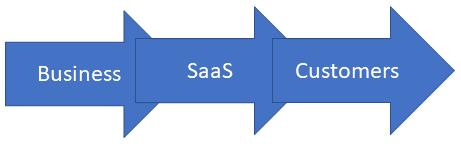
    This isn’t controversial; we still do the dev bit largely before the ops bit; the business has to decide what we want to offer the customer and customers are at the end of the line. And that is the key. Customers are at the end of the line. Now, I get to make you uncomfortable. Nothing in the above diagram matters except the first and last arrows. Think of it like this:

    What’s important in what we do comes down to two questions: “What does the business unit want to offer customers?” and “What do the customers expect of the business unit?” In this sense, “business unit” might be IT and “customers” might be co-workers. That changes nothing. What the business unit offers and what customers want is all that matters. The rest is implementation detail.

    Don’t believe me? It is an easy case to prove. Let’s try this one, with or without IT involvement, depending upon the problem being solved and the organization:

    The business unit determines what they want to offer, customers let their demands be known (one way or another) and the business offers the solution they think fits for the customers. As I said above, the rest is implementation details.

    What is your point?

    This leads me to the inevitable observation. Testing and security are:

    • Completely expected by users. They don’t want buggy software, and they don’t want to enter information assuming it will get nicked by hackers. There is no compromise here; users don’t “kind of want a product that works” nor do they want a product that “might be secure, but we’re not sure.”
    • Desired by the business. They have constraints on what is reasonable–the old meme of a server with the network cable cut is only funny because it shows extremes. But they absolutely do want the product or service they are offering customers to be stable and secure. “We can just spin out a new version” only works so often and for so long.

    So, your toolchains need to include stability and security tools—I would argue at every step of the process, but where and how much is really a business call. My security peeps will get upset that I called security a business call, but it is. You can choose to be non-compliant and insecure; the impact of those decisions on your organization is all on you. OTOH, of all the things that the organization (both the business generally and IT specifically) are focused on, you can afford to drop a few and get security and stability right the first time.

    Meanwhile, you’re keeping things running while we debate things like this. While I repeatedly refer to a large portion of my target audience as “implementation detail,” I’m sure you all know how much I (and many others) appreciate the rockstar job you’re doing keeping the IT org supporting the greater org.