Tag: adopting DevOps

  • DevOps for the Development and Delivery of High-Performance Applications

    DevOps for the Development and Delivery of High-Performance Applications

    Engineering teams that successfully implement DevOps practices often deliver software with higher business value. These organizations can easily identify areas where problematic code exists, quickly eliminate issues and deliver high-performance applications more quickly than their competitors that use traditional delivery methodologies. DevOps practitioners understand that creating an efficient model for performance testing goes hand-in-hand with four key objectives of digital transformation: extending performance testing to new roles; integration into continuous integration/continuous delivery (CI/CD) processes; end-to-end performance monitoring; and continuous optimization.

    Reduce Cycle Time and Time to Market

    In order to meet the requirements of rapid, high-quality application delivery, modern software teams need an approach that goes beyond conventional performance testing. This is where DevOps-centric approaches can provide faster, more efficient development and help ensure the delivery of high-quality software. Building the components of an application using agile approaches and validating features as they are created ensures that applications can be tested and verified more quickly, with no increase in associated costs or resources.

    By adopting DevOps practices, individual steps within the application delivery process can be automated as part of a DevOps tool-chain. For example, automating quality assurance test runs can eliminate – or significantly reduce – time-consuming human or analog searches for defects in code. Test automation can lead to an increased volume and expanded scope of testing, which, in turn, leads to a reduction in the defect escape rate. That saves resources, time and money.

    Shift Left to Increase Agility

    To mitigate performance errors and to address issues as early as possible in the application delivery cycle, tests should be executed during the build stage of the development process. By shifting left – running the tests as early as possible, ideally as part of a code commit – enterprises reduce the risk of discovering defects or issues with the product after significant amounts of development work have been completed. It is widely accepted that addressing defects later in development cycles takes significantly more time and money versus identifying and remediating defects early in the development cycle.

    As developers perform rapid, high quality, incremental changes, business analysts or product owners can more easily share changes, concepts or suggestions with their development teams. This continuous flow of communication can significantly reduce feedback time, increasing an organization’s ability to react to changing market requirements and allowing a level of flexibility within the development process that drives competitive advantage.

    DevOps in a Hybrid Landscape

    By supporting a wide range of tools and technologies, organizations that adopt DevOps practices can support applications that run in a local network environment, in cloud-based environments or, more commonly, in hybrid IT environments. As companies continue cloud migrations and transformations, well-designed DevOps tools can help simplify this transition while continuing to provide support for the legacy applications that provide core capabilities and processing for many enterprises. These hybrid tools are fully integrated into existing application development processes, allowing all application delivery teams to successfully transition to DevOps-centric practices without leaving any teams behind.

    One particularly important DevOps practice is performance optimization through continuous analysis. By using a centralized store and a common approach for quality-centric data collation, this practice helps analyze, enforce and improve the connections between software developer, CI Build and end-to-end performance testing to ensure a “quality first” mentality and higher-value delivery outcomes. The application of data visualization techniques allows teams to access code – build – test results in real-time and make decisions based on up-to-date insights.

    If DevOps practices are successfully established within a team or organization, they not only support more efficient software development and delivery but also are cost-effective. However, in order to successfully implement DevOps practices, enterprises need to understand and implement both technological and cultural changes. Through a combination of process, tooling and cultural simplification, and aligning teams toward common business objectives, organizations can deliver their end goal of creating high-quality, high-value software that satisfies the needs of the end user. By focusing on the common goal, and understanding the journey necessary to get there, enterprises can do so more quickly and at less cost – a win-win!

  • How Managed Detection and Response (MDR) Solutions Benefit DevOps

    How Managed Detection and Response (MDR) Solutions Benefit DevOps

    Managed Detection and Response (MDR), a relative newcomer in the cybersecurity realm, is starting to have a noticeable impact on enterprises seeking to better secure their operations. Research giant Gartner notes that, “By 2025, 50% of organizations will be using MDR services for threat monitoring, detection and response functions that offer threat containment capabilities.” Despite rising adoption rates, though, much confusion remains about MDR and how it should fit into enterprise IT.

    MDR is typically defined as an outsourced security service that enables organizations to better detect malicious activity over the network. MDR is usually sold as a service, and vendors offer tools and technologies that integrate into a business’s IT to detect and mitigate network intrusions, malware attacks, attempted data theft and other malicious threats. MDR can be a powerful ally in the quest to contain cyberattacks, but only if deployed correctly and leveraged properly.

    Enterprise Benefits

    MDR offers obvious benefits for enterprises, but there’s enormous potential when MDR is integrated with DevOps. Many organizations are turning to DevSecOps methodologies to build cybersecurity into their development and deployment pipelines, and MDR can help.

    “One challenge is that DevSecOps is a term that is poorly defined in most cases, and misunderstood in many others,” said Dave Martin, senior director, product management – threat response at Open Systems. “Some people think of DevSecOps as an extension of a quality assurance department, which means that cybersecurity is mostly an afterthought, and not part of the development cycle. MDR, at least how we do it at Open Systems, brings forth a full-time security operations layer, which includes a security analyst, that can become part of the DevOps team,” Martin said. 

    Martin makes an interesting point. As more organizations attempt to implement DevSecOps, knowledge, along with action, are lacking. MDR has the potential to supplement knowledge and insight into the security posture of the code being generated. Many organizations leave cybersecurity to the network or operations teams, expecting endpoint or network security tools alone to contain threats. However, many threats in the wild may leverage older code, or target unpatched applications. MDR can enable DevOps teams to get ahead of the latest threats by keeping developers informed about evolving threats and vulnerabilities, as well as incorporating tools for continuous cybersecurity into the development and deployment pipelines. One of the core concepts of MDR is providing access to experts that can take action to mitigate an attack. This is an important consideration, according to the Enterprise Strategy Group, which reports that 51% of survey respondents face a problematic shortage of skills in the area of cybersecurity.

    What’s more, MDR becomes a tool to secure the DevOps environment, as well as a tool for developers to make code more secure. “It is critical to find advanced threats, ones that may have bypassed existing security controls, before those threats impact DevOps, yet people need to be made aware of those threats so they are not mistakenly included in the development pipeline,” said Martin.

    Choosing an MDR Provider

    With so many players in the MDR space, choosing a provider that fits into a DevOps and enterprise strategy can be daunting. According to Reports and Data, the global MDR market is expected to grow at a CAGR of 30.4% until it reaches $4.6 billion by 2026. Today, providers number in the dozens, and while many claim they have “complete” offerings, they may not consider the needs of DevSecOps along with traditional network operations concerns.

    There are some important considerations when choosing an MDR platform. For example, visibility of the attack surface is a critical concern. If an MDR provider does not have visibility into all potential attack surfaces, breaches and compromises may still occur. Also, adopters should be keenly aware of how false positives are contained, as well as the level of alert activity. Many cybersecurity solutions can introduce alert fatigue and obscure effectiveness. Automation should be a key part of any MDR solution, as it can help to categorize threats, initiate responses and identify the latest threat trends without human interaction. 

    “MDR should tear down many of the cybersecurity silos that businesses have today, and bring the various pieces of IT together into a unified cybersecurity sensitive culture,” said Martin.

    Ultimately, MDR is about people, processes and technology, and should bring these elements together to ensure success in the ongoing battle against cybercriminals. 

  • AI Everywhere Requires MLOps and NetDevOps to Intersect

    AI Everywhere Requires MLOps and NetDevOps to Intersect

    As xOps workflows become more prevalent in IT, it’s inevitable to see overlap and intersection between them. In networking, NetDevOps has been a hot topic for the past three years. NetDevOps focuses on bringing automation, simulation and validation workflows to network operations. The goal is to reduce errors in production configuration deployment, reduce time to production and create a collaborative workflow across cross-functional teams and network team members.

    MLOps followed a similar trajectory, but with a focus on machine learning workflows. As networking evolves and machine learning and artificial intelligence (ML/AI) start to become more prevalent in all of IT, it’s inevitable that these different operational workflow methodologies start to intersect. NetDevOps evolved out of DevOps, applying lessons learned from software development workflows and applying them to network development. As the conversation shifts to ML/AI, the question currently facing many cutting-edge networking professionals in the data center space is, “Where do NetDevOps and MLOps intersect?”

    The Intersection of MLOps and NetDevOps

    Machine learning and artificial intelligence are most commonly applied to networking in three basic ways:

    • Autonomic networks
      • Intent-based configurations
      • Network devices that self-configure based on contextual information
    • Self-healing networks
      • React to network events to mitigate downtime
    • Telemetry analysis and correlation
      • Take streaming telemetry data and correlate it in a meaningful way

    All the above applications can be implemented in fairly simple ways, and many networks today have at least some variation of these technologies already applied. The challenge is that the majority of these current implementations don’t use true ML/AI. They tend to use decision trees or switch-case conditionals to create conclusions. These conclusions are reached by feeding in a pre-coded set of expected outputs. This requires large datasets, which already exist for fields like image recognition. For instance, it’s fairly easy to confirm the technology is seeing pictures of a banana; although, if the data set is, say, 100,000 images, it may take a very long time to do so manually. ML engineers tend to use existing datasets for this exact reason, but the problem is, few of these datasets exist today in the networking realm.

    Creating a solid, structured ML workflow requires a model that can be trained. This model can iterate multiple times and derive conclusions that do not need to be preprogrammed. In essence, we are trying to create these big datasets ourselves (using automation, of course) instead of relying on existing ones. But to develop such a model, certain foundations are required.

    NetDevOps Foundations

    The first foundation required for ML workflows in NetDevOps is a structured configuration model. This is mostly implemented using automation and standardized data structures. While models like OpenConfig and YANG exist, they are not comprehensive across all features commonly implemented in data centers, so most data models will have to be customized for the use case. Using this data model, and implementing it with automation technology, the ML workflow has an easy way to deploy configuration across an entire network’s fabric without having to configure each node by hand.

    The second foundation required is an environment that allows idempotent configuration iteration so the model can train itself. Idempotence refers to any function you can repeat several times without changing the final result. This is where network simulation is critical. A comprehensive network simulation platform allows the ML system to apply the standardized configuration model, and iterate over configuration evolution. That allows the application to make small configuration tweaks to allow for a nearly unlimited dataset.

    Finally, a good foundation in network MLOps requires telemetry. Historically, telemetry was used as a method to correlate logs and identify problems. Most telemetry solutions have fallen short, though, when it comes to root cause identification and action plan recommendation. These problems are much harder to solve.

    One approach could use a simulation platform to iterate configurations and architectures that eventually lead to matching production logs with simulation attempts. This methodology would train the AI model to identify which triggers affect which nodes. In this methodology, we have two independent tracks; the first to correlating logs to identify patterns and trends in the data, and the second iterating on a network architecture until the logs generated match those from production.

    This solution creates many interesting parallels to existing AI/ML solutions. For instance, iterating on a network would be equivalent to IBM’s DeepBlue learning chess, or AlphaGo learning to play Go. The model trains by playing games, in simulation, against themselves, over and over. With every iteration, they learn something new about how each decision influences an outcome. Given enough iterations, the machines become unbeatable. Matching logs from simulation to production is similar to AI/ML in facial and voice recognition, too. In recognition software, pattern matching is used to train a model that becomes increasingly efficient at identifying images the more data it is fed.

  • 7 Trends Influencing DevOps and DevSecOps Adoption

    7 Trends Influencing DevOps and DevSecOps Adoption

    Enterprise technology adoption trends can be broadly categorized under three pillars: infrastructure, architecture and technology. Let’s explore what these trends are and how they influence DevOps and DevSecOps adoption in tech corporations worldwide.

    Trends in Architecture

    In computing, architecture is the collection of protocols encompassing the utility, structure and execution of software applications. Architecture defines how an application works and determines the function of each component, such as data storage and computing capability, for example. Architecture trends directly influence how technology is developed, which also makes it influential on the field of DevOps.

    Trend #1: Monolithic to Microservice Architecture

    The shift from massive, inflexible systems that limit compatibility to lightweight, nimble software has increased DevOps and DevSecOps adoption. As architectures such as containers become mainstream, it is easier than ever for teams to code, debug and deploy software quickly, and work collaboratively. Microservice architecture offers the benefit of quickly being able to install, run and maintain systems, and is a catalyst to greater DevOps adoption, while containers spur DevSecOps adoption.

    Trend #2: Cloud-First Trend

    Mobile-first, cloud-first development has revolutionized data transportation, security and collaboration, and made development efficient, safe and transparent. This approach leads many organizations to adopt DevOps/DevSecOps.

    Trends in Infrastructure

    In IT, infrastructure refers to software, hardware, networking resources, systems and tools that allow companies to operate and manage their production processes.

    Infrastructure trends also heavily influence both the hardware and software tools companies use for tracking and manufacturing their products, and therefore directly impact their willingness to adopt DevOps and DevSecOps.

    Trend #3: Kubernetes Plus/Minus DevOps

    A significant infrastructure trend that affects DevOps is the increasing adoption of Kubernetes by global technology companies. Kubernetes is open-source software designed to orchestrate the management, deployment and scaling of containers, and  has seen widespread adoption in the tech industry. Kubernetes empowers organizations to be more productive, with an emphasis on security and collaboration. Containers in Kubernetes seamlessly allow multiple teams to develop a project simultaneously. Resource management and transparency are significantly enhanced, bugs can be fixed more quickly and work cycles can be shortened.

    Kubernetes and container management systems also reduce the need for human interaction and facilitate a fully automated, ‘NoOps’ scenario. Kubernetes uses a pipeline architecture approach that makes it easier for developers to use AI and ML tools to analyze, predict, and automate data and work processes.

    Furthermore, Kubernetes sets an infrastructure backed on logging, continuous detection, consistency, and self-healing, making it extremely easy and considerably faster for computers to make sense of the data, potentially eliminating human interaction. The infrastructure established by the trendy Kubernetes technology is both advancing and restraining DevOps adoption in companies worldwide, depending on how the companies implement Kubernetes into their work cycle.

    Trend #4: The Agile Infrastructure Trend

    Agile infrastructure for software development has become the standard for software development, and is perhaps the most influential trend impacting DevOps adoption. Agile, like DevOps, focuses on collaboration, organization, diversifying skill sets to achieve resilience, rapid iteration and self-improving work processes. Adapting to an Agile methodology means each team has members skilled in various disciplines that work in concert. Each product delivered is followed by a feedback cycle. Agile teams in an enterprise are transparent, collaborative and resilient to internal and external conditions.

    Trends in Technology

    Advancements in technology enable new ways of thinking and new best practices. As tech trends change, the work cycles, processes and mindsets also evolve.

    Trend #5: Release & Deployment Automation

    Manually moving software between testing and production environments is an inefficient, painful task that must be repeated every time updates are added, new versions are released or new features are built. But with the rise of release and deployment automation, software companies can entirely automate this process, saving time while boosting reliability. With the click of a button, test code can be automatically converted to production-ready work and deployed to version controls or hosting services. With this use of automation, DevOps adoption skyrockets.

    Trend #6: Site Reliability Engineers

    Site Reliability Engineers (SREs) are in huge demand as organizations strive to create highly scalable and secure software. SREs build robust, reliable software that leverages automation, create self-healing systems that focus on operations and align closely with business imperatives.

    Trend #7: Shift Toward AI/ML

    The evolution of artificial intelligence and machine learning is changing our entire perspective on the development and use of technology. With increasing automation, ML systems can process large amounts of data, make reliable predictions and provide extremely accurate analyses. AI can make use of this data and these predictions to determine what to do next, and create truly intelligent machines that can function with minimal human interaction.

    While this makes systems faster, more autonomous and reliable—which aligns with what DevOps promotes—it can eventually create a NoOps cycle that doesn’t require human intervention. In the short-term, this trend does influence DevOps adoption, but, in the long term, AI/ML could ultimately eliminate DevOps altogether.

  • Unlocking Your DevOps Automation Mindset

    Unlocking Your DevOps Automation Mindset

    In the new digital normal, where remote working has upended conventional software development cycles, the role of DevOps is central. Many enterprises have an accelerated digital agenda, but are often underinvested in rebooting DevOps for several reasons, including a lack of experience and insight into how it can help businesses recover from the new challenges created by the pandemic. This can be a strategic mistake, as real acceleration is driven at the developer level. Here are three ways DevOps automation can help enterprises overcome challenges in product life cycles and excel during this time of flux.

    DevOps Can Accelerate Product Life Cycles to Meet Demand

    In 2015, Adidas released a new line of Yeezy sneakers, which became an instant hit. The company quickly sold more than 2,600 shoes every five seconds. But Adidas’ IT infrastructure could not keep up with demand and crashed, and software developers were unable to find a quick fix.

    Impacted by customer and employee dissatisfaction, Adidas needed a solution to recover from the chaos and prevent future challenges. That’s when the company embraced cloud-native architecture, Kubernetes and DevOps. Today, Adidas’s IT infrastructure has accelerated its software product delivery cycle from once every six weeks to five times a day, while building a more resilient system.

    It is not that Adidas wasn’t aware of DevOps in 2015. The company hadn’t yet invested in educating its teams about the DevOps automation mindset, nor had it made DevOps automation a priority. Adidas needed a shift in culture, one that it brought about by rebooting its DevOps practice. This DevOps success story underscores how an accelerating go-to-market demand needs to be supported by underlying structural and systemic change.

    Today, as the pandemic continues to disrupt software development workflows, I urge enterprises to use this opportunity to reboot DevOps and gain speed, agility and resilience. DevOps can change the mechanics of dependencies between development and operations to reduce friction. By leveraging extreme programming and design thinking in conjunction with DevOps, enterprises can accelerate every segment of the software development life cycle independently, while maintaining resilience and adequate levels of governance. It provides the opportunity to invest in security-as-code (aka DevSecOps) so it is sustainable and scales easily. This also enables enterprises to reimagine software architecture and governance by implementing advanced digital architectures.

    For enterprises on the path to such transformation, there are four key DevOps Research and Assessments (DORA) metrics indicative of their DevOps practice’s success. These are: lead time for changes, deployment frequency, time to restore service and change failure rate. The first two of these could be seen as an “offensive strategy” and the latter two as a “defensive strategy” to measure speed. This means to accelerate delivery, organizations must introduce a faster lead time for changes to production, increase the frequency of new software deployment, shorten the time it takes to restore services to production and reduce the change failure rate to production. As you can see, Adidas needed improvements in all four of these areas to successfully reinvent its performance.

    DevOps Automation Can Reduce Complexities in the Software Development Process

    It took more than four years for BMW, the premium automobile manufacturer, to move from a waterfall software development methodology to a 100% agile, DevOps methodology. Today, 20,000 employees in the company use an agile software development toolchain, allowing them to streamline and synchronize their end-to-end software development. BMW has reduced its time-to-market by 25%, minimize incidents by 30% and gain a 360-degree view of IT.

    Today, enterprises are shifting from waterfall to agile weekly and daily releases. My belief is that every enterprise needs to adopt a 100% agile methodology, just like BMW did. Testing and continuous improvement/continuous development (CI/CD) is key for deploying code in small chunks and reducing merge issues and refactor efforts. Ultimately, this increases developer velocity and decreases lead time.

    The shift from a partial to a 100% agile model requires more than simply senior leadership’s resolve. It needs a dedicated pool of certified DevOps automation consultants, coaches and subject matter experts with experience in SAFE, LESS, Scrum and Kanban frameworks. Best-in-class enterprises and OSS toolchains that cater to DevSecOps, service meshes and omnichannel apps are essential. Simultaneously, agile-based delivery coaching, audits and continuous support to existing and new delivery teams are a must.

    While DORA metrics can serve as a good measure of an enterprise’s DevOps performance, businesses will need tools to assess DevOps maturity, improve developer productivity and provide specific recommendations for improvement. Data will play an important role in decision making and aid every developer’s performance, more than at any time in the past.

    Automation Makes Room for New Product Development

    Many software development teams struggle to keep up with the onslaught of new technologies entering the market. Take, for instance, artificial intelligence (AI); the number of applications built using AI is rapidly increasing. However, it continues to be new to many development teams. A similar story unfolds with Internet of Things (IoT), which creates complex systems with information pouring in from thousands of sensors and appliances every second with multiple software and hardware configurations. Testing these devices, configurations and performance cannot be done manually. This is where a DevOps automation mindset can help. It can ensure quality assurance processes have considerable test coverage across these different technologies and configurations by introducing automation.

    Newer technologies, such as Kubernetes, serverless apps, 5G, edge and cloud computing are increasingly used in product development, making DevOps even more important today. DevOps also plays a key role in transforming the developer experience. Today, developers need the foundation of agility, decision-making power and speed to deliver solutions on-demand. To facilitate this, enterprises must automate the management of development, testing, quality assurance and IT operations to successfully build continuous delivery processes. Further, given COVID-19 and the shift to working remotely, DevOps can help product teams collaborate remotely, leveraging well-established platforms available with any of the major cloud providers.

    As enterprises accelerate and adapt to work in this new normal, leveraging both the cloud and a remote workforce, a DevOps Automation mindset can speed up this transition. Enterprises must assess performance and enhance capability at the developer level to truly accelerate the journey to digital transformation.

  • Review, Review, Review

    Review, Review, Review

    Ossification is an issue in IT, and always has been. It is borne largely out of staff and management knowing what to expect from existing software/infrastructure, and the deep product knowledge that allows teams to make existing systems do what is needed. But this becomes a series of rocks that the ship of progress smacks into.

    Contrary to popular belief, DevOps and other new methodologies are not immune to this problem. Quite the contrary, we’ve spoken with people that say “We’re a Jenkins shop,” which sounds exactly like “We’re an Oracle shop” of a decade ago. The wave just ushered in new tools, it didn’t change tendencies. OK, it did more than usher in new tools, but it didn’t change tendencies.

    So, it’s time for a friendly reminder: Review what you are doing, review cloud usage, review tools in the toolchain, review methodologies, review security posture (which has suffered in this environment for far too many shops) and review customer satisfaction.

    Many organizations used the push of Agile and DevOps to update stagnant parts of the infrastructure and development toolsets. Don’t let them become stagnant again. Just as you don’t want change for the sake of change, you don’t want to stay with one tool or methodology just because it is comfortable.

    This isn’t some easy task that I ⁠— or anyone else, no matter how much they try to tell you differently ⁠— can dictate to an organization. There isn’t a handy list, because no two organizations are exactly the same. Not in toolsets, not in culture and not in appetite for risk. The only thing we can offer is guidance to look closely at where you are, what’s available in a given area ⁠— Application Release Orchestration, for example ⁠— and evaluate the available tools just like you were making a fresh choice and did not have a tool in place. Then do the same for processes. Is this the best process for what we’re trying to achieve? Are there tweaks we can make to it? Should we completely change the process to take in changes in environment that have happened since we adopted this process?

    Finally, if you don’t have someone responsible for monitoring cloud costs, appoint someone. Get them the tools, help them understand where the money is going and what cloud-based server usage is. Could these servers be spun down outside of business hours? Could we follow the sun better by staggering cloud data centers in which cloud servers are active, rather than hosting them always in one location or leaving them on 24/7 in multiple locations? Is one team using a cloud feature no one else is? If so, how does it apply, and are the other teams not using it because they don’t need it, or is there some other solution they’ve adopted?

    Basically, question everything. We’re launching a new project that will be a simple dynamic app. Make a few selections from a limited list, get a summary of what you should do and why. It is all really quite simple. Should we host in a web page or make it a standalone mobile app? If mobile app, what tools for development and what targets? Integration of Git — should it be local or on one of the big providers? Do we want any team member to trigger builds on commit or do we want someone managing branch merging before-hand?

    These are all things we already do on other projects, but we’re digging in and seeing what could be better. What could we improve, and what would the rewards for that improvement be? It takes a bit of time and some discussion. We’re confident we’ll burn through it in the next day or so and come up with a plan for development and architecture that best suits the app, but is informed by where we’re at now. It’s been a fun exercise, to be honest. If nothing else, it gave us a strong reminder that any given cloud provider’s “simple” pricing is not that simple, and we need to pay more attention to app characteristics versus fees.

    You’ve rocked it this far, even kept the lights on during the great shift to working from home. Don’t stop improving the environment though, find innovative ways to make it better and keep clipping along.

  • The Role of DevOps in Custom Software Development

    The Role of DevOps in Custom Software Development

    Hundreds of tech giants and big retail companies such as Etsy, Netflix, Amazon and Target have adopted an ecosystem called DevOps. It establishes a good collaboration between cross-functional teams such as development and operations which simplifies the processes. DevOps has calibrated a new standard for building custom applications.

    Do you know any predefined technique to check whether developers have adhered to all coding principles? A quality check is not the right answer. What if you want to check and optimize their entire system of writing code, understanding the project and following coding guidelines?

    You must have dug into the details of not being able to accomplish the projects before the deadline. Well, there is not a single reason for this failure. There is a need for restructuring the entire ecosystem of project development, which will include polishing of coding rules, eliminating duplicates of code, unit tests, bug removal and understanding and improving the project architecture. DevOps aims for such a practice that includes neat coding, bug-free testing and the fastest deliverables.

    This blog explains everything about how DevOps plays a significant role in custom software development and makes a super-productive project development environment.

    The term “DevOps” is the combination of two different terms: development and operations. Thanks to Patrick Debois and Andrew Clay Shafer for originating the idea of DevOps in 2008. They have altered the traditional techniques of software development. Gone are the days when the software was written once and used for years. For the era of rapid software development and extreme personalization, you need smart software that updates in seconds.

    Custom Software and DevOps

    Now is the time where generic needs seem limited and are absolute off-the-shelf in the software industry.

    DevOps is the process of creating custom software that fulfills everyone’s demands in no time. It chooses to streamline the project development phases by automating the process, making faster deliveries and upscaling the software quality in the world of high-end customizations.

    How Does Automation of Software Development Plays a Predominant Role?

    Software development life cycle comprises of various components such as time, manpower, expenses, knowledge resources and problem-solving capabilities. It continuously evolves around bringing a unique solution that stays reliable over time.

    The optimization of the expenses, time and manual efforts is possible using the automation of SDLC. Especially when customizing the features, manual efforts make the tasks tedious and slow. Automation overcomes these drawbacks and makes customizations super easy to fulfill.

    Automation testing has carried out the responsibility of making project development glitch-free, as it detects the errors at a much faster pace. For instance, a custom software/application, such as the social media platform Instagram, carries a lot of features and functionalities to add. To make this a glitch-free development, automated test runs stand as the rock-solid solution.

    DevOps not only improves the programming practice of the coders but also scrutinizes the testing. It streamlines communication among the coders, front-end engineers, clients and project managers. Thanks to its immediate nature of validation and rectification.

    The automated workflow of SDLC saves a lot of business expenses as it requires less time for rebuilding the applications. Also, it optimizes the time required for running the manual tests. It brings in the high quality of work that decreases the glitch fixing need and hence, reducing the overall project costs of custom software.

     How Is Continuous Delivery or Faster Delivery Important?

    Continuous delivery means delivering the small chunks of code a developer has built, in short cycles. It lowers the project development costs significantly of custom software as the hidden fixed costs with the primary release of projects will not exist.

    Smaller release, smaller risks. Yes, there will be nothing like once the project delivery has been done, you can not opt for a small change request as a part of the suggestion. Because the deliveries won’t stop when you opt for custom software development. This sort of development is required to adopt changes very fast and hence, needs deliverables to be delivered at a faster pace for the rapid feedback implementation and live changes.

    So, hypothetically, you will not need to be afraid of how it will turn out. For instance:

    1. Amazon deploys code at every 11.7 seconds.
    2. Popular social media platform Instagram follows the same practice 30-50 times a day.
    3. Netflix pushes its code thousands of times a day.

    What led them to this?

    • To avoid bad commits.
    • Freedom to deploy the code whenever possible.
    • Avoiding the mess for going through the thousands of deploys for one error.
    • To speed up the work and make changes in seconds.
    • To respond to users unpredictable queries and turn it into a feature.

    This can be easily achieved through DevOps in custom software.

    There are many reasons for more occurrences of deployments. All the reasons lead one focus (i.e., faster delivery for custom software and small but speedy updates for the custom software that is used by millions of people online).

    Faster bug fixes and updates are the new demand for sure. All thanks to DevOps methodology. The most valued part is, developers and delivery managers will come to know users’ preferences at the very early stage of development. As the project goes on, there will be zero chances of bug generation and a smooth operation will be established. 

    Thus, the successful glitch-free customized software development is possible with a DevOps strategy. The teams will get to learn from peers and end-users about the project at an earlier stage using DevOps.

    Responsiveness Is the Best Software Quality 

    The main advantage of the DevOps technique is its quick responsiveness to clients’ feedback and rapid execution.

    If you can quickly look into the client’s feedback in the small chunk of code you’ve submitted, you can respond to them faster. Thus, can lead the fastest execution possible.

    The integration of a quality assurance team will add a lot of potential in improving product quality.

    Responsiveness plays a crucial role in decreasing the frequency of a module collapsing (i.e., maintains the module dependency because of the continuous delivery and quick implementation of feedback).

    Purpose and Role of DevOps in Custom Software Development

    You need a super key to stay ahead of competitions and it always comes by streamlining the process. Be it a business revenue, cross-selling of products, increasing the target market and anything that comes up with competitors.

    DevOps is that key here. Yes, you read it right. Bring in this methodology at your information technology firm to witness the enormous growth.

    Custom software development has become pivotal in the IT industry. To create the best-customized experience, consistency is required. That is the reason why DevOps is gaining popularity so fast. DevOps is the master key to connecting resources with the same thread. 

    You might have wondered how Netflix updates and personalizes the experience for everyone so rapidly. Netflix does thousands of deployments per day. That’s the reason it can give its users a top-quality personalized experience. 

    “The rate at which this entertainment game-changer has adopted new technologies and implemented them into its DevOps approach is setting new standards in IT,” said Coman Hamilton, editor at JAXenter.

    Netflix had started nailing this modern approach from 2015 itself. Now you can understand how technology has come so far approaching 2020. So, what next doable thing is up for today’s need for deployments using DevOps?

    DevOps is an exemplary technique that enables IT to showcase its power. It empowers the dynamic nature of custom software and stabilizes the work environment by keeping everyone on the same page at all instances of time.

    For a company to be responsive and relaxing throughout the year without overloading the work, adopting DevOps is a must. The purpose of enabling development and IT operations together serves as time-saving and an in-budget procedure of building applications with the utmost quality.

    Where to Start?

    DevOps is not a new software to learn or a new framework to set in. It is the way of working and adopting it—everyone must be involved. Educating resources is important when you are planning to adopt a big change. Conduct a conference, state the pain areas and showcase the possibilities with DevOps. You can start with teams that have great adoption skills, the ones who can take challenges and are ready to learn.

    Essentials to Consider for the Best Practices of DevOps Implementation

    Breaking the Silos

    If you want to make DevOps an organizational practice, you will have to first break down the functional silos. As DevOps will make everyone come closer, the communication gap among the teams will not be questioned. In an information technology organization, the more communication engineers keep, the more successful they will be in project development.

    Make this a daily practice, “exchange of ideas is an exchange of solutions.”

    Using the Right Tools

    There are several tools to help your team automate the process and track down the work done. You will need a tool such as Jira when entering a DevOps environment. Also, choosing the right tools for the right needs is necessary. For example, Jira is a very good tool for tracking the issues and for managing the projects, while Querysurge is used to perform continuous testing and data analysis purposes.

    As per the project and company needs, one can go for the right set of tools to use. Make your organization resourceful with the automation and project tracking tools that are already overcoming manual efforts.

    User-Centric

    Adopting DevOps is a cultural change and it listens to its end-users. The end-user of any particular industry will want the best features and robust functionality. Firms will have to step in with the altering demands and stay committed to user satisfaction. Start making customer-centric applications.

    Automation at Its Best

    As we know, DevOps detects diseases at an earlier stage. It has the lowest percentage of risks involved as it uses automated testing of a small snippet of code. Keep it in a practice to code and test. It will automatically follow the test-driven development practice used in agile teams. Use the most of automation practices that eliminate the slow process of software development. This way the teams get faster development completions without any hampering of deadlines.

    Conclusion

    You may end up thinking DevOps works for IT firms and is not going to help non-IT industries or businesses. It’s not like that.

    Think about the software you have used for years in your non-IT firm. Are you using a software that drives your business but it’s not up to date? Think about customizing it to improve the way it works. These customizations come from experienced custom software development companies. Prominent companies are nailing DevOps nowadays.

    — Hardik Shah

  • The Role of Bots in DevOps

    The Role of Bots in DevOps

    DevOps has evolved from its infancy into a mainstream focus area for a majority of CIOs. DevOps has become a main focus and has been shaping the world of software and infrastructure engineering and operations for the last few years.

    Some of the key DevOps trends include:

    • DevOps assembly lines automation.
    • Smart, actionable alerts from monitoring tools.
    • Monitor and orchestration infrastructure.

    Improved Collaboration

    With the increase of DevOps adoption, organizations today face many challenges in the end-to-end service delivery life cycle.

    • For applications with complex environment configurations, creating, setting up and deploying a new environment is costly, time-consuming and prone to errors.
    • Due to manual interventions, moving/promoting code across environments involves risks and may give rise to outages.
    • Development teams are looking to maximize change by writing new code or enhancing existing code, while operations teams are looking to minimize change to keep up with key performance indicators (KPIs) and service level agreements (SLAs). These goals are opposing in nature and create a culture of blame between dev and ops teams.
    • Organizations are unable to keep dev, test and production in synchronization due to process and tool gaps. A manual process cannot bridge this gap in consistency; thus, outages in production are common.

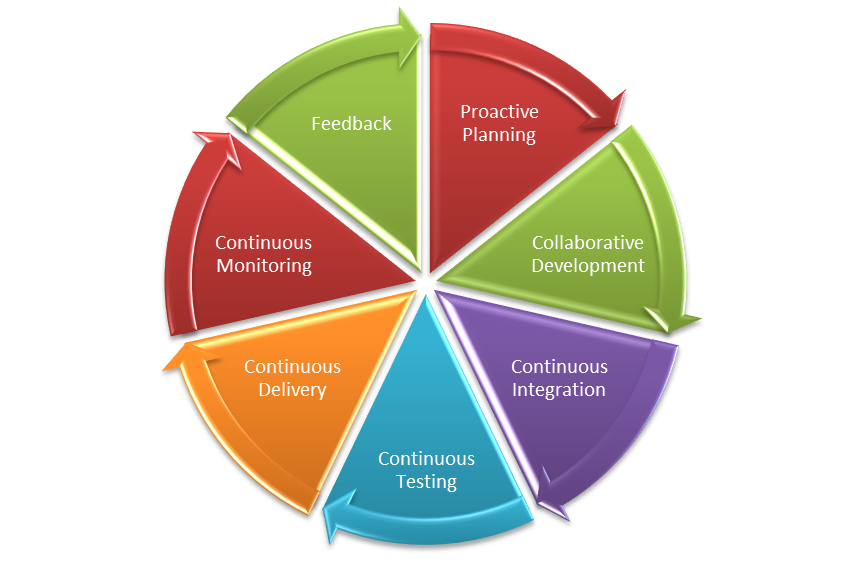
    Various collaboration mechanisms let teams work and learn together to produce better results. The figure below depicts the end-to-end life cycle of DevOps. Collaboration across the phases is essential to the success of your enterprise DevOps transformation.

    DevOps Lifecycle

    What are ChatOps and Bots?

    ChatOps is a term coined by GitHub to describe “putting tools in the middle of a conversation.” In a typical CI/CD pipeline, there are multiple tools that you interact with that have varied functionalities, such as source code management (SCM), defect management, continuous integration, continuous deployment and others. These are all discrete tools, but there is nothing that bridges them together. This is where ChatOps comes into play.

    A bot is a bridge between the collaboration tool and the DevOps tools. The bot receives a request from the user in the form of a chat command through a collaboration tool, analyzes the request and executes a set of commands on the target DevOps tool.

    The main components of ChatOps and bots are:

    Chat app/collaboration tool: This is the front-end chat system that connects the various stakeholders and enables them to interact between themselves and the systems around them.

    The bot: This is the core of ChatOps. A bot is the glue between your collaboration tool and your systems. It facilitates a two-way communication channel where you can fetch relevant information from the systems and act on the information received. A bot fits in between your collaboration tool and the DevOps tools, e.g. Hubot, Lita, ErrBot or AWS Lex.

    Target platform/infrastructure: Integration with the target platforms/DevOps tools is a key ingredient to a successful implementation of bots. These are the target tools and platforms on which the bot will execute the required commands. The tools integration allows your bot to communicate with tools and execute actions such as build, deploy, test, provision and scale infrastructure directly from the chat window.

    Where Bots Fit in the DevOps Pipeline

    Bots can prove to be an accelerator in various stages of the CI/CD pipeline. Below are the details of the integration with various DevOps tools in each phase of the life cycle:

    • Proactive planning – JIRA
    • Requirements management – JIRA
    • Continuous integration – Jenkins
    • Continuous deployment – Ansible, Chef
    • Continuous monitoring – Nagios, Grafana, Splunk
    • Continuous feedback – JIRA

    A chatbot plays a major role in bringing the different teams together into a single, persistent chat room to triage and resolve the issue at hand. In addition to just troubleshooting and triaging issues, bots can be used for various other business-as-usual jobs including:

    • Cleaning up servers.
    • Kicking off build and deployment jobs.
    • Rotating server logs.
    • On-boarding application on the monitoring tools.
    • Collecting metrics from tools such as Nagios or AppDynamics.

    Bot Technical Blueprint

    To achieve the aforesaid targets, we need to have a supportive bot platform in place. How closely the tools integrate with the bot ensures the quality of the implementation and opens new opportunities of automation.
    Bot Blueprint
    As the diagram depicts, the chatbot is hosted on a chat tool such as Slack. This can be on the cloud platform or an existing chat/communicator application. The bot is integrated with a key-value pair reference database, which is fed with the responses depending upon the activities or capabilities that have been fed to it. The key could be the name of the application to retrieve data from or any unique ID that would reduce the number of reads. A lookup of the defined key corresponding to the secondary key is performed on the response database and a response is sent back to the chatbot. Depending upon the number of outputs, the queries can be defined and stored in the response database.

    DevOps Bots: Use Cases

    Below are some examples of use cases for bots. This includes the complete life cycle of DevOps:

    Proactive Planning
    Create new user stories in sprint planning tools and assign sprints to teams. Update sprints and product backlogs.

    Build and Continuous Integration
    Execute build jobs and report back statistics of the build job. Perform daily/nightly builds and report on the status of the build to the relevant teams.

    Continuous Deployment
    Run deployment jobs and perform deployments across environments. Roll back deployments in case of failures, status checks, perform post-deployment actions such as JVM restarts.

    Infrastructure Provisioning and Configuration Management
    Kick off Chef jobs to provision infrastructure or provision application environments. Enable monitoring and restarting services and servers.

    Continuous Monitoring
    Provide application statistics or performing daily data lookups and grabbing metrics.

    Continuous Feedback
    Monitor application health and perform analytics.

    Key Measurement Metrics

    To achieve optimization and enhance performance of the continuous delivery process, metric measurement is the key. These indicators will help in taking certain corrective and preventive actions based on the results. Below are some of the key metrics indicators that can be measured.

    Effort Reduction
    Indicates the reduction of human/manual efforts for tasks such as triggering a build or deployment or collecting metrics from monitoring tools.

    Human Error Reduction Rate
    Reduction in the effort required due to rework caused by human errors.

    Reduce Issue Triaging time
    Indicates the time taken to resolve issues where multiple parties are involved and triaging of problems is required.

    Conclusion

    DevOps bots can significantly improve team efficiency, as well as a team’s ability to respond to emergencies. They save time and money, are fun to build and use and can have a positive impact on team morale, as well as increases the overall productivity of teams. This applies to both the engineering and operations teams. Enterprises embracing digitization are looking for partners with an engineering mindset who know how to bring in collaborative agile teams with the very latest knowledge of open source platforms and DevOps toolchains.


    Contact the Authors

    For more details please contact the authors on LinkedIn @
    Shriniwas Sathe
    Saswati Mohanty

    — Shriniwas Sathe

  • Agile vs. ITIL: Two Divergent Paths to DevOps?

    Agile vs. ITIL: Two Divergent Paths to DevOps?

    Truth be told, there are dozens of different frameworks in existence and all have their unique perspectives on how a project is managed and executed. Frameworks such as Agile, ITIL, lean, cobit, six sigma and many others were built on an ideology of following a path defined by best practices.

    With DevOps, two of those frameworks, Agile and ITIL, have become the basis for arguments on how to do DevOps correctly. Yet, until recently those frameworks were very different in the paths offered to bring about project success. With the announcement of ITIL V4, things have changed a little: ITIL is becoming a little more like Agile, adding to the confusion of what path makes the most sense in the world of DevOps.

    A Quick Glance Backwards

    The foundations of DevOps were built upon the ruins of non-iterative application release cycles. Or look at it this way: DevOps is all about not taking a plunge over the waterfall. While those observations are little more than metaphors for something that rings true, DevOps has brought a new paradigm to software development and deployment. A new paradigm that comes with its own recommended practices.

    Yet, current DevOps practices—or let’s call them rules—can come up short in the modern enterprise, meaning that other management best practices—such as those illustrated in the Agile and ITIL methodologies—are borrowed to drive DevOps further forward. That said, the common DevOps ideology is built around a few foundational practices that define the framework of DevOps. The primary goal here is to bring application development and operations together as a functional team. Some of the generic best practices include:

    • Implement collaboration and teamwork tools to improve communications as well as improving the ability to share knowledge, ideas and automatically document interactions. Simply put, incorporating teamwork with an audit trail goes a long way toward bringing order to DevOps.
    • Incorporate tools to capture requests. One of the most important capabilities delivered from DevOps is the ability to adapt to change. Traditional application development frameworks are usually based on waterfall processes, where everything is defined at the outset and then an application is eventually delivered. Waterfall ideologies offer no leeway to adapt to change in the middle of a development cycle. DevOps eschews those limitations by incorporating the understanding that change is constant. However, requests for changes must be recorded, tracked and reported upon.
    • Adopt a framework ideology that can match workloads to team capacity. In other words, team leaders and managers need to have a clear view of what work is in progress and the context of that work as it applies to a team’s abilities.
    • Use systems to log metrics on automated and manual processes, which will give insight into productivity, as well as identifying where improvements can made.
    • Implement test automation. The idea here is to automate the testing of code using test data in a sandbox environment. Code that passes the tests can be forwarded further along the DevOps process, while code that fails is automatically returned to developers for correction.
    • Use a continuous feedback system in which a chain of communications can be established to keep developers and operators informed of the status of any issues, as well as change requests and the progress of any code through the framework.

    While the above best practices are simplified representations of a full DevOps framework, they do establish that DevOps relies heavily on collaboration and iterative processes to support the ideology of continuous development and deployment. Now, comparing the DevOps ideology to what constitutes either Agile software development practices or the ITIL Framework brings up some additional questions and establishes that Agile and ITIL may very well have different goals. A more simple way of looking at it is to think of Agile as a set of practices to provide faster software delivery, while ITIL is a framework squarely focused on processes and not practices.

    The Path Becomes Muddy

    Therein lies the real dilemma of establishing a path to DevOps using either Agile or ITIL ideologies. ITIL is designed from the perspective of the governance of IT service management and establishes a framework that supports continuous measurement and should deliver improvement of the quality of IT services. Agile is a set of processes designed for software development that meets the needs of customers and cross functional teams.

    Interestingly, Agile and ITIL prove to be complimentary in the world of DevOps, where ITIL can be used to ensure quality and value while Agile brings forth a continuous stream of improvements in applications. Ultimately, with the arrival of ITIL V4, Agile and ITIL will become more aligned with each other and offer benefits to DevOps.

    — Frank Ohlhorst

  • Containers: All Your Base are Belong to Us

    Containers: All Your Base are Belong to Us

    The world is still changing. No surprise there, but the direction and velocity have been modified by the growth of container usage. Back in 2015, we at devopsy.kinsta.cloud showcased a survey we performed that said container usage was staged to take off. That it did, with a vengeance. No matter the category—pilot programs, test, production—it seems to have a greater penetration each year.

    And why not? There are a whole collection of benefits to containers—smaller footprint than VMs, more portable than cloud instances, more agile than … well, any of the alternatives. And the weaknesses—the use (and abuse) of IPTables and persistent problems with persistent storage—are being addressed at a rapid clip.

    But It’s Not All Roses

    Sorry to say that there is, as always, a fly in the ointment. We have to identify weaknesses in new architectures to plan for them and overcome them. And container infrastructure is not immune to this process. Nothing is perfect.

    The first problem is with overall security. Your container management system is now the center of the world. A single point of penetration that could yield dozens to thousands of infected servers. It is like a magnet to ne’er-do-wells. Protect it, lock it down, follow advice on Container Journal and Security Boulevard about how to keep your system as protected as possible.

    That was the easy one. We have a ton of experience protecting important central systems.

    The more difficult ones all revolve around your physical infrastructure and where it meets your virtual container infrastructure. Look at all the boxes in your data center and the services they provide, then map out how those services integrate with your containers. Once you’ve mapped them, work the mappings into your DevOps projects. Load balancing and storage provisioning are two areas in which what a traditional DC does is duplicated inside the container environment, and where that processing is to occur should be a conscious choice about what is best for the application, not a decision based on what is easiest/in front of you.

    It is an (arguably) bigger issue with storage. Just because the container can grow or shrink its internal storage does not make it the right place to position a fair selection of your data. Think about what will be needed in the future—with or without the application that this container or container set represents—and make a conscious choice about what is ephemeral data that can go away should an instance die versus what is needed long-term. Work those choices into DevOps processes. It can be a pain to access persistent data that is remote to a container, so make the painful parts automated via your DevOps processes.

    Both of these problems are compounded in most (but not all) cloud environments. Too much cloud functionality is designed to lock users in. While that has been a standard practice in IT for decades, the problem with containers is that they are inherently portable. Build them to be so. Yes, lock-in functionality always brings benefits, but mobility lets a team choose where best to deploy a container system with each inflection point (purposely being vague here—a highly agile/DevOps shop could have daily inflection points, while a single team just piloting containers in their DevOps environment may only have them on occasion when something large changes with the system). Should something change at a preferred cloud vendor that makes them no longer preferred, the fewer modifications required to move to another platform the better. So building default container/container management into the DevOps toolchain is preferred to building in vendor-specific options when a choice is available. Storage is an easy one to point at and say “choice might not be available.” Allocating disk is not very portable between platforms, but if that’s one of only a handful of things that must change, portability is still an option.

    In short, containers are coming, and they’re coming fast. Build them into your DevOps toolchain as portable solutions that automate the worst of the speed bumps. Make conscious choices about where infrastructure-based functionality should reside, and implement based upon those choices.

    And keep rocking it. If moving from any other environment (with the arguable exception of cloud), containers will be faster to spin up and to spin down. Just address the issues before they hit you, and all will be well.

    — Don Macvittie