Category: Compliance

  • What is the NIST Cybersecurity Framework?

    What is the NIST Cybersecurity Framework?

    Cybersecurity threats are easier to handle when you have a framework to build off of. That’s why NIST developed the Cybersecurity Framework. Learn more.

    What You Need to Know About the NIST Cybersecurity Framework

    The National Institute of Standards and Technology, or NIST, helps organizations to better understand and manage their cybersecurity risks. NIST does this through its Cybersecurity Framework.

    The 5 Elements of the NIST Cybersecurity Framework

    There are five central elements of the NIST Cybersecurity Framework:

    1. Identify
    2. Protect
    3. Detect
    4. Respond
    5. Recover

    The 3 Components of the NIST Cybersecurity Framework

    In addition to the five main elements of the NIST Cybersecurity Framework, there are also three essential components.

    Framework Core: The Framework Core provides you with a set of activities to help you achieve specific cybersecurity outcomes. In order to help you achieve each activity, the Framework Core provides you with examples.

    Implementation Tiers: The Implementation Tiers provide you with an outline to increase the sophistication in your cybersecurity risk management.

    Framework Profiles: The Framework Profiles outline your cybersecurity activities and provides a look at the potential cybersecurity outcomes needed to meet your cybersecurity goals.

    How to Use the NIST Cybersecurity Framework

    In order to use the NIST Cybersecurity Framework, you must follow these three steps:

    1. Determine the appropriate implementation tier.
    2. Understand the gap between its current and target profiles.
    3. Put plans in place to implement the activities from the Framework Core to move toward the target profiles.

    The CIS Controls for NIST Cybersecurity Framework

    The Center for Internet Security (CIS) regularly publishes CIS Critical Security Controls that map to the NIST Cybersecurity Framework. While there are many sections to the CIS Controls, the most relevant is CIS Control 18, Application Software Security. The section recommends the following actions:

    1. Establish secure coding practices.
    2. Ensure software development personnel are trained in secure coding.
    3. Apply static and dynamic code analysis tools.

    To read more, please visit: https://www.perforce.com/blog/kw/nist-cybersecurity-static-analysis

  • What Is OWASP?

    What Is OWASP?

    With cybersecurity attacks rising, it is important for you to enforce secure software best practices, like OWASP and the OWASP Top 10. OWASP helps you to safeguard your code against software security vulnerabilities. Continue reading to learn why OWASP is important.

    What You Need to Know About OWASP

    The Open Web Application Security Project (OWASP) is an international nonprofit organization that educates software development teams—like yours—on how to conceive, develop, acquire, operate and maintain secure applications. Each of OWASP’s materials have been developed to improve your application security through your team, your processes and your technology.

    What You Need to Know About OWASP Top 10

    The most well-known OWASP resource is the OWASP Top 10. Every year, a team of security experts updates the OWASP Top 10 to include the 10 most critical web application and API security risks.

    The 2020 OWASP Top 10 is as follows:

    1. Injection
    2. Broken Authentication
    3. Sensitive Data Exposure
    4. XML External Entities (XXE)
    5. Broken Access Control
    6. Security Misconfiguration
    7. Cross-Site Scripting (XSS)
    8. Insecure Deserialization
    9. Using Components with Known Vulnerabilities
    10. Insufficient Logging and Monitoring

    Here Is Why OWASP Is Important

    OWASP and the OWASP Top 10 is important as it provides you with the following three benefits:

    1. It helps you to safeguard against cybersecurity vulnerabilities.
    2. It helps you strengthen software encryption.
    3. It helps you reduce the number of security errors, bugs, and defects in the code.

    Why a Static Code Analysis Tool Is Beneficial for OWASP

    One of the most effective practices for enforcing OWASP is to use a SAST tool. A SAST tool helps you to enforce secure coding standards and best practices. In addition, a SAST tool is able to flag security violations and provide you with guidance on how to fix those vulnerabilities and weaknesses.

    To read more, please visit: https://www.perforce.com/blog/kw/what-is-OWASP

  • What Is PA-DSS?

    What Is PA-DSS?

    If you develop payment application software, you must ensure that it is secure and compliant with PA DSS. Read on to learn more about the payment application security standard.

    What You Need to Know About PA DSS

    The Payment Application Data Security Standard (PA DSS) is a part of PCI DSS and is a global security standard. PA DSS applies to the development of payment application software. What’s more, if you are a software vendor that makes and sells payment applications, you must comply with PA DSS. This is to ensure the security of all of your software components. Compliance is essential because if you do not comply, you could receive massive fines.

    Important Requirements for PA DSS Compliance

    The PA DSS requirements apply to the storing, processing and transmitting of cardholder data and sensitive authentication data. There are 14 requirements that every organization that handles credit card information must follow:

    1. Do not retain full track data, card verification code or value (CAV2, CID, CVC2, CVV2), or PIN block data.
    2. Protect stored cardholder data.
    3. Provide secure authentication features.
    4. Log payment application activity.
    5. Develop secure payment applications.
    6. Protect wireless transmissions.
    7. Test payment applications to address vulnerabilities and maintain payment application updates.
    8. Facilitate secure network implementation.
    9. Cardholder data must never be stored on a server connected to the internet.
    10. Facilitate secure remote access to payment applications.
    11. Encrypt sensitive traffic over public networks.
    12. Secure all non-console administrative access.
    13. Maintain a PA-DSS Implementation Guide for customers, resellers, and integrators.
    14. Assign PA-DSS responsibilities for personnel. And maintain training programs for personnel, customers, resellers, and integrators. The Steps to Achieve PA DSS Compliance.

    There are five simple steps in order to comply with PA DSS:

    1. Comply with Requirement 5, which outlines the process for how to develop secure payment applications.
    2. Apply coding standards, such as OWASP, CWE, and CERT.
    3. Train developers in secure coding.
    4. Use a SAST tool to enforce PA DSS requirements automatically.

    To read more, please visit: https://www.perforce.com/blog/kw/what-is-pa-dss

  • 5 Ways to Accelerate Standards Compliance With Static Code Analysis

    5 Ways to Accelerate Standards Compliance With Static Code Analysis

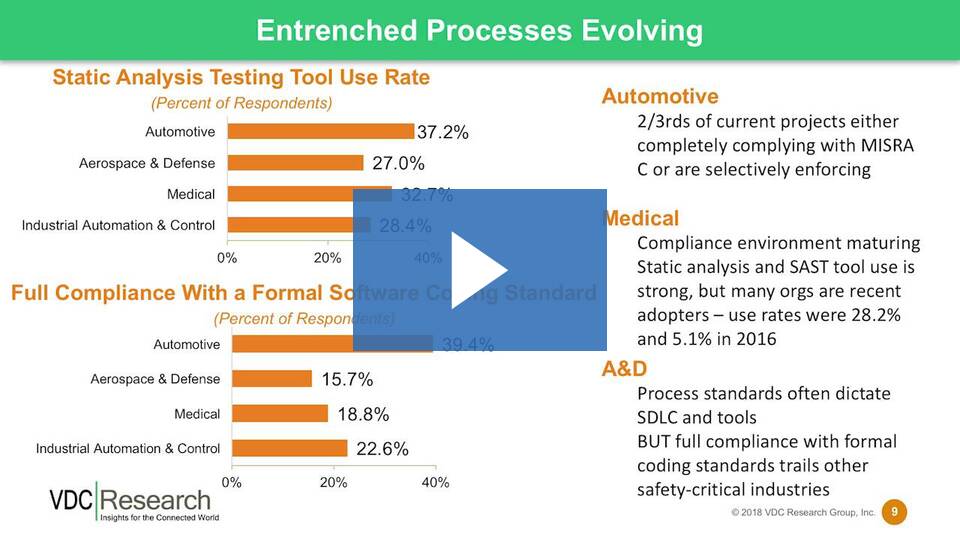
    In mission- and safety-critical industries, static code analysis is essential to facilitating the development of robust and reliable software. However, according to VDC Research, a B2B technology market intelligence and consulting firm, only 27% of embedded developers report using static code analysis tools. This raises an important question: Why is the adoption rate for static code analysis tools so low, when they are more effective than manual code reviews at finding coding errors, weaknesses, and vulnerabilities?

    In this webinar, we’ll answer that question, as well as explain how to effectively implement a static code analysis tool in your software development process. In addition, our presenters will review the results of the VDC Research paper on software development trends, techniques and best practices for standards compliance within embedded software development teams.

    Three key takeaways from the webinar include:
    1. Understanding trends for standards compliance.
    2. Identifying common challenges for automotive, medical, industrial automation and other types of embedded software applications.
    3. Learning best practices for achieving compliance using different tools, techniques, and processes.


    To read more, please visit: https://www.perforce.com/webinars/kw/5-ways-accelerate-standards-compliance-static-code-analysis

  • What Is ISO 21434? Compliance Tips for Automotive Software Developers

    What Is ISO 21434? Compliance Tips for Automotive Software Developers

    What Is ISO 21434? Compliance Tips for Automotive Software Developers

    To read more, please visit: https://www.perforce.com/blog/qac/ISO-21434-Compliance

  • Software Safety vs. Security: What’s the Difference?

    Software Safety vs. Security: What’s the Difference?

    When developing software, you must ensure that that it is both safe and secure. But what is the difference between your code being safe, and your code being secure? Here, we discuss the differences between the two, and explain why you need to ensure that your software is both safe and secure.

    The Difference Between Safety and Security

    The most significant difference between safety and security is this: Safety means no harm is caused — deliberate or otherwise — while security means no deliberate harm is caused — at all. However, there are other important differences.

    Code Security Prevents Cyberattacks: Code security is about preventing unwanted or illegal activity in your software.

    Code Safety Ensures Reliability: Code safety is a broad term that indicates whether software is reliable and safe to use.

    Security Helps Achieve Safety: Security is a means to achieve safety.

    How Coding Standards — Like MISRA — Drive Software Safety

    Safety is essential to industries, such as automotive, rail, medical device, and aerospace and defense. For years, MISR coding guidelines have helped developers in those industries keep high-reliability systems safe. In addition, the MISRA C:2012 Amendment 1 outlines security measures to help you identify and avoid common security vulnerabilities in your software systems. While coding standards don’t provide you with foolproof security, they do help you to ensure that your code is reliable and maintains high quality.

    How to Enforce Software Safety and Security

    The most effective way to enforce software safety and security is to use a static code analysis tool. In fact, MISRA recommends that you use a static code analysis tool to ensure the highest degree of compliance. By using a static code analysis tool, you’re able to identify software safety and security vulnerabilities, errors and bugs. This enables you to fix these potential weaknesses before they become dangerous and damaging. What’s more, a static code analyzer leads to more secure, safer software.

    To read more, please visit: https://www.perforce.com/blog/kw/software-safety-vs-security-whats-different

  • What Is DISA STIG?

    What Is DISA STIG?

    You need to ensure that your software is secure and safeguarded from security vulnerabilities. DISA STIGs help you ensure the security of your software. Read on to learn how.

    What You Need to Know About DISA STIG

    Defense Information Systems Agency (DISA) provides technical guides referred to as Security Technical Implementation Guides (STIGs). DISA is a part of the Department of Defense and it was created to provide guidance for the IT and technological aspects of organizing, delivering and managing defense-related information. The most prominent of these are the STIG guidelines which outline how an organization should handle and manage security software and systems.

    What’s Included in the Complete STIG Security List

    Each STIG provides you with technical guidance to secure information systems and software that might otherwise be vulnerable to security issues.

    The DoD regularly updates STIGs to ensure that you are able to complete the following three actions:

    1. Configure hardware and software properly.
    2. Implement security protocols.
    3. Organize training processes.

    By using a STIG, you are able to identify potential security vulnerabilities in your code. DISA STIG Compliance Levels While each STIG is unique, every DISA STIG has three compliance levels, which are referred to as “categories.” The categories indicate the severity of the risk of failing to address a particular security vulnerability and weakness. From the most to least severe, the categories are:

    Category I: Category I refers to any vulnerability that will directly and immediately result in loss of confidentiality, availability, or integrity. In addition, these vulnerabilities can enable cybercriminals unauthorized access to classified data or facilities, which can lead to DoS attack. Category I risks are the most severe as they can result in loss of life, damage to facilities or mission familiar.

    Category II: Category II vulnerabilities are any vulnerabilities that can result in the loss of confidentiality, availability or integrity.

    Category III: Category III vulnerabilities are any vulnerabilities that degrades measures to protect against the loss of confidentiality, availability, or integrity.

    To read more, please visit: https://www.perforce.com/blog/kw/what-is-DISA-STIG

  • What is CERT? Overview of CERT Secure Coding

    What is CERT? Overview of CERT Secure Coding

    As you write code, you must ensure it is secure and safeguarded from potential security threats. That’s why CERT is essential.

    Read on to learn more about CERT.

    What You Need to Know About CERT Secure Coding

    CERT is a secure coding standard that supports commonly used programming languages, like C, C++ and Java. The CERT Secure Coding standard was developed, and is maintained, by the Software Engineering Institute at Carnegie Mellon University.  The rules and recommendations outlined in CERT target insecure coding practices and undefined behaviors that lead to security risks. Each rule and recommendation is developed by members of the software development and software security communities.

    Why CERT Secure Coding Is Important

    CERT helps to ensure that software developed with coding languages — such as C, C++ and Java — is secure and reliable. The aim of secure coding standards like CERT is to not only detect security risks, but to provide guidance on improving the security and quality of that code. By using CERT, you ensure that your software is safeguarded from potential vulnerabilities.

    What Is a CERT Risk Assessment?

    For each CERT guideline, there is an associated risk assessment to help determine the potential security consequences of violating that specific rule or recommendation. There are three sections of the CERT risk assessment: severity, likelihood and remediation cost. Each risk assessment section is assigned a value between 1 and 3, based upon the results of the assessment. This helps determine the severity of the violation.

    Why You Should Use a SAST Tool to Complement CERT Secure Coding

    The most effective way to ensure your code is secure and safeguarded from security vulnerabilities is to use a static application security testing (SAST) tool. A SAST tool identifies and eliminates security vulnerabilities and software defects early in the software development process. This helps ensure that your software is secure, reliable and compliant.

    To read more, please visit: https://www.perforce.com/blog/kw/what-is-cert