Category: Perforce

  • Top 10 Common Software Vulnerabilities

    Top 10 Common Software Vulnerabilities

    An essential part of an effective software security process is being familiar with software vulnerabilities, which are flaws or weaknesses in your code. Often, testing and manual code reviews are unable to identify every single vulnerability, which can impact the performance and security of your software. For that reason, it is important to have a working understanding of software vulnerabilities as it will enable you to more effectively manage potential security threats.

    The top 10 most common security vulnerabilities are as follows:

    1. Insufficient Logging and Monitoring: Insufficient logging and monitoring process are dangerous as they leave your data vulnerable to tampering, extraction, or even destruction.
    2. Injection Flaws: Injection flaws can trick the targeted system into executing unintended commands as well as provide untrustworthy agents access to protected data.
    3. Sensitive Data Exposure: Sensitive data—which includes addresses, passwords and account numbers—must be adequately protected against human-error and security breaches to avoid potential exposures.
    4. Using Components with Known Vulnerabilities: Components—which are made up of libraries, frameworks and other software modules—are often run on the same privileges as your application. Which means if a component is vulnerable, those weaknesses can be exploited in an effort to access your application.
    5. Cross-Site Scripting (XSS) Flaws: Cross-site scripting flaws can be exploited by untrustworthy agents in an effort to execute their own scripts in your system.
    6. Broken Authentication: If authentication and session management application functions are implemented incorrectly, a software vulnerability can be created.
    7. Broken Access Control: If user restrictions are broken, it can create a software vulnerability that can be exploited.
    8. XML External Entities (XXE): In order to properly understand an XML data, an XML parser is necessary. However, if the parser is poorly configured and the XML input that contains a reference to an external entity, it can provide a flaw that an untrustworthy agent can exploit.
    9. Security Misconfiguration: Security misconfigurations are often brought upon for numerous reasons, including: insecure default configurations, incomplete or impromptu configurations, open cloud storage, misconfigured HTTP headers and wordy error messages that contain sensitive information.
    10. Insecure Deserialization: Deserialization flaws often result in remote code executions, which enables untrustworthy agents to perform replay, injection and privilege escalation attacks.

    Prevent Software Vulnerabilities

    In order to efficiently and effectively prevent software vulnerabilities, we recommend the following best practices:

    • Establish software design requirements.
    • Use a coding standard.
    • Test your software.

    To read more, please visit: https://www.perforce.com/blog/kw/common-software-vulnerabilities

  • What is SAST? Overview + SAST Tools

    What is SAST? Overview + SAST Tools

    Static Application Security Testing Overview

    With the growing number of cybersecurity threats, you must ensure that your software is protected against potential vulnerabilities and threats. One of the most beneficial practices is to use static application security testing (SAST).

    What You Need to Know
    Static application security testing is a type of software test used for inspecting and analyzing code to identify security vulnerabilities. Software security tools — such as static code analyzers — scan your code as it’s being written to identify potential weaknesses, errors and bugs. These kinds of tools are invaluable to software developers, as they are able to detect the most prevalent and common software security vulnerabilities.
    How It Works
    In the simplest terms, static application security testing works by having a static code analyzer check your code for design and coding flaws that could make your software vulnerable to security vulnerabilities. During this inspection, the static code analyzer will identify security issues, including programming errors, unsensitized input processing and vulnerable constructs.
    Problems That It Solves
    In general, static application security testing has been designed to solve three main software development problems:

      1. Detecting source-code vulnerabilities. The most significant benefit of using a static application security testing tool is identifying software security issues early on in development when they are easier (and less costly) to fix.
      2. Eliminating late diagnostics. A common cause of massive technical debt is late diagnoses of problems in the source code. However, by using a static application security testing tool, you are able to easily diagnose the vulnerabilities and errors in your code.
      3. Enhancing root-cause analysis. With a static application security testing tool, you receive notifications that pinpoint the exact location of vulnerabilities and errors in your code.

    To learn more about static application security testing and how it can help ensure the security of your software, please visit: https://www.perforce.com/blog/kw/what-is-sast?utm_source=content-syndication-devops&utm_medium=content-syndication&utm_campaign=kwk-global-2021-wtl-demo&utm_content=what-is-sast

  • What Is PA-DSS?

    What Is PA-DSS?

    If you develop payment application software, you must ensure that it is secure and compliant with PA DSS. Read on to learn more about the payment application security standard.

    What You Need to Know About PA DSS

    The Payment Application Data Security Standard (PA DSS) is a part of PCI DSS and is a global security standard. PA DSS applies to the development of payment application software. What’s more, if you are a software vendor that makes and sells payment applications, you must comply with PA DSS. This is to ensure the security of all of your software components. Compliance is essential because if you do not comply, you could receive massive fines.

    Important Requirements for PA DSS Compliance

    The PA DSS requirements apply to the storing, processing and transmitting of cardholder data and sensitive authentication data. There are 14 requirements that every organization that handles credit card information must follow:

    1. Do not retain full track data, card verification code or value (CAV2, CID, CVC2, CVV2), or PIN block data.
    2. Protect stored cardholder data.
    3. Provide secure authentication features.
    4. Log payment application activity.
    5. Develop secure payment applications.
    6. Protect wireless transmissions.
    7. Test payment applications to address vulnerabilities and maintain payment application updates.
    8. Facilitate secure network implementation.
    9. Cardholder data must never be stored on a server connected to the internet.
    10. Facilitate secure remote access to payment applications.
    11. Encrypt sensitive traffic over public networks.
    12. Secure all non-console administrative access.
    13. Maintain a PA-DSS Implementation Guide for customers, resellers, and integrators.
    14. Assign PA-DSS responsibilities for personnel. And maintain training programs for personnel, customers, resellers, and integrators. The Steps to Achieve PA DSS Compliance.

    There are five simple steps in order to comply with PA DSS:

    1. Comply with Requirement 5, which outlines the process for how to develop secure payment applications.
    2. Apply coding standards, such as OWASP, CWE, and CERT.
    3. Train developers in secure coding.
    4. Use a SAST tool to enforce PA DSS requirements automatically.

    To read more, please visit: https://www.perforce.com/blog/kw/what-is-pa-dss

  • Best Practices for a Secure Software Development Project

    Best Practices for a Secure Software Development Project

    The beginning of any new software development project can be daunting, as there are many decisions that need to be made and considerations that must be thought through. Often this includes defining project requirements, selecting the right processes, choosing the right tools and ensuring software security.

    In this webinar, we will walk you through the most time-consuming and difficult challenges of starting a new project.

    This includes the following four topics:
    1. Project requirements
    2. Development processes
    3. Tool selection
    4. DevOps/DevSecOps pipeline management


    To read more, please visit: https://www.perforce.com/webinars/kw/best-practices-secure-software-development-project

  • 5 Ways to Accelerate Standards Compliance With Static Code Analysis

    5 Ways to Accelerate Standards Compliance With Static Code Analysis

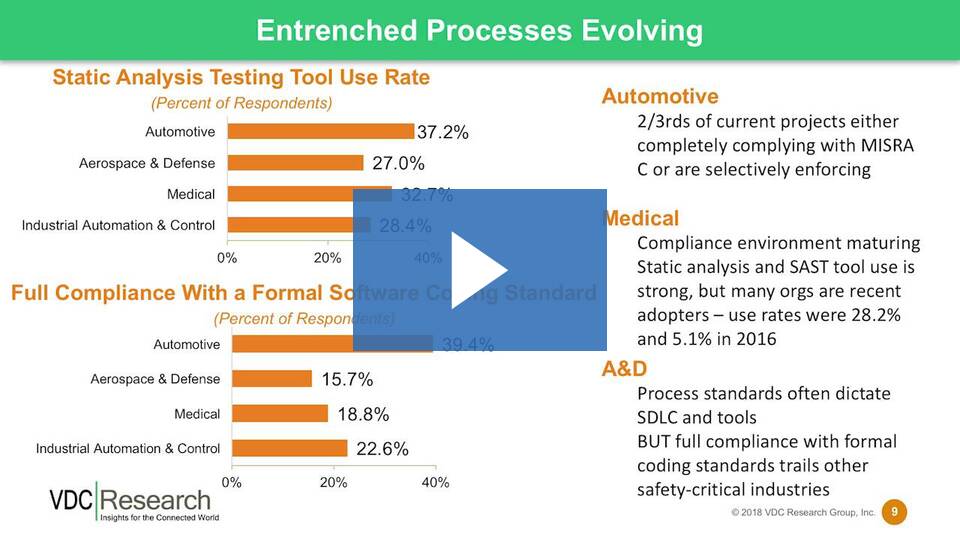
    In mission- and safety-critical industries, static code analysis is essential to facilitating the development of robust and reliable software. However, according to VDC Research, a B2B technology market intelligence and consulting firm, only 27% of embedded developers report using static code analysis tools. This raises an important question: Why is the adoption rate for static code analysis tools so low, when they are more effective than manual code reviews at finding coding errors, weaknesses, and vulnerabilities?

    In this webinar, we’ll answer that question, as well as explain how to effectively implement a static code analysis tool in your software development process. In addition, our presenters will review the results of the VDC Research paper on software development trends, techniques and best practices for standards compliance within embedded software development teams.

    Three key takeaways from the webinar include:
    1. Understanding trends for standards compliance.
    2. Identifying common challenges for automotive, medical, industrial automation and other types of embedded software applications.
    3. Learning best practices for achieving compliance using different tools, techniques, and processes.


    To read more, please visit: https://www.perforce.com/webinars/kw/5-ways-accelerate-standards-compliance-static-code-analysis

  • Top 10 Embedded Security Vulnerabilities

    Top 10 Embedded Security Vulnerabilities

    Nearly all of detected security vulnerabilities can be attributed to just 10 types. Here, we discuss the most common cybersecurity vulnerabilities and offer guidance on how to mitigate their risk.

    Vulnerability 10: Numeric Errors

    Numeric errors can refer to several different categories of problems, including wrap around errors, improper validation of array index, integer overflow, incorrect byte ordering and more. A common place for numeric errors is in math calculations and data overflow from an external source.

    Vulnerability 9: Cryptographic Issues

    Cryptographic issues are weaknesses related to the use of cryptography. This type of vulnerability is often caused by missing encryption of sensitive data, inadequate encryption strength and more.

    Vulnerability 8: Code Injection

    Code injections effect interpreted environments such as PHP.

    Vulnerability 7: Code

    This is a catchall vulnerability that can include such things as mismanaging passwords, improper handling of API contracts and code generation issues.

    Vulnerability 6: Resource Management Errors

    This type of vulnerability refers to a wide range of issues, including improper management of system resources, resource locking and insufficient resource pool.

    Vulnerability 5: Improper Access Control

    Improper access control is when software does not restrict, or incorrectly restricts, access to a resource from an unauthorized actor.

    Vulnerability 4: Improper Input Validation

    Improper input validation refers to getting incorrect or missing information from anything that could possibly impact a program’s control flow or data flow.

    Vulnerability 3: Information Exposure

    Information exposure is the intentional or unintentional disclosure of information that isn’t explicitly authorized.

    Vulnerability 2: Access Control

    This vulnerability refers to any weakness related to the management of permissions, privileges or other security features.

    Vulnerability 1: Memory Buffer Problems

    Memory buffer problems occur when software can read or write to locations outside the boundaries of the memory buffer.

    How to Prevent Cyberattacks

    An effective way to address each of these vulnerabilities is to rely on a static code analysis and static application security testing (SAST) tool. These types of tools analyze your code as it’s being written for potential coding errors, bugs and vulnerabilities. By addressing vulnerabilities earlier in development, you save time and money.

    For a more in-depth look at these 10 vulnerabilities and how to best mitigate their potential risk, review the associated white paper.

    To read more, please visit: www.perforce.com/blog/kw/common-software-vulnerabilities

  • What Is ISO 21434? Compliance Tips for Automotive Software Developers

    What Is ISO 21434? Compliance Tips for Automotive Software Developers

    What Is ISO 21434? Compliance Tips for Automotive Software Developers

    To read more, please visit: https://www.perforce.com/blog/qac/ISO-21434-Compliance

  • What is the NIST Cybersecurity Framework?

    What is the NIST Cybersecurity Framework?

    Cybersecurity threats are easier to handle when you have a framework to build off of. That’s why NIST developed the Cybersecurity Framework. Learn more.

    What You Need to Know About the NIST Cybersecurity Framework

    The National Institute of Standards and Technology, or NIST, helps organizations to better understand and manage their cybersecurity risks. NIST does this through its Cybersecurity Framework.

    The 5 Elements of the NIST Cybersecurity Framework

    There are five central elements of the NIST Cybersecurity Framework:

    1. Identify
    2. Protect
    3. Detect
    4. Respond
    5. Recover

    The 3 Components of the NIST Cybersecurity Framework

    In addition to the five main elements of the NIST Cybersecurity Framework, there are also three essential components.

    Framework Core: The Framework Core provides you with a set of activities to help you achieve specific cybersecurity outcomes. In order to help you achieve each activity, the Framework Core provides you with examples.

    Implementation Tiers: The Implementation Tiers provide you with an outline to increase the sophistication in your cybersecurity risk management.

    Framework Profiles: The Framework Profiles outline your cybersecurity activities and provides a look at the potential cybersecurity outcomes needed to meet your cybersecurity goals.

    How to Use the NIST Cybersecurity Framework

    In order to use the NIST Cybersecurity Framework, you must follow these three steps:

    1. Determine the appropriate implementation tier.
    2. Understand the gap between its current and target profiles.
    3. Put plans in place to implement the activities from the Framework Core to move toward the target profiles.

    The CIS Controls for NIST Cybersecurity Framework

    The Center for Internet Security (CIS) regularly publishes CIS Critical Security Controls that map to the NIST Cybersecurity Framework. While there are many sections to the CIS Controls, the most relevant is CIS Control 18, Application Software Security. The section recommends the following actions:

    1. Establish secure coding practices.
    2. Ensure software development personnel are trained in secure coding.
    3. Apply static and dynamic code analysis tools.

    To read more, please visit: https://www.perforce.com/blog/kw/nist-cybersecurity-static-analysis

  • What Is OWASP?

    What Is OWASP?

    With cybersecurity attacks rising, it is important for you to enforce secure software best practices, like OWASP and the OWASP Top 10. OWASP helps you to safeguard your code against software security vulnerabilities. Continue reading to learn why OWASP is important.

    What You Need to Know About OWASP

    The Open Web Application Security Project (OWASP) is an international nonprofit organization that educates software development teams—like yours—on how to conceive, develop, acquire, operate and maintain secure applications. Each of OWASP’s materials have been developed to improve your application security through your team, your processes and your technology.

    What You Need to Know About OWASP Top 10

    The most well-known OWASP resource is the OWASP Top 10. Every year, a team of security experts updates the OWASP Top 10 to include the 10 most critical web application and API security risks.

    The 2020 OWASP Top 10 is as follows:

    1. Injection
    2. Broken Authentication
    3. Sensitive Data Exposure
    4. XML External Entities (XXE)
    5. Broken Access Control
    6. Security Misconfiguration
    7. Cross-Site Scripting (XSS)
    8. Insecure Deserialization
    9. Using Components with Known Vulnerabilities
    10. Insufficient Logging and Monitoring

    Here Is Why OWASP Is Important

    OWASP and the OWASP Top 10 is important as it provides you with the following three benefits:

    1. It helps you to safeguard against cybersecurity vulnerabilities.
    2. It helps you strengthen software encryption.
    3. It helps you reduce the number of security errors, bugs, and defects in the code.

    Why a Static Code Analysis Tool Is Beneficial for OWASP

    One of the most effective practices for enforcing OWASP is to use a SAST tool. A SAST tool helps you to enforce secure coding standards and best practices. In addition, a SAST tool is able to flag security violations and provide you with guidance on how to fix those vulnerabilities and weaknesses.

    To read more, please visit: https://www.perforce.com/blog/kw/what-is-OWASP