Category: News

  • Datadog Extends Reach of Integrated DevOps Platform

    Datadog Extends Reach of Integrated DevOps Platform

    At its Dash 2022 conference, Datadog announced today it is extending the reach of its namesake cloud-delivered monitoring and observability platform to address continuous testing, application security and cost management.

    In addition, Datadog has made available in beta a Data Streams Monitoring tool that makes it simpler to identify upstream issues that are likely to impact DevOps workflows. Also in beta is a Dynamic Instrumentation tool that makes it possible to employ Datadog agent software to collect data on the fly from specific source code to investigate performance issues. Datadog is also making available in beta a Resource Catalog to make it easier to navigate cloud resources that IT teams are employing and has added a Datadog Workflows tool to create blueprints to for automating repeatable processes.

    Datadog is also expanding the reach of its Watchdog telemetry analysis service infused with machine learning algorithms to add beta support for containers. There is also now a beta of an Event Management tool that DevOps teams can employ to more easily investigate a stream of related alerts using the Watchdog service.

    The Datadog Continuous Testing service, now generally available, provides DevOps teams with a workbench for generating and maintaining tests that can be integrated within continuous integration (CI) workflows. Datadog has also added an Intelligent Test Runner tool, in beta, to enable DevOps teams to only run tests that need to run when a change is made by analyzing code execution paths to increase developer productivity.

    Renaud Boutet, senior vice president of product at Datadog, said the goal is to make it possible for DevOps teams to create and run tests from within the Datadog user interface in parallel using a set of no-code tools without having to employ scripts. The capability will make it possible to automatically generate tests using data collected by the Datadog platform as part of an infinite DevOps workflow loop, he added.

    At the same time, Datadog is making generally available a cloud security management service that combines its existing cloud security posture management (CSPM) service and the cloud workload security (CWS) service to provide an integrated cloud-native application platform (CNAP) at no additional cost. In addition, Datadog is making it possible to block access to application components that are under attack or might be attacked in real-time based on the known vulnerabilities detected using tools that are currently in beta.

    That approach reduces the total cost of cybersecurity by providing IT teams with a single service through which they can manage application security using a platform Datadog gained last year with the acquisition of Sqreen.

    Finally, Datadog is making generally available a cloud cost management tool that leverages its monitoring capabilities to enable organizations to automatically attribute spend to applications, services and individual teams. Changes to spending patterns that impact costs are surfaced alongside the same tools IT teams are already using to monitor their cloud computing environment. That unified visibility increases awareness of costs in a way that encourages DevOps teams to optimize the utilization of multiple classes of cloud resources.

    The services being added are extensions of a Datadog platform that employs a single set of agents it provides. The Datadog platform also supports the open source OpenTelemetry agent to deliver a wide range of services. That approach eliminates the need for IT teams to deploy multiple agents each time they add an additional monitoring, security, testing or cost management tool.

    Datadog has been making a case for an integrated platform that reduces the level of integration effort DevOps teams would otherwise need to expend when deploying separate point products to address monitoring, observability, security and cost management issues. That approach makes it easier for DevOps teams to collaborate and reduces the total cost of DevOps. In contrast, each time a DevOps teams adds a point product to address a specific issue, they need to deploy and maintain a separate set of agents.

    In the longer term, it’s not clear how problematic that agent issue will be once open source OpenTelemetry agent software is more widely employed. However, it may still be years before open source software provides the same capabilities that are available today using proprietary agent software.

    It may take some time before every application is as fully instrumented as it should be, but as monitoring and observability platforms continue to evolve, it is possible to more proactively manage application environments.


  • Red Hat and IBM Pledge to Bring NLP to Ansible

    Red Hat and IBM Pledge to Bring NLP to Ansible

    At the Ansiblefest 2022 conference today, Red Hat and its parent company IBM announced the Project Wisdom initiative to bring natural language processing (NLP) to the open source Ansible IT operations automation platform.

    At the same time, Red Hat announced that the curated instances of Ansible from Red Hat are now available in the marketplaces operated by Amazon Web Services (AWS) and Microsoft.

    Richard Henshall, senior manager of Ansible product management at Red Hat, said the goal is to make IT automation much more accessible to a broader range of end users and IT professionals that lack the declarative programming expertise to use YAML files to automate IT processes. Instead, Red Hat and IBM Research teams are pledging to combine their expertise to create an artificial intelligence (AI) model that would enable anyone to use natural language to automate an IT process.

    Ansible has emerged as the de facto open source standard for automating a wide range of IT processes, but the number of processes that could be automated still far exceeds the number of IT processes that are currently automated. In recent years, IT automation tools have become more accessible thanks in part to the rise of low-code and no-code tools, but some level of programming expertise is still required. Project Wisdom is being launched to eliminate the need to acquire those skills before being able to automate a process.

    Of course, there will still be complex processes that may require the ability to programmatically manipulate YAML files, but the number of trivial IT processes that could be automated is still incalculable. In theory, a natural language interface for Ansible would greatly reduce the time and effort required for anyone to automate an IT process regardless of their skill level.

    Interest in IT automation is rising once again as the global economy continues to soften. Organizations are looking to automate as many processes as possible in their efforts to keep IT staff size as small as possible. The more time IT teams spend on manual processes the less they will be able to manage IT environments that get more complex with each passing day.

    It’s not clear to what degree IT processes can be automated, but as businesses become more dependent on IT, the line between IT automation and business processes continues to blur. Natural language processing capabilities could make it simpler for organizations to greatly accelerate digital business transformation initiatives.

    Regardless of the level of IT automation achieved, it’s clear the way IT is managed is about to evolve once again. The days when IT teams configured and provisioned IT resources using fragile custom scripts are coming to an end as platforms like Ansible are more widely adopted. The only issue that remains to be seen is how quickly IT processes can be automated and whether the rate of automation can keep up with the volume of applications currently being developed.

  • New Relic Reports Major Spike in Volume of Log Data

    New Relic Reports Major Spike in Volume of Log Data

    New Relic today shared a report based on anonymized data it collects that showed a 35% increase in the volume of logging data collected by its observability platform.

    The report also identified logs generated by NGINX proxy software (38%) as being the most common type of log, followed by Syslog (25%) and Amazon Load Balancer (20%).

    In addition, Fluent Bit is the most commonly used open source processor and forwarder tool (38%) among IT teams that have adopted the New Relic platform. Another 16% are using New Relic infrastructure agent, followed by 14% that send log data directly to New Relic via an HTTP endpoint.

    The report also found 50% of all logs ingested by language agents come from Java applications, followed by .Net (26%), Ruby (22%) and Node.js (2%).

    Jemiah Sius, director of developer relations at New Relic, said as more cloud-native applications are deployed, the volume of log data that is collected is only going to increase as open source OpenTelemetry tools are more widely adopted. In addition, IT teams will also be collecting metrics, traces and events to better pinpoint the root cause of issues using observability platforms such as New Relic One, he added.

    Amazon Web Services (AWS) is now, of course, one of the biggest sources of log data. The New Relic report noted that the serverless AWS Lambda service is the most widely employed source of log data among AWS customers that employ the New Relic One platform. However, use of the AWS Firehose service for extracting, transforming and loading (ETL) data has grown sharply in the last year, noted Sius.

    The New Relic report found while only 32% of New Relic accounts that use AWS have adopted Firehose, there has been a 62% increase in adoption year-over-year.

    Log data is usually the first thing any IT team consults whenever there is an issue, but as the volume of log data increases it’s becoming more difficult to associate log data with specific IT events. The issue that each IT team will have to come to terms with is how much log data to store alongside metrics, traces and other data formats to help them proactively identify the root cause of an IT issue.

    Observability platforms, in the meantime, promise to make it possible to query that log data to identify relationships between events. The goal is to enable IT teams to investigate issues before they can disrupt IT services rather than merely reacting to events after they have unfolded, said Sius.

    The hope, of course, is that machine learning algorithms will soon automatically identify issues before most IT teams even know there is a problem. Given the overall complexity of modern IT environments, it’s unlikely most IT teams even know what queries to launch to identify the root cause of an issue. Instead, as machine learning algorithms become more familiar with what constitutes normal IT events, it will become simpler for those algorithms to surface the issues that are actually worth IT’s attention.

  • Oracle Enables Partners to Reuse Cloud Platform

    Oracle Enables Partners to Reuse Cloud Platform

    At its CloudWorld event, Oracle today announced it will enable IT teams to deploy the same platform it uses to independently deliver cloud services anywhere they see fit.

    Leo Leung, vice president of products and strategy for Oracle, said an Oracle Alloy offering will enable organizations to provide a full set of cloud services they can extend and brand as their own. All of the more than 100 infrastructure and platform services that the company makes available on Oracle Cloud can now be deployed anywhere, he said.

    In addition, Oracle unfurled a MySQL HeatWave service through which IT teams can access instances of the open source MySQL database running on the Amazon Web Services (AWS) cloud. A similar offering for the Microsoft Azure cloud is also planned.

    As part of an ongoing effort to gain share against rival cloud service providers, Oracle has been making a wide range of services available at a lower cost. Oracle Alloy now extends those efforts by making it possible for a wide range of organizations, including traditional enterprise IT organizations and internet service providers, to benefit from the company’s research and development efforts.

    Organizations that ally with Oracle can set their own pricing, rate cards, account types and discount schedules and define the support structure and service levels. A preconfigured instance of Oracle Fusion Financials to enable Oracle Alloy partners to manage customer invoicing and billing is also provided.

    It’s not clear to what degree these organizations might want to compete with cloud service providers such as Amazon Web Services (AWS), Microsoft and Google, but Oracle Alloy does provide an alternative approach to cloud computing that enables organizations to retain more control over the IT services they provide to others. The challenge, of course, is that acquiring the infrastructure is only one part of the equation. Organizations will also need to hire and retain IT specialists needed to manage cloud platforms on an ongoing basis.

    As the volume of applications being deployed in cloud computing environments steadily increases, Oracle clearly views Oracle Alloy as an opportunity to make up for lost ground in a market segment that it initially all but ignored when cloud computing first emerged more than a decade ago. Now, Oracle provides cloud services in 40 commercial and government regions across 22 countries. It has added 10 public cloud regions over the past year and has plans to add six additional commercial regions.

    Oracle is betting that, in some cases, partners will opt to deploy some cloud services themselves while relying on Oracle for others depending on the level of demand for specific classes of services. In effect, Oracle is enabling a set of federated cloud services to emerge that are no longer specifically tied to a single provider. It remains to be seen how receptive organizations will be to that approach, but it’s certain that the number of organizations that could afford to deliver cloud services could substantially increase. In theory, at least, increased competition should also lead to lower cloud costs for the organizations that consume those services.

  • JFrog Adds Module to Better Secure Software Supply Chains

    JFrog Adds Module to Better Secure Software Supply Chains

    JFrog today added a JFrog Advanced Security module to its Artifactory repository that enables DevOps teams to scan both binaries and source code for vulnerabilities and misconfigurations.

    Stephen Chin, vice president of developer relations for JFrog, said that approach will enable DevOps team to ensure applications are secure before they are deployed in a production environment.

    In addition to discovering vulnerabilities, the JFrog Advanced Security module also detects exposed secrets such as passwords, access tokens and private keys, said Chin. Leveraging existing scanning capabilities provided via the JFrog Xray software composition analysis tool, it can also be used to inspect the file used to provision infrastructure-as-code, he added.

    Most importantly, it provides development teams with the context needed to determine which components of an application are using containers that encapsulate code that is actually exploitable, noted Chin.

    One of the major issues DevOps teams encounter today is that they are often presented with a long list of vulnerabilities by cybersecurity teams—many of which don’t meaningfully impact applications that are not exposed to the Internet. DevOps teams then need to manually report why any given vulnerability doesn’t need to be remediated. The JFrog Advanced Security module helps automate that process, said Chin.

    In general, JFrog continues to pursue a binary-first approach to securing software supply chains, said Chin. While it’s important to address vulnerabilities in source code whenever possible, it is application binaries running in a production environment that cybercriminals are going to exploit, he noted.

    Cybercriminals have, in effect, opened a new front in their efforts to compromise IT environments by injecting malware into software components before they are deployed in a production environment. The hope is that, once deployed in those environments, malware can be activated at some later date. As a result, DevOps teams are now being required to improve cybersecurity hygiene across their software development processes, said Chin.

    It’s not clear at what rate organizations are embracing DevSecOps best practices to achieve that goal, but in the wake of an executive order issued by the Biden administration that requires federal agencies to better secure their software supply chains, the expectation is that more enterprise IT organizations will follow suit. The challenge is finding a way to build and deploy more secure applications without negatively impacting the rate at which they are built and deployed. Earlier this year, JFrog launched the open source Pyrsia project that employs blockchain technology to ensure open source software packages are not compromised by vulnerabilities and malicious code.

    In the longer term, it’s only a matter of time before the historic divide that has existed between DevOps teams and cybersecurity professionals starts to narrow as applications become more secure. The biggest immediate challenge is that many of the applications deployed in production environments already have known vulnerabilities. In the months ahead, many DevOps teams will be asked to assess the severity of those vulnerabilities as part of ongoing efforts to improve application security. Those patching efforts will undoubtedly have a significant impact on the amount of time available to write the code needed to build new applications or update existing ones with new capabilities.

    One way or another, however, the amount of technical security debt that has been allowed to build over the last several decades needs to be addressed.

  • Dell Launches Project Frontier Initiative to Advance Edge Computing

    Dell Launches Project Frontier Initiative to Advance Edge Computing

    Dell Technologies this week launched Project Frontier initiative that promises to make deploying software at the edge simpler using integrated platforms that will be available in 2023.

    Announced at a Dell Technologies Summit event, Project Frontier will create an integrated edge computing platform for vertical industry segments such as manufacturing and retail.

    Dell CEO Michael Dell told conference attendees these platforms will help customers simplify, optimize and scale their edge applications in a secure way.

    The offerings can be centrally managed either by an internal IT operations team or via managed services that Dell provides to simplify onboarding and ensure zero-trust security. The overall goal is to reduce the number of instances that might require IT personnel in the field to configure and update them.

    According to a 2022 IDC survey, 42% of businesses say the most challenging aspect of edge deployments is putting together an entire edge solution. To address that challenge, Dell is also launching a Dell Edge Design Program through which it will collaborate with customers to further advance edge computing solutions.

    Through its Dell Validated Design program, the company is already building edge computing platforms for specific customers, but the goal now is to make it simpler to deploy edge computing platforms at scale.

    The number of application workloads being deployed on edge computing platforms is rising sharply as organizations seek to process and analyze data closer to the point where it is created and consumed. In fact, that shift is at the core of many digital business transformation initiatives that depend on edge computing platforms and devices running, for example, internet of things (IoT) applications to process data in near-real-time.

    A major issue—and one that remains largely unsolved, in many cases—is that organizations lack the ability to consistently deploy software on edge computing platforms. That results in a hodgepodge of homegrown tools deploying software on a wide range of edge computing platforms using manual processes that don’t scale well.

    It’s too early to say just how much software will ultimately be deployed on the edge, but there may come a day when there is more software at the edge than there is in the cloud. Of course, the real challenge will be unifying the management of DevOps processes, regardless of where any given piece of software might be deployed. In fact, Dell is betting that as edge computing continues to evolve, the line between edge computing and cloud computing will continue to blur until they are little more than natural extensions of each other.

    Dell, of course, is not the only IT vendor that views edge computing as the next trillion-dollar IT opportunity. There is already no shortage of options. The issue will be determining which IT vendor has the most robust edge computing ecosystem. In the meantime, DevOps teams would be well-advised to revisit DevOps workflows now with an eye toward making sure they can truly scale. After all, as edge computing platforms continue to proliferate, their ability to build, deploy, update and secure software is about to be put to the ultimate test.

  • Kill the Password: Google on Board | 4-Day Week Proves Worthy

    Kill the Password: Google on Board | 4-Day Week Proves Worthy

    Welcome to The Long View—where we peruse the news of the week and strip it to the essentials. Let’s work out what really matters.

    This week: Passkeys is getting another big-tech supporter, and the four-day workweek train picks up speed. (more…)

  • Microsoft Expands DevOps Portfolio in the Cloud

    Microsoft Expands DevOps Portfolio in the Cloud

    At the Ignite conference this week, Microsoft launched a slew of updates to its DevOps portfolio as part of an effort to make it simpler to build, manage and secure cloud applications.

    Microsoft is adding Azure Deployment Environments, available in preview, that enable developer teams to invoke a set of best practices to quickly spin up application infrastructure using project-based templates.

    Microsoft is also making generally available Visual Studio Image for Dev Box, a self-service environment for accessing workstations on the Microsoft Azure cloud. Those images make it simpler to access Visual Studio functions and complimentary tools. Microsoft has also made generally available the latest version of the Visual Studio 2022 application development platform.

    In addition, Microsoft has signed an agreement with Postman to collaborate on integration that promises to accelerate the development of application programming interfaces (APIs) starting with the ability to both import and export APIs from Azure API management into Postman.

    Microsoft is also making generally available a predictive tool that employs machine learning algorithms to automatically scale virtual machines on Azure. In addition, updates to the Azure Monitor Log service now make it possible to ingest logs at a fifth of current costs and archive them for up to seven years. ​​​​​​​Microsoft is also now providing tools to migrate from legacy log agents to the Azure Monitor Agent (AMA) and has added Java profiling with a Java Flight Recorder (JFR) tool that collects data from a Java virtual machine and Java applications.

    In terms of managing application environments, Microsoft has now extended the reach of Azure Automanage to now include servers managed via the company’s Arc management platform, in addition to virtual machines running on the Azure cloud. Other capabilities added to Azure Automange include enhanced backup settings and different auditing modes for the compute server baselines and the ability to specify custom Log Analytics Workspaces and Azure tags to identify resources based on settings.

    Microsoft is also previewing an enhanced Azure remote support service through which Microsoft personnel will collect logs and commands to help resolve issues.

    Finally, in terms of securing applications, a GitHub Advanced Security for Azure DevOps tool that, now available in private preview, promises to make it simpler to identify and fix exposed secrets and vulnerable open source dependencies across the software life cycle using a CodeQL code scanner.

    At the same time, Microsoft is making available Microsoft Defender for DevOps to better secure code created to configure clouds. In addition, it will also enable DevOps teams to better prioritize their remediation efforts across multi-pipeline DevOps environments spanning multiple clouds. Microsoft Defender for DevOps is available in preview and supports GitHub and Azure DevOps with future support for other DevOps platforms planned.

    Another security addition available in preview is Microsoft Defender Cloud Security Posture Management (CSPM), which promises to provide contextual risk-based information via attack path analysis surfaced using a cloud security graph service to identify the most exploitable cloud resources. Microsoft has also made generally available a multi-cloud security framework for Microsoft Defender for Cloud to help organizations adopt DevSecOps best practices.

    Microsoft is also previewing support for agentless scanning for Microsoft Defender for Servers and an expansion of Microsoft Defender for Containers that adds support for Amazon Web Services Elastic Container Registry.

    Microsoft CEO Satya Nadella told conference attendees that Microsoft is making a concerted effort to natively embed security capabilities within its platforms to reduce the total cost of security. Many of the tools DevOps teams rely on today don’t integrate well, which is challenging at a time when application environments are becoming more dynamic as more cloud-native applications are deployed.

    It’s too early to say how much better security will entice organizations to opt for one cloud platform versus another. But it is almost certain that cloud service providers will be expected to contribute to securing software supply chains.

  • Google Looks to Secure Software Supply Chains

    Google Looks to Secure Software Supply Chains

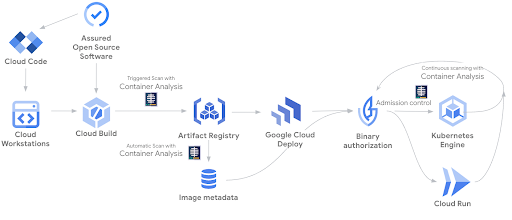
    At the Google Cloud Next ’22 conference, Google today launched a managed Software Delivery Shield (SDS) service to enable DevOps team to store, manage and secure the build artifacts in Artifact Registry. At its core, SDS is based on a trust-based policy engine to establish, maintain and verify a chain of trust across the software supply chain.

    In addition, Google has updated its container analysis tool to include vulnerability scanning for Maven and Go containers along with preview support for non-containerized Maven packages.

    The managed Software Delivery Shield service spans a range of Google runtimes environments, including Google Kubernetes Engine (GKE), Cloud Code, Cloud Build, Cloud Deploy, Artifact Registry and Binary Authorization. Cloud Build also now officially supports Supply chain Levels for Software Artifacts (SLSA) Level 3 best practices by default in addition to generating authenticated and non-falsifiable build provenance for both containerized applications and non-containerized Maven and Python packages.

    GKE, in preview now, provides detailed assessments, assigns severity ratings and surfaces the security posture of the clusters and workloads, including insights into operating system vulnerabilities, workload configurations and other actionable insights. Log data can now also be captured while security event information can be routed to, for example, a security information and event management (SIEM) platform.

    The Google Cloud Run serverless platform can also, in preview, display software supply chain security insights such as SLSA build-level compliance, build provenance and vulnerabilities found in running services.

    At the same time, Google is also making available in preview Cloud Workstations, which provide fully managed secure development environments on Google Cloud that can be accessed via a browser. Built-in security capabilities include virtual private cloud (VPC) controls, no local storage of source code, private ingress/egress, forced image updates and identity access management (IAM) policies.

    Finally, the Cloud Code plug-in for integrated development environments (IDEs) now includes a preview of Source Protect to give developers real-time security feedback in the form of vulnerability dependencies and license reporting as they write code.

    Collectively, Google claimed it now provides more than 250 curated packages across Java and Python with verified provenance. It also automatically generates a software bill of materials (SBOM) to create an inventory of all components and dependencies.

    Historically, cloud service providers have been advocating a shared responsibility approach to cloud security that required organizations to not only secure their applications but also the way cloud infrastructure is provisioned. The challenge is developers generally provision cloud infrastructure themselves even though they generally have limited cybersecurity expertise. Too many developers assume the underlying cloud infrastructure is more secure than it actually is.

    Now, cloud service providers are extending the security services they provide at a time when organizations are making security a bigger factor in determining where to build and deploy applications.

    Sunil Putti, vice president and general manager for Google Cloud Platform, said Google is attempting to make cybersecurity invisible to developers in the sense that guardrails will automatically be embedded within the platform.

    The issue is that cloud computing environments are becoming more complex as new classes of cloud-native applications are deployed alongside legacy monolithic applications. Complexity, as always, is the enemy of cybersecurity.

  • GitLab Allies With Google to Improve Developer Productivity

    GitLab Allies With Google to Improve Developer Productivity

    GitLab Inc., in collaboration with Google, today launched an open source Cloud Seed tool that makes it simpler for DevOps teams to consume Google Cloud Platform (GCP) resources.

    The Cloud Seed tool, announced at the virtual Google Cloud Next ’22 conference, is integrated within the GitLab web UI to make it simpler for developers to consume Google cloud resources—such as Cloud Run for building and deploying containerized applications—and the managed Cloud SQL database service.

    Nima Badiey, global vice president of alliances for GitLab, said the goal is to reduce friction that would otherwise be created by requiring developers to write code to consume these services using a set of lower-level application programming interfaces (APIs).

    That self-service approach not only improves productivity but provides the added benefit of reducing the odds those services might be misconfigured in a way that creates a cybersecurity vulnerability, he added.

    As it seeks to gain ground on Amazon Web Services (AWS) and Microsoft, Google has a vested interest in working with providers of DevOps platforms to make it simpler for developers to consume cloud resources. The challenge is that developers often make mistakes when they programmatically invoke cloud services. Those resulting misconfigurations are all too often not discovered and remediated until after there has been some type of cybersecurity incident.

    In the wake of a series of high-profile breaches of software supply chains, there is a lot more focus on security. The challenge, of course, is finding a way to ensure application development platforms are as secure as possible without slowing down the rate at which software is developed and deployed. Achieving that goal requires the right mix of policies, training and systems, said Badiey.

    Most organizations are trying to strike a balance between the need for greater security and their need to attract and retain developer talent. In theory, the rise of DevSecOps best practices is pushing more responsibility for security further left toward developers. However, most developers have little to no cybersecurity expertise, so it’s clear more guardrails need to be built into DevOps tools and platforms to prevent cybersecurity mistakes from being made.

    It’s not clear how much improved developer productivity and greater security will drive organizations toward one cloud platform versus another, but in an age where many more organizations now routinely employ two or more cloud platforms, it could make a significant difference. Developers don’t especially enjoy remediating applications after they are deployed in a production environment because they have generally already moved on to other projects. IT operations and cybersecurity professionals are also likely to nudge developers toward platforms that create the least amount of operational overhead for them.

    Regardless, one thing that is certain is compliance requirements are about to become stricter for all concerned as scrutiny of software supply chains intensifies in the months ahead. The issue now is how to proactively address those requirements before they become a much larger issue.