Category: KubeCon + CNC NA 2021

  • Snapt Announces the One Security Package to Run Kubernetes in Public Cloud

    Snapt sponsors KubeCon Europe and brings AI-powered threat intelligence, WAAP, and bot protection for Kubernetes ingress in public cloud – all in one click.

    Valencia, Spain, May 16, 2022 — Snapt, the leading provider of future-proof, cloud-neutral, and platform-agnostic load balancing and security solutions, demonstrates a powerful, AI-powered platform for securing Kubernetes ingress in public cloud environments at KubeCon Europe in Valencia. Snapt Nova is a centrally managed load balancing and application security platform designed for cloud-native and hybrid environments and includes real-time threat intelligence, web application and API protection, and bot protection. Snapt demonstrates Snapt Nova at KubeCon Europe, 16-20 May, at booth S32 on the show floor or our virtual booth here: https://bit.ly/38VKVwo (link for registered attendees only).

    Attendees at KubeCon can also talk to Snapt to request a free health check to test their infrastructure’s security, scale, and speed. This offer is exclusive to attendees at KubeCon Europe 2022.

    Snapt Nova is Application Delivery Control as a Service, providing load balancing, global traffic routing, and web application and API protection on-demand to every node from a centralized controller and UI. Snapt Nova’s centralized control plane enables Software-Defined Load Balancing with a real-time low-latency connection to millions of data plane nodes. Snapt Nova meets the needs of DevOps, NetOps, and SecOps teams securing Kubernetes ingress at scale in public cloud environments – including multi-cloud.

    “Snapt Nova makes it a breeze to get public cloud Kubernetes into production,” said Dave Blakey, Co-CEO at Snapt. “Snapt Nova ensures your application is highly available, secure from threats like Denial of Service, and optimized for performance. It provides visibility into Kubernetes and other platforms, even in multi-cloud environments. We designed Snapt Nova for modern application teams, so we built it with a full REST API, centralized control plane, monitoring in a single pane of glass, and integration with modern tool stacks.”

    Snapt Nova simplifies securing and scaling Kubernetes applications in the cloud. It integrates easily with all public clouds and Kubernetes, including native upstream service discovery for rapid configuration and deployment of application services. Snapt Nova’s centralized controller provides elastic scalability with extremely low latency in response to demand, so application services always keep pace with application traffic. Snapt Nova’s worker nodes are lightweight, containerized, and fast, even supporting deployment on ARM architectures.

    Snapt Nova also reduces the complexity of deploying Kubernetes alongside other platforms and architectures, enabling NetOps and SecOps teams to ensure the reliability and security of every part of their network. Centralized policy, security, and global traffic routing help organizations keep global networks and hybrid architectures consistent, simple, and compliant. A modern web GUI with one-click deployment, wizards, and data visualization enables operators to get started quickly and address problems efficiently without deploying infrastructure as code.

    Snapt Nova provides a full REST API for complete automation and integration with CI/CD workflows for DevOps practitioners.

    Role-Based Access Control allows NetOps or PlatformOps teams to set global policy using Snapt Nova’s GUI and delegate per-application control to multiple DevOps teams using the API. This capability enables application teams to develop, test, and launch applications quickly and automatically while enabling NetOps teams to set the guardrails and monitor overall network health, security, and performance.

    Snapt Nova includes real-time threat intelligence, so Kubernetes deployments benefit from application security that is always up-to-date with the latest emerging threats and trends, allowing automatic pre-emptive blocking of current and potential threats. Snapt Nova’s threat intelligence, powered by advanced machine learning and unique real-time, real-world threat data from Snapt’s worldwide network of threat sensors, identifies, tracks, and blocks botnets, malware, cybercriminals, and platform abuse.

    Snapt Nova includes robust Layer 7 Web Application and API Protection that blocks hackers, denial of service (DoS), bots, data leaks, SQL injection, XSS, CSRF, and more while ensuring your Kubernetes ingress is compliant, safe, and secure. Mutual TLS enables end-to-end encryption for protecting sensitive data. The API gateway enforces API access controls and SLAs and protects against the OWASP Top 10 API vulnerabilities. Snapt Nova’s application security is enhanced by machine learning and AI-powered autonomous response, enabling sophisticated traffic profiling, anomaly detection, continuous self-learning, and lightning-fast reaction when threats are detected.

    Snapt Nova automatically detects and blocks malicious bots in real-time. It combines on-node activity recognition, centralized AI-powered behavior profiling, and a global database of known bots. Snapt Nova’s distributed application delivery controllers (ADCs) use a powerful activity recognition engine to identify suspicious browsing patterns, non-human input, and traffic from questionable sources.

    The distributed ADCs can also submit a suspicious user for central evaluation by the Bot AI. Using machine learning to develop an in-depth profile of normal and automated browsing behavior, Snapt Nova can consistently identify bots where other systems fail. This self-learning system constantly evolves, improving its speed and intelligence.

    For users ready to learn more about securing and simplifying Kubernetes ingress, Snapt will be demonstrating Snapt Nova at booth S32 at KubeCon Europe on 16-20 May. For more information, download the Snapt Nova and Kubernetes datasheet.

    Snapt is a Silver Sponsor of KubeCon Europe.

    About Snapt
    Snapt provides future-proof load balancing and security solutions that are cloud-neutral and platform-agnostic. Snapt eliminates downtime and automatically scales your sites and applications to ensure maximum responsiveness. Using a single pane of glass, our solutions deliver centralized control and intelligence for all your clouds, platforms, architectures, and applications.

    Snapt lets you embrace change on your terms — we grow, shift, and evolve with you. Snapt provides the lowest total cost of ownership while providing high performance and fast, expert support from day one.

    For more information, visit www.snapt.net.

    Media inquiries
    Iwan Price-Evans
    +1 404 618 1201

  • Splunk Donates eBPF Telemetry Data Collector to CNCF

    Splunk Donates eBPF Telemetry Data Collector to CNCF

    Splunk Inc. announced during the KubeCon + CloudNativeCon North America conference that it donated a data collector to the OpenTelemetry project run by the Cloud Native Computing Foundation (CNCF).

    Splunk’s data collector runs as a sandbox-level program at the kernel of a Linux operating system and takes advantage of extended Berkeley Packet Filter (eBPF) technology to make it simpler to collect networking telemetry.

    The OpenTelemetry initiative itself spans a range of open source tools, application programming interfaces (APIs) and software development kits (SDKs) that are used to instrument applications. Previously, Splunk contributed the SignalFx Smart Agent and Smart Gateway to the OpenTelemetry project along with more than 64,000 code contributions.

    Morgan McLean, a director of product management for Splunk, said that while OpenTelemetry is officially in beta, some elements of the project are more mature than others. For example, tools for capturing metrics and traces are already being employed, while another set of tools for capturing log data will be ready sometime next year, he said.

    The data collector contributed by Splunk is among the first that operate at the kernel level to collect data, added McLean. That approach makes it possible for some types of data to be captured by default rather than requiring developers to always instrument their applications using agents to enable an observability platform. It will also contribute toward the eventual convergence of network operations and DevOps processes.

    Going forward, DevOps teams should expect to employ a mix of open source data collectors that operate at both the eBPF and application level, said McLean. The eventual goal is to instrument every application by default by making it much simpler to collect data. Today, most DevOps teams are employing a mix of proprietary and open source agent software to collect data that then must be deployed and then integrated with all the applications they build. Given the cost and level of effort required, the percentage of applications that are actually instrumented is, not surprisingly, fairly low.

    However, as agent software becomes more readily accessible, the percentage of applications that are instrumented should increase considerably in the years ahead. For DevOps teams that depend on that data to optimize application performance, that capability should prove to be a boon for improving overall observability in IT environments.

    Observability, in one form or another, has always been a core tenet of any DevOps best practice. Initially, DevOps teams focused on continuous monitoring as the most effective way to proactively manage application environments. However, it can still take days, sometimes weeks, to discover the root cause of an issue.

    Monitoring focuses on predefined metrics to identify when a specific platform or application is performing within expectations. The metrics tracked generally focus on, for example, resource utilization. Observability platforms combine metrics, logs and traces—a specialized form of logging—to instrument applications in a way that makes it simpler to troubleshoot issues without relying on a limited set of predefined metrics focused on a specific process or function.

    Those observability platforms then make it possible to correlate events so that it is easier to identify anomalous behavior indicative of an issue’s root cause. Armed with these insights, it becomes a lot simpler for IT teams to resolve issues faster.

    It’s unclear when OpenTelemetry tools will become more widely employed, but as more tools for collecting data become available, the impact on DevOps will be nothing short of profound.

  • Energy Efficiency and the Data Center

    Energy Efficiency and the Data Center

    The IT industry has historically been a leader in the ongoing race to reduce CO2 emissions. Reducing emissions is good for the environment and for the corporate bottom line. The data center is well-known as a voracious data consumer. But the data center consumption findings keep pace with the trend. Even in the face of remarkable growth in data center capacity and performance, their energy consumption has increased only a few percentage points since the 2010s. This almost-flat rate of energy consumption is primarily the result of the shift to cloud computing as well as the shift to solar and wind energy, where it makes sense.

    Investments in renewable energy sources have helped tamp down criticism over the overall IT carbon footprint. Knowing that it takes a tremendous amount of energy to power a data center, owners and operators are always looking for ways to improve efficiency and reduce carbon expenditure. Today, there are newer and better ways for organizations to deliver the performance to properly power modern applications while keeping in mind the energy efficiency and carbon reduction the world requires.

    Minimizing Energy Use and CO2 Production

    How did we get here? Decades of semiconductor process miniaturization in concurrence with living out Moore’s Law has culminated in ongoing improvements in performance, storage capacity and device density. Today’s mobile phones are a great example of that ongoing progress. A secondary factor in the mobile phone revolution is a processor architecture optimized for efficiency and flexibility. This ARM architecture has been used to power almost all devices since the first iPhone. Over the years, ARM has also become a realistic platform for servers; often a better choice than an x86 system.

    Energy efficiency is one area where ARM systems win out over conventional server architecture. But it was not until recently that ARM processors could deliver the required performance for the data center. Today’s systems, based on Armv8 designs, have brought into play x86-class capabilities in a more energy-efficient way. The advent of the ARM-based AWS Graviton processors, which by some estimates have already captured 20% of the instance share on AWS, demonstrates that ARM can run production workloads while delivering what AWS calls “up to 40% better price performance over comparable current-generation x86-based instances for a wide variety of workloads.”

    To illustrate the impact on carbon production when a data center shifts from x86-based architecture to ARM servers, an analysis of the top elements contributing to data center energy use was undertaken. The energy savings was calculated and translated to reduced CO2 emissions based on the fuel mix used to power the electric grid in various locations. The results prove that an ARM-powered data center reduces CO2 production by 74%, equivalent to almost half a million barrels of oil.

    Power Consumption Reduced by Efficient Servers

    The premise is simple—innovative server design significantly reduces data center energy use. In this model, a server’s power draw and physical size are key factors. The energy needed for other data center subsystems was extrapolated by using ratios derived from experience and validated by estimates from other data center operators.

    Data center energy use can be divided into five categories of equipment and infrastructure: Servers, network communications, power supplies, conversion and UPS, cooling systems and storage. Servers and cooling comprise about 75% of the total.
    The calculations were based on the energy used by a medium-sized data center with 750 racks of conventional 1U servers (42 servers/rack; around 31,500 in total). Assumptions used included servers comprising two-thirds of the floor space and that the equipment space accounts for 65% of the total, translating to a 62,000 square-foot data center. For comparison, facilities operated by the major cloud vendors can be a million square feet or more. Knowing server power consumption and the ratios for the equipment categories, algebra can be used to calculate the energy consumption for each.

    The data center in this hypothetical example has, as we said, 31,500 servers. Using the 912.5W power draw of a Dell R640 as typical of 1U x86 servers, the total server usage in the ARM data center would be 251,795 MWh/year. Using this formula, the amount of energy saved by using ARM servers can be calculated. Each server requires about one-quarter the electricity of a standard server. In the formula, the assumption is that the ARM server installation would require half the equipment racks (375 instead of 750) and 52% of the power-per-system, comprising a data center using only 26% as much electricity (152,409 MWh/year) as one based on x86 systems.

    The math shows that switching one medium-sized data center to ARM servers can produce annual savings equivalent to 45,459 fewer cars on the road or 486,749 fewer barrels of oil used.

    The value in CO2 reduction is widely understood for preserving the environment. It is also advantageous from an economic standpoint. In fact, there are many technical and economic reasons to adopt energy-efficient ARM-powered servers in the next-generation cloud data center.


    To hear more about cloud-native topics, join the Cloud Native Computing Foundation and the cloud-native community at KubeCon+CloudNativeCon North America 2021 – October 11-15, 2021

  • CNCF Adopts Meshery to Advance Service Mesh Management

    CNCF Adopts Meshery to Advance Service Mesh Management

    The Cloud Native Computing Foundation (CNCF) announced this week during the ServiceMeshCon/KubeCon + CloudNativeCon conference that Meshery, a service mesh management plane created by Layer5, has become a sandbox-level project.

    In addition, Layer5 has also donated Service Mesh Performance (SMP), a set of tools for measuring the efficiency of a service mesh, to the CNCF. SMP provides an open source framework to define standardized benchmarking practices, performance test configurations and measurements as part of an effort to create a MeshMark index for rating a service mesh. A set of service mesh performance methodologies will also be published by the IEEE later this month, developed in collaboration with engineers from Layer5, Intel, Red Hat and HashiCorp.

    Layer5 CEO Lee Calcote said the goal is to make it simpler for IT teams to determine which service mesh to employ based on their specific use case requirements.

    Several service mesh platforms are starting to gain traction as a means to both manage application programming interfaces (APIs) and provide a layer of abstraction between lower-level networking and security APIs that makes those services more programmatically accessible to developers.

    Meshery itself is an implementation of SMP and the conformance tool created for the Service Mesh Interface (SMI), a separate CNCF project to promote interoperability between service meshes. Meshery is based on a set of microservices that are designed to make the platform easily extensible.

    That approach makes it possible to manage multiple instances of service meshes that might be deployed on virtual machines as well as Kubernetes clusters using a range of management tools that are part of the Meshery project.

    Meshery supports AWS App Mesh, Citrix Service Mesh, HashiCorp Consul, Istio, Kuma, Linkerd, Network Service Mesh, NGINX Service Mesh, Open Service Mesh and Traefik Mesh. Meshery also provides IT teams with more than 60+ best practices in the form of templates that can be used to deploy a service mesh.

    It’s still early days as far as adoption of service mesh in the enterprise is concerned. Most IT teams still rely on either proxy software or a gateway to manage APIs. However, as the number of APIs that need to be managed steadily increases, it won’t be long before many IT teams start to at least evaluate a service mesh.

    In the longer term, the impact those service meshes are likely to have on the management of IT could be profound. It is becoming apparent that a service mesh also provides a higher level of abstraction for invoking networking and security services. In fact, the service mesh may wind up playing a key role in driving the convergence of network and security operations with DevOps best practices.

    In the meantime, IT teams will need to decide to what degree they may want to standardize on a single service mesh versus letting individual teams implement their own preferred platform that could one day be centrally managed via Mashery. One way or another, the way APIs are managed and invoked will soon fundamentally change forever.

  • Top 5 Must-Haves for IaC Automation Tools

    Top 5 Must-Haves for IaC Automation Tools

    These days, there are a lot of different DevOps tools to accomplish a lot of different jobs. Almost daily another startup comes out with a new and innovative product or a newer (maybe even better) version of existing tools. One of the biggest innovations has been infrastructure-as-code (IaC). Giving infrastructure admins and developers alike the ability to create, manipulate and destroy infrastructure using code files changes the way we administer our environments. Though these tools are revolutionary and can solve many problems, sometimes they come with a whole new set of issues—as can any type of tooling, really. 

    Generally, IaC tools are run locally at first. When an infrastructure admin or developer is just starting out with it, they store the files locally; maybe in a repository, then clone the files to execute locally. This is perfectly acceptable and a very common practice. The issues arise when it comes to scaling this practice to a team; for example, with regard to visibility and governance. If everyone is running their deployments locally, the team doesn’t have clear visibility into who is deploying what, when and with what variables. This is where IaC automation tools come into play.

    There are many different types of tools to solve these problems. Some are better than others. CI/CD pipeline tools, custom-built automation platforms, purpose-built IaC automation platforms—each has their pros and cons. Getting into all of that can be overwhelming and we could go on for hours about each option. But, we’re here to talk a bit more generically today. So, we’ll save all of that for another time. For now, let’s take a step back and talk about the top five must-haves for any infrastructure-as-code automation platform you’re considering. Because each company and use case is different, we’ll talk about these considerations in no particular order. 

    Role-Based Access Control (RBAC)

    This first factor is pretty important. I know I said I wasn’t discussing these in any real order, but this one should really be close to the top of the list for anyone looking into IaC automation. We talked about how automating IaC can cause visibility issues when you scale across a team. You may want to know who deployed what, when, where and why, for example. Usually, the reason you want that kind of visibility is that you would like to control all of these aspects. That way you can help limit waste, budget problems, security concerns and the like. You may want to provide self-service deployment access, but only within certain parameters; maybe only to certain people or teams. Having granular RBAC can help you design a security policy that makes the most sense for your organization and its needs. Some tools have this baked in, some take a bit of work to make it work. The point is that you should have some form of control over your deployment process. 

    Self-Hosted Agents/Runners

    Following the security thread: A lot of these IaC automation tools are SaaS platforms. SaaS can be very secure. But sometimes, for compliance or regulatory reasons, you may want to retain a bit more control over your deployments. This is where self-hosted agents or runners come in. This type of design allows you to keep your “secrets”—such as your cloud credentials and other sensitive variable information—secure in your own way. You can use whatever secrets management solution you want, be it something from your cloud provider or another third-party solution. It also allows you to keep your code secure. All of these tools, when deploying your code, have to get a copy of that code to deploy. So, they’ll do a ‘Git clone’ or some kind of file copy process to get your files from where they are stored, to execute them. If this is a SaaS solution, then they will essentially have access to your code. Again, this may not be a huge issue for some, but it very much is for others. If you don’t want to give a third party this level of access to your code and secrets, a self-hosted agent or runner can help keep it all secure and under your control. 

    Plan on Pull Request

    This feature is a big one when it comes to workflow. Some may not even know how important plan on pull request (PR) is until they realize how easy it can make their life. This feature may be called something different depending on the platform. Plan on PR, PR plan, speculative plan, etc. Essentially, this means that whenever you open a pull request against a branch, your automation platform will complete a deployment just up to the “plan” phase so that you can see exactly what this code change will do. For example, if you accidentally add an extra 0 to a variable or code file, you may end up with 100 instances instead of 10. Ideally, you’d like to know what was going to happen with a change before it is deployed, giving you the option to quickly fix a potential mistake before it actually goes through. In DevOps, you always want to ‘fail faster’ and close the loop so that big mistakes are caught before they happen. That is why this feature is so important. And if the automation platform you choose is doing this correctly, when it runs this plan phase it’ll automatically update the pull request directly with the possible changes as a comment. This way, your developers can see what is going to happen before they try to merge the deployment back to the main branch for deployment to production. And if they take it a step further by adding service checks to the pull request, you can even configure it so that if the deployment plan fails for any reason, developers are actually blocked entirely from merging the PR back until it is resolved. All of these features help to enable the ability to work in a GitOps methodology. Don’t get me started on the wildl misuse of the term GitOps—it is very specific. While one of the central pillars of GitOps is using your repository as your “single source of truth” for what should be deployed, it’s not just using Git to store your Terraform files; it is an infrastructure administration via pull request methodology. If you want more information about GitOps, you can read more here. 

    Continuous Deployment

    This feature is essential for most folks. But, depending on the workflow, it can be less important. Even if it isn’t a must-have now, it may be down the road when you evolve and grow into new workflows. Continuous deployment is the ability for your automation platform to have a webhook or other connection to your source code repository so that it can automatically trigger a deployment process whenever you commit or push to the repository. This feature goes hand-in-hand with the plan pull request feature we just spoke about. To make that feature function properly, a CD feature would be needed, as well. Now, I want to make sure I clarify. Just because you have continuous deployment enabled doesn’t mean it is just going to push to production in the middle of the day every time a commit or push is done. You should still be given the ability to pause the deployment process after the plan phase. This way you can validate that the plan looks acceptable before you approve the deployment. For some use cases, like developer sandboxes, you may “auto-approve” the deployments because you don’t care about having to get validation first. It all depends on your workflow and processes. A good platform will give you the ability to control all of this. 

    Shift Left Extensibility

    This one is a bit of a wild card. It can mean a lot of different things depending on the situation. Essentially, what I am talking about here is the ability to integrate—or at least be interoperable—with a multitude of other tools during the deployment process. There is a concept called continuous verification which means to shift some tools and processes left into the deployment process so that you can stay on top of problems before they start. In the PR plan feature section earlier, we talked about catching issues before deploying. This isn’t just for resource configuration issues. What about security issues? Compliance issues? Performance issues? Or even budget issues? If your IaC automation tool gives you the ability to integrate the processes and tools you are using to validate these things into the deployment process, they no longer have to be an afterthought. You never have to worry about going over budget if you are constantly validating the budget each time you deploy. You don’t have to worry about a security issue if you’re validating security during every deployment. This type of functionality can look and be named very differently between tools. But as long as you have the ability to get all of these other groups (security, finance, etc.) involved sooner, everyone will be better off. Like we talked about before, in DevOps, it’s always better to fail faster. And integrating these checks into your deployments can help you achieve this. 

    Conclusion

    We’ve made it through all five! We’ve talked about some basic security features. We talked about some automation workflow must-haves to make your life easier. And we even scratched the surface on some next-step-type things to look into such as continuous verification. That was a lot—hopefully this has been helpful for anyone looking into IaC automation platforms and you now have an idea what to look for. Some features may be named differently, but the ideas behind them are the same. If your platform can’t do these, it may not be the right one for you. Or, maybe it is and that feature just isn’t that important to you. As I mentioned, your mileage may vary. Every organization is different.


    To hear more about cloud-native topics, join the Cloud Native Computing Foundation and the cloud-native community at KubeCon+CloudNativeCon North America 2021 – October 11-15, 2021

  • Rethinking Your Approach to Ops Governance

    Rethinking Your Approach to Ops Governance

    The “You build it, you run it” approach has changed the mindset of modern organizations that are increasingly adopting DevOps practices. No longer completely beholden to the requirements of operations, engineering teams are continually acquiring more autonomy to deliver rapid innovation. At the same time, more organizations are adopting platform teams to accelerate development, empowering teams with easier access to services without requiring them to understand the underlying complexity. While this approach is helping teams build, scale and ship software faster, it’s also resurfacing previous areas of tension around operational governance. 

    Organizations are generally choosing between two governance approaches: Mandated or paved path. Each has a different perspective on the appropriate level of autonomy to grant development teams and where governance should sit within the development life cycle. But there’s a third approach—the “trust and verify” approach—that can provide both high levels of autonomy for development teams and the sophisticated governance that operations teams need to ensure compliance and security.

    What is a Platform Team and Why are Organizations Adopting the Model?

    A platform team provides a foundation of self-service APIs, tools, services, workflows and support that accelerates the delivery of digital services and products. Platform teams operate similarly to any R&D team; employing customer support, operations, development, SRE, product managers and other personnel. They use research, customer feedback and usage data to iteratively improve their services.

    Rather than each development team reinventing the wheel, the platform team builds shared services that shield developers from the underlying complexity of infrastructure and enable self-serve access to services. As engineering resources become even more in-demand and scarce, organizations are using platform teams to optimize resources and share outputs.

    Two Platform Governance Approaches: Mandated Vs. Paved Path

    Organizations today typically are using one of two approaches to platform governance: Mandated or paved path.

    A mandated approach solves the governance problem by mandating that all engineering teams use the platform. However, this approach puts the onus on the platform team to keep up with the changing demands of engineering. Organizations must invest in a platform team that can keep up with engineering requirements so they still feel like they can innovate and use the best tools.

    The second approach is a paved path, popularized by Jeff Lawson of Twilio. This allows for engineers to go outside the platform if they are willing to take on the SLAs the platform provides and are responsible for all the costs of maintaining their own alternatives. Lawson said in this McKinsey interview, “What you do is you create the incentive structure for teams to take the paved path. But if they really have to go a different route, you make it possible for them to do that.”  

    While the paved path approach offers more autonomy for engineering teams, it requires teams that veer off the path to maintain the integrity of their software. Without guardrails, operations must put full trust in teams to keep their services secure and compliant. It can often be difficult for operations teams to maintain visibility into the services and infrastructure that fall outside the core platform.

    So, given that a mandated approach restricts autonomy and a paved path can make compliance more difficult, what is the middle ground?

    Bridging the Gap Between Mandated and Paved Path

    First, it’s important to understand that governance is not synonymous with command and control. Instead, operations teams should think of governance as the practice of maintaining visibility and providing best practices. Rather than a mandated platform approach, organizations can choose an approach that offers more autonomy to engineering teams (similar to paved path) while also maintaining operational governance. This is a trust and verify approach. 

    Using the trust and verify approach, organizations should focus their efforts on technology, not people, to maintain compliance. The goal would be to have a platform that could easily connect to the entire toolchain any product team uses for complete visibility and context. In this way, operations can gain governance without adding friction for product teams. This requires a top-down approach within organizations: I&O leaders investing in engineering resources or an off-the-shelf platform that can enable this technology. Both engineering and operations can flourish in this modern environment. Approaching governance from a trust and verify perspective will expand access to innovation while ensuring compliance and security standards. 

    Governance Should be Over Technology, not People

    Creating a bridge to a trust and verify approach means placing the responsibility for governance on technology rather than people to maintain detailed audit trails of human and machine actions tied to identity and reduce the potential for human error through automation. This approach provides autonomy for engineering teams while also ensuring governance through visibility and process controls embedded into workflows and tooling. 

    Shellie Miller, senior manager, technology governance and compliance at Hulu, believes technology can support DevOps practices. “To have a successful DevOps organization, we don’t need to have command and control or have this clear line of separation between dev and operations. It’s putting the responsibility on the infrastructure, the platform and the tooling and the policies and the processes that you have to enable those self-serve capabilities,” Miller said. 

    Mitigating Human Error Through Automation

    This investment in technology should focus on automation and process controls that fit within teams’ current processes. “What auditors are really trying to do is mitigate human error,” said Miller. “Teams should really focus on automating controls, building those security practices and those best practices into the platform. That way, dev teams are just subscribing to that offering.” 

    Changes to applications, systems, data and code—one of the biggest culprits with regard to risk—is where automation and process controls embedded into platform offerings can make a huge impact. “From an engineering perspective, constant change is needed to support rapidly changing consumer demands,” Miller added. “However, from an audit perspective, these activities increase risk of material impact to viewer experience, revenue and/or financial reporting.”

    Investment in Governance Comes From the Top

    While technology holds the key to better governance and compliance standards, there’s an investment that must be made, whether that’s investing engineering resources in building automation or investing in an off-the-shelf platform that can enable automation.

    “Leadership and organizational backing is absolutely key,” said Miller. “You can’t get to compliance or governance or any kind of operational maturity, for that matter, when you’re doing a bottom-up approach.”

    Building a compliance and security program around technology and not people means having the proper skills and mindsets. A bottom-up approach could create friction, especially due to a lack of education and understanding of the why and how. A top-down approach ensures there are resources to both implement the technology and to foster a culture of understanding and education. 

    The most common question I get asked is, ‘Why can’t we trust our people?’” Miller said. “Compliance requirements don’t generally start with the thought that our people are being malicious. We should run an organization of trust, and through automated monitoring and governance, we can verify and govern without being intrusive and disruptive. Lack of training and the demand on teams is what drives the perception that there’s no trust. Security and compliance is intended to mitigate risk and prevent threats to the systems that enable the business.”

    Building on a “Trust and Verify” Platform Approach

    When it comes to governance, technology is our greatest asset. Of course, this investment can be substantial for many organizations that don’t have the engineering resources to build in-house. Today, new open source or off-the-shelf platforms enable operations teams to build self-service capabilities that provide guardrails against human error, an audit trail of human and machine actions and visibility across disparate tools and services. 

    No-code solutions that also provide a developer platform for deeper customization enable teams to build out these core requirements of governance without consuming considerable engineering resources. The door to a future where operations teams can provide more autonomy to development teams while maintaining governance is now open. Every organization has the ability to attain a “trust and verify” approach and meet the needs of both dev and ops.


    To hear more about cloud-native topics, join the Cloud Native Computing Foundation and the cloud-native community at KubeCon+CloudNativeCon North America 2021 – October 11-15, 2021

  • New Relic I/O Aims to Simplify Instrumentation

    New Relic I/O Aims to Simplify Instrumentation

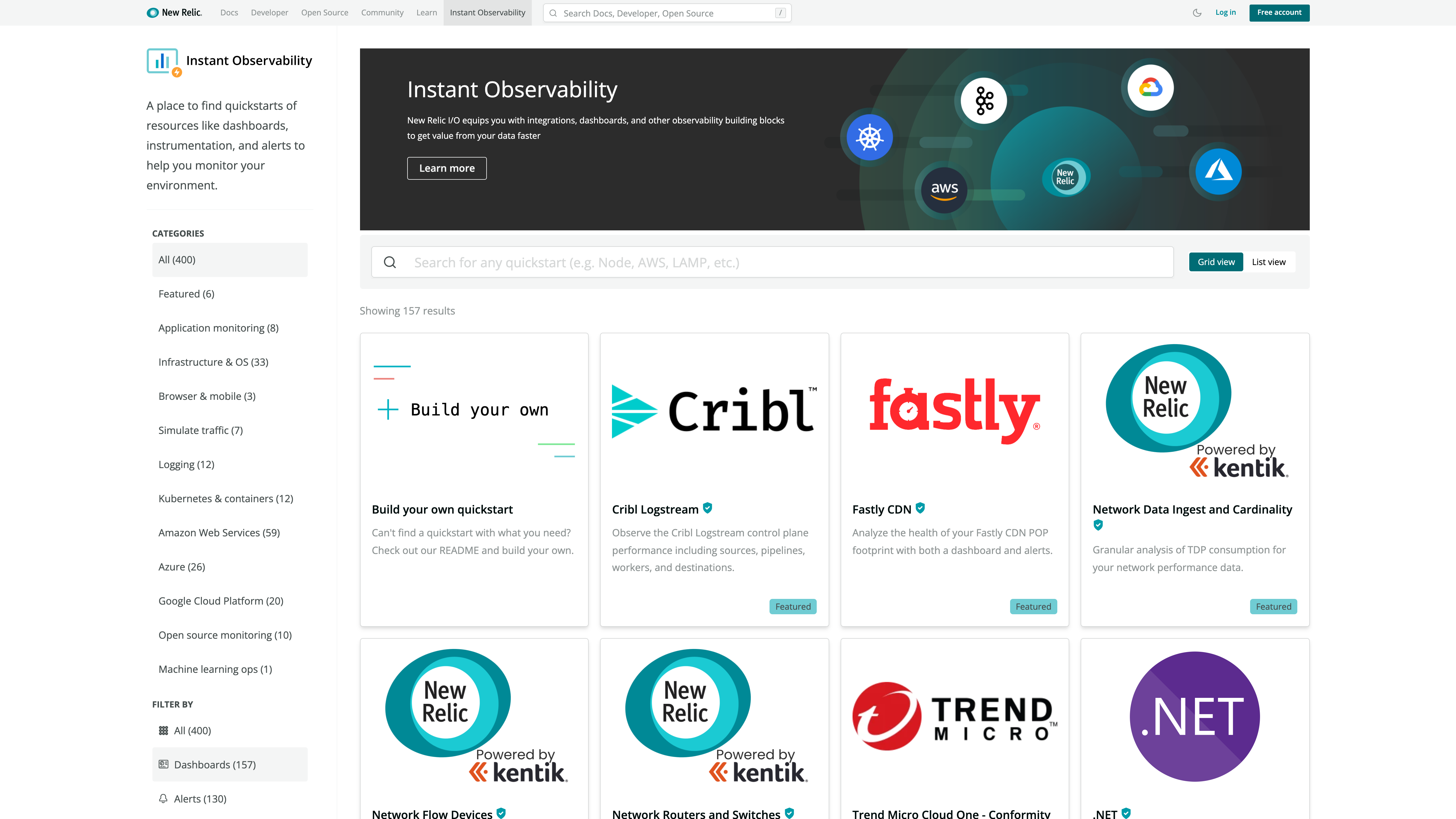
    New Relic today at the KubeCon + CloudNativeCon North America conference launched a New Relic Instant Observability (I/O) initiative through which it is making available open source tools to simplify application instrumentation.

    Marck Robinson, senior vice president for engineering at New Relic, said the catalog of tools will help DevOps teams instrument a much wider range of applications. New Relic will make those tools available as part of the free tier of its observability platform delivered via the cloud. DevOps teams will be able to use more than 400 pre-configured quickstarts to both instrument applications and create dashboards, Robinson said.

    New Relic itself is contributing quickstarts for cloud services, open source tools and platforms such as Kubernetes, Istio and Cassandra. Third-party vendors that have already contributed to the catalog include Cribl, Fastly, Gigamon, Kentik, Lacework and Trend Micro. Each contribution is being vetted by New Relic as part of an effort to foster the development of a larger open source observability ecosystem, noted Robinson.

    Robinson said overall, New Relic is trying to make it easier for DevOps teams to close an instrumentation gap that is impeding IT organizations from moving beyond monitoring to embrace true observability of their IT environments. The recent New Relic 2021 Observability Forecast report notes only a quarter of respondents (26%) have a mature observability practice, with the most commonly cited barriers to observability being a lack of resources (38%) and skills gaps (29%).

    As a result, DevOps teams often encounter a last-mile observability challenge when it comes to both instrumenting applications and then building their dashboards, said Robinson.

    As part of a larger effort to make it easier to instrument applications, New Relic has open sourced agent software, standardized on the OpenTelemetry tools being advanced under the auspices of the Cloud Native Computing Foundation (CNCF) and contributed the Pixie observability platform for Kubernetes environments to the CNCF.

    Observability in one some or another has always been a core tenet of any DevOps best practice. Initially, DevOps teams focused on continuous monitoring as the most effective way to proactively manage application environments. However, it can still take days, sometimes weeks, to discover the root cause of an issue. However, observability platforms are emerging that correlate events in a way that makes it easier for analytics tools to identify anomalous behavior indicative of a root cause of an IT issue. Armed with these insights, it becomes a lot simpler for IT teams to resolve issues faster.

    In contrast, monitoring focuses on predefined metrics to identify when a specific platform or application is performing within expectations. The metrics tracked generally focus on, for example, resource utilization. Observability, on the other hand, combines metrics, logs and traces—a specialized form of logging—to instrument applications in a way that makes it simpler to troubleshot issues without having to rely solely on a limited set of metrics that have been pre-defined to monitor a specific process.

    With the rise of microservices-based applications, the shift to the cloud and more end users than ever working remotely, the need for observability has never been more critical. The issue now is finding a way to make it much simpler to achieve.

  • Why You Need a Value Stream Delivery Platform

    Why You Need a Value Stream Delivery Platform

    While the pandemic was significantly challenging for businesses, it exposed the need to quickly adapt and change. Software products for internal or client use continue to provide an opportunity for a competitive edge in nearly any industry. Businesses will immerse themselves and compete in the digital economy by consistently producing better software products at an ever-increasing pace.

    In the past year, two new solutions with similar names have been gaining attention: value stream management platforms and value stream delivery platforms. Both are designed to help firms improve their software development process. The end goal for both is also similar—speed up development—but how each accomplishes this goal is important to differentiate the two.

    So which one should you use? We’ll cut to the chase—the value stream delivery platform provides more strategic long-term value. Here’s why.

    First: Value Stream Mapping

    To understand the need, you first need to understand value stream mapping. This involves visualizing the value stream processes and events from conception and creation to testing, production and, finally, release. By mapping the value stream, you can get a better understanding of the workflow and identify dependencies between the different activities, which will help you identify any blockages or impediments to delay delivering customer value.

    Staying abreast of your value stream is essential to delivering value to the customer as it connects all the multiple teams, tools and applications along the way. By gaining clearer visibility into the entire software delivery process, you can then scale your enterprise by bringing other teams on board for greater collaboration. Additionally, tracking your value streams can help reduce any risks to performance, as you can easily see the throughput and stability of your products.

    Value Stream Management Platforms (VSMP) Explained

    Simply put, value stream management helps solve poor visibility across the software delivery life cycle. You can measure and manage the performance of your software delivery team, identify any areas for improvement and leverage best practices that support collaboration through teams. Additionally, a value stream management platform helps connect applications, teams and tools through the collection of static data used to improve ongoing delivery performance.

    One benefit to using a value stream management platform is that existing toolchains remain undisturbed. The VSMP simply integrates with the different datasets across the existing process and provides the desired visibility and analytics to the different product value stream(s) across the organization.

    An Underlying Problem: Toolchains

    The lure of easy visibility that a value stream management platform provides is somewhat deceptive. The constant pressure to create and deliver better software faster using multiple tools and manually built toolchains has reached its breaking point:

    • Poor interoperability, manual handoffs and disparate data have created DevOps automation silos
    • The multiple test environments used through the process and the need for multi-cloud and hybrid deployments add tons of unnecessary complexity
    • Increased policy and security requirements simply cannot scale and remain manual

    Developers are caught in the middle—they must understand both a complex development and deployment process plus build a complex product for their customers—but being an expert in both is nearly impossible.

    The use of internal platform teams has been recognized as a way to solve this problem. The platform team is responsible for providing an easy-to-use solution; essentially treating developers as customers. In turn, the developers can focus their efforts on the software products they’re responsible for and on satisfying client needs.

    How is a Value Stream Delivery Platform Different?

    Many firms have learned the hard way that building an internal platform is risky, time-consuming and expensive. A value stream delivery platform replaces the traditional, manually built toolchains used today and sidesteps the risk, cost and development time involved in building a platform in-house.

    A VSDP should:

    • Cover the entire process of planning and creation, integration and verification, deployment and operations and, finally, monitoring and improvement
    •  Have both security and compliance capabilities built into the platform foundation
    •  Integrate DevOps point solutions, plus easily add or change tools over time
    •  Provide a centralized data model that creates one source of truth for the development process
    • Provide metrics and reports to accelerate process and value stream improvements
    • Improve software quality through continued enhancements based on best practices

    A value stream delivery platform cuts the administrative burden on DevOps teams, allowing them to refocus their efforts on providing significantly higher value. Instead of maintaining toolchains, they can now help identify process bottlenecks, expand automation and work directly with application teams to drive standards.

    Value stream management platforms provide value in understanding the process and where it can be improved. But they don’t fix the underlying toolchain problem. Instead, the improved visibility may tempt some to squeeze more productivity from developers over the short term without addressing the underlying toolchain problem. However, replacing toolchains with a value stream delivery platform can help address all these issues, and may prompt you to retire your value stream management platform.


    To hear more about cloud-native topics, join the Cloud Native Computing Foundation and the cloud-native community at KubeCon+CloudNativeCon North America 2021 – October 11-15, 2021

  • The Inevitability of Multi-Cloud-Native Apps

    The Inevitability of Multi-Cloud-Native Apps

    We all know the story: Enterprises moved to the cloud. They learned about data center virtualization and multi-tenancy and self-service developer provisioning. Along came Kubernetes, and they moved to cloud-native, where they learned about automation, DevOps and infrastructure-as-code (IaC). Now, even though most enterprises are still figuring out how to do cloud-native at scale, there’s a new imperative they must master: Multi-cloud-native applications. And for almost every enterprise with a global footprint, the move to multi-cloud-native applications is not optional—it’s inevitable. 

    But before we explore why this is the case, let’s first retrace our steps. For almost every enterprise out there, the journey to the cloud started with adopting a public or private self-service infrastructure provisioning and management model. These enterprises quickly realized that this new IT model required a new set of tools to solve challenges they’d never before faced—enabling their developers with self-service provisioning, managing and operating infrastructure. Enterprises figured it out, but as soon as they figured out the cloud, they quickly had to gear up for the second phase: Automating and operationalizing an enterprise-wide rollout of cloud operating models throughout their entire developer organization. 

    Of course, this phase has its own set of challenges, and a rich ecosystem of tools emerged to address them. Even so, we all can agree that the majority of mainstream enterprises are still in this second phase. They’ve adopted cloud, they’ve expanded its use, and they’re grappling with the challenges around multi-tenancy, security, DevSecOps and governance. Hand-in-hand with this goes a whole new set of challenges around cost management. Suddenly, enterprises are faced with managing the variable costs of public cloud infrastructure: Optimizing compute infrastructure, utilization and capacity to rein in cloud spend. It’s an issue Sarah Wang and Martin Cassado took head-on in their research on the Trillion-Dollar Paradox.

    So, enterprises moved to the cloud and are now, for the most part, successfully grappling with scaling it. But nothing stays the same for long, and businesses drive IT to innovate. This is where cloud-native entered the picture to help enterprise software development teams become more agile and help businesses transform to deliver new services and experiences faster. In fact, the consumer experience this model makes possible has rapidly become the norm.

    Consistently delivering rapid software iteration across a global footprint forces DevOps organizations to grapple with an entirely new set of technical challenges: Leveraging containerized applications and microservices architectures in production across multiple Kubernetes clusters running in multiple geographies. Customers want an on-demand experience. This third phase is what we call multi-cloud-native, and it was pioneered by hyperscale IaaS players like Google, AWS, Azure and Tencent.

    The reality is, of course, that hyperscalers aren’t the only ones who have figured out how to deliver multi-cloud-native apps. Webscale innovators like Doordash, Uber, Twitter and Netflix have done it, too. To get there, they had to make and share their multi-cloud-native apps across every geography where their customers live. And, in turn, to make that happen they had to tackle a new set of challenges: Develop new tools and techniques like geographically distributed, planet-scale databases and analytics engines, application architectures that run apps on the backend close to the consumer in a multi-cloud-native way. This enabled them to do arbitrage across fleets of infrastructure capacity across regions, all while giving their customers that instant experience they increasingly grew to expect.

    What enterprises must realize is that this experience consumers have grown to expect from webscalers is rapidly becoming the same experience they expect when accessing their bank account, their insurance apps and their tax records. For almost every planet-scale enterprise, this sets up a whole new set of challenges: To span multiple clouds and multiple geographies running multiple Kubernetes clusters, you now must worry about new ways to do autoscaling, self-healing, disaster recovery, operations management and cost optimization—all of which are things that you’re just now getting figured out for virtual machines (VMs) and clusters in single regions.

    Enterprises must face the reality that cloud-native application models are not the destination but rather a waypoint on a journey to becoming multi-cloud-native. Because the consumer experiences delivered by webscalers make this the inevitable destination.

    The Enterprise Journey: Cloud, Cloud-Native and Multi-Cloud-Native

    Don’t take my word for it.

    Uber and Twitter public disclosures describe how the multi-cloud-native model is an integral part of their strategic game plan. Hybrid and multi-cloud are part of this, too, leveraging Kubernetes as a cluster manager, but they still need tools to manage all those clusters across multiple environments in multiple regions at planet scale.

    The bottom line is that the architecture that webscale companies are using today is the same one enterprises will need to adopt tomorrow to remain competitive. Alternatively, these enterprises will cede market share and relevance to the next webscale innovator to disrupt an industry. In adopting this model of building multi-cloud-native apps, enterprises will have to deal with unified access management, controlling multiple clusters, resource management and more, all across multiple regions and clusters of capacity, aggregating versus disaggregating cluster resources, using logical services that span clouds versus namespaces that span a single cluster.

    The Enterprise Solution: Planet-Scale Cluster Manager

    They will need a planet-scale cluster manager to do this; something that can observe costs, operations, performance and SLAs across clusters, across public and private clouds, spanning VMs and Kubernetes through a single pane of glass so they can operate above the clouds in an automated, easy-to-use way. Band-aid solutions like running multiple spreadsheet models to figure out how to optimize are not scalable. What’s needed are tools like machine learning to automate and optimize at scale, bin packing technology to intelligently and automatically optimize across a planet-scale infrastructure fleet and high levels of automation either with humans in or out of the loop. That’s how hyperscalers and webscalers are already doing it.

    Every planet-scale enterprise is multi-cloud-native, running data-driven apps. It’s not a fiction: It’s already happening across webscale companies, not just hyperscalers. Multi-cloud-native is the path that every enterprise is going to need to follow if they want to transform themselves to compete with the next webscale upstart. The good news is, the pioneers have left us a map to follow.


    To hear more about cloud-native topics, join the Cloud Native Computing Foundation and the cloud-native community at KubeCon+CloudNativeCon North America 2021 – October 11-15, 2021