Category: Features

  • Carving through the hype – take the DevOps maturity assessment

    Carving through the hype – take the DevOps maturity assessment

    As anyone who spends time with their family over the holidays can attest, the notion of maturity is a highly subjective concept.

    Whether it’s sizing up the next generation’s advancement or defaulting to time-honored inter-sibling behaviors, annual get-togethers offer tangible proof of what’s new and those things that likely won’t ever change.

    In the domain of DevOps – an umbrella concept that encompasses a massive array of processes and supporting capabilities – gauging the maturity of your organization’s standing is also a highly interpretive task.

    Given that “DevOps” means something different to nearly every organization, based on its unique makeup, methodologies, tools, and most importantly, business goals, attempting to measure progress against any outside model may seem an effort of limited value.

    That said, as an increasing number of organizations seek to embrace DevOps, and growing recognition that well-worn stories of leading-edge “unicorns” don’t relate closely to most people’s real-world expectations, many teams are left wondering where their own efforts stand, especially in comparison to their peers.

    To help acquit this pursuit, and allow organizations to scope their progress, CA recently launched the second iteration of its online DevOps Assessment.

    Split into three short surveys covering core limbs of the DevOps tree – “Develop and Test”, “Release and Deploy”, and “Manage and Monitor” – this free tool offers detailed insight into how your organization’s maturity stacks up to that of other practitioners.

    For instance, in the domain of development, how well do your teams fare in defining and managing requirements, and then presenting them to others in a structured manner? Related to release cycles, are your teams truly meeting business-driven expectations for more frequent application deployments, shorter lead times, and higher success rates? Or, when it comes to applications monitoring, are you able to distinguish the most critical and recurrent problems and how they truly impact business services?

    These are perhaps some of the most fundamental questions that one could apply to measurement of DevOps adoption in general, but further investigation attempts to take a closer look at more finite, underlying issues.

    Are your development teams accurately replicating realistic conditions from production systems to create virtual services and testing scenarios? Are your application release deployments fully automated across development, test and production environments? Can your teams monitor complete business services that link user experience, transactions and applications to infrastructure to pinpoint any root cause issues?

    The best thing about the survey is that it immediately provides visibility into how your answers compare to those of previous respondents. There’s no fuzzy math or editorial interpretation (though we may highlight trends in a report at some point), merely instant validation, and the option to create a customized report card charting where your efforts stand in relation to those of your peers.

    If you’re wondering precisely just how to achieve your long-term DevOps goals comparative to where you stand today, it might even be worth leveraging some of the involved questions for the purpose of evolving process and methodology.

    The only remaining questions are: Do you think that you’re ahead of the curve? Are you afraid to find out just how far you’re behind the crowd? And most importantly, what do you have to lose?

    Take the survey today and get a real-world fix on your overall level of DevOps maturity. Guaranteed it’s a far more informative activity than debating family and friends over whose turn it is to carve the turkey, or wash the dishes.

  • DevOpsSec: 1 in 16 Chances

    DevOpsSec: 1 in 16 Chances

    The quantitative research summarized below, covering over 7,000 repositories across nearly 100 countries, highlights some of the challenges with quality at modern development velocities, especially important for DevOpsSec practices. By leveraging automation in your repository manager, you can improve application quality and reduce unplanned work while lowering exposure to risk. While this practice supports DevOpsSec initiatives, at its core, it is simply a focus on “building quality in”.

    (Written as a collaboration between me and Mike Hansen, Head of Products at Sonatype; Mike wrote the better parts.)

    Innovation and Risk

    Repository managers like Nexus, Artifactory and Archiva have been serving software components for development teams and their tooling for years now.  We can measure over 70,000 active repository manager installations across the globe today.  Use of a repository manager improves build performance and reliability while also providing a secure, private location to host open source, third party, and proprietary components needed across continuous delivery and DevOps tool chains.

    Industry averages show software development organizations electively downloading over 240,000 components a year from public internet repositories.  While these components accelerate development and increase innovation, the vast majority of components go through little to no vetting process to determine if known security vulnerabilities, risky license types, or outdated/unsupported are being used.
    DevOpsSec: tracking known vulnerabilities requires better hygiene.

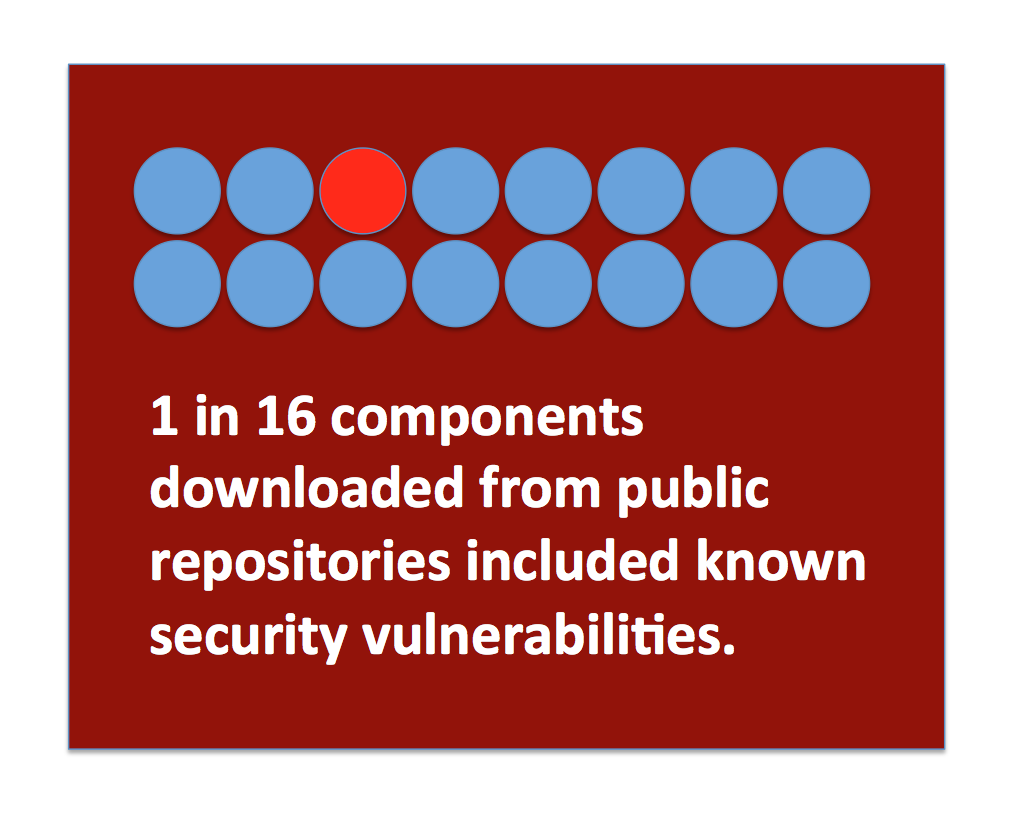
    Earlier this year, researchers found that 1 in 16 downloads includes a known security vulnerability. That accounts for over 15,000 elective downloads of components with known security vulnerabilities per organization, per year.

    Why the Focus on Repository Managers?

    Repository managers like Archiva, Artifactory, and Nexus have become a critical piece of the DevOps toolchains and are commonly used across the entire application lifecycle. It is effectively a binary parts warehouse for your applications. Given how integral this warehouse has become, software supply chain intelligence and automation can be used to significantly reduce unplanned work and eliminate avoidable risk.

    To understand this opportunity, let’s take a quantitative look at the world’s software development ecosystem.

    Global Visibility

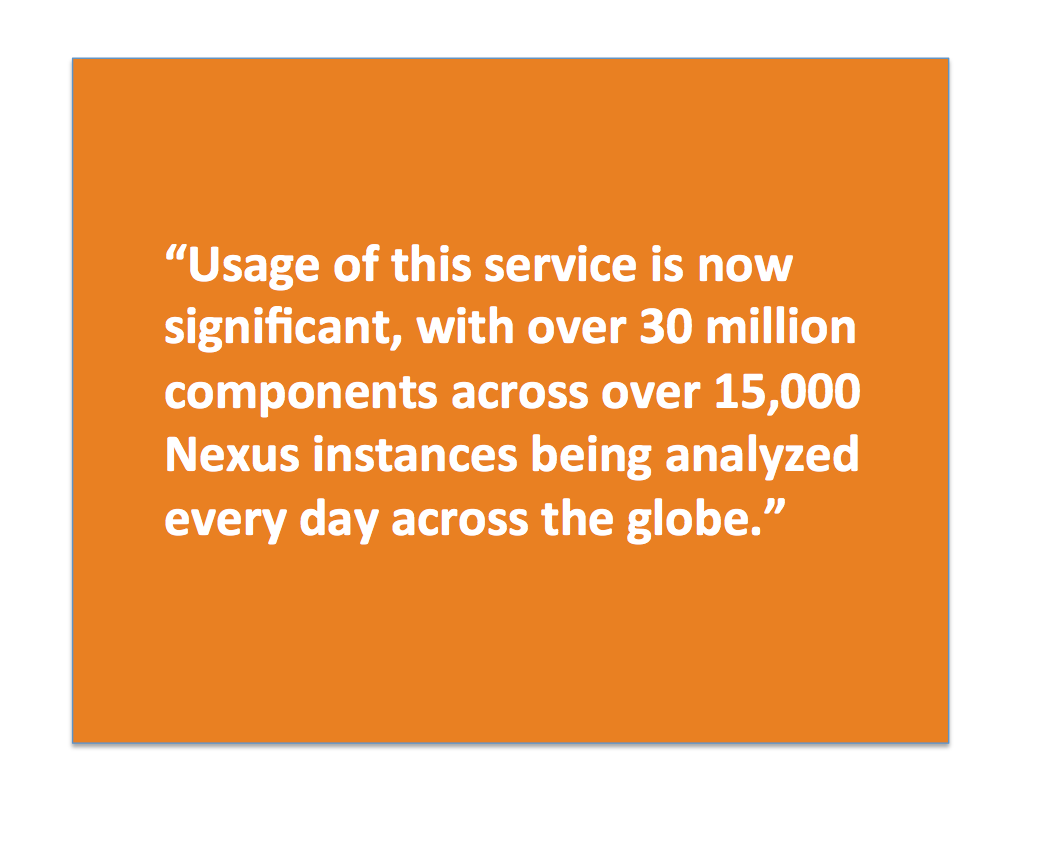
    Not long ago Sonatype introduced a free feature in its Nexus Repository Manager that is providing new data on the health of software supply chains.  This features, called Nexus RHC (Repository Health Check) – offers a simple way to get basic visibility into what OSS is flowing into development via your repository manager.  RHC provides a summary of components in the repository that have known security vulnerabilities and risky license types. Usage of this service is now significant, with over 30 million components across over 15,000 Nexus instances being analyzed every day across the globe.DevOpsSec: identifying known vulnerabilities.
    There are also around a million developers using those repositories. With the law of big numbers working for us, we can gain a statistically valid view into the behaviors of the modern software development ecosystem. The findings are quite telling.

    The Data

    We analyzed over 7,000 repositories containing 500 or more software components using the RHC service during the past 90 days. These repositories are representative of those used by development teams in medium to large organizations. The question was straightforward: To what extent are bad things flowing in, causing downstream rework and creating avoidable risk scenarios?

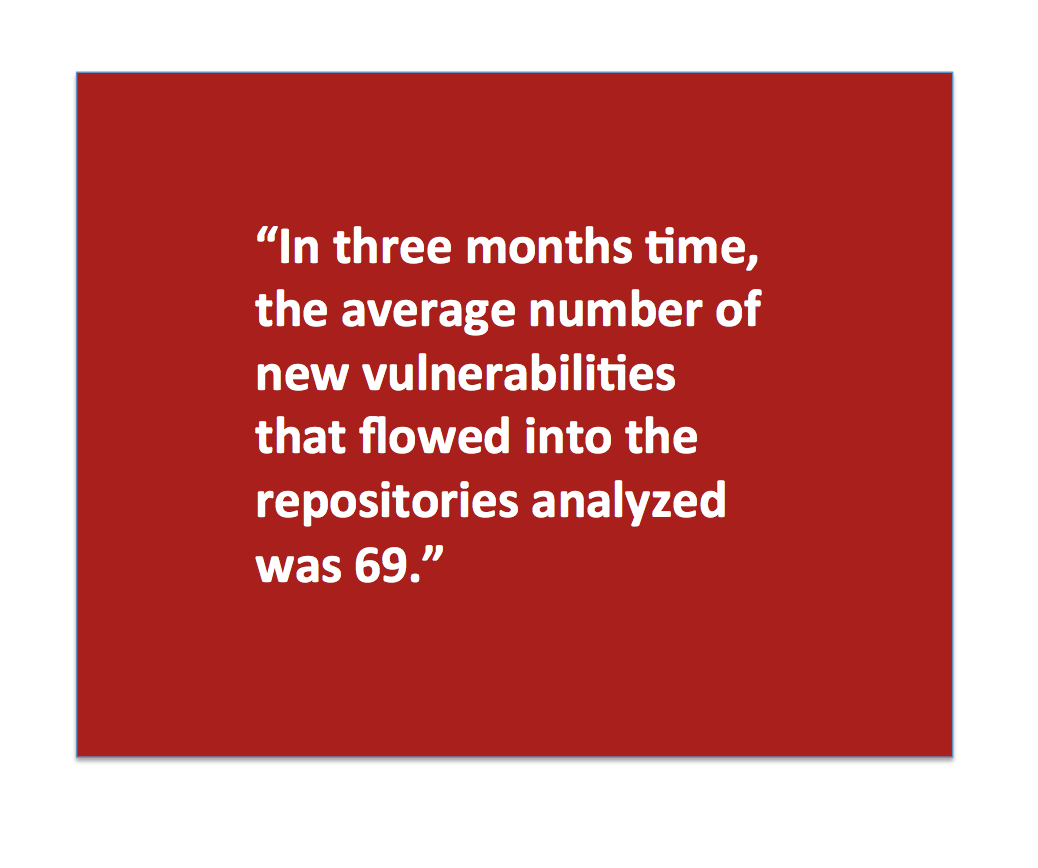
    In three months time, the average number of new vulnerabilities that flowed into the repositories analyzed was 69. That is an average of 23 vulnerabilities per month, which is a little more than one every weekday. If you only include higher risk vulnerabilities – those with a CVSS score of 5 or greater – the average number was 48, or about 16 per month. That is a little less than one every weekday. For a sense of the kind of vulnerabilities in this higher risk category, the Heartbleed bug had a score of 5, the lowest risk in this grouping.
    DevOpsSec: tracking known vulnerabilities.

    These are not isolated instances or outliers. In the set of repositories analyzed, 98.3% consumed at least 1 vulnerable component and 97.7% consumed at least 1 higher risk (CVSS >= 5) component. In a period of just three months, nearly every repository consumed something the organization running it would rather not have, and that is only with respect to known vulnerabilities. There are plenty of other attributes that are worthy of consideration given availability of the corresponding data.

    Whether or not security is of particular concern, the real point is that a lack of visibility and control combined with an abundance of supply has led to inferior quality parts routinely being used by the world’s development organizations, adding avoidable risk and slowing us down.
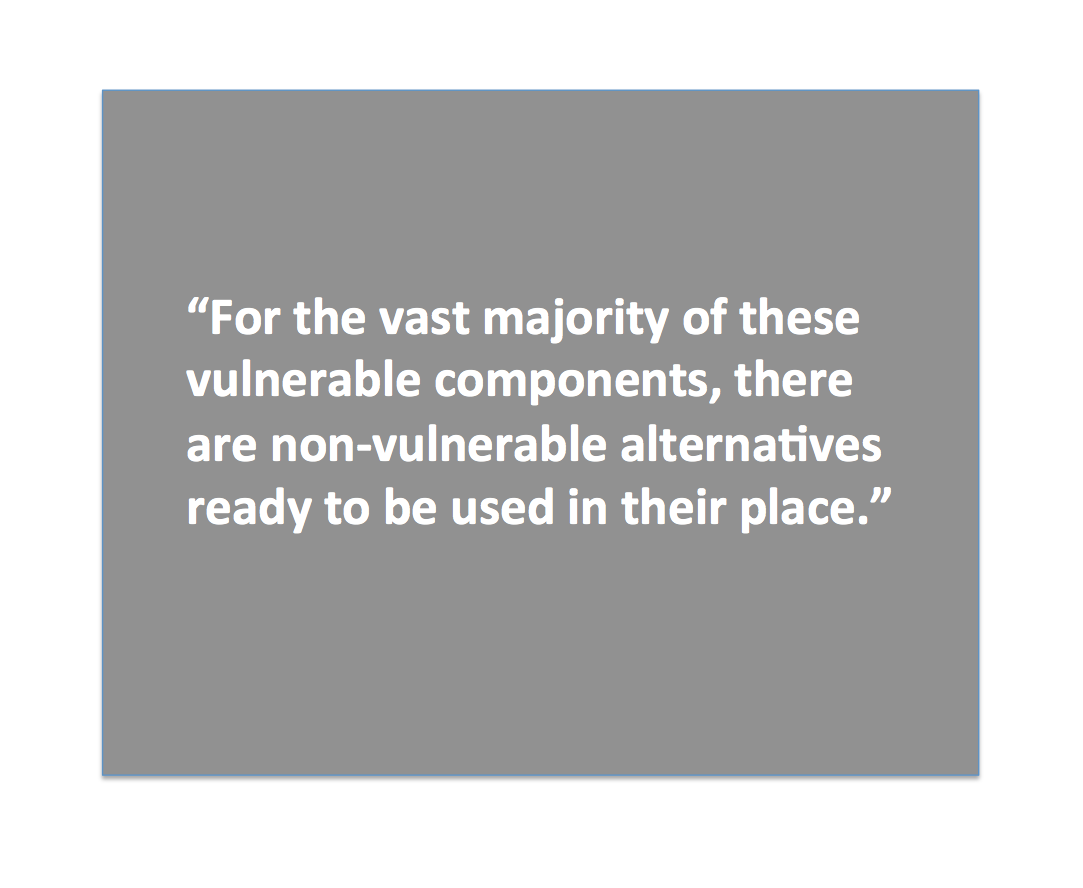
    Image title

    Going (Way) Beyond Security


    The consumption of vulnerable components is a quantifiable problem that we used to illustrate the current challenges that every organization has with open source component selection. However, security vulnerabilities are only one of the many dimensions.
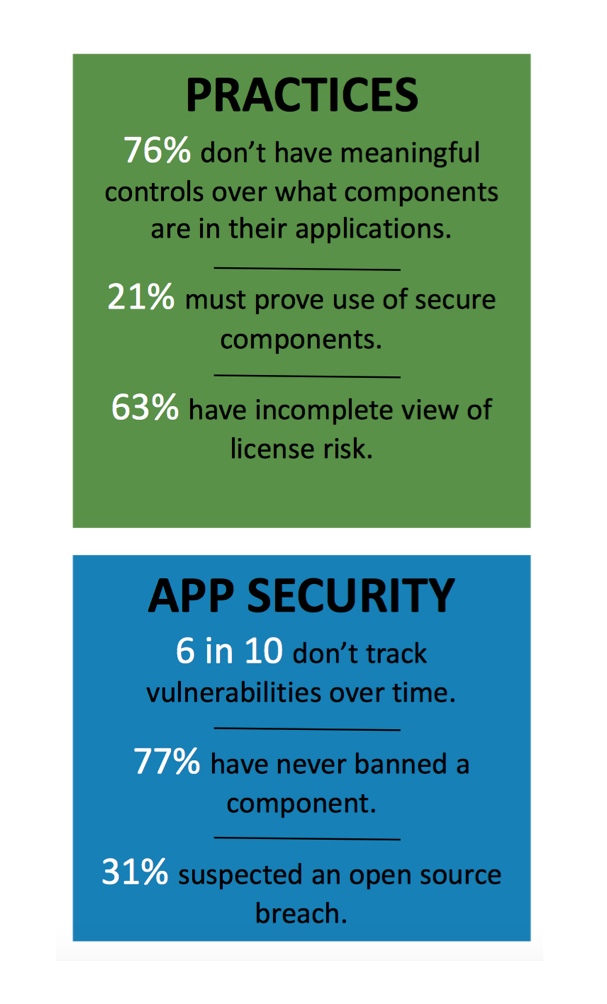
    DevOpsSec: Surveys show the need for improved OSS governance.Others include architectural aspects such as rules covering component age and popularity, intellectual property coverage with rules related to open source licensing and technical debt controls associated with technology stack selection.  Introducing more formalized vetting processes coupled with software supply chain intelligence and automation will yield significant overall quality and efficiency benefits for an organization, allowing them to operate with a lower risk profile.

    Yes, A Firewall for Repository Managers

    In November, Sonatype became the first company to introduce a “firewall” for use with repository managers.  Called Nexus Firewall, the solution offers perimeter quality control for software development. Similar to a network firewall, it leverages rules you define that automatically shield an organization from unacceptable software components entering and another set for stopping them from exiting your application development. The basic concept looks like this:
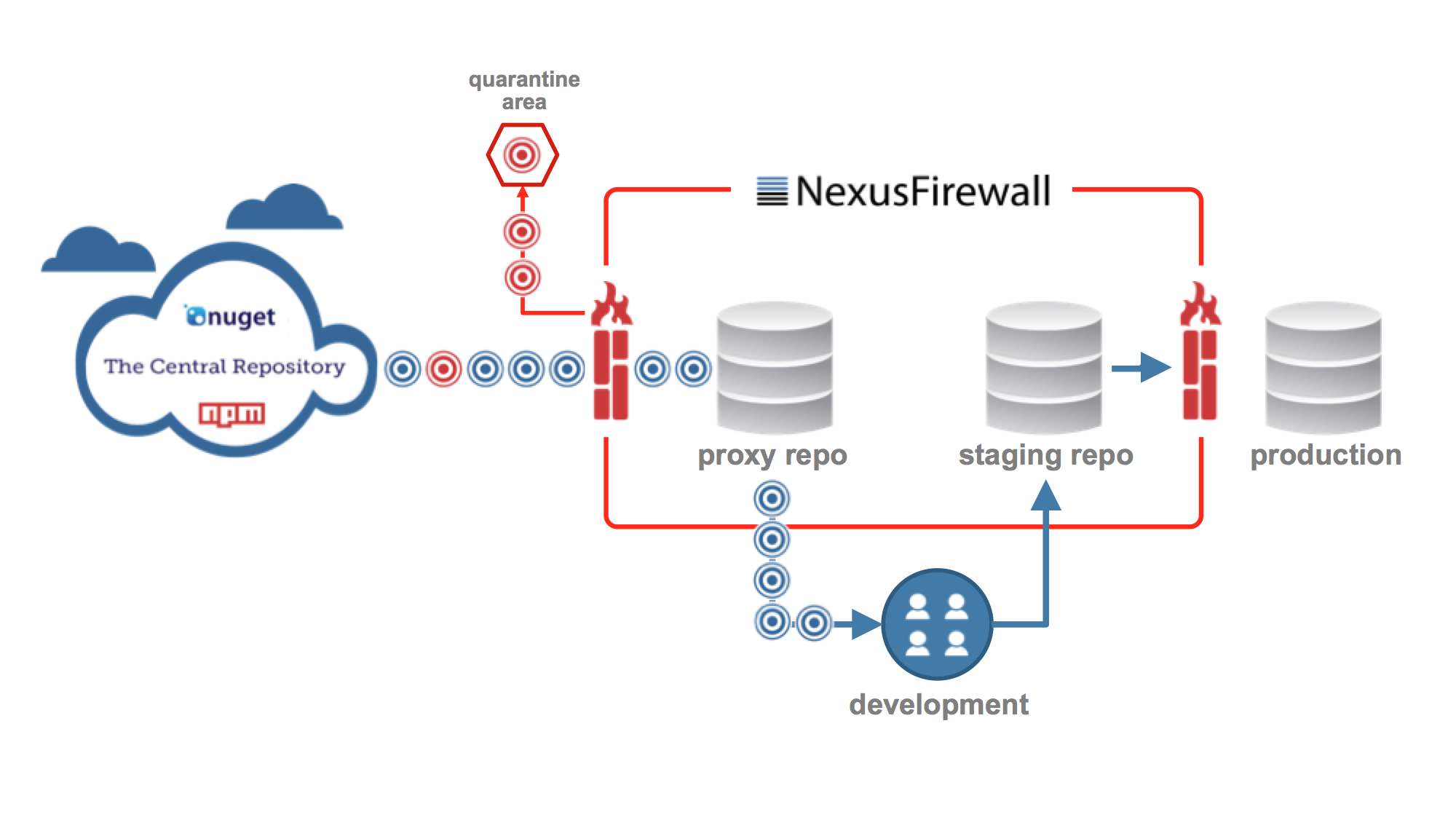
    Nexus Firewall: shifting DevOpsSec further left than ever before.

    In order to build quality in from the beginning, this solution represents a “shift (far) left” innovation.  The Nexus Firewall improves speed and reduce risk through the quarantine of components with known vulnerabilities. With a repository firewall in place, organizations can shield your application development from waste and risk by automatically blocking unacceptable software components inbound and preventing release of applications containing such components outbound.  1 in 16 downloads with known security vulnerabilities could be reduced to zero in 16.

    The firewall also goes beyond blocking, providing organizations with the visibility and data needed to make ideal decisions for open source component selection early, significantly reducing waste related to rework and eliminating avoidable risk.

    For DevOpsSec, Shift (Far) Left to Build Quality In

    The consumption of these unacceptable or, at a minimum, inferior components is unnecessary.  For the vast majority of these vulnerable components, there are non-vulnerable alternatives ready to be used in their place. The challenge is that it has been historically difficult for developers to understand these risks and even harder to avoid them.  Few developers have countless hours to commit to researching vulnerabilities in the components they use and fewer more want to rely on colleagues in security, legal, or audit teams to spend hours or weeks to return with “go” or “no go” vetting decisions.

    The volumes and velocity of component consumption we see today validates that any form of manual review process or automated workflows outside of the development teams will be quickly outpaced.  DevOps and Continuous Delivery processes need to rely on automatic intelligence to help developers select the highest quality components and avoid those with known risks.  When known security vulnerabilities and other risks are identified, software supply chain intelligence will be required to guide developers through the identification and selection of safer, higher quality components.

    An example of the kind of information made available is shown below.
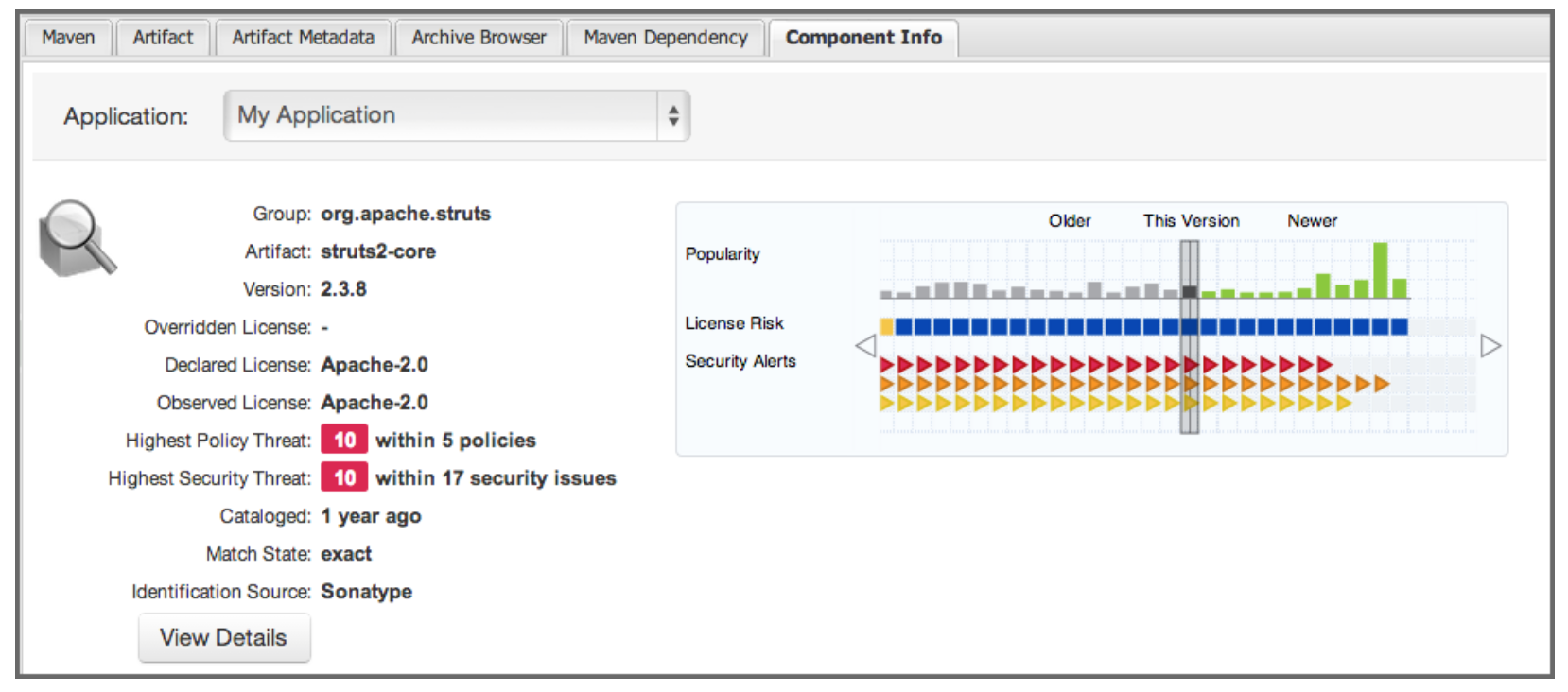
    DevOpsSec: Identify the best components that meet policy guidelines from the beginning.

    The information is divided into two areas. On the left side is component data, which includes details related to the component itself. To the right, there’s a graphical display of any security or license issues, as well as popularity data for each version of the component displayed. Selecting different versions updates this information accordingly, including whether or not a particular version passes the established criteria.

    A Must for DevOpsSec: Quality at Velocity

    Simply by enabling a repository firewall, organizations can immediately improve quality and reduce waste and exposure to risk. None of this comes at the expense of development speed.

    The repository firewall automatically quarantines components that do not pass your rules preventing quality issues from entering the software being developed, immediately reducing risk and avoiding wasteful rework at some later point. Quality is improved, efficiencies are gained and risk is reduced, all through automation and all at the speed of modern development.

    One of my favorite reference books is Continuous Delivery by Jez Humble and Dave Farley.  Let me share a few of their words to help remind us of the importance of innovations and practices that allow us to bring pain forward.  Jez and Dave remark:

    “The techniques that we describe in this book, such as continuous integration, comprehensive automated testing, and automated deployment, are designed to catch defects as early in the delivery process as possible (an application of the principle “Bring Pain Forward”).  The next step is to fix them  A fire alarm is useless if everyone ignores it.  Delivery teams must be disciplined about fixing defects are soon as they are found.”

    Well said Dave and Jez.  Well said.


  • DevOps Leadership: Leading a DevOps Revolution in Pay TV

    DevOps Leadership: Leading a DevOps Revolution in Pay TV

    The State of DevOps in Pay TV

    Pay TV is largely rooted in an ancient operator model. “Operators in this industry usually take a year or longer to release new code into software. Their Ops teams are focused on making sure that existing environments never fail,” says Mark Hydar, Head of DevOps, Ericsson TV Platforms. That is as opposed to moving to the CI and CD of DevOps with their continually changing environments.

    Newer Pay TV models that revolve around sending TV shows to a web browser in exchange for a modest monthly subscription arrived with DevOps and evolve faster because of it. Older models where you offer a set top box for a consumer’s home TV are still transforming sluggishly, taking small bites at adopting DevOps.

    “An operator such as a Vodafone has customers who pay a lot of money for the reliability that comes with the set top box model. It’s on a big screen, the customer uses a remote, and they demand 4K and to be able to connect it to their home audio system. The expectation with that is that it never fails,” says Hydar. Environments of constant change such as DevOps where the perception is that the risk of failure is high present a lot of apparent / assumed conflict for operators and ops teams supporting the legacy model.

    Moving Operators to DevOps

    These operators need a guiding hand as they take baby steps toward fast and ferocious innovation and improvement. “Our approach is to first educate the operators’ directors and above on what the consumer tells us they want. Our field research and R&D tell us that by 2020, there will be a lot more connected handsets and smart devices out there,” says Hydar.

    The current generation, the Millennials, have “surpassed the Gen-Xers as the largest generation in the U.S. labor force”. This generation is spending less time in front of a fixed screen and a lot more time with mobile screens, says Hydar; operators need to figure out what they can do to stay aligned with what the current consumer wants while protecting and growing the revenue they currently have with “cord cutters”.

    Ericsson next works to help operators roll innovations out to customers faster by adopting Agile methodologies and moving to a DevOps deployment model while learning how to sustain that model, according to Hydar. But this transition only happens as Ericsson aids its operator customers in dealing with an expected level of internal apprehension and hesitation by bringing each internal group along a bit at a time.

    For example, Ericsson will recommend that operators and their CIOs take existing data center engineers who address trouble tickets and retool their skillsets so that they can look at software bugs and start to think more like developers.

    “Once we suggest that, the CIO will often feel like, wow, and then there will be some push back, some resistance, and what-if questions. Over a period of a month or two, there will be a high volume of pointed questions that come to us, but that goes away,” says Hydar. Operator leadership eventually wraps their heads around it, see the benefits, and translate the changes to a lower cost of ownership, says Hydar.

    As for the operations side who are still keeping the status quo up and running, Ericsson simply informs them as to what is coming down the pike in a very positive way. “We tell them how it is going to make their life better and how they can accomplish more,” says Hydar.

    When approaching the test and development teams, Ericsson focuses on how they test and roll software today, introduces them to how they can innovate and deliver software faster, and leads them to want to align with that process. “They start to see the benefits and gain momentum both on the test and development sides,” says Hydar. Development begins to change.

    Finally, Ericsson goes back to the Ops teams and brings them together in summits where they discuss the speed of delivery of some the software projects, and the test findings. “The Ops team starts to take notice. They want to learn about Agile. That’s where you introduce training in what it takes to be a Scrum master, what DevOps means, and how they as operations people can integrate themselves with development,” says Hydar.

  • #DevOpsThanks, what are you thankful for

    #DevOpsThanks, what are you thankful for

    Here in the US this Thursday is our Thanksgiving holiday. Originally celebrated the 4th Thursday in November, it has expanded where most people also take off the following day, Friday, for a long weekend. In fact many schools here in the US close the entire week to celebrate this holiday commemorating the Pilgrims giving thanks for making it through their first year here in the New World with the help of their friends, the native peoples of America. It also marks the official start of the Christmas/New Years holiday season here.

    Beyond that though Thanksgiving always gives me a moment to pause, reflect and think about what I have to be thankful for.  Here at devopsy.kinsta.cloud we wanted to ask our readers, no matter where in the world you are, what you have to be thankful for. It could be something DevOps or IT related, it could be something unrelated. But if you tweet what you are thankful for and use the hashtag #DevOpsThanks our team will monitor and we are picking the top ten tweets to win one of our new DevOps T-shirts. So lets hear what you are thankful for this year.

    I wanted to take a moment and list a few things we are thankful for here at devopsy.kinsta.cloud

    1. Most of all we are thankful to you our millions of readers who have made our site successful and inspire us to keep pushing to bring the most and best DevOps related content.
    2. We are grateful for all of the DevOps practitioners who are the real heroes of this story; that are doing more, faster and better every day.
    3. We are extremely thankful for our 70 + sponsors whose support enables us to keep the lights on here and keep pushing with new ideas.
    4. We are thankful for our feature writers: Tony Bradley, David Geer, George Hulme, Ericka Chickowski and Chris Riley who have contributed so many great articles.
    5. For our 200 + contributors who have given the site its depth and voice with all of your great contributed articles.
    6. We are thankful that we live in such amazing times.  Where the commonplace would be considered miraculous just a few years ago. We couldn’t talk, learn and practice DevOps if not for all of the great technologies and advances that have come before it.
    7. We are thankful that in a time where our world on some days seems ready to blow up in conflict, our audience continues to grow not only here in the US (which is now a minority of our audience) but throughout the entire globe.

    On a personal note, I am grateful for the terrific group of people who have joined with me at devopsy.kinsta.cloud, who bought into a common dream of creating something new & great; who with me push the rope up the hill everyday to make it happen.  I am also grateful to my wife and kids, who don’t see me quite as often as they did before devopsy.kinsta.cloud but who are the reason I get up and do it everyday.  Most of all I am grateful to God or whatever you want to call him for giving me the chance to live a blessed life and the opportunity to meet such great people and do something I love for a living.

    So what about you? What are you grateful for? Tweet it on #DevOpsthanks for chance for a t-shirt.

  • DOES 15 – The 7 habits of successful DevOps

    DOES 15 – The 7 habits of successful DevOps

    Dipping back into the DevOps Enterprise Summit 2015 well, today’s feature is my talk with Sam Guckenheimer of Microsoft.  Sam presented on the transformation he oversaw at Microsoft’s Visual Studio moving to Visual Studio Online. It is the story of COTS to SaaS and all of the pitfalls and idiot taxes Sam and team paid along the way. 

    From this ordeal Sam and his team developed the 7 habits of successful DevOps. Like my earlier interview with Jeff Snover, it is a great peek into how things have changed in Satya Nadella’s Microsoft.

    Here is Sam’s complete presentation at DOES 15. Just a heads up that it is about an hour long, but I think well worth the time.

    If you like what Sam is talking about and want to learn how the 7 habits of successful DevOps can help you lead the transformation in your organization, stay tuned for podcast I just recorded with Sam that will be in our leadership suite next week. In the meantime you can download and find out more about Sam’s 7 successful habits here.

  • CA World 2015 wrap up

    CA World 2015 wrap up

    Just back to my room from the Sheryl Crow/Fall Out Boys concert that ended CA World 2015. It was a full two days of information and news showing how CA Technologies is evolving to remain relevant in the changing world of ITOps and Development. There was certainly lots of new things to report as CA has had a busy year. Among the highlights:

    Rally Software’s agile business is going to transform CA. While you didn’t hear or see the name Rally, you saw Agile everywhere.  From the large “agile transformation zone” to the frequent mentioning of agile ways and training by all of the executives there. The entire top cadre of CA management has undergone agile training according to CEO Mike Gregoire. Agile training is going to be a big part of CA’s business going forward. It represents an expansion from the core software shop business that CA is built on.  How this will effect relations with their channel partners who have traditionally delivered training and pro services around CA software tools, remains to be seen.  But in order to use CA’s portfolio of software, some training and transformation counseling will be necessary.  My prediction is that over the next 18 to 24 months the Rally culture is going to profoundly change CA for the better, making them more nimble, agile and delivering transformation change to their large enterprise customers.

    New leadership faces. While Gregoire himself is now one of the veterans of the exec team having been there about 3 years, much of senior management is new having just taken the reigns in the last few months. I had a chance to question Otto Berkes, CTO and Ayman Sayed, Chief Product Officer. While both have only been on the job for a few months each, they both seemed to have a firm grip on the companies road map and what the market is looking for.

    aymanSayed in particular seemed to have strong feelings about what the market is going to demand in the coming months and years, as well as a willingness to have CA deliver it. Among these is a change in how products are sold and delivered. CA had already started delivering some of their solutions as SaaS based solutions. Sayed went further saying that CA is going to move to a freemium model with some products. Not just a free trial period but actual free versions of their product and dare we say it, even open sourcing some code.

    This will mark a big departure from CA’s traditional enterprise sales force. But I think it is an idea whose time has come. Today’s technical buyers don’t like to be “sold to” or even marketed to. They like to be educated, they like to hear about problem solving, they like to try solutions and if they find they work they will buy these solutions without the hard sell that traditional enterprise sales team used to exert.

    Other new faces were the Xceedium team joining CA’s security team. My old friend Mo Rosen is aboard and Xceedium’s privileged identity management solution is being integrated with CA’s existing identity products to create a full spectrum of choices both host-based and in the cloud.

    The idea of solutions that work both on premises and in the cloud is another big theme at today’s CA. They recognize that for the foreseeable future hybrid environments will rule.

    ottoaymanOf course DevOps was everywhere. It has been and remains one of the foundational aspects of CA’s business model. In listening to several sessions on DevOps at CA it also became clear that CA is using DevOps to expand their business from tools for IT operations to providing developers with tools for the total software development lifecycle.

    Among these developer tools API and API management is big business at CA. Their API and APM business lines are both leaders in their markets. CA seeks to use these best of breed tools to expand their customers use of CA portfolio products.

    I also had a chance to speak one on one with GM of the DevOps business at CA, Mike Madden.  Madden comes from the mainframe division over to DevOps and he recognizes that in todays bi-modal or variable speed IT world DevOps and mainframes actually work together. Madden has a good vision of what DevOps is and what CA needs to do to remain and grow their relevance in the market. He is also a big fan of the agile business from Rally and I think we will continue to see that as a big part of the DevOps business.

    This years CA World was considerably larger than last years event. When you think about it CA World is really different than many other conferences. Just about all of the 5000 attendees are CA customers. The idea is that attendees already use CA product, they are primed to perhaps buy more.

    It will be interesting to see what changes are in store and what next years CA World will look like. A sure bet is that DevOps will continue to play a major part of the CA story.

  • BoomTown No Bust with VM Supported Parallel Testing Environment

    BoomTown No Bust with VM Supported Parallel Testing Environment

    An Introduction to BoomTown DevOps Processes

    BoomTown uses a specific set of DevOps processes in order to deliver websites with the latest real estate listings and housing data as well as a CRM solution and analytics tools for real estate professionals. “Our development, operations, and QA teams automate everything in sight while offloading to cloud providers and other services the tasks that those providers are best suited to,” says Brian Baumgartner, QA Manager, BoomTown.

    As only one example, BoomTown recently adopted Amazon Web Services (AWS) for hosting various aspects of its infrastructure. “It enables us to provide high availability and resilient service while allowing our development team to focus on revolutionizing the Real Estate software industry,” says Baumgartner.

    Docker containers support regular deployment processes at BoomTown, containerizing the environment setup for a more reliable, orderly deployment experience, whether the firm is pushing code to QA or to production, explains Baumgartner. TeamCity, the increasingly popular and frequently appearing name in build management tools and CI servers courtesy of JetBrains is BoomTown’s go to build platform. New Relic is BoomTown’s performance management solution of choice, enabling live transparency into the production application and server performance that keeps BoomTown citizens (customers) content.

    BoomTown Before & After Using Sauce Labs VMs to Scale Testing

    Prior to applying Sauce Labs, BoomTown’s QA analyst team processed all software tests exclusively in a manual fashion. Every test run crossed their laps / machines / laptops. “Before a new feature release, an analyst would execute a full set of regression tests against the product or feature, often through several different browsers and versions to verify the new release and its function. This process alone took up to two weeks for large projects,” says Baumgartner.

    BoomTown now uses a test automation framework constructed using several popular DevOps tools. The custom built testing automation leverages Ruby, Selenium WebDriver, Cucumber, MySQL, Sinatra, and Angular JS, says Joey Gryder, Senior Software Engineer in Test, BoomTown. The framework offers BoomTown views into historical and real-time test results as well as the capability to run manual tests through its dashboard front end software connection to its backend systems.

    BoomTown applies a single web service to assert control and manipulation of test system automation features. A “test runner” library enables QA to run Cucumber features in a parallel execution approach. BoomTown uses MySQL to store test results. “When we combine all this with Sauce Labs’ VMs, we can schedule nightly test runs using our full testing suite on a variety of browser configurations,” says Baumgartner. This has enabled BoomTown to run up to 100 tests on software nightly.

    Parallelization

    Where time, resource, and person hours’ savings are concerned, the secret sauce in BoomTown’s software testing framework is its use of Sauce Labs VMs to support many automated tests in parallel. This has cut BoomTown’s longest test run time of an hour and a half down to less than 15 minutes.

    “With Sauce Labs, it is trivial to spin up any number of parallel VMs, configured against your desired browsers to run through a set of Selenium WebDriver test steps. Without such a solution, BoomTown’s test team would have had to either execute its entire test suite locally through a single machine and browser, or build an in-house testing lab to achieve parallel browser testing,” explains Baumgartner. (Sauce Labs is obviously not the only player with competitors including BrowserStack and TestingBot; let your due diligence be your guide in selecting the best service for your needs.)

    BoomTown saw offloading the work as the best option in order to accelerate otherwise time intensive testing tasks, preventing QA from becoming a sort of time-related bottleneck on CD. “We did this simply by increasing our VM count and running more tests in parallel,” says Baumgartner.

    Adding VMs and increasing the number of parallel testing instances is an easily scaled approach that continues to speed tests and drive CD even as BoomTown adds tests and lengthens total test runtime.

    Using automated parallel tests supported by Sauce Labs VMs frees up QA analysts to be more creative in their testing, finding more and more interesting ways to break the application under testing loads, says Baumgartner; meanwhile the automated testing ‘machine’ verifies the mundane and repetitive tests that the team has already established.

    “We recently incorporated automation as a quality gate in our CI process. Before a pull request is accepted, it must pass a set of critical path UI tests that run up in Sauce Labs. This sets a certain level of quality expectations during our daily development process, which saves us time in testing,” explains Gryder.

  • DOES 15 – Jason Josephy and Courtney Kissler, Nordstrom

    DOES 15 – Jason Josephy and Courtney Kissler, Nordstrom

    Few verticals have seemed to embrace DevOps as quickly as the retail sector. Macys, Target, Nordstrom, WalMart and more have all demonstrated success adopting DevOps patterns and culture.  We spoke to many of the folks from these retailers at the recent DevOps Enterprise Summit 2015 (DOES 15).  Here is my interview with Jason Josephy and Courtney Kissler of Nordstrom.

    I spoke to them right after they came off the stage where they showed a 20% improvement in cycle times year over year. This translated into significant savings to the company.  Courtney has presented at DOES 14 so like many other presenters at this years event, this was an update on what happened since they last presented.  It is a great interview, have a listen:

    Here is a link to their actual presentation:
    DOES15 – Courtney Kissler & Jason Josephy – Mindsets and Metrics and Mainframes… Oh My!

    Stay tuned over the coming weeks as we will post more of our devopsy.kinsta.cloud exclusive interviews with many of the speakers and attendees of DOES ’15

  • Your DevOps Subculture

    Your DevOps Subculture

    I’m often asked how to create a DevOps Culture and there is no single answer to this question. The focus initially for me in any cultural movement is to understand how the organization incentivizes and what its core beliefs are. When it comes to DevOps, I am normally looking for ways to bring these two teams together from a fundamental aspect first. One method I have found that works well when I’m consulting with these two teams is a Culture Session.

    Teams often end up with a subculture that incorporates aspects of the macro culture. These subcultures can evolve into the silos that DevOps is designed to break down. A Culture Session is one where you bring these teams together en masse and work on defining a new unified subculture.

    Culture Session

    The session starts before we even meet, with buy-in from the leadership. There will likely be detractors that will not want to attend or contribute. Having leadership not only broadcast the meeting, but support the change will be critical to success. We want to address this issue from the top down as well as from the bottom up.

    With both teams in the same room we will begin to address the culture we want. Language should focus on the fact that the team is made up of all engineers. Creating a sense of a single team spanning Development and Operations is a key focal point in DevOps. In order to build a unified new culture, we must discover the core beliefs of the new team. Ask the team what they consider our core beliefs of their culture is. Don’t restrict the statements that come out of this part of the session, everything has merit and should be included.

    It can be difficult sometimes to get a team to think in terms of beliefs. If we are greeted with blank stares or eye-rolls when asked what we believe in, try a different tactic. Ask the team what would be an ideal company to work for and build beliefs off of these statements. Here are some examples from my sessions, converted into beliefs.

    I want to work for a company that… Belief
    is fun to work for We value a fun work environment
    let’s me work from home We value results over where work is accomplished
    wants to hear my ideas We value everyone’s input always
    helps me to grow my career We value the growth of people as much as the business
    has a diverse workforce We value equality in all aspects of our culture
    has a community that supports each other We value consistent adherence


    Once you have a fair number of items (based on the number of participants) we can begin to order the list. It’s acceptable to write these on yellow sticky notes as well if you don’t have a whiteboard. The ordering is accomplished via a process similar to voting in Lean Coffee. Everyone gets three votes; dispersed any way they desire. I tend to use dots on the cards and then add up each card. List the top 5-10 cards from highest to lowest, and these are your top cultural values. Discuss the results with the team, are they surprising?

    Aligned Goals

    I believe that aligned goals create a more comfortable work environment and encourage the building of trust. Your teams goals should not only be aligned with the business, but also with your culture. This will make introducing and reinforcing the proper behaviors easier. Some of the highest performing teams I’ve worked with had alignment on all three fronts: Business, Behaviors and Culture.

    Behavior and Community

    Now that you have a core set of beliefs, it is time to begin talking about the behaviors we wish to see that drive those beliefs. The leaders at all levels must continuously encourage the community to reduce behaviors that are not aligned with core beliefs, while encouraging those that do. Over time the community will govern its own members, solidifying the positive culture and beliefs. The ability of the community to manage its own members requires the alignment I spoke of earlier.

    DevOps Language

    What I call DevOps Language is key to building and maintaining a strong community. A major component to DevOps is a culture that is accepting, open, honest, collaborative and trusting. We tend to get defensive when we feel that our abilities or intentions are being called into question. The following shifts may appear simple and non-significant in the beginning, but these simple changes in how we communicate greatly enhance our ability to clearly get our message across.

    Why to How

    Moving from “why” to “how” is a great first step in adopting a DevOps Language. Often we are faced with a lack of understanding that we desire to fill. Perhaps you are looking to get a better handle on the design or structure of a block of code or infrastructure. Maybe you are attempting to learn a process on a new team you’ve just joined. Regardless of the scenario, you are going to have questions. Like many “trigger” words, “why” tends to send some people into defense mode. Why can (and tone of voice is crucial here) make people feel as though you are questioning their intelligence and intent or even implying that you would have done it different (aka better). Moving the language from why to how you did something invites the listener to share their reasoning and experiences, not defend their position.

    I Know to I Agree

    Another simple change that I have found and adopted into my DevOps Language is “I agree”. I had a bad habit of saying “I know” when someone would tell me something I… well that I already knew! Again, the issue here is subtle, but with all things subtle they build over time. Saying “I know” sounds condescending at times and can be seen as an attempt to exert your superiority. In other words, this is not an collaborate language tactic. When we say “I agree” instead, we are saying that we are aligned in our thinking. This is including all parties and doesn’t shut the conversation down.

    Should’ve to Will

    DevOps is all about collaborating to make our future better. We often need to review events of the past to identify how to create a better future. The key to this review is to not focus on counter factuals rather we use forward thinking language. Concentrate on moving from “we should or could have” to “we will”. Over time this will help the team to maintain a forward thinking bias rather than dwelling too long on the past.

    Closing

    Creating systemic long term positive change within your organization takes time, effort and alignment. Creating a unified culture and belief structure through collaboration and inclusion paves the way for your DevOps future. Focus on the language and behaviors that reinforce your culture. Encourage members of the community to help govern and guide the culture, using the agreed upon beliefs. Include the beliefs and DevOps language in the interview and hiring process, in order to include new employees early and often.

    Let’s collaborate! I am always looking for ways to learn and grow. How have you aligned your teams around culture? How can I make this exercise more effective?