Category: Features

  • Five Great DevOps Job Opportunities

    Five Great DevOps Job Opportunities

    DevOps.com is now providing a weekly DevOps jobs report through which opportunities for DevOps professionals will be highlighted to better serve our audience.

    Our goal in these challenging economic times is to make it easier for DevOps professionals to advance their careers.

    Of course, the pool of available DevOps talent is still relatively constrained, so when one DevOps professional takes on a new role it tends to create an opportunity for others.

    The five job postings shared this week are selected based on the company looking to hire, the vertical industry segment and, naturally, the pay scale being offered.

    We’re also committed to providing additional insights into the state of the DevOps job market. In the meantime, for your consideration:

    CareerBuilder.com

    The DarkStar Group
    Fairfax, Virginia
    AWS DevOps Engineer (Security Clearance)
    $250,000

    Indeed.com

    Dutch Bros. Coffee
    Grants Pass, Oregon
    Senior DevOps Engineer
    $139,473 to $161,688

    LinkedIn

    Claravine
    Remote
    DevOps Engineer
    $105,000 to $115,00

    SimplyHired.com

    Motorola Solutions
    New York, New York
    Infrastructure Operations Engineer
    $93,620 to $180,000

    Dice.com

    Scholastic Inc.
    New York, New York
    Associate DevOps Engineer
    $58,500 to $93,500

  • DevOps is Making Gains on Mainframe Platforms

    DevOps is Making Gains on Mainframe Platforms

    A survey of 800 executive and technical professionals conducted by BMC found close to two-thirds (62%) are employing DevOps workflows to build and deploy applications.

    In addition, the survey also finds that just under a third of respondents (32%) are applying artificial intelligence to IT operations (AIOps) across all platforms.

    John McKenny, senior vice president and general manager of intelligent Z optimization and transformation at BMC, said the survey shows that organizations continue to invest in mainframe applications alongside distributed computing environments.

    In fact, 61% of respondents noted that data volume on mainframes increased in the last year, with 56% reporting an increase in the number of databases running. Well over a third of respondents (35%) also reported increased interest in taking advantage of cloud technologies to handle, for example, storage and data protection.

    Overall, the survey found that 94% of respondents have a positive perception of the mainframe, with nearly two-thirds (63%) reporting increased mainframe investments over the past year.

    Compliance and security lead the list of priorities for mainframe organizations, with 61% of respondents citing these as top issues, followed by cost optimization (49%), enhancing automation (41%) and data recovery (40%).

    In general, organizations with mainframes are adopting modern application development tools such as VS Code to attract a younger generation of developers. It’s critical to continue to attract developers to mainframe platforms that continue to run the most mission-critical applications in the enterprise, said McKenny. Many of those applications are being modernized using DevOps tools and practices rather than being moved to another platform, he added.

    He added that the appetite for using generative artificial intelligence (AI) to write code for mainframe applications is less clear because of intellectual property concerns. Most organizations are not going to want to expose their mainframe code to a general-purpose large language model (LLM) that drives a public generative AI platform, but there will be a role for private LLMs that are trained using code that has been validated, noted McKenny.

    Regardless of how generative AI evolves, there’s still much work to be done to further the adoption of DevOps best practices in mainframe environments. Each organization will determine how stringently to apply those practices based on the frequency at which applications running on mainframes need to be updated. In most cases, organizations with mainframes will use a mix of waterfall and DevOps-based approaches to building and deploying applications for many years. The decision as to which approach to employ will, naturally, have as much to do with culture as it does the rate at which the application needs to be built and deployed to drive, for example, a digital business transformation initiative.

    The days when mainframes were managed in isolation from the rest of a distributed computing environment are slowly coming to an end. A mainframe is, arguably, just another node for deploying applications. The challenge and the opportunity now is getting the right DevOps tools in the hands of the IT team managing heterogeneous IT environments, including mainframes.

  • Summit Highlights Open Source Software Security Progress

    Summit Highlights Open Source Software Security Progress

    More than a year after the Open Source Security Foundation (OpenSSF) summit kicked off an initiative to better secure open source software-based software supply chains, a lot of progress has been made—but much work remains to be done.

    The OpenSSF this week hosted a Secure Open Source Software (SOSS) Summit 2023 event in Washington, D.C., during which it made available a Secure Open Source Software Vision Brief 2023. The brief describes the various efforts being made to improve open source software security, including, for example, providing maintainers of open source software projects with free DevSecOps tools.

    This week, the Cybersecurity and Infrastructure Security Agency (CISA) also published an Open Source Software Security Roadmap that defines its role in providing more visibility into how open source is being used and the associated risks.

    However, it’s not clear how much maintainers of these projects are embracing DevSecOps workflows. Many projects are led by a handful of maintainers that often lack the time and skills required to ensure the components they employ have not, for example, been compromised by malware that might find its way into downstream applications.

    Sonatype CTO Brian Fox said the focus of the summit’s participants will be on education and securing public code repositories. While there is a lot of focus on maintainers, he added that there is not enough attention to all the organizations that have not updated open source components within a software build with known vulnerabilities. Many IT teams are reluctant to upgrade components for fear of breaking applications with complex dependencies, but the amount of code that is potentially insecure is massive. “There’s a huge mountain to climb,” he said.

    The challenge is determining which code to upgrade first in a way that will have the most impact in terms of improving application security, added Fox.

    Shawn Ahmed, chief product officer for CloudBees, also noted that organizations should evaluate the DevSecOps processes being applied by maintainers of open source software projects. CloudBees, for example, reviews the plugins provided by the open source community for the Jenkins continuous integration/continuous delivery (CI/CD) platform for vulnerabilities every month, he noted.

    It’s also critical for organizations that consume open source software to contribute code to improve the security of open source software, added Ahmed. Too many organizations are focused on open source software security without devoting resources that would help resolve the issue. he added. “We need to make sure open source software is not a vulnerability threat,” said Ahmed.

    Moran Ashkenazi, chief strategy officer (CSO) and vice president of security engineering for JFrog, said on the plus side, there is a lot more awareness of open source software security issues since the disclosure of a zero-day vulnerability in the Log4j shell tool widely used to manage logs in Java applications. But added that this issue is not going to be resolved overnight. “That was a wakeup call,” she said.

    Tapabrata Pal, vice president of architecture for Fidelity Investments, noted that the fundamental problem is that cybercriminals have become more adept at injecting malware into software supply chains, so no one knows whether their application environments might be compromised. “It’s a serious issue,” he said.

    It’s not known whether the open source software that many developers routinely incorporate into their applications might contain vulnerabilities that could be exploited, but the level of technical debt that has accrued over the last several decades is considerable. The issue is finding a way to address it without becoming overwhelmed by the enormity of the task.

  • CloudBees CEO: State of Software Development is a Disaster

    CloudBees CEO: State of Software Development is a Disaster

    CloudBees CEO Anuj Kapur told attendees at a DevOps World event today that with developers spending only 30% of their time writing code the current state of software development in enterprise IT organizations is a disaster.

    After more than 14 years of effort, the promise of DevOps—in terms of being able to accelerate the rate at which applications are being deployed—remains largely academic, said Kapur. In fact, the effort to shift more responsibility for application security further left toward developers has only increased the amount of cognitive load and reduced the amount of time available to write code, he noted.

    However, with the rise of generative artificial intelligence (AI), an inflection point that will dramatically increase the velocity at which applications are being built and deployed has arrived, said Kapur. The challenge will be achieving that goal without increasing the cognitive load on developers. That cognitive overload results in 70% of developers’ time not being productive within organizations that often hire thousands of developers, he noted.

    Despite all the DevOps issues that need to be addressed, AI advances promise improvement. The overall DevOps market is still relatively young, given the current level of adoption, said Kapur. “We continue to believe the market is early,” he said.

    Today, CloudBees took the wraps off the first major update to the open source Jenkins continuous integration/continuous delivery (CI/CD) platform to have been made in the past several years. At the same time, the company also unveiled a DevSecOps platform based on Kubernetes that is optimized for building and deploying cloud-native applications based on portable Tekton pipelines. That latter platform provides the foundation through which CloudBees will, in the months ahead, apply generative AI to software engineering to, for example, create unit tests on the fly and automate rollbacks.

    In addition, DevSecOps capabilities will be extended all the way out to the integrated development environments (IDE) to reduce the cognitive load of developers.

    The overall goal is to reduce the number of manual processes that create bottlenecks that make it challenging to manage DevOps at scale.

    Criticism of the level of developer productivity enabled by DevOps compared to other development approaches needs to be tempered, said Tapabrata Pal, vice president of architecture for Fidelity Investments, because it still represents a significant advance. There is still clearly too much toil, but the issues that impede the pace at which developers can effectively write code tend to be more cultural than technical, he added.

    Organizations are not inclined to automatically trust the code created by developers, so consequently, there is still a lot of friction in the DevOps process, noted Pal.

    In theory, advances in AI should reduce that friction, but it’s still early days in terms of the large language models (LLMs) that drive generative AI platforms and their ability to create reliable code, he added. That should improve as LLMs are specifically trained using high-quality code, but in the meantime, the pace at which substandard code might be generated could overwhelm DevOps processes until AI is applied there as well, said Pal.

    Thomas Haver, master software engineer for M&T Bank, added that while assisted AI technologies will have a major impact, it’s not reasonable to expect large organizations to absorb them overnight. Patience will be required to ensure advances are made in ways that are both secure and sustainable, he added. In some cases, organizations may opt to build their own LLMs to achieve that goal, noted Haver. “You should not expect to change on a dime,” he said. “It will take time to see the fruits of our labor.”

    While many DevOps challenges need to be resolved, the benefits continue to outweigh the cost and effort required to succeed. The hope is that, with the help of AI, the return on those investments will continue to accrue.

  • Google De-Recruits 100s of Recruiters ¦ ARM Valued at $45½B in IPO

    Google De-Recruits 100s of Recruiters ¦ ARM Valued at $45½B in IPO

    Welcome to The Long View—where we peruse the news of the week and strip it to the essentials. Let’s work out what really matters.

    This week: Google fires hundreds of recruiters, and ARM gets a sky-high valuation. (more…)

  • ngrok Adds Load Balancing to Programmable Network Service

    ngrok Adds Load Balancing to Programmable Network Service

    ngrok today added a global server load balancing capability to its service for managing ingress via an application programming interface (API).

    Alan Shreve, ngrok CEO, said the ngrok Global Server Load Balancing (GSLB) service reduces latency and increases overall resiliency by automatically rerouting traffic across a global network of points-of-presence ngrok manages.

    The overall goal is to provide a higher level of abstraction for managing network operations (NetOps) that can be programmatically invoked. NetOps takes the place of what are essentially the equivalent of Assembly programming tools to provision networking equipment, he added. The long arc of computing is moving toward higher levels of abstraction to make IT capabilities more accessible, noted Shreve.

    That approach eliminates the need for IT teams to assign network operations teams to manage appliances in favor of a service that also provides a demilitarized zone (DMZ) via a service that accesses reverse proxies and firewalls, noted Shreve. The ngrok service ensures unauthorized requests are instantly blocked.

    The ngrok service provides a programmable approach to managing network services that makes it simpler for DevOps teams to invoke them. Instead of waiting for a network operations team to provision networking equipment, an API makes it possible to integrate the provisioning of networking services within the context of a larger DevOps workflow.

    One of the challenges that IT teams continue to encounter is that while virtual machines can be spun up in minutes, the provisioning of network services can require anywhere from minutes to days, depending on the age of the networking equipment. The ngrok service doesn’t eliminate the need for network professionals, but it does make it simpler for them to collaborate with application development and deployment teams, said Shreve.

    It’s not clear if NetOps teams will one day simply become an extension of a DevOps team, but as applications become more distributed, the need to minimize network latency is becoming more critical. A service like ngrok makes it simpler for DevOps teams to ensure the appropriate level of bandwidth is available so distributed application performance doesn’t slow to a crawl.

    Of course, the bigger challenge will be bridging the cultural divide that currently exists between many NetOps and DevOps teams. Both groups have their own distinct nomenclature for describing services that, in many cases, the other simply doesn’t comprehend. As distributed application development accelerates, each organization will need to determine how to demolish those silos so both teams can more easily achieve a common goal.

    In the meantime, IT leaders might to reconsider their strategy as networking services become increasingly programmable via APIs. Most modern networking equipment today is software-defined in the sense that network operations teams have access to graphical tools to provision networking equipment. However, as APIs become more accessible, the need for those graphical tools may not be nearly as high as it is today as networking becomes just another service to be managed as code.

  • CloudBees Unfurls Dual CI/CD Strategy at DevOps World Event

    CloudBees Unfurls Dual CI/CD Strategy at DevOps World Event

    During a DevOps World event, CloudBees took the wraps off the first major update to the open source Jenkins continuous integration/continuous delivery (CI/CD) platform made in the past several years.

    At the same time, the company also unveiled a proprietary DevSecOps platform based on Kubernetes that is optimized for building and deploying cloud-native applications based on portable Tekton pipelines.

    Shawn Ahmed, chief product officer for CloudBees, said the updates to Jenkins make it possible to horizontally scale Jenkins controllers while at the same time ensuring high availability. The latest update also provides a workspace caching mechanism to simplify sharing them across multiple jobs in a way that significantly reduces the amount of compute and storage resources consumed, he added.

    CloudBees also added a Baseline capability to the Jenkins repository to improve startup times without causing build storms.
    Collectively, those capabilities will increase the number of jobs that can be simultaneously executed to improve overall productivity, said Ahmed.

    CloudBees has also added a Pipeline Explorer tool in the cloud-based edition of Jenkins that enables DevOps teams to visually debug and troubleshoot pipeline jobs. That tool will also provide the foundations for self-healing and artificial intelligence (AI) capabilities that CloudBees plans to add to the Jenkins platform later this year and into 2024, added Ahmed. For example, AI tools will surface suggestions on how to fix a problem in a pipeline, he noted.

    The DevSecOps platform, meanwhile, leverages Tekton pipelines to provide DevOps teams with more granular control over how pipelines can be orchestrated, said Ahmed. It also provides access to GitHub Actions-style domain-specific language (DSL), support for feature flagging, security, compliance, pipeline orchestration capabilities, analytics and value stream management (VSM) tools that can be deployed by an internal IT team or accessed via a single or multi-tenant managed cloud service.

    Those built-in capabilities will make it simpler for platform engineering teams to centrally manage building and deployment of cloud-native applications by enabling developers to self-service their own engineering requirements via an internal developer platform (IDP), said Ahmed. The overall goal is to provide a more integrated approach that breaks down software engineering silos that exist in many existing DevOps workflows, said Ahmed.

    Each DevOps team will need to decide for themselves to what degree to move forward using Jenkins to build and deploy applications versus opting for a more modern alternative in the form of the DevSecOps platform. CloudBees, however, is committed to providing plug-ins and integrations across both platforms to enable DevOps teams to protect their investment in existing tooling, noted Ahmed.

    The status of Jenkins X, an open source CI/CD platform based on Kubernetes that CloudBees previously donated to the Cloud Delivery Foundation (CDF), is not immediately clear. Regardless of the approach, however, there is a clear opportunity to revamp DevOps workflows by upgrading Jenkins or switching to a more modern platform such as DevSecOps. The challenge, as always, is determining the pace at which any such transition might be made.

  • JFrog Launches New Channel Partner Program

    JFrog Launches New Channel Partner Program

    At JFrog’s swampUP event in San Jose, California, the company launched its Global Channel Partner Program. The program, led by Kelly Hartman, VP of alliances and partners, is JFrog’s first formal program to work with the channel to bring its DevOps and DevSecOps solutions to market.

    Rather than the traditional pyramid model, Hartman, who was formerly at AWS, has designed a flatter program; partners can choose to work with JFrog in a co-selling arrangement, as a traditional reseller or as part of JFrog’s government sales partners. Partners can choose which type of relationship they want to use on a case-by-case, deal-by-deal basis. This gives them lots of flexibility.

    This program is a sign of JFrog’s continuing evolution from a startup to a public company. Several of the founding channel partners in the program weren’t surprised at the announcement; the feeling was, as Mike King of IT Methods said, “They have been knocking on this door for some time.” Hartman added that the goal was not to make JFrog a 100%-channel company. Rather, the aim is to have as much business run through the partners as JFrog’s customers want while keeping the emphasis on the JFrog customer base.

    The program is primarily aimed at DevOps consultants worldwide, rather than the larger integrators, JFrog said. The DevOps consultant market is broadly fragmented, and made up of numerous sized companies – from one to two-person operations all the way up to 1,000+-person organizations, such as IT Methods.

    Hartman said she is learning from her past experience at AWS and other organizations. She has not crafted a traditional program with tiers and marketing development funds; instead, much of what partners need is built into a self-service portal, including a campaign in a box and social media kits.

    IT Methods is an ideal partner for JFrog, King said. They offer a fully-managed SaaS, single-tenant platform allowing their customers to manage their DevOps environments. IT Methods supports more than 45 DevOps tools and its major clients are large enterprises. They have offered JFrog via their platform for six years, but welcome the formal partner program and accompanying certification offered for SMEs. King said he was pleasantly surprised at the JFrog program’s maturity, considering it is a new program. He added that joint lead generation and closing capability and partner enablement offerings would put JFrog “at the head of the class.”

    The JFrog channel partner program joins their existing technology partner and cloud partner programs. In fact, Hartman said they are working with their cloud provider partners to source new channel partners. 

    It was an exciting new development in what promises to be a gangbuster swampUP here in San Jose. More developments will follow.

  • Latest eBPF Advances Are Harbingers of Major Changes to IT

    Latest eBPF Advances Are Harbingers of Major Changes to IT

    The open source community advancing the extended Berkeley Packet Filter (eBPF) gathered at a virtual eBPF Summit today that featured a demonstration of eBPF being used in a Windows environment. eBPF enables applications to run within a sandbox in the Linux microkernel.

    Microsoft has signaled its intent to employ eBPF within Windows like the latest version of Linux already does today. That capability makes it possible to, for example, run networking, security, observability and storage software closer to the kernel to dramatically improve performance versus running that software in user space.

    Liz Rice, chief open source officer for Isovalent, a provider of networking software based on eBPF, said that while it’s clear eBPF will have a major impact on IT, the transition to eBPF won’t be a single event. Instead, it will be more of an evolutionary process that will occur as organizations upgrade their operating systems and the various tools and applications they employ.

    The eBPF Foundation, an arm of the Linux Foundation, was formed to expand the use of eBPF across all operating systems. Members of the eBPF Foundation include Facebook, Google, Isovalent, Microsoft and Netflix.

    In effect, eBPF changes the way operating systems are designed. It bridges the boundary between kernel and user space by enabling developers to combine and apply logic across multiple subsystems that were historically completely independent. That approach enables, for example, a security tool to scale to the point where it can identify threats at much higher levels of throughput at a time when brute-force cyberattacks are overwhelming existing cybersecurity tools.

    Similarly, networking, storage and observability tools should be able to run at much higher levels of scale. That’s especially critical for DevOps teams embracing observability platforms that need to dynamically process massive amounts of data in near-real-time.

    Less clear is the degree to which eBPF might one day drive convergence across distinct categories once multiple tools and applications run at the microkernel level.

    IT organizations would be well-advised to ask their vendors when they plan to support eBPF as they plan their upgrade cycles. It’s not likely IT teams are going to want to upgrade every tool and application that can benefit from eBPF all at once. In fact, updates to these applications that don’t support eBPF might even be postponed in the knowledge that a much larger and arguably more critical update is on the immediate horizon.

    In the meantime, as the number of organizations running the latest versions of Linux continues to increase, more hands-on experience with eBPF will be gained. IT teams may not need to concern themselves with what is occurring in the microkernel of the operating systems, but they should at least understand how eBPF ultimately helps reduce the total cost of running IT and how it makes the Linux microkernel more programmable. Those IT teams, however, will soon discover how stark a difference in performance there will be.

  • JFrog Extends DevOps Reach to Manage and Secure AI Models

    JFrog Extends DevOps Reach to Manage and Secure AI Models

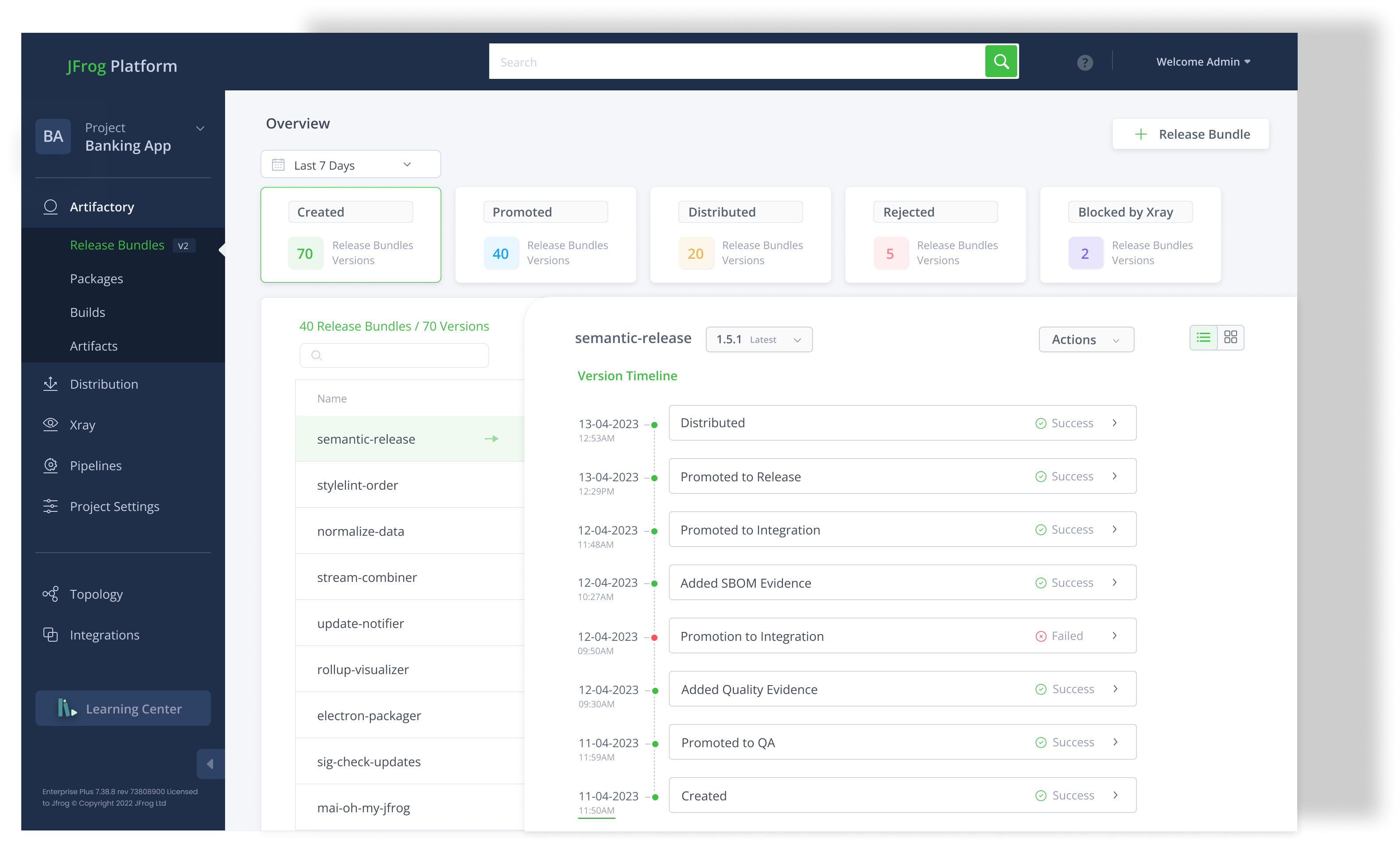
    At its swampUP 2023 conference, JFrog today added additional security capabilities to its continuous integration/continuous development (CI/CD) environment as well as making it possible to manage machine learning models within the context of a DevOps workflow.

    The latest edition of the JFrog Software Supply Chain Platform adds an integrated static application security testing tool (SAST) to scan source code alongside the existing JFrog Xray tool for scanning binaries.

    JFrog has also added an Open-Source Software (OSS) Catalog to the JFrog Curation service to make it simpler for DevOps teams to discover specific packages that have been determined to be secure. JFrog is also adding Release Lifecycle Management (RLM) capabilities that enable aggregating software artifacts into an immutable software package that serves as the single source of truth as multiple iterations of an application are developed. JFrog RLM uses anti-tampering systems, compliance checks and evidence capture to collect data and insights to ensure the immutability of signed binaries.

    Finally, ML Model Management capabilities, available in beta, are being added to the platform to make it possible to store AI models, run AI models from Hugging Face, a provider of open source AI models, as a proxy in cache via an application programming interface (API) and apply DevSecOps best practices to govern, secure and ensure licensing compliance.

    JFrog CTO Yoav Landman said that as DevOps teams become more familiar with AI models, it’s becoming increasingly clear they are managed like any other software artifact incorporated into a DevOps pipeline. He noted that the approach provides the added benefit of helping to ensure AI models have not been poisoned by malicious data and prompts that would deliberately cause a hallucination.

    Most AI models today are created by data scientists using machine learning operations (MLOps) best practices that each organization defines. In some instances, those processes include what is known as a feature store that enables data scientists to track which components are being used at any given time. However, once a model is completed, it needs to be integrated into an application—a process that, from a DevOps perspective, is best facilitated by storing an AI model in a Git repository alongside other components that need to be managed.

    It’s still early days as far as the convergence of DevOps and MLOps practices are concerned. Going forward, as it becomes apparent almost every application will be invoke some type of AI model, the need to integrate these workflows is becoming a more pressing concern.

    It’s now only a matter of time before AI models become a pervasive element of the software development life cycle as they are continuously retrained and updated. It will generally fall to DevOps teams to manage the deployment and updating of those AI models in collaboration with the data science teams that train them. The immediate challenge, of course, will be to bridge the significant cultural divide between two very different types of IT professionals.