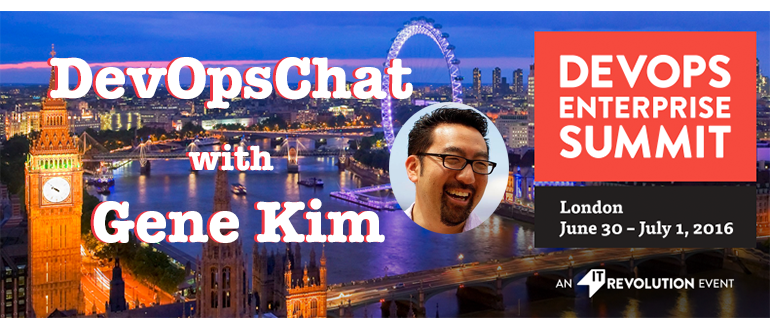
I recently had a chance to sit down with author and researcher Gene Kim about the upcoming DevOps Enterprise Summit in London (DOES). This is the first DOES out of the US and Gene and team are planning to make it a great success. Below is the audio of our conversation and below that is a the transcript of the conversation.
Of course if you are thinking about attending DOES London, you can also attend next week’s DevOps Connect: CD Summit/Jenkins Days and receive a full credit towards a DOES London ticket. A great 2 for 1 sale. BTW, Gene mentions the DevOps Enterprise YouTube channel in our discussion. Here is the link for it: https://www.youtube.com/channel/UCkyYEVVmT9vQ4yPBR4ciFUA
Enjoy!
Alan Shimel: Hi, this is Alan Shimel, devopsy.kinsta.cloud here for a special DevOps chat with Gene Kim, bestselling author, researcher and DevOps personality. Hi, Gene. How are you?
Gene Kim: Doing great, Alan. Oh, my goodness. How about a researcher who loves studying high performing technology organizations.
Alan Shimel: Okay. Hi, I’m here with Gene Kim, a researcher who loves studying high performing technology associations and writes a good book.
Gene Kim: Ah, love it. So much better.
Alan Shimel: All kidding aside, Gene, it’s a pleasure to have you on our show again. And we’re here to talk about the upcoming DevOps Enterprise Summit, London for 2016.
Gene Kim: I love it. In fact, this has been so fun. It’s our first year in London and so it’s been amazing. Sort of tapping you know the network to find great DevOps transformation stories in large complex organizations. But you know after just a lot of hard work on behalf of the entire programming committee, you know I think it’s shaping up to be just a fantastic conference.
Alan Shimel: Yeah. I mean I had a look earlier today at the speakers announced and you know part of me was really happy that I knew a lot of the names of who are these speakers and part of me was really happy that I didn’t know a lot of the names, right. Because you always want to hear new stories and from new people. So I think there’s something for everyone there. But Gene, you know what I’ve had the pleasure and honor of being on a program committee with you for the RSA Rugged DevOps event we do every year and so forth. But a lot of our listeners may not really understand what goes on behind the scenes and how do you get great speakers. Would you give our listeners just a little bit of like pull back the curtain a bit and talk to us about how you always come up with great speakers?
Gene Kim: Yeah. You know in fact, so let me first acknowledge the amazing programming committee that we have. One of them is Owen Gartner who is part of the DevOps initiative at Barclays Capital. Ben Grinnell, he’s at North Highlands Consulting Firm. There’s Marco Swindell from Accenture. There’s Benjamin Wootton from Sendachi Consulting. And then two committee members from the U.S. DevOps Enterprise Summit, which is Damon Edwards and John Willis, who are both a part of the DevOps movement from the very beginning. So the job of the programming committee is really to shape and to kind of form the vision of the conference and shape the talks to help achieve those objectives. And I think what’s been different about the DevOps Enterprise Summit is that you know we really aim to create a vendor neutral conference that really focuses on the technology leaders who are driving DevOps transformations in large complex organizations.
And so it means that with some rare exceptions, you don’t have a lot of the speakers from the DevOps community speaking because they’re not you know in large complex organizations. And so you know the challenge really was to find these amazing stories out there of people driving these audacious transformations in you know very conservative organizations. And you know for that you need people who aren’t just well networked in the industry and in the local market. And so you know we spent, my goodness, five, six weeks just you know scouring our rolodexes, brainstorming about all these – this is where we’ve heard about DevOps transformations going on and then actively reached out and you know vetted them just to gain some assurance that you know they weren’t just talking a good game, but they actually had _____ to show for it.
So you know as a first year conference, you know there was just a tremendous amount of work that went into that.
Alan Shimel: Sure. And Gene, you know to me it’s obvious why London, right. You know when we look at our own Google Analytics here at devopsy.kinsta.cloud, London is the second biggest city from an audience perspective for us. But I’m curious, why did you pick London?
Gene Kim: You know it was because that was actually one of the feedbacks that we got from our speakers and attendees, that you know because we’ve had the DevOps Enterprise Summit now going into the third year in San Francisco on the West Coast of the United States, that is a very long way to travel from people in the UK or from the European continents. So you know the ask was, hey, can you hold it somewhere in the European Union, whether it’s in the UK or in the EU. And so we were actually considering London, the Netherlands and there might have been a couple other options, but ultimately we decided to do it in London just because that’s where our network was. And when I say the network, that’s where the program committee was and that’s where I think our network was strongest. Which was very important because I think it gave us the best chance for succeeding and generating you know the right programming, the right speakers and so forth, the right transformation stories.
Alan Shimel: And you know what, I’ll reiterate it. London is a fantastic town. The DevOps scene there is just happening. Not to date myself and sound all groovy, but it’s a happening scene and it’s a vibrant dynamic DevOps community as well. So I think you couldn’t have picked a better place to do it in, Gene.
Gene Kim: You know it’s just a huge center of economic activity. You have a huge financial services industry. You have basically every type of you know industry vertical that are operating, you know in and around London. So, yeah, I agree, it was a great – and also where so much of the progressive DevOps activity is going on within government agencies. Like the UK.gov, the UK Digital Services, all that pioneered inside the UK government.
Alan Shimel: Absolutely. You’re a hundred percent right there, Gene. So, Gene, listeners who are listening to this, maybe they haven’t quite decided if they want to go to does London or not. Give me right now, have all the speakers been released or announced at this point or no?
Gene Kim: No. And we’re about 60 percent announced.
Alan Shimel: Right.
Gene Kim: But I can certainly share with you the talks that I’m super excited about.
Alan Shimel: Go ahead.
Gene Kim: You know one of them is Ron van Kemenade. You know so he is famous for his work at ING as the Global CIO. And so many of us in the DevOps community were aware of the ING DevOps Days that was held in 2011. In fact, that was probably the event that kicked off the first Target DevOps Days and the first DevOps Days at Capital One. You know it was such a novel concept. And so Ron van Kemenade as the CIO, will be talking about you know their journey when ING back in 2011 was very much like Parts Unlimited and the Phoenix Project. You know it was certainly very different from the organization they’ve become where they’ve created a world class technology organization that is widely admired. And so I’m excited that he’ll be talking about his role as the technology leader and to tell the whole inside story of how that transformation happened. And I’m particularly excited that I’ve asked him to share you know in his mind, what does it mean to be a technology leader. You know it’s not about picking Cassandra over Redis, versus Zookeeper, versus NoSQL, versus you know MySQL, right.
So what does it mean? I think that’s not well understood and certainly not well understood by me. You know there’s a talk from Robin Hughes from LV. So that’s the Liverpool Victoria Insurance Company. So multibillion pound turnover company. So again, an organization that’s been around for over a century and you know this is just a phenomenal DevOps transformation that was really driven by the operations team. And Robin Hughes will be telling the story about how they transformed one of the largest business applications inside their portfolio and enabled developer productivity. So I think that’s great. Anthony Collard, he’s the Deputy Director at HMRC. So that’s the Majesty’s Revenue Collection. So in the US we would call it the IRS, Internal Revenue Services. And you know they have over 60 scrum teams now working to help make life better for tax payers. Whether it’s the people at home or within businesses. And it’s just an incredible story about genuine innovation and creation of phenomenal efficiencies that you know haven’t been typically associated with the way government operates.
In fact, I was so inspired by it, I actually wanted to voluntarily pay UK taxes just to reward these amazing efforts.
Alan Shimel: Don’t count me in on that one, Gene. Thanks. But it’s good for you. Let me also just throw a couple of other names that I recognize and got me all excited. One is actually a friend of mine that I’ve worked with, Jonathan Fletcher over at Hiscox.
Gene Kim: Right.
Alan Shimel: I don’t know how much you know about Jonathan, but he’s brilliant. He’s not the – I don’t want to say the suit, but he’s not the title who leads the entire DevOps transformation there. But that person relies on Jonathan to make it happen. ‘Cause I’ve looked at that organization. This guy, I love listening to him talk about what they’ve done there.
Gene Kim: And it’s another phenomenal story. Another insurance company.
Alan Shimel: Yep.
Gene Kim: And I think what makes them so remarkable, so obviously they’re a multibillion British pound turnover company. But again, over 100 years old. And yet they’re growing at 30 percent in certain market segments.
Alan Shimel: Yes.
Gene Kim: When that’s happening its putting tremendous pressure on the technology organization, you know for them to deliver what the organization needs. And so here’s an incredible effort initiative, where they – and this one is driven by kind of an operations platform and architecture that is enabling development teams to respond quickly to the market and scale with demand. Yeah.
Alan Shimel: Yeah.
Gene Kim: I love that Hiscox story.
Alan Shimel: Yeah. No. The thing about Hiscox is you know though they’re UK based most of their business is on the continent. You know they have a large presence for instance in the Caribbean as well as the Western U.S. So this is a global organization dealing with regulations and I mean its insurance. I don’t want to tell well, too much on them and Fletcher, Jonathan is a tremendous, tremendous talent. I’m sure it’s gonna translate into a great presentation. Another one Gene, that I wanted to highlight if you don’t mind me stealing a little bit from you, is Gareth Rushgrove, you know who’s at Puppet now. But you know Gareth, besides curating the DevOps weekly newsletter, you know he has a great security background like we do, Gene. And I can listen to him all day.
Gene Kim: Yeah. And what’s great is that maybe not so well known is that he was part of the early UK.gov effort.
Alan Shimel: Yes.
Gene Kim: Where he had to deal with all of the regulatory and compliance bodies inside you know a very powerful central government, as well as the intelligence agencies. And so the fact that he was able to span those boundaries and earn the trust of those agencies and essentially help define kind of the next generation of security standards and strategies, is just a really inspiring one. It’s just a really neat guy.
Alan Shimel: Yeah. He’s a rock star. I just wanted to mention two others Gene and they’re from DevOps San Francisco who are I guess coming over to London. And that’s Jason Cox from Disney and Rosalind Radcliffe from IBM. Just two brilliant people and I just appreciate brilliance. So you know looking forward —
Gene Kim: I love them both.
Alan Shimel: I’m sorry what, Gene?
Gene Kim: What I love about the conferences if you take a look, this is like a great cross section across you know almost every industry vertical. So you’ve got Unilever from you know the consumer goods on the financial services. You have Barclays from _____ –
Gene Kim: – insurance companies. You’ve got Pearson Publishers. News UK is another publisher. Thomas Cook Group does retailing and travel services.
Alan Shimel: Yes.
Gene Kim: Zurich Insurance. You know actually I never realized we have so many insurance companies. So we have 26 speakers announced. You know I’ll tell you another part of the programming committee is that a lot of these we handpicked from people from our own investigation. But then we also had I think it was about 80 submissions through our call for presenters. And so you can imagine how challenging it is when you have only 25 speaking slots, of which over half had already been taken.
Alan Shimel: Yeah.
Gene Kim: You can imagine the vigorous debate about you know which talks really need to be a part of the programming. And I just very much appreciate you know the candor and the fact that everyone had the best interest I think for the attendees in mind as we were trying to figure out how do we create the best program for the technology leadership community around DevOps.
Alan Shimel: Yeah. And debate is a kind word. Gene, let me –
Gene Kim: Yeah.
Alan Shimel: – pivot a little bit ’cause we’re running low on time. So we’ve got this great lineup of speakers. We’ve hit a bunch of them and there’s more yet. But okay, if they attend DevOps Enterprise London, what are they taking out of it. Give me three bullet points. What are the three lessons? What are the three most important things they’re taking out of their attendance at this event?
Gene Kim: Yeah. I think the most important thing is that they are going to hear transformation stories of organizations that look like them. So I think in the DevOps community we’re very used to hearing stories from you know Google, Amazon, Facebook, Etsy, Netflix and so forth. But if you’re in a large insurance company that’s been around for over a hundred years or a government agency that’s been around for five hundred years, you know they don’t relate very well to those unicorns. So to hear how those same type of technology transformations have occurred in large complex organizations, that is the mission of the conference is to share 30 minute experience reports where each speaker shares what business problem were they trying to solve, where did they start and why. What did they do and what were their outcomes and what do they still not know how to do and what are they looking for help with. So, yeah, I think what I’ve heard over and over again is that you know these stories, when you go to this conference you’re surrounded with people just like us, right. Or rather just like me.
I think the second thing that they’ll hear is that they’re achieving the same sort of outcomes you know in these large complex organizations that we’ve only typically seen in the unicorn organizations. But there’s an element to me that has a tremendous amount of significance and meaning is that each one of these leaders, even though they were given some degree of air cover, I mean it’s as much true for the London conference as for the two previous conferences in the U.S. Each one of these leaders I think wildly exceeded the air cover they were given. Essentially putting themselves into some degree of personal jeopardy. And so when you ask why would they do that? What you see that each one of these speakers have in common is that if they have a sense of utter clarity and conviction that the capabilities that they’re creating for their organization are needed in order to win in the marketplace, let alone survive in the marketplace. So there’s kind of this other dimension of just the hero nature of these stories that I just find so inspiring. And it’s been an honor to help chronicle.
Alan Shimel: Excellent.
Gene Kim: Oh, and I guess the third dimension is like to see the value they’re creating. And I would suspect that in the London conference it’s going to very much match the U.S. conferences, where we’ve observed that one out of four of the speakers at the DevOps Enterprise has gotten promoted in the last three years. Many of them more than twice.
Alan Shimel: What a great metric.
Gene Kim: Yeah. This is a reflection of you know I think the value that they’re creating is being recognized by their organizations and they’re being asked increasingly to try to replicate that across a broader portion of the organization and help elevate the state of the practice.
Alan Shimel: Fantastic. Well, if that’s not enough to get them to attend to DevOps Enterprise, London, Gene, I don’t know what is. But we’re almost at the end of our time here and we’re gonna have to wrap up. I just want to quickly mention for our devopsy.kinsta.cloud audience, that we will be out there and working with Robin and Todd and the team on setting up an interview area where we’ll be doing interviews with many of these speakers when they come off stage. And much like we did in San Francisco last year and also just hearing some great insights and stories from these folks.
Gene Kim: Yeah. By the way, I’m hoping you’ll post in the show notes, I actually love the devopsy.kinsta.cloud interviews that you did. And so we have them all on the YouTube channel, where you can actually see all of your interviews Alan.
Alan Shimel: Yep.
Gene Kim: As well as all the DevOps Enterprise talks from the years past.
Alan Shimel: Absolutely.
Gene Kim: So I think it’s just a phenomenal resource for anyone who’s interested in this topic.
Alan Shimel: And that’s the DevOps Enterprise Summit YouTube channel.
Gene Kim: Correct. Yes. And the link will be in the show notes.
Alan Shimel: Fantastic. I’ll put it in there. And I’ve actually featured many of them over the months on devopsy.kinsta.cloud. You can find articles and embeds and links to it as well. But Gene, let me let you go because I probably took up more time than I was supposed to. I apologize. We’re really looking forward to a smashing DevOps Enterprise Summit in London.

