Category: DOES 2015

  • DevOps Chat: Sanjeev Sharma, DevOps Enterprise Summit London 2016

    DevOps Chat: Sanjeev Sharma, DevOps Enterprise Summit London 2016

    I had a chance to speak with CTO of technical sales of DevOps for IBM right before the recent DevOps Enterprise Summit in London. I also interviewed Sanjeev at the DOES London event and that video will be available shortly, but I wanted to give you a preview of what he was speaking about in case you didn’t get a chance to attend DOES London 2016.

    Below is the audio file of our chat and below that is a transcript of our conversation.

    Of course Sanjeev is a frequent contributor  to devopsy.kinsta.cloud and you can read more of his articles here.

    Alan Shimel:                Hi, everyone, Alan Shimel, Editor in Chief of devopsy.kinsta.cloud and we’re here with another DevOps Chat. Today’s guest is Sanjeev Sharma, CTO of Technical Sales of DevOps IBM. Sanjeev, I mangled that probably. Why don’t you correct me?

    Sanjeev Sharma:         Sure. No, Alan, you got it right. My title is CTO for DevOps Technical Sales. I’m a Distinguished Engineer here at IBM and happy to chat with you, my favorite topic, DevOps.

    Alan Shimel:                Yeah and always happy to have you on, Sanjeev. Sanjeev, today, specifically, I wanted to talk a little bit about the upcoming Gene Kim’s DevOps Enterprise Summit event taking this Thursday and Friday, June 30 and July 1, over at the Hilton Metropole in London, England. You, of course, I think are handling or moderating a panel at the event. Correct?

    Sanjeev Sharma:         Yes, sir. Yes, Alan. I’m really excited about it, and as you know, Gene has been hosting these events. This is his third year, if I remember correctly, but this is the first time he’s having it in Europe, so very excited about it. IBM, of course, is a sponsor for the event, but I also have the privilege of hosting a panel.

    On the panel, we’ll be focusing on how to assess a large enterprise’s readiness to adopt DevOps. People ask about – ask the question, “How long does it take to get from here to London? I live in Washington, D.C.” Well, I have to ask them the question, right? First of all, where in London do you want to go? Secondly, where in Washington, D.C. do you live? It can take you about an hour just to get to the airport. Knowing your Point B, where you want to go, and knowing where you are, your current state, your Point A, is very important. We will be focused on that.

    I’m pleased to have a very exciting panel. I have the leader of DevOps adoption at Lloyds Bank with me on the panel, Mark Howell. I have a VP of Application Development from Monetize on the panel with me, and then I have my peer, Rosalind Radcliffe, who is the CTO for DevOps Architecture for our Enterprise Organization aligned here at IBM. She comes from the mainframe side of the world, also as a third panelist, talking about this topic.

    Alan Shimel:                Got it. Sanjeev, before we jump exactly or primarily into the panel, as you said, this is the third year for Gene’s DevOps Enterprise Summit, first year in London. It’s happening at an auspicious time after all of this Brexit, right on the heels of it. For those who may not be familiar though, they’ve never had the chance to attend a summit, you have, obviously. Can you give our audience an idea of what the summit or what these DevOps Enterprise Summits are about? What are they trying to do? Then, we’ll dive into it specifically.

    Sanjeev Sharma:         Sure, Alan, sure, sure. I think DevOps, as folks listening to this and people who follow your phenomenal devopsy.kinsta.cloud probably realize, it came from – had its origin primarily in what we like to call the “unicorns” of the world, the cutting-edge companies, the startup companies, who are normally leaps and bounds ahead of your traditional enterprise.

    Gene Kim started this event. I think he had this as the tagline for his first one, I don’t know if he still uses it, saying, “DevOps is also for the horses, not just for the unicorns.” Right? The focus of this event is how are large enterprises, with all the complexities, the legacy, the sheer inertia of it, which comes from the size of them, how are they adopting DevOps?

    We, obviously, at IBM found that very exciting because that’s our sweet spot. Every DevOps Summit I’ve attended, the speakers Gene has been able to go find, and of course, being from IBM, I have to look at everything a little bit through my own lens, but this is not a vendor-specific event. It is totally agnostic. It is people sharing their real-life’s journeys of adopting DevOps, what stumbling blocks they encountered, what challenges they had to overcome, and these challenges, while they vary from company to company, the ones, if you’re a large enterprise with a large legacy install base, with a large distributed set of practitioners, vendors, and business partners, outsourcers, geographic time issues, these are common problems.

    You hear a lot at this summit about how large organizations are addressing these challenges, which companies face. For anybody who does not work in the proverbial startup with the proverbial “two-pizza” team, but works in such an organization, I think this is a must-attend event. This will be actually my first time speaking. I’ve attended the previous events, but I’ve not had an option to present or speak, so I’m really looking forward to it, to be a part of the action.

    Alan Shimel:                Got it. Sanjeev, thank you. That was actually dead on, and I hope that gives people a good sense of what the DOES shows are about and why they may want to attend. Let’s now jump in though. As you mentioned, you’ve got a great cast. I’ve met the gentleman from Lloyds Bank, and for those maybe on this side of the pond who aren’t familiar with Lloyds Bank, would you call them a mid-size or a large bank, as banks go, Sanjeev?

    Sanjeev Sharma:         I would qualify them as a large bank.

    Alan Shimel:                Yup. What’s interesting, and I always find this interesting when you talk to DevOps people, Sanjeev, is we think of financial and the whole financial industry as being rather conservative. But yet, when it comes to new technology, such as DevOps, or I don’t want to say new, but a little more out there technologies and things such as DevOps, we see large banks and financial institutions, whether they be insurance, banks, but finance, really kind of leading the way here. Lloyds Bank is, I think, a great example of that.

    Sanjeev Sharma:         Yes and I think, in fact, both the companies I have on, Monetize is the second panelist. In fact, Garret Evans, who was a VP of AppDev at Monetize, is the other panelist other than Mark Howell from Lloyds. They’re both in the financial services industry, and they both come at it from kind of a different angle in the sense that Monetize is a service provider, and you would call them as a company. They’re not a bank themselves. They provide services to financial organizations, and they’re on the cutting-edge of technology. They’re way ahead of their – on the innovation forefront, and Lloyds too. But Lloyds still has that whole legacy, like more large banks, still has the legacy, “keep the lights on” applications that they to run.

    But it is interesting what you mentioned about how financial services, which we, until a few years ago, one would think of them as the slow plodding conservative people in their suits and ties and risk-averse, being at the forefront of DevOps adoption, and that is very true. They are a prime example of how adopting things like Agile and DevOps actually reduced your risk, actually makes you agile in a disciplined and organized manner, as an organization, rather than some people’s view of it being the Wild West.

    I think they’re a prime example. Why are they doing this? They’re doing it because of all the industries out there, they are one who are going through probably the most transformative change in their existence they’ve ever had. Financial services, banking, peer-to-peer lending, peer-to-peer money transfer, these are all undergoing a massive transformational change. They’re getting challenged by these FinTechs, or financial startups.

    I think this has become a very interesting place for them, and I worked with financial services, it’s kind of my core industry, all over the world. Right? When you go to the developing nations, you see these financial services companies facing the challenge of, “How do I go and reach the un-banked populations who need banking services without – but cannot access a traditional bank?”

    Then, in the developed world, you have this challenge of, “HOw do I go access the Millennials, who, again, do not want to go into a traditional bank, but need banking services, but do not consume and access those banking services the way you and I, and the folks with much more grey hair than them, are used to doing so?”

    It is ripe for transformation, ripe for disruption, and DevOps provides that enablement for the IT organizations in these financial institutions to be ready for the disruption and enable it, and not be the inhibiter, but be the enabler.

    Alan Shimel:                Excellent, absolutely. Sanjeev, we’ve left an important person out of your panel though. Haven’t we? Besides yourself and the two financial institutions, we also have Rosalind Radcliffe on here.

    Sanjeev Sharma:         Absolutely. I didn’t want to – I’m not intending to ignore her [chuckles].

    Alan Shimel:                Why don’t you give our listeners a little background? Rosalind has been a frequent guest on our podcast, but for those who may not be aware, why don’t you give them a little background?

    Sanjeev Sharma:         Absolutely. Rosalind is my peer. She’s also a Distinguished Engineer here at IBM. She’s in the Development Labs in our Enterprise Modernization side of IBM. She focuses on the very – to simplify it and make it very generic – on the mainframe end of the world, although, her influence extends across to all aspects of DevOps, and she’s been a great person we’ve worked with, a great partner, in expanding IBM’s DevOps capabilities.

    She actually has her own session also, I think, a couple of sessions before my panel, where she’ll be talking about DevOps and how it’s adopted in the mainframe world, especially talking about testing, which is a major area where we’ve seen a lot of traction when it comes to DevOps adoption on the mainframe.

    She is going to be bringing to our panel the mainframe point of view, and I’m generalizing here when I say “mainframe.” Right? It could be Systems Z, or Series I, or large traditional legacy systems, but bringing that because if you look at large organizations, especially large organizations who have been around for a while, be it they’re banks, or retail, or government institutions, and those which are transaction heavy, they still rely on the mainframe to run their core businesses.

    How they are adopting DevOps has been a surprise, a refreshing surprise, so to speak, in the sense that a lot of these large organizations have come forward and their mainframe teams have the lead of saying, “We want to adopt DevOps first.” It is unique, and when we tell people that, they’re usually surprised going, “Mainframe?” One usually thinks of them as being at the laggard end of adopting new technologies and new processes.

    But we have found that to be exactly the opposite. I’m sure there are organizations out there where their mainframe teams are going, “Hey, it’s not broken. Why should I try to fix it?” but most mainframe organization’s mainframe teams are in the process of modernizing their application-delivery capabilities. I think DevOps has given them the opportunity, the platform, and the capability to move into the modern world. There’s a significant C-change going on in how customers are consuming the mainframe.

    Linux’s own mainframe is a great example. OpenStack’s own mainframe is great example. And, of course, the z/OS, which IBM’s operating system for the mainframe has also evolved and become extremely modern. She has a very – is going to be able to bring a very unique perspective, which I think will apply to a lot of the attendees, so I’m very fortunate to have her on the panel.

    Alan Shimel:                Absolutely. Sanjeev, believe it or not, we’re almost out of time already, but real quickly, specifically now to your panel, give me, if you can, three reasons why it’s a must-attend panel for those who may be in attendance in London.

    Sanjeev Sharma:         Sure. Number one, people don’t want to hear theory, and I’m sure all our attendees, or our listeners who have the opportunity to attend, don’t want to come and listen to theory. I mean you can Google DevOps, you to YouTube, watch 100 videos on the theory of DevOps, read some books. People want to hear how a company actually undertook that journey and succeeded with it. Right?

    That’s what we have on this panel. We have three examples of people, and I’m not even counting my own experiences working with the dozens of companies I’ve worked with in my role. My goal is not to talk there, but be the facilitator, but the three people we have on the panel are bringing tons of experience, real-world experience, and they will be, hopefully, sharing very openly. I know these folks. I know they’ll be sharing very openly and are willing to talk about all the pitfalls and the speed bumps they hit along the way, so real-world experience.

    Number two, it’s an interactive panel. We are going to have no slides, maybe one slide in the beginning just so people know who we are. The idea is – in fact, we are going to do it very uniquely. I’m going to have my iPad up there with me, with these organizations, both Monetize, Lloyds Bank, and Rosalind. They’re going to give me some drawings before and which I’m going to draw out during the panel, so people can, in real life, see real-life versions of what their application delivery pipelines and their architectures look like, and what changes they needed to make.

    Thirdly, we are going to focus or talk a lot about culture because the biggest bottleneck, the biggest inhibitor to adopting DevOps, is cultural inertia, especially in a large organization. Right? Things have been going on for a while. This is how we always do things, always start things. The responsibility is not mine. It’s not broken. Why should I try to fix it? These are all the specific examples of cultural inertia. We intend to spend a lot of time talking about how, in a large organization, which has set ways of doing things, which have highly distributed teams, how does one overcome that cultural inertia?

    I would say those are three very good reasons to come to our panel. We are on Thursday, I believe, at 2:45 PM, but please check the agenda, they’ve been moving things around on the agenda, for the final time and location, but come there. Our plan is to open it up for questions from the audience, so you’ll be able to ask your own questions, and, of course, all of us panelists will be around for the entire event to meet with you and answer any questions one-on-one also. I hope to see you all there.

    Alan Shimel:                Absolutely. Sanjeev, thanks for giving a quick preview of both DevOps Enterprise Summit and the great all-star panel you’re hosting there. I will be there. We’ll be filming. I think we’re actually going to video interview, so we’ll follow-up then. But for anyone who is attending DevOps Enterprise Summit in London, please be sure to take in Sanjeev’s panel. As most things Sanjeev does, I’m sure it will be a great event.

    For those who are considering going to DevOps Enterprise Summit in London, I highly encourage you to do it. If you can’t make London though, the San Francisco version of the event will be in the fall, and I encourage you to go there. Sanjeev Sharma, IBM, thanks for being today’s guest on DevOps Chats.

    Sanjeev Sharma:         Thanks, Alan. Thanks for the opportunity and I look forward to working more with you.
  • DevOps Chat: Gene Kim, DevOps Enterprise Summit London 2016

    DevOps Chat: Gene Kim, DevOps Enterprise Summit London 2016

    I recently had a chance to sit down with author and researcher Gene Kim about the upcoming DevOps Enterprise Summit in London (DOES). This is the first DOES out of the US and Gene and team are planning to make it a great success. Below is the audio of our conversation and below that is a the transcript of the conversation.

    Of course if you are thinking about attending DOES London, you can also attend next week’s DevOps Connect: CD Summit/Jenkins Days and receive a full credit towards a DOES London ticket. A great 2 for 1 sale. BTW, Gene mentions the DevOps Enterprise YouTube channel in our discussion. Here is the link for it: https://www.youtube.com/channel/UCkyYEVVmT9vQ4yPBR4ciFUA

    Enjoy!

    Alan Shimel:                Hi, this is Alan Shimel, devopsy.kinsta.cloud here for a special DevOps chat with Gene Kim, bestselling author, researcher and DevOps personality. Hi, Gene. How are you?

    Gene Kim:                   Doing great, Alan. Oh, my goodness. How about a researcher who loves studying high performing technology organizations.

    Alan Shimel:                Okay. Hi, I’m here with Gene Kim, a researcher who loves studying high performing technology associations and writes a good book.

    Gene Kim:                   Ah, love it. So much better.

    Alan Shimel:                All kidding aside, Gene, it’s a pleasure to have you on our show again. And we’re here to talk about the upcoming DevOps Enterprise Summit, London for 2016.

    Gene Kim:                   I love it. In fact, this has been so fun. It’s our first year in London and so it’s been amazing. Sort of tapping you know the network to find great DevOps transformation stories in large complex organizations. But you know after just a lot of hard work on behalf of the entire programming committee, you know I think it’s shaping up to be just a fantastic conference.

    Alan Shimel:                Yeah. I mean I had a look earlier today at the speakers announced and you know part of me was really happy that I knew a lot of the names of who are these speakers and part of me was really happy that I didn’t know a lot of the names, right. Because you always want to hear new stories and from new people. So I think there’s something for everyone there. But Gene, you know what I’ve had the pleasure and honor of being on a program committee with you for the RSA Rugged DevOps event we do every year and so forth. But a lot of our listeners may not really understand what goes on behind the scenes and how do you get great speakers. Would you give our listeners just a little bit of like pull back the curtain a bit and talk to us about how you always come up with great speakers?

    Gene Kim:                   Yeah. You know in fact, so let me first acknowledge the amazing programming committee that we have. One of them is Owen Gartner who is part of the DevOps initiative at Barclays Capital. Ben Grinnell, he’s at North Highlands Consulting Firm. There’s Marco Swindell from Accenture. There’s Benjamin Wootton from Sendachi Consulting. And then two committee members from the U.S. DevOps Enterprise Summit, which is Damon Edwards and John Willis, who are both a part of the DevOps movement from the very beginning. So the job of the programming committee is really to shape and to kind of form the vision of the conference and shape the talks to help achieve those objectives. And I think what’s been different about the DevOps Enterprise Summit is that you know we really aim to create a vendor neutral conference that really focuses on the technology leaders who are driving DevOps transformations in large complex organizations.

    And so it means that with some rare exceptions, you don’t have a lot of the speakers from the DevOps community speaking because they’re not you know in large complex organizations. And so you know the challenge really was to find these amazing stories out there of people driving these audacious transformations in you know very conservative organizations. And you know for that you need people who aren’t just well networked in the industry and in the local market. And so you know we spent, my goodness, five, six weeks just you know scouring our rolodexes, brainstorming about all these – this is where we’ve heard about DevOps transformations going on and then actively reached out and you know vetted them just to gain some assurance that you know they weren’t just talking a good game, but they actually had _____ to show for it.

    So you know as a first year conference, you know there was just a tremendous amount of work that went into that.

    Alan Shimel:                Sure. And Gene, you know to me it’s obvious why London, right. You know when we look at our own Google Analytics here at devopsy.kinsta.cloud, London is the second biggest city from an audience perspective for us. But I’m curious, why did you pick London?

    Gene Kim:                   You know it was because that was actually one of the feedbacks that we got from our speakers and attendees, that you know because we’ve had the DevOps Enterprise Summit now going into the third year in San Francisco on the West Coast of the United States, that is a very long way to travel from people in the UK or from the European continents. So you know the ask was, hey, can you hold it somewhere in the European Union, whether it’s in the UK or in the EU. And so we were actually considering London, the Netherlands and there might have been a couple other options, but ultimately we decided to do it in London just because that’s where our network was. And when I say the network, that’s where the program committee was and that’s where I think our network was strongest. Which was very important because I think it gave us the best chance for succeeding and generating you know the right programming, the right speakers and so forth, the right transformation stories.

    Alan Shimel:                And you know what, I’ll reiterate it. London is a fantastic town. The DevOps scene there is just happening. Not to date myself and sound all groovy, but it’s a happening scene and it’s a vibrant dynamic DevOps community as well. So I think you couldn’t have picked a better place to do it in, Gene.

    Gene Kim:                   You know it’s just a huge center of economic activity. You have a huge financial services industry. You have basically every type of you know industry vertical that are operating, you know in and around London. So, yeah, I agree, it was a great – and also where so much of the progressive DevOps activity is going on within government agencies. Like the UK.gov, the UK Digital Services, all that pioneered inside the UK government.

    Alan Shimel:                Absolutely. You’re a hundred percent right there, Gene. So, Gene, listeners who are listening to this, maybe they haven’t quite decided if they want to go to does London or not. Give me right now, have all the speakers been released or announced at this point or no?

    Gene Kim:                   No. And we’re about 60 percent announced.

    Alan Shimel:                Right.

    Gene Kim:                   But I can certainly share with you the talks that I’m super excited about.

    Alan Shimel:                Go ahead.

    Gene Kim:                   You know one of them is Ron van Kemenade. You know so he is famous for his work at ING as the Global CIO. And so many of us in the DevOps community were aware of the ING DevOps Days that was held in 2011. In fact, that was probably the event that kicked off the first Target DevOps Days and the first DevOps Days at Capital One. You know it was such a novel concept. And so Ron van Kemenade as the CIO, will be talking about you know their journey when ING back in 2011 was very much like Parts Unlimited and the Phoenix Project. You know it was certainly very different from the organization they’ve become where they’ve created a world class technology organization that is widely admired. And so I’m excited that he’ll be talking about his role as the technology leader and to tell the whole inside story of how that transformation happened. And I’m particularly excited that I’ve asked him to share you know in his mind, what does it mean to be a technology leader. You know it’s not about picking Cassandra over Redis, versus Zookeeper, versus NoSQL, versus you know MySQL, right.

    So what does it mean? I think that’s not well understood and certainly not well understood by me. You know there’s a talk from Robin Hughes from LV. So that’s the Liverpool Victoria Insurance Company. So multibillion pound turnover company. So again, an organization that’s been around for over a century and you know this is just a phenomenal DevOps transformation that was really driven by the operations team. And Robin Hughes will be telling the story about how they transformed one of the largest business applications inside their portfolio and enabled developer productivity. So I think that’s great. Anthony Collard, he’s the Deputy Director at HMRC. So that’s the Majesty’s Revenue Collection. So in the US we would call it the IRS, Internal Revenue Services. And you know they have over 60 scrum teams now working to help make life better for tax payers. Whether it’s the people at home or within businesses. And it’s just an incredible story about genuine innovation and creation of phenomenal efficiencies that you know haven’t been typically associated with the way government operates.

    In fact, I was so inspired by it, I actually wanted to voluntarily pay UK taxes just to reward these amazing efforts.

    Alan Shimel:                Don’t count me in on that one, Gene. Thanks. But it’s good for you. Let me also just throw a couple of other names that I recognize and got me all excited. One is actually a friend of mine that I’ve worked with, Jonathan Fletcher over at Hiscox.

    Gene Kim:                   Right.

    Alan Shimel:                I don’t know how much you know about Jonathan, but he’s brilliant. He’s not the – I don’t want to say the suit, but he’s not the title who leads the entire DevOps transformation there. But that person relies on Jonathan to make it happen. ‘Cause I’ve looked at that organization. This guy, I love listening to him talk about what they’ve done there.

    Gene Kim:                   And it’s another phenomenal story. Another insurance company.

    Alan Shimel:                Yep.

    Gene Kim:                   And I think what makes them so remarkable, so obviously they’re a multibillion British pound turnover company. But again, over 100 years old. And yet they’re growing at 30 percent in certain market segments.

    Alan Shimel:                Yes.

    Gene Kim:                   When that’s happening its putting tremendous pressure on the technology organization, you know for them to deliver what the organization needs. And so here’s an incredible effort initiative, where they – and this one is driven by kind of an operations platform and architecture that is enabling development teams to respond quickly to the market and scale with demand. Yeah.

    Alan Shimel:                Yeah.

    Gene Kim:                   I love that Hiscox story.

    Alan Shimel:                Yeah. No. The thing about Hiscox is you know though they’re UK based most of their business is on the continent. You know they have a large presence for instance in the Caribbean as well as the Western U.S. So this is a global organization dealing with regulations and I mean its insurance. I don’t want to tell well, too much on them and Fletcher, Jonathan is a tremendous, tremendous talent. I’m sure it’s gonna translate into a great presentation. Another one Gene, that I wanted to highlight if you don’t mind me stealing a little bit from you, is Gareth Rushgrove, you know who’s at Puppet now. But you know Gareth, besides curating the DevOps weekly newsletter, you know he has a great security background like we do, Gene. And I can listen to him all day.

    Gene Kim:                   Yeah. And what’s great is that maybe not so well known is that he was part of the early UK.gov effort.

    Alan Shimel:                Yes.

    Gene Kim:                   Where he had to deal with all of the regulatory and compliance bodies inside you know a very powerful central government, as well as the intelligence agencies. And so the fact that he was able to span those boundaries and earn the trust of those agencies and essentially help define kind of the next generation of security standards and strategies, is just a really inspiring one. It’s just a really neat guy.

    Alan Shimel:                Yeah. He’s a rock star. I just wanted to mention two others Gene and they’re from DevOps San Francisco who are I guess coming over to London. And that’s Jason Cox from Disney and Rosalind Radcliffe from IBM. Just two brilliant people and I just appreciate brilliance. So you know looking forward —

    Gene Kim:                   I love them both.

    Alan Shimel:                I’m sorry what, Gene?

    Gene Kim:                   What I love about the conferences if you take a look, this is like a great cross section across you know almost every industry vertical. So you’ve got Unilever from you know the consumer goods on the financial services. You have   Barclays from _____ –

    Gene Kim:                   – insurance companies. You’ve got Pearson Publishers. News UK is another publisher. Thomas Cook Group does retailing and travel services.

    Alan Shimel:                Yes.

    Gene Kim:                   Zurich Insurance. You know actually I never realized we have so many insurance companies. So we have 26 speakers announced. You know I’ll tell you another part of the programming committee is that a lot of these we handpicked from people from our own investigation. But then we also had I think it was about 80 submissions through our call for presenters. And so you can imagine how challenging it is when you have only 25 speaking slots, of which over half had already been taken.

    Alan Shimel:                Yeah.

    Gene Kim:                   You can imagine the vigorous debate about you know which talks really need to be a part of the programming. And I just very much appreciate you know the candor and the fact that everyone had the best interest I think for the attendees in mind as we were trying to figure out how do we create the best program for the technology leadership community around DevOps.

    Alan Shimel:                Yeah. And debate is a kind word. Gene, let me –

    Gene Kim:                   Yeah.

    Alan Shimel:                – pivot a little bit ’cause we’re running low on time. So we’ve got this great lineup of speakers. We’ve hit a bunch of them and there’s more yet. But okay, if they attend DevOps Enterprise London, what are they taking out of it. Give me three bullet points. What are the three lessons? What are the three most important things they’re taking out of their attendance at this event?

    Gene Kim:                   Yeah. I think the most important thing is that they are going to hear transformation stories of organizations that look like them. So I think in the DevOps community we’re very used to hearing stories from you know Google, Amazon, Facebook, Etsy, Netflix and so forth. But if you’re in a large insurance company that’s been around for over a hundred years or a government agency that’s been around for five hundred years, you know they don’t relate very well to those unicorns. So to hear how those same type of technology transformations have occurred in large complex organizations, that is the mission of the conference is to share 30 minute experience reports where each speaker shares what business problem were they trying to solve, where did they start and why. What did they do and what were their outcomes and what do they still not know how to do and what are they looking for help with. So, yeah, I think what I’ve heard over and over again is that you know these stories, when you go to this conference you’re surrounded with people just like us, right. Or rather just like me.

    I think the second thing that they’ll hear is that they’re achieving the same sort of outcomes you know in these large complex organizations that we’ve only typically seen in the unicorn organizations. But there’s an element to me that has a tremendous amount of significance and meaning is that each one of these leaders, even though they were given some degree of air cover, I mean it’s as much true for the London conference as for the two previous conferences in the U.S. Each one of these leaders I think wildly exceeded the air cover they were given. Essentially putting themselves into some degree of personal jeopardy. And so when you ask why would they do that? What you see that each one of these speakers have in common is that if they have a sense of utter clarity and conviction that the capabilities that they’re creating for their organization are needed in order to win in the marketplace, let alone survive in the marketplace. So there’s kind of this other dimension of just the hero nature of these stories that I just find so inspiring. And it’s been an honor to help chronicle.

    Alan Shimel:                Excellent.

    Gene Kim:                   Oh, and I guess the third dimension is like to see the value they’re creating. And I would suspect that in the London conference it’s going to very much match the U.S. conferences, where we’ve observed that one out of four of the speakers at the DevOps Enterprise has gotten promoted in the last three years. Many of them more than twice.

    Alan Shimel:                What a great metric.

    Gene Kim:                   Yeah. This is a reflection of you know I think the value that they’re creating is being recognized by their organizations and they’re being asked increasingly to try to replicate that across a broader portion of the organization and help elevate the state of the practice.

    Alan Shimel:                Fantastic. Well, if that’s not enough to get them to attend to DevOps Enterprise, London, Gene, I don’t know what is. But we’re almost at the end of our time here and we’re gonna have to wrap up. I just want to quickly mention for our devopsy.kinsta.cloud audience, that we will be out there and working with Robin and Todd and the team on setting up an interview area where we’ll be doing interviews with many of these speakers when they come off stage. And much like we did in San Francisco last year and also just hearing some great insights and stories from these folks.

    Gene Kim:                   Yeah. By the way, I’m hoping you’ll post in the show notes, I actually love the devopsy.kinsta.cloud interviews that you did. And so we have them all on the YouTube channel, where you can actually see all of your interviews Alan.

    Alan Shimel:                Yep.

    Gene Kim:                   As well as all the DevOps Enterprise talks from the years past.

    Alan Shimel:                Absolutely.

    Gene Kim:                   So I think it’s just a phenomenal resource for anyone who’s interested in this topic.

    Alan Shimel:                And that’s the DevOps Enterprise Summit YouTube channel.

    Gene Kim:                   Correct. Yes. And the link will be in the show notes.

    Alan Shimel:                Fantastic. I’ll put it in there. And I’ve actually featured many of them over the months on devopsy.kinsta.cloud. You can find articles and embeds and links to it as well. But Gene, let me let you go because I probably took up more time than I was supposed to. I apologize. We’re really looking forward to a smashing DevOps Enterprise Summit in London.

  • What to Expect: DevOps Enterprise Summit London

    What to Expect: DevOps Enterprise Summit London

    After the success of the first two years of the U.S. DevOps Enterprise Summit, people have been asking us to host a similar conference in other locations, specifically in Europe. This summer, we’re hosting our first DevOps Enterprise Summit in London!

    This conference is for technology leaders who are driving transformations in large, complex organizations. These are successful enterprises that have been around for decades (and, in some cases, for centuries!), with thousands (or tens of thousands) of employees, and billions of dollars in annual revenue. These are organizations with massive and complex daily operations, and all the resulting processes and bureaucracies that come with it. In many ways, these complex operations and bureaucracies are the very things that create the worst-case conditions for DevOps transformations!

    We’ve heard amazing case studies from Barclays Capital, GE Capital, Disney, Marks & Spencer, Bank of America, Capital One, Telstra and many more, where leaders have created amazing DevOps outcomes that are more typically associated with organizations such as Google, Amazon, Facebook and so forth.

    For this inaugural year of DevOps Enterprise Summit London, we’ll be bringing some of our “greatest hits” from the United States, but the rest of the programming will feature DevOps transformations in organizations residing in the U.K. and continental Europe. (And we’re still holding the DevOps Enterprise Summit in San Francisco, so feel free to join us there as well!)

    New World and Old World DevOps

    The speakers at DevOps Enterprise are pioneering the practices of how large, complex organizations transform and deliver software. It’s my belief that these principles are universal, regardless of what continent or country the organization resides in.

    One of the biggest surprises from co-authoring “The Phoenix Project” has been how many people have told me that the book describes their organization, seemingly independent of company size, industry vertical, for-profit or nonprofit or the continent they’re writing from. This validates that the problems that result when Dev and Ops can’t get along are universal.

    The good news is that the DevOps solutions we deploy to fix the problems also have lots of commonalities!

    It’s always inspiring to hear how these leaders have overcome the challenges they faced. I see our speakers as genuine heroes who have put themselves in personal jeopardy, often risking their careers and livelihoods, to achieve something they believe is genuinely important. They  possessed the clarity and conviction that the capabilities they were creating for their organizations were needed to win in the marketplace—or maybe even just to survive.

    I think one of the interesting statistics is that more than 25 percent of DevOps Enterprise speakers have been promoted in the last two years—some more than once! It’s a fantastic testament that the organization values the contributions they have made, and their risk-taking and heroism paid off.

    The DevOps Movement Matures

    Every year at the DevOps Enterprise Summit, I have asked all speakers to share what problems they didn’t know how to fix or the problems that they were looking for help on. What I’ve found is that the answers have evolved. From year to year, we are seeing trends on the obstacles facing the DevOps Enterprise community.

    In 2014, attendees’ stated problems were about needing better strategies and tactics for creating automated tests for legacy applications, as well as the culture and leadership aspects during transformation, information security and compliance practices and identifying metrics to best improve performance with DevOps initiatives.

    In 2015, the problems were focused on people and organizational design. Examples included the need for effective strategies and methods for leading change in large organizations. Speakers and attendees also wanted to know what the organization charts looked like for organizations successfully adopting DevOps. What were the respective roles and responsibilities, and how had they changed from more traditional IT organizations?

    Now, as we approach DevOps Enterprise Summit 2016, we are seeking to address the next phase of challenges facing the community: What are the modern architectural and technical practices that every technology leader needs to know about? What are the technology practices for managing infrastructure, environments and automated testing? And what are the transition patterns to get there?

    From the HR perspective, how do you go about reskilling the workforce and employing these new design patterns? Lastly, we are seeing compliance and security discussed more often, including: What are concrete ways for DevOps to bridge the information security and compliance gap to show auditors and regulators that effective controls exist to prevent, detect and correct problems?

    The programming committee always invites a handful of speakers to return from year to year. While to some this might appear redundant, it’s actually quite fascinating to witness their journeys unfold. It’s like an episode of, “Where Are They Now,” and the speakers never cease to amaze!

    Solving Problems Together

    As a vendor-neutral conference, DevOps Enterprise Summit curates stories that are from the enterprise point-of-view. Most of the presentations follow a very specific “experience report” structure—speakers describe their organization and their industry, the business problem they faced, where they started their transformation, what they did and the business outcomes. It’s a simple format but very powerful because it helps other people facing the same problems learn how other people solved the problem, and it often reveals practices that can be used in other contexts.

    I’m so excited to share some of the initial speakers we have slated for DOES London:

    • Chris Jackson, Director of Cloud Product Engineering at Pearson
    • Robin Hughes, Head of Development Services at LV=
    • Justin Dean, SVP, Platform and Technical Operations at Ticketmaster
    • Jeremy Waite, Chief Digital Strategist at Salesforce
    • Gareth Rushgrove, Senior Software Engineer at Puppet Labs, Inc; ex-UK GDS
    • Antony Collard, Deputy Director at HMRC
    • Finbarr Joy, Group CTO at Lebara
    • Amy Philipps, Head of Test at Songkick
    • Jason Cox, Director, Systems Engineering at The Walt Disney Company
    • Rosalind Radcliffe, Distinguished Engineer, Chief Architect for DevOps for Enterprise System at IBM

    What also amazes me about DevOps Enterprise is the concentration of talent in the technology leaders who attend—they’re all people who are passionate about technology and helping teams win, and willing to do disruptive things to get there.

    Ross Clanton from Target (a large U.S. retailer) told me he valued being surrounded by people who were not only trying to solve the same problems that he was facing, but were the best in the game—and there’s a huge intrinsic value of being surrounded by those kind of people. I can definitely relate; I learn something in every one of my interactions at the conference, and I have no doubt that the practices this group is pioneering will be commonplace within a generation.

    Like in any aspect of life, peers are important. As Buzz Aldrin said, “Show me your friends, and I will show you your future.”

    DOES is a unique opportunity to meet some very talented and inspirational new friends who can help shape your career path. We hope you’ll join us in London.

    DevOps Enterprise Summit London

    June 30 & July 1, 2016

    Hilton London Metropole

    225 Edgware Road, London, UK

    @DOESsummitEU

    Early Bird £600 +VAT (ends May 2)


    DevOps Enterprise Summit San Francisco

    November 7–9, 2016

    Hilton San Francisco Union Square

    333 O’Farrell Street, San Francisco, CA

    @DOESsummit

    Early Bird $1,450 (ends May 16)
    Check out videos from previous DevOps Enterprise Summits on YouTube.

  • Submit your proposal for DevOps Enterprise Summit San Francisco!

    Submit your proposal for DevOps Enterprise Summit San Francisco!

    The theme for this year’s #DOES16 San Francisco conference is Leading Change.

    We want to hear stories from the leaders of large, complex organizations implementing DevOps principles and practices.

    The submission deadline is midnight PDT, May 2, 2016.

    All submissions will be notified by June 17, 2016.

    Get details >>>

    DevOps Enterprise Summit keynote

    DevOps Enterprise Summit


    DevOps Enterprise Summit

    DevOps Enterprise Summit


    This year’s programming will be based on a series of survey questions about the biggest issues IT professionals continue to work with. Several universal topics emerged, and we will be selecting talks that address them:

    People and Culture:  We’re interested in the strategies and methods you employed to successfully lead change and to enable DevOps outcomes in large organizations. How did your approach to leadership and organizational design differ from those used in more traditional IT organizations? How is the workforce different, both for employees as well as contractors and outsourcers? And what have been your results?

    Process and Technology: We are interested in the practices you have adopted to integrate change into your workforce and build on changing relationships with your vendors. What are modern architectural and technical practices that every technology leader needs to know about?

    Compliance and Security: We’re interested in concrete ways you have helped DevOps bridge the information security and compliance gap, showing auditors and regulators that effective controls exist to prevent, detect, and correct problems.
    Submit your proposal >>>

    For the full news release, click here.

    EARLY BIRD TICKETS ON SALE NOW!

    If you missed the Blind Bird tickets, don’t fret.

    We are offering a discounted Early Bird rate for  $1,450 (ends May 16). That’s a savings of more than 25% off the full-price ticket.

    We encourage you to act quickly as the past two years have sold out.

    Get tickets >>>

  • DOES 15 – Jason Josephy and Courtney Kissler, Nordstrom

    DOES 15 – Jason Josephy and Courtney Kissler, Nordstrom

    Few verticals have seemed to embrace DevOps as quickly as the retail sector. Macys, Target, Nordstrom, WalMart and more have all demonstrated success adopting DevOps patterns and culture.  We spoke to many of the folks from these retailers at the recent DevOps Enterprise Summit 2015 (DOES 15).  Here is my interview with Jason Josephy and Courtney Kissler of Nordstrom.

    I spoke to them right after they came off the stage where they showed a 20% improvement in cycle times year over year. This translated into significant savings to the company.  Courtney has presented at DOES 14 so like many other presenters at this years event, this was an update on what happened since they last presented.  It is a great interview, have a listen:

    Here is a link to their actual presentation:
    DOES15 – Courtney Kissler & Jason Josephy – Mindsets and Metrics and Mainframes… Oh My!

    Stay tuned over the coming weeks as we will post more of our devopsy.kinsta.cloud exclusive interviews with many of the speakers and attendees of DOES ’15

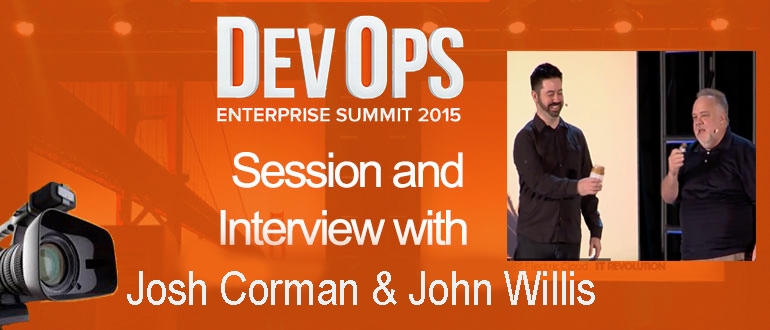
  • DOES 2015 – Josh Corman, John Willis on Immutable Awesomeness

    DOES 2015 – Josh Corman, John Willis on Immutable Awesomeness

    Continuing recapping my favorite sessions of DevOps Enterprise Summit 2015, here is Josh Corman and John Willis talking about Immutable Awesomeness. What is Immutable Awesomeness you ask? Have a listen to my interview with John and Josh and then listen into the actual session where they go over it.

    Just a couple of hints: 1. Software supply chains are a great way to look at your development/deployment process 2.In a world where software controls everything, it really is a case of life and death 3. If you can’t get excited about what this all means, listen to the session again.

    Of course what makes this interview and session great is the unbridled enthusiasm that both John and Josh bring to the subject. In fact there was a palpable buzz in the theater when they walked off the stage and over to my video studio. The same enthusiasm carried over to our interview too. It was a lot of fun to interview these two.

    So have a listen and enjoy. Also if you enjoy John Willis presenting, he will be headlining the DevOps Connect: cdSummit SoCal on December 3rd, joining some other great speakers.

    Here is John and Josh’s actual presentation:

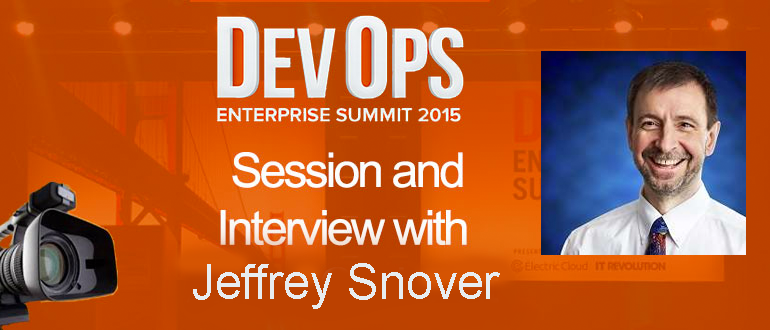
  • DOES 15 – Jeffrey Snover on Windows Nano Server

    DOES 15 – Jeffrey Snover on Windows Nano Server

    One of my favorite presentations at the recent DevOps Enterprise Summit 2015 was Jeffrey Snover of distinguished engineer at Microsoft talking about his 16 year quest to bring what is today called Windows Nano Server to market.  Interestingly when I spoke with Gene Kim about what he thought were some of the best presentations  of DOES he also brought up Snover’s presentation as well.

    Windows Server without Windows was something once considered heretical from anyone at Microsoft. As Jeffrey relayed to me in the interview below and on stage, he paid a price for evangelizing for this. But today we have a version of Windows Server that has only 1/20th of the footprint of regular Windows Server. It runs on mainframes, command lines and has virtually (no pun intended) all of the functionality that you need for a server in the cloud without the GUI overhead that Windows usually brings.

    As importantly for me, Jeffrey also gave us a glimpse of what it is like to work in Satya Nadella’s Microsoft. It sounds like a very different place than when Steve Ballmer was CEO.  Is also sounds very refreshing as well.

    Here is my interview with Snover:

    :

    Here is Jeffrey’s actual presentation at DOES ’15


  • DOES 15 videos – Adrian Cockcroft

    DOES 15 videos – Adrian Cockcroft

    At this years DevOps Enterprise Summit we were very happy to partner with Gene Kim’s IT Revolution and Electric Cloud to conduct on site interviews with just about all of the speakers from this years conference, as well as many other attendees. All in all devopsy.kinsta.cloud conducted something like 86 video interviews over the 3 days of the Summit.

    Over the coming weeks we will be highlighting some of the best of the best here for you. We will present them in different formats.Some will have commentary around their sessions, others will feature background info on the topic and speaker and finally we will have updated info for some of the others.

    In that vein I wanted to lead off the series with this interview of none other than Adrian Cockcroft of Battery Ventures and formerly Netflix. My conversation with Adrian touches on really just three questions:

    1. What was his presentation about: Systems integration or systems thinking. It offered an inside look at the Netflix culture and talent density.
    2. what did he think of DOES 2015 – Adrian is on the program committee though by his own admission he was a bit pre-occupied on other business this year to help too much. But like many who attended Adrian is was really impressed at how deep the penetration into different verticals were.
    3. What does he see in the next 3-5 years for DevOps? Adrian says that companies that don’t adopt DevOps ways run the risk of disappearing.

    if the short 7 minute interview above wasn’t enough, here is Adrian’s complete session at DOES 15 (warning it is 31 minutes long)


  • 5 DevOps Success Factors Surfacing At DOES 15

    5 DevOps Success Factors Surfacing At DOES 15

    Two days into a breakneck schedule of energizing presentations at DevOps Enterprise Summit 2015 (DOES 2015) and  there are already some common themes bubbling up from the speakers and attendees. As IT practitioners from big name enterprises like Capital One, HP, Target, Ticketmaster and more step up to the podium to share their personal stories about the journey to continuous delivery, they’ve proven that their transformations rely on similar success factors.

    Success Factor: DevOps Champions

    DevOps change agents and champions are the engine that can help turn an enterprise IT ship around. And while it will eventually take a lot of people to power a large organization’s shift to DevOps, the passion and vision of a single DevOps change agent is contagious—particularly when they can demonstrate and document the results of new process patterns.

    “One person can make a difference,” says Sherry Chang, chief architect of DevOps and continuous delivery with Intel, who says when she first started helping her firm in its transformation, she had no formal DevOps title or role, but she believed strongly that changes needed to be made and was determined to drive them. She says she connected with others to start small and spread the DevOps gospel.

    Success Factor: The Yin/Yang of Grassroots/Executive Support

    Building DevOps momentum can’t depend solely on support from the bottom up or the top down. Those experienced in walking the DevOps path say that buy-in must come from both sides of the coin to truly transform the business.

    Most transformations tend to start at the grassroots level—that’s what those champions are especially good for kick starting—because risk-averse executives tend to like to grab onto new initiatives that already look like potential winners.

    “Those change agents are important in the early days because they can demonstrate success, which then helps to start growing a grassroots movement, where more and more passionate folks start to get bought into the different changes that are being talked about, and then that got us to gain our tops-down buy-in,” says Heather Mickman, director at Target.

    Success Factor: Internal DevOps Events

    Many of the biggest enterprises that shared their stories explained that a key component of the culture shift at their organization has been some sort of large-scale internal event—essentially in-house DevOps conferences. These events give DevOps champions the chance to bring in outside thought leaders and practitioners at other companies to demonstrate to people within the host enterprise that there really is something to DevOps, automation, continuous delivery and the like. For example, CapitalOne recently hosted more than 1,200 software engineers for an in-house event it calls SECon and brought in many of the same speakers we’re seeing this week at DOES.

    Target has also hosted numerous internal DevOps days, as well as an executive summit that Ross Clanton, senior group manager at Target, called a “tipping point” for gaining top down support from executives.

    Success Factor: Empowerment

    Giving staff the tools the need to do their job and then getting out of the way to actually let them do it has been another common theme weaving its way through DOES talks.

    “Teams crave responsibility,” says Jody Mulkey, CTO at Ticketmaster. “Folks on our development teams, they all want responsibility to run their products. They didn’t all want it in the beginning, to be quite honest. But once they saw how quickly teams were able to deliver and how they were able to minimize these business disruptions based on the ability to quickly make changes to their software, it was pretty incredible.”

    He says of the 73 development teams at Ticketmaster in North America, 100 percent push their own code.

    Success Factor: Test Automation

    Time and time again, presenters have called out the importance of test automation in eliminating waste and idle time in the development lifecycle and elevating the process. On Monday, there was a whole panel dedicated to the topic with representatives from Intel, Quicken Loans and Bluware talking about how to scale this across the enterprise. And as Paul Schmid explained in his description of the DevOps transformation at Sherwin-Williams, like many organizations, his has been learning the hard way that test automation ideally should be one of the first steps to shifting gears to continuous delivery.

    “Tests for us are really important, and we are not mature in this at all. So a lot of what was talked about this morning hit right at home,” he says. “Testing is really important and it’s definitely the next step for us, and we’re putting a lot of time, effort, and money into it.”

  • Live blogging DOES 2015

    Live blogging DOES 2015

    We will be live blogging from DOES 2015. Ericka Chickowski and Alan Shimel are live at the show in case you can’t be here yourself.