Category: RSA

  • Microsoft kills Python 3.7 ¦ … and VBScript ¦ Exascaling ARM on Jupiter

    Microsoft kills Python 3.7 ¦ … and VBScript ¦ Exascaling ARM on Jupiter

    Welcome to The Long View—where we peruse the news of the week and strip it to the essentials. Let’s work out what really matters.

    This week: VS Code drops support for Python 3.7, Windows drops VBScript, and Europe plans the fastest ARM supercomputer. (more…)

  • Best of 2021 – Torvalds’ Bug Warning is a Lesson for Linux Users 

    Best of 2021 – Torvalds’ Bug Warning is a Lesson for Linux Users 

    As we close out 2021, we at devopsy.kinsta.cloud wanted to highlight the most popular articles of the year. Following is the third in our series of the Best of 2021.

    Linux does, occasionally, raise security concerns. While many users see it as the most secure, robust and versatile operating system available — that’s this writer’s opinion, as well — security precautions still have to be taken.

    A recent, widely publicized case illustrated this point; Linux creator himself, Linus Torvalds, warned against the use of the Linux 5.12 release. He described a “nasty bug,” and wrote that the situation is a “mess,” due to the use of swap files when adding Linux updates. This nasty bug, in fact, had the potential to destroy entire root directories.

    Some of the main takeaways following this “mess” include: tread very carefully when installing early Linux releases, especially those that involve swapping files instead of partitions, and especially, despite Linux’s well-known security advantages, avoid becoming complacent, because Linux security is not always foolproof.

    Hence, while the “state of Linux security today is quite good, and has evolved in a positive way with more visibility and security features built, like many operating systems, you must install, configure and manage it with security in mind; that is how cybercriminals take advantage, [via] the human touch,” said Joseph Carson, chief security scientist and advisory CISO at Thycotic, a provider of privileged access management (PAM) solutions.

    A Patch for Nastiness

    As Torvalds noted a few weeks ago, “most people don’t use a swap file, but a separate swap partition and the bug in question really only happens when you have a regular file system, and put a file on as a swap.”

    “The bad news is that the reason we support swap files in the first place is that they do end up having some flexibility advantages, and so some people do use them for that reason. If so, do not use [release candidate] RC1,” Torvalds wrote. “Thus, the renaming of the tag.”

    After issuing the warning, Torvalds released a patch that he says prevents the bug from destroying swap file systems. However, it may have already been too late for early adopters of release 5.12. Ubuntu, a leading Linux distro, can swap files by default.

    “It is nasty bug if you are still using swap files,” Carson said. “If you do still use swap files, then you could be impacted, resulting in potential data loss or a corrupted system.”

    DevOps teams – or anyone else running Linux and installing patches, whether on multi-servers or on individual workstations – still need, of course, to follow strict best practices. “Like any operating system, security depends entirely on how you use, configure or manage the operating system,” Carson said. “Each new Linux update tries to improve security; however, to get the value, you must enable and configure it correctly.”

    Linux Goodness

    The fact that Torvalds was so forthcoming about the bug, as well as the level of transparency that the Linux kernel offers, also demonstrates one of the many reasons Linux remains popular. Given that the Linux kernel, in one variety or another, is used “not only in about 50% of the internet servers of the world, but also in a substantial part of all our smartphones, it is good to see this level of transparency at ‘root level,” said Dirk Schrader, global vice president, security research at New Net Technologies (NNT), which providers cybersecurity and compliance software.

    “The security of Linux is based on its transparency; the ability to review the code of a distribution,” says Schrader. “Quite often forgotten is that transparency also involves talking about the mistakes, the errors, those nasty bugs.”

    Citing National Institute of Standards and Technology (NIST) vulnerability database statistics, Schrader described how, compared to the Windows family of desktop and server operating systems, for example, the Linux kernel shows better results for overall vulnerabilities. The number of vulnerabilities have also declined over the past four years, while Microsoft’s operating systems do not display the same trend, according to NIST’s national vulnerability database.

    Since Linux’s famous kernel is open source and transparent, it is possible to extrapolate that there are a greater number of potential vulnerability watchdogs compared to those monitoring vulnerabilities in closed systems. Some may argue that Microsoft has been, at times, less successful at detecting vulnerabilities and issuing much-needed patches.

    However, Linux users still must remain vigilant.

    “Still, for any of the Linux distributions, anyone using the early release candidates — RC1 in particular — should make sure that their own development or build process is undergoing change control, so that no mishaps will transfer the nasty bug into a production environment,”  said Schrader.

  • WhiteHat Security Allies With Bit Discovery on Vulnerability Intelligence

    WhiteHat Security Allies With Bit Discovery on Vulnerability Intelligence

    WhiteHat Security, a subsidiary of NTT, has announced an integration with Bit Discovery to make it easier for developers and cybersecurity teams to discover the extent to which the attack surface they need to defend might be impacted by a vulnerability.

    Bit Discovery maintains a database made up of more than 5 billion internet-connected assets and hundreds of third-party resources to automatically generate an inventory of the assets that make up an organization’s attack surface. Bit Discovery continuously scans internet-connected assets to monitor new domains, phishing sites and connected devices to provide cybersecurity teams with a deeper understanding of the threats their organization faces.

    WhiteHat Security integrated its application security platform for scanning for application vulnerabilities with the Bit Discovery database via application programming interfaces (APIs) to make it possible to search that database via a dashboard. All vulnerabilities surfaced via that dashboard are verified by WhiteHat’s Threat Research Center, a team of application security experts, to reduce any potential alerts that might actually be false positives.

    Craig Hinkley, WhiteHat Security CEO, said the goal is to make it simpler for organizations to shift more responsibility for applications security left toward developers in a way that doesn’t result in them chasing their tail every time a new vulnerability is discovered. Instead, a virtuous cycle of workflows can be created that enables developers and cybersecurity teams to collaborate more effectively, Hinkley added.

    Ultimately, the goal is to make scanning for application vulnerabilities a more natural extension of any quality assurance process. The simple fact that there is so much focus today on DevSecOps best practices only highlights how much work there is to be done before security becomes just another routine gate within an automated DevOps workflow, noted Hinkley.

    In the meantime, unfortunately, cybersecurity teams are finding it increasingly difficult to keep pace with the rate at which applications are being developed and updated. The Bit Discovery database integration provides a way for cybersecurity teams to have more relevant conversations with developers about which vulnerabilities need to be prioritized based on the actual threat they represent to the organization. In the absence of that integration, security becomes a losing battle, simply because developers and cybersecurity teams both are overwhelmed by the volume of vulnerabilities that would otherwise need to be investigated on their own without any assistance.

    The integration between WhiteHat Security and Bit Discovery comes at a time when the focus on software supply chains has increased significantly in the wake of a series of recent high-profile breaches. More attention is now being paid to preventing malware from finding its way into the application development process. The challenge is finding a way to provide developers with actionable insights into risks that need to be mitigated before and after an application is deployed in a production environment. After all, vulnerabilities are just as often discovered after an application is deployed as they are before.

    It may be a while before most organizations are able to implement a robust set of DevSecOps best practices, but the more reliable the vulnerability intelligence being provided to developers, the more likely it becomes they will act on it before a cybercriminal exploits it.

  • SecDevOps is the Solution to Cybersecurity

    SecDevOps is the Solution to Cybersecurity

    Anybody paying attention to world news will notice that the threats and risks perpetrated by cybercriminal actors, in many forms, is a serious problem on the rise, affecting individuals, organizations and nations daily. The cybersecurity threat space is indeed alarming and growing rapidly. The cybersecurity solution space is struggling to keep up. After all, there is no such thing as 100% security.

    What is the Solution to Cybersecurity’s Problem?

    In my opinion, the industry has long underestimated the problem of cybersecurity, which has resulted in solutions that do not sufficiently stand up to the cybersecurity threat space. What is clear is that solutions must come from rapid software changes that detect and plug security holes as fast as they are found, and continuously deploy innovative defensive solutions that keep bad actors off their guard. To do that requires Agile and DevOps continuous delivery practices coupled with a security-aware mindset.

    What is a Security Aware Mindset?

    To put things in perspective, it is useful to consider the mindsets of design, QA, operations and security.

    Design mindset – create a product or service that customers want, now. The Agile framework addresses this requirement.

    QA mindset – verify a product or service works the way customers expect it to, when it is released, for all production configurations available at the time of the release. The DevOps framework addresses this requirement.

    Ops mindset – ensure a product or service continues to work the way customers expect, for all production configurations, for the life of the product or service. The site reliability engineering (SRE) and ITIL frameworks address this requirement.

    Security mindset – defend valuables for organizations that create or use a product or service against unintended and malicious actions, by people and organizations, both inside and outside of the organizations, for all production and non-production configurations, for as long as there is something of value to protect. The DevSecOps framework was created to address this requirement; as we have seen, this does not yet offer sufficient safeguards for the growing cybersecurity threat problems.

    The security mindset has multiple additional vectors of thought required compared to the design, QA and ops mindset. This helps us to understand why the cybersecurity problem space is bigger and requires more comprehensive solutions.

    Not long ago I considered security assurance to be a subset of testing practices. In 2016, in my blog, “Seven Pillars of DevOps – Essential Foundations for Enterprise Success“, I did not break out security as a separate pillar. At that time, this type of thinking was typical of developers. Security was someone else’s job. Perimeter defenses were deemed sufficient.

    Soon after, I realized that way of thinking was naïve on my part. By the time that I co-authored a subsequent blog, “Nine Pillars of Continuous Security Best Practices,” I added a separate pillar for security specific practices, and also added security practices within each of the other pillars.

    In parallel, DevSecOps became a thing in the DevOps world. The idea of integrating security practices into DevOps makes a lot of sense, because DevOps is the answer to continuous delivery of software, and security needs continuous delivery of defensive solutions. However, simply adding security to DevOps is not a sufficient solution, because DevOps was conceived to address specific problems associated with design, QA and Ops – not security. Simply adding security as another metric for releases is not enough. What is needed is a re-think of how DevOps can be used to deliver continuous security, as indicated in my book, “Engineering DevOps.” This is the same idea behind what is referred to as SecDevOps.

    In my opinion, it is now time for SecDevOps to gain favor over DevSecOps when it comes to integrating security practices with DevOps practices. This represents a much more significant shift than simply putting security first in the name. With SecDevOps, security concerns within the entire development organization and at every stage in the DevOps value stream, are explicitly prioritized over other types of concerns. This makes sense, given the much wider blast radius of security events versus other quality concerns that DevOps was originally designed to address.

    With SecDevOps, security tools and resources are weighted at the highest priority level. SecDevOps and secure coding practices are required training for application developers. Threat modeling is part of the value stream. Security tasks that are required to mitigate security risks are given the highest priority in backlog planning. At each stage in the DevOps pipeline, security concerns rise to the top of the priority list. Release and deployment readiness are weighted at the highest level. In short, SecDevOps explicitly plugs some important security holes that are not covered by DevSecOps. With SecDevOps, security becomes continuous, not just an add-on to DevOps.

    What This Means

    By explicitly plugging some important security holes that are not covered by DevOps or DevSecOps practices alone, it makes sense for SecDevOps to now emerge as the preferred framework to close the gaps between the growing security problem space with the evolving security solution space. SecDevOps offers the required security-first mindset and solves the need for rapid software changes that detect and plug security holes as fast as they are found, and continuously deploys innovative defensive solutions to keep bad actors off their guard.

  • SAST, DAST, SCA: What’s Best For AppSec Testing?

    SAST, DAST, SCA: What’s Best For AppSec Testing?

    According to the most recent Verizon Data Breach Investigations Report, almost 90% of data breaches are driven by financial gain, up from 71% in last year’s report. Most noteworthy, however, is that cloud platforms are particularly at risk, with web application attacks increasing by 43%. As more information is stored within cloud infrastructures, and as more enterprises rely on web applications to maintain business continuity, security teams should consider how security controls can be integrated to DevOps without impacting productivity. However, the security market is often shrouded by acronyms and buzzwords. With the increase in automated security testing tools, such as SAST, DAST and SCA, it’s important to understand the difference between each of these practices, and when to use them in the development cycle.

    DevOps is the convergence of software development and IT operations that aims to continuously build, test and release software. Understandably, DevOps is becoming an integral part of any business as it facilitates delivering new products to end users faster and driving increased revenue. However, failure to secure these digital assets can open organizations to cyberattacks resulting in operational downtime, loss of customer trust and even hefty fines from a regulatory body. The sharp rise of application layer attacks proves that enterprises must proactively address security issues earlier in the software development stage.

    The evolution of DevSecOps takes the concept of DevOps one step further, putting security where it should be: at the heart of the development life cycle, using automation. DevSecOps has helped security professionals understand how they can successfully integrate automated security processes without slowing down development while allowing DevOps to focus on what matters most – building and creating software.

    There are a host of automated application security testing tools out there, each with unique benefits, that are commonly used in the agile software development cycle. This raises the question: what tools should we use, and when, to ensure a secure software development life cycle (SDLC)?

    The Difference Between SAST, SCA and DAST

    The most popular application security testing tools businesses implement in their development cycles are static application security testing (SAST), software composition analysis (SCA) and dynamic application security testing (DAST). Knowing the differences between them and when to use them is crucial to enhance your DevSecOps strategy and secure your web applications.

    Static Application Security Testing (SAST)

    As the pressure to deliver high quality and secure code increases, and DevOps embraces new agile methodologies and technologies, integrated static analysis within the continuous software development pipeline can help detect vulnerabilities early in the software development process from the inside out (white box testing). The benefit of a SAST solution is it doesn’t require a running system to perform code security checks and won’t slow you down like a manual code review or penetration test.

    One aspect that makes SAST unique is that it automatically checks for vulnerabilities within the application source code, byte code or binaries, line by line. This ensures security weaknesses – such as those listed in the OWASP top 10 and the 2019 CWE top 25 – in the proprietary code are detected from the start and during development. As a result, developers can identify the risks and fix any vulnerabilities before they make it into production. They are empowered to shift left and recognize early code defects in the development cycle, a security best practice, which also reduces the cost of fixing security issues.

    However, SAST does have some disadvantages in that it requires access to source code and the underlying framework, making it unsuitable for testing commercial off-the-shelf software (COTS) or working with outsourced development. It is also unable to identify runtime and environment-related issues, which makes it difficult to determine the actual and contextual risks of security flaws and suggest meaningful remediation.

    Dynamic Application Security Testing (DAST)

    Unlike SAST, dynamic application security testing (DAST) is done from the outside in (black box testing), and identifies vulnerabilities when the application is running. DAST tools crawl web pages, locate web services endpoints, inputs and outputs; it requires a working version of a web application for the testing to work. Without looking into the source code, dynamic analysis works to simulate penetration testing to uncover exploitable vulnerabilities and business logic issues from a hacker’s point of view, with reliable results.

    Yet, because this scanning occurs towards the end of the SDLC (running applications), the findings can be substantial and often put additional pressure on DevOps teams to fix these runtime vulnerabilities on short notice, creating friction between the security and development teams. Further drawbacks of DAST include the risk that vulnerabilities can be found too late in the SDLC, resulting in rushed or delayed remediation.

    Software Composition Analysis (SCA)

    Releasing new features on a deadline means that developers often don’t write all their own code. The use of prepackaged open source code is commonplace in modern DevOps practices, and so is the need for security governance. Some SAST solutions now include software composition analysis (SCA) functionality to locate weaknesses in proprietary code and vulnerabilities in open source code.

    SCA tools are designed to analyze the open source components by detecting software licenses, deprecated dependencies and known vulnerabilities and potential exploits in a codebase. SCA enables DevOps teams to manage their security exposure and license compliance while still allowing the use of prepackaged code to speed up development processes. In addition, composition analysis can be run and expanded to newer architectures, including containerized environments, to automate detection for publicly disclosed vulnerabilities within your containers and prevent those disguised in public registries, such as Docker Hub, from being brought into the project.

    With open source components now present in 96% of commercial applications, the ability to spot software supply chain vulnerabilities in development, in and out of the cloud, are vital to reduce web application risks – all of which can be a potential entry point for malicious actors, as we’ve learned from the Equifax and SolarWinds breaches.

    Choosing the Best Application Security Testing Tool

    There is no shortage of application security testing tools. The real conundrum arises when decision makers are presented with a host of various options and pressured to choose. However, these tools are not mutually exclusive. Instead, they form a holistic, almost linear, approach to the entire DevOps pipeline from plan to implementation. What does vary, however, is the application development model. Which tool(s) should you choose for your specific use case? Here are some general guidelines:

    Outsourced Development and Commercial off-the-shelf (COTS) Applications: When it comes to critical business applications for prepackaged code, black box testing is advised for enhanced security peace of mind. Without access to the source code, DAST scanning and/or penetration testing are ideal to test the running application for any critical software vulnerabilities before deployment and to monitor security compliance in the long run.

    Internal Development and Software Customization: For businesses with the resources and infrastructure to create applications in-house, it’s important to build security testing into the SDLC from the beginning. Doing so can help protect against application vulnerabilities including cross-site scripting. For true DevSecOps, arm your development teams with SAST/SCA tools to ensure code security in the ‘code and build’ stage, and apply black box testing (DAST) for security assurance before deployment. Once deployed, regular penetration testing and continuous vulnerability assessment of the underlying infrastructure are also recommended to keep security issues in check with each new release.

    As cyberattacks targeting web applications increase, it is essential for organizations to have complete application security across the SDLC, providing maximum security coverage for development and ensuring they can keep up with business operations.

  • Debugging is Broken – Here’s How To Fix It

    Debugging is Broken – Here’s How To Fix It

    Let’s face it, debugging is broken.

    Whether you wholeheartedly agree or vehemently disagree with that statement, I think we can all agree that debugging, at the very least, has room for improvement. In fact, the way software developers debug their code hasn’t changed much. Of course, there are now a wide array of observability and monitoring tools available to make a developer’s life easier, but when we look at the process developers typically follow when debugging code, it’s stayed relatively unchanged over the years.

    Having the right tools available definitely improved the overall debugging experience, but they’re not the only factor. Internal organizational processes are equally as important, and should be adapted to make developers’ lives as smooth and stress-free as possible while still maintaining the proper levels of organizational security and compliance. Inefficient or highly restrictive processes, while great for the compliance team, can adversely affect the velocity of getting to the bottom of issues quickly. The right solution is typically a combination of adapting those processes to fit the company culture, along with a combination of tools that allow for compliance with industry standards and best practices.

    How Developers Debug Code

    When you talk to developers today about how they debug their applications, the process is typically not all that different than it was many years ago. The standard approach to debugging is still through the use of logging frameworks. Of course, teams are taking advantage of things like application performance management (APM) tools and other tools in the monitoring and observability space, but when you look at the primary method of debugging issues that require developers to dive into the code, logging is typically the main approach.

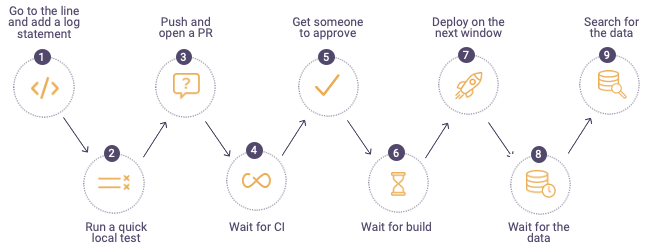
    The process typically looks something like this:


    debugging process

    When a defect is found, developers will first go to the log files on the production or pre-production servers in the environment where they are debugging. If they can’t find information in the logs to help them get to the root cause of the issue, they go back to their code and add additional log lines, finally sending their code through the process shown above. For highly advanced organizations, the process can take minutes or hours, but more often than not, this process drags on for days – or even weeks. It becomes especially time-consuming when the defect developers are trying to find and remediate is in production. In these cases, the cost to the business can be staggering; there’s got to be a better and more efficient approach to debugging.

    Where Tools Can Help

    While new and shiny tools don’t always solve all debugging problems, they can often ease some of the pain developers face and, in the process, make their lives a little bit easier. Debugging, observability and monitoring tools can get developers the data they need to solve problems faster than the more traditional method of digging through logs and using trial and error.

    The place many organizations start when considering diagnostic tools is with APM. These types of tools focus specifically on monitoring and management of the application availability, and can help to collect metrics and other relevant application information that can aid in pinpointing infrastructure issues. Most often, these tools are not actually used by developers themselves, but rather operations or production support teams to ensure availability and performance thresholds of applications.

    Another critical category of telemetry are tracing tools, which can help developers better understand how requests flow through multiple tiers of applications and even help identify error rates and latency. There are many vendors selling this category of tools, but there are also open source options which allow developers to integrate tracing into their applications via a vendor-neutral approach.

    After diagnosing an issue with an APM solution, there is often a handoff to development to remediate the issue. When developers need to debug, they often use their local IDEs or, even better, a remote debugging solution. Remote debuggers are used directly by developers to simplify debugging of applications in remote environments. These tools helps developers get to the bottom of customer issues faster by giving them direct access to the underlying application data in a safe and secure way while the application is running without stopping it or having to redeploy it. A major benefit of remote debuggers is that they can give developers the data they need from production environments without compromising security or requiring developers to have direct access to sensitive environments. While remote debuggers and other debugging tools are not a silver bullet, they can be a critical component that empowers developers to better address critical issues.

    Fixing Organizational Problems

    If solving customer issues is taking longer than expected or is potentially hurting your brand, it’s critical to sit down with your development team and use a data-driven approach to identify where the problems lie. Do a deep dive into your issue tracking or ITSM system to identify trends or recurring issues within particular application components. Development teams can often become so overwhelmed tackling issues and building out new features that valuable information in these internal systems can go untapped. Customer issues and defects should be reviewed periodically to assess things like business impact, cost to fix and alignment with the product roadmap. There is valuable information that can help focus the team’s effort on time-saving activities as well as improving the product, making for happier customers.

    Another area to look at is your software delivery process. Are there bottlenecks in your delivery pipeline that could be made easier or more efficient but have been overlooked? The speed and efficiency of your software delivery pipeline has a direct impact on developers’ ability to debug effectively and can contribute to a broken or slow debugging process. Developers should have the ability to push code into new environments as quickly as possible to remove slowdowns from too much context switching. This means automating as much of the delivery pipeline as possible, removing unnecessary manual deployment approvals and shifting left as many activities as possible.

    When it comes to empowering developers and fixing broken debugging processes, organizations should focus on fixing organizational bottlenecks as well as equipping developers with tools that can save them time and improve their daily workflows. Focusing on these areas can increase development team velocity and eliminate costly day-to-day slowdowns which add up over time and negatively impact productivity. With a few key changes, debugging can be a much more manageable and predictable process.

  • Seeing the Bigger Picture With BizDevSecOps

    Seeing the Bigger Picture With BizDevSecOps

    Not long ago, if you can believe it, software was shipped on physical floppy disks and CDs. These physical relics contained dense paper instruction books that humans read diligently for hours on end (I guess they had more time to spare back then?). Complexity was a given for computer-based tasks.

    Fast forward past the consumerization of IT to 2021, and you’ll find extremely high standards for technology. End users now expect intuitive apps with instant end value and 100% uptime. If they don’t receive gratification within minutes, they’re likely to trash it.

    In the race to meet digital innovation demands, software companies are increasingly tapping new strategies to deliver iteratively. Thus, disciplines like DevOps, DevSecOps, low-code and SRE have flourished. But are we adequately considering the end value of that work? Some feel business leadership needs a larger seat at the table and more input: enter the newest iteration of these disciplines, BizDevSecOps.

    I recently met with Gregg Ostrowski, CTO at AppDynamics, to discuss how to introduce BizDevSecOps in an organization. For Ostrowski, it boils down to having full-stack observability to connect application performance, security threats and revenue generation. Only by democratizing access to important metrics and identifying runtime weaknesses can business outcomes truly drive production.

    Full-Stack Observability

    Within our new pandemic-first reality, all organizations are amplifying their use of digital services to interact with customers. However, software teams are struggling to keep pace in this new environment — 89% of technologists report feeling under tremendous pressure at work, the Agents of Transformation 2021 report found. This strain has only increased as IT complexity soars amid the pandemic — 83% felt their job became more complex over the past year.

    IT staff is under mounting pressure to perform, and they may not have the correct elements in place to support elegant and profitable applications, said Ostrowski. When it comes to monitoring, in particular, alert fatigue could especially hamper innovation attempts and make it difficult to know what to prioritize.

    Instead, Ostrowski advocates for letting tangible business outcomes, such as conversion rates and performance, drive development. To correlate the impact on revenue more directly, he encourages “giving business leaders a seat at table during the entire CI/CD pipeline.” One aspect to roping in business, security, development and operations is unified observability across the entire stack.

    The Pendulum Swings

    But wouldn’t it be challenging to give business leaders a seat within a technical software delivery process? Well, this wouldn’t be the first time business has directed technological change.

    Ostrowski recalls the mid–2000s and the dawn of the mobile market. During this period, IT became consumerized for laypeople, with glossy apps and impressively intuitive experiences. He recalls a general loss of faith in IT staff, as workers often had “better tech at home than they did in the office.” This drove business leaders to invest heavily in modernizing their companies.

    In the following years, cloud solutions quickly re-empowered IT with new computing models, emboldening them to compete using the same tools as tech companies. However, simple deployments using a single server quickly morphed into arranging multiple workloads on various cloud service providers (CSPs). Virtualization, serverless and microservices architectures also brought novel complexities into the stack.

    “The IT staff is being asked to do jobs they’ve never done before,” Ostrowski said. He explained that SREs, for example, must understand networking, infrastructure and security — a vast portfolio for a single person and role. Supporting many disparate paradigms is simply beyond the scope and scale of what a single person can do, meaning new automation must be constructed — because “if you’re too busy debugging, you can’t innovate,” says Ostrowski.

    Amid mounting complexity and the burden of rising cloud costs, it appears business leaders again have a role in directing and prioritizing technological efforts.

    Getting Busy With BizDevSecOps

    According to Ostrowski, connecting IT and business with BizDevSecOps all hinges on collaboration. “If you don’t get to a point where you can collaborate with all these pillars, you’ll degrade your business,” said Ostrowski.

    BizDevSecOps also could help connect the dots to comprehend anomalies. For example, suppose a commerce application is experiencing a 15% conversion rate, but it drops to 7% after an upgrade. In this scenario, collaboration is crucial to identify usability bottlenecks in production and adjust accordingly.

    Tracking business outcomes can align development around improving the user experience. If broken features are hurting conversion rates, all stakeholders need to know to adjust accordingly. “User experience is the golden gem,” said Ostrowski.

    Other benefits of a BizDevSecOps approach may include:

    • Correlating activity and revenue: Ensuring spikes of activity are associated with revenue generation and not attacks or faulty instances.
    • Workload optimization: Monitoring business outcomes can help adjust the scope and size of machines as needed.
    • Before and after: Comparing financial results before and after migrations, new versions or new feature additions.
    • Postmortems: Pinpoint and correlate data when conducting postmortems.
    • Progressive delivery: A more rapid release frequency helps a business retain agility and pivot when needed.

    Visibility Enables BizDevSecOps

    DevSecOps is now a common philosophy — it promotes development with security baked into the application. Now, BizDevSecOps could be the next iteration; a collaborative approach that considers additional perspectives. BizDevSecOps is a vital method to “continue to build trust and collaboration so everyone has a seat at the table,” said Ostrowski.

    Ninety-six percent of technologists agreed that monitoring the entire IT stack to connect technical performance to business outcomes will be important in 2021, the Agents of Transformation Report found. To enable this, business, security and development must inevitably de-silo. According to Ostrowski, adopting BizDevSecOps depends on a window into performance management and business intelligence, because “when changes happen and no one knows about it, it’s a serious problem,” he added.

  • 1Password Extends Encryption to Automate Secrets Management

    1Password Extends Encryption to Automate Secrets Management

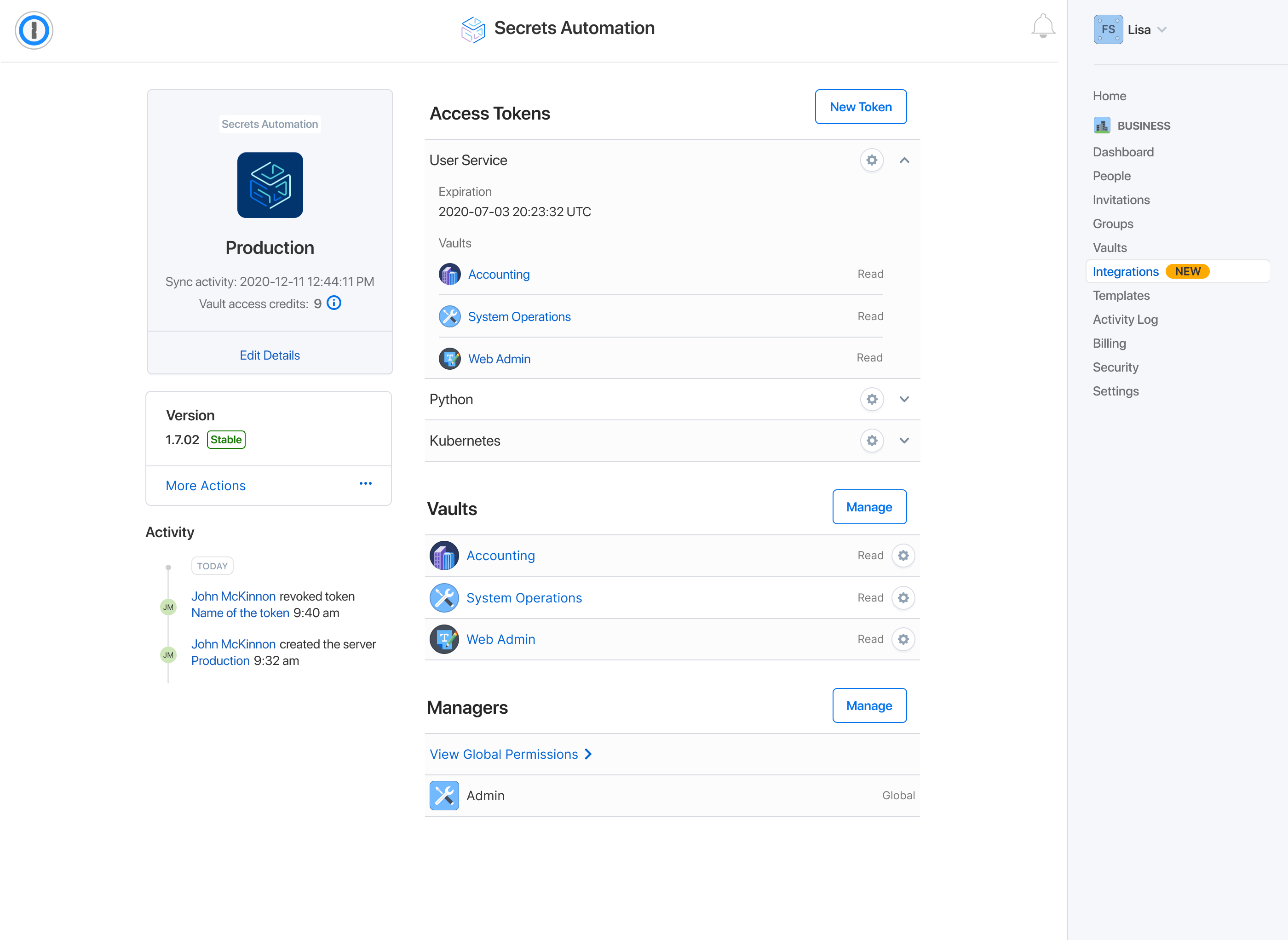
    1Password this week added a Secrets Automation platform to its offerings that enables IT organizations to more easily encrypt, manage and orchestrate credentials, application programming interface (API) tokens, keys and certificates.

    In addition, the company revealed it has acquired SecretHub, a provider of a separate secrets management tool. Terms of the acquisition were not disclosed.

    Carson Brown, senior product manager for 1Password, said the SecretHub team will now focus on the development of the 1Password Secrets Automation platform based on encryption technology previously created by 1Password.

    Finally, 1Password this week also announced an alliance with GitHub under which it will, at some future date, enable DevOps teams to employ SecretsHub to encrypt secrets used to access the source code repository. 1Password already provides integrations with HashiCorp Vault, Terraform, Kubernetes and Ansible, in addition to client libraries written in Go, Node and Python.

    The 1Password platform for managing and securing passwords is already in use by more than 80,000 businesses worldwide. The Secrets Automation platform now extends the reach of the company’s core encryption technology into the realm of DevSecOps best practices, said Brown.

    It’s still early in the cycle of DevSecOps best practices adoption, but it’s clear an initial focus will be secrets management. In the wake of recent high-profile breaches involving software supply chains, there’s now increased scrutiny of secrets management. Cybercriminals have become more adept at scanning for secrets left exposed as plain text. The challenge organizations face is that developers, while building applications, tend to copy secrets for the sake of convenience, which they often forget to delete after an application is deployed in a production environment.

    In response, many IT teams vacillate between overly restrictive and overly permissive access controls that are rarely implemented consistently.

    Of course, it’s now also only a matter of time before auditors start citing all those unencrypted secrets as compliance violations, Brown noted. A set of DevSecOps best practices based on automatic encryption of secrets eliminates those compliance concerns in a way that is transparent to application developers, noted Brown.

    It’s not immediately clear whether it will be DevOps teams that lead the charge to automate the encryption of secrets, or whether cybersecurity teams will take the lead. Regardless of which team assumes responsibility, the number of secrets that need to be tracked keeps expanding as the number of platforms employed increases. Manually keeping track of all those secrets is no longer feasible. Centralizing secrets management is the first step toward regaining control over an IT environment, said Brown.

    Secrets management may not always be the first thing that comes to mind when organizations begin their DevSecOps journey. As it turns out, however, securing secrets may very well turn out to be the first order of business as senior business and IT leaders review their entire software supply chain. After all, once it becomes apparent just how dependent organizations are on software, they quickly realize how much of their intellectual property is one compromised credential away from being stolen.