Category: Low-Code/No-Code

  • Exploring Low/No-Code Platforms, GenAI, Copilots and Code Generators

    Exploring Low/No-Code Platforms, GenAI, Copilots and Code Generators

    The emergence of low/no-code platforms is challenging traditional notions of coding expertise. Gone are the days when coding was an exclusive skill set reserved for a knowledgeable few. Low/no-code platforms have democratized software development. They empower individuals from non-IT or technical backgrounds to translate their business ideas into applications without the need to master complex programming languages.

    These low/no-code platforms, with their user-friendly drag-and-drop interfaces and pre-built components, have simplified application development. Imagine building a smart home application with just a few clicks and drags — low/no-code platforms are making it possible.

    Add generative artificial intelligence (Gen AI) into the mix, and the new development practices change the field remarkably.

    The Impact of Gen AI on Low-Code Platforms

    Expect low-code platforms to evolve further, becoming more intelligent, adaptable and seamlessly integrated into the software development lifecycle. There will be a shift towards platforms that use Gen AI to understand user intent, automate routine tasks and generate complex code snippets.

    Gartner predicts that, by 2026, over 80% of enterprises will use GenAI APIs and models or deploy GenAI-enabled applications in production environments, up from less than 5% in early 2023.

    Combining low-code and Gen AI will empower developers by automating routine tasks and allowing them to focus on high-level logic and creativity. Gen AI acts as a multiplier that can accelerate and optimize developmental operations.
    McKinsey estimates that generative AI could add $2.6 trillion to $4.4 trillion annually to the global economy by 2040.

    Another Tool: AI Copilots and Code Generators

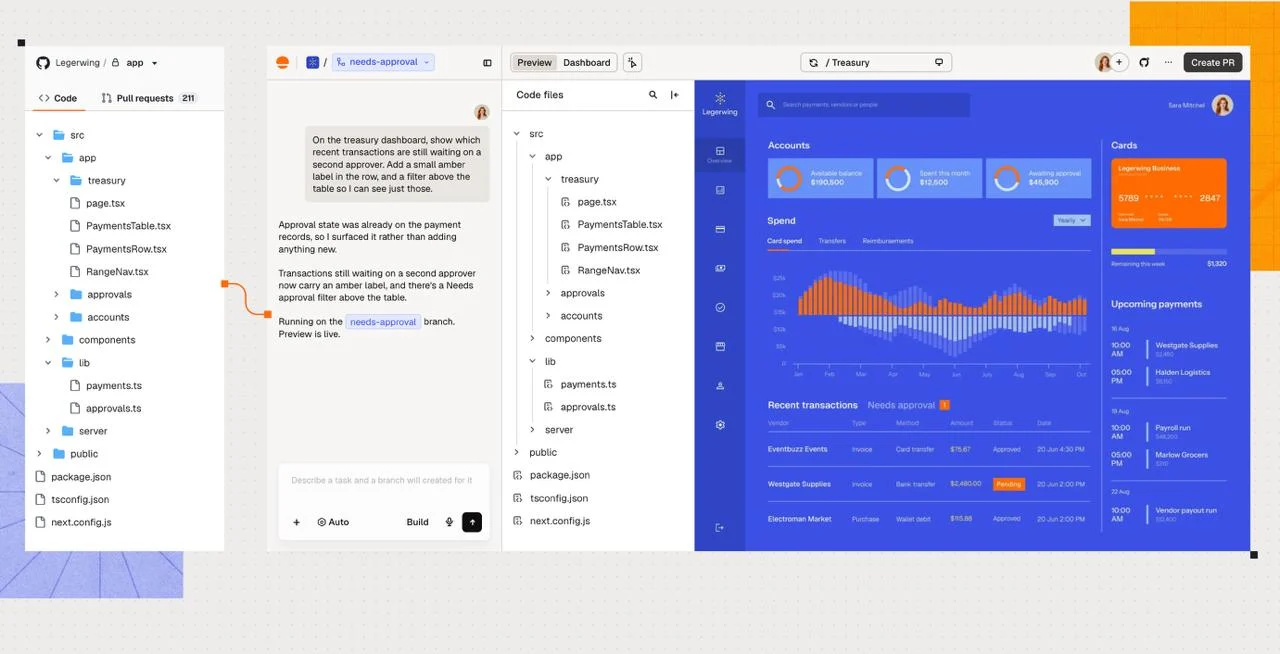
    Another promising application for AI large language models (LLMs) is AI-powered assistants. Enter copilots and code generators — AI assistants that take the hassle out of coding.

    While low/no-code platforms have transformed application development, copilots and code generators add an extra layer of efficiency.

    AI copilots use a chat interface to simplify coding through a chat interface, where developers articulate their code requirements in natural language prompts, and the copilot generates the code accordingly. These assistants provide real-time assistance, offering contextual suggestions and code snippets, and they can anticipate potential bugs. Moreover, they can explain code blocks, generate unit tests and propose bug fixes, which enhances the coding process.
    AI copilots are like trusted assistants, ready to aid you with specific coding tasks or generate complex code – and they do it swiftly.

    The Big Question

    As a result of low/no-code platforms gaining traction, the skill sets required in the tech industry will transform. Gone are the days when proficiency in multiple programming languages was a must-have.

    With low/no-code tools taking center stage, does this mean coding is becoming obsolete?

    A big no.

    While basic programming knowledge remains valuable, it’s no longer the sole requirement for building innovative applications. With low/no-code platforms democratizing application development, individuals from diverse backgrounds can leverage technology to create impactful solutions.

    Do GenAI, copilots, and code generators render low/no-code platforms obsolete?

    Again, no.

    While GenAI, copilots, and code generators excel at certain specific tasks, low/no-code platforms offer a holistic solution, combining visual interface design, database integration and more. They’re the Swiss army knives of development, catering to a wide range of needs beyond just code generation.

    Gen AI, copilots and code generators are not here to replace low/no-code platforms or traditional coding practices. Instead, they are positioned to complement and enhance them. The fusion of these technologies holds great promise in simplifying software development, boosting efficiency, and unlocking new avenues for innovation.

    The Final Word

    With better code suggestions and automated testing capabilities, low/no-code platforms deliver high-quality solutions that meet the demands of today’s tech-savvy users.

    With the thrilling combination of low/no-code platforms and GenAI, the future of software development is promising. While these advancements may disrupt traditional coding, they also present opportunities for innovation and creativity.

    It’s time for us to embrace this change and build a brighter tomorrow, one line of code — or lack thereof — at a time.

  • Microsoft kills Python 3.7 ¦ … and VBScript ¦ Exascaling ARM on Jupiter

    Microsoft kills Python 3.7 ¦ … and VBScript ¦ Exascaling ARM on Jupiter

    Welcome to The Long View—where we peruse the news of the week and strip it to the essentials. Let’s work out what really matters.

    This week: VS Code drops support for Python 3.7, Windows drops VBScript, and Europe plans the fastest ARM supercomputer. (more…)

  • Raspberry Pi 5: Faster, Better, Stronger — Spendier

    Raspberry Pi 5: Faster, Better, Stronger — Spendier

    Welcome to The Long View—where we peruse the news of the week and strip it to the essentials. Let’s work out what really matters.

    In a cheeky extra post this week: Everyone’s favorite single-board ARM computer, the Raspberry Pi, has a new generation coming soon. Compared to the ’4, RPi5 has double the performance, quadruple the base RAM and far more capable I/O. (more…)

  • Google’s Shiny New AI Dev Environment — the ‘Experimental’ Project IDX

    Google’s Shiny New AI Dev Environment — the ‘Experimental’ Project IDX

    Welcome to The Long View—where we peruse the news of the week and strip it to the essentials. Let’s work out what really matters.

    This week: Google’s full-stack, browser based development environment in the cloud. It’s not just a Copilot clone, but aims to help you “get an app from zero to production.” (more…)

  • How to Avoid Risk When Using Multiple Low-Code Platforms

    How to Avoid Risk When Using Multiple Low-Code Platforms

    Organizations are still increasing their use of low-code/no-code (LCNC). But this adoption isn’t always consolidated around one tool—frequently, multiple low-code/no-code platforms are used under the same roof. In fact, Gartner predicts that by 2024, 75% of large enterprises will be using at least four low-code development tools for both IT application development and citizen development initiatives.

    Utilizing multiple low-code/no-code platforms simultaneously introduces some security concerns. This is partially due to a lack of standard policies to govern different platforms in the same way. Low-code platforms are often incompatible with traditional IT security processes, like vulnerability scanning, manual code reviews and runtime security monitoring. Organizations going all-in on citizen development need safe ways to use low-code/no-code platforms. So, how can they safely enable this innovation without hindering productivity?

    I recently met with Michael Bargury, CTO and co-founder, Zenity, about securing LCNC systems. Bargury, who oversees the OWASP Low-Code Top Ten list, has significant insight into both the benefits and drawbacks of low-code/no-code platforms. Below, we’ll review the potential risks of using multiple low-code platforms and consider ways to mitigate these concerns.

    Why Companies Have Multiple Low-Code Platforms

    Interest in low-code has been rising, and low-code/no-code adoption continues to accelerate across enterprises. According to Bargury, large enterprises often don’t get a choice in the matter—low-code tools are arising organically, and it’s challenging to keep a lid on their proliferation.

    One way this occurs is that low-code becomes embedded into the SaaS platforms everyone already uses. Software platforms integral to business operations, like Salesforce, Microsoft Office and ServiceNow, have arguably mutated into low-code platforms, making them more like cloud providers than SaaS vendors, said Bargury.

    The other way low-code platforms emerge is through bottom-up transitions, says Bargury. This could be a specific knowledge worker working in a subset of the business to automate a domain-specific operation or integrate various tools. Then, there are the platforms, like OutSystems, Mendix or Mulesoft that specifically target professional developers.

    Organizations going all-in on citizen development may build a center of excellence and focus efforts on a single platform. And low-code platforms targeting developers will sometimes encourage more consolidation. Yet, “different platforms solve different use cases better,” explained Bargury. As a result, you will usually have a few converging in the same enterprises.

    Potential Security Concerns of Multiple Low-Code Platforms

    The emergence of low-code is similar to the bring your own device (BYOD) movement. IT and security leaders fought to avoid it at one point, but nowadays, everyone does it. So, what are the security implications if low-code becomes similarly ubiquitous? Well, no matter how it’s generated, low-code-bred programs are still applications susceptible to the same logical problems. And unfortunately, compared to your typical traditional code development life cycle, low-code development is fraught with discrepancies, says Bargury.

    Immature CI/CD Pipelines

    Some platforms do not offer the kind of mature CI/CD process one would expect from a software development platform. For example, there may be no way to create tests or separate your environments. Since there’s no coherent and consistent way to push code from development into production, you lack a way to apply secure development across platforms. “You don’t have a way to ensure every piece of software is up to your standards,” said Bargury.

    Opaque Underyling Codebases

    In traditional software development, you apply your own security reviews to ensure applications don’t contain risks. This includes shift-left scanning, security gates, manual reviews to catch mistakes early on and runtime scanning to catch unknown vulnerabilities in production. But there aren’t always parallels in low-code development. Low-code solutions typically have their own way of doing things with fewer standards, and they avoid exposing the underlying code and Git, said Bargury.

    Lack of Visibility

    As such, with low-code obfuscation, you lose a degree of visibility into how an application runs. Logs may be insufficient or wholly inaccessible. It’s also tricky—or at times impossible—to set up runtime monitoring, let alone scan various platforms. This means that low-code users can’t leverage powerful observability tools to identify errors and remediate security holes.

    Lack of Unified Policies

    Finally, establishing common authorization and permissions across multiple low-code development platforms is another hurdle. Since low-code vendors have their proprietary building blocks, you’re unable to leverage something like OPA or Kyverno to create and unify policies. Lacking shared policies across tools makes it challenging to verify that best practices have been implemented, says Bargury.

    How to Secure Multi-LCNC

    Low-code can grant much creative potential. But, knowing the above risks, what should IT be doing to reduce risks around low-code—especially when using multiple platforms? Well, Bargury shared several steps to help cybersecurity leaders start safely addressing the emergence of increasingly low-code capabilities.

    1. Take low-code development under the application security umbrella. First, low-code must be brought under the security umbrella, if it isn’t already. “It should be part of their mandate,” said Bargury. Shift the responsibility to professionals well-trained in resolving threats.
    2. Understand your surface area. As a basic security tenant, you can’t secure what you don’t know. Thus, Bargury recommends increasing your visibility into each low-code platform by collecting logs when possible and centralizing your analysis.
    3. Create automated guardrails. Next, it’s critical to identify your risks and set guardrails for your low-code users—especially when citizen development is involved. The OWASP framework provides a good overview of common risks and mitigation advice across robotic process automation (RPA), integration and low-code. In general, it’s important to design permissions with the rule of least privilege in mind. This can help reduce the chance of vulnerabilities like LCNC-SEC-03: Data Leakage and Unexpected Consequences and LCNC-SEC-01: Account Impersonation.
    4. Address gaps within the development life cycle (SDLC). Lastly, low-code platforms often provide the building blocks to secure applications, but it’s still up to you to ensure they are safely used. Cybersecurity teams should continually audit the low-code SDLC to ensure holes don’t persist.

    You’re Responsible for Securing Low-Code Development

    Low-code development platforms aren’t 100% safe from harm. It’s not out of the question for hackers to abuse low-code platforms and turn them against their owners. For example, Microsoft’s Detection and Response Team (DART) reported how a hacker group used entry to a low-code tool to remain hidden within an organization for six months, using credential stuffing to access an administrative account. By creating automations, they were able to use internal discovery tools and exfiltrate secrets and data that could have been used for privilege escalation.

    As you can see, there are legitimate concerns for low-code, especially at scale. However, security responsibility is not always that transparent. To date, there isn’t an equivalent of a shared cloud responsibility model in the realm of low-code development. As such, at the end of the day, you need to take the reins to own the applications that you build and ensure everything is secure.

  • Can ChatGPT Fix Bugs? ‘Wolverine’ Dev Says YES

    Can ChatGPT Fix Bugs? ‘Wolverine’ Dev Says YES

    Welcome to The Long View—where we peruse the news of the week and strip it to the essentials. Let’s work out what really matters.

    This week: Instead of AI aids for programming, what about for debugging? The pseudonymous “BioBootloader” says he’s persuaded GPT-4 to make his code self heal. (more…)