Category: Software Delivery Management

  • Software Delivery Management: New Mindset

    Software Delivery Management: New Mindset

    Innovation and mindset can take a while to evolve. It was the case with social media, wireless communications and the Internet of Things.

    Software delivery is a good example of a concept that’s ready to stand on its own. As software becomes more integral to companies and to society at large, the way it’s designed, built and distributed has evolved. Today, the delivery process is far more sophisticated than it used to be, with more resources in the mix and more moving parts. After years of looking at aspects of the software delivery process as separate pieces, people are thinking differently about how all the pieces fit together.

    That change in thinking is putting momentum behind the creation of a new IT category called software delivery management (SDM). SDM pulls together under one umbrella all the teams, tools, information sources and processes that relate to the delivery of software. It aims to eliminate inefficiencies that have cropped up along the way and help create a more value-driven process, aligning organizations’ resources toward a common set of goals.

    The Road to SDM

    For decades people divided IT into two basic camps: hardware and software. The categories were analyzed largely in terms of output. Experts tracked how many computer boxes a big integrated manufacturer such as IBM or Digital Equipment Corp. made, or how many software disks Microsoft spun off its production lines. Companies had their own methods of getting products out the door. Management techniques such as TQM helped guide these processes, but little outside attention was paid to specific steps companies took along the way.

    All of this changed as software itself started to evolve. The internet, smartphones and more versatile operating systems opened up the software market to everybody. Software producers (manufacturers and individual companies alike) spent a lot of cycles working to perfect aspects of the software delivery process. Companies created teams to research, scope, develop, engineer, produce, integrate, test, market and sell software apps. They applied a variety of tools to accomplish specific tasks and implemented processes such as continuous integration and continuous delivery (CI/CD) to help streamline the engineering functions.

    These advancements brought software to where it is today—companies are delivering apps quickly and updating them often. Operations teams are collaborating with developers, and organizations are doing their best to anticipate customer needs and institute quality control mechanisms. Software is achieving things never thought possible.

    Stashed in Silos

    But the delivery process isn’t perfect. Too often, pieces are separated from each other. Tools don’t work together. Teams don’t talk to each other enough. Information is stashed in silos that one side of the organization isn’t sharing with another. Data that does get shared hasn’t been updated.

    Disconnects like these cause ripple effects throughout the organization. Projects get delayed; apps get delivered with bugs and/or vulnerabilities; developers find themselves overworked, restarting initiatives because they didn’t have the information they needed to do it right the first time. Executives get frustrated that teams aren’t delivering on their goals.

    The disconnects can’t really be blamed on a particular team, tool or misplaced plan. They’re the fault of the overall process itself. A development team might be doing a great job with a top-quality tool and a well-thought-out plan. But if the product development group supplied developers with out-of-date information and a testing tool doesn’t integrate with a tracking database, the project will run into problems.

    All Processes Connected

    What’s needed is a new category that looks at software delivery from a holistic vantage point. Everything connects with everything. SDM provides those connections. It outlines a set of pillars to unify data, insights, processes and functions—aligning organizations around a common set of goals.

    In upcoming blogs, we’ll look more closely at how SDM works, what kinds of benefits it can provide and how it can generate true business value for an organization.
    — Anders Wallgren

  • Whitepaper – Continuous Everything: Why Software Delivery Management Matters

    Whitepaper – Continuous Everything: Why Software Delivery Management Matters

    Software Delivery Management breaks down silos, providing visibility across an organization into the software development lifecycle. It relies on four foundational pillars:

    • Common Data
    • Universal Insights
    • Common Connected Processes
    • All Functions Collaborating

    These pillars support a unified system of record in which all functions can enjoy continuous insights and feedback, resulting in faster software delivery and positive impact on the business.

    To learn more about SDM, this whitepaper will help you understand how and why SDM is evolving and the benefits it will provide to your organization. Break down the silos and see how the business of DevOps and Software Delivery Management can transform your organization into a faster software delivery machine.

    [su_button url=”https://www.cloudbees.com/resource/whitepaper/continuous-everything-why-software-delivery-management-matters” target=”blank” background=”#ef2d3f”]Download Now[/su_button]

  • How CloudBees Makes Software Delivery Management Possible

    How CloudBees Makes Software Delivery Management Possible

    Editor’s Note: This is the third blog in a series about Software Delivery Management written by Shawn Ahmed, CloudBees vice president of product marketing. 

    Today, I’m so excited to announce CloudBees’ entry into the Software Delivery Management (SDM) market with our solution for SDM. It’s been a long time coming, in which CloudBees has reimagined how we could tie all the disparate and siloed tools from across an organization’s teams and departments to provide better, software faster.

    In my previous blog posts, I talked about recognizing the limitations and gaps we see in DevOps and software delivery today. We know there’s little controversy about the benefits of a mature continuous integration/continuous delivery (CI/CD) pipeline. They include reducing the failure rate for changes to under 15% from over 50%, recovery time after downtime measured in minutes instead of weeks and cycle times measured in hours, not weeks. CI/CD helps enterprises deliver software that works better, from a technical standpoint: better performance, fewer failures.

    But there’s a limit to what CI/CD can provide to all those organizations undergoing their own DevOps transformation today.  CI/CD only connects the parts of the software lifecycle that happen inside the software engineering department. It starts with a bug or feature ticket and ends with a deployment. But when you talk to developers, engineering managers, operations and other stakeholders, they will tell you that things still aren’t perfect.  Even if they are able to implement multiple best practices, and achieve the quality and velocity promised with effective CI/CD and DevOps, there is still work to do. Developers don’t have visibility into the real business or customer need, or adoption; engineering management is still scrambling to understand where things are and continually communicate this to management; operations and shared services are still wrestling with multiple disconnected tools.  We are delivering faster, but are we delivering better? Delivering the right thing for the business goals? For the customer? More importantly, it doesn’t tell us if the software is actually meeting the needs of customers.

    Software Delivery Management (SDM) truly changes the game by going beyond CI/CD  and empowering developers and other stakeholders to best collaborate and creatively solve problems. It gives them the data, insights and best practices that allow them to truly continuously improve, keep value flowing and efficiently develop and deliver the right products and features to customers.

    At CloudBees, we are right in the heart of this exciting new category. We’re extending the feedback loop to integrate the entire software lifecycle, starting with researching market demands and customer needs and then evaluating how software can be used to meet those needs, all the way from code through to customer support.

    CloudBees Solution for SDM

    The Software Delivery Management strategy is all about recognizing software delivery as a core business process and any solution developed to support SDM needs a comprehensive management system. I previously outlined the four pillars of SDM that a solution needs to rest upon:

    • COMMON DATA – All information within and around software delivery activity would need to be captured and stored with a consistent domain model to enable and facilitate connected processes, shared insights and collaboration.
    • UNIVERSAL INSIGHTS – Visibility and insights would need to enable a common understanding and continuous learning from data across, up-and-down and throughout all functions in the organization.
    • COMMON CONNECTED PROCESSES – Processes would need to orchestrate the entirety of the software delivery value stream and connect functions together to efficiently bring ideas to market with maximum value and adoption.
    • ALL FUNCTIONS COLLABORATING – And finally, all functions and teams within and around the software delivery organization would consequently work together to amplify value creation efforts.

    Our new CloudBees solution for SDM  will help organizations facilitate collaboration between software development teams and other business stakeholders. You can expect our solution to include some of the most important capabilities that close the gap for software delivery.

    Initially, our solution will be comprised of a platform to support SDM and will include modules for the product hub and value stream management.  Future modules will become incorporated into the solution as it evolves. The CloudBees solution for SDM  doesn’t replace our existing products such as CloudBees Core, CloudBees Flow and others. Instead, those products will become modules. Our customers can continue to evolve with us towards SDM as our solution for SDM unfolds.

    I’m excited that our solution will support some of the most important needs of SDM now and in the future such as:

    • One unified system of record  – With the CloudBees solution for SDM, information spread across multiple software planning, development and delivery tools can be captured, linked and cross-referenced The building of a single, unified system of record means everybody can see up-to-the-minute software delivery status via connected processes and get the information they need, when they need it.

    • Workflow engine – Software development is fundamentally about giving highly educated people the tools they need to find creative technology solutions to business problems. With the CloudBees workflow engine, it’s possible to tie together all of the low-value steps that need to happen as the software is developed, allowing engineers to focus their energy on high-value, creative projects—including collaborative brainstorming with other business stakeholders.
    • Recommendations engine – CloudBees’ SDM tool will provide intelligent recommendations to fuel continual, incremental improvement in terms of both the software delivery process and how well the software meets customer needs, based on feedback and real-world data, such as from feature flagging.

    CloudBees Solution for SDM: Preview Program

    While Software Delivery Management emerges as a market category, we want your voice to shape our solution. We’re also launching the CloudBees Solution for SDM Preview Program to ensure our solution meets the needs of organizations.

    Using software to build business value isn’t just about delivering faster, it’s about creating software that appropriately addresses customer needs. Software Delivery Management is the only way to make sure the software your organization creates is meeting customer desires and building value for the business.

    Learn how CloudBees makes software delivery management possible and visit our booth at DevOps World | Jenkins World. Download our new whitepaper on SDM —  Continuous Everything: Why Software Delivery Management Matters.

  • The Benefits of Software Delivery Management

    The Benefits of Software Delivery Management

    Editor’s Note: This blog post is the second in a series about Software Delivery Management written by Shawn Ahmed, vice president of product marketing. 

    In a prior job as an engineering manager, I spent a lot of time identifying and trying to remove bottlenecks and inefficiencies that got in the way of value delivery.  I wanted to give my team of creative, highly-trained developers the insights, data and processes automation to do their work as efficiently as possible, individually and as teams.

    In practice, it was extremely frustrating. I often started my workday by manually sorting through information, alerts and statuses from the 10-20 of the most important tools of some total 40-50 different tools we were using. I was always trying to piece together a holistic view of where different features were in the value delivery lifecycle, where things might be stuck, but most importantly why. My daily goal of having a birds-eye view of everything in development was elusive. All the information was siloed and disconnected, and I couldn’t make sense of it manually, often resulting in unnoticed bottlenecks and inefficiencies that simply slowed us down, wasted time in forensic analysis…

    The pipe dream was to one day gather and connect information from my software development and delivery toolchain to other parts of the business like our back-office business systems. Getting a complete view of the features in development was hard enough – understanding how those features are being used? Who is using them? Are the features being adopted? Are they driving business growth? Getting answers to questions like this was not something I considered possible in near real-time.

    But now there’s a way.

    Software Delivery Management (SDM) gives everyone in the software development and delivery organization, from developers to engineering managers, product managers to product marketers, doc writers, UI designers, support and business executives a way to easily see not just where product and features are sitting in the value delivery process, but also how the software is driving value. This is more than just extending the continuous integration/continuous delivery (CI/CD) process, but about extending the DevOps philosophy of collaboration and information sharing to the entire company.  Just think. If you’re an engineering manager, here’s how software delivery management can transform the way you work, collaborate and connect with your development teams and your peers throughout the organization.

    Faster development

    Without software addressing SDM, engineering teams rely on a diverse set of tools, each one designed for one step in the process. Getting a complete end to end view of value delivery across the different tools is a slow, manual process and the likelihood of unnoticed bottlenecks and inefficiencies getting in the way of value delivery is high. With CI/CD automation you may have gotten orders of magnitude faster at build/test automation and deploying code often.

    But with Software Delivery Management, software, all artifacts and data from disparate tools used to move a product or feature from initial idea to max adoption are integrated into a unified common data layer, with the key information connected and easily accessible, giving each individual and team an unprecedented level of insight into bottlenecks and inefficiencies  dramatically improving the speed at which better software gets to users safely.

    Better software

    Without software addressing SDM, there is no easy way for stakeholders to get an end-to-end view of the software development and delivery process and evaluate how well an application met its business objectives. The software organization, responsible for developing the capabilities to address business needs, lacks clear and continuous insights into the business drivers and specific customers’ needs. Once a capability has been delivered both the business stakeholders and the software organization lack true visibility into the adoption, outcomes and impact of the software. Without these insights, continuous improvement—and the resulting exceptional software quality – is impossible.

    With Software Delivery Management, the continuous feedback loop established with CI/CD and DevOps is extended to fully include all stakeholders, from the ideation phase through user adoption and back to ideation. As usage data comes in, the application can be tweaked using feature flags and metrics-based testing of the software continuously while it’s in production. This allows developers to deploy software and features with specific groups before rolling it out in full production.

    All of these things enable developers to better align the software with the business objective and improve the user experience. The result is software that’s not just delivered faster, but also better meets business objectives and customer needs, because even the best ideas are only ideas if they aren’t executed correctly. Instead of just delivering faster, Software Delivery Management helps teams deliver the right things.

    Tighter collaboration

    Without Software Delivery Management, developers often don’t understand the purpose or the desired impact of what they are tasked to create. Business stakeholders often don’t have insight into what’s in development, how it will be implemented, when it will be delivered and how it drives impact. This is exaggerated by a lack of connected processes. Most organizations end up using massive spreadsheets, meetings, long email threads and Slack messages as a way to work around this—it’s what I used to do as an engineering manager. Yet the business still feels like development is a black hole, developers feel like they have no control, and nobody is really collaborating.

    With Software Delivery Management, the silos between the software organization and other cross-functional stakeholders are broken down, so both can continuously understand what is needed, what is being delivered, and how it is driving business and customer impact. Information about the project is available to all stakeholders in real-time, in the form they need it.  No more waiting for an email response or combing through a spreadsheet and hoping it has the relevant data. This makes it possible for the stakeholders to continually and seamlessly collaborate.

    Software is ultimately made by creative, highly-skilled people who understand both the possibilities and the limits of software to solve business problems and create business opportunities. Software Delivery Management helps these individuals focus more on the creative problem-solving that software development requires by providing visibility, improving communication and eliminating disconnected teams and manual processes as much as possible. At the same time, the most creative solutions often come from cross-functional collaboration – and Software Delivery Management brings together not just different parts of the engineering department, like DevOps does, but facilitates collaboration between engineering and sales, marketing and/or other business units.

    The goal of enterprise software development isn’t to create the software as fast as possible or to create the most technically sophisticated application. The goal is to use software as a tool to create business value and to create that value as quickly as possible. The ability to bring business strategy and software engineering together is critical to creating applications that are as effective as possible at meeting the business goals.

    Wondering how Software Delivery Management can help you not just deliver software faster, but also create software that users love? Learn more about how CloudBees can help.

    Register for DevOps World | Jenkins World 2019 to learn more about CloudBees and how SDM can play a role in your organization. Join the new CloudBees solution for SDM Preview Program.

  • Software Delivery Management is a Game Changer!

    Software Delivery Management is a Game Changer!

    Editor’s Note: This article is a first in a series of blogs about Software Delivery Management written by Shawn Ahmed, vice president of product marketing. 

    We truly live in exciting times … software has transformed every part of our existence. I remember the world just 20-30 years ago it seems so analog compared to now. The pace of innovation around us driven by software is sort of like the expansion principles of the universe, it’s scale and velocity is exponential and it’s become a part of every direction of my life. Clearly, it’s not slowing down any time soon either …

    When I see a new incredible software-driven innovation, I remind myself that the teams behind it somehow managed to deliver amazing innovation, despite how difficult it actually is to do so. The bigger the development organization gets, the more teams you have working on different parts of the software. Teams may be working on completely different products and features across those products in different states of maturity and in different stages of value delivery. They’re grappling with complex architectures that span on-premises and cloud infrastructures or dealing with the daredevil nature of going completely cloud-native. Some teams are developing, some will be testing, some are operating the software. Let’s not forget to mention the people responsible for supporting the software and successfully implementing it in the market and all the people that work on researching and ensuring we are building things that actually matter. The product managers, doc writers, the designers and the product marketers to the people upstairs with C’s in their title worrying about the software keeping them competitive.

    Bring on Software Delivery Management

    In a prior job, I remember coming into the office before anyone else arrived because, as an engineering manager, I struggled with collecting and getting a complete end-to-end view of my product and feature development activity across the SDLC. I’d start manually collecting data from development toolchains that seemed to exponentially grow and get more complex. Think more than 40-50 tools across the various teams, and of course, none of them shared anything…siloed and disconnected.

    If you self-identify here, I am sure you will agree what a pain in the ass it is. Honestly, even with all that effort, most of the time I couldn’t identify the bottlenecks and inefficiencies that impacted (as my good friend Ben Williams would say) Delivery of Value. My teams were busy and all I wanted to do was to help them be more efficient.

    Or maybe you identify with the developer that comes in the morning just trying to wrap their head around what they should focus on first? Digging around for clues and information in Jira, GitHub, Jenkins, etc. to get started. Or just trying to understand where and why their features are stuck across the software delivery value streams. Or when they are about to start building something new, just quickly being able to understand any previous work that has been done, any potential UI mocks, documentation outlines or POC architecture docs. Or how about you just want to know where your feature fits into the universe of value and who is using it and how. You just want to get feedback early and often on the features you’re developing.

    Yeah … I know, I am just touching the tip of the iceberg of crazy. That’s why I am so pumped about the new category of software being dubbed Software Delivery Management (SDM). The sole purpose of this category of software is to unlock the true potential of software value delivery. The concepts and pillars of SDM were first introduced by Christina Noren in San Francisco months ago. The brainchild of industry luminaries like Sacha Labourey, Francois Dechery, Ben Williams and their amazing development organization tried to put some pillars into place to guide their efforts. Those pillars are:

    • COMMON DATA – All information within and around software delivery activity would need to be captured and stored with a consistent domain model to enable and facilitate connected processes, shared insights and collaboration.
    • UNIVERSAL INSIGHTS – Visibility and insights would need to enable a common understanding and continuous learning from data across, up-and-down and throughout all functions in the organization.
    • COMMON CONNECTED PROCESSES – Processes would need to orchestrate the entirety of the software delivery value stream and connect functions together to efficiently bring ideas to market with maximum value and adoption.
    • ALL FUNCTIONS COLLABORATING – And finally, all functions and teams within and around the software delivery organization would consequently work together to amplify value creation efforts.

    Okay, so what’s in a category you may ask? Do you actually have any software in the category? Anything built that’s even remotely close to the guiding pillars? Any running code that can actually solve those pains and reach the Promised Land that presumably comes when you use software that supports SDM?

    Short answer: YES!! We have been busy at CloudBees 🙂 And if you want to learn how CloudBees makes Software Delivery Management possible through its brand new software product called CloudBees SDM, come to DevOps World | Jenkins World in San Francisco August 12-15 and hear more about the unveiling of the product. We also have an early access Preview Program you can participate in, on the journey to software delivery value!

  • The Story Behind Software Delivery Management

    The Story Behind Software Delivery Management

    Software Delivery Management is finally here and we’re all part of making history to launch CloudBees into this emerging category.

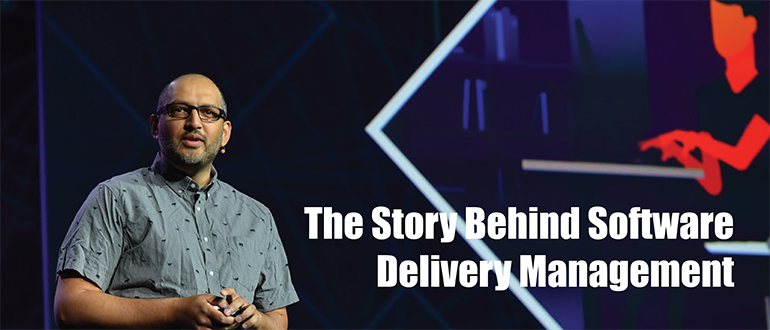
    I know each keynote during a conference is important, but sitting in the audience during DevOps World | Jenkins World 2019 in San Francisco was truly a defining and pivotal moment for our company.  Shawn Ahmed, vice president of product marketing, and the team launched CloudBees into the emerging category of Software Delivery Management. You could feel the excitement in the air. It was tangible.

    In my mind, Shawn’s explanation can be boiled down to one sentence: SDM lets you see what’s going on in your dev cycle, produce better software and deliver it into the hands of users while adding more value to the customers. Of course, it’s an oversimplification because Software Delivery Management relies on four pillars including common data, connected processes, universal insights and all functions collaborating to bring it all together. But if you were to ask a non-developer like me to describe SDM, it’s what I would say.

    What made Software Delivery Management relatable to me, and I suspect many others, was Shawn’s personal backstory of the problem plaguing software development companies today.

    Before SDM

    Indeed, Shawn began the keynote by sharing his personal story of being an engineering manager for a software company who developed applications for financial services.

    These were highly regulated companies under intense pressure to make the digital transformation, but the stakes for getting software right were high, he recalled. Shawn’s company had six months before their investment funds ran out and they needed to increase revenue without increasing their team of 100 developers. Not an easy task, at all.

    Shawn investigated what happened with the development team. His findings? They wasted time each morning sorting through six or seven tools to see what they should work on, and then wondered what happened to the feature they even worked on. It was a black hole. Developers didn’t know when their feature would be released or what was holding it back.

    Shawn also found the operations team had similar frustrations. They were responsible for making sure applications met the clients’ compliance requirements. But the ops team had no context for any particular feature that came through the pipeline. Who wrote the code? Why was the feature developed?

    But it was the engineering managers who finally woke him up, Shawn said. His engineering managers were doing their best to get everyone on the same page, see and eliminate bottlenecks and speed up the development and delivery process. But the hurdle? They were trying to manually collect data from dozens of DevOps tools and it was never current.

    Everyone in the engineering department was operating off different data sets, Shawn explained. Getting a full, birds-eye view of the entire software stream was essentially impossible.

    Seeing the importance of getting the full value of the value stream and working off a set of common data to collaborate more efficiently enabled Shawn to “see” the proverbial light.

    They developed a custom solution to give everyone in the software organization access to real-time, common data, Shawn recalled. Just that one step increased efficiency dramatically. Meetings and calls dropped precipitously. They no longer had to do time-consuming forensic investigations into bugs or bottlenecks, he said.

    Customers were thrilled. The jump in efficiency meant Shawn’s team could take on more projects, increasing revenue. Of course, investors were thrilled, too—and then the company was quickly acquired.

    After the acquisition, Shawn got a call from CloudBees, asking if he’d be willing to help create a new category: Software Delivery Management.

    And that’s how it all began.

    What is Software Delivery Management?

    The goal of Software Delivery Management is to provide a way for companies—from small, 100-developer organizations to developer teams with over 10,000—a way to use common data throughout the entire software organization. This allows for development to become much more efficient so that other stakeholders in other parts of the organization – not only from the development teams but also doc writers, product management, product marketing, customer support, and others can work off the same set of data. Everyone is on the same page.

    Using common data, this leads to better collaboration among the different stakeholders throughout the organization with connected processes. A truly seamless collaboration environment gives everyone universal insights to see what’s going on.

    With Software Delivery Management, organizations have the ability to use one interface to query the entire DevOps toolchain—and everyone in the software organization can run any query and access the same data. Managers can set organization-wide policies and set up alerts or automated actions when policies are broken. There’s also a Recommendations Engine to surface information about common bottlenecks and provide recommendations for how to eliminate them.

    Here’s how it works:

    • One dashboard pulls data from the multitude of tools that teams across the software organization are using, from tools like Jenkins and Jira to observability and monitoring tools. This data is displayed in one place, with context, to give anyone in the software organization visibility into the complete pipeline.

    • The Value Stream View lets engineering managers—or anyone else—see how features move through the lifecycle, from idea to production. This lets you see where features are stuck in the process and easily troubleshoot. Teams can be automatically alerted when their feature is delayed and proactively troubleshoot.
    • The Policy Engine lets organizations set rules for alerts. For example, a team should be alerted if a pull request is waiting more than seven days for a review. Not only are the policies customizable, but teams can also customize what action should be taken when a policy is broken.
    • Developers can immediately see what the top priorities are, with a personalized daily morning brief. Clicking on this morning brief takes developers to a Contributions Dashboard that lets developers easily see how their work fits into the team’s workflow.

    • Developers are also given access before development is started, what the original problem statement is and the original RFE.

    And that’s just the beginning of SDM.

    You can watch Shawn’s full keynote below or head to CloudBees TV. For more information about CloudBees and SDM, sign up for the CloudBees solution for SDM Preview Program.


  • eBook – From Release Anxiety to Release Orchestration

    eBook – From Release Anxiety to Release Orchestration

    From-Release-Anxiety-to-Release-Orchestration

    Release managers carry the weight of a successful digital transformation on their shoulders. However, while their colleagues in Development and Operations get to use and experiment with the latest and greatest tools, Release Managers often must rely on emails, spreadsheets and disconnected project management tools to keep abreast of things. Weekend-long release sessions, early morning update meetings, and last-minute delays leave release managers in a constant state of “release anxiety.”

    This eBook examines common job requirements for release managers and describes how Adaptive Release Orchestration eliminates release anxiety by making releases systematic, predictable and repeatable.

    [su_button url=”https://www.cloudbees.com/resource/ebook/release-anxiety-release-orchestration” target=”blank” background=”#ef2d3f”]Download Now[/su_button]

  • Whitepaper – DevOps Performance: The Importance of Measuring Throughput and Stability

    Whitepaper – DevOps Performance: The Importance of Measuring Throughput and Stability

    DevOps-Performance-The-Importance-of-Measuring-Throughput-and-Stability

    Measuring DevOps performance in any business can be a difficult task. Product and engineering teams often lack insight into their software development value streams to determine how work is flowing, where the blockages appear and how to improve their continuous delivery process. These hurdles can be addressed by knowing what key metrics will guarantee success to ensure optimal performance.

    This whitepaper presents a deep dive into:

    • Why measuring DevOps performance is key to an organization’s successful delivery of software.
    • The analysis of DevOps performance metrics for delivering value stream management insights.
    • How CloudBees DevOptics can provide you with a tool for understanding your DevOps software delivery process in a clear and easy-to-understand manner.

    [su_button url=”https://www.cloudbees.com/resource/whitepaper/devops-performance-importance-measuring-throughput-and-stability” target=”blank” background=”#ef2d3f”]Download Now[/su_button]

  • Value Stream Management: Software Delivery Visibility and Insight

    Value Stream Management: Software Delivery Visibility and Insight

    Overview

    The digital economy has pushed organizations to produce better products faster, leading them to adopt DevOps and continuous integration/continuous delivery (CI/CD) for efficient software delivery. This industry shift impacts all groups within an organization to evaluate and adopt new business practices to meet this growing need and stay competitive in the market.

    Indeed, IT leaders implemented DevOps practices and tools to achieve modern software development, but it’s unclear to them whether there is any return on investment (ROI). Product and engineering leaders struggle with determining how to measure and manage their software delivery capability. The complexity of multiple teams, tools and applications means the whole process can be disconnected and difficult to track. Adding to this challenging scenario, today CIOs are measured on delivering quality software products, with zero defects that engage customers and generate revenue.

    What is value stream management?

    A value stream consists of a series of steps used by an organization to continuously deliver value to customers. Value stream management is a practice that enables the organization to track and manage the flow of value from the ideation stage all the way to customer delivery. Proper value stream management ensures the facets related to end-to-end software development are connected and measured to properly and efficiently move the flow of value related to a product or service to the customer.

    value stream management

    But when we start talking about value stream management, you need to think about value stream mapping as well. Value stream mapping is the exercise of visualizing the process of events that takes a product from idea, to creation, testing, production and finally release to the customer. Mapping the value stream of a product helps you understand how the artifacts and workflow, the dependencies at each stage and identifying the blockages or bottlenecks that result in waste and delay delivering value.

    Why track value streams?

    Managing your value streams lets you focus on delivering value to the customer. To do this, you need to connect multiple teams, tools and applications to gain clear visibility and insight into how the value is flowing through the software delivery process. This means having a platform that scales easily and enables collaboration, while reducing risk, along with accessing real-time metrics on DevOps performance across the teams, and tracking throughput and stability related to product releases. The goal is to deliver quality software at speed that your customers want in order to drive value back to the organization.

    In short, value stream management can help you solve these challenges:

    • Poor visibility across the software delivery process makes it difficult to measure and manage DevOps performance – to identify improvements, leverage best practices and support collaboration across teams.
    • No connection between applications, teams and tools means intensive, error-prone methods of collecting static data for measuring and managing the organization’s continuous delivery capabilities.
    • Difficulty in end-to-end value stream management resulting in lack of information to track flow of value from idea to production, and guesswork on identifying bottlenecks and wait times, leading to increased waste and delays in delivering value.
    • Lack of real-time performance metrics to benchmark and track DevOps performance based on industry standard indicators related to Throughput (Deployment Frequency, Mean Lead Time) and Stability (Mean Time To Recover, Change Failure Rate).

    What does a good value stream management platform look like?

    As your software delivery processes become more complex, you’ll need a value stream management solution that provides one view across the infrastructure, with data and metrics that can be trusted, in order to truly report on how the organization’s DevOps performance is progressing. You should look for the following:

    • A scalable and flexible CI/CD solution that enforces an organization’s governance needs.
    • A solution that easily maps, actively measures and manages your value streams, acting as a single source of truth to analyze and continually improve the flow of value.
    • Real-time performance metrics related to Throughput (Deployment Frequency, Mean Lead Time) and Stability. (Mean Time To Recover, Change Failure Rate).

    CloudBees solution

    The CloudBees suite of CloudBees Core and CloudBees DevOptics makes value stream management easy. The solution provides a CI/CD automation engine with the flexibility to support diverse software portfolios and the unified governance required by growing organizations. Based on Jenkins, CloudBees Core extends Jenkins with functionality that embeds best practices, rapid onboarding, security and compliance. It provides a shared, centrally-managed CI/CD service but delivers a self-service experience for engineering teams.

    By connecting data from across the DevOps toolchain to surface metrics, analytics and actionable insights, CloudBees DevOptics helps you optimize your software delivery process by breaking down silos, detect patterns and identify bottlenecks. It visualizes the software delivery process using key DevOps performance metrics including: Deployment Frequency (DF), Mean Lead Time (MLT), Mean Time To Recover (MTTR) and Change Failure Rate (CFR), to truly understand the velocity and quality of the software being deployed, and where your teams can improve.

    Additional resources

  • Introducing Software Delivery Management

    Introducing Software Delivery Management

    If you were amongst the attendees of our first few CloudBees Days events of 2019, in Madrid April 4, Zurich April 10, or yesterday in Dallas April 16, you witnessed us introducing the world to a new category of software we are inventing here at CloudBees: Software Delivery Management, or SDM (yeah, I know the world needs another TLA – sorry.) Tomorrow at the San Francisco event, we have a big announcement that is key to us realizing this new vision.

    So what is Software Delivery Management, or SDM? Why does the world need it?

    Well, at the most basic level, with “software eating the world,” every company in the world is learning how to be a software company. That means that every company is trying to get better at delivering software. This is a big change for many from the time when software development in most companies was the province of IT as a cost center. This is what “digital transformation” is about. Software development organizations are now the engines of innovation at the companies that have transformed most quickly.

    Digital Natives like Facebook, Netflix, Amazon, Google and the like as well as scores of fast moving startups have pioneered a set of continuous integration, delivery and deployment practices (CI/CD) as well as industrialized agile and DevOps methodologies to deliver new releases to their customers, 1000s of times more frequently, with higher quality, fewer defects and faster time to recover.

    Even software companies like us are learning to be more effective software companies to keep up, and essentially going through our own digital transformations.

    These transformations usually start with adopting CI/CD, agile and DevOps tools, practices and cultures. At CloudBees, as the leading CI/CD vendor to enterprises in the world, with nearly 50% of the Fortune 100 amongst our 1000s of customers, and the corporate sponsor of Jenkins, the dominant CI/CD automation server in the world, we have a front row seat to this mad dash. In the last year, we’ve seen these initiatives move from important to top level urgency at the largest companies in the world.

    But once these transforming companies start seeing faster and better software through these practices, they start to see other problems.

    People outside of engineering have a hard time knowing what’s been deployed. Engineers working on a feature are disconnected from the user and market input that drove product management to prioritize the feature. A feature might be behind a feature flag but customer success doesn’t know what enabling the feature for a customer will do exactly. Roadmaps are increasingly irrelevant so marketing and sales feel like they don’t know what’s coming down the line to make the most of the innovation in the market. Engineering doesn’t know what changes in system performance or user behavior resulted specifically from their latest change. Senior management doesn’t have a trustworthy view of value moving through the system and the business impact of this faster pace of innovation.

    For a new greenfield product built to be buzzword compliant from the start – cloud native, microservices on Kubernetes or serverless, etc. – some of the newer generation cloud native CD tools (like our own Jenkins X) + some of the latest generation observability tools may solve these problems to an extent, and from a developer’s perspective – seeing how their feature flows through to, and performs in, production.

    But that’s not the reality of software development in an organization of any complexity in terms of sheer size, the diversity of software being developed and environments to which it is being delivered, and the range of stakeholders who legitimately care when software is at the center of the business. In our Madrid event this month, I was really struck by how many attendees in roles like head of DevOps transformation talked about the impedance mismatches with other functions of the business once software development becomes truly continuous and agile – this is what I’ve written about before as “Continuous Everything.”

    So Software Delivery Management (SDM) is the new category of software system that we are inventing to solve this problem of getting every function in and beyond the software delivery organization on the same page. On the same page about what’s being or been delivered, why, and its impact. Ensuring that the entire organization can have connected processes on top of a common real time view of the truth. That encompasses the entirety of diverse software product portfolios, from mainframe to microservices, on premise to public cloud, embedded to mobile, and beyond.

    SDM will be for the software development organization what Salesforce.com is for the sales organization, NetSuite is for finance and Workday is for HR.

    Like the best of these systems, it serves all roles and all levels in the organizations that use them. For SDM, our aim is that even developers find that using such a system doesn’t control them, but sets them free by giving them all the context they need to build software that has an impact – and the ability to see that impact in concrete ways. And other roles can interact with software development in a supportive rather than disruptive way. While pointy-haired bosses like me stay out of their way when we can see that things are humming along. Together, everyone in an organization using SDM cooperates fluidly with one another to “Build Stuff that Matters.”

    Watch this space in the coming weeks and months for more detail on what the building blocks of an SDM are, how it will benefit different people in different roles in software organizations, and how we’re using our own internal experiences at CloudBees to inform its design.

    Meanwhile, the foundation of software delivery management as a category and as a practice is CI/CD, and choosing CloudBees for CI/CD today is the best first step on that journey we will hopefully take together.