Category: Blogs

  • Embracing a DevOps Culture, Part 1

    Embracing a DevOps Culture, Part 1

    DevOps is popular right now. So it should come as no surprise that organizations across all industries are eager to embrace the “DevOps culture.” However, unlike ITIL, implementing DevOps into an organization does not happen overnight.

    Compared to companies such as Netflix or Amazon, most organizations do not have thousands of application deployments per day. In fact, it’s usually newer companies that are able to fully embrace DevOps, since all of their business operations rely on IT already.

    DevOps Philosophy > Procedure

    There are many articles out there that try to define DevOps, but DevOps is more of a philosophy than a procedure. If you polled 100 organizations on their experiences implementing a DevOps strategy within their existing business processes, you’d likely get 100 different answers.

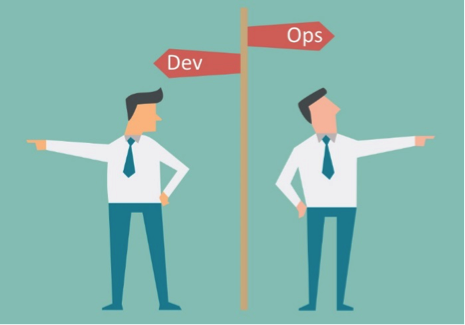
    An organization’s journey toward DevOps is usually unique, since there are so many different factors that influence a DevOps integration. These include the size and age of the company, what industry it’s in (banking/finance, retail, health care, e-commerce, education, public services), how sophisticated its technology is, the nature of its IT (data center or SaaS), organizational structure (siloed or integrated), development methodology (agile or waterfall), the nature of its mission-critical applications (Web 2.0, virtualized, client-server … ) and more. For most companies that exist outside of the startup ecosystem and rely on Web 2.0 and agile application development, Dev and Ops just don’t get along.

    pic01

    Dev vs. Ops

    Trying to collaborate with Dev and Ops can feel like trying to mix oil and vinegar if the goals of each department are not aligned. As a result, IT’s ability to deliver maximum business value is greatly reduced. To efficiently drive the business forward, Dev and Ops must get along.

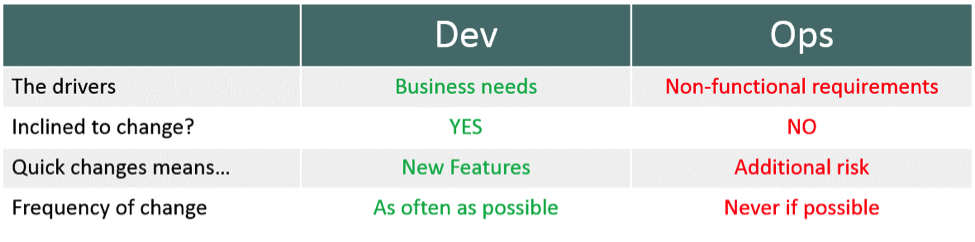
    Most often, the conflict between Dev and Ops is because the focus of one department is at odds with the focus of the other, which creates tension when it comes time to collaborate with one another. While Development is focused on continuously delivering new products and/or features to meet business needs, IT Operations strives to preserve the availability and the stability of IT services and the IT cost-efficiency.

    pic02

    DevOps Can’t Be Limited by Tools

    First, for a seamless collaboration to occur between Dev and Ops, both departments must use compatible tools. Mismatched toolsets create bottlenecks, misunderstanding and miscommunications, which result in so much wasted time that the implementation process ends up hurting the business.

    Next, processes must align; compatible toolsets with conflicting processes are useless. For example, it’s not unusual to find the service desk is using a ticketing system which is separate from the application development tools used to manage product defects and enhancements.

    Developers tend to rely on toolsets that are optimized for rapid development to provide fast feedback on code changes, to automate build creation and for application release deployments. In addition, the Dev team may be unaware of the runtime environment, which makes it difficult to adjust the code accordingly, whereas Operations uses solutions on the target runtime environment, where stability and performance outstrip flexibility requirements.

    Since the integration process is unique to each organization, it’s key to find tools that are the right fit for your new processes and employees. Just because a team uses the latest application release automation tools to consistently drive repeatable deployments of application into production, does not mean they have adopted DevOps.

    In fact, version control, application release automation and application auto-discovery of business transactions are all tools that help developers meet their objectives, but may not address the other portion of the equation: Operations.

    At the end of the day, one of the most important decisions is choosing the right leadership team across your business—from your C-level executive team to the heads of your Dev and Ops teams. The integration process for DevOps can be difficult; to merge two separate departments and processes together to drive collaboration, both the Dev and Ops team need leaders with clear vision of the bigger picture and what’s needed from everyone to drive the company’s forward.

    About the Author/Vincent Geffray

    vinnyVincent Geffray is Senior Director of Product Marketing at Everbridge with focus on IT Service Alerting & Communications Automation and IoT.

    He has more than 14 years of experience in the information technology business, designing, promoting and selling Enterprise IT Operations Management solutions, including Critical Communications, Application Performance Management, IT Process and Workload Automation. He also has international experience, as he started his career in Europe. Vincent holds a Master of Science (Mechanical Engineering and Computer Science) and executive certificates from the MIT – Sloan School of Management.

    Vincent’s LinkedIn: www.linkedin.com/in/vgeffray

    Vincent’s Twitter: @vgeffray

  • It’s Time to Couple Security, Business Leadership

    It’s Time to Couple Security, Business Leadership

    With the RSA Conference next week, the biggest conference of the year when it comes to enterprise security management, now is an ideal time to look at how IT and security leaders keep security efforts aligned with business objectives.

    There’s a reason why attaining adequate and consistent information security is one of the most challenging aspects of technology management today. The business needs to push IT as far as it can to compete. The CIO and business leaders need to provide the applications and access to data to help people be as productive as quickly as they can be, and get the business services and features to market that customers seek. The role of security, however, is to make sure all of this is done in a reasonably and adequately secured fashion.

    This obviously causes a natural friction between the objectives of the business and the needs of the security team.

    When this friction between the business and security isn’t properly managed, a misalignment arises—and it’s costly.

    It means without executive leadership, security efforts can be sidetracked by the business, appropriate budgets aren’t put into place and overall security and governance efforts are weak. And a lack of healthy dialogue between the security leadership and business leadership will leave misconceptions about the level of security in place.

    The Case for Security Leadership

    A few years ago a Global Information Security Survey conducted by CSO online and PricewaterhouseCoopers found that 43 percent of organizations surveyed believed that their organizations where information security “leaders.” However, when screened for common attributes of what might be considered common among information security front-runners, only 5 percent appeared to actually have mature security programs.

    That’s quite a disparity.

    And when we have this much of a disconnect between security and leadership, proactive security investments don’t get funded, there’s no consistent security policy enforced across the organization and executives don’t understand the real types of business technology risks they face.

    Fortunately, that is starting to change. According to PwC’s most recent “Global State of Information Security Survey 2016,” boards are today more involved in security budget, strategy, policy and other aspects of information security management.

    In my interviews with CISOs and CIOs over the years, it’s hard to find anyone who doesn’t agree that security and business alignment requires healthy and open lines of communication. And this is one of the first places nearly everyone recommends enterprises start if they are not aligned.

    Executive leadership is critical when it comes to successfully aligning security and business objectives. This is because information security teams need to make unpopular decisions. They may have to slow down the release of a new service (especially if the only security review came at the end of the development pipeline), require more automated tests or suggest other ways of doing things that may mitigate unnecessary risk.

    But let’s face it, without executive backing, these efforts will get run over by the momentum of the business. Does this mean everything security suggests it should get? Of course not, but that’s where good communication comes in: At least business leaders come to understand how technical risks translate into business risk.

    What is undeniable is that enterprises with security programs that are aligned with their business and the risk appetite of their organization are going to have more successful in their risk management efforts than those who wing these things.

    In an Accenture 2014 report, “The Cyber Security Leap: From Laggard to Leader,” Accenture concluded that “as part of establishing better governance and controls, CISOs should foster a strong working relationship with their boards and create greater visibility into business processes. They need to educate and collaborate to successfully articulate and prioritize business risk, including insider-related risks. The strategy should be continually assessed to evolve with the organization’s posture and get the best use out of resources.” I agree completely. And if more organizations conducted themselves in such a way, there’d be a much smaller gap between security teams and their organization’s board of directors, as well as a tighter separation between security perception and security reality.

  • An Engineering Think Tank to Change the World

    An Engineering Think Tank to Change the World

    In his famous book “Mythical Man Month,” Fred Brooks says, “Techniques proven and routine in other engineering disciplines are considered radical innovations in software engineering.”

    While being very fond of engineering on the big scale, such as building millions of high-end and yet individually configured cars or double-deck aircraft or space ships, for example, I have always asked myself, why the most promising industry—software engineering—is so often not capable of doing engineering on that scale, too? Or, why are so many big enterprise IT projects painful in so many ways?

    With these questions that nobody seemed to be really interested in on my mind, one day I met some higher corporate management, who wondered why the IT department would be so reluctant to follow their lean transformation advice and instead talked about some agile and continuous integration thingy.

    From that moment, I understood that everything necessary to radically upgrade software engineering was already there! The  biggest problem was that we do not communicate enough—and furthermore, there is no holistic view on the complete IT value chain.

    By that I mean we need to create awareness for the value chain, starting with digitized formal models of business processes and written business requirements.

    That was how the following chart came to existence, and I still love it. Apparently, most awesome things happen on the borders of separated knowledge domains; you need just to talk to colleagues from departments you’d never talk to! What if we would mix knowledge from big industry, best available process improvement and quality assurance methodology, and apply all this to how we design, build and deliver software?pic1

    At first I thought I had found a new perspective on DevOps, but now I believe there could be more to it. Well, now the door to the radical innovation is open! Just imagine: What if we would apply the Internet of Things approach to our industry? Maybe we could close the loop of process improvement in software development and test, moving it to real time and running optimization not by ambiguous frameworks but by hard facts coming from virtual sensors, with unprecedented levels of transparency?

    This was how a couple of friends and I came to the idea of our foundation we call SIGSPL (Special Interest Group for Software Production Lines). This public organization is a non-profit think tank, built around three generic domains—Labor Automation, Analysis and Advanced Visualization—which we consider to be the three pillars of the upcoming convergent software engineering in the post DevOps era. pic3

    We are sure this sort of thing inevitably will happen, but our mission is to catalyze these processes to make radical innovation happen intentionally and faster, so we all can build information technology that rocks!

    We are a small team of six with some infrastructure, publications at our blog and a well-established yet growing knowledge base. We would like to reach out to more like-minded people to let this idea grow and change the world. Our plan is to foster further exchange and discussions between DevOps experts and other specialists “unexpected” in this context, such as production lines and supply chain management experts, Six Sigma Black Belts, 3D artists, hackers, venture capitalists and many, many others.

    Our proof that we are not ponding to nowhere is our magic triangle diagram, showing some well-known tools we map to the three generic domains, which are also of high interest for venture capital. Our question to the world is, What would appear in the middle of this triangle in, say, five years?

    pic4


    About the Author/Peter Muryshkin

    1Peter studied M.Sc. in Applied Computer Science and works in management consulting roles focusing on complex analysis and customer satisfaction, including IT Business Analyst and Change Manager. His current scientific research focus is digital transformation applied to the field of software engineering in large distributed organizations.

    LinkedIn: https://de.linkedin.com/in/muryshkin
    Team blog:
    http://sigspl.org/blog/

  • To Be Continuous Podcast: Staging Servers Must Die

    To Be Continuous Podcast: Staging Servers Must Die

    Welcome to To Be Continuous,  a show about continuous delivery and software development hosted by Paul Biggar, founder of CircleCI, and Edith Harbaugh, CEO of LaunchDarkly. In this episode, Edith and Paul discuss a blog post by Edith, in which she asserts that you should kill your staging servers so that continuous delivery can live.

    This podcast is brought to you by Heavybit, a program that helps developer-focused companies take their product to market.

    [soundcloud url=”https://api.soundcloud.com/tracks/248544923?secret_token=s-fUn5T” params=”auto_play=false&hide_related=false&show_comments=true&show_user=true&show_reposts=false&visual=false” width=”100%” height=”166″ iframe=”true” /]


    Paul: So today we’re gonna talk about a post that Edith wrote. The post is about the death of staging servers. Can you give us a little bit of an introduction to what the post is, because I think we’re gonna talk about it quite a bit.

    Edith: Sure Paul, happy to. By the way, did you read it yourself?

    Paul: I confess, I may have skimmed it, a little more than read it.

    Edith: Yeah, so I’ll give you the summary. And then we’ll talk about it. And then you should go read it, and then we’ll talk about it again.

    So the article’s an outgrowth from what I was seeing with LaunchDarkly, my company. So already one of the comments I saw on it is, and I like this comment because they talked about me in the third person. They said, “Harbaugh is biased.”

    Paul: Right, I would say so.

    Edith: But by the way, she does have a good point. So I’ll state upfront, yes, I’m very biased. My company makes a platform to manage feature flags. So my bias, though, is I’ve seen what our customers are doing.

    And it’s the reason I wrote the article, is that this was a national extension to the way I saw our customers using feature flagging.

    Paul: So were your customers using your product wrong, or was there a thing that was happening, that you’re talking about?

    Edith: So feature flagging at it’s most basic is very simple. It’s just an if-then statement. You don’t need LaunchDarkly or any sort of system to manage that, you can just put a conditional in your code. What happens after that is you get more sophisticated. And you wanna have some sort of dashboard where you could see the different feature flags that are visible and uplevel them. Not even just to the business side, but even amongst the various developers.

    You want to have a central place where you can manage. That was kind of our first version, is just you can manage feature flags.

    The next thing that our customers were asking for in our road map was to support for environments. They wanted to be able to have feature flags on dev, QA, staging production, have visibility all in one place.

    Paul: I’m a little confused when you say this, because surely an environment is just a flag?

    Edith: Yes, go on.

    Paul: It seems like you could say, have another flag that is a string, that is like staging or production or Dev or whatever. That you flag features on.

    Edith: And that’s basically what LaunchDarkly is doing, so for us, we just have another flag.

    So each environment gets an API key.

    Paul: So again, forgive ignorance on this, why not use the existing flag?

    What was missing from the existing feature flag infrastructure that meant environments had to be a separate top level, or first class feature?

    Edith: So now we’re getting a little meta. The reason why people liked using LaunchDarkly is because they can get a consolidated view of all their feature flags.

    So that they could not just have these floating around fig file for each machine, but have a roll up of what flags are turned on and off for different environments. And then on top of that the ability to manage the flags in different environments.

    Paul: Got you, so they wanted a view that applied to just their environments?

    Edith: Well, to see per environment what was turned on and off. So basically they were following a software life cycle, where you had dev people working on the developer boxes, pushing a QA, pushing a staging, and then pushing to productions.

    Paul: When features moved from one to the other, was there a human promoting these, or was there an API call promoting these?

    Edith: At this point it’s mainly human. I could see down the line that it would just be an API. And even beyond that … The next thing people ask for, once they got more people on board LaunchDarkly, we’re using more feature flags, is they wanted the ability to have lockdown of different flags in different environments.

    Paul: Lockdown like people can’t change the flags?

    Edith: So they wanted QA to have rights, and QA to change some flags, but not in production.

    Paul: I see, okay yeah.

    Edith: Then after that the natural step then is okay, if you have a feature flag in system where you can control any step, who sees permissions?

    Who gets to see what? Why do you really have a separate QA staging and production box? Why not just collapse all this, and manage visibility with a feature flag itself?

    Paul: Sure. That makes perfect sense.

    All the feature flags provide the primitives on which you can build the things that they want.

    Edith: The point I made in the article is that

    people use the substraction of a QA and a staging environment to basically try to encapsulate a change. So that was the original intent, and at the time it was very good, because the alternative was just to push everything to production to have everything break.

    But if you’re actually doing—

    Paul: If you’re doing feature flags properly, then the concept of really having a staging server doesn’t make that much sense.

    Because you’re not pushing a feature to the staging server, you’re pushing a feature to production and then slow rolling it to people and really having it in the staging server doesn’t make that much sense. Is that kind of the point?

    Edith: Yeah, so that was the title of the article, Kill the Staging Server.

    Paul: This might be a good point to actually stop and read the article.

    Edith: Yeah, I’d appreciate that. Thanks, Paul.

    Paul: We’re gonna take a, what’s gonna appear to be a 10-second break, but it’s actually going to be a five-minute break, while I read the article. I recommend you press pause and read the article yourselves right now.

    Edith:  So welcome back, Paul has been furiously whiteboarding. I’d love to hear his thoughts now.

    Paul: Yeah, so it’s a good article, I really liked it. The first thing that came to mind was the concept of names.

    So the idea of having multiple environments is a weird one in particular. So imagine that you have … Service rented architecture, and it’s got like six machines or something like that, or it’s got 20 machines or whatever. The idea that you can’t spin up a new instance of it is kind of a little bit odd.

    Edith: Yeah.

    Paul: So what people have done historically, and this goes back to when things ran on machines, or particular ports, or whatever, was that everything had a name. It had DNS name or had a staging name.

    And if you look in rails, configuration files, there’s a production name, there’s a staging name, there’s a dev name, there’s different environment variables for all of these. But it doesn’t actually make sense to have a name. Because a name implies there is one of them.

    Edith: Well this goes back, are you going down the whole pets vs. cattle thing?

    Paul: I’m going down the pets vs. cattle thing, yeah. If you’re naming your pets, then you can’t just suddenly get six of them, you can’t suddenly kill them. But what you really want is cattle.

    So a staging server is not, I mean a staging server is a pet. And a very very important pet that everybody loves, and everyone plays with, and it gets a little bit confused as a result of it. And that analogy went—

    Edith: I’m not sure if you’re agreeing with me, or disagreeing with me, so. We’ll continue, it’d be great if you disagreed, but I would also enjoy it if you agreed.

    Paul: If that analogy holds, then what you’re suggesting is that we killed the cherished family pet.

    Edith: Well, you know, sometimes … aw, I can’t even go there.

    Paul: Well the analogy breaks down, but let’s say it’s for the best if that pet spends some time on the farm.

    Edith: Went for a long walk.

    Paul: Right. So obviously production is an actual thing that needs a name, it is a unique environment. But nothing else is really unique environment.

    Edith: Yeah, and to fast forward, I think, I got a lot of feedback on the article, which I loved. That’s kind of why I wrote it, for feedback. I think there are cases where you do want to not go directly from a developer to production.

    I think there are many cases where you want to have other places to test them.

    Paul: I do agree with this, yes.

    Edith: I think a lot of the cases though, of a forced march of we go from this step to this step to this step to production is actually very harmful, when if you just pushed off much quicker and perhaps skipped some of these steps, you’d get the feedback you want directly.

    Paul: So what we did at CircleCI, and initially we had a staging environment. And we would occasionally use the staging environment if we want to test something that wasn’t that easy to write unitests for, or something along those lines. And usually for us that was stuff around LXC, or stuff around starting Amazon boxes.

    Things that you didn’t really do that often, and that either had an expense, or had a weird architectural thing, where you couldn’t just do it in software, and practice it in software. So I think there is that need. Occasionally you’ll have things where it’s not tested well enough, so you need to put it up somewhere where a human validates to the best of their knowledge that it actually works.

    And you can put that in your, I was gonna say you could run it on, but the whole point of the staging server in that situation is that it’s something which isn’t really that easy to put into VMs, or whatever. The other kind of use case that you see is where you don’t want to be running stuff on live production databases, and you can’t get a copy too quickly. So you see people like Haroku trying to build products that avoid the need for that.

    So with Haroku … You can take a copy of a database, you can have a view or a read only view on a database, that’s a copy on the right in some way or whatever. So that you don’t need a separate staging environment, or separate copy or separate staging database or whatever.

    But if everything is well-tested, if everything works in software, then there’s really no need for staging environments. So that says to me that staging environments is a sort of a yellow flag somewhere. It shouldn’t really exist, but sometimes you might need it.

    Edith: I actually want to write a follow up article now, of the staging server is dead, long live the staging server. Because I do think that there are used cases where you don’t want to push to prod. I do however think people—

    Paul: What are these cases where you don’t want to push to prod?

    Edith: So what I heard from Sean Burns, our advisor, is if you’re testing a really deep infrastructure change, for example switching some batch processing.

    Paul: Mm, no, I don’t believe that for a second.

    Edith: Alright.

    Paul: So if you’re testing a really deep infrastructural change, there’s two ways to do that. That deep infrastructural change. One of them is to say, “We’re gonna have these machines over here, we’re gonna have these machines over here.” And that’s the quarterly release cycle thing. We’re taking a big big risk, all hands on deck, whatever.

    The way that you want to be releasing that sort of thing is that you wanna have it in the code base. You wanna have an if statement, a feature flag, that controls how much of the data goes one way or the other, and you duplicate the data, or you put 1 percent of it through.

    Edith: I think the key there is to duplicate or have some fail safe. I mean the biggest risk you run with doing this is data loss, which is awful. If you’re cavalier about how you do this—

    Paul: Well, I don’t think data loss is the worst thing, the worst thing is your whole damn service goes down.

    Edith: Well, the worst thing is your whole service goes down, and you lose a case worth of somebody’s data.

    I think people are actually more forgiving of a five-minute flip than you losing like a lot of their analytics. So his point was he had been at Flurry, was that we cannot afford to lose people’s data.

    Paul: So it would be ludicrous then, in my mind, to create a whole brand new infrastructural thing where you’re gonna do some kind of overnight or immediate change, or wait for downtime change or something. If the data is all live, you can’t afford to have, we’re gonna switch over and see if it works. Regardless of how well it’s tested, like it’s ludicrous.

    Edith: Yeah, so that was, now I’m coming back around to my article. I mean that was the point I was making.

    People think that they are reducing risks by doing all this tested staging.

    Paul: Yeah, in fact they’re increasing risk.

    Edith: Yeah, you would think you’re—

    Paul: Well, the whole point of continuous delivery is that by having a harsh cross over between one thing and another thing, you increase risk even though you think you’re decreasing risk.

    Edith: Yeah, so Ket Beck wrote a really good article, about reversibility. So he’s at Facebook now, but he said everything at Facebook is reversible.

    Paul: Interesting.

    Edith: That this actually makes you much less risky, ’cause you’re like okay we make these risky changes—

    Paul: But they’re reversible, so it’s, right.

    Edith: Yeah, vs. the more cutover. As I called in the article waterfall deployments.

    Paul: I mean I think that’s a really good way of thinking about it. It ties it to a name that everybody knows is bad.

    Edith: Well it was a deliberate—

    Paul: Yeah, good choice. So the agile deployments then, are the ones where it happens seamlessly, and you can go back and forth and change the requirements and whatever else.

    Edith: So that was Sean’s example No. 1, was what if it’s a really risky back and change? He had some good examples from his own career.

    Paul: Did he have any examples that I would agree with?

    Edith: Well a priori without hearing them, I don’t know if you’re going to agree or disagree. Another thing people brought up, was it just seems very risky to people. It seems to increase risk because I think they’re used to thinking of staging server as a safe harbor.

    Paul: I think there’s some semantics around the use of staging server. You very often want to have a complete copy of your environment that you can test against. So is that a staging server, or is that where you type docker up, you know new environment.

    And then you run your testing on this whole brand new infrastructure that has never been touched by anything before?

    Edith: Yeah, and the critique I made in the article, is I think people do that a lot. And they spend a lot of energy testing there, but these are artificial test pieces.

    Thanks for listening to this episode of To Be Continuous, brought to you by Heavybit.

    You can find the full episode of this podcast here. For more on Continuous Delivery and to hear other Heavybit podcasts, copy this link into your favorite podcast player. We’ll have show-specific RSS and iTunes subscription options soon. You can also follow To Be Continuous on Twitter at @continuouscast.
  • How To Maintain Open Source Code Hygiene

    How To Maintain Open Source Code Hygiene

    To maintain good open source code hygiene in the development process, you must first establish what you mean by open source code hygiene, including good and bad hygiene. “By hygiene, we just mean is it appropriate? Is it clean for the intended use?” says Mike Pittenger, VP of Strategy at Black Duck Software.

    Black Duck suggests three metrics it uses to determine whether it is appropriate to apply a given open source code project to a certain development endeavor:

    • For software that will be distributed at large, avoid open source code that the development community has made available through a GPL license.
    • For secure software, check your potential open source code for vulnerabilities in general and make sure to use the most secure version available.
    • Monitor the code periodically to check for new vulnerabilities or other concerns.

    As an example of the third point, Pittenger notes OpenSSL is no longer a viable option because of the vulnerabilities that have come to light in the form of Heartbleed.

    Checking Source Code for Open Source Concerns

    While the InfoSec Institute recommends at least 14 different open source vulnerability scanners for web applications alone, offerings such as Black Duck’s can serve as a shortcut to discovery of known bad open source components. “Instead of having to load Nessus, Metasploit or Nexpose with a Heartbleed rule and scanning every application, every server that they’ve got, they can just go into their Black Duck console, type in OpenSSL, and it would immediately show them every version they used in their software applications,” says Pittenger. Of course, you should always do your own due diligence to determine whether any scanning product is the best choice for your organization and aligns with your needs and requirements.

    Due to the many open source code reuse scenarios active in enterprise DevOps shops, you will want to continually monitor code for newly registered vulnerabilities. Enterprises can view reusing existing assets as a built-in savings by not having to purchase or create new assets. In the case of reusing legacy source code, there is also a time savings, as developers want to shrink time to market for code-based projects.

    “Let’s say you have a company that is pulling information from a database to display in pie charts. You have a rendering component that you will reuse. When you’re starting on a new product, do you build a new rendering library from scratch or do you use the existing one?” asks Pittenger.

    Even if those components are open source, there can be great savings in reusing the library.

    The fact that enterprises do this underlines the importance of continuing to check any code that leverages open source code, as this is how vulnerabilities can spread over time. It’s also important to check open source code, because it may be a form of low-hanging fruit for attackers. Open source code is fully viewable by attackers who build malware and launch attacks, whereas proprietary code is closed.

    Since people constantly discover new vulnerabilities in open source code components that previously had tested free of such holes, it’s important to monitor those components for newly uncovered weaknesses, even as you reuse open software in new projects.

    Containers are a great example. You may want to dismantle an image in varying degrees to build a new application. “If I have a base image and it’s built using a LAMP stack (i.e., a Linux OS, an Apache HTTP server, a MySQL RDBMS and PHP), I can strip down my base image, take away the existing app and take it all the way down to the Linux component, then build it up for the new application,” Pittenger said. “That is a typical, consistent reuse of open source components.”

    During the process, recheck every component for vulnerabilities. Even if everything checks out doesn’t mean you have the best assurance of security for those components going forward. By monitoring those components, you can stay on top of updates to fix any newly discovered security holes.

  • Rugged DevOps: Less Capture the Flag, More Teamwork

    Rugged DevOps: Less Capture the Flag, More Teamwork

    At the recent DEVNEXUS conference in Atlanta, I caught up with Chris Corriere to talk about his experiences in the realm of Rugged DevOps. Chris is a DevOps Engineer at AutoTrader and a contributor here at DevOps.com. During our conversation, we discussed automation, culture and collaboration, and which thought leaders he is following. Chris also shared insights on the upcoming DevOps Days Atlanta conference where he serves on the organizing committee.

    Derek Weeks: What’s your definition of rugged DevOps?

    Corriere: Rugged DevOps to me is definitely manifested in the security sector but it’s a shifting quality and awareness left in doing the best we can with the tools we have, the constraints we’re given, and in the environment we’re in. It’s about being more experimental, understanding that we’re going to encounter failure, and learning to adapt accordingly. We’re very much having to make tough decisions in real time. If you’re running anything in production these days, you need to do that as safely and as consistently as you can.

    Weeks: Is rugged DevOps only about security?

    Corriere: No. Security is really about mitigating risks. I think a lot of this ties into situational awareness about understanding your company’s risk. Is it user data? Is it credit card transactions or do you have a Russian botnet running in your infrastructure that you’re not aware of? What’s the asset you need to protect? Are you trying to protect an asset that is not there?

    You can’t have security come in and become suffocating where it’s not needed. In other situations you can’t leave things wide open that really do need to be protected because you’re more concerned with moving quickly than moving safely.

    https://youtu.be/fgMPKkM1NdY

    At the end of the day when you’re mitigating risk, it doesn’t matter if it’s customer data or a broken build or a bad user experience, these are all risks we need to mitigate. That’s really what rugged DevOps is. It is about is tying that value back to the user. It’s knowing what problems we trying to solve and understanding what we doing effectively (or not). It can be locked down as tight as you please, but if you cannot use the tool to solve the problem you picked it up for, it might as well not be running.

    Weeks: Security teams have been one of the last parts of the organization to come into DevOps practices. What’s been your experience with engaging security teams at Auto Trader?

    Corriere: That’s a good question. I’ve had experience with more than just security teams at Auto Trader. I’ve been involved in security a few places and they’ve approached me first when they found out I was into the DevOps stuff. They often come looking for assistance. They want to know: How do we get this baked in? How do we make this a priority?

    It really ties back into multi-factor authentication. It’s a good way to frame it up where you want developers and operations (those people who aren’t permanently rooted in security) to be aware of these things, to have automated scans, to be aware of cross-site scripting, and to understand how to remediate those kinds of issues.

    We’ve been implementing open source tools earlier in the development lifecycle to give us quicker feedback loops in order to be able to triage these things. Security applauds that but they can’t trust us too much with it. They’ve got to verify that we’re doing a good job with this, right? It’s a give and take where I’ve seen security come and offer automated solutions to DevOps teams and those solutions get adopted. The DevOps teams then take that and really start to run with it. Then security wanted to slow down a little bit because they were concerned about the quality of the vulnerability remediation. There is some back and forth there that has to be anticipated.

    ________________________________

    “We’ve been implementing open source tools earlier in the development lifecycle to give us quicker feedback loops.”

    ________________________________

    For security to trust you you’ve got to trust security to a large extent. If you’re putting more automation into the left side of your process and doing things before they hit production should be making your job easier. One of the side effects of that security may start going through some systems with a finer tooth comb because they’re not doing as much fire fighting. That may result in another ask from security. Understanding that this isn’t a declaration of war—we are simply continuing with an incremental progression toward further improvements. Interactions are cyclic and will happen again.

    We need to help security understand our pipeline, determine what’s going to be a good fit, and keep that communication level high so the trust is there. In these symbiotic relationships, cooperation is dependent on that trust. If that trust goes away you end up in something more competitive.

    There’s always room to drop back to where it’s more commensal and knowing when the kitchen’s gotten too hot. At those times, everybody needs to take a cool down lap and come back to it at the beginning of the next month. It goes back to that situation awareness, knowing where you’re at right now before you try to get to where you’re going.

    Weeks: We talked earlier today about red teams, blue teams, purple teams. What are they and can you describe some of the practices you’ve used to end up with more purple teams?

    Corriere: Yeah. Red teams take an attacking, reactive posture. Red security teams are worried about internal compromise, and when they find gray areas—for example, things that haven’t been fully signed off and authorized—it can result in unplanned work cropping up for the DevOps team. Generally that kind of unplanned work is introduced because the “Red” team felt they were not able to accomplish their job another way.

    Then the blue team side of the equation is really trying to stomp all that out. Blue teams keep things standard and locked down. They make sure everything’s approved in triplicate before it gets implemented, which can be rigid and very frustrating for developers.

    Purple teams allow that experimentation in earlier in the development lifecycle where they’ve got a little bit more leash. They’re allowed to experiment and stand up new things and make those things work before they getting it approved. Again, it’s about being transparent. Teams first want to understand what change was introduced and what the advantages of it are. They may also acknowledge that you need more than one solution to some problems, and that one tool might not fit everybody. If they’re using tools to automate that’s good. We can’t box them all into one necessarily. That’s where you see this go from blue and red to more of a purple. There’s more communication. There’s more conversation. There’s less capture the flag, more teamwork.

    ________________________________

    “There’s more communication. There’s more conversation. There’s less capture the flag, more teamwork.”

    ________________________________

    Weeks: You’ve been involved in the conversations around rugged DevOps for awhile. Who are some of the other thought leaders you learn from?

    Corriere: Jamesha Fisher out of San Francisco is one. She’s done some neat security stuff and is starting to look more into the vulnerabilities around some of the automation tools. Where are those vulnerable and where can they be leveraged against us? Automation is great until it automatically starts doing things we didn’t want. Another aspect of that is really trying to think more like an attacker; we need to think about: how would I break into this thing instead of just thinking how do I protect it.

    Georgia Weidman is popular in a lot of security circles and I’ve missed her workshop once. I’d like to catch it. She’s got a book out on pen testing which covers a lot of operations and concepts from an attack perspective. I would say that can be a fault of some rugged DevOps practices; you’re so quick to get the thing working and provide business value that you don’t realize where you’ve left something vulnerable. Sometimes you’ve got questions about why that thing you work with frequently is always locked down. Perhaps you find you can’t use it the way you want to. At those moments, it’s time to read through Georgia’s book. You’ll get some information as to why that thing is not open the way you want and where someone might use it for reasons might not expect.

    ________________________________

    “You’re so quick to get the thing working to provide business value that you don’t realize where you’ve left something vulnerable.”

    ________________________________

    Weeks: As we wrap up I know you’re on the organizing committee for DevOpsDays Atlanta. Do you want to give us an insight on the dates of when that’s coming up and call for papers, et cetera or we can help you share that?

    Corriere: Our CFP is open through the first of March. Our event is going to be in April. It’s the 26th and 27th which is a Tuesday and Wednesday. Monday, the 25th of April, we have Jeff Sussna coming in to do a full day workshop on continuous design. He’s going to be giving the keynote on our first day. We’re excited to have Jeff in town and excited to have him as a keynote. John Willis is going to be giving our keynote on the second day.

    We’re looking for proposals from anything in progress, people learning in the field, or trying to drop that barrier of entry. We’ve got a lot of bright people in the space. We’ve got a lot of people learning as they go. We need to be more vocal about that learning process and how we find our way through it. There’s not always this instantaneous vision that strikes us. We understand how to convert a shop into continuous delivery every night. There are definitely steps in between that. We need to have more conversations about those step in our industry. Yeah, anywhere in the stack, any interesting projects going on, we’d love to hear from you if you’ve got something.

    If you are interested in learning more about this subject, I invite you to download Amy DeMartine’s Forrester research paper, “The 7 Habits of Rugged DevOps.”

    As Amy notes, “DevOps practices can only increase speed and quality up to a point without security and risk (S&R) pros’ expertise. Old application security practices hinder speedy releases, and security vulnerabilities represent defects that can leave a company open to cyberattacks. But DevOps practitioners can leap forward with both increased speed and quality by including S&R pros in DevOps feedback loops and including security practices in the automated life cycle. These new practices are called Rugged DevOps.”