Category: Blogs

  • Using Generative AI for Issue Remediation and Software Reliability

    Using Generative AI for Issue Remediation and Software Reliability

    In today’s fast-paced digital landscape, keeping your services up and performant, especially for cloud-based and online services, is crucial for staying competitive. Downtime or latency issues can drive customers away, especially when all it takes is a click to switch over to a competing SaaS solution. DevOps and site reliability engineering (SRE) teams face the constant challenge of minimizing mean-time-to-remediation (MTTR) when dealing with errors and issues. As valuable as search engines like Google are, the sheer amount of information available can make finding the right solutions a time-consuming task. What if there was a way to automate and streamline this process, making error investigation more intelligent, focused and efficient?

    This article will walk you through the journey of error resolution from the first obscure log line to identifying the problem hidden within it. We’ll resolve the issue using several tactics, ultimately leading to the use of generative AI to cut MTTR and provide precise IT recommendations. This journey includes useful measures and principles that can be applied by DevOps teams and explores the potential for applying generative AI.

    The Current Experience of DevOps/SRE

    Picture this: A log line pops up with an obscure error message, and the first instinct is to search for this message on Google for potential solutions. After all, someone else must have encountered a similar problem, right? However, the abundance of resources and search results can be overwhelming. The search results are often displayed based on website relevance, not necessarily the relevance of the error itself. Consequently, precious time is wasted sifting through countless search results, leading to a longer time to understand and remediate the error. For DevOps and SRE teams responsible for maintaining system stability, reducing MTTR is a crucial key performance indicator (KPI). This begs the question: How can we leverage automation and artificial intelligence to improve the search process and accelerate error resolution?

    Our First Step: Cognitive Insights

    In our organization’s initial attempt to tackle this challenge, we focused on leveraging crowdsourcing techniques to get more relevant results than the brute-force Google search. Moreover, we wanted to automate the process and run it offline so that when an incident occurs, we can offer useful insights rather than starting the search as the system is down or malfunctioning.

    The approach involves an offline phase and an online phase. The offline phase involved analyzing all our ingested logs and identifying common log patterns. This also allowed us to count how often this pattern occurred in our system and how prevalent it is. Then we crawled relevant technology forums like StackOverflow, Google Groups and Bing Groups for relevant discourse around these log patterns that could offer relevant solutions. The next step was to rank the search results by relevance and take the top five most relevant links.

    The offline phase resulted in a library of known log patterns and, for each one, a cognitive insight containing these links, as well as additional information such as the severity level, how many times this pattern occurred in the logs, the date of first occurrence and additional tags of involved technologies, tools and domains.

    The online phase occurs in real-time as new logs come in. Upon ingesting the log, it is automatically matched against all known patterns; if it matches one, it gets the cognitive insight for that pattern. This means that as soon as the problematic log comes in, the DevOps engineer already has focused and ranked search results and context to start from, which accelerates the investigation process.

    The Next Step: Why Don’t we ask Generative AI?

    After reflecting on our initial approach, we had an epiphany. Large language models (LLMs) like ChatGPT had already crawled the web and absorbed a vast amount of information. So, why not leverage their capabilities and ask them directly for insights? The idea was simple: Let the AI “read the posts” for us and provide us with recommendations. We started by formulating specific questions such as “What could the possible errors be?” and even went a step further by asking for further investigation steps. However, implementing this seemingly straightforward approach came with its own set of challenges. We needed to run preprocessing before asking the generative AI, as well as running post-processing on the answers it returned, to get what we expected. Let’s see what that process entails.

    How we Did It: Analyzing, Sanitizing and Validating

    Before asking ChatGPT (or any other generative AI tool) for assistance, several preparatory steps were necessary. First, we had to analyze incoming logs, identify patterns and score them based on severity. This allowed us to prioritize the most critical issues.

    Secondly, we had to carefully design our prompts for the generative AI using prompt engineering, ensuring that we framed our questions in a way that yielded precise and relevant responses. Prompt engineering is the practice of strategically designing effective prompts or instructions for language models to achieve more accurate responses. It involves carefully specifying the input format, context or constraints to guide the model’s generation process and obtain more accurate and desired results. This is true for any use of generative AI, and for our case in particular. Beyond accuracy, prompt engineering helped us tune the requested format and length of the answer to fit the “executive summary” paragraph we popped up for the user. This ensured it wasn’t too lengthy nor too short to provide meaningful insights.

    Additionally, we took great care in sanitizing the queries and removing any sensitive data to maintain privacy and security. This step was especially crucial for those working with public services, highlighting the importance of protecting users’ personally identifiable information (PII), such as names, emails, phone numbers, IP addresses or GPS coordinates.

    With all this preprocessing done, we sent the prompt to the generative AI. It is important to note that public services may not always be available (as some returned a “service is busy” message when working with ChatGPT and other services), so automation should take care of delays and employ retries as needed.

    Finally, as responses were received from the AI, it was essential to validate those. We ran an analysis and filtered out non-relevant answers from different domains (after all, a log is also a product of a tree, and Kafka is also a novelist), ensuring there was no offensive content or misleading information. The semantic integrity of the responses was also carefully evaluated.

    These AI insights have proven to be a powerful troubleshooting tool, and we’ve made it an integral part of our service.

    This journey is not unique. In fact, DevOps teams can employ similar measures for their own telemetry data to serve their own operational workflows. These principles, such as data sanitization and validation, even apply to other types of data and use cases.

  • Harnessing AI for Automated and Toil-Free SRE

    Harnessing AI for Automated and Toil-Free SRE

    In my recent blog Revolutionizing the Nine Pillars of SRE With AI-Engineered Tools, I indicated that AI can help reduce toil by automating more complex tasks that were previously challenging to automate. Machine learning models can predict system behavior, enabling proactive responses. In this blog, I explain in more detail how AI-engineered tools can be used to improve toil reduction and automation.

    AI Use Cases for Toil Reduction and Automation

    In each of the following use cases, AI not only reduces toil but also contributes to improving system reliability, efficiency and scalability, forming a critical part of modern site reliability engineering (SRE) practices.

    Anomaly Detection and Predictive Maintenance: AI can monitor system logs and operational metrics to detect anomalies, predict system failures and schedule maintenance. This leads to fewer unexpected issues and lower downtime. Tools such as Splunk‘s Machine Learning Toolkit and Elastic’s Machine Learning features can be used for this purpose.

    Automated Testing: AI can be used to automate testing procedures, ensuring code reliability before deployment and reducing the toil of manual testing. Tools like Mabl or Testim use machine learning to create, execute and maintain tests, reducing the need for human intervention.

    Incident Triage and Resolution: AI can analyze incident data, diagnose issues, suggest solutions and, in some cases, automate the resolution process. Tools such as PagerDuty’s Event Intelligence or BigPanda help automate these processes and reduce resolution times.

    Capacity Planning and Resource Allocation: AI can predict system load and adjust resources accordingly to ensure optimal performance and scalability. Dynatrace and Datadog are examples of AI-driven platforms that can provide predictive analytics and capacity planning.

    Proactive Fault Isolation: AI can help isolate faults before they escalate into significant issues, reducing downtime and maintaining system reliability. IBM’s Watson AIOps and Moogsoft’s AIOps platform use AI to quickly isolate and remediate faults.

    Security and Threat Detection: AI can monitor system activity, detect threats and prevent security incidents, reducing the toil of manual monitoring and intervention. Tools like Darktrace and CrowdStrike Falcon use AI for cybersecurity.

    Network Optimization: AI can analyze network traffic and performance data to optimize network configurations and improve system performance. Tools such as Mist (from Juniper Networks) and Cisco’s DNA Center can provide these functionalities.

    Code Review and Technical Debt Management: AI can analyze code changes and identify issues and potential technical debt, providing guidance for incremental code improvements. Tools like DeepCode and CodeClimate can help manage and reduce technical debt.

    Overcoming Challenges

    Organizations must overcome challenges with their people, processes or technologies when transforming SRE practices to using AI tools for toil reduction and automation.

    Lack of Skilled Personnel: AI technologies often require a level of expertise that may not exist within current teams. This lack of skill can be a significant barrier to the successful implementation and usage of AI tools. Invest in training existing staff and consider hiring new team members with the necessary skill sets. There are plenty of resources and courses available online to train your teams on AI tools and technologies.

    Data Quality Issues: AI tools rely on quality data to deliver reliable insights. Data might be unclean, unstructured or siloed across different systems, which can hinder the effectiveness of AI. Implement robust data management and governance practices to ensure your data is clean, structured and accessible. AI tools can also be used to assist in data cleansing and structuring processes.

    Resistance to Change: People can be resistant to new technologies, especially when it comes to something as transformative as AI. This resistance can slow down or even halt the transition to AI-based SRE practices. Develop a strong change management strategy, which could involve regular communication about the benefits and importance of the change, provide training and support and gradually integrate AI tools into existing workflows to allow for a smoother transition.

    Integration with Existing Systems: AI tools need to work in tandem with existing IT systems, tools and processes. Integration issues can prevent AI tools from accessing necessary data or functioning as expected. Plan the integration process carefully, ensuring that the selected AI tools are compatible with your existing systems. Where possible, choose AI solutions that offer flexible APIs and other integration options.

    High Costs: Implementing AI tools can require substantial investment, including purchasing or subscribing to the tools, integrating them into your existing systems and training staff. Calculate the return on investment (ROI) before implementation to understand the potential benefits and savings the AI tools can provide in the long run. Look for scalable solutions that allow you to start small and increase your investment as you see value.

    Compliance and Security Concerns: The use of AI tools, particularly those that leverage cloud computing, may raise concerns about data security and compliance with various regulations. Conduct a thorough risk assessment before implementing any AI tool. Choose vendors that adhere to industry-standard security protocols and offer comprehensive security features. Consider working with a third-party auditor to ensure compliance.

    Summary

    As organizations journey toward greater operational efficiency and reliability through SRE, the transformative potential of AI is becoming increasingly clear. AI-driven tools are revolutionizing various facets of SRE, including toil reduction, automation and defining service-level indicators, objectives and agreements. These innovative technologies can automate complex tasks, predict system behavior, refine performance targets, optimize deployments and aid in effective incident management. For example, AI tools such as Datadog, Dynatrace and New Relic can provide actionable insights into your systems, while others like Nobl9 can use machine learning to define SLOs based on historical performance data.

    However, the road to this AI-infused future is not without its challenges. Teams might grapple with issues such as a lack of skilled personnel, data quality, resistance to change, system integration, high costs and security concerns. Yet, with the right approach, these hurdles can be overcome. By investing in training and hiring skilled personnel, implementing robust data management practices, fostering a culture receptive to change and carefully planning the integration of AI tools, organizations can leverage the power of AI. Calculating ROI before implementation and choosing vendors who adhere to stringent security protocols can further ensure success. The use of AI in SRE represents a powerful convergence of technology and practice that is reshaping the landscape of modern IT operations.

  • Five Great DevOps Job Opportunities

    Five Great DevOps Job Opportunities

    DevOps.com is now providing a weekly DevOps jobs report through which opportunities for DevOps professionals will be highlighted to better serve our audience.

    Our goal in these challenging economic times is to make it easier for DevOps professionals to advance their careers.

    Of course, the pool of available DevOps talent is still relatively constrained, so when one DevOps professional takes on a new role it tends to create an opportunity for others.

    The five job postings shared this week are selected based on the company looking to hire, the vertical industry segment and, naturally, the pay scale being offered.

    We’re also committed to providing additional insights into the state of the DevOps job market. In the meantime, for your consideration:

    Indeed.com

    SAP
    San Francisco, California
    DevOps Engineer
    $141,378 to $162,000

    CareeerBuilder.com

    Citigroup
    Tampa, Florida
    DevOps Lead Engineer
    $110,090 to $165,130

    Dice.com

    Cognizant Technology Solutions
    Seattle, Washington
    xStore DevOps Lead
    $114,365 to $127,538

    LinkedIn

    J.Crew
    New York, New York
    Lead DevOps Engineer
    $108,800 to $136,000

    SimplyHired.com

    Hearst Media Services
    New York, New York
    DevOps Engineer
    $98,900 to $125,000

  • Syslogs in Linux: Understanding Facilities and Levels

    Syslogs in Linux: Understanding Facilities and Levels

    Recently, I found myself in the position of investigating the root cause of a booting failure in an embedded device. To diagnose the problem effectively, I relied on syslogs, which proved to be invaluable. Syslogs, or system logs, are a crucial element of Linux systems, as they capture and retain important data about different events and actions. In this article, we will emphasize the importance of syslogs in Linux and examine the various facilities and levels utilized to classify and prioritize log messages.

    Understanding Facilities

    Facilities in syslogs are used to categorize log messages based on their sources or purposes. They provide a way to differentiate between various components of a Linux system.

    Photo from RFC5424

    Understanding Levels

    Syslog levels indicate the severity or importance of log messages. They help prioritize and filter log entries based on their significance.

    Photo from RFC5424

    An Example

    For easier debugging, you can clear out the syslog before running the user application for investigation and to get fewer lines of logs. To clear out the syslogs, you can either truncate or delete them.

    Remember that clearing syslogs removes log history, so ensure you don’t require the information for troubleshooting, analysis, or compliance purposes before clearing the logs. Additionally, clearing logs may require administrative privileges, so you may need to use the command or run the commands as the root user.

    After clearing the syslog, remember to restart the rsyslog. Otherwise, your application won’t be able to log your user-level messages. Below is an example in Ubuntu on how to truncate, remove and restart the service.

    This is a simple C++ code that generates a log message for the facility user that indicates an informational message.

    In this example, we include the <syslog.h> header file, which provides the necessary functions and constants for syslog logging. The <openlog() function is used to open a connection to the syslog service, specifying a custom identifier (“SyslogSampleApp”) for our application, the logging options (LOG_PID to include process ID), and the facility (LOG_USER for user-level messages).

    We then use the syslog() function to generate log messages of different levels. In this case, we create a user-level message using LOG_INFO. You can adjust the log levels based on your specific needs.

    Finally, we close the syslog connection closelog() to release any resources associated with the syslog service.

    Viewing your syslog depends on the Linux distribution that you’re using. /var/log/syslog is used for Debian and Ubuntu while /var/log/messages is used for Red Hat and CentOS.

    Conclusion

    Syslogs are an integral aspect of Linux systems, serving as a foundation for efficient monitoring, troubleshooting and analysis. They play a crucial role in capturing and organizing log messages across various facilities and levels. This categorization allows for valuable insights into system behavior, promotes effective issue resolution, and contributes to the overall maintenance of system health and security. It is essential to utilize the appropriate log level, such as LOG_INFO, to ensure that the syslog remains uncluttered and focused on the relevant scenario, avoiding the unnecessary inclusion of LOG_ERR entries.

  • Complete Guide to AWS Savings Plans

    Complete Guide to AWS Savings Plans

    AWS Savings Plans are a flexible and cost-effective way to save on your Amazon Web Services (AWS) usage. These plans allow you to commit to a specific amount of compute capacity over a one- or three-year term in exchange for a significant discount on your AWS usage. Savings plans can help you reduce your AWS bill by up to 72%, depending on the type of plan and your level of commitment.

    Why Do You Need AWS Savings Plans?

    With the growing reliance on cloud infrastructure in modern IT, it is crucial for organizations to optimize cloud computing costs without compromising on performance or scalability. AWS Savings Plans address this need by providing a flexible and cost-effective solution that allows you to commit to a certain level of usage at a discounted rate.

    With AWS Savings Plans, by committing to a specific amount of compute capacity over a set time period, you can save up to 72% on your AWS usage. This can result in significant cost savings for your organization, freeing up resources to invest in other business-critical initiatives.

    Another benefit of AWS Savings Plans is the flexibility they offer. Unlike Reserved Instances, which require you to specify instance type, operating system and region, Savings Plans are more flexible and can be applied across different instance types, regions and operating systems. This flexibility makes it easier for you to optimize your cloud computing costs while still meeting your business needs.

    Difference Between AWS Savings Plans and Reserved Instances

    AWS Savings Plans and Reserved Instances are both designed to help you save on your AWS usage, but they offer different levels of flexibility and cost savings.

    Reserved Instances require you to commit to a specific instance type, operating system and region for a one- or three-year term in exchange for a discount on your AWS usage. While this can result in significant cost savings, it also limits your ability to optimize your cloud computing costs based on changing business needs.

    AWS Savings Plans offer a more flexible solution that allows you to commit to a certain level of usage across different instance types, regions and operating systems. Additionally, in most scenarios, Savings Plans can provide a higher level of cost savings compared to Reserved Instances.

    Types of AWS Savings Plans

    There are two types of AWS Savings Plans: Compute Savings Plans and EC2 Instance Savings Plans.

    Compute Savings Plans

    Compute Savings Plans are the most flexible type of Savings Plans, providing a significant discount on your AWS usage across any instance type, region or operating system. This flexibility makes it easy for you to optimize your cloud computing costs based on your changing business needs.

    Compute Savings Plans offer a discount of up to 66% compared to on-demand pricing, depending on the level of commitment you make. They can be used across all AWS services that are powered by Amazon EC2 instances, including Amazon EMR, AWS Lambda and Amazon ECS.

    EC2 Instance Savings Plans

    EC2 Instance Savings Plans are a more specific type of Savings Plan, offering a discount on your AWS usage for a specific instance type within a region. These plans provide a higher level of cost savings compared to Compute Savings Plans, with discounts of up to 72%.

    EC2 Instance Savings Plans are ideal for organizations that have a predictable workload and require specific instance types within a region. However, they offer less flexibility than Compute Savings Plans, as they cannot be applied across different instance types, regions or operating systems.

    AWS Savings Plans Pricing Models

    AWS Savings Plans offer three different payment options to suit your organization’s budget and commitment level: All Upfront, Partial Upfront and No Upfront.

    All Upfront

    With the All Upfront payment option, you pay for the entire term of your Savings Plan upfront, resulting in the highest discount compared to on-demand pricing. This option is ideal for organizations that have the budget available to make a significant upfront payment in exchange for maximum cost savings.

    Partial Upfront

    The Partial Upfront payment option allows you to pay a portion of your Savings Plan upfront and the remaining balance on a monthly basis. This option provides a balance between upfront commitment and ongoing flexibility, with a lower discount compared to the All Upfront option.

    No Upfront

    With the No Upfront payment option, you pay for your Savings Plan on a monthly basis, with no upfront payment required. This option provides the lowest discount compared to on-demand pricing but offers the greatest flexibility for organizations with limited budgets or uncertain future usage requirements.

    How to Monitor and Manage AWS Savings Plans

    Monitoring and managing your AWS Savings Plans, as part of your overall cloud operations strategy, is critical to ensuring that you are optimizing your cloud computing costs and maximizing your savings. AWS provides several tools and services to help you monitor and manage your Savings Plans effectively:

    • AWS Cost Explorer: A powerful tool that allows you to analyze your Savings Plans usage and costs, helping you identify opportunities to optimize your cloud computing costs. With Cost Explorer, you can view your Savings Plans coverage, utilization and savings, as well as forecast your future usage and costs.
    • AWS Budgets: This service allows you to set custom cost and usage budgets for your organization, helping you track your Savings Plans usage and ensure that you are staying within your budget.
    • Savings Plans Recommendations: This feature analyzes your past usage and recommends the optimal Savings Plans for your organization. It can help you make informed decisions about which Savings Plans to purchase and how much commitment to make.

    Conclusion

    AWS Savings Plans are an excellent solution for organizations looking to optimize their cloud computing costs and save on their AWS usage. With their flexibility, cost savings and easy monitoring and management options, AWS Savings Plans are a valuable tool for any organization using AWS services.

    To unlock the full potential of AWS Savings Plans, it’s crucial to understand the different types of plans, their pricing models and how to effectively monitor and manage your usage. By doing so, you can maximize your savings and ensure that your organization is getting the most out of its investment in AWS.

  • AI ‘is Getting Worse’ ¦ AI ‘Will Lose India Jobs’ (Probably Isn’t ¦ Probably Won’t)

    AI ‘is Getting Worse’ ¦ AI ‘Will Lose India Jobs’ (Probably Isn’t ¦ Probably Won’t)

    Welcome to The Long View—where we peruse the news of the week and strip it to the essentials. Let’s work out what really matters.

    This week, a conundrum: On the one hand, researchers say ChatGPT is losing the plot; and on the other, we hear outsourced coding jobs in India will be replaced by AI. (more…)

  • Google Announces Availability of iPaaS Service

    Google Announces Availability of iPaaS Service

    Google today made available an integration platform-as-a-service (iPaaS) capable of invoking a range of methods to integrate applications.

    Initially developed for the Apigee application programming interface (API) management platform Google acquired in 2016, the Application Integration service can now, for example, also consume a publish and subscribe event or an event driven through a Salesforce platform.

    Amit Zavery, vice president and general manager for Google Platform, said the Application Integration service provides IT organizations with all the benefits of an iPaaS without requiring them to stand up and manage an integration platform themselves.

    The Google Application Integration service also provides access to a Visual Integration Designer tool that can be used to build workflows using a low-code tool. In total, there are now more than 75 connectors that can be used to integrate multiple Google Cloud services and third-party platforms that can run in either a cloud or on-premises IT environment, said Zavery.

    In general, visual tools are transforming how integrations are created and expanded within organizations, noted Zavery. Rather than using lower-level procedural code, a visual tool enables developers to employ low-code to create integrations. That makes it simpler to collaborate with business users that can now more easily participate in developing workflows.

    In fact, in some cases, business users, otherwise known as citizen developers, have enough technical acumen to create their own workflows using low-code tools.

    There are, naturally, going to be plenty of complex integration challenges that will require procedural code, but the bulk of the integrations required today are not especially complex.

    Regardless of who creates the integration, the number of them being employed across an enterprise organization continues to increase as more digital business transformation initiatives are launched. Developers are not going to be able to keep pace with the demand for those integrations if they rely solely on procedural code. The only way to effectively reduce the backlog for integrations is to rely more on visual tools to construct them. In most cases, the integration being created is relatively trivial. The only reason it wasn’t created sooner is there are not enough developers available to complete that task using procedural code.

    There are, of course, no shortage of iPaaS options available. As more workloads are deployed in the cloud, Google is betting the center of gravity for integration will shift toward the places where modern microservices-based workloads are deployed to reduce overall latency.

    It’s not clear whether organizations still view integration as an afterthought versus employing an integration platform around which all applications revolve. That latter approach tends to reduce the total cost of integration when compared to using multiple point products that are not managed via single framework, noted Zavery.

    Ultimately, IT teams that adopt an iPaaS are able to focus more on higher-value IT tasks. The issue is determining which integration projects really require professional developers with lots of integration expertise and which, via a low-code tool, can be handled by almost any developer.

  • Postman Acquires Akita Software to Gain API Observability

    Postman Acquires Akita Software to Gain API Observability

    Postman today announced it has acquired Akita Software to gain access to a platform for monitoring and observing application programming interfaces (APIs).

    The first integration of the respective products offered by both companies will arrive in beta this fall.

    Postman CEO Abhinav Asthana said the acquisition of Akita Software will make it much simpler for organizations to discover what APIs are being employed across an enterprise. A recent Postman survey found that 28% of developers are now deploying APIs at least once per week.

    The Akita Software platform will make it simpler for organizations to discover both rogue APIs that have been created by a shadow IT project and zombie APIs that have been inadvertently left exposed long after they are needed.

    Akita Software’s CEO Jean Yang said the integration with Postman’s API management platform will provide a rich source of data that can be used to add artificial intelligence (AI) capabilities to Akita’s API observability platform. For example, generative AI capabilities should make it simpler to create summaries in natural language that explain the calls an API is making to specific data sources.

    In addition, the combined company will be in a better position to enable organizations to better secure their APIs after deployment by surfacing anomalous behavior indicative of an API that is being used to exfiltrate data, she added.

    The merger with Postman will, in effect, enable the combined entity to provide a complete ecosystem for managing APIs, noted Yang.

    Most APIs are used primarily to interconnect internal-facing applications and systems, with a subset used to integrate partners. Only a relatively small percentage of APIs are externally facing in the sense that they expose data to the internet. Many organizations, however, fail to appreciate how quickly an internally facing API can become externally facing over the course of its life cycle. As such, IT teams need tools and platforms that can manage and secure APIs as they evolve.

    As APIs continue to play a crucial role in advancing business goals, there is a clear need for increased visibility as the types of APIs employed also continue to expand. Most APIs in use today are based on the REST format, but there are also APIs based on GraphQL, event-driven architecture and various messaging platforms. None of these newer APIs will supplant REST APIs any time soon. Rather, they are being applied to drive additional processes alongside REST APIs.

    In the longer term, it’s not clear how many APIs will be managed by the developers that created them versus a centralized DevOps team. However, the more APIs that are deployed in a production environment, the less feasible it becomes for developers to manage their life cycle. The challenge is making sure there is some type of structured workflow in place that, at the very least, makes everyone involved in the process aware that a new API has been created and deployed.

  • How Platform Engineering Bridges the IT and DevOps Divide

    How Platform Engineering Bridges the IT and DevOps Divide

    Ballooning lead and process time, with an opaque corollary relationship to fixed and marginal cost, is a significant and complex burden for any enterprise. And multi-cloud complexity and inefficient organizational and technical processes are some of the most wasteful areas companies face–so much so that Synergy Research reports organizations are cutting back on their cloud spend as tech budgets continue to fall under intense scrutiny, resulting in a Q1 2023 cloud spending growth rate of 19% compared to 32% just last year. With cloud cost containment a top priority, Forrester advised tech leaders to demonstrate to CFOs how they will stay on budget and demonstrate ROI at the board level. A key area where companies can eliminate expensive waste and increase time to value is the relationship and workflow between IT and developers, which, while being the DevOps charter for nearly 15 years, has gotten less attention among the viable cost-containment strategies for enterprises in 2023. Revisiting the latest iteration of this DevOps charter through the implementation of platform engineering strategies can help enterprises create a faster, leaner and more scalable dynamic. Let us examine why it’s now time for enterprises to consider platform engineering as a potent way to not only increase efficiency but also to bridge the divide between DevOps and IT.

    The Old Way: Forcing DevOps to Dance to the ITSM Tune

    In traditional enterprise organizations, IT typically dictates a top-down ITSM practice that limits the tools an organization can use for development and deployment; in many cases, it inhibits CI/CD and other core capabilities and practices of DevOps. This awkward attempt to accommodate modern DevOps practice through an aging ITSM paradigm has led to a suboptimal software delivery performance and poor developer experience (DX).

    McKinsey, highlighting the criticality of DX, found developers at a leading SaaS provider spent 20% to 30% of their time integrating different services such as firewall changes, DNS and security access to deliver code through its CI/CD pipeline. That’s a lot of time spent on low-value, repetitive tasks, ensuring a painful journey for a disappointing result. If the DX pain is high enough, developers often go around IT and create resources on their own, leading to shadow IT, adding new cost burdens and growing security exposures. Every minute and engineer count: Five minutes saved per day among 500 developers saves a week’s development time.

    Surely, there is a better way.

    Platform Engineering: Collaboration Through Composition

    Platforming engineering and “platform as a product” have been key to the PaaS ecosystem for years but are now gaining fresh traction in the industry. In Puppet’s State of DevOps Report, 51% of respondents said they had already adopted platform engineering and 93% said it was a step in the right direction. Gartner predicted 80% of software engineering organizations will have platform teams by 2026.

    The concept can be defined in several ways. Gartner reported platform engineering is “an emerging trend intended to modernize enterprise software delivery… designed to support the needs of software developers and others by providing common, reusable tools and capabilities, and interfacing to complex infrastructure.” PlatformEngineering.org’s recent blog post defines it as the discipline of designing and building toolchains and workflows for self-service capabilities in software engineering organizations during the cloud-native era.

    Regardless of definition, platform engineering is the latest iteration of IT centralization, though now attempting to retain all the benefits of distributed team empowerment through “composition” rather than converged control. As modernization continues, we experience the ebb and flow of composition and decomposition, both organizationally and technically. Microservices, Kubernetes, and GitOps patterns pushed the rational limits of decomposition and significantly raised the level of technical complexity in the enterprise. The natural counter pressure is a new cycle of composition that aims to simplify that complexity through platform engineering practices. Teams now look for these toolchains and workflows to be centralized in internal developer platforms (aka IDPs), exposing the development, deployment and maintenance of the entire life cycle of modern, cloud-native applications.

    IDPs can facilitate the flow, speed and innovation DevOps teams are demanding without sacrificing stability, security and control. They enable developers to configure their toolchain while meeting all controls through approved blueprints or “golden paths,” reducing lead and process time. Developers can focus on delivering business value instead of infrastructure tasks.

    Bringing IT and DevOps Back Into Alignment Saves Time, Money and Sanity

    Platform engineering creates a collaborative framework that connects IT and DevOps teams, so they can focus on outcomes rather than methods. Developers can use an IDP to follow conventions that speed up development and prevent anti-pattern creep. Guardrailing choices through golden paths reduce cognitive load and simplify execution context for security teams. The result? Developers can focus on what they were hired for and want to do–creating innovative, transformative applications and differentiated value. Security can sleep well knowing bespoke behavior isn’t opening new attack surface areas.

    On the Day 2 operations side, IDPs enable SRE and support teams to have a fleet-wide view and work effectively with developers to streamline the management of production needs across all applications, clouds and tech stacks.

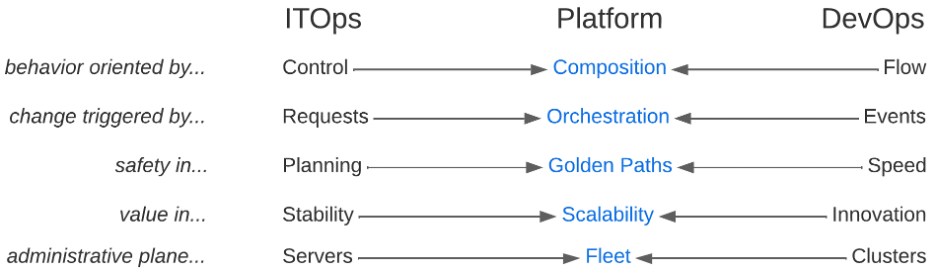
    The reframing of composition breaks the false dichotomies between IT and DevOps practices. You don’t have to choose between control and flow, change isn’t triggered by serial requests or async events, safety isn’t found in planning or speed, value isn’t found in stability or innovation and administrative plane primitives aren’t servers or clusters. Platform engineering practices allow you to prioritize composition, orchestration, golden paths, holistic scalability and fleet management to get teams out of entrenched myopia and embrace systems thinking that gets your business delivering strategic gain instead of tactical win/loss tallies.

    Finally, platform engineering positively impacts software delivery and operational performance metrics by streamlining development processes and reducing manual efforts. The bottom line is faster time to market while ensuring more consistency, less human error and improved software quality. This maximizes productivity, minimizes downtime and optimizes resource utilization, leading to cost advantages and increased efficiency for enterprises.