Category: Blogs

  • Steady On. We Still Have a Job to Do

    Steady On. We Still Have a Job to Do

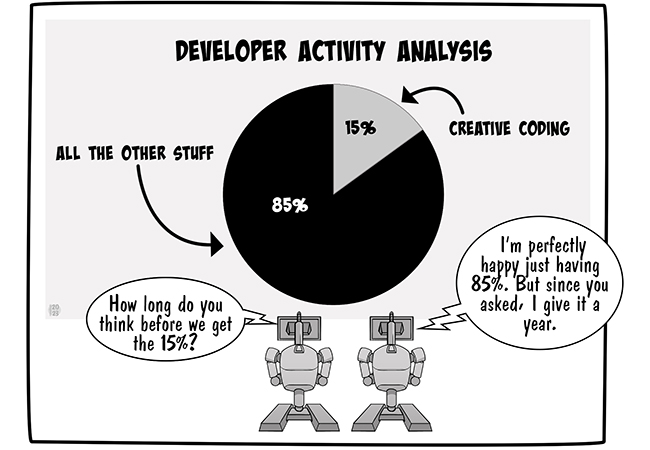
    It is all the rage to talk about how significantly large language models (LLMs) and generative AI will change every niche and corner of IT. And change IT it will. But the hype cycle is at its highest right now, and I’d caution against getting too worked up about it. We’re in for a few interesting years, and the spaces I cover (DevOps and security—with a more application-centric perspective but with ops experience) are definitely going to benefit from the various AI bits being worked in. All testing—including AppSec, but all testing—will benefit both in test generation and results analysis/filtering. In fact, I’ll go ahead and say that the question in testing will no longer be, “How much time to we have to devote to it?” and will rapidly become “How many systems’ resources do we have to dedicate to it?” It will still be a long process—AI isn’t speeding up the cumulative time it takes to run thorough testing (be it functional or security). It will make that the bottleneck though, because test generation will at least be LLM-assisted, and will eventually become completely generative AI-created while at the same time, results will get more and more filtering and analysis. A minor result here plus a minor result there will automatically be detected as an extended vulnerability. There are a ton of other possibilities, but these two seem pretty obvious when I look across the testing technology space. More testing and better results analysis are on the horizon—without requiring more staff. Of course, you can do so much more, which would require the organization to add staff to follow up on results, but that’s nothing new; testing finds issues that are interruptive and take man-hours to fix—we all know of bits in the application portfolio that we should probably fix but that aren’t high enough priority to do so, for example. But fixing is different than finding. I have seen demos in security scanners that offer auto-fix options for developers. Run the test during CI, create a ticket and let the developer see suggested code rework right in the IDE. It is early days for this, but if you look, you can find vendors doing it. And that’s really rather cool.

    But we’ve all heard the “this changes everything” storyline over and over. 4GLs, XML, Java and JavaScript were all going to eliminate developers. In fact, they all created more developers. AI has a better chance of actually removing parts of our workload than any of these technologies did, but we’re still in “watch and wait” mode. It seems obvious that grunt coding will fall to LLMs … And aside from keeping staff trained to manage source, that is a good thing. We use open source, modules and libraries to do much the same thing today. I see this as equivalent to entry-level writing jobs. We’ll have to transform from the current model, but the current entry level development model wasn’t ideal anyway, so lets make a better one. Testing capabilities will be greatly enhanced, but testing of all kinds was so far behind new code generation at most orgs that the impact will be all positive as testing catches up. AI-based test generation today can generate thousands of permutations for a given piece of code, and analyze the results to just have analysts look at the truly disconcerting or confusing test results. And the question will become, “How many servers do we want to dedicate to run this?” Which is different, but just means we have more tests running to make a more solid and/or secure product and environment.

    So, in summary, is change coming? Yes. And that is not significantly different than the last couple decades where change has become IT’s constant companion. For most of you, the way you do your job today is not the same as the way you did it even two years ago. ML/GAI/LLMs are just another iteration. The apps still have to be built, deployed and maintained. So until HAL comes along, keep kicking it. You’re keeping it together, and who knows what the future brings.

  • EP 38: DevOps Building Blocks, Part One: How CI/CD Drives DevOps Automation

    EP 38: DevOps Building Blocks, Part One: How CI/CD Drives DevOps Automation

    Automation is the key to DevOps success, and CI/CD is the driving force behind it. The CI/CD pipeline is a series of automated workflows that help DevOps teams reduce manual tasks, achieve faster feedback, identify and fix issues early in the SDLC and improve the quality of software. However, keeping up with the latest CI/CD best practices and tools can be challenging.

    In this episode, hosts Alan Shimel and Mitch Ashley are joined by Bryan Cole (Tricentis), Adam Arakelian (Dell), Jacqueline Porter (GitLab), Ravi Lachhman (Harness). This panel of DevOps leaders break down everything you need to know about CI/CD workflows to help you get started with your DevOps implementation. Our experts define CI and CD, share tips and tricks on how to build a CI/CD pipeline from scratch and discuss the best practices and key metrics to measure the success of your CI/CD pipeline.

  • Five Great DevOps Job Opportunities

    Five Great DevOps Job Opportunities

    DevOps.com is now providing a weekly DevOps jobs report through which opportunities for DevOps professionals will be highlighted to better serve our audience.

    Our goal in these challenging economic times is to make it easier for DevOps professionals to advance their careers.

    Of course, the pool of available DevOps talent is still relatively constrained, so when one DevOps professional takes on a new role it tends to create an opportunity for others.

    The five job postings shared this week are selected based on the company looking to hire, the vertical industry segment and, naturally, the pay scale being offered.

    We’re also committed to providing additional insights into the state of the DevOps job market. In the meantime, for your consideration:

    LinkedIn

    Icertis
    Phoenix, Arizona
    Principal Azure DevOps Engineer
    $132,000 to $199,000

    SimplyHired.com

    Decision Sciences International
    Remote
    DevOps Engineer
    $130,000+

    Indeed.com

    Hewlett-Packard Enterprise
    Durham, North Carolina
    DevOps Engineer
    $124,500 to $286,300

    CareerBuilder.com

    CACI
    Oklahoma City, Oklahoma
    DevOps Platform Engineer
    $104,200 to $229,200

    Dice.com

    SPECTRUM
    Greenwood Village, Colorado
    DevOps Engineer
    $78,900 to $139,500

  • Internal Developer Platform (IDP) Reference Architectures

    Internal Developer Platform (IDP) Reference Architectures

    If you’ve been following the DevOps space recently, you’ve probably noticed the excitement brewing around platform engineering. Despite uncertainty in other areas of tech, it seems like platform engineering is poised for growth—Gartner even expects that by 2026, 80% of software engineering organizations will have established platform teams.

    The platform engineering idea hinges on an internal tooling system known as an internal developer platform (IDP), which platform teams own and operate and is exposed to developers to improve their efficiency, satisfaction and release fluidity. IDPs have been the talk of the town. But what does an IDP actually look like? What sort of components are they usually composed of?

    Well, at PlatformCon 2023, McKinsey representatives shared a reference architecture for building out IDPs. This framework was modeled after hundreds of internal platforms and could be a helpful benchmark for other organizations as they begin developing and standardizing their internal developer platforms.

    Below, we’ll examine the sample IDP reference architecture and its components. We’ll also have a refresher on the platform engineering concept and offer some expert tips on overcoming potential obstacles while implementing platform engineering and IDPs.

    Why Engineer Internal Platforms, Why Now?

    First, for those new to the idea, let’s explain what platform engineering is. I’ve previously defined platform engineering as “maintaining an internal self-service platform that serves the needs of developer consumers.” The practice doesn’t necessarily supplant DevOps, rather, the experts I’ve spoken to view it as the next evolution.

    This trend is essentially a response to developers overseeing more and more aspects of software life cycle management. Complexity in enterprise-level software delivery workflows has escalated in the last decade, leading to what The State of Platform Engineering Report describes as “increased cognitive load on engineers.” This is negative, as it could lead to shadow operations and burnout.

    The fact is, most developers require the same sort of technologies, which could be standardized across the board. For instance, take the consolidation around containers and Kubernetes, infrastructure-as-code and the need to implement similar build configurations and security policies across applications.

    By outsourcing the maintenance of tools for shipping and running cloud-native applications to a common platform, you take the burden off developers and free them up to code. Also, by centralizing DevOps tooling, you can enforce more governance and build out internal standards. Which should help reusability and overall deployment agility … at least, that’s the promise of it all. 😉

    Sample IDP Reference Architectures

    So, let’s turn to some real-world examples to see how this is being implemented. Mike Gatto, senior DevOps engineer, McKinsey, shared an internal platform reference architecture for AWS-specific environments:

    McKinsey’s Internal Developer Platform reference architecture

    As you can see, the architecture is divided into these subgroups. At a high level, they perform the following functions:

    • Developer control plane: This is the version control, where developers publish their code. They provide a workload specification (in McKinsey’s case, a Score file) that codifies specific configurations.
    • Integration and delivery: This includes the CI pipeline to build application code into a container and publish it to a registry. This notifies the platform orchestrator to initiate a build. Then, resources are provisioned. This area also includes a CD pipeline and infrastructure control plane.
    • Monitoring and logging: This plane includes tools for observability, analytics, and application performance monitoring.
    • Security plane: This area includes tools for secrets management, policies, and security vetting.
    • Resource plane: This plane encompasses cluster management, database tools, networking, and messaging architectures.

    “By separating developer and platform team concerns and allowing them to control the respective areas they’re experienced in separately, without requiring too much overlap,” said Gatto, “we’re making deployments more compliant and better aligned with client initiatives.”

    Humanitec has also created internal developer platform reference architectures for GCP and Azure, displayed below.

    IDP Reference Architecture for GCP
    IDP Reference Architecture for Azure

    PlatformEngineering.org has also expanded McKinsey’s original IDP reference architecture with a tooling landscape that adopts the same umbrella subgroupings but includes other pluggable tools.

    The Internal Developer Platform tooling landscape

    Roadblocks to Developer Platforms

    Starting from a blueprint could be a big help to rapidly construct IDPs. Yet, there will still be some potential roadblocks associated with adopting an internal developer experience platform. One of them is creating common platforms that actually cater well to all environments.

    “You can not and should not try to please everybody,” said Kaspar von Grünberg, CEO and co-founder of Humanitech. “Platform engineering is an 80/20 game.”

    “Platform organizations often face a lot of pressure when it comes to meeting demands for building more services that are both agile and agnostic to cloud and data center environments,” said Venkat Ramakrishnan, VP, product management and engineering, Portworx by Pure Storage. “At the same time, almost all platform engineering teams are understaffed while facing the need to support large application development initiatives and developer teams twice their size.”

    Tips to Get Platform Engineering On Track

    Reference architectures for various clouds could help cater IDPs to different scenarios. But outside of that, it will take a product mindset approach to strategically accept feedback and iterate the platform. This will involve doubling down on developer experience and adopting cloud-native foundations that can scale.

    “Platform engineering teams must consider adopting Kubernetes as it enables them to manage and deploy applications in production at scale, without having to manage applications at the individual level,” added Ramakrishnan. “Additionally, it may not be realistic to expand platform engineering teams alongside growing platforms, so teams should also consider leveraging automation and self-service capabilities to help them better manage projects at scale.”

    Is ‘You Build It, You Run It’ Dead?

    The idea of ‘you build it, you run it’ is starting to look a little antiquated next to the new and shiny platform model. It’s tough to say, but I’ll be keeping an eye on this area to see if all the effort to standardize the internal engineering approach pays off!

  • JFrog’s swampUP 2023: Ready for Next 

    JFrog’s swampUP 2023: Ready for Next 

    In the ever-changing landscape of technology and software development, staying ahead is essential. JFrog has led a pioneering effort to transform DevSecOps since its founding in 2008. Micheline Nijmeh has been chief marketing officer for the past three years, and in that time, she said JFrog has steadily tackled critical issues across the industry.

    “JFrog really started off addressing a pain point, which involved being a software supply chain platform that simplifies the DevSecOps processes by automating the entire software build and release process for large enterprises,” Nijmeh said. 

    On Sept. 13, JFrog will host its marquee event: swampUP. For those anticipating this year’s event, this is more than just a conference. The people heading to San Jose, California, are dedicated to advancing the DevSecOps landscape, and the event is designed to foster a holistic environment for collaboration and learning, Nijmeh said.

    “It really brings everyone together. Whether you’re a DevOps practitioner, security practitioner, as well as leaders and managers, all in one place,” Nijmeh said. 

    Image from swampUP 2022 courtesy of JFrog

    This year’s theme, “Ready for Next,” captures JFrog’s dedication to continuous growth, she added. Nijmeh explained that organizations are always evolving and transforming, and that they need a partner that can grow with them.

    Among the numerous topics that will be discussed at JFrog’s ninth swampUP event is security and DevSecOps, Nijmeh said, adding that “security is top of mind as always.” 

    Several keynote speakers will focus on security, including Bruce Schneier, a security guru and New York Times best-selling author of 14 books.  

    And although security will always be a hot topic, DevOps is expected to generate buzz as well. 

    “We have John Willis, who’s known as the godfather of DevOps. We’re also having folks from Riot Games, Fidelity, Netflix, CapitalOne and others representing their use cases on how they are addressing not just DevOps, but DevSecOps, in some cases,” Nijmeh said. 

    With a star-studded roster of speakers, expectations are sky-high. Furthermore, Nijmeh explained that the show has continued to evolve and has grown to be much more comprehensive. 

    “It’s not just about DevOps, it’s [also] about security. All the way from the left to the right. From development to deployment,” Nijmeh said. 

    For attendees, JFrog has placed focus on actionable insights, as it aims to provide information and tools that can actually be implemented within their organizations right away. SwampUP aims to provide attendees with practical know-how. Although the goal is to be ‘ready for next,’ it’s vital that practitioners and leaders understand what they can do today as well. 

    “Anything that we announce at swampUP will be available to our customers,” Nijmeh said. We’ll be sharing some partner announcements and some new innovations that no one has ever seen before.”

    Image from swampUP 2022 courtesy of JFrog

  • Broadcom Survey Surfaces Drive to Consolidate Automation Platforms

    Broadcom Survey Surfaces Drive to Consolidate Automation Platforms

    Broadcom this week published a global survey of 535 IT leaders that found more than three-quarters (78%) are moving to consolidate cloud automation tools and platforms. However, thus far, only 8% of respondents said they had completed that effort.

    Overall, the survey also found more than 81% already have multiple cloud automation solutions in place, and 70% noted this issue had created significant challenges, including increasing time to automate (59%), time to report (52%) and time to remediation (52%) and higher costs (49%). In addition, 46% noted it’s more difficult to troubleshoot IT environments, while 41% noted multiple tools increase compliance risks.

    IT teams also find that having multiple automation tools slows down software delivery (37%) and contributes to the over-provisioning of IT environments (32%).

    Aline Gerew, head of automation for the Agile Operations Division at Broadcom, said the multiple islands of automation that have evolved on various cloud computing platforms now need to be centralized to reduce the current level of friction in the cloud. Those efforts need to start with platforms capable of unifying observability across all the platforms employed, she added.

    The amount of consolidation that any IT organization can implement depends on the amount of political capital they have. In many cases, the applications and associated automation tools running in any given environment have been adopted by a department or business unit that exercises a lot of autonomy regarding IT. The issue that creates is multiple tools and platforms increase the total cost of IT. At a time when many organizations are experiencing economic headwinds, the need to reduce the total cost of IT naturally becomes a more pressing concern.

    Rather than consolidate automation tools and platforms, the simpler option is to deploy an automation framework that is designed to be integrated with the various tools and platforms that are already in place, noted Gerew. That approach enables automation to be applied at much higher levels of scale to reduce costs without forcing every arm of an organization to standardize on the same tools and platform, she noted.

    The survey found that, when it comes to cloud automation, the most important consideration factors are operational costs (62%), performance (53%) and operational efficiency (49%).

    Responsibility for cloud automation will naturally vary from one organization to the next, but the survey noted that 67% of respondents currently have a cloud architect on staff and another 33% are planning to hire one.

    That role is increasingly required as organizations find themselves managing a wide range of cloud computing environments, including software-as-a-service applications (57%), legacy applications that have been lifted into the cloud (56%), new cloud-native applications (46%) and legacy applications that have been refactored for the cloud (41%).

    It’s apparent that cloud computing environments are becoming more complex with each passing day. There may come a day when artificial intelligence (AI) helps reduce the level of complexity; in the meantime, IT organizations need to find ways to streamline the management of cloud computing environments. Today, those environments are made up of applications based on a wide range of increasingly divergent architectures as the rate of application deployments exceeds the retirement of legacy apps.

  • From DevOps to the Future: The Evolutionary Leap to Platform Engineering

    From DevOps to the Future: The Evolutionary Leap to Platform Engineering

    The paradigm of technology development never ceases to amaze. Over the past few decades, we’ve witnessed an unbroken chain of progress from traditional IT to Agile methodologies, from cloud computing to microservices and now, another leap is on the horizon. Enter the age of the platform engineer, a role that is swiftly emerging as a logical evolution of DevOps culture.

    From the Roots: Understanding DevOps

    DevOps revolutionized the way teams design, build and deliver software. With its advent, we saw the amalgamation of developers and operators into a single team, fostering a culture of collaboration and integration. The core idea was to tear down the traditional silos and ensure seamless interaction between different stakeholders in the development process.

    This unique approach has proven its mettle over time, bringing about shorter development cycles, higher deployment frequency, more dependable releases and quicker resolution of issues. DevOps set the stage for continuous delivery, integration and monitoring, thus speeding up the digital transformation of many organizations.

    The Evolution: Birth of the Platform Engineer

    As we delve further into the era of cloud-native technologies, containers and service meshes, the demands on the DevOps methodology have evolved. To cater to the increasing complexity and scale of modern infrastructures, we witness the emergence of a new breed of professionals, aptly titled platform engineers.

    This role is not just a renaming of the traditional DevOps engineer; it is an evolution. Platform engineers build upon the foundational practices of DevOps but go beyond by embracing a holistic view of the technology stack. They focus on creating platforms that provide a unified, consistent, and efficient environment for development and operations teams to work within.

    Platform Engineering: The Core Components

    Platform engineers possess a skillset that spans software development, infrastructure management, system operations, and, importantly, a deep understanding of the business context. They are entrusted with the design, construction and management of the underlying platforms supporting the deployment and scaling of applications.

    A significant part of the platform engineer’s role involves creating self-service infrastructures that empower teams to deliver software independently and efficiently. This can involve building and managing internal toolchains, maintaining cloud-native infrastructures, designing service observability systems and ensuring high levels of automation across the board. 

    The Future is Here: Embracing Platform Engineering

    The rise of the platform engineer signifies a shift towards more scalability, resilience and efficiency in managing modern tech ecosystems. It’s about leveraging technology to its fullest extent and creating a platform that is more than the sum of its parts. 

    As the technology landscape continues to evolve, the transition from DevOps to platform engineering may soon become the norm. It’s an exciting prospect, promising a future where innovative platforms can seamlessly integrate and orchestrate the complexities of the modern digital world. After all, in this era of rapid digital transformation, those who adapt will thrive. 

    In conclusion, the platform engineer role is not replacing DevOps but evolving from it, extending the principles that made DevOps so successful to meet the challenges and opportunities of the new tech era. As we continue this exciting journey into the future of software development and delivery, there’s no doubt that platform engineering will play an increasingly important role. 

  • Embracing Chaos With AI: Reinventing SRE’s Anti-Fragility Practices

    Embracing Chaos With AI: Reinventing SRE’s Anti-Fragility Practices

    In my recent blog, Revolutionizing the Nine Pillars of SRE with AI-Engineered Tools, I indicated that AI can contribute to the development of more resilient systems by analyzing system behavior under stress and identifying vulnerabilities. In this blog, I explain, in more detail, how AI-engineered tools can improve the SRE anti-fragility pillar of practice.

    AI Use Cases for SRE Anti-Fragility

    Fire Drills: AI can assist in creating more effective and dynamic fire drills by predicting potential failures based on patterns and anomalies in data. Tools like Gremlin and ChaosIQ can be used to design, schedule and manage chaos experiments. However, resistance from team members may be a challenge due to the potential for disruption. To overcome this, it’s important to communicate the benefits and ensure there are safeguards in place to prevent unnecessary disruption.

    Chaos Engineering – Infrastructure: By introducing controlled failures in the infrastructure, AI can learn and identify weaknesses that would not be apparent under normal conditions. Tools like Chaos Monkey and Netflix’s Simian Army can be helpful here. A significant challenge could be to deal with the resulting chaos and anomalies. Adequate training and support are required to ensure the teams can handle the chaos experiments and learn from them.

    Chaos Engineering – Applications: AI can introduce failures at the application level to understand how the system behaves and recovers. Tools like Litmus can help conduct these experiments. Challenges could include resistance from developers and potential impacts on the user experience. Having a well-defined scope and process and conducting these experiments in pre-production environments can help mitigate these risks.

    Chaos Engineering – Security of Production Environments: By simulating attacks and breaches, AI can help understand vulnerabilities in the security architecture. Tools like Game of Hacks and AttackIQ can simulate different types of attacks. The main challenge could be the potential exposure of vulnerabilities, making it essential to have robust security measures in place and conduct these exercises in a controlled environment.

    Identifying Reliability Weaknesses in Production Logs: AI can analyze vast amounts of log data to identify patterns or anomalies that may indicate reliability issues. Tools like Splunk and Logz.io can help here. However, the sheer volume and complexity of log data can pose a challenge. To overcome this, robust data management strategies and powerful AI-driven analytics tools should be deployed.

    Predicting System Failures: AI can analyze system usage and performance data to predict potential system failures before they occur. Tools like Dynatrace and New Relic can be useful in this scenario. A major challenge here is the accuracy of predictions, which can be addressed by training the AI model with quality data and continuously refining it.

    Automated Rollbacks: AI can help in the automated rollback of deployments if chaos experiments or real-time monitoring reveal major issues. Spinnaker is one tool that can help in this aspect. The challenge is to ensure accurate triggers for rollbacks without causing unnecessary disruption. This can be mitigated by proper testing and calibration of the AI system.

    RoadMap for SREs to Transform Incident Response to Using AI

    Here is a practical roadmap for organizations that want to transform to using AI tools for SRE anti-fragility.

    Define Anti-Fragility Goals: Define what you want to achieve with your AI-driven anti-fragility measures. Is it to reduce system downtime, improve security or enhance overall system resilience? Defining these goals upfront will help guide the selection and implementation of AI tools.

    Identify Use Cases: As per the use cases listed above, identify those that are most relevant to your organization and your specific infrastructure and applications. Prioritize them based on your anti-fragility goals.

    Evaluate AI Tools: Assess various AI tools available in the market, such as Gremlin, ChaosIQ, Chaos Monkey, Litmus, Game of Hacks, AttackIQ, Splunk, Logz.io, Dynatrace, New Relic and Spinnaker. Look for those that align best with your defined use cases and overall goals.

    Pilot and Learn: Select one or two tools and use cases to start. Run pilot programs to understand the effectiveness of these tools and to gain valuable insights. This step also includes training your team to use these tools effectively.

    Integrate with SRE Practices: Once you have gained sufficient confidence in the chosen tools, integrate them with your existing SRE practices. Ensure that these tools can interact with your current monitoring, incident management and deployment tools.

    Iterate and Improve: Continually measure the impact of these AI tools on your systems’ anti-fragility. Use this feedback to refine your approach, re-adjust your goals, and explore other use cases or tools.

    Expand Scope: As your team becomes more comfortable with AI tools and chaos engineering practices, you can gradually expand the scope of AI-driven anti-fragility measures across more applications, systems and use cases.

    Summary

    The rising complexity of digital systems and increasing customer expectations necessitate a shift towards a more resilient and adaptive approach to system reliability. SRE’s anti-fragility pillar embraces this challenge, allowing systems not just to resist stress but to thrive under it. The incorporation of AI tools in the realm of anti-fragility brings this dynamic resilience to a new level, enhancing capabilities from conducting fire drills and chaos engineering to identifying reliability weaknesses in production logs. With AI-driven tools like Gremlin, ChaosIQ, and Splunk, SREs can effectively simulate failures, analyze intricate system patterns, and proactively fix potential issues to build stronger, more reliable systems.

    Embarking on a journey to harness AI for anti-fragility is an exciting endeavor that promises profound benefits. An achievable roadmap begins with setting clear goals, selecting relevant use cases, evaluating suitable AI tools, and running pilot programs. The key is to integrate these tools into existing SRE practices gradually and iteratively, continually assessing their impact and refining the approach based on the insights gained. This journey is a continuous process of learning, adapting, and expanding, fostering an environment where systems can thrive amidst chaos and uncertainty. The future of SRE is here, and it’s more robust and resilient than ever.

  • Cisco Aligns With Nutanix on Hybrid Cloud Computing

    Cisco Aligns With Nutanix on Hybrid Cloud Computing

    Cisco and Nutanix this week announced a strategic partnership through which the two companies will collaborate to advance hybrid cloud computing.

    As part of that agreement, Cisco is committing to making AHV virtual machine software from Nutanix available from the edge to the cloud, starting with the Cisco Unified Compute Systems (UCS) rack and, soon after, blade servers.

    Jeremy Foster, senior vice president and general manager of Cisco Compute, said via a software-as-a-service (SaaS) platform, Cisco will be able to centrally manage virtual machines from Nutanix alongside the other major virtual machines it already supports.

    In addition, the partnership will enable Cisco to apply multiple forms of artificial intelligence (AI) across a hybrid cloud computing environment, he added.

    Thomas Cornely, senior vice president of product management for Nutanix, said the goal is to provide IT teams with an opportunity to consolidate infrastructure across a hybrid cloud computing environment. In effect, Nutanix and Cisco are working toward converging the control planes across their entire respective portfolios, he added.

    The goal is to enable IT teams to streamline the number of platforms that need to be supported as part of an effort to reduce the total cost of IT, said Cornely.

    The issue that IT organizations regularly encounter is that each platform requires hiring additional IT personnel to manage. At a time when many organizations are encountering economic headwinds, there is a natural inclination to reduce the number of platforms as the size of the IT staff is reduced. Despite advances in automation, IT labor costs still represent the largest overall segment of any IT budget.

    It’s not clear how aggressively IT teams are consolidating IT infrastructure to reduce costs, but after more than a decade of continuous investments in IT, many organizations are discovering they are supporting a wide range of platforms. During a downturn, however, IT teams tend to more aggressively eliminate “snowflake” platforms that require unique skillsets to manage, noted Cornely.

    In the meantime, IT environments are also becoming more distributed as more workloads move to the network edge. Those workloads are not replacing applications running in on-premises or cloud computing environments, so the overall IT footprint will continue to increase. Given the chronic shortage of IT skills, the only way to effectively manage that IT estate will be to rely more on automation frameworks increasingly infused with AI.

    Each IT organization will need to determine for itself what level of automation to embrace, but Cisco is betting most will opt to rely on a SaaS platform provided by a vendor versus building and maintaining an IT management platform themselves. Regardless, legacy approaches that depend heavily on manual processes will increasingly give way to cloud-based platforms that can more easily manage workloads wherever they happen to be deployed.

    The issue now, as always, is funding the transition to new platforms to bring the total cost of IT back under control and eventually pay for themselves.