Category: Blogs

  • Five Great DevOps Job Opportunities

    Five Great DevOps Job Opportunities

    DevOps.com is now providing a weekly DevOps jobs report through which opportunities for DevOps professionals will be highlighted to better serve our audience.

    Our goal in these challenging economic times is to make it easier for DevOps professionals to advance their careers.

    Of course, the pool of available DevOps talent is still relatively constrained, so when one DevOps professional takes on a new role it tends to create an opportunity for others.

    The five job postings shared this week are selected based on the company looking to hire, the vertical industry segment and, naturally, the pay scale being offered.

    We’re also committed to providing additional insights into the state of the DevOps job market. In the meantime, for your consideration:

    Indeed.com

    Intel
    Chandler, Arizona
    Cloud Software DevOps Engineer
    $156,410 to $250,410

    LinkedIn

    General Dynamics Information Technology
    Remote
    Cloud FinOps Analyst
    $122,336 to $204,360

    CareerBuilder.com

    Infoway Software
    Doral, Florida
    DevOps Lead
    $120,000 to $190,000

    SimplyHired

    Peraton
    Herndon, Virginia
    DevOps Systems Engineer
    $112,000 to $179,000

    Dice.com

    University of Virginia
    Charlottesville, Virginia
    DevOps Developer
    $95,000 to $125,000

  • Building Scalable Cloud Applications With MySQL

    Building Scalable Cloud Applications With MySQL

    Relational database systems such as MySQL have long been the go-to choice for handling large and complex data handling tasks. But, with the introduction of new technologies like NoSQL, many developers started to question whether traditional relational databases still have the upper hand. However, when building high-scalability cloud applications, relational databases like MySQL still have the edge over NoSQL. Here are five reasons MySQL remains superior to NoSQL in supporting developers of high-scale cloud applications.

    1. Enablement of Complex Queries

    Structured query language (SQL) is the most widely adopted language for relational databases, and MySQL is no different. SQL gives developers a powerful platform for creating complex queries and ad hoc reports, efficiently managing large datasets and creating tables and indexes for data optimization. By contrast, NoSQL usually offers only rudimentary query and data manipulation capabilities, often proving inefficient when handling complex data sets. Most data analysts are also familiar with SQL, so it’s a drop-in tool they can use to help gain insights.

    2. Scalability and Reliability

    MySQL is noted for its scalability when handling massive data loads and is particularly well suited to cloud-based applications that require consistently high performance. MySQL ensures that the consistency of data is maintained. MySQL is the go-to option for scalability and reliability for larger cloud applications. Companies such as Facebook, GitHub and WordPress have built billion-dollar businesses on MySQL, and it’s been tested and validated in some of the harshest and most demanding workloads of any database.

    3. High-Performance Replication at Scale

    MySQL replication offers a reliable solution for cloud applications that need to scale. Unlike other databases, MySQL’s replication capabilities provide effective data safety, making it a robust choice for applications that require high availability and durability. Additionally, MySQL enables seamless version upgrades without disrupting operations, ensuring the system always has the latest features and security patches. The read scaling feature of MySQL improves performance by distributing the read load across multiple instances, making it ideal for large-scale cloud applications. With a proven track record at scale, MySQL replication is the optimal choice for applications that want to grow and scale efficiently.

    4. High Availability and Durability

    MySQL provides enhanced high availability and durability, ensuring that critical data is always available even during maintenance and disaster recovery. This is because MySQL is fully ACID-compliant (atomicity, consistency, isolation, durability) and provides full support for transactions. Even when the system fails, the transaction can be rolled back and the data is not lost. With NoSQL databases, data is primarily written in memory and doesn’t provide the same degree of durability or consistency.

    5. Ease of Implementation and Debugging

    MySQL is easy to install, implement and debug compared to NoSQL. MySQL is supported by a large community of developers and database administrators who use it for a diverse range of applications. MySQL is also open-source and free to use, making it a great choice for businesses of all sizes. NoSQL systems require the installation of additional tools, libraries, and other components for implementation, making it more complex and time-consuming.

    MySQL provides many benefits for developers of high-scale cloud applications, ranging from its powerful SQL language for complex querying to its high availability and flexibility for managing multi-table joins. NoSQL remains a viable option in some cases, but developers who are building high-scale cloud applications are mainly sticking with MySQL due to its scalable and reliable nature, easy implementation and flexible query-handling capabilities. Choosing the right database engine is critical for any organization that relies heavily on large and data-heavy applications. MySQL continues to stand the test of time when it comes to ensuring performance and getting consistent results.

  • How Event-Driven Architectures Drive Real-Time Operations

    How Event-Driven Architectures Drive Real-Time Operations

    People, events, the human brain—in fact, the whole world operate in real-time, but businesses have struggled to keep up. With the help of event-driven architecture (EDA) and the Open API economy, businesses can now do the same. The power of an event-driven world means that, after years of geopolitical events affecting how businesses operate, many businesses are starting to uncover real value by truly being able to operate in real-time.

    Whether it be retail and manufacturing or energy and resources and financial services, locating and responding to vital issues within a company’s supply chains or product lines in real-time, is key to success.

    Amazon’s CTO, Dr. Werner Vogels, said that “the world is event driven” in his keynote speech at AWS re:Invent in December 2022. Now, new IDC research unveils that nine out of 10 of the world’s largest companies will deploy real-time intelligence driven by event-streaming technologies by 2025.

    But What’s the Secret Behind Such Success?

    A recent IDC Infobrief, sponsored by Solace, surveyed over 300 enterprise IT professionals in North America, Asia and Europe, all of whom work for large companies implementing or considering EDA. The results are quite telling–an overwhelming 93% of respondents at companies that have deployed EDA across multiple use cases said EDA has either met or exceeded their expectations. In addition to technical advantages from EDA, most businesses also see clear business benefits: A full 23% of respondents reported increasing productivity; 22% said better customer acquisition and 18% saw revenues increase as a result of EDA efforts.

    1. Get Support From the Top to Ensure Alignment Throughout

    Expanding the footprint of EDA across the enterprise is a journey, and every journey starts by assembling those that are critical to its overall success. Business sponsorship and engaging key stakeholders is vital, especially in the early days of EDA adoption – 56% of respondents in the early EDA stages cited this as a priority when ROI and business benefits may not be immediately clear.

    The impact of well-aligned C-suite, operational and technical teams is reflective of business-level digital maturity, too. As 35% of respondents at an advanced stage of EDA rollout felt C-level support was critical, it comes as no surprise that respondents with higher levels of EDA maturity also have higher levels of overall digital maturity, including digital strategy and change management support.

    2. Tackle Complexities Head-On With the Backing of IT

    As EDA becomes more pervasive across an organization, demands on IT become more sophisticated, requiring a deepening of EDA skills in the IT organization, notably with DevOps teams, developers and architects. More than one-third (36.1%) of respondents cited the lack of skills to execute EDA as a hurdle to adoption. Approaches to logging, governance and oversight (30.7%) can also become increasingly challenging and must be thought through carefully.

    This is where EDA providers themselves need to step up and provide adequate training and a certification path for architects DevOps and developers looking to gain the fundamental knowledge and skills to design and implement event-driven systems. This should include technical details such as understanding various design patterns for EDA, microservices choreography versus orchestration, the saga pattern and RESTful microservices. Education should also clearly define and demonstrate key concepts and tools for EDA success, such as event portal, topic hierarchy best practices and event mesh.

    3. The Benchmark for Success Chops and Changes: Businesses Need to Go With the Flow

    The right measures of EDA success in the early days of adoption are not the same measures as EDA adoption grows over time.

    Fewer EDA-mature organizations cited “cost reduction” (23%) and “number of projects completed” (31%) as top measures of success. In the medium term, after two or three use cases, most organizations saw “operational stability” along with “number of projects” to measure success. Further, after broad adoption, “increased revenue” (43%), “operational stability” (32%) and “amount of resiliency” (30%) become more important measures.

    This changing set of measures is reflective of the maturity curve of EDA adoption across multiple applications within a business’s ecosystem. A business is truly operating in real-time when deploying EDA across key customer-facing, employee-facing and supplier-facing organizations. This is where revenue is being generated in high volumes, organization-wide – hence stability and resilience become key to ensuring things continue to run smoothly on what can often be a global scale.

    4. Keep Everyone in the Loop

    It is essential to take the company with you along the entire journey. The research showed the bumps in the roadmap. In the early stages of EDA maturity, lack of understanding of EDA benefits and inconsistent buy-in are the most frequently cited organizational challenges (38%). As organizations progress to a centralized EDA status, cost concerns (42%) and finding the right use cases (36%) can hamper success. More advanced stages of EDA also cite a lack of understanding of EDA benefits (45%), and cost concerns (39%) but change resistance (38%) becomes a major hurdle.

    Continuous focus on change management and communicating business benefits is vital. The core group of invested stakeholders who began the journey must band together to demonstrate the value of EDA clearly and consistently to other areas of the business on a regular basis.

    5. Recognize the Benefits That Partners Bring to the Table

    To accelerate business and technical benefits and reduce the impact of challenges, survey respondents cited “finding a supportive partner to assist with the implementation of EDA” (37.7%) as a critical consideration. Partnerships and product integrations with the providers of preferred business software and SaaS services can make it easy to event-enable an organization. Given the amount of new technical skills and learning previously cited, this can provide peace of mind for organizations taking their first steps on the journey to EDA.

    EDA isn’t just a change in IT architecture, it’s a mindset that applies to modern business leadership organization-wide. To keep the momentum during the journey, respondents also noted the use of a robust change management plan that “ensures coordinated middle management support” (35.1%), as they are typically accountable for getting work delivered and reporting across the organization.

    EDA Becomes the Norm

    The InfoBrief results speak for themselves – EDA is quickly becoming the “normal” process for businesses looking to operate in real-time. As more and more companies recognize the business benefits at stake, understanding these five requirements will be a necessity for successful EDA deployment.

  • Observe Inc. Brings Generative AI to Observability

    Observe Inc. Brings Generative AI to Observability

    Observe, Inc. today revamped the Hubble user interface to its observability platform that has been infused with generative artificial intelligence (AI).

    Fresh from raising an additional $50 million in funding, Observe CEO Jeremy Burton said as the company’s software-as-a-service (SaaS) platform continues to be infused with AI using multiple large language models (LLMs), it’s becoming apparent that observability is rapidly becoming democratized.

    Most IT organizations still rely primarily on legacy monitoring tools to track a set of predefined metrics. Observability platforms have arisen to aggregate metrics, logs and traces to enable DevOps teams to launch queries and surface the root cause of performance issues or IT incidents. The challenge is that most observability platforms have required IT teams to master a proprietary query language such as Observe’s RegEx.

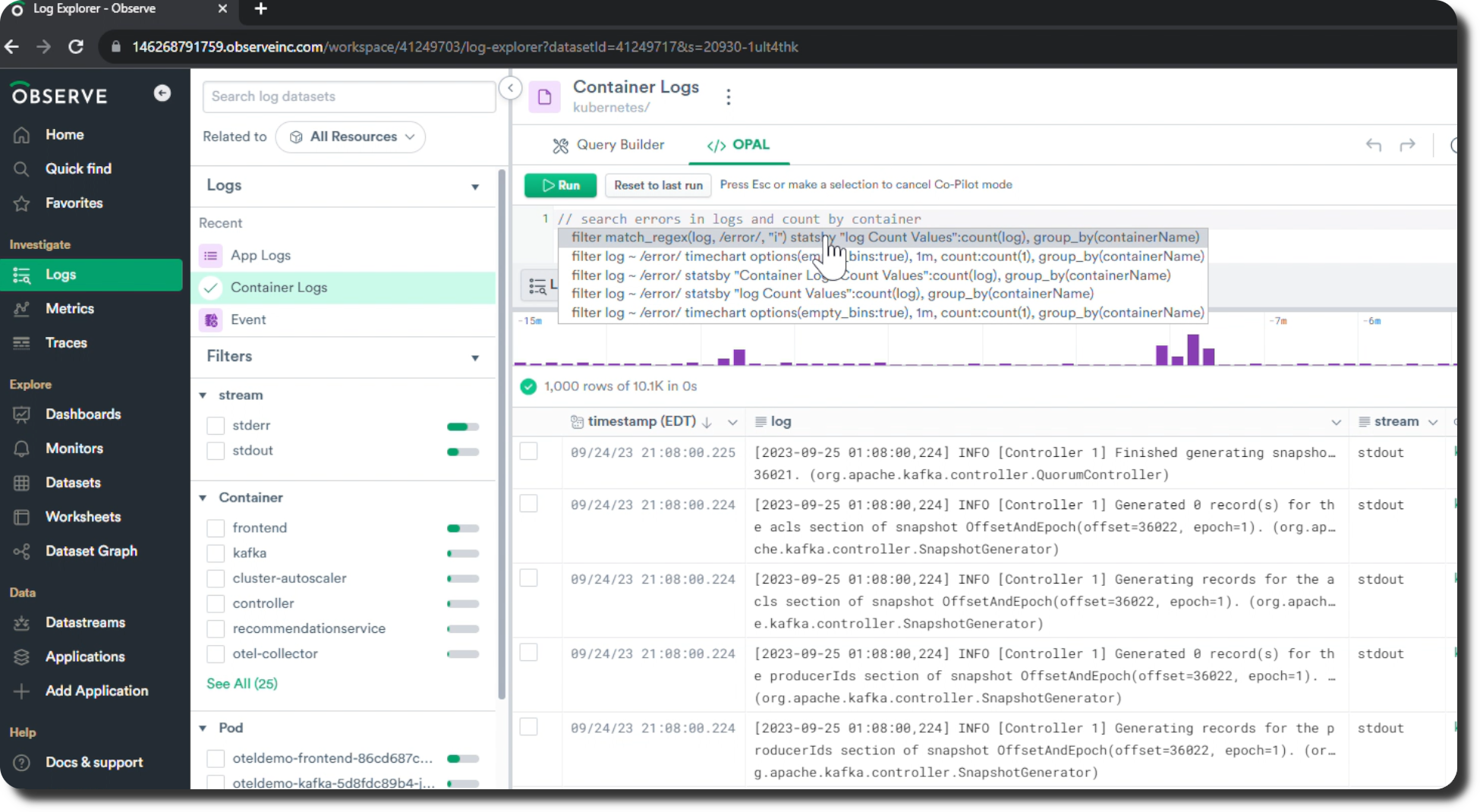
    However, with the rise of generative AI tools, it is now possible for IT professionals of all skill levels to employ a natural language chatbot to generate a RedEx query, noted Burton. A RegEx generation tool also parses data to add structure to logs on-the-fly, and there is also an OPAL Co-Pilot that generates OPAL code in response to natural language inputs.

    Observe

    The Hubble interface furthers those capabilities by simplifying the onboarding experience anytime there is a new member added to an IT team, he added. Hubble also expands the range of data access options available, including a public application programming interface (API), a command line interface (CLI), export to CSV and data sharing to the Snowflake cloud platform.

    IT teams are also coping with an explosion of telemetry data generated by modern distributed applications based on microservices architectures. Legacy observability and monitoring tools were not designed for these data volumes, so when there is an incident, the mean-time-to-resolution (MTTR) is increasingly extended. In contrast, the Observe platform now features a ‘Live’ mode that enables data to be queried in 20 seconds or less from when it was created.

    Other capabilities include an assistant embedded in Slack to help users troubleshoot issues and summarize threads for incident response.

    While it’s still early days as far as the adoption of observability platforms are concerned, there is already no shortage of options. The pending acquisition of Splunk by Cisco next year will cause more organizations to reevaluate their IT management options, so the pace at which organizations are transitioning to cloud-hosted observability platforms should increase, noted Burton. Even after the merger is completed, it might be several more months before Cisco integrates its AppDynamics platform with the observability platforms that Splunk added to its IT operational analytics platform, he added.

    In the meantime, IT environments are only going to become more complex. It won’t be feasible for most IT teams to manage highly distributed computing environments without some help from AI. The challenge, as always, will be finding the budget dollars needed to deploy an observability platform before the number of increased IT incidents makes the need for one painfully obvious.

  • Intermittent Microservice Problem

    Intermittent Microservice Problem

    In a Kubernetes environment, a recent pod scheduling failure occurred due to a specific configuration. Which Kubernetes resource type, often associated with node constraints, might have caused this failure, especially if it wasn’t defined correctly?

    1. NodeSelector
    2. ResourceQuota
    3. PriorityClass
    4. Taint
    5. PodDisruptionBudget

    201 people answered the question. And their answers are reflected in the chart below.

    The wording of this question is deliberately tricky, especially the part about “often associated with node constraints”. The correct answer, therefore, is “Taint”. 46 people, 23% got it right. A very close, very likely, answer is “NodeSelector” but one that is not a “node constraint”. An additional 54,  28%, picked this option. Let’s discuss why “Taint” is the right answer in the context of a pod scheduling failure due to a specific configuration, and why the other choices are not as suitable.

    Taint (Correct Answer):

    Taints in Kubernetes are node-level attributes that can be applied to nodes to affect pod scheduling. When a node is tainted, it essentially broadcasts a constraint to pods that they should not be scheduled on that node unless they have a corresponding “toleration.” Here’s why taints are the correct answer:

    Node Constraints: Taints are directly related to node constraints. They allow you to specify criteria that restrict which pods can run on specific nodes based on attributes like hardware, software, or other node characteristics. This makes them a crucial resource for controlling where certain workloads are placed within the cluster.

    Pod Scheduling: When taints are applied to nodes and pods do not have matching tolerations, they will not be scheduled on those tainted nodes. If a pod is failing to schedule due to a node constraint issue, it’s likely because of taints.

    NodeSelector (Not the Best Choice):

    NodeSelector is a Kubernetes feature that allows you to set node affinity for your pods based on labels assigned to nodes. While it does influence pod scheduling, it is not primarily associated with node constraints set at the node level like taints.

    Node Affinity: NodeSelector is more about node affinity (i.e., preferring nodes with certain labels) rather than constraints. It doesn’t directly prevent pod scheduling but rather guides the scheduler’s preference.

    ResourceQuota (Not Related to Node Constraints):

    ResourceQuotas are Kubernetes objects that limit resource consumption (CPU, memory, etc.) within namespaces. They do not directly influence pod scheduling based on node constraints, making them less relevant to the given scenario.

    Resource Limitation: ResourceQuotas control resource usage within namespaces, but they do not define node-specific constraints or affect where pods can be scheduled within the cluster.

    PriorityClass (Not Related to Node Constraints): PriorityClasses are used to prioritize pods in scheduling order, but they do not define node constraints like taints. They affect the order in which pods are scheduled but do not directly relate to why a pod may fail to schedule due to node-specific constraints.

    Scheduling Priority: PriorityClasses are about setting scheduling priorities, not specifying where pods can or cannot run based on node characteristics.

    PodDisruptionBudget (Not Related to Node Constraints):

    PodDisruptionBudgets are used to control the disruption of pods during voluntary disruptions (e.g., draining a node). They are not associated with node constraints or pod scheduling based on node attributes.

    Disruption Control: PodDisruptionBudgets are for controlling disruptions during node maintenance or other planned events, but they do not deal with node constraints affecting pod scheduling.

    In summary, when debugging a pod scheduling failure due to a specific configuration, especially one related to node constraints, “Taint” is the most appropriate answer because taints directly influence pod scheduling based on node attributes, whereas the other options are not primarily associated with this aspect of Kubernetes resource management.

    DevOps/SRE run into these scenarios all the time. Troubleshooting these scenarios by analyzing each of the above options is time consuming. Coupled with the frequency of their occurrence makes debugging such failures prohibitively expensive unless there is an escalation and this prevents DevOps/SRE to be proactive. It’s the classical example of technical debt on which we never land up making a down payment. The usual answer is “hire more people”. Do you agree with this or have you found a way out of this dilemma? Please send us your thoughts to TheNeoQuiz@webb.ai.