Category: Blogs

  • Chuck Norris doesn’t need DevOps, but have we beat “What is DevOps” to death yet?

    Chuck Norris doesn’t need DevOps, but have we beat “What is DevOps” to death yet?

    Chuck-Norris-Card (1)Some interesting and lots of the usual around the DeOps blog beat last week and over the weekend. An interesting piece by Daniel Bryant on his Tai-Dev Blog on why “Chuck Norris doesn’t do DevOps”. It is actually a video of a presentation he gave at the recent London Java Community event and is the subject of a talk that Bryant has been working on for some time.  You can also see the slides from the show on slideshare here.

    Chuck Norris doesn’t do DevOps because he doesn’t have to. Chuck can do everything and he can do it by himself. He has no need to work with Dev or Ops, he does it all. But for the rest of us, to get something done we have to work as part of a team. As such we need DevOps to help us work better, faster deeper. So until we are all as good as Chuck Norris, we need to keep at it.

    To understand why Chuck Norris doesn’t do DevOps, do we have to also define DevOps?  Hasn’t been there enough good descriptions of what DevOps is?  Usually when you keep seeing people trying to solve the same issue over and over again, it generally means it hasn’t been done satisfactorily to date. Is this the case with a definition of DevOps? You would think so by how “What is DevOps” blog posts we see.

    Vishal Biyani on his blog last week writes exactly that. It is actually part of one of a multi-part series of blog posts that will according to Biyani cover:

    • Getting basics right: What is DevOps anyway? (This post)
    • It’s all about delivering: CI & CD
    • Configuration Chaos :  Managing your infrastructure, as code!
    • Monitor, measure and move: From logs to performance and beyond
    • Putting it all together: Collaborate, communicate and continuously improve
    • Further Reading

    Giving Biyani credit he refers back to Magnus Hedemark at Redhat. The first part explains the basic premise behind DevOps, a brief history and the motive behind the DevOps movement.

    I think this is what we should do more often. Refer back to a well written definition that we can point to with consistency rather than having as many definitions of DevOps as there are stars in the sky. An example is OlinData who back in January wrote a well done “what is DevOps” post.  It is no worse than countless others I have seen.  The issue, how many more people will write their own definition instead of just pointing at OlinData’s or Dev2Ops.com definition or any others.

    As long as we spend so many cycles defining what DevOps is, we are wasting cycles that we could be using on doing DevOps and expanding DevOps knowledge. I think we have beaten the what it is fairly well by now, let’s move on.

    An example of moving on is the “BlueMIx” 100 Days announced by IBM and written about on this IBM blog. I will be writing more about IBM and BlueMix, but suffice to say here, IBM is scheduling 100 workshops around the world to help Developers do DevOps with some pretty cool tools from Big Blue.  It promises to be a great event if you can get to one in your area.

    Another good example of blogs moving DevOps forward is the Ranger4 blog. They had a good post up with the 7 Habits of Highly Effective Continuous Delivery Experts.  Good article that take it to the next level.

    Anyway, that is my report today. For those that notice these things, I will be handling the Cup o’ Joe blog here for a while, as reading blogs is something I do.  You can write me at ashimmy@devops.com if you have something on your blog you want us to mention.


  • DevOps and The Goal

    DevOps and The Goal

    Reading, “The Goal” was a pivotal event in my career.  More than a decade ago a friend of mine who was an operations professor at Georgia Tech told me it was his favorite book.  We were discussing the challenges of getting work done in a corporate environment.  I was grumbling about leading a web dev team in a company that did not embrace the software development discipline.  Already a fan of Tom DeMarco and Timothy Lister’s, “Peopleware”, and being very vocal about the lack of ability to focus whether due to environmental distractions or the constantly changing priorities and schedules, I was receptive to the message in “The Goal”.  It gave me a vocabulary and a roadmap for improving our throughput issues.

    Our throughput problems were a textbook case for development disaster.  When I joined the project, we had three source code repositories, from none of which could we build production and when we did produce a build it would work in pre-production environments but not production (this just slightly predates the widespread acceptance of continuous integration).  We also had the classic inconsistent release cycles that would lengthen based upon insistence by the business owners to include more features.  Looking back, it is not surprising in the least that we were not successful.

    Not surprisingly, these issues led to a lack of trust with the business.  Overcoming the technical problems was straightforward using brute-force tactics.  We addressed the source code problem by recruiting a senior developer and empowering him to make improvements.  We overcame the build quality issue by using a primitive form of agile and enforcing knowledge transfer; the operations engineer sat between two developers during the build and release process and he was the only one allowed touch the keyboard.  Our tactics were basic, and they worked.

    The bigger challenge facing us was getting our business owners to accept a different SDLC model.  We were saddled with a classic waterfall process, each phase being dependent upon the last with a lot of idle time built-in at each phase gate.  The shortcomings of the waterfall process were amplified because the business lacked confidence about when, if ever, they would get a feature released to production. This lack of confidence led to a constant rearranging of the priorities to get the most important feature du jour in the next release.  The constantly changing priorities created even more idle-time and a lot of work-in-progress (WIP) which Goldratt’s Theory of Constraints (TOC) tells us is at the root of inefficiency.

    Using TOC as a guide, we redefined our SDLC from requirements through QA.  We focused on developing a process that de-coupled the phases, reduced idle-time and work-in-progress (WIP).  De-coupling the phases meant the work could queue between each phase allowing the teams, (requirements, development, QA, and operations) to vary independently; they didn’t have to wait on the team before or after to complete their work which reduced idle-time.  We then focused on improving the slowest areas, which seemed to be requirements and deployments.

    We convinced our business owners to trial a monthly release cycle (this was a long time ago, even before continuous integration was widely accepted!).  The monthly release cycle helped give the business confidence that they would see their features in production at an expected pace and it allowed requirements to cycle on schedule independent of development and QA.  Some features would get done in a month and some would span several months.  Over a period of three months we got into a rhythm that worked for about 14 months until organizational focus changed and we focused elsewhere.

    Reading “The Phoenix Project” reminded me about those days and the challenges Goldratt helped us overcome.  I really liked “The Phoenix Project” and many of the situations rang true.  I have since moved from development to operations (twice!) which gives me a unique perspective as I see both sides.  I see DevOps as the embodiment of Goldratt’s ideas in IT; reducing work-in-progress, reducing cycle-time and always focusing on the most constrained processes.  Add a consistent release schedule and it looks a lot like DevOps.  Everyone has their own ideas about what is DevOps and how best to implement, I suggest we follow Goldratt’s advice and focus our efforts where they will have the most benefit.

  • Follow Friday, DevOps Twitter Accounts to Follow

    Follow Friday, DevOps Twitter Accounts to Follow

    twitterdevopsAs part of doing my research for this blog I have been looking around for a good list of DevOps people to follow. I have found a small list here and there, but unlike in the infosec community where we had the @securitytwits, there is no analogue to that in DevOps.

    So with a tip of the hat to Bill Brenner of Akamai (and formerly of CSO.com) I am going to start a new tradition here on devopsy.kinsta.cloud.  We will have our own Follow Friday: DevOps Peeps to follow on Twitter.

    I am starting with a small list that I actually found on a Puppet Labs blog. I will add to this list every week and also start a Twitter list of them.  You are already following most of these folks, but you have to start somewhere.

    If you would like to be added to the list or have a suggestion for the list please leave it in a comment or email me at parker@devops.com.

     @patrickdebois: @RealGeneKim: @botchagalupe: @jezhumble; @garethr; @kartar; @KrisBuytaert; @jordansissel; @agentdero; @allspaw; @monkchips: @DEVOPS_BORAT; @lnxchk: @damonedwards;  @lusis; @obfuscurity; @shanley: @adrianco; @scriptrock; @jumpcloud; @sd_architect; @govictorops @SoftLayer @docker; @chef;

  • Don’t let automation be the tail wagging the dog

    Don’t let automation be the tail wagging the dog

    There is quite a bit of talk right now about DevOps and how important automation is.  This could be compared to GM in the 1980s when the company tried to transform the way they built cars through automation and robot.  In the early 1980’s GM spent $90B dollars in an attempt to speed up the way cars were delivered to the market.  This failed with famous stories of robots painting each other and others welding doors shut.  Ultimately this project failed and the robots were scraped.  It was later reported that the money lost on the project could have been spent to acquire both Toyota and Nissan at the time.

    Automation dominates the conversation when it comes to DevOps.  If you do not learn how to build cookbooks you are not doing DevOps.  I fear this is going to set companies trying to transform IT off on the wrong track, focused on the outcome and not on the scientific process to get there.    Alan Sharp-Paul recently wrote that you cannot automate what you don’t understand.  The best way to understand it is in two key ways, change and performance.

    Let Science set you free

    This was the secret that Toyota used to dominate the automobile industry.  They were able to transform all of their employees into little scientist.  Constantly tinkering to squeeze our inefficiencies in the system.  Every worker was empowered to think how things could be done better.

    At the heart of the agile and DevOps processes is the practical application of the scientific method.  Think back to your 8th grade science fairs.  No not the volcanos but the ones that won best of show.  These had a clear hypothesis that stated what they were going to try and prove.  They were able to understand what they were going to change and measure the difference between the before and after.  They could clearly state what changed and if it was a successful experiment or a failure.

    This thinking is key for companies trying to transform to a DevOps IT organization.  If a company does not understand the experiments that are running and what the outcomes should be then automation will just make the problem worse. That is why change management and performance management are foundational for transforming to a DevOps culture.

    Tracking your experiments

    Any good scientist knows exactly what he is working on.  He knows every experiment that is running anticipating the outcome.  He knows all the details about each change that has been made to see how they impact the outcome.  This is the same way that IT should be tracking every change happening.

    Every change done in IT is a scientific experiment running. Tracking every change allows for understanding of the outcome of changes within the application.  Developers and Operations will be more informed about the cause and effect of their changes.  There are multiple different ways that you can track changes but the key is that you are doing it very well before you start to apply automation.

    Measuring the outcome

    There is no need to track the experiments if there are not being measured.  A scientist is very deliberate in how they measure the outcomes.  Good enough just does not get this done.  This is beyond just monitoring.  Monitoring in a lot of cases is after the fact, in production.  This is about measuring the difference for every experiment regardless of where it is being tests.  This creates the need to test changes all the way to when the first functional tests are done, measuring the changes of every code update.  Following it through all of testing and to production.  Understanding how each experiment impacts the system as a whole.

    Efficiency through automation  

    Once there is good understanding of all the experiments and a standard platform for measuring the outcome then automation starts to return exponential benefit.  Because every experiment it known the lower priority ones can be identified and automated.  Risk is better assessed.  Processes can start to speed up because there is visibility and accountability.  Applications are no longer classified as high risk or low risk only change is classified that way.  Determining what can be automated just becomes another experiment that is tried and measured for success and and failure.  Automation becomes just another outcome of DevOps to the business and not the route to achieve it.

  • Is DevOps a Title?

    Is DevOps a Title?

    So, I’ve wanted to write on this topic for a while as I think it deserves a little attention! I’ve heard numerous times that you shouldn’t have DevOps in your title or that job reqs shouldn’t be “DevOps Engineers”. This came up again at the DevOps State of the Union event that we hosted in Boston recently. There were definitely some very vocal folks saying that it just didn’t make sense to look for a DevOps engineer or hire a DevOps engineer. These folks make the following points:

    –          DevOps is a methodology not a job description – we don’t call our developers Agile engineers, they are just developers. They happen to follow the Agile methodology but they their job description isn’t to do Agile, it’s to create awesome products.

    –          DevOps should permeate an organization – having a DevOps group sort of missed the point of DevOps. DevOps should be embedded into the fabric of the company, not an adjunct to the development process. If it isn’t embedded how can you actually practice DevOps?

    –          DevOps does not equal tools – asking for a DevOps engineer with 5 years of experience in Chef or Puppet is sort of an oxymoron. Very few people have long-term experience with new, up-and-coming toolsets. So asking for that doesn’t make sense and again, it’s a methodology, not a toolset.

    It was an interesting discussion and I’m curious to hear what other people think about this perspective. We see a number of job descriptions and cards that say DevOps engineer on them. I can completely understand why people would do that, but I also understand the criticism of that approach as well.

    Before I sign-off, I’ll weigh in with my thoughts and hopefully we can add some discussion in the comments. As a proponent of DevOps, I’d like to see as many people adopt DevOps as possible. Strategically for businesses, I think it will make a significant difference in their operations. They will move faster, understand customers better, and be more efficient with the resources that they have. If it takes assigning a group or a title to bring DevOps into an organization, I think that they should do it. It’s a way to get started and work at embedding DevOps into their culture. I fully agree with the statements that DevOps isn’t a title or a tool, but I guess I’m practical about it too – some organizations will take different views on how to bring it into their company and have it take hold. In the end, I’m pro-DevOps, so if that’s how you need to make it happen, go for it! My guess is that over time, you’ll end up building DevOps into the fabric of the company and you won’t necessarily think of it as a job description or title, but just as a part of everybody’s job.

    What are your thoughts – is DevOps a title? If so, why? If not, why not? I’m looking forward to hearing your thoughts in the comments!

  • DevOps Board of Advisors and other DevOps blog musings

    DevOps Board of Advisors and other DevOps blog musings

    Well it looks like putting big names on Board of Advisors is having a good week in the DevOps world. Our friend Steve Hall over at ScriptRock announced on their blog yesterday that DevOps luminary, Kevin Behr (@kevinbehr) has joined the company’s board of advisors.  ScriptRock has also been putting some great content up on their blog as well. If you don’t already you should follow it. Also stay tuned for some ScriptRock folks posting here on devopsy.kinsta.cloud.

    dreamteamSpeaking of Board of Advisors, here at devopsy.kinsta.cloud we announced our own Dream Team board yesterday. With Brad Feld, David Cohen, Sean Charnock, Dean Mann, Gene Kim, Rich Mogull and regular devopsy.kinsta.cloud journalists George Hulme, Tony Bradley and Ericka Chickowski, it is a great group that should help a ton with all of the many plans for devopsy.kinsta.cloud. Rajat Bhargava, CEO of JumpCloud is one of the members of the board here and JumpCloud put up a nice post about it too.

    What do you think about boards of advisors? Helpful or not?

    It was a busy day with in other DevOps blog news, but two posts I wanted to call out were:

    1. Back to the future with Old School Devops on the Logentries Blog. First of all you have to love the Motorola beeper.  I remember those, in fact I had one. It is an old chocolate meets peanut butter story where the lead dev happens to be having a beer with the Ops dude. Luckily that is when the crap hits the fan and together they can solve the world’s problems almost. Of course it doesn’t always work like that does it?  I suppose what makes it old school is that today the Dev is the Ops 😉 Either way the point of the article is sometimes simple works is best.

    2. How to measure DevOps success: Ok put on your thinking caps for something really important. Helen Beal over on the AppDynamics blog has a really great article up on measuring your DevOps success. This is an issue we hear about often. How do I know if this DevOps stuff is really working? We have all seen numbers like a 20% productivity spike with DevOps, but how do we really measure it? What do we measure? Do we measure tools, culture, revenue something else?  This is as good a stab at it as I have seen put out there and worth your time.

    What DevOps blogs are your reading? Drop a line and let us know here in comments or at parker@devops.com.

    Also stay tuned tomorrow for our first Frequent Friday list of DevOps people to follow.

  • Can you appreciate DevOps, if you can’t exactly say what it is?

    I recently had a conversation with some SOX IT auditors and was asked what I meant when I said we were a DevOps shop. I stumbled a little, torn somewhere between an overly simplistic answer and a desire to baptize the unholy. I started by talking about collaboration between the developers and the admins. Mentioning that many of our developers are on call and have sudo access raised some eyebrows. Using Puppet made them pretty happy.

    Thinking back on it, what I realize is that for me devops isn’t a strictly defined thing, it’s a mix of operational changes that draw on the best of any tool, without prejudice. We do what works. We do not do what does not work. If we are doing something, and it ceases to work, we stop doing it. I don’t know if that’s devops, but it’s what we do. And it works. So we’re going to keep doing it.

    Configuration as code

    This is not news, central and key to successful devops is controlling system configuration and change management with code, not with disparate manually managed text files. Here’s the thing, you cannot operate at scale without it. You also cannot change direction, or iterate through rapid change without it. You can rapidly, accurately, and verifiably push changes, stand up environments, or demonstrate a fact to an auditor with just a few keystrokes.

    To be sure, it’s a helluva lot easier to start a business on these principles than to migrate after your business is a real thing. However it’s worth the effort.

    Sysadmins are our friends, Developers are on call

    Most places I’ve worked, neither of those statements were strictly true. At Craftsy, both are. The relationship we foster is one of open collaboration. I’ve never been somewhere where the sysadmins were jerks enough to really justify the animosity they received from dev, and I’ve never met a developer so hopelessly irresponsible to really justify the vitriolic mistrust dealt out by the SA team.

    Give your developers sudo and get them in the oncall rotation. Now, they share a burden with your SA group, and a responsibility to the systems their code runs on. Figure out a sensible rotation and escalation, but without that shared responsibility you will always struggle with trust between your dev and your ops.

    SaaS, Paas, IaaS, CotS, Cloud, OnPrem, Whatev

    The punchline is “all of the above”. Never let yourself get married to a particular way of doing things. We run stuff in the cloud. We run stuff locally. We buy software. We rent software. We rent services. We borrow code. We cloud. And whatever comes up next, we’ll try it one way, whichever way seems to make the most sense. If it works, we’ll keep doing it that way.

    I’ve heard some reasonable objections to Cloud/*aaS based on security concerns. Safely extending the trust relationship of your LAN isn’t easy. It isn’t impossible either. Tools like the AWS VPC offering, or SSO/IAM systems offer some very flexible approaches to open your environment and leverage the best tool, regardless of how it’s made available.

    Do what works

    I’m not sure exactly what the SOX guys thought of my ideas around devops. IT, much like accounting, is an area that traditionally is slow to adopt new approaches. It’s a counterintuitive truth that an industry so deeply engaged with technology is simultaneously so awkwardly regimented in its ways. The standard answer, that change has to come slowly to maintain stability is unsatisfying. Indeed, it belies the fundamental failings of the old methods.

    DevOps sets the table for you to achieve stability in any environment precisely by engaging deeply the technology around you.

  • Organizational Dysfunction: The original vulnerability

    Organizational Dysfunction: The original vulnerability

    During your teenage years, you may have figured out a way to get a ‘yes’ from your parents by playing off of the responsibility and knowledge gap between them…walking up to your mom and saying something like, “Hey Mom, Dad said he would drive me, can I go out tonight?” and then proceed to your dad and say something like, “Hey Dad, Mom said I can go out tonight and you need to drive me.” There is nothing cleverer than a determined teenager wanting to get his or her way. Such is the case of targeted attackers and the way they play one IT department’s responsibilities off another. This is the grey area where the organizational chart and separation of duty can introduce weaknesses exploited by the more advanced threats we face today.

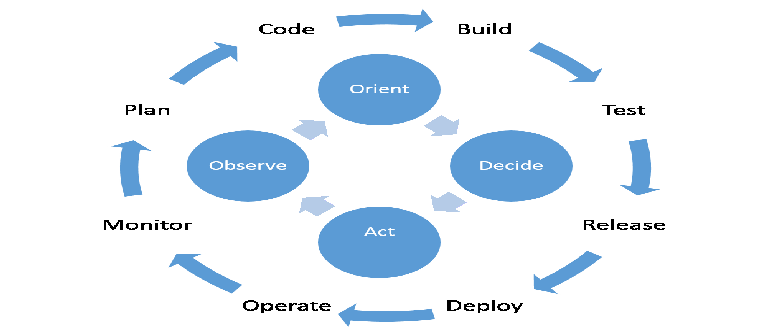
    You don’t have to look far into your organization to see this at work. The security team does its thing, networking engineers do their thing, and IT operations teams in general all have administrative realms that define functional boundaries as to what they can see and do. To borrow from Colonel John Boyd’s OODA loop, each team has its observation and orientation (OO) process for gaining operational visibility and making decisions, as well as specific decisions and actions (DA) they can execute within their administrative realm or set of capabilities to bring change to their organization. The weakness I’m highlighting in this post is when the decision and action appropriate for a set of observations, and the observations themselves, exist in two separate departments and can be exploited by the attacker.

    To exemplify the problem, let’s begin with the question: Is a distributed denial-of-service (DDoS) attack a security or a network engineering issue? The problem I see most often is that one department will have a precise view into network telemetry for early threat detection, but will not yet have the ability to mitigate or remediate the threat.

    Or how about the situation where credentials for one of your executives are harvested, and now the attacker need not trigger any security events at all in order to carry out an attack. In this situation, the attacker merely needs to log in and plan the next stage of the attack, roaming freely and without suspicion across your network because they are only generating networking traffic. The network team does not act because everything is still available, and the security team does not act because there is nothing being denied in access logs, no firewall violations, and nothing triggered on the IDS/IPS.

    Let me be clear in that I am not saying that everyone has to become an expert in everything; specialization is healthy, but only when it does not compromise communication! In the example of Mom and Dad being played by the teenager, if Mom and Dad had a better communication protocol, the teenager’s tactics would be thwarted. If you look at some of your operational procedures, and start to think like an attacker (or teenager again), I’m sure you will find at least half a dozen communication gaps that a clever attacker could exploit.

    This organizational dysfunction is going to require change that may appear to be radical because the systems that support it are so ingrained. Big analyst firms have defined their technology categories as law and they police them as if you were breaking the law if you dare to create something different – something more cross functional. Some best practices out there are, in my opinion, worst practices because they are so focused on the operational effectiveness of the department, and they leave out other departments or the active threat entirely. Lastly, even some prescriptive compliance requirements force organizations into strict separation of duties, but when implemented, create a broken OODA loop where the ‘OO’ does not connect with the ‘DA.’

    There is an opportunity for DevOps to completely recalibrate how we deliver a cross functional operational unit which is why I took the time to write this article for devopsy.kinsta.cloud.  Through the lens of Boyd’s OODA loop, you can already see the security ramifications because the tempo of DevOps allows the defense to loop at a faster rate than the adversary – the dominant strategy of the OODA Loop.

    I hope this post is a call to action for all you big thinkers. Get creative, get innovative, and do not be afraid to erase some lines and boundaries within your IT organization if it fosters a higher level of communication amongst your teams. Think of your organization like a great band playing live music. All of the performers play different instruments, yet they are listening to one another just as hard if not harder than they are producing sound. They improvise and adapt to one another; monitoring systems are put in place so they can have just enough of each sound in their own ear. This is what effective, cross-functional teams look like.  I’m just going to say it: DevOps is Rock and Roll!

    Oh, and hey, follow me on twitter: @tkeanini

  • Closing the Deltas Between Development and Production

    Who hasn’t heard the classic statements “It works on my machine!” or, “Man that would have been easier with real data!”?  In either case, had the development happened in production, problems would have been avoided!  Fortunately, in a DevOps world, the walls between production and non-production get broken down making the reality of developing and testing in production more tangible.  In no particular order, here are some of the things I’ve done to breakdown those walls.

    Develop on and deploy from a single code line.

    Many times we find ourselves in complex processes around deployments and production bug fixes.  For example, the code is branched for release candidates and deployments are done from the branches.  Branching before release by itself isn’t complicated, however, when there is a production bug, engineers find themselves repeating or merging the fix into at least two, if not several, different places.  Repeat that a few times over and, uh oh, now there is a problem because there are many moving parts and questions about what exactly is in production.  Unfortunately, the differences are most likely unintentional.

    Instead, simplify the process and have everyone work off the same code line and have that same code line deployed directly to production.  Now there is only one code base, therefore no question about what code is running in production.  Production isn’t static, so change will still happen after deployment.   Notation is required indicating what version was deployed, so you can still reproduce production.

     Let testing happen on the production database.

    Ok, even I’m not that crazy, but let developers use a copy of the production database.  There are two very important aspects to this.  First, refresh it often.  I suggest daily.  I have had very good luck using EBS snapshots to get a copy of the database on a different server, but if your database is small, good old SQL dumps also will work.  Second, make it safe.  Put some safe guards in place to make sure a change doesn’t accidently get made to the real production database.  Keep your ACLs tight, change the passwords and practice proper database user management.  Lastly, a bonus outcome is that you are constantly testing your database backups and recovery procedures.

    Minimize the steps between development and production.

    Each step, especially the manual ones, between the developer’s machine and production is another point where unexpected changes can be introduced.  It sounds obvious, but the gates code must pass through before entering production must be purposeful and prove their usefulness.  For example, if code must go through a regression, but no regressions are being found, then that step is not useful and just increases the probability of unintended change.  I have been a part of a process where code had to be deployed to “staging” where it was then hooked up to the live production database, but was only to be exercised in a read-only manner.  After doing that for many, many releases and very rarely finding defects before production, we decided to just get better at deploying to production and eliminated the deployment to staging.  In the end, we got faster and with no impacts to quality.  Less can be more.

    Depending on your situation, database size, regulatory compliance, etc. you might to be able to do all of them, but breaking down those walls will yield better code, fewer bugs, happier engineers and fewer sleepless nights to name a few.  So, grab that wrecking ball and break down a few walls.

  • PEBKAC Avoidance

    PEBKAC Avoidance

    We’ve all said it. We’ve all done it. We’ve all shook our heads at it. PEBKAC. Problem exists between keyboard and chair.

    User error.

    While generally applied to the end-user community – those folks who are considered technical neophytes by IT professionals – it can and should also be applied to those of us who have, at least once (admit it, come on, I know you’ve done it) fat fingered a configuration on a web server, a switch, a router, or some other network or application service.

    It’s okay. We’ve all been there – head down on the keyboard, a litany of words we wouldn’t use in front of our mothers streaming from our lips between enumerations of how long we’ve sat at our desk looking for the problem. Mine was a misconfiguration of route metrics in the now long gone Network Computing lab that sent traffic from one side of the lab over a simulated T1 and back over the 100 Mbps link. When you’re trying to simulate a WAN environment and put WAN optimization solutions on either end, this is highly problematic and tends to, well, not work. Not work at all. If it wasn’t for the astute observation of my lab partner,  I’d probably still be at my desk hunting for the problem.

    The point is, we’ve all had our PEBKAC moments. We know they happen, and avoiding them is a very real goal of devops in general. We want consistent, repeatable and successful deployment processes in part to avoid the time and effort it takes to troubleshoot some minute configuration error in the lengthy and often complicated data path over which application traffic must traverse in our domain.

    And it’s no longer just about downtime, which is costly and frustrating for everyone involved. It’s also about security; security of the network, the applications, and data.

    Tufin Technologies, in a 2010 survey of 100 registered DEF CON 18 attendees, found that “73 percent of hackers came across a misconfigured network more than three quarters of the time – which, according to 76 percent of the sample, was the easiest IT resource to exploit.” [1]

    With more and more layers of complexity added to the network in an attempt to simplify the network (yes, how’s THAT for irony?), there are more and more opportunities to experience the unique pain of PEBKAC every time a new service is provisioned. Consider the math:

    A typical data center has over 500 servers, each running a hypervisor. Each hypervisor carries an average of 20 virtual workloads. Each workload requires at least 5 separate network attributes to be configured. That’s a total of 250,000 opportunities to make a mistake. At even an error rate of less than 1 percent, that’s still 250 problems you’ll need to track down.

    This is, in part, why Devops exists. To enable the development and use of reliable processes and methods for provisioning services. That means configuration is happening under the covers, unless you’re already living in rainbow unicorn land where services configure themselves automatically. I didn’t think so.

    There’s a reason why typists are measured based not just on speed but on the number of errors made while typing. It’s not just about the speed, it’s about the accuracy because eventually, you’re going to miss the mistake you made and it’s going to be sent out in a corporate wide e-mail and … well, you can peruse the Internet at your leisure to see how well those turn out. The same is true for deployments and provisioning. It’s not just about how fast you can get a service up and running, it’s about how fast you can get that service up and running correctly.

    Devops should focus as much on accuracy as it does speed. You’ll save more time avoiding misconfiguration and the associated long hours of troubleshooting by simply slowing down a few MPH (or WPM) and ensuring that you’ve got it right the first time.


    [1] http://www.continuitycentral.com/news05331.html, http://www.darkreading.com/perimeter/misconfigured-networks-are-easiest-prey/227200159