Category: ITIL

  • New Relic Adds Ability to Correlate IT Events to Business Processes

    New Relic Adds Ability to Correlate IT Events to Business Processes

    New Relic this week added an ability to enable DevOps teams to better understand the potential business impact any change to an IT environment might have.

    Manav Khurana, chief product officer for New Relic, said New Relic Pathpoint adds a dashboard to the company’s observability platform through which business metrics can be collected alongside telemetry data. That data is collected either via connectors provided by New Relic or via a metrics application programming interface (API) that IT teams can invoke.

    IT teams can use that API to connect to custom applications or an end-to-end business process, noted Khurana.

    All that data is then modeled alongside DevOps telemetry data to provide insights into the impact any change might have on the business in real-time, he added. That approach provides the added benefit of making it easier to strategically align the management of applications, services and infrastructure by business function, noted Khurana.

    In the near future, New Relic will also extend the natural language capabilities it is currently previewing to New Relic Pathpoint, he said.

    Longer term, New Relic is working toward making it possible to model how proposed changes to business processes will impact IT environments, added Khurana.

    Business and IT leaders intuitively understand that every business event creates a corresponding IT event, but most organizations manage those processes in isolation. New Relic Pathpoint presents an opportunity to close a divide between IT teams and the rest of the business that has plagued organizations for decades.

    It may be a while before advances in data analytics and AI eliminate that divide completely, but creating a common set of metrics for managing business and IT processes is a crucial first step.

    In the meantime, DevOps teams, in addition to accelerating the pace at which applications can be built and deployed, are being asked to employ observability platforms such as New Relic One to minimize disruption to the business. Observability has always been a core DevOps tenet, but achieving and maintaining it is challenging. Most DevOps teams today aspire to be able to maintain some level of continuous monitoring. However, as it becomes easier and less costly to instrument applications using open source agent software, interest is rising in observability platforms that simplify the investigation of anomalies indicative of an issue that could disrupt an application environment. As that shift occurs, more organizations will seek to correlate IT and business events.

    It’s still early days as far as the adoption of observability platforms is concerned, but it’s apparent that as application environments become more complex, the plethora of monitoring tools that DevOps teams rely on will need to be streamlined. It’s not uncommon for DevOps teams to have multiple monitoring tools that surface a set of predefined but often conflicting metrics. Observability platforms, however, unify logs, metrics and traces in a way that makes it simpler to launch queries to identify the root cause of an issue, hopefully before any catastrophic disruption can occur.

  • Skillsoft Survey Sees AI Driving Increased Need to Retrain IT Teams

    Skillsoft Survey Sees AI Driving Increased Need to Retrain IT Teams

    More organizations than ever will need to invest in IT training as advances in artificial intelligence (AI) transform roles and responsibilities in the coming year.

    A survey of 2,740 IT decision-makers conducted by Skillsoft, a provider of an online training platform, finds two-thirds (66%) were already dealing with skills gaps in 2023. As AI becomes more pervasively applied to the management of IT, that skills gap is only going to widen given the limited pool of IT professionals that have any experience using AI to manage IT.

    Skillsoft CIO Orla Daly said it’s already apparent AI creates an imperative for training because there are simply not enough IT people with the requisite skills required. In fact, the survey finds nearly half of IT decision-makers (45%) plan to close skills gaps by training their existing teams. That training is crucial because the primary reason IT staff change jobs is a lack of growth and development opportunities, noted Daly.

    While there is naturally a lot of consternation over the potential elimination of IT jobs, in the final analysis, AI will add more different types of jobs than it eliminates, adds Daly. Each of those jobs will require new skills that will need to be acquired and honed, she notes. “Training is the price of innovation,” said Daly.

    In the meantime, there is much interest in finding ways to automate existing IT processes to create more time for IT teams to experiment with AI technologies, said Daly.

    The report also finds well over half of IT decision-makers (56%) expect their IT budgets to increase to help pay for new platforms and tools, compared with only 12% expecting a decrease.

    It’s not clear to what degree AI will transform the management of AI, but it’s already apparent that many manual tasks involving, for example, generating reports are about to be automated. The instant summarization capabilities that generative AI enables also promise to dramatically reduce the time required to onboard new members to an incident response team. Rather than having to allocate someone on the team to bring new members up to speed, each new member of the team will use queries framed in natural language to determine for themselves the extent of the crisis at hand.

    In addition, many tasks that today require expensive specialists to perform might become more accessible to a wider range of organizations as, for example, more DevOps processes are automated. That doesn’t necessarily mean that DevOps as an IT discipline disappears as much as it leads to the democratization of best DevOps practices.

    Each IT organization in the year ahead will need to determine to what degree to rely on AI to manage IT processes. It may take a while before IT teams have enough confidence in AI to rely on it to manage mission-critical applications but many of the tasks that today conspire to make the management of IT tedious will undoubtedly fade away. The challenge and the opportunity now is identify those tasks today with an eye toward revamping how IT might be managed in the age of AI tomorrow.

  • Senser Extends AIOps Reach to Manage SLOs and SLAs

    Senser Extends AIOps Reach to Manage SLOs and SLAs

    Senser is extending the reach of its artificial intelligence for IT operations (AIOps) platform to now include an ability to define and maintain service level agreements (SLAs) and service level objectives (SLOs).

    SLOs are a set of internal performance goals that require access to telemetry data from service level indicators (SLIs), while an SLA is a formal commitment to maintaining specific levels of service.

    Senser CEO Amir Krayden said the company’s AIOps platform collects data from SLIs and then applies predictive AI models to enable IT teams to achieve SLOs and SLAs. The Senser AIOps platform leverages extended Berkeley Packet Filter (eBPF) and graph technology to gain visibility into the entire IT environment versus requiring IT teams to deploy agent software. Machine learning algorithms are then used to aggregate and analyze that data to define thresholds for predicting performance in addition to recommending benchmarks for tracking SLOs and SLAs.

    That approach provides a single source of truth for identifying the actual level of service being provided based on a topology of the infrastructure, network, applications and application programming interfaces (APIs) that makes it possible to identify the root cause of issues and the potential impact of an outage for degradation of performance.

    IT teams have been attempting to achieve and maintain SLAs and SLOs for decades, but given all the dependencies that exist in a distributed computing environment, it’s difficult to achieve that goal. Senser is making a case for applying AI within the context of a platform for automating the management of IT to define and maintain SLOs and SLAs to make it possible to consistently manage SLAs and SLOs in a way that reduces the level of cognitive load that would otherwise be required. Senser is also working toward adding generative AI capabilities to provide summaries that explain what IT events have occurred.

    Collectively, the goal is to provide IT teams with a more efficient holistic approach to monitoring and observability that legacy platforms are not going to be able to achieve and maintain, said Krayden.

    At the core of that capability is eBPF, a technology that allows software to run within a sandbox in the Linux microkernel. That capability enables networking, storage and observability software to scale at much higher levels of throughput because they are no longer running in user space. That’s especially critical for any application that needs to dynamically process massive amounts of data in near-real-time.

    As the number of organizations running the latest versions of Linux continues to increase, more hands-on experience with eBPF will be gained. IT teams may not need to concern themselves with what is occurring in the microkernel of the operating systems, but they do need to understand how eBPF ultimately reduces the total cost of running IT at scale.

    Ultimately, the goal is to reduce the current level of complexity that today makes effectively managing highly distributed computing environments all but impossible for IT teams to manually maintain in an era where the pace at which applications are being built and deployed only continues to accelerate.

  • ScienceLogic Unveils Revamped AIOps Platform

    ScienceLogic Unveils Revamped AIOps Platform

    Via an early access program, ScienceLogic this week made available a Hollywood update to its artificial intelligence for IT operations (AIOps) platform that, among other capabilities, provides root cause analysis capabilities that can be invoked via a natural language interface.

    For the first time, this release of the ScienceLogic SL1 platform incorporates predictive and generative AI technologies the company gained with the acquisition of Zebrium in 2022.

    Michael Nappi, chief product officer for ScienceLogic, said Zebrium provided ScienceLogic with an AI model that surfaces insights in a way that is simpler for IT teams to understand and act on. In addition to recommending automated workflows to run, the platform gives IT teams the option to automatically run them when, for example, there is an IT incident that an existing workflow has been defined to address, he added. Each organization will need to determine its level of comfort in automating those processes based on the level of potential risk to the business, noted Nappi.

    In addition, the SL1 user interface displays IT operational information at the business service level to provide IT teams with a guided experience that makes it simpler to prioritize tasks based on their relevance to the business, noted Nappi. There is also now an SL1 toolkit that DevOps teams can use to build or customize PowerPacks templates for monitoring specific processes and services.

    Finally, SL1 is now integrated with Slack and WebEx to streamline collaboration across IT teams. Previously, the platform only supported Microsoft Teams.

    In effect, SL1 now provides IT teams with a cockpit through which they can invoke AI to autonomously manage a wide range of tasks, said Nappi.

    It’s not clear how much advances in AI might one day soon democratize the management of IT, but it is clear the level of expertise required to manage complex IT environments is declining. The overall goal is to reduce dependency on IT professionals, such as software engineers, who are hard to find and retain.

    The rate of change being made to complex IT environments is now also occurring faster than IT teams can track without the aid of AI, noted Nappi. ScienceLogic, in the longer term, is working toward making it possible to interact with a chatbot in real-time to enable IT teams to meet that challenge, he noted.

    Each IT organization will need to decide for itself how heavily to rely on AI to manage IT functions, but in time, many IT professionals are not going to want to work for organizations that don’t provide some level of AI to reduce the level of toil they regularly encounter today. Rather than having to manually perform a series of monotonous tasks, AI should enable IT professionals to act more like supervisors in an IT environment.

    It may be a while before that aspiration is fully realized, but in the meantime, IT teams would be well-advised to start identifying which tasks will soon be automated using AI because roles and responsibilities will evolve. The challenge and the opportunity now is determining how IT teams can add more value to the business as those transitions occur.

  • Atlassian Delivers on Generative AI Promise for DevOps and ITSM

    Atlassian Delivers on Generative AI Promise for DevOps and ITSM

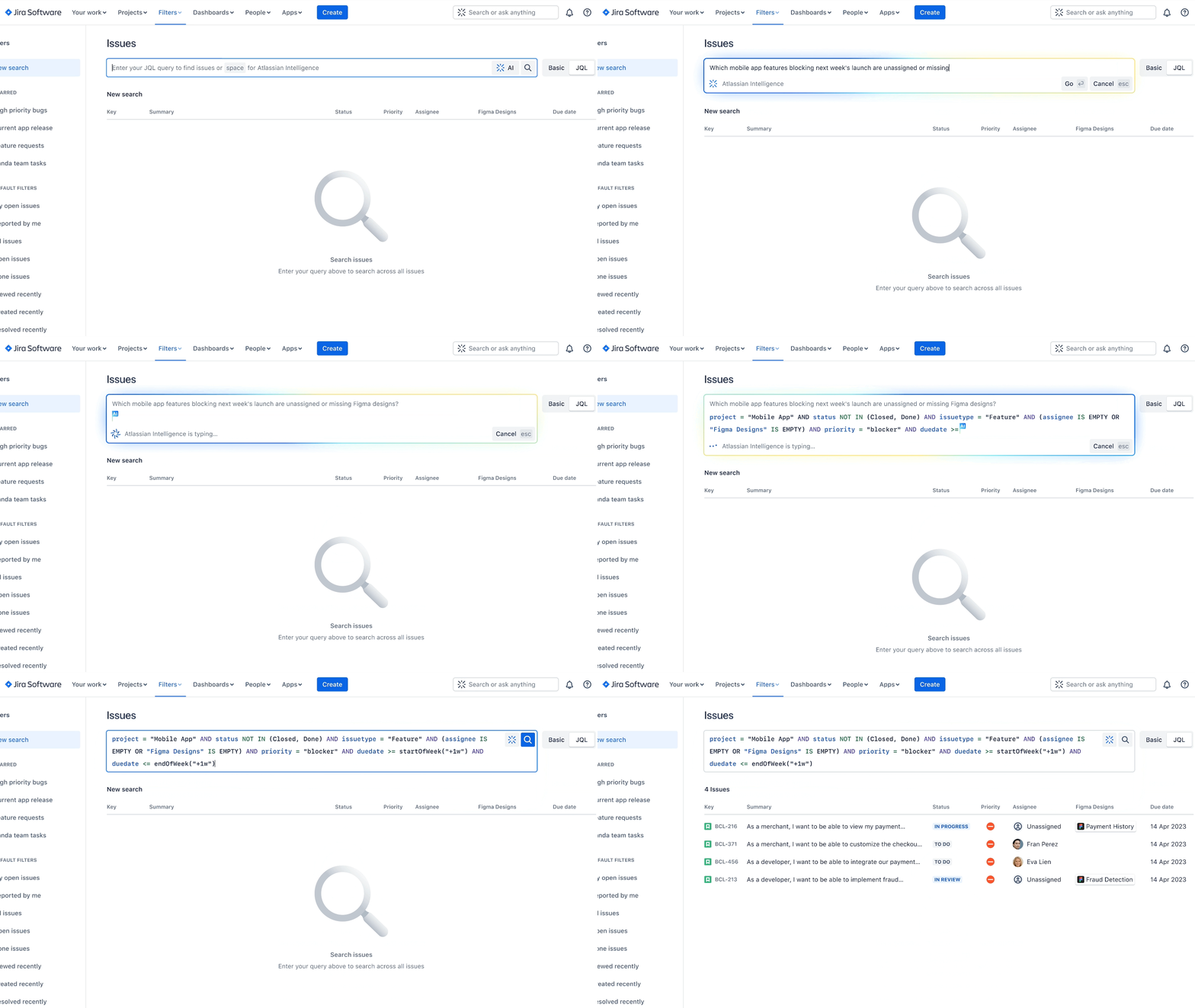
    During a virtual Unleash event, Atlassian today announced its generative artificial intelligence (AI) capabilities are now generally available across its Jira and Confluence suite of tools for managing IT and DevOps workflows.

    In addition, Atlassian also committed to adding generative AI capabilities to its Bitbucket continuous integration/continuous deployment (CI/CD) platform to enable DevOps teams to review pull requests and leave comments automatically with suggested changes around syntax and code conventions via a natural language interface. Developers will also be able to autogenerate pull request descriptions from commit messages.

    Matt Schvimmer, head of products for the Agile and DevOps division of Atlassian, said the capabilities provided by Atlassian Intelligence will reduce the level of toil and stress DevOps teams experience at a time when the velocity at which applications are being developed and deployed only continues to increase.

    Atlassian reported nearly 10% of its more than 265,000 customers have already leveraged Atlassian Intelligence since the launch of the beta program. Organizations, for example, can instantly create user stories within Jira Software tickets, change the tone of a customer response within Jira Service Management, create summaries, launch workflow requests via prompts and generate a starting point for a test plan in Confluence.

    Natural language capabilities, currently available for Confluence, will shortly be generally made available for Jira. An ability that promises to help demystify company-specific concepts, jargon or acronyms is also available now in beta, with support for Jira Software and Jira Service Management to shortly follow.

    There is little doubt at this juncture that AI will be pervasively applied across both ITSM and DevOps workflows. As those advances are made, it should also become feasible to reduce the level of toil these teams regularly encounter. At the same time, the level of scale at which ITSM and DevOps workflows can be effectively managed should also increase substantially.

    Each organization will need to decide how quickly to incorporate AI into those workflows, but hopefully, the level of burnout experienced by IT personnel will be sharply reduced as more tasks are automated. Less clear is the impact AI will have on the size of IT teams required to provide those services, but for the foreseeable future, there will always be a need for some level of human supervision.

    In the longer term, the war for IT and DevOps talent that has been waged now for multiple decades should diminish as managing these workflows becomes more accessible, noted Schvimmer. Organizations will not need to rely so much on the expertise of a handful of specialists, he added.

    Organizations, however, would be well-advised to make sure AI is embraced from both the bottom up and the top down to ensure optimal adoption, said Schvimmer.

    In the meantime, IT teams should take an inventory of the processes that are likely to be automated by AI today with an eye toward restructuring teams as more tasks are automated. Ultimately, the goal should be to let machines handle the tasks they do best to enable the IT staff to provide services that deliver more value to the business.

  • PagerDuty Previews Generative AI Copilot for ITSM

    PagerDuty Previews Generative AI Copilot for ITSM

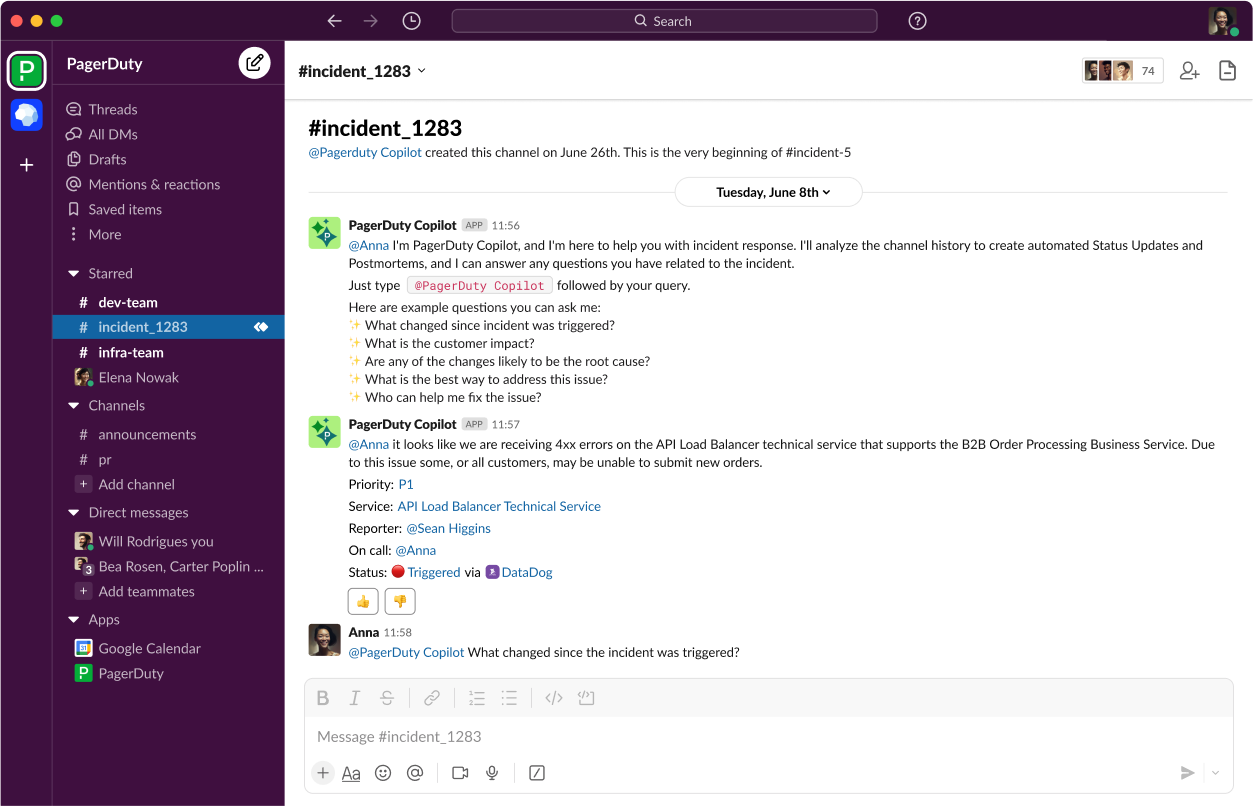
    Under an early access program, PagerDuty, Inc. is making available a tool that brings generative artificial intelligence (AI) capabilities to its IT service management (ITSM) platform.

    Jonathan Rende, senior vice president of products for PagerDuty, said PagerDuty Copilot for the PagerDuty Operations Cloud extends previous investments in machine learning algorithms the company has made as part of an ongoing effort to apply AI to ITSM.

    Designed to be invoked via Slack, PagerDuty Copilot makes use of multiple large language models (LLMs) to automate tasks ranging from providing summarization of IT incidents to creating code to automate workflows. PagerDuty plans to transparently swap LLMs in and out of its platforms as AI advances continue to be rapidly made, noted Rende.

    PagerDuty Copilot provides a level of abstraction for invoking AI models along with appropriate guardrails that make it simpler to manage IT operations without IT teams needing to have AI expertise, said Rende.

    The overall goal is to boost the productivity of IT operations teams by eliminating much of the drudgery and toil that conspires to make working in IT tedious, noted Rende. AI technologies are not likely to replace the need for IT personnel as much as they will enable IT teams to focus on tasks that add more value to the business, he added.

    It’s now only a matter of time before generative AI capabilities are pervasively applied across both ITSM and DevOps workflows. Less clear is the impact those capabilities will have on the best practices currently relied on to manage those workflows as more tasks are automated. Ultimately, however, AI should make it easier for more organizations to embrace those best practices as the level of skill and expertise required to manage IT at scale is reduced.

    In addition, the whole concept of issuing tickets to manage tasks tracked by a central system of record may need to evolve simply because AI has automated requests for service. There will naturally need to be some system of record for tracking requests. Still, ultimately that process will be managed via copilots rather than by a ticket created by an end user that is then tracked via an ITSM platform.

    Savvy IT teams, in the meantime, are already moving to determine which tasks and workflows will be automated in anticipation of AI becoming more widely embedded in ITSM and DevOps platforms. Roles and responsibilities within IT teams will inevitably evolve as AI increasingly automates mainly mundane tasks, such as creating reports that many IT professionals would rather not spend time writing.

    The biggest IT management platform challenge in the future might not necessarily be adjusting to AI as much as it will be orchestrating requests that are likely to be generated by multiple types of copilots that have been embedded into almost every application.

    One way or another, AI is about to transform how IT operations are managed. As disruptive as those advances will be, AI, more importantly, will also enable organizations to manage IT at levels of scale that were previously unimaginable.

  • Immutable Infrastructure: The Next Step for DevOps

    Immutable Infrastructure: The Next Step for DevOps

    Immutable infrastructure, a concept that is rapidly gaining traction within the dynamic field of DevOps, offers a transformative approach to organizational security for companies of all sizes. 

    Instead of the traditional method where existing components are continuously updated and modified, immutable infrastructure advocates for an entirely different philosophy: Components are replaced wholesale with new versions and never altered after deployment. This type of paradigm shift promises a plethora of advantages, chief among them being enhanced consistency and reliability, which is a potential game-changer for DevOps practices.

    This article offers a thorough exploration of immutable infrastructure, taking a look at its core principles and examining why it’s becoming a focal point in the DevOps community. To help further bring these concepts to life, we’ll thoroughly examine the tools and techniques that are pivotal in its implementation.

    Understanding Immutable Infrastructure

    Immutable infrastructure is rapidly gaining traction in the world of cloud services and DevOps for its innovative approach to managing servers and components. Once deployed, these elements are not modified or updated; instead, new servers are created from a common image whenever changes are necessary. 

    This type of approach simplifies rollback procedures and minimizes troubleshooting, as the integrity of servers is maintained. Furthermore, this methodology, facilitated by OS-level virtualization, marks a significant departure from more traditional practices.

    And with the AI market already worth $313 billion, integrations of models and solutions will only become more popular. Integrating AI into immutable infrastructure can significantly enhance its efficiency and reliability. 

    In such systems, AI can be used to monitor and analyze system performance continuously. By applying machine learning algorithms, it can predict potential issues and automate the process of deploying new server instances before problems arise. 

    Comparing Immutable and Mutable Infrastructures

    The Immutable Approach

    Immutable infrastructure offers streamlined change tracking and rollback, with each new server or VM being easily identifiable. Its uniform configuration across servers simplifies testing and the unaltered state post-deployment reduces complexity. 

    This makes it ideal for environments with numerous interdependent elements, such as in DevOps and cloud computing, virtually eliminating configuration drift.

    Challenges With Mutable Infrastructure

    In contrast, mutable infrastructure necessitates more time for server provisioning due to manual configurations. It’s prone to various update failures and connectivity issues, with each server’s unique configuration complicating diagnostics. 

    This traditional approach struggles with unpredictability, making it less suitable for modern DevOps practices and resulting in frequent configuration drifts.

    Advantages of Immutable Infrastructure

    Opting for immutable infrastructure brings numerous benefits. Support calls are significantly reduced and security is enhanced, thanks in part to the use of machine learning to identify anomalies. 

    The implementation of safelisting rules strengthens security controls. Moreover, this approach mitigates configuration drift and negates the need for synchronization during updates, leaning on cloud platforms for swift VM management. It also ensures rapid recovery due to easy rollbacks and encourages experimentation, thus fostering innovation.

    Best Practices for Immutable Servers

    Adopting immutable servers involves several best practices all organizations would be wise to apply. Building images in a chroot environment helps isolate changes while keeping test suites lean and efficient while avoiding overburdening the change process as a whole. 

    Caching installation files near the build location optimizes update speeds, layering images on top of a base server image expedites updates, and minimizing the OS image reduces boot times and security risks. Additionally, using containers can dramatically speed up and simplify the process.

    Essential Tools for Immutable Infrastructure

    When it comes to immutable infrastructure, certain key tools have emerged as indispensable for efficiently managing and maintaining this modern approach. These tools help create, manage and deploy server images and infrastructure-as-code throughout organizations. 

    Here’s a closer look at some of these essential tools:

    Packer

    Packer is a crucial tool for creating identical machine images for various platforms from a single source configuration. This tool is instrumental in the immutable infrastructure because it allows for the creation of fixed server images that can be quickly deployed, ensuring consistency across environments.

    Terraform

    Terraform by HashiCorp is another key player, enabling users to define and provide data center infrastructure using a declarative configuration language. It helps maintain the infrastructure-as-code, which is an essential aspect of immutable infrastructure. 

    Terraform allows for safe and predictable changes to infrastructure, with efficient management of both cloud and on-premises resources.

    Docker

    Nowadays, Docker is synonymous with containerization, allowing applications to be packaged into containers—consistent, isolated environments that encapsulate all the necessary components of immutable infrastructure. 

    Docker helps to simplify the deployment process and ensures that applications run the same way everywhere, aligning perfectly with the core principles of immutable infrastructure.

    Kubernetes

    While not directly mentioned earlier, Kubernetes deserves recognition for being a powerful orchestration tool for containers, including those that are managed by Docker. Kubernetes excels in automating deployment, scaling and management of containerized applications, which aligns well with immutable infrastructure principles.

    SaltStack

    SaltStack offers configuration management and orchestration tools, standing out for its ability to manage and automate more complex and scalable infrastructures, making it suitable for environments where immutable infrastructure is implemented. SaltStack ensures that server configurations are enforced and maintained as defined, preventing drift.

    Jenkins

    An open source automation server, Jenkins plays a significant role in the continuous integration and continuous deployment, or CI/CD, pipeline. Jenkins helps to automate the various stages of the delivery pipeline, which is crucial in testing and deploying immutable infrastructures.

    Ansible

    While Ansible is generally associated with configuration management, it also excels in automated deployment. Because it doesn’t require agents on the servers it’s managing and uses a simple, human-readable YAML syntax, it’s useful for setting up and maintaining immutable servers.

    Git

    Git, a version control system, is essential for tracking changes in the configuration code, scripts and templates used to create and manage immutable infrastructure. It allows teams to manage their infrastructure-as-code, ensuring a detailed audit trail of what was changed, when and by whom.

    Ultimately, a slew of tools and platforms are available to make the transition to immutable infrastructure as seamless as possible. From container orchestration with Kubernetes to configuration management through Ansible, you have a robust array of options at your disposal. 

    Yet, when it comes to handling specification files or any form of documentation, you want an added layer of security. A robust custom document viewer with extra security features, for instance, could be an invaluable asset in this regard, offering the ideal blend of accessibility and protection while ensuring that your infrastructure is immutable and secure from prying eyes.

    Choosing the Right Tools For Your Organization

    When integrating immutable infrastructure into your operations, selecting the right mix of tools that align with your specific requirements and existing workflows is crucial. Essential factors such as compatibility, scalability and ease of use should be considered to create a robust, efficient and effective immutable environment. 

    Each of the tools highlighted above has its own strengths and is a part of a broader ecosystem designed to support the reliable, consistent and secure deployment of applications and services across organizations of all sizes. Companies can fully embrace the immutable infrastructure model by learning how to properly harness these tools, improving stability, scalability and efficiency across all of their IT operations.