Category: IT as Code

  • Oracle Enables Partners to Reuse Cloud Platform

    Oracle Enables Partners to Reuse Cloud Platform

    At its CloudWorld event, Oracle today announced it will enable IT teams to deploy the same platform it uses to independently deliver cloud services anywhere they see fit.

    Leo Leung, vice president of products and strategy for Oracle, said an Oracle Alloy offering will enable organizations to provide a full set of cloud services they can extend and brand as their own. All of the more than 100 infrastructure and platform services that the company makes available on Oracle Cloud can now be deployed anywhere, he said.

    In addition, Oracle unfurled a MySQL HeatWave service through which IT teams can access instances of the open source MySQL database running on the Amazon Web Services (AWS) cloud. A similar offering for the Microsoft Azure cloud is also planned.

    As part of an ongoing effort to gain share against rival cloud service providers, Oracle has been making a wide range of services available at a lower cost. Oracle Alloy now extends those efforts by making it possible for a wide range of organizations, including traditional enterprise IT organizations and internet service providers, to benefit from the company’s research and development efforts.

    Organizations that ally with Oracle can set their own pricing, rate cards, account types and discount schedules and define the support structure and service levels. A preconfigured instance of Oracle Fusion Financials to enable Oracle Alloy partners to manage customer invoicing and billing is also provided.

    It’s not clear to what degree these organizations might want to compete with cloud service providers such as Amazon Web Services (AWS), Microsoft and Google, but Oracle Alloy does provide an alternative approach to cloud computing that enables organizations to retain more control over the IT services they provide to others. The challenge, of course, is that acquiring the infrastructure is only one part of the equation. Organizations will also need to hire and retain IT specialists needed to manage cloud platforms on an ongoing basis.

    As the volume of applications being deployed in cloud computing environments steadily increases, Oracle clearly views Oracle Alloy as an opportunity to make up for lost ground in a market segment that it initially all but ignored when cloud computing first emerged more than a decade ago. Now, Oracle provides cloud services in 40 commercial and government regions across 22 countries. It has added 10 public cloud regions over the past year and has plans to add six additional commercial regions.

    Oracle is betting that, in some cases, partners will opt to deploy some cloud services themselves while relying on Oracle for others depending on the level of demand for specific classes of services. In effect, Oracle is enabling a set of federated cloud services to emerge that are no longer specifically tied to a single provider. It remains to be seen how receptive organizations will be to that approach, but it’s certain that the number of organizations that could afford to deliver cloud services could substantially increase. In theory, at least, increased competition should also lead to lower cloud costs for the organizations that consume those services.

  • Of Max and Min: When Performance Engineering Plans Go Awry

    Of Max and Min: When Performance Engineering Plans Go Awry

    Modern software developers have access to powerful tools and services which allow them to quickly develop, demo and deploy fully functional applications. But what happens when the single-user prototype satisfies all required functionality but the user says the system seems slow? Or if the initial implementation turns out fine for one user, but multiple users start to experience delays? Or if users are happy, but the cost of auto-scaling grows prohibitive?

    The Problem with Performance Engineering

    Concern over non-functional aspects of computing systems—response times, resource utilization and costs—falls under the domain of computer systems performance engineering (CSPE). Unfortunately, the practice of CSPE has evolved into something more akin to art than engineering—with few standardized principles and practices. Because software is constantly evolving its languages and abstractions, CSPE practitioners appear obligated to evolve and change their abstractions and languages, too.1 As a result, part of our jobs as performance engineers is to understand what the heck other performance engineers really intend or mean.

    There are many reasons for this state of affairs, but ultimately this lack of a common language and engineering standards for CSPE is a deficiency in the education and training of software engineers. There is very little in the typical university software engineering curriculum that prepares software engineers for doing CSPE. This sometimes leads to practices that are not backed by scientific or engineering principles. As a result, practitioners are forced to “wing it”—creating their own art or hitching their wagons to someone else’s star and learning (or not) through trial and error.


    The PMWG – A POSIX for Performance?

    The Performance Management Working Group (PMWG) was started in the late 1980s during the “UNIX wars,” when computer vendors were feuding over claims to the UNIX leadership mantle and had formed two factions: UNIX International and the Open Software Foundation. The group was unique in that its members included computer systems vendors on both sides of the “war.” Its members put aside those differences to try to come up with performance management standards and practices that would put UNIX on par (at least) with the performance management tools found on mainframes.

    In retrospect, the PMWG was probably the best chance UNIX had for establishing, promoting and enshrining some basic performance engineering principles—a kind of POSIX for performance. Unfortunately, the group failed—in large part, in my opinion, because it put too much priority on the latter stages of the performance management data pipeline and did not spend enough effort toward establishing key primitives. Today, in the absence of established rules and practices for performance engineering, history is repeating itself. Current efforts in observability continue to focus mainly on data presentation and data transport and storage, without much focus on the right metrics and data quality based on basic performance engineering principles. Presentation, transport and storage are important, but the efforts around metrics, logging and tracing coverage and data quality are sporadic at best.


    Inertia, Expediency and Superstition

    Why are more formal, engineering-based practices around CSPE needed? Consider the use of CPU utilization as a key performance indicator (KPI) of system performance. I’m a member of Bloomberg’s Trading Solutions SRE team, which manages hundreds of machines on which the company’s Trading Solutions software runs. We often see or hear statements like “This host’s CPU is too busy,” or “That host is out of CPU resources.” I’ve found that these observations are not actually very helpful and sometimes divert our attention from the real problem(s). When misused as a system KPI, focusing solely on CPU utilization can lead us down the wrong path and draw incorrect conclusions. To understand why, let’s first look at how we assess the performance of real-world, non-computing systems.

    Take fast-food restaurants. One of the most important attributes of fast-food restaurants (besides their health inspection rating) is that they are fast. But we’ve all been to fast food restaurants that are anything but fast. Without actually standing in line and waiting, we can often tell that we will have a slow experience at a fast food joint if there is a long line. The line length gives us a lot of information. Our assessment of the situation is different whether there are 100 customers versus 10 customers versus a single customer waiting in line.

    In the real world, this line length (or queue length) assessment is almost universal. Supermarket checkouts, ATMs, airport security screening, toll booths, elevators and COVID-19 testing are all areas where we apply this semi-conscious assessment. In contrast, we almost never use “cashier utilization” or “self-serve soda fountain utilization” as a way of assessing how slow a fast-food restaurant is. We always say “the lines are long” or, if we actually choose to wait in line, we’ll make the more direct statement that “service is slow.”

    Which brings us back to our computing systems. Why do we reflexively look to CPU utilization when computing systems are slow while, in the physical world, we rely on queue lengths? The question is even more relevant when we consider that the concept of CPU is less well-defined today. Are we measuring the CPU, its cores or hardware threads?2 I believe the contributing factors to this misuse include inertia, expediency and superstition.

    In the early days of computing, CPUs were perhaps the most expensive component of the large monolithic computer systems of the time. Measuring how much these expensive components were being used was an important part of maximizing the financial investment in these large machines. Fortunately, measures of CPU utilization were relatively easy to estimate. Ease of implementation meant that CPU utilization measures were almost universally available.

    The universal availability of this simple metric, combined with some correlation (sometimes weak) between high CPU utilization and system slowness made it a default indicator of systems performance. When a belief becomes ingrained to the point of superstition, even weak correlations are enough to validate and perpetuate it. Better metrics—for example, run queue lengths at the CPU(s)3—can help us shed our superstitions to better understand our systems and lead us in the right direction in identifying and correcting problems.

    Dispelling Superstition and Other Irrational Practices

    Which brings us to the title and purpose of this series. As a title, “Of Max and Min” is meant to evoke John Steinbeck’s classic novella “Of Mice and Men,” which in turn got its title from the famous line in Robert Burns’ poem “To a Mouse”: The best-laid plans of mice and men oft go awry. The two main characters in “Of Mice and Men” fail in their efforts to better their lives during the Great Depression because they are tragically ill-equipped to do so. Similarly, we should not be surprised if plans go awry when software engineers are tasked with doing performance engineering without the proper training in performance engineering principles.

    “Max and Min” also highlights the importance of data analysis and statistics in understanding systems behavior. Effective CSPE requires us to be familiar with concepts in statistics, numerical analysis, and even operations research—in addition to the more standard computer science areas of algorithmic complexity and computer architecture.

    With “Of Max and Min,” in addition to calling out superstitions, I will be pointing out some common mistakes we make and blind spots that we have.4 Through case studies, I’ll illustrate how our blind spots can lead to mistakes that can persist for years. I will also try to cover some basic CSPE principles that I believe are skipped in most software engineering training. Like everyone else, I’ve been winging it for 40+ years. And I’m still learning. If you disagree with any of my points or have further insights into the topics that I am presenting, please let me know.


    1But, as in the application of the principles behind algorithmic complexity, there are some performance engineering principles that can and should be adhered to regardless of the system and language du jour.

    2There are in fact some bizarre implementations of “CPU utilization”. Here’s an example of how AIX “broke” the meaning of CPU utilization on their multiprocessor systems running in hyper-threading mode.

    3UNIX and Linux do in fact have metrics that could be used as CPU queue length indicators.  In a future installment, I will go into the quirks of some of the CPU queue length implementations and further argue for more consistent mathematical bases for queue length metric implementations.

    4For example, have you ever wondered why, after so many outages caused by logging, malloc, DNS and other low-level services, we still don’t have good, out-of-the-box visibility into these and other low-level components? We are accepting key blind spots as a fact of life when we really shouldn’t.

    About Me

    Like many software engineers, I started off studying a different field (Physics). Unlike most software engineers, I’ve always wanted to be a performance engineer. When I started taking computer classes as an undergraduate in Columbia College’s Physics program, I did not wish for a career writing programs in Fortran (yes, it was that long ago). But I did envision myself making systems run better and faster.

    To that end, when I added a Computer Science major to my undergraduate studies, I also added a minor in Industrial Engineering and Operations Research. For those unfamiliar with IEOR, it is a multidisciplinary engineering field that leverages mathematical and analytical methods to address complex system problems like resource allocation, supply chains, wait times, fairness, etc. Tools and methodologies from IEOR are invaluable to CSPE.

    At the start of my career, I joined the Bell Labs Computer Center as a computer systems performance engineer, where I made the somewhat contrarian decision (for 1980) to work in the group supporting their in-house, low-key UNIX systems (as opposed to their commercially popular MVS mainframes). I didn’t realize it at the time, but having access to the source code of the system you support/study can be a boon to understanding. At Bell Labs, I had the opportunity to contribute to the UNIX System V kernel, where I co-developed the first general-purpose kernel and user-land tracing system for UNIX and made significant performance enhancements to the virtual memory subsystem, and participated in the PMWG.

    Since then, I’ve spent the bulk of my professional career working on financial software systems—ranging from market data to messaging to transaction management. I’ve worked on monitoring systems on an enterprise level. I’ve made and witnessed many CSPE mistakes. In my current role as an SRE on the Trading Solutions team at Bloomberg, I’m seeing and helping remedy lots of operating system issues that stem from our runtime scale.


    Thanks

    Thanks to everyone who reviewed this document and provided constructive feedback. Special thanks to Nate McNamara and Peter Wainwright for suggesting substantive organizational and structural improvements. Peter also reined in my default stream of consciousness, run-on style. None of them had any hand in the writing of this paragraph.


  • Five Great DevOps Job Opportunities

    Five Great DevOps Job Opportunities

    devopsy.kinsta.cloud is now providing a weekly DevOps jobs report through which opportunities for DevOps professionals will be highlighted as part of an effort to better serve our audience.

    Our goal in these challenging economic times is to make it just that much easier for DevOps professionals to advance their careers.

    Of course, the pool of available DevOps talent is still relatively constrained, so when one DevOps professional takes on a new role it tends to create an opportunity for others.

    The five job postings shared this week are selected based on the company looking to hire, the vertical industry segment and naturally, the pay scale being offered.

    We’re also committed to providing additional insights into the state of the DevOps job market. In the meantime, for your consideration:

    Dice.com

    Oscar Technology
    Remote
    DevOps Engineer- Go Language
    $120,000 to $180,000

    LinkedIn

    Proprio
    Seattle, Wash
    Senior ML-DevOps Engineer
    $120,000 to $170,000

    SimplyHired

    DISH
    Littleton, Col.
    Senior DevOps Engineer
    $106,210 to $143,750.

    Indeed.com

    RumbleOn
    Irving, Tex.
    DevOps Engineer
    $115,000 to $135,000

    Monster.com

    PROLIM Corp.
    Washington, D.C.
    AWS DevOps Engineer
    $90,000 to $110,000

  • Keeping the DevOps Pipeline Flowing as Attack Surfaces Grow

    Keeping the DevOps Pipeline Flowing as Attack Surfaces Grow

    The attack surfaces that today’s businesses and public entities must manage have never been more complex and difficult to protect. The introduction of cloud and SaaS offerings over the past decade has caused seemingly insurmountable IT sprawl, with a third of successful attacks now occurring via unmanaged or virtually unknown assets. And while shadow IT is an urgent threat confronting many organizations, the migration of the software development life cycle to the cloud—and the rise of machine identities—is compounding the attack surface in profound ways. Emerging out of the Agile and lean strategies for software development in the 2010s, DevOps predates the mainstreaming of cloud computing.

    But once the value of cloud-based IT resources came to be widely appreciated, development teams began moving their developer environments to the cloud in a big way—to the point where many people today think of DevOps and cloud as inseparable. Recent Gartner research showed that much of enterprise IT spending is now directed toward cloud projects. In fact, for IT categories like application software, infrastructure software, business process services and system infrastructure, more than 51% of IT spending will shift away from traditional solutions to the public cloud by 2025. Nearly two-thirds of spending on application software alone will be directed toward the cloud by 2025.

    The explosion in cloud DevOps has brought with it a huge uptick in the number of privileges, credentials, identities and access rights under management. We’re all familiar with how digital identity and access management (IAM) works in conventional settings through combinations of usernames and passwords. In the DevOps world, where cloud containers can run as distinct microservice processes interacting with other processes (machine-to-machine communication), identities and privileges are usually governed through SSL/TLS certificates. These machine identities have emerged as a critical security priority across multiple industries, not just because they’ve proliferated exponentially, but because of the lack of effective tools and strategies available to IT security teams.

    Machine Identities—Scope of the Issue

    A recent global survey of 1,000 CIOs found that the average organization has 250,000 machine identities under management coming into 2022, with that number expected to double by 2024. The study also found that 83% of organizations suffered a machine identity-related outage in the past year, with 57% of organizations experiencing at least one data breach or security incident related to compromised machine identities over the same time period.

    Because the perimeter defense solutions and strategies that formed the basis of IT security best practices for many years are of little use in cloud environments, security admins have had to rely on existing IAM and privileged access management (PAM) tools to secure data, accounts, and development pipelines. Not surprisingly, identities and access privileges have become the leading attack vector in the cloud, providing attackers with an exponentially higher number of vulnerabilities to target within the enterprise than were available even a few years ago. We’ve seen these points of weakness come into play in recent high-profile breaches and attacks such as SolarWinds, Codecov and PHP.

    Embracing Zero-Trust Principles to Secure the DevOps Pipeline

    Fortunately for today’s DevOps teams, cloud-oriented privilege management technologies have evolved rapidly in recent years, especially in the categories of cloud infrastructure entitlement management (CIEM) and time-based role access management or just-in-time privileging. CIEM solutions target the security weak points and process vulnerabilities that are unique to the cloud environments. These include the lack of deep visibility into user, group, and role privileges, which together make it difficult to conduct oversight and control over the activities of users within cloud infrastructure and applications. Where conventional approaches such as IAM and PAM are designed primarily to secure data, apps, and users within the organization, CIEM is designed to manage permissions risks to prevent cloud breaches and data theft.

    Emerging CIEM solutions are bringing to bear advanced capabilities in discovery, monitoring and auditing to significantly broaden visibility into DevOps processes for IT security professionals. With a CIEM solution, security teams can scan cloud applications for existing users, groups, roles and granted privileges down to the resource level. Each user, group, role, and privilege can be categorized to identify and verify that privileged users have the appropriate levels of access. Access reports can be generated to concisely outline users and groups with the most privilege and the highest risk.

    On the audit front, CIEM solutions provide the capability to track and report on levels of privilege as well as all activity associated with those privileges. In this way, it becomes possible to generate privileged access reports for consumption by internal and external auditors to ensure compliance with regulatory and other requirements such as SOX, GDPR, HIPAA, GLBA, PCI-DSS, ISO 27001, SOC 2, FedRAMP and more. Similarly, with the ability to monitor privileged access across all cloud applications, security teams can apply behavior analysis to identify privilege abuse and abnormal activities from users. As with conventional SIEM tools, CIEM solutions will generate alerts to administrators to suspect activities or behaviors—for instance, if a user attempts to circumvent policies preventing direct privileged access to cloud services.

    Just-In-Time Privileging and Zero Standing Privileges

    Importantly, CIEM solutions are also effectively eliminating standing privileges to cloud resources based on least-privilege access and zero-trust principles. The automated granting and expiring of permissions—just-in-time (JIT) privilege grants—is highly effective at minimizing attack surfaces. Because these JIT/zero standing privilege (ZSP) solutions work on a zero-trust model, no one and nothing is trusted with standing access to cloud accounts and data.

    With JIT permissioning, elevated privileges can extend either for the duration of a session or task, or for a set amount of time. Once the task is complete, those elevated privileges are automatically revoked–all without sys-admin involvement. Where a user previously had standing access privileges potentially extending around the clock for months at a time, converting to JIT granting would compress that attack surface to several hours per month. Further, JIT permissioning largely frees organizations from having to maintain and pay for both privileged and non-privileged accounts. Dynamic secrets generation – where a dynamic secret is generated on demand and is unique to a client, instead of a static secret being defined and shared ahead of time – also provides a better model for securing temporarily deployed services and features.

    DevOps and DevSecOps are still new and fast-evolving concepts within the wider computer science and cybersecurity universe. No doubt, DevOps has been wildly successful in accelerating automation and speeding time to market for innovative applications and business services. To date, however, security solutions providers have struggled with cloud access management. In other words, they have struggled to accelerate privileged access solutions that could secure the devices, data, and resources used by DevOps teams, especially in cross-cloud environments. Dynamic permissioning platforms using JIT privilege grants and employing ZSP principles show great promise in solving these problems.

  • Implementing Data-Driven DevSecOps

    Implementing Data-Driven DevSecOps

    Right now, the way DevSecOps is typically implemented doesn’t fit with the rapid and agile DevOps CI/CD pipeline at all. It’s like applying 19th-century firefighting methods to a modern forest fire.

    Back then, firefighters employed a “bucket brigade,” where they would form a queue and pass buckets from one hand to another to put out a blaze. No doubt, it’s a lot of work, but much of the effort is wasted. Water inevitably spills out of the buckets as they are handed from one person to the next and by the time the bucket is emptied into the fire, half the water is gone. And not only is so much effort wasted, it’s far too slow and ineffectual to combat the kind of wildfires we face today.

    Likewise, the largely manual methods of current DevSecOps initiatives are ineffectual in fighting the fires of digital threats and cyberattacks modern mobile apps face. Like a modern megafire, these threats and attacks are growing and changing every second, seeking new vectors to spark new attacks elsewhere. Traditional DevSecOps tools like code scanning and penetration testing identify vulnerabilities and then the security teams start the manual “bucket brigade” to add as much protection as they can against them before the app has to be released. But neither the threats nor the CI/CD process has paused. New features have been added that have created new vulnerabilities, and the threat landscape has evolved. It’s inefficient because pentesting can’t provide the kind of real-time data about attacks and threats that developers need to provide protection against current threats. The result is the release of vulnerable mobile apps. 

    A Data-Driven Process

    In business, the C-suite is working hard to transform their companies into data-driven organizations where decisions are made not on the basis of gut feelings or expert opinion, but rather on analysis of hard data. That same approach needs to be brought to security implementation for mobile applications.

    Additionally, the implementation of security into a mobile app needs to be automated. With so much of the CI/CD process already automated, security cannot lag behind.

    These two elements combined create data-driven DevSecOps. In this method, the development and security teams have a system of record that provides real-time cyberattack and cyberthreat information about apps in the field, which drives decisions the team makes about the protections that are most urgent and that must be included in the next build. 

    It’s now well within the realm of possibility for mobile app developers to gather near-real-time information on exactly the kinds of threats and vulnerabilities that their mobile apps are facing in the field. When combined with location, network and other kinds of data, developers can gain a granular understanding not only of the most common threats their apps experience, but also which threats are most prevalent in specific geographic regions. They can also proactively identify the rapidly mounting threats that will become an enormous problem in the near future.

    With this data in hand, development teams can make informed decisions about which protections they should prioritize in the next build to make the best use of their time and resources to provide maximum protection to their end users. 

    The Need for Automation

    But having data isn’t enough. Development teams need the ability to act quickly on the insights provided, and manual implementation methods are too slow and cumbersome to keep up with the rapidly changing threat landscape for mobile apps. Once the decision is made, a system must also exist to automate the incorporation of mobile app security, anti-fraud and anti-cheat protections from within the CI/CD pipeline, so that security implementation runs as smoothly as feature creation.

    The advantages of data-driven DevSecOps are many. First, publishers, developers and security teams can understand exactly what cybercriminals are doing against their own apps with real users. With this data and the wealth of other data that organizations can collect from their apps, they can determine which threats are the most pressing, which are rapidly emerging and even how they are distributed among different geographic regions—all of which is extremely valuable information when deciding which protections to build into the next release.

    Finally, once the app is released, teams can use the data they receive about threats and attacks to prove the effectiveness and value of each protection that was included. It’s important information not only for continuous improvement, but also to justify the value of data-driven DevSecOps to management and the C-suite.

    With data-driven DevSecOps, organizations can provide data, transparency and visibility around security to all stakeholders in the CI/CD process—all while making the incorporation of security far more efficient and effective, along with the real-time data to prove it.

  • Google Looks to Secure Software Supply Chains

    Google Looks to Secure Software Supply Chains

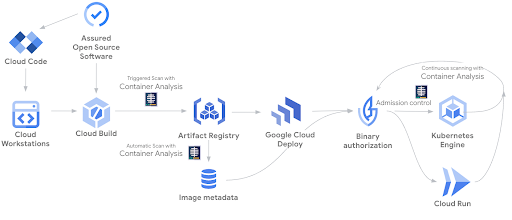
    At the Google Cloud Next ’22 conference, Google today launched a managed Software Delivery Shield (SDS) service to enable DevOps team to store, manage and secure the build artifacts in Artifact Registry. At its core, SDS is based on a trust-based policy engine to establish, maintain and verify a chain of trust across the software supply chain.

    In addition, Google has updated its container analysis tool to include vulnerability scanning for Maven and Go containers along with preview support for non-containerized Maven packages.

    The managed Software Delivery Shield service spans a range of Google runtimes environments, including Google Kubernetes Engine (GKE), Cloud Code, Cloud Build, Cloud Deploy, Artifact Registry and Binary Authorization. Cloud Build also now officially supports Supply chain Levels for Software Artifacts (SLSA) Level 3 best practices by default in addition to generating authenticated and non-falsifiable build provenance for both containerized applications and non-containerized Maven and Python packages.

    GKE, in preview now, provides detailed assessments, assigns severity ratings and surfaces the security posture of the clusters and workloads, including insights into operating system vulnerabilities, workload configurations and other actionable insights. Log data can now also be captured while security event information can be routed to, for example, a security information and event management (SIEM) platform.

    The Google Cloud Run serverless platform can also, in preview, display software supply chain security insights such as SLSA build-level compliance, build provenance and vulnerabilities found in running services.

    At the same time, Google is also making available in preview Cloud Workstations, which provide fully managed secure development environments on Google Cloud that can be accessed via a browser. Built-in security capabilities include virtual private cloud (VPC) controls, no local storage of source code, private ingress/egress, forced image updates and identity access management (IAM) policies.

    Finally, the Cloud Code plug-in for integrated development environments (IDEs) now includes a preview of Source Protect to give developers real-time security feedback in the form of vulnerability dependencies and license reporting as they write code.

    Collectively, Google claimed it now provides more than 250 curated packages across Java and Python with verified provenance. It also automatically generates a software bill of materials (SBOM) to create an inventory of all components and dependencies.

    Historically, cloud service providers have been advocating a shared responsibility approach to cloud security that required organizations to not only secure their applications but also the way cloud infrastructure is provisioned. The challenge is developers generally provision cloud infrastructure themselves even though they generally have limited cybersecurity expertise. Too many developers assume the underlying cloud infrastructure is more secure than it actually is.

    Now, cloud service providers are extending the security services they provide at a time when organizations are making security a bigger factor in determining where to build and deploy applications.

    Sunil Putti, vice president and general manager for Google Cloud Platform, said Google is attempting to make cybersecurity invisible to developers in the sense that guardrails will automatically be embedded within the platform.

    The issue is that cloud computing environments are becoming more complex as new classes of cloud-native applications are deployed alongside legacy monolithic applications. Complexity, as always, is the enemy of cybersecurity.

  • GitLab Allies With Google to Improve Developer Productivity

    GitLab Allies With Google to Improve Developer Productivity

    GitLab Inc., in collaboration with Google, today launched an open source Cloud Seed tool that makes it simpler for DevOps teams to consume Google Cloud Platform (GCP) resources.

    The Cloud Seed tool, announced at the virtual Google Cloud Next ’22 conference, is integrated within the GitLab web UI to make it simpler for developers to consume Google cloud resources—such as Cloud Run for building and deploying containerized applications—and the managed Cloud SQL database service.

    Nima Badiey, global vice president of alliances for GitLab, said the goal is to reduce friction that would otherwise be created by requiring developers to write code to consume these services using a set of lower-level application programming interfaces (APIs).

    That self-service approach not only improves productivity but provides the added benefit of reducing the odds those services might be misconfigured in a way that creates a cybersecurity vulnerability, he added.

    As it seeks to gain ground on Amazon Web Services (AWS) and Microsoft, Google has a vested interest in working with providers of DevOps platforms to make it simpler for developers to consume cloud resources. The challenge is that developers often make mistakes when they programmatically invoke cloud services. Those resulting misconfigurations are all too often not discovered and remediated until after there has been some type of cybersecurity incident.

    In the wake of a series of high-profile breaches of software supply chains, there is a lot more focus on security. The challenge, of course, is finding a way to ensure application development platforms are as secure as possible without slowing down the rate at which software is developed and deployed. Achieving that goal requires the right mix of policies, training and systems, said Badiey.

    Most organizations are trying to strike a balance between the need for greater security and their need to attract and retain developer talent. In theory, the rise of DevSecOps best practices is pushing more responsibility for security further left toward developers. However, most developers have little to no cybersecurity expertise, so it’s clear more guardrails need to be built into DevOps tools and platforms to prevent cybersecurity mistakes from being made.

    It’s not clear how much improved developer productivity and greater security will drive organizations toward one cloud platform versus another, but in an age where many more organizations now routinely employ two or more cloud platforms, it could make a significant difference. Developers don’t especially enjoy remediating applications after they are deployed in a production environment because they have generally already moved on to other projects. IT operations and cybersecurity professionals are also likely to nudge developers toward platforms that create the least amount of operational overhead for them.

    Regardless, one thing that is certain is compliance requirements are about to become stricter for all concerned as scrutiny of software supply chains intensifies in the months ahead. The issue now is how to proactively address those requirements before they become a much larger issue.

  • Endor Labs Applies Graph Analysis to Secure Software Supply Chains

    Endor Labs Applies Graph Analysis to Secure Software Supply Chains

    Endor Labs exited stealth mode today to launch a platform that applies graph analysis to identify the depth of dependencies that exist within an application.

    Fresh from raising $25 million in funding, Endor Labs CEO Varun Badhwar said the Dependency Lifecycle Management Platform makes it simpler for organizations to manage dependencies within applications that can involve tens of thousands of components.

    Existing software composition analysis (SCA) tools are not able to as accurately identify the dependencies between software components because they generate too many false positives, he added.

    To address that problem, the Dependency Lifecycle Management Platform provides the equivalent of a credit risk score for each component employed with an application environment, said Badhwar.

    Designed to run out-of-band within a continuous integration process, the Dependency Lifecycle Management Platform is currently being made available via a private beta program.

    On average, bout 80% of an application is made up of open source components that developers downloaded from a repository. The challenge is that many of those components have known vulnerabilities. The Dependency Lifecycle Management Platform makes it simpler to both identify those vulnerabilities during the build process and find components that might be impacted by a newly discovered zero-day vulnerability, said Badhwar.

    Overall, the Dependency Lifecycle Management Platform improves the productivity of both application development and cybersecurity teams by streamlining vulnerability management, he added.

    Having a full understanding of their dependency graph also lets customers generate and analyze accurate software bills of materials (SBOMs) as applications are dynamically updated, noted Badhwar.

    In the wake of a series of high-profile breaches, there has been increased focus on software supply chains. The challenge is most developers don’t have a lot of cybersecurity expertise and, even when provided with tools to identify vulnerabilities, there are simply too many alerts generated. In the absence of any context, most of those alerts simply wind up being ignored. In the meantime, the rate at which new applications are being deployed and updated isn’t slowing down, especially as more organizations embrace cloud-native applications that make it easier to rip and replace software components.

    It’s going to take years for organizations to implement DevSecOps best practices to teach developers how to build more secure applications, but that journey needs to begin with tools that make it simpler for developers to address issues before applications are deployed. The best way to combat application vulnerabilities is to make sure they don’t manifest themselves in code in the first place. Based on the number of vulnerabilities that continue to find their way into application environments, it’s apparent that the current processes being used to build applications are fundamentally broken.

    At this juncture, it will take years to fix the application development and deployment process, but as more secure applications eventually replace millions of insecure applications the overall security posture of organizations will steadily improve. The issue now is finding ways to achieve that goal before another known vulnerability leads to another major security crisis.

  • Distributed Systems: Turning Networking to Your Advantage

    Distributed Systems: Turning Networking to Your Advantage

    Whether it’s the office, the classroom, the store or the bank, a great many spheres of human life have moved online. Each day, we grow more and more used to consuming applications on demand that instantly connect us with the rest of the world. Our expanding appetite for the internet depends on an ongoing trend toward distributed systems, with most companies today spreading their information technology across hybrid and multi-cloud architectures that consist of small, independent and loosely coupled containers. Companies are scaling their applications by deploying more clusters of containers across an ever-broadening surface. There are four key lessons businesses can observe from the proliferation of distributed systems.

    Don’t Underestimate the Benefits of Distributed Systems

    There’s a reason why the trend toward distributed systems persists; they are chock full of benefits.

    Distributed systems are incredibly scalable, as they allow companies to scale applications by adding, replacing or removing nodes as necessary. New applications can be rolled out quickly and in multiple iterations, accelerating time-to-market. Codebases are smaller and easier to change. Distributed systems optimize developer efficiency and team collaboration because numerous teams can work on different parts of a system simultaneously.

    Distributed systems are highly resilient. When (and only when) built effectively, distributed systems will continue working even if a significant part shuts down, as traffic can be rerouted to functioning servers—just look at the resilience of the internet. Fewer single points of failure create more stability and fault tolerance.

    With so many benefits, it’s not difficult to see how distributed systems have enabled our connected, digital economy. Netflix is a prime example of how they have supported the growth of SaaS-based applications. Thanks to a complicated distributed system, anyone on Earth can access a massive library of movies, tv shows, and documentaries to stream whatever they want on demand, paying a monthly subscription.

    While Netflix is considered to be in the entertainment industry, we think of it as a technology company first and foremost because the success of its business model is based on the efficacy of its distributed system. Netflix’s platform is scalable, resilient, performant, efficient and therefore profitable because it is distributed.

    Know That Distributed Systems are Complex and Challenging

    Distributed systems are innately complex and therefore difficult to build and operate. They consist of many asynchronous components that must work in tandem with one another. As the system scales, it becomes even more challenging to understand, let alone operate.

    These challenges are hardly unique to Netflix. Any company that manages a distributed system at scale suffers because of the convoluted nature of distributed systems. Other internet giants like Spotify, YouTube and Twitter also grapple with compounding complexity. If you’re overwhelmed by the labyrinth that is your distributed system, take comfort in knowing that these challenges are (to an extent) unavoidable.

    Turn Networking to Your Advantage

    A distributed system is a set of computers, containers or any other nodes that connect to a network to communicate with other entities by passing messages. What truly allows distributed systems to be ‘distributed’ and to function is the network. This makes the network both a liability and an opportunity. Yes, even the best systems will fail at some point on various levels. There is no such thing as complete control in distributed systems, but that doesn’t mean you can’t turn networking to your advantage.

    Developers can efficiently manage their distributed system by prioritizing networking and employing the right tools across an architecture. Netflix has built exceptionally well-connected systems with servers deployed in thousands of locations worldwide that connect to the control plane in the cloud. If a server fails, traffic can easily be rerouted elsewhere. The distributed system is scalable, resilient, performant and efficient. Robust networking solutions give the team at Netflix visibility into and control over the application.

    Networking truly is the key to bolstering the advantages and overcoming the challenges of distributed systems. Invest resources in your network and it will take care of your distributed system.

    Aim for Simplicity

    Turn networking to your advantage by taking care when building a networking stack. The two most predictable pitfalls to avoid here are not choosing a stack that addresses your unique challenges and differentiators and selecting tools that are overly complicated for your use case.

    It’s all too common for companies building and managing distributed systems to adopt popular or default tools that come with their orchestration platform without giving their suitability much thought. It is never a good idea to copy-paste a networking stack seen elsewhere, assuming that what has worked for others will also work for you. It may, but do not blindly select the stacks everyone is talking about without giving them much thought.

    Many organizations followed the herd by adopting Istio, only to later discover that the service mesh is far too complicated and resource-intensive for their platform. While Istio’s numerous features are helpful for some, they quickly become burdensome. The trending tools are not necessarily the best for your use case.

    Some companies go the opposite route and build their own custom solutions instead of following the herd. Just as Netflix built Zookeeper for service discovery and Spotify built Backstage for API management cataloging, global companies with expansive distributed systems can benefit from the control offered by a custom tool. This option is expensive, time-consuming and not viable for non-tech or smaller companies.

    You’re (probably) not Netflix, so don’t try to be. You may think you have the same problems, but you don’t. Yes, distributed systems are always complex and full of challenges. But the complexity of distributed systems compounds at scale to such an extent that it becomes incomparable. Internet giants like Netflix and Spotify require the advanced features of complicated tools or custom solutions built in-house (and they have the means to invest in these resources). If your platform is a fraction of the size of Netflix’s, your distributed system relies on a far simpler network.

    It’s extremely easy to choose solutions that are overly engineered for your use case, but it’s best to opt for simpler alternatives. Start with simple solutions, gain control of your networking stack and then advance to another level of complexity later on. Gaining control of your network will allow you to tap into the benefits of distributed systems while avoiding some of the challenges. Turn networking to your advantage and make your infrastructure scalable by choosing simplicity over complexity.

  • Forget Automation: Why IT Should Take UX Cues From Fine Dining

    Forget Automation: Why IT Should Take UX Cues From Fine Dining

    As a college student, I worked at a five-star Italian restaurant where I learned the discipline and practice of customer service. The general manager knew exactly which corner to stand in to get a view of every single table during service. They would gauge diners’ experience according to how they were interacting, their microsignals, how much food was left on their plate and the way they glanced around the restaurant. What does this intense attention to detail and individual customer experience have to do with running a service-oriented technology business? Everything.

    The tech industry is notorious for automating processes at the expense of personalization, and that aversion can extend to building the relationships necessary to produce a successful end product. Understandably, some companies and their developers prefer to keep relationships with their clients strictly functional because these connections are messy, people are unpredictable and nothing ever goes completely according to plan. It’s a dance we have to do over and again with every new client and project. 

    For those of us who wish to function as service-oriented tech companies, keeping on top of client and customer experiences requires us to stay attentive and listen with active care. Just like the veteran restaurant manager, we have to constantly scan our environment for cues of satisfaction and dissatisfaction.

    Service is More Than an End Product

    Before opening every night, the general manager would make staff hold long pieces of string to measure the angles and distance between tables to ensure they were straight and the edges perfectly aligned. Then, after telling staff the evening specials, he would randomly quiz them about the menu. What color is a fava bean? 

    Seeing the value of such old-school standards left a deep impression and helped me embed attention to detail as a foundational practice across the board, from designing good UX to cultivating relationships. Creating a desirable environment is about successfully orchestrating a million tiny details and always looking for tweaks to make the customer experience better. 

    That seemingly omniscient Italian from my earliest experience in the restaurant industry also taught me that being empathic goes hand-in-hand with the hard-nosed realities of running a service-oriented business. They showed me how to take care of people, how to make them feel good and how to read body language. 

    It might be easy to stereotype tech companies as impersonal dispensers of products (and their developers as cogs in the machinery), but we don’t want to just take orders. Our job is to become strategic partners from the ground up for long-term success, and that requires constant care and continual adaptation. 

    Mapping the Client Experience

    We must be willing to redesign how we work with customers and end users over and over again—it’s always changing because expectations are always changing, and market norms are always changing. The moment that we stop trying to get better through small incremental improvements is the moment we stop being service-oriented.

    In the same way that a restaurant has a sequence of service that maps a diner’s journey from the moment they enter the door, we can architect a customer experience from every touchpoint. 

    In the sales process, it’s valuable to layer in different people to create more relationship touchpoints throughout an organization, so, in our case, a new client meets a member of our operations team and then somebody from our engineering team in order to ensure that they feel fully supported. Then, we set expectations in terms of communication as part of a scripted onboarding experience. In our review meetings, we seek feedback to determine whether we have under-delivered and course correct if necessary. 

    The other thing I learned from that Italian restaurant is that no mistake is irredeemable. It doesn’t really matter if you get it right or wrong the first time, it is how you respond when the unexpected happens that matters. Turning a situation around after making a horrible mistake—even sending out a cold steak—can breed even more loyal customers because it demonstrates that you really care.

    The Creative Heart of Service

    Despite the image of tech as cold and distant, it’s important to recognize that coding and development itself is creative and we should seek to nurture a healthy environment so that people can perform at their best. To that end, it makes sense to think of your responsibility as running the entire length of the chain, from employees to clients and, finally, to end users. Finding humanity in the work along each link is key to building successful partnerships. 

    In the context of building products, we must be creative to design seamless, curated experiences for end users. There are plenty of apps that sit on someone’s phone unused before ultimately being deleted. The only way to grab the attention of people that share the same interests and problems is by understanding their needs. 

    To that end, we must always be asking our clients: What is the easiest point of entry for the user? Creating a low barrier is a quick win that in and of itself is an onboarding experience and an opportunity to build trust. 

    Equally, what may make one customer happy may not actually have any resonance in the wider market. If customers were only hiring us to write code, we would only be interested in meeting their expectations. The goal is not just to build products, but successful products that establish or reinforce a client’s reputable presence in the marketplace. 

    Adding Value Through Relationships

    When we stand in our metaphorical corner of the room to observe the customer experience, we are consolidating data from products that have millions of users and harvesting insight. We are not interested in quick fixes. Customer service and a focus on the end-user experience means being oriented to what the market wants, not designing in a vacuum. We can then continue to build value over time.

    In the restaurant business, the little surprise at the end of dinner adds value because it is unexpected. A complimentary after-dinner liqueur with a pithy origin story is a point of detail at its finest. Creating a richer, fuller customer experience can set a tech business apart in an exploding marketplace. For my old mentors, paying attention to every nuance from the beginning to the end is what defines five-star service.