Category: IT Security

  • IBM Unveils Simulation Tool for Attacking SCM Platforms

    IBM Unveils Simulation Tool for Attacking SCM Platforms

    At the Black Hat USA 2022 conference, IBM today revealed it is making available a toolkit for launching simulated attacks against source code management (SCM) platforms. The toolkit was launched as a proof-of-concept.

    Brett Hawkins, head of adversary simulation for the X-Force Red arm of IBM Security, said the SCMKit takes advantage of the REST application programming interface (API) functionality in most SCM platforms to launch various types of attack modules using validated SCM platform credentials. IBM also described a series of attack scenarios that the simulation tool can be used to launch.

    The SCMKit can currently launch simulated attacks against GitHub Enterprise, GitLab Enterprise and Bitbucket Server. The kit can support reconnaissance, privilege escalation and persistence attack module capabilities for creating personal access tokens or secure socket shell (SSH) keys. The SCMKit is based on a modular framework that makes it possible to add additional modules in the future, added Hawkins.

    IBM created the SCMKit to focus more attention on an attack vector that can be exploited to compromise a software supply chain, said Hawkins. In the wake of a series of high-profile security breaches, the Biden administration issued an executive order that required federal agencies to review the security of their software supply chains. While there is more awareness of the issue than ever, Hawkins noted there has not been nearly as much focus on identifying specific attack vectors against SCM platforms that cybercriminals are able to exploit.

    It’s not clear to what degree organizations are launching penetration tests against their preferred SCM platform as they work to secure software supply chains. However, it won’t be long before testing the security integrity of those platforms becomes more commonplace. In some instances, organizations will launch those tests themselves. In other cases, third-party IT services firms will be tasked with launching those tests.

    Of course, the challenge is that penetration testing techniques are also often used by cybercriminals to conduct reconnaissance. The SCMKit doesn’t uncover any new techniques, but it does provide cybercriminals with a guide for launching attacks against SCM platforms. As such, IT organizations should assume these types of attacks will increase in frequency in the months ahead.

    Regardless of the tool employed, it’s clear that cybercriminals have come to appreciate the fact that software supply chains are the soft underbelly of IT. Organizations today have typically focused most of their security efforts on production environments. However, malware inserted into, say, a software repository could easily find its way into multiple downstream applications. At some future date, the malware then reaches out to a command-and-control system that then enables cybercriminals to, for example, launch a ransomware attack or simply exfiltrate data. That malware could also move laterally across an application environment to wreak additional havoc.

    It may be a while before the full extent of the threat to application security is fully appreciated, but as more organizations embrace DevSecOps best practices to secure their software supply chain, it’s all but certain that penetration testing will become much more pervasive in DevOps environments.

  • JFrog Aligns With AWS to Improve Cloud Application Security

    JFrog Aligns With AWS to Improve Cloud Application Security

    At the AWS re:Inforce event this week, JFrog announced it integrated its JFrog Xray software composition analysis tool with AWS Security Hub, a cloud security posture management (CSPM) service that alerts IT teams whenever a security issue is detected.

    In addition, JFrog also announced it is participating in a preview of an AWS Marketplace Vendor Insights tool. AWS created Marketplace Vendor Insights to provide cybersecurity and compliance risk assessments of the third-party software made available on the AWS marketplace.

    Steve Bohac, partner marketing manager for JFrog, said the integration of JFrog Xray with AWS Security Hub will streamline the flow of cybersecurity alerts an IT team receives by centralizing the delivery via AWS Security Hub. AWS this week similarly moved to integrate the Amazon GuardDuty Malware Protection service with AWS Security Hub.

    Collectively, security services accessed via AWS Security Hub are intended to make it simpler for IT teams that have deployed application workloads on the AWS cloud to embrace DevSecOps best practices. JFrog Xray, for example, is designed to be deployed using the AWS Lambda serverless computing framework, noted Bohac.

    The arrival of these services comes at a time when the focus on cloud security, as part of a larger effort to better secure software supply chains, is rising in the wake of a series of high-profile application breaches. In general, cloud platforms are more secure than on-premises IT environments; however, the processes used to build and deploy cloud applications are often problematic in that mistakes are frequently made. Developers routinely use open source tools like Terraform to provision cloud infrastructure and accelerate application development. Most of those developers have limited cybersecurity expertise so, inevitably, there are misconfigurations that cybercriminals have become more adept at finding and exploiting.

    The ongoing chronic shortage of cybersecurity professionals means most organizations are not able to keep pace with the rate at which workloads are being deployed in the cloud.

    Fortunately, more organizations are also starting to embrace DevSecOps best practices to make software supply chains more secure. The challenge is that no matter how much time and effort is made to educate developers, there will always be a development team that makes a mistake. Tools such as JFrog Xray make it feasible to discover those issues before an application is deployed.

    It’s not clear how long it might be before DevSecOps has a meaningful impact on cloud application security. The number of applications already deployed on cloud platforms is already innumerable. In theory, at least, as each of those applications is reviewed and updated, they should become more secure as DevSecOps best practices are more widely employed. However, it may be years before the overall security of cloud applications materially improves.

    Eventually, the next generation of cloud applications should be substantially more secure than their predecessors. The hope is, in the meantime, any vulnerable cloud applications that have security flaws won’t be exploited before IT teams can bring to bear the resources required to fix them. In effect, it is a race against time.

  • Scribe Security Unveils Pair of Tools to Secure Software Supply Chains

    Scribe Security Unveils Pair of Tools to Secure Software Supply Chains

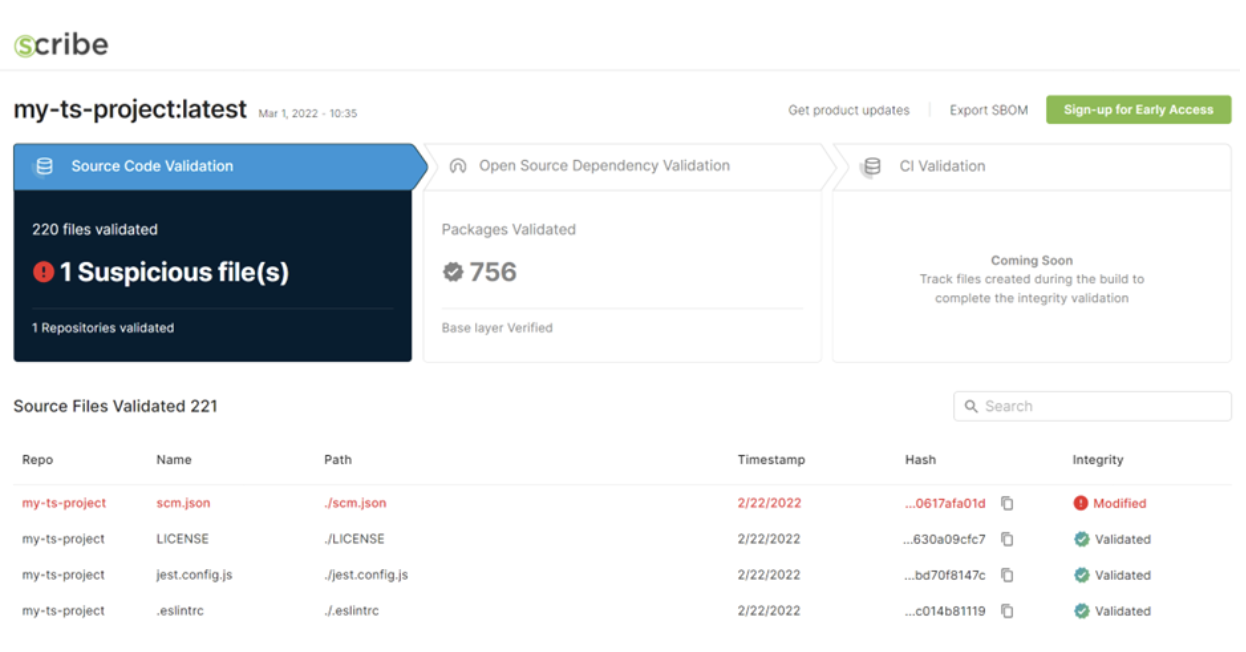
    Scribe Security today unveiled a Scribe Integrity tool that scans software artifacts to make sure they comply with IT organizations’ security policies before they are integrated into an application.

    The Scribe Integrity tool authenticates open source and proprietary source code before it is uploaded into a build. It assumes that all artifacts are “guilty” until they can prove their innocence, said Rubi Arbel, CEO of Scribe Security. That approach makes it possible to ensure the integrity of the overall software supply chain is maintained in a way that doesn’t adversely impact the productivity of developers, he added.

    In addition, the company launched GitGat, an open source policy-as-code tool based on Open Policy Agent (OPA) agent software that enables DevOps teams to periodically run reports that surface insights into the security posture of code residing in GitHub repositories.

    Arbel said that, in time, GitGat’s reach will be extended to add support for additional continuous integration/continuous delivery (CI/CD) platforms.

    The first release of Scribe Integrity addresses Node.js code and the npm package manager with support for additional types of code planned.

    The Scribe Integrity tool also identifies all dependencies to enable DevOps teams to generate an accurate software bill of materials (SBOM) as each software artifact is included in the application, he noted. That’s critical because it enables developers, IT operations and cybersecurity teams to simultaneously see what artifacts, including containers, make up an application, noted Arbel. In the future, the company plans to make available a Scribe Hub that will make it easier to share insights into those software artifacts, he added.

    A series of high-profile security breaches clearly demonstrated cybercriminals’ skill at injecting malware into software artifacts and compromise any application that incorporates that artifact into an application. That malware can then be activated at some later date to potentially compromise any number of downstream applications.

    Those incidents resulted in a greater appreciation for DevSecOps best practices to maintain the integrity of software supply chains. The issue that DevOps teams are trying to address is how to build more secure applications without slowing down the rate at which those applications are built and deployed. As such, DevOps teams are adding tools to the application development process that make it easier for developers to scan code before it is included in an application and verify the integrity of any software component that becomes part of a DevOps workflow.

    It’s unknown how long it may be before the adoption of DevSecOps best practices has a meaningful impact on application security. However, waiting to focus on security until after an application has been deployed is way too late. Cybercriminals today can discover flaws and misconfigurations in applications in a matter of minutes. As more applications are deployed, developers can find themselves spending more of their time fixing vulnerabilities than they do writing new code. A new approach to building applications that are secure from the ground up is clearly required.

  • Styra Unfurls Cloud Service for Implementing Compliance-as-Code

    Styra Unfurls Cloud Service for Implementing Compliance-as-Code

    Styra, Inc. today launched an authorization service based on the Open Policy Agent (OPA) software that can be invoked via an application programming interface (API).

    Torin Sandall, vice president of open source for Styra, said the Styra Run cloud service will make it much simpler to embed enterprise-grade authorization capabilities within applications. Today, developers spend too much time building, maintaining and operating their own authorization platforms to manage permissions across multiple applications.

    In addition to enabling developers to access pre-built OPA logic, Sandall noted the service also offloads storage and global replication of end-user permissions data to a cloud service.

    The service itself currently runs on Amazon Web Services (AWS), but Styra plans to make the service available on other cloud platforms in the future, he added.

    OPA makes use of a general-purpose policy enforcement engine that developers can embed within applications using the Rego language. OPA is now being advanced under the auspices of the Cloud Native Computing Foundation (CNCF) and is gaining traction among cloud-native application developers. OPA provides a means to enforce compliance-as-code across a wide range of microservices that now routinely access a wide range of distributed data.

    However, Styra Run should make OPA more accessible to a wider range of organizations, especially those that are looking to shift responsibility for security and compliance further left toward developers as part of a set of DevSecOps processes, noted Sandall. Developers that don’t have a lot of compliance expertise can now rely on a cloud service that enables them to focus more of their time and effort on writing code, he added.

    The arrival of Styra Run also comes at a time when more organizations are reviewing their software supply chain processes in the wake of a series of high-profile security breaches. It’s not clear to what degree compliance and cybersecurity teams have developed an appreciation for OPA, but as more organizations embrace compliance-as-code, the pressure on those teams should decrease as those applications are inherently more secure than legacy applications.

    There will, of course, be some developers that prefer to embed OPA into applications themselves, but a cloud service accessed via API will be the path of least resistance for most developers building software-as-a-service (SaaS) applications, said Sandall. The issue may simply be making developers aware that another low-latency option exists; one that doesn’t require them to deeply master the Rego programming language for the sole purpose of achieving compliance, he added.

    Regardless of approach, the general expectation going forward is that applications will more easily be able to meet a wide range of compliance mandates without requiring IT teams to deploy and maintain dedicated compliance infrastructure. As such, there may soon come a day when any application that doesn’t use some type of compliance-as-code framework will simply be rejected out of hand.

  • Rezilion Launches Vulnerability Prioritization Platform

    Rezilion Launches Vulnerability Prioritization Platform

    Rezilion today announced general availability of a platform that enables DevOps teams to better prioritize remediation efforts by identifying which vulnerabilities both run in memory and actually impact a class or function that can be executed.

    Liran Tancman, Rezilion CEO, said the biggest DevSecOps challenge organizations face today is that the bulk of vulnerabilities that developers are tasked with remediating don’t constitute a significant cybersecurity threat.

    Rezilion has created a searchable proprietary next-generation vulnerability database (NGVDB) that identifies which issues impact specific classes and functions. That capability enables DevOps teams to de-prioritize close to 95% of software vulnerabilities, said Tancman.

    In addition, the Rezilion platform will surface remediation suggestions that lower the amount of disruption and/or cost, he said. A fully-automated remediation capability, for example, will automatically upgrade and test vulnerable software components and packages within a continuous integration (CI) pipeline that were found to be exploitable. In the longer term, Rezilion is also working toward surfacing remediation suggestions that might be addressed using an alternative to patching, said Tancman.

    The Rezlion platform is also integrated with IT service management platforms such as ServiceNow and project management tools such as Jira to make it easier to address vulnerabilities as part of existing workflows, he added.

    Most developers today are simply overwhelmed by the number of vulnerabilities that cybersecurity teams routinely ask them to patch, noted Tancman. The goal should be to enable developers to focus their limited time and effort on remediating the vulnerabilities that truly matter to ensure application security, he said.

    In addition, developers need to have more confidence in the fact that the patch they are being asked to make won’t break their existing applications, added Tancman.

    Vulnerability prioritization is, of course, at the heart of the long-standing divide that exists between DevOps and cybersecurity professionals. Spreadsheets filled with long lists of vulnerabilities are regularly created, but there is usually no context provided in terms of how severe a threat any given vulnerability poses. As a result, developers would allocate a small portion of their time to applying patches that are prioritized based on intuition and level of complexity rather than severity.

    Naturally, developers are going to allocate most of their time to creating new applications and features. For any DevSecOps initiative to succeed, it’s critical to ensure optimal use of the time allocated to remediation. Cybersecurity teams will continue to compile lists of vulnerabilities, but that list can now be triaged in a way that causes the least amount of friction.

    In the wake of a series of high-profile security breaches, there is now more focus than ever on securing software supply chains. The challenge is to find a way to better secure applications both before and after they are deployed in a production environment. There will always be vulnerabilities that are discovered after an application has been deployed. However, just because a vulnerability exists, that doesn’t mean it’s exploitable. The trouble with application security today is that, all too often, remediation efforts turn out to be a waste of time.

  • GitGuardian Tightens Integration With GitHub to Secure Secrets

    GitGuardian Tightens Integration With GitHub to Secure Secrets

    GitGuardian has expanded its ability to secure code repositories by providing deeper integration with GitHub.

    Ziad Ghalleb, product marketing manager for GitGuardian, said the results of security scans are now provided in the context of pull requests alongside suggestions for remediating issues.

    The company also expanded developer onboarding options by adding an application programming interface (API) key provisioning mechanism integrated with its command line interface (CLI) in addition to making it easier to configure that CLI.

    Finally, GitGuardian extended support for role-based access controls (RBAC) to its platform so that team members can be assigned different permissions levels for incidents based on their role.

    GitGuardian makes it possible to scan source code to detect API keys, passwords, certificates, encryption keys and other sensitive data in a code repository in real-time. Developers building an application often make secrets easily accessible as plain text for the sake of convenience. However, when those applications are deployed in a production environment, developers often forget to delete these secrets. Cybercriminals know to scan for these secrets to make compromising an application environment easier.

    A recent GitGuardian report found a typical company with 400 developers would discover 1,050 unique hardcoded secrets when scanning its entire codebase. Each secret had 13 different occurrences, which meant the effort required to remediate those associated vulnerabilities would be considerable, the report noted.

    Secrets management is, of course, getting more attention as more organizations review their software supply chain processes in the wake of a series of high-profile security breaches. GitGuardian makes it simpler to achieve that goal within the context of a set of DevSecOps best practices by integrating with GitHub with a single click, said Ghalleb.

    It’s still early days as far as adoption of DevSecOps best practices is concerned, but it’s clear more responsibility for application security is being shifted left toward developers. The challenge is many developers still lack the tools required to make sure applications are secure before they are deployed in production environments.

    Naturally, the earlier an application security issue is resolved the less costly it is to fix. The problem with secrets management is cybersecurity teams are usually a lot more focused on discovering vulnerabilities than looking for instances of poorly secured credentials. Once an application is deployed in a production environment, it may be months before anyone discovers there is an issue—if it’s discovered at all. In fact, the number of existing applications running in production environments that have secrets management issues could be staggering.

    One way or another, it’s only a matter of time before more of those issues are surfaced. In the meantime, DevOps teams can reduce the number of applications that might have this issue by making it easier to discover secrets within applications before they are deployed in production environments. After all, the only thing worse than a secret being discovered by a cybersecurity team is having one uncovered by cybercriminals that use it to wreak havoc.

  • This DevSecOps Thing Is Real After All

    This DevSecOps Thing Is Real After All

    Whether you made it to San Francisco, California last month for RSA Conference or not, you don’t want to miss Tuesday’s DevOps Connect: DevSecOps Virtual Summit.

    On Tuesday, July 12, 2022, we are presenting a virtual broadcast of the sessions from our recent DevOps Connect: DevSecOps event at RSA Conference in June 2022. All of the great sessions will be available as well as some bonus sessions that didn’t make it to RSAC.  

    For me, this event was extremely gratifying because it served as validation that I wasn’t crazy all those years ago. When I started devopsy.kinsta.cloud in 2014, I did so because I thought it would be great for security—back then it felt as though I was a lone voice crying out in the wilderness! Now, here we are in 2022 and DevSecOps is real. It is accepted, it is sought-after and it is changing the way software is developed, deployed and managed.

    When I put on the first DevSecOps event at RSA Conference seven years ago, it was a bit controversial. The idea of bringing together the security community with the DevOps tribe was like what I imagine peace treaty negotiations between two warring parties would be. The security folks said no one else cared about security. The DevOps people, like many other IT pros, claimed the security folks were just people who said no to all their initiatives. The lack of trust ran deep. But we kept at it—and while the situation is far from perfect today, so much progress has been made.

    This year’s event featured our best speaker lineup yet. Jim Zemlin, executive director of The Linux Foundation, kicked off the event by talking about open source and security—software supply chain, SBOMs and security, oh my!  Continuing the open source and security trend, CNCF executive director Priyanka Sharma presented a great session discussing cloud-native and DevSecOps.

    And you won’t want to miss two of my favorite sessions. The first involves my friend John Willis asking, “What would Deming do?” in his session at 11:30 a.m. ET. Given the current state of world affairs and the software and security market, what would Edward Deming, the patron saint of DevOps, say and do? John is a bit of a Deming expert himself, so his insights are spot on, I think. And second, Carolyn Wong (who is a superstar) talks at 12:00 p.m. ET in her session about pentesting at scale, pentesting-as-a-service and DevSecOps.

    But wait—there’s more! Chenxi Wang has a powerful session, delivered off the cuff, about the current state of DevSecOps, software supply chain security, investing and more; that’s at 9:55 a.m. ET.

    We’ll also feature two amazing panels: One is made up of the authors of a recent book, Reinventing Cybersecurity. The other features folks from Intel, Mitre, NIST and the U.S. Senate talking about security compliance with an emphasis on software supply chain security and SBOMs (see a pattern here yet?).

    And that’s just the tip of the iceberg—there is even more from this year’s event that you don’t want to miss. So, head on over and register—it’s free. Many of the speakers will be online, live, during their presentations to answer questions, network and offer their guidance. There are also exhibits and sponsor booths and other fun stuff like a yoga class and a DJ spinning great tunes.

    This DevSecOps stuff is real and you will learn a lot from these sessions. We can’t wait to see you there!

    While you’re at it, check out our upcoming CloudNativeDay Virtual Summit August 10, 2022, which is shaping up to be a great event, as well!

  • Turning Off DevSecOps Noise for Functional Fidelity

    Turning Off DevSecOps Noise for Functional Fidelity

    Analyzing the DevOps and DevSecOps software marketplace demonstrates the high demand for tools and platforms that reduce false positives. As businesses and organizations adopt a rigorous, disciplined software development life cycle and ascribe to strict compliance frameworks, they quickly realize that automated tools can generate a substantial amount of noise, in the form of false positives, that pollute their efforts to maintain a lean and focused operation.

    True Positive Vs. False Positive Vulnerabilities

    Static application security testing (SAST) is fundamentally about using pattern recognition to identify vulnerabilities in code. The more aggressive the scan rules, the more likely a snippet of code will be flagged as a vulnerability; in other words, a “true positive” finding. Automated scanning is fundamental to effective DevSecOps. But if the scanning is too aggressive, it may generate findings that aren’t actual problems; in other words, false positive findings 

    You want your scan to return true positive findings—actual vulnerabilities that can be fixed and remediated. A false positive is a finding that isn’t actually a vulnerability. The ideal tool catches all the true positive vulnerabilities and returns a minimal number of false positives.

    Many platforms give their users granular control over which rules run and are applied to their code. This first layer of control is similar to allowing your team to tune their scans to focus only on certain frequencies while ignoring others. Often, this is used to increase the speed with which a platform might complete a scan. It can also be used to tune out “noisy” rules. It’s perfectly legitimate to use controls like these, but it’s important to recognize that those completed scans aren’t comprehensive.

    Speeding Up Can Slow You Down

    Positive findings, whether they are true or false, take more time and resources to evaluate and remediate. Investing resources to remediate true positives is worthwhile. It would be ideal if they had been caught earlier in the process, but catching a vulnerability before it hits production is the entire reason you are doing DevSecOps in the first place! False positives may not require actual remediation, but reviewing them and then manually confirming their false nature is directly counterproductive to the reasons an organization adopted automated SAST in the first place.

    SAST Plus DAST Keeps You Ahead

    The gold standard for effective security testing is to pair SAST with dynamic application security testing (DAST), sometimes also called interactive application security testing (IAST). This process will correlate the positive findings from the SAST scans and test them using simulated data in an emulated runtime environment. 

    DAST/IAST actually tests each bit of code that looks problematic because of a particular pattern and then tests whether the code is actually vulnerable. DAST provides an automated, testable, repeatable and provable method to test those positive findings for trueness and falseness. If you are only doing SAST scanning, then the noise-to-signal ratio from your platform is governed strictly by the intelligence embedded into their pattern-matching code. Depending on the quality of the tool being used, your actual mileage may vary.

    DevSecOps Is the Right Path

    Businesses and organizations clearly understand the problem of potential vulnerabilities. Guarding against a security breach is critically important to protecting proprietary information and the privacy of their customers. DevSecOps is clearly the right path to take to reach that goal. However, it is critically important that the vehicle(s) these teams use to get there (in this case, SAST and DAST/IAST) have built-in functionality to focus their efforts on real problems and not waste it on phantom issues.

  • More Than Half of DevOps Pros Have Backdoor Access to IT Infrastructure

    More Than Half of DevOps Pros Have Backdoor Access to IT Infrastructure

    A survey of 600 DevOps professionals conducted by strongDM, a platform for managing access to IT infrastructure, found nearly two-thirds (64%) had productivity impacted on a daily or weekly basis because of access issues.

    It’s not surprising that, as a result, DevOps teams created a number of workarounds to gain access, even though those methods don’t comply with cybersecurity best practices, according to the survey. More than half of respondents (55%) maintained backdoor access to systems, and 42% have embraced shadow IT to get access to tools and systems they needed for their roles, the survey found.

    Worse yet, the survey found that 53% of respondents admitted they are sharing credentials across teams.

    Well over half (57%) of respondents said it could take days or weeks for access requests to be approved, with 40% reporting it takes days to add tools to existing access solutions. Nearly three-quarters (73%) of respondents also noted it requires 15 minutes or more to gain access to infrastructure.

    More than half of respondents (52%) said they have missed deadlines due to issues with accessing infrastructure, with 53% of those respondents being held accountable for the missed deadline even if it was caused by their lack of access to infrastructure.

    Justin McCarthy, CTO for strongDM, said despite all the hype surrounding identity management and zero-trust IT, it’s clear many organizations are still struggling with the basics of access control. That issue has been further exacerbated by the need to enable more DevOps professionals to work from home since the start of the COVID-19 pandemic more than two years ago, he added.

    Many of those organizations are still relying on virtual private networks (VPNs) even though it’s been shown that stealing the credentials to access those VPNs is relatively trivial, McCarthy added.

    In place of those approaches to access IT infrastructure, strongDM is making a case for a dedicated infrastructure access platform that manages and audits access to databases, servers, clusters and web apps. It is based on local client software, a gateway intermediary and configuration tools that track roles and permissions.

    The benefits of that approach span everything from lower IT support costs to faster onboarding of new IT staff, noted McCarthy.

    Managing infrastructure access for DevOps teams is, of course, always going to be a challenge. DevOps teams are made up of engineers—among the most challenging types of end users to support. Many of them will use their own expertise to circumvent any process they deem to be inefficient. The trouble is, many of those end-runs would not pass muster with cybersecurity teams responsible for access management. The challenge each of those cybersecurity teams needs to come to terms with is the amount of time they want to spend time looking for these cybersecurity policy workarounds versus making it easier to securely access IT infrastructure.

    The sad truth is both DevOps and cybersecurity professionals are wasting a lot of time and effort trying to outwit each other when that time could be put to better use.

  • TechStrong Con: Open Source Software Community Needs Security Help

    TechStrong Con: Open Source Software Community Needs Security Help

    The only way to make significant improvements in the state of open source security is if more organizations that benefit from open source projects commit to making more resources available to achieve that goal.

    At the virtual TechStong Con event, executives on an Open Source and DevOps panel called for more contributions from enterprise IT organizations to ensure the integrity of open source software.

    Organizations of all sizes now benefit from open source software whether directly or indirectly. Those organizations have a responsibility to participate in the development of that software in any way they can, said Jeffrey Barnes, senior software engineer for Remote Operations, a provider of medical transcription services. “We need to give back to the community,” he said.

    Those efforts don’t necessarily have to involve contributing actual code, added Barnes. Many open source projects are in need of documentation and testing help because the number of actual maintainers of the project is relatively small, he noted.

    The challenge is that many enterprise IT organizations don’t understand how to participate in open source software development processes, noted Tom Sweet, CIO for Industrial Refrigeration Pros. An organization might download a piece of open source software and then extend it. Rather than continuing to maintain that branch on their own, organizations should contribute that code back to the project to reduce maintainers’ overall IT burden, Sweet said.

    “Many organizations are struggling to contribute back,” said Sweet. “It’s an evolution.”

    Organizations clearly need to make contributing code back to open source software projects a natural extension of their DevOps workflows. In the meantime, the Open Source Security Foundation (OpenSSF), an arm of the Linux Foundation, is focusing on 10 streams of investment that, in total, would require more than $150 million in funding to drive greater adoption of DevSecOps best practices among maintainers of open source software projects.

    The core issue is that many of those projects are maintained by a small number of programmers that voluntarily contribute their time and effort to build components that others are free to use. Like any other developer, the amount of security expertise those individuals have is limited. The onus for making sure the projects and software are secure is on the organizations that decide to deploy that software.

    Unfortunately, many IT vendors and large enterprise IT organizations reuse that code without contributing anything meaningful back to the project—whether that be in terms of financing or helping open source maintainers find and remediate vulnerabilities.

    It’s not clear to what degree business and IT leaders realize how dependent their organizations actually are on open source software. Many of them assume that open source projects are supported by IT vendors when, in reality, there are many projects that are dependent on the efforts of a small handful of developers volunteering their time and skills.

    Many organizations, of course, may soon decide not to employ open source software if it doesn’t have a critical mass of developers working on it. However, in an era where DevOps teams and developers routinely download software, enforcing those policies is going to be problematic. The best thing enterprise IT organizations can do is engage with the open source software community more rather than less.