Category: Infrastructure/Networking

  • Why SDN’s Hot Streak Continues in 2020

    Why SDN’s Hot Streak Continues in 2020

    The software-defined networking (SDN) market is expected to grow by double-digits between now and 2023, driven by the increasing mainstream adoption of this technology. And for good reason: SDN gives IT the ability to make changes through software code instead of reconfiguring each device, and manage data traffic from a central console to move it in any direction.

    Communication gear still drives the physical movement of bits, but software drives the data plan and the control plan. This allows network managers—and even applications—to dynamically manage network resources based on complex system needs. SDN supports real-time integration across multiple servers, services and clouds, and it also processes huge volumes of data. IT departments can now overcome traditional networking issues such as performance bottlenecks and develop a more responsive network strategy.

    SDN Plays a Critical Role in Cloud Adoption and Improves Security for IT Departments

    SDN architecture integrates easily with cloud-based environments, both public and private ones. This gives network managers greater flexibility, speed and automation in managing their network clouds.

    On the security front, SDN allows an IT department to divide a network connection between an end user and the data center, and provide different security settings for the various types of network traffic. For example, a network could have one public-facing, low security network without any sensitive information. But another network segment could have a software-based firewall and encryption policies that allow for more sensitive data to travel over it. Having the ability to match security policies to specific workloads is a key advantage of SDN. 

    One of the hottest trends with SDN is microsegmentation, where IT professionals customize security settings to different types of traffic. With this security model, the goal is to apply segmentation rules down to the workload or application. This mitigates the likelihood of an attacker migrating between compromised workloads or applications to others. Basically, microsegmentation creates intelligent groupings of workloads based on their characteristics as communicated inside the data center. This approach does not depend on dynamically changing networks, specific business or technical requirements which means microsegmentation provides enhanced security.

    The software-defined wide area network (SD-WAN) takes SDN even further by connecting enterprise networks over large geographical areas, such as branch offices and data centers. Traditional WAN connections typically needed technology that required special proprietary hardware. SD-WAN moves more of the network control into the cloud through software, allowing for greater scalability, flexibility and reduced hardware costs. SD-WAN is expected to grow even faster than SDN in the coming years for several reasons:

    • Greater reliability of application performance, a huge advantage for users in today’s digital workspaces.
    • High level of connection security for cloud applications without performance trade-offs.
    • Increased bandwidth which reduces congestion and slowdowns.
    • More business agility through faster deployments of new applications.
    • Simpler IT administration through a centralized console instead of in-field configurations.

    SDN and its offspring of SD-WANs continue to defy expectations in creating greater agility, flexibility, security and reliability. Leading-edge IT organizations are embracing the imperatives of digital transformation through SDN and SD-WAN to provide for agile deployment, provisioning and operational management.

    — Melinda Cross

  • Storj Labs Unfurls Decentralized Storage Service

    Storj Labs Unfurls Decentralized Storage Service

    Storj Labs has made generally available a distributed storage platform based on the excess capacity available on devices ranging from servers to individual desktops.

    Company CEO Ben Golub said the goal is to provide IT organizations with an alternative to storing data inexpensively using storage resources that have been vetted by Storj Labs.

    At the core of the Tardigrade Decentralized Cloud Storage Service provided by Storj Labs is an open source object storage system that is compatible with the S3 application programming interface (API) defined by Amazon Web Services (AWS). That object storage system distributes 80 slices of a file across a subset of thousands of nodes that each contain only a slice of the data required to reconstruct that file when needed. Only 29 of those slices are needed to reconstruct a file, so Golub said it’s relatively simple to ensure data is secure without having to manage encryption keys.

    Following an extensive beta test of the Tardigrade, the company claims to have achieved 99.95% availability, with a service level agreement of 99.9999999% achieved in terms of durability. Golub said Tardigrade makes use of erasure coding to make sure data is distributed in a highly resilient fashion.

    Storj Labs compensates owners and data centers along with individuals with access to a lot of excess storage capacity for making capacity available, Golub said. Most storage drives are not anywhere near full capacity, which Golub noted has made it relatively easy for Storj Labs to amass 19PB of storage for its Tardigrade service. Each provider of storage capacity is required to pass a series of data stewardship tests for a period of time before being allowed to become a member of the Tardigrade service.

    Storj Labs has also set up an open source partner program through which any open source project with a Tardigrade connector will receive a portion of the storage revenue generated by users of that software. That approach allows participants in projects to be partially compensated for their efforts as alternatives to cloud service providers, which routinely commercialize open source software without helping to fund its development, said Golub. Based on his previous experience as CEO of Docker Inc., he noted many open source projects die on the vine simply because the team that created it simply can’t afford to sustain it.

    Interest in Tardigrade Decentralized Cloud Storage Service for certain use cases as an alternative to pubic clouds could be high, he said, given the fact that there has been no meaningful decline in cloud storage service pricing in the last three years. Use cases that should prove to be especially appealing include data protection and image retention. Storj Labs is also making available a library of bindings for Go, Android, C, .NET/Xamarin, Node.js, Swift and Python to make it easier for developers to invoke Tardigrade storage services as code.

    It may be a while before IT organizations are completely comfortable with decentralized storage services as an alternative to public clouds. However, as the amount of data that needs to be stored continues to grow, every option available to store data may be needed soon.

    — Mike Vizard

  • Why the Buzz on Software-Defined Everything (SDx)?

    Why the Buzz on Software-Defined Everything (SDx)?

    You’ve likely heard the buzz getting louder the last few years around software-defined everything (SDx). You’re probably finding a swarm of companies knocking on your door selling a host of services around implementing software-defined networking (SDN), software-defined storage (SDS) and software-defined data center (SDDC). What you may not realize is that this software-defined movement is truly a disruptive technology shift that is dramatically changing the way an organization accesses storage, networks and data centers.

    The overarching mission of SDx is to break down the discrete IT silos (compute, storage and networking) by using software to bridge the technological and organizational gaps. By giving software systems a starring role in managing different kinds of hardware, the premise is that productivity will increase through more robust network access from both portable and traditional devices. 

    What are the true potential and outcomes of SDx that an IT administrator can tout to management? For starters, early adopters have reported being able to deliver significant cost savings and greater speed of delivery. They cite benefits such as decreased hardware costs, greater automation, more rapid deployment of IT resources and shorter timelines to implementation—to name the key ones. 

    Let’s take the traditional data center, where most organizations grapple with the high costs of ongoing management and maintenance of network switches, servers, storage devices and other hardware. Keeping these resources updated can be complex and expensive for an IT department. Moving to an SDDC, for example, can lower the total cost of ownership by reducing hardware costs (servers, racks, disk and tape, routers, etc.), and minimizing the data center size and the use of power, cooling and ongoing maintenance. With an SDDC, the IT department enjoys the benefits of a more simplified process that increases the speed of appropriating and provisioning networking. Software-automated provisioning can enable application deployment within minutes, for example.

    Instead of the IT department being considered a hindrance, SDDC allows developers to create applications that are best for the business, instead of what works based on the hardware.

    “Every technology organization needs to be able to transform ideas into working functionality that creates value for customers. That means you need not only world-class development processes but infrastructure processes as well—and that’s where software-defined data centers become absolutely relevant,” said Gene Kim, co-author of  “The Phoenix Project: A Novel About IT, DevOps, and Helping Your Business Win.”

    The main elements of an SDDC include:

    • A software implementation of a computer, which is called virtualization.
    • An SDN where hardware and software resources are merged into a software-based virtual network.
    • An SDS that includes storage virtualization. 
    • Automation software that allows an IT administrator to provision, control and manage all SDDCs components.

    The second big driver of SDx adoption by IT departments is the increased agility they experience in responding to business demands. Much of this is made possible with SDS, which is an innovative way to restructure your infrastructure by separating hardware from software, and using software in place of disks and networking devices. SDS uses standard servers to manage storage requests by virtualizing your physical storage. This gives you more control over where and how data is stored.

    Some of the key benefits of SDS over traditional storage include:

    • Automatic storage management capabilities reduce the number of manual tasks for your storage administrators. They adapt to different needs without any human oversight or new hardware requirements.
    • Flexibility to increase your storage requirements while decreasing the capacity of your existing hardware.
    • Lower costs since SDS solutions run on standard hardware, and the automation reduces the number of administrators required. 
    • More scalability options, depending on your business requirements, by adding extra storage arrays or including additional CPUs and memory.


    As business requirements continue to increase in speed and number, forward-thinking IT departments are moving away from hardware commitments and rigid architectures that constrict their ability to react and adjust to changing needs. Software-defined technologies are becoming the innovative powerhouses behind building more efficient and agile IT services for today and well into the future.

    — Melinda Cross

  • Cato Networks Offers Instant SD-WAN Service

    Cato Networks Offers Instant SD-WAN Service

    Cato Networks has added an instant-on capability to its software-defined wide area network service (SD-WAN) service to make it easier for IT teams to provide employees with remote access to applications.

    Dave Greenfield, technology evangelist for Cato Networks, said rather than having to configure and install a virtual private network (VPN) client on every device to access applications, IT teams can simply share a URL to provide network access via a single sign-on protocol without requiring client software. At a time when many IT teams are scrambling to allow every employee to work at home to help combat the spread of the COVID-19 coronavirus, the Cato Software Defined Perimeter (SDP) service provides an alternative approach to achieve that goal at scale, he said.

    The Cato SDP network is an instance of a global SD-WAN service co-managed by Cato Networks. IT teams still control who gains access to what applications using multifactor authentication, while Cato Networks manages the underlying network and security infrastructure, including all the firewalls and endpoint protection software. As such, Greenfield said, Cato SDP is one of the first instances of a service based on what Gartner is now describing as a secure access service edge (SASE) architecture.

    Greenfield said trying to scale access using legacy VPN software is problematic because it requires IT teams to acquire more software licenses and bandwidth, while end users are provided with passwords to access the corporate network, which can be easily hacked. And, perhaps most problematic, most VPNs limit the number of simultaneous users allowed on the network.

    Cato SDP provides access to a zero trust network environment that only provides access to applications that end users have been specifically authorized to use, said Greenfield, noting all of that can be accomplished in as little as 10 minutes.

    Cato SD-WAN

    Since the beginning of the COVID-19 outbreak, Greenfield said Cato Networks has seen a sharp increase in usage of its global network, which consists of points-of-presence residing in third-party data centers distributed around the world. This setup makes it possible to optimize application experiences based on where end users are physically accessing the internet.

    It may be a few months to as long as two years before the COVID-19 pandemic subsides. What today may be viewed as a singular disruptive event could very well be a harbinger for how organizations will need to work from now on. Even once IT teams get everyone in their organization up and running from home, many of them will have to ask themselves how long they are prepared to manage IT as a remote service. The emergence of SASE-based services provides an alternative co-managed approach that allows IT teams to rely on an external service provider without having to give up control over their applications to a managed service provider (MSP).

    Naturally, it may be a while before the current crisis subsides enough for organizations to realize they may need to fundamentally change the way they consume IT. The only thing that is for certain right now is that conversation is all but inevitable.

    — Mike Vizard

  • Taking the Fear Out of Legacy Modernization

    Taking the Fear Out of Legacy Modernization

    Once a cutting edge and golden standard of technology, legacy-based monolithic applications have become a big burden for many organizations. While pivotal in supporting business functions, they have and will continue to lose the flexibility and overall usability required to be successful in today’s competitive digital and agile business landscape.

    But for most businesses, and especially the Fortune 1000s, looking to streamline their services and improve overall functionality, the prospect of breaking away from these systems is often seen as a double-edged sword. Ridding themselves of brittle, complex and tightly integrated technology, on one hand, can provide the right environment to introduce newer software. This can help elevate their businesses to be nimbler, more innovative and productive, ultimately driving better experiences and increased revenue. On the other hand, though, maintaining them can be viewed as the safer option that doesn’t include the fear of lost business intelligence, downtime for consumers and the biggest of all, an exorbitant cost that they simply can’t justify.

    What’s important for them to realize is these modernization efforts don’t always require a complete overhaul or significant downtime to operations from rearchitecting or reengineering their applications. In fact, any organization in need of change can choose from a variety of alternative modernization processes that best suit their needs.

    Below is a closer look at those opportunities and success stories from BBVA, Companies House and MTA after implementation.

    Automated Conversion

    With many large financial institutions, for instance, they are often running mission-critical applications and processes on their legacy systems that reduce their ability to meet the demand of modern business processes. As they look to reduce costs, enable data and business process integration to better navigate an increasingly global banking landscape, legacy modernization is top of mind. To make necessary changes and continue business as usual, one of the best strategies could be automated conversion.

    By utilizing the necessary tools, an organization can produce a revitalized version of their legacy system in a new environment in a modern code, such as Java or C#. Through this process, once an application and/or database is translated, developers are uniquely positioned to maintain business logic from their legacy system while extending application functionality and enabling enhanced integration capabilities for target databases. Because this approach is software-based, this modernization strategy is significantly less costly and can be completed in steps to minimize any interruption to business.

    In the case of BBVA, the second largest bank in Spain that operates in over 40 countries, the organization needed to reduce licensing costs of its mainframe and enhance its features, simultaneously freeing data trapped within its legacy system to enable these global operations. By pursuing an automated conversion to its systems, the bank was able to convert its code while taking total technical inventory, identifying key risk factors in its mainframe and ultimately removing significant amounts of dead code and approximately 38% of its programs.

    As a result of the reduced cost of its mainframe operations, the company achieved positive ROI of their transformation strategy within two years.

    Data Replication

    Fully rewriting applications can be time consuming, costly and risky, with the potential loss of vital information and processes. An alternative option to keep the legacy system fully intact while freeing essential data from its mainframe is data replication.

    Data replication allows an organization to replicate its mainframe and non-relational data through an entirely new, relational model. This allows the legacy system to continue with its standard functions, but automatically copy and convert data to the new model with a full replica of the legacy database, enabling greater visibility and flexibility for a business.

    This process was especially effective for Companies House, Britain’s government bureau that records and stores information on the country’s 1.8 million unique companies. Since the organization requires daily data updates because of the need for public access to this information, the organization couldn’t afford any downtime while modernizing. By replicating its data onto a relational model, the company was not only able to more seamlessly integrate its code into its target database, but more easily manage daily updates to its data–ultimately resulting in faster service for consumers and significantly reduced costs for the company.

    Batch Offloading

    Many legacy systems remain fully intact today because of their incredible ability to process vast amounts of data in a reliable and effective fashion. That said, as the amount of information within the system grows, so do the costs of maintaining these systems. For organizations with limited IT budgets and resources, the ideal approach lies in batch offloading.

    Batch offloading is often an easy first step in a modernization effort. This process requires an organization to convert one or more batch process applications to modern programming languages. By moving some of these processes off of the mainframe, organizations can future-proof their processes, maintain greater flexibility and reduce costs. These savings can also trickle down to the consumer, giving these organizations an edge against their competitors.

    For New York’s Metropolitan Transportation Authority (MTA), the organization aimed to move critical applications off its legacy mainframe to make way for refreshed, cost-effective platforms. By undertaking the batch offloading strategy, the MTA continued without any interruption or significant changes to its mainframe’s processes for users. The organization was able to reduce the costs from maintaining its legacy system and prepare for the next steps in its broader modernization strategy.

    Choosing the Right Approach

    A business doesn’t have to be a member of the Fortune 1000 in order to successfully execute a modernization project like one. By developing a strong understanding of the functions of current systems, the risks associated with maintaining it, organizational needs and a realistic timeline for transformation efforts, a company can uniquely position itself to make significant changes to operations without interruptions to business.

    While this transition is a significant undertaking for any organization, it’s up to them to identify the best modernization strategy for its goals in order to reduce costs, improve the customer experience and future-proof their processes to achieve overall success.

    — Cameron Jenkins

  • Lenovo Looks to Automate Edge Computing

    Lenovo Looks to Automate Edge Computing

    Lenovo is extending its IT automation framework for provisioning IT infrastructure out to edge computing platforms.

    Charles Ferland, vice president and general manager for networking and communications service providers at Lenovo Data Center Group, said the Lenovo Open Cloud Automation (LOC-A) framework provides a single pane of glass through which IT teams can not only provision IT infrastructure but also invoke other frameworks to automate, for example, the deployment of virtual machines on top of that IT infrastructure.

    Ferland said while there are plenty of frameworks for automating the deployment of virtual machines, many IT teams will spend weeks manually provisioning IT infrastructure. LOC-A provides a mechanism to reduce the time and effort required to minutes. However, rather than completely reinvent the IT automation wheel, Lenovo decided to also integrate LOC-A with frameworks such as Ansible, Puppet and Chef, he said, noting that approach makes it possible for IT teams to adopt LOC-A without having to replace any of the IT automation frameworks they already might have in place.

    LOC-A can also be extended to edge computing platforms other than ones provided by Lenovo, he added.

    Beyond simply reducing the amount of time required to provision IT infrastructure, Ferland noted LOC-A also serves to reduce errors that typically occur when IT teams manually provision IT infrastructure. In many cases, those configuration errors can lead to cybersecurity issues later. Of course, many IT teams have developed custom scripts to automate the provisioning of IT infrastructure. However, most of those scripts don’t scale and are poorly documented, noted Ferland. When a member of the IT team that wrote the script leaves the company, often the IT team left behind must develop another script. In many cases, IT personnel view the scripts they develop as a tool that belongs to them rather than the company that hired them. Ferland said the primary goal is to provide a scalable IT automation framework that helps IT teams further advance the adoption of best DevOps practices.

    Ferland said Lenovo developed LOC-A to provide a cloud-like experience for on-premises IT infrastructure that is similar to what IT teams experience when provisioning IT infrastructure on a public cloud computing platform. LOC-A is currently being employed by telecommunications carriers including T-Systems.

    It’s no coincidence Lenovo’s decision to extend LOC-A to the edge comes at a time when carriers are creating 5G networks that require applications to be processed in real-time as close to where data is created. Those edge computing platforms are going to be deployed in, for example, locations that IT teams are not going to be able to physically reach easily.

    It’s unclear to what degree IT automation frameworks might induce IT teams to standardize on IT infrastructure at the edge. Lenovo, however, clearly views providing this capability as a means to differentiate its platforms at a time when there is currently very little standardization at the edge. The challenge, of course, is the less standardization at the edge there is, the more difficult it becomes to manage.

    — Mike Vizard

  • How 5G Mobile Networks Will Change IoT Security

    How 5G Mobile Networks Will Change IoT Security

    Depending on your location, you might have noticed a new 5G icon on your cell phone recently. The roll-out of the new 5G mobile network is largely a positive change for consumers and businesses. The fifth generation of cellular networks (hence 5G) purports to be one of the fastest wireless networks ever created.

    This technology claims to provide more efficient interconnectivity, and faster data transfers between people, objects and devices. All good things, right? But what security risks does 5G represent for the modern age?

    Some cybersecurity experts suggest that new vulnerabilities are versions of problems not entirely flushed out from 4G and even 3G networks. This article will attempt to explore some problems and opportunities that IoT security experts need to be aware of, and how savvy enterprises can be proactive about security in the age of 5G.

    Riding the 5G Wave

    A business’s potential is only as great as the technology they elect, as an organization, to adopt and use. One of the first benefits that 5G provides comes from the additional speed that the network provides. 4G posted average download speeds around 20Mbps. With a fully deployed and optimized 5G network, users should expect those download speeds to reach anywhere from 500 to 1,500Mbps. 

    Raw speed is one thing, being able to harness this type of efficiency is another. A Barclays’ poll recently reported that only around 28% of businesses understand 5G or the practical business applications the network offers. 

    Along with the challenges of leveraging the increased speed of the 5G network for business purposes, another important aspect of 5G education involves the security risks associated with faster technology. We suspect that if only 28% of businesses understand the practical applications of a 5G network, the awareness of potential security risks may be a similarly low figure.

    Getting Up to Speed on G Security

    While 5G touts a tighter grip on security, experts in the space will remind us that some of the concerning holes in the security of 4G, and even 3G, networks have been carried over into the rollout of 5G. Give credit where it’s due, the 5G security wins are associated with the encryption process which improves anti-tracking and spoofing features. This means that would-be criminals have a much harder time tracking and manipulating device connections.

    5G is also more software and cloud-focused than previous versions, which allows for better monitoring so threats can be spotted and mitigated more quickly. 

    While this is good for consumers, it’s not a perfect system by any means. “Stingray” devices can still be used to deploy fake base station attacks, which allow attackers to intercept mobile traffic and potentially manipulate data.

    Downgrade Attacks

    Purdue University and the University of Iowa outlined findings from design issues in the 5G protocol that exposed 11 vulnerabilities that may be exploited by bad actors. Five of these discovered vulnerabilities were carried over from 3G and 4G networks. Notably, a “downgrade attack” which essentially reverts the devices to use old mobile data networks. On top of potentially leading to higher wireless bills, this may allow attackers to track calls, texts or browsing habits on devices.

    If a device is forced to operate in a limited-service mode, an article in WIRED explains how IMSI numbers may also become exposed because of a downgrade attack.

    “One purported benefit of 5G is that it protects phone identifiers, like your device’s ‘international mobile subscriber identity,’ to help prevent tracking or targeted attacks,” stated WIRED. “But downgrade attacks like the ones the researchers found can bump your device down to 4G or put it into limited service mode, then force it to send its IMSI number unencrypted. Increasingly, networks use an alternative ID called a Temporary Mobile Subscriber Identity that refreshes periodically to stymie tracking.”

    Tips to Avoid Security Pitfalls in the Age of 5G

    In the age of the fastest speeds ever seen and nearly ubiquitous connectivity because of the rapid adoption of IoT devices, it’s becoming apparent that a zero trust model could help address security concerns with 5G and beyond. 

    This may require additional education to be available for employees, but an increase in security best practices for endpoint users is something that will benefit an organization tremendously. Zero-trust security models continually check the user’s presence and behavior within a network regardless of whether the user is human or machine. 

    It might seem like a great idea, but adopting the model isn’t a change to be taken lightly. A survey conducted by AT&T about 5G security indicated that just 33% of respondents reported they are currently using multi-factor authentication—the road to zero trust will take buy-in from executives and managers. 

    Sharing the Burden of Security

    The 5G rollout does provide built-in security features, but it should not be viewed as the Holy Grail. An organization will benefit from having a comprehensive security model, but that doesn’t mean they need to single-handedly oversee every aspect of that model. 

    5G is a combined effort that involves network operators and enterprises, and shared responsibility is essential for long-term success. Managed service providers should be considered by companies that may be short-staffed, or don’t have the in-house resources to cover other important areas of security, such as ransomware protection.

    Security within a business can’t exist in a silo, it’s a team sport—make sure you’re on the winning side.

    — Marty Puranik

  • Cohesity, HPE, Cisco Create ROBO Platform

    Cohesity, HPE, Cisco Create ROBO Platform

    Cohesity, in tandem with Hewlett-Packard Enterprise (HPE) and Cisco Systems, today announced an integrated server and storage platform for remote office/branch offices (ROBOs) designed to be installed in a turnkey fashion.

    Rather than requiring IT staff to be present in a ROBO, the platforms are designed to be installed by a local office manager and then centrally managed using the Helios management platform developed by Cohesity. IT organizations will have the choice of configuring those platforms with servers from either HPE or Cisco. The platforms themselves can be ordered only directly from either HPE or Cisco. HPE is also an investor in Cohesity.

    Raj Dutt, director of product marketing for Cohesity, said the ROBO platforms being offered in collaboration with both companies is an extension of a capability Cohesity already has that allows its distributed file system to be deployed on virtual machines. The ROBO platforms, which replace the need to manage local instances of Windows file servers, extend that capability to a set of turnkey physical appliances that can be managed either via APIs provided by Cohesity or through the graphical user interface (GUI) the company makes available as part of Helios, said Dutt.

    At the core of the ROBO platforms is a multiprotocol storage system capable of storing files locally or accessing data stored in object-based storage systems that support the S3 application programming interface (API) defined by Amazon Web Services (AWS). Cohesity claims this is the first platform to combine file and object services with backup and recovery and archival services in the cloud in a turnkey platform designed specifically for ROBO environments. That capability also enables Cohesity to store an immutable copy of data that can be recovered in the event of a ransomware attack, noted Dutt.

    Dutt, citing data from Enterprise Strategy Group (ESG), said more than half of enterprise data will be created and processed outside the data center or a public cloud by 2022. Much of that data will be created and processed in real-time on a wide variety of edge computing platforms. The goal now is to reduce the amount of data any edge computing platform needs to access over a wide area network (WAN), he said. The Cohesity platform also employs global variable-length sliding window deduplication and compression to optimize both storage efficiency and bandwidth utilization. All data at rest and in-flight is also encrypted.

    It’s unclear to what degree organizations will be modernizing the management of IT in ROBO environments. What is clear is the need to have local IT administrators or dispatch IT teams to set up systems in ROBO environments is coming to an end, as IT infrastructure deployments and ongoing management become more automated. In the event of platform failure, it would even be less expensive to simply make a second appliance available locally or use an overnight delivery service to send a replacement. Of course, that may mean fewer road trips for the IT staff. However, most IT organizations have plenty of other tasks in the data center to keep most of their IT staff fully engaged.

    — Mike Vizard

  • Veeam Updates Backup and Recovery Platform

    Veeam Updates Backup and Recovery Platform

    Veeam today announced the general availability of version 10 of the Veeam Availability Suite, which, among more than 150 enhancements, adds support for network-attached storage (NAS) systems, additional ransomware protection via an ability to create immutable backups in the cloud, an ability to recover multiple virtual machines simultaneously and a set of application programming interfaces (APIs) for mining data.

    Danny Allan, chief technology officer and senior vice president of product strategy for Veeam, said IT organizations are looking for more efficient methods of protecting data, as there is no longer enough time in the day to back up petabytes of data.

    Veeam now provides the ability to back up massive amounts of unstructured data residing in NAS systems by only updating the primary backup file with the most recent changes made to data on the NAS platform, said Allan. That approach, he noted, also curtails costs because it substantially reduces the amount of data that needs to be replicated across a network.

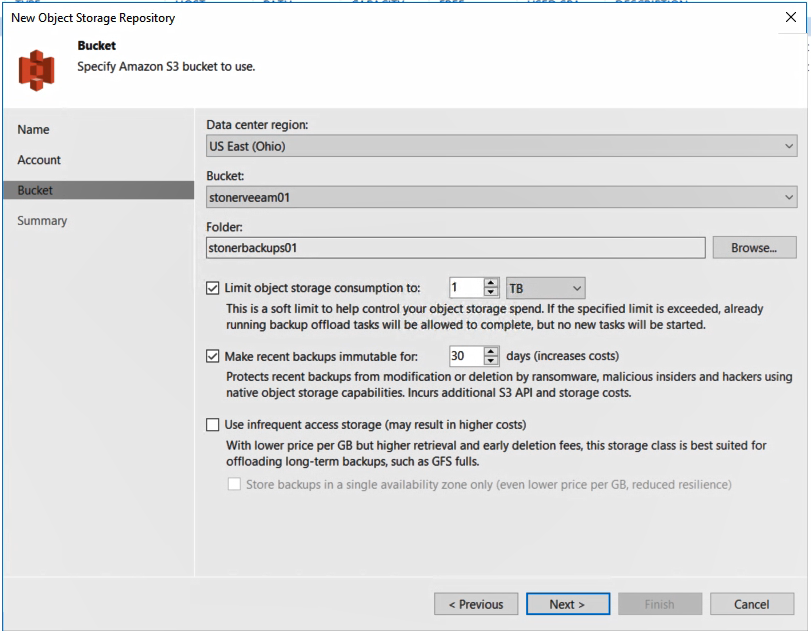
    backup and recoveryAt the same time, Allan said backup and recovery platforms are playing a more strategic role in the battle to combat ransomware. Veeam Availability Suite v10 users can create an immutable copy of data that can reside in any platform that supports the S3 API defined by Amazon Web Services (AWS). Dubbed S2 Object Lock, the offering was developed with the goal of creating a pristine image of a data set that can be recovered in the event of a ransomware attack that a cybercriminal or malicious insider has employed to encrypt an organization’s data.

    In addition, Veeam is moving to lower disaster recovery costs by making it possible to recover multiple virtual machines simultaneously in the event of a data center outage.

    Finally, an API now makes it possible for analytics applications to access data stored using Veeam Availability Suite.

    Fresh off being acquired by the venture capital firm Insight Partners for $5 billion, Veeam is moving to expand its core capabilities for backing up virtual machines to create a data management platform that will span multiple clouds. The goal is to create a platform for managing data across a hybrid cloud computing environment, Allan said.

    With organizations now routinely managing petabytes of data, competition among backup and recovery vendors has never been more fierce. Each provider of backup and recovery tools is, to one degree or another, evolving into becoming a data management platform, a process that largely began when IT teams stared using backup tools to migrate large amounts of data into the public cloud. Now the providers of those tools see an opportunity to enable IT teams to move data not just in and out of clouds but also between them.

    It’s too early to say how this battle will play out. Backup and recovery is one of those rare categories of software that refuses to be consolidated even as new startups launch regularly. It’s not uncommon for most IT organizations to employ multiple backup and recovery tools from different vendors. Less clear is how long the tendency to employ multiple tools will persist, but as new capabilities are added to each backup and recovery tool the pressure on the other tools to continue to prove their value continues to intensify.

    — Mike Vizard

  • 3 Lessons in Network Visibility from the A-List

    3 Lessons in Network Visibility from the A-List

    The network can be host to multiple performance killers. Here are three worth noting

    Like Ed Sheeran as a secret stormtrooper in “Star Wars: The Rise of Skywalker,” some cameos are hard to spot. They can appear out of nowhere halfway through the film or remain a complete mystery until behind-the-scenes footage reveals the masked actor.

    The same can be said for guest appearances on your network. It’s tough to spot the hidden malware, application interactions, network delays and other “cameos” popping up, especially when organizations today are grappling with the complexities of public, private and hybrid cloud infrastructure and multi-tier applications. To adequately support a robust and secure digital infrastructure, you need network and application-layer visibility.

    With movie awards season upon us, I invite you to sit back, relax—pop some champagne, if you’d like—and I’ll tell you about three cameos that can be easy to miss in the network environment, and what you should do about them.

    Hidden Malware

    At a pivotal moment in the Oscar-nominated “Joker,” the evil protagonist studies a tape to prepare for his appearance on a popular TV show. On the tape, he sees a comedian appear on the same show—played by Justin Theroux. It’s a blink-and-you’ll-miss-it cameo from Theroux, very much like hidden malware traversing the network without detection.

    Whether they’re sophisticated or non-targeted, high-volume criminally motivated attacks can move throughout the network without your knowledge and cause enterprises significant damage and cost, to the tune of $6 billion by 2021. Emotet, described by the Department of Homeland Security as one of the most costly and destructive instances of malware, likely comes to mind as one of the most pertinent examples. It has the ability to move laterally through the organization, spread other damaging malware and constantly evolve.

    Spotting hidden malware requires network visibility that spans the entire distributed digital infrastructure, as well as having access to network data to ensure visibility for all security and performance tools. Specifically, organizations need reliable access to data in motion to tap into traffic across cloud and on-premise infrastructure and traffic flowing across 5G and 100GB networks. This type of pervasive visibility allows enterprises to keep up with the speed at which networks and businesses run, as well as with security demands.

    Interactions Between Applications or Microservices

    When Brad Pitt’s character in “Once Upon a Time in Hollywood” unknowingly ends up at the Manson Family compound, he comes across Dakota Fanning, who plays a key member of the infamous cult. Their meeting is short but meaningful, and sets the stage for additional character development and exchanges down the line. Interactions between applications or microservices are just as meaningful, with 80% of network traffic consisting of such communication on average.

    Understanding these interactions is critical for guiding digital transformation (DX) efforts, which are a top priority for 87% of business leaders. Among the goals of DX are streamlining business processes, cutting costs, improving productivity and introducing new business models that redefine industries—or build new ones. These are ambitious goals, and they’re ultimately realized through new digital applications built on intricate microservices-based architectures that need to be managed and secured.

    Only with a clear view, and the right kind of data, can you understand the applications’ interactions, performance and security characteristics to accelerate DX. And the only way to get to this view is to look at the data in motion on the network. The ability to isolate specific applications or microservices communication streams for deeper inspection allows infosec teams to easily understand access patterns and put in place effective micro-segmentation strategies. Application developers, too, can benefit from this by better understanding communication bottlenecks between applications and microservices, as well as troubleshoot them.

    Traffic Bottlenecks

    The latest rendition of “Little Women” follows a non-linear storytelling structure, constantly jumping between two timelines. It can be jarring to viewers when the girls’ father returns from war, revealing himself as the actor Bob Odenkirk. While this moment is meant to be an intimate glimpse into a family coming together after a long separation, it brings the movie-watching experience to a standstill, since the audience associates Bob Odenkirk less with a serious scene and more with his previous comedic roles.

    Networks today are similarly prone to experiencing abrupt slowdowns or bottlenecks that limit network performance and waste bandwidth. Managing the network to ensure constant availability is a major challenge when data volumes are growing exponentially. It’s estimated that about 1.7MB of new information will be created every second for every human being on the planet this year. This data explosion paired with digital transformation technology investments and lightning-fast 5G and 100GB networks has led to a very complex enterprise infrastructure setup—and network blind spots across physical, virtual and cloud environments.

    The solution lies in having the right kind of data to help you understand network and application performance. By analyzing the network traffic, you get immediate actionable data points that can be used to address trouble spots.

    Whether we’re talking big screen or enterprise network, surprise cameos are common and they are easy to miss—and this is particularly problematic when things like malware and bottlenecks pose a threat to network security and speed. For the NetOps and infosec pros tasked with complex infrastructure development, implementation, maintenance and security, you need a clear line of sight into what’s happening within the network. Armed with insights on traffic patterns (both cloud and on-premises), delays in data flow and insecure areas, you can use this intel to write the screenplay (or plan) to support a robust and secure digital infrastructure.

    — Shane Buckley