Category: Infrastructure/Networking

  • Intel Expands Scope of OneAPI Toolkit Initiative

    Intel Expands Scope of OneAPI Toolkit Initiative

    Intel has made available a 2022 edition of its oneAPI toolkit through which it makes processor extensions accessible to DevOps teams.

    James Reinders, chief evangelist for Intel software products, said the goal is to make it simpler for DevOps teams to expose extensions to any company’s processors in the runtimes developers use.

    At its core, the oneAPI toolkit is a collection of APIs that Intel created for x86, graphics processing units (GPUs), application-specific integrated chips (ASICs), field programmable gate arrays (FPGAs) and other classes of processors.

    Reinders noted that developers have never had as much ready access to so many different processor classes before. The challenge organizations face, however, is making it simpler for developers to take advantage of those capabilities in a way that doesn’t require them to write low-level code, he added.

    The oneAPI 2022 toolkit adds additional capabilities including the world’s first unified compiler implementing C++, SYCL and Fortran, data-parallel Python for CPUs and GPUs, advanced accelerator performance modeling and tuning and performance acceleration for artificial intelligence (AI) and ray tracing visualization workloads. Collectively, Intel said it has made 900 new and enhanced features available via the oneAPI toolkit in the last year, including deeper Microsoft Visual Studio Code integration, support for Microsoft Visual Studio 2022 and Microsoft WSL2 for Linux development on Windows.

    As IT continues to evolve it will become more routine for developers to invoke heterogeneous classes of processors within the same application, said Reinders. Those capabilities will drive an explosion of software development innovation through the rest of the decade and beyond, he added.

    Intel is especially focused on making it easier for developers to invoke inference engines that take advantage of processor extensions to run AI workloads, Reinders said. Going forward, most applications will take advantage of machine learning algorithms that run inference engines optimized by Intel via extensions to its processors. As those workloads are constructed, integrating AI models within DevOps workflows will become the next major challenge, noted Reinders.

    It’s too early to say how simplified access to heterogeneous processors, also known as XPUs, might change the application development landscape. The one thing that is clear is IT organizations now have more options than ever. The issue now is finding a way to invoke all those capabilities in a way that doesn’t overwhelm developers. DevOps teams will play a key role in deciding which processors and associated extensions to make available to their development teams.

    In the meantime, the battle for processor dominance will only intensify in the months ahead. DevOps teams will need to decide how comfortable they are using processors manufactured by a single company like Intel or whether they want to employ a mix of processors provided by multiple vendors. Regardless of what they decide, it appears APIs will play a critical role in making it easier to benefit from advances in processor technologies.

  • Crafting an Agile Enterprise Architecture

    Crafting an Agile Enterprise Architecture

    Digital transformation, business agility and enterprise architecture are frequently heard terms in this era of digital technologies and rapid change. The appropriation of digitalized applications, solutions and processes has enabled organizations to increase efficiencies. In turn, this allows them to respond to shifting customer needs and trends in a more flexible and agile manner. 

    Digital transformation, the rise in mobility and a remote workforce have created a shift in the business model paradigm. The adoption of a more agile approach has been gathering steam, and businesses that are building agility into their processes are seeing the payoffs. The results are greater productivity, faster time-to-market (TTM) and increased consumer satisfaction.  

    The Culture of Agile 

    Digital transformation succeeds in a business environment that embraces a more collaborative and flexible philosophy. Moving from simply doing agile business processes to being agile across the board requires a shift in the corporate mindset. When a business develops a truly agile architecture, everyone in the enterprise is involved in delivering solutions; from business operations and tech to marketing, finance, compliance and security. The agile culture moves from a company-oriented one to a people or customer-oriented culture, embracing the tenets of collaboration, co-creation, ownership, flexibility and communication.

    Short-Term Cycles and Fluid Planning

    Agility is redefining enterprise architecture from the traditional schematic of centralized governance, lengthy development cycles, scheduled quarterly reviews and reliance on a waterfall delivery method. Instead of long-term operating and strategy plans, agile enterprise architecture involves short-term cycles and fluid planning that is customer and market-centric. The language changes from top-down project mandates and management to continuous product development, experimentation, testing and monitoring within collaborative product teams. 

    Essentials for Crafting Your Agile Enterprise Architecture 

    The blueprint for a truly agile architecture requires fundamental shifts in the business dynamic. There are three essentials that stand out as requirements for attaining agility across the entire enterprise. 

    • Collaboration – The bedrock of successful enterprise-wide agility is collaboration. Innovation will flourish when it is decentralized, and isolated silos give way to cross-functional, agile and self-organizing teams. An isolated IT team leads to delayed projects, overrun budgets, productivity that is hard to measure and disconnects between business and operations. Every department must be involved in supporting and achieving key business goals. 

    Teams containing a mix of business line and IT professionals accelerate development and delivery, greatly reducing time to market. Based upon a shared customer-centric goal and vision, there is shared ownership of outcomes and a deeper level of engagement throughout the enterprise. Daily communication and collaborative feedback nurtures creativity, problem-solving, and drive continuous integration and continuous development. Collaborative input from colleagues, inside and outside the organization, is essential for enterprise, technology, and solution architects. 

    • Current state mapping – Adopting agile practices and principles throughout an enterprise entails potentially massive change. Without a clear roadmap for navigating the process, a business can flounder. Instead of achieving a leaner simplicity, there is increased complexity and a muddied vision. Before a business can successfully embrace an agile architecture, the current state of operations must be fully understood. Essentially, a blueprint of functionalities, capabilities, applications, and the tech stack must be crafted. Everything, from the data catalog to business process workflows must be mapped. Business leaders can ask the following questions to analyze the current state and assess impact points:
    • Which projects should we prioritize and what capabilities will they require?
    • Which processes rely upon what software applications?
    • If we remove one or two apps, how will that impact processes?

    Once the blueprint of the current state is mapped out, a business can work in a structured way to create the future state of its architecture with ease and at its own pace. 

    • Balance agile transformation with daily operations – Continuing to work with some of the current architecture for a time can allow the top level of the organization to ease into adopting the agile mindset and culture. In the iterative process of developing agile architecture, the architects, executives, and tech leaders will need to strike a balance between transforming initiatives and effectively maintaining daily operations. They will have to discern how much direction is needed versus support and how much they will set the pace.

    If the focus is first on value delivered to customers, then the architecture will be prioritized according to the most strategic projects, capabilities and applications. An agile architecture will adopt a ‘just enough’ approach to project design and delivery. 

    Agile Architecture Optimizes Collaboration

    Enterprise agility facilitates more direct communication and involvement of enterprise architects within the cross-functional teams. Through daily discussions and various touchpoints, architects can provide guidance, advice, and feedback on IT decisions and assist teams in jointly owning the solutions. 

    Working together, enterprise and solution architects can develop a complete view of the IT landscape and how it will need to be modified to fit into future needs; minimizing waste and optimizing resources. Solution architects can view the architectural map across all apps, solutions, and systems and collaborate on improvements. They can also help enterprise architects scale standardization across the entire business. That cornerstone of collaboration at the core of agile transformation enables architects and non-tech leaders alike to gain more clarity and alignment.

    The Value of Agile 

    Business value is greatly improved when enterprise architecture combines agile practices. According to a report from McKinsey & Co., businesses transitioning to more agile models can improve financial performance by 20-30%, with 30-50% improving operational performance, TTM, and customer satisfaction scores. Embedding an agile model within processes, people, and technology will cultivate ongoing support for CI/CD, groundbreaking innovation, synergistic collaboration — and ultimately maximize customer outcomes.

  • Red Hat Adds Service to Customize RHEL Images

    Red Hat Adds Service to Customize RHEL Images

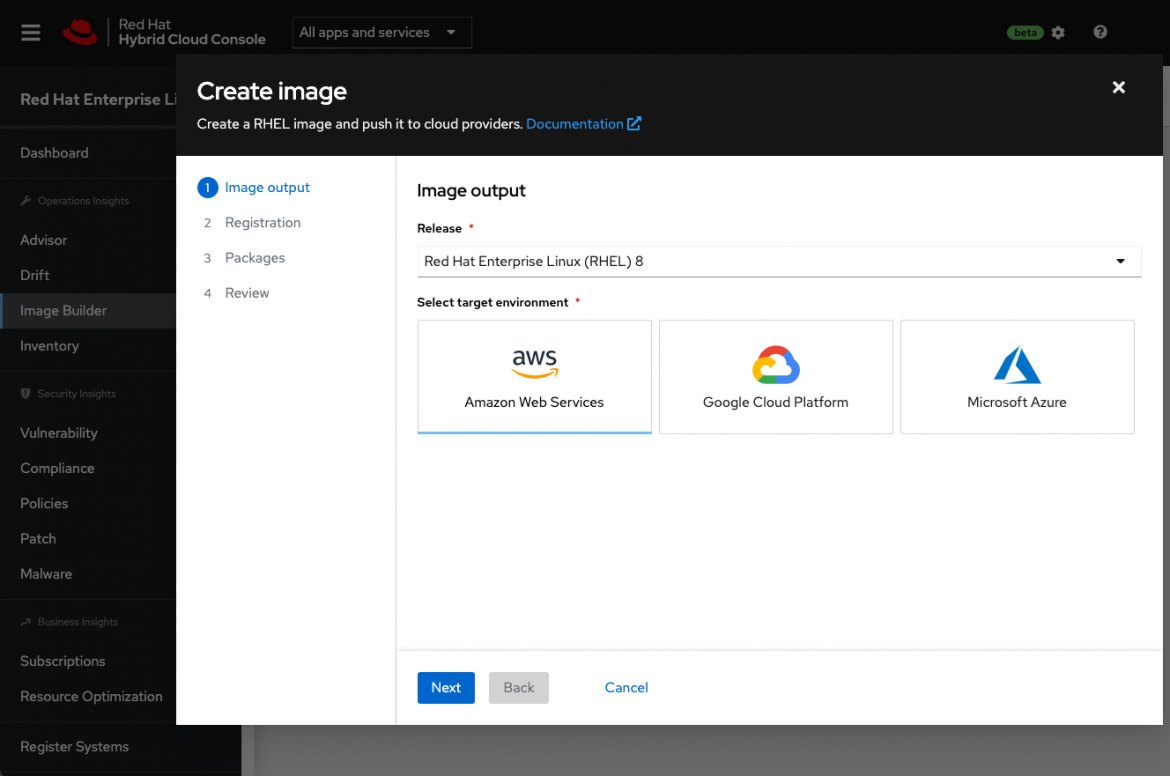
    Red Hat this week announced a public beta of an Image Builder service that streamlines the process of building customized instances of the Red Hat Enterprise Linux (RHEL) operating system.

    Scott Herold, director of product management for RHEL at Red Hat, said the Image Builder service enables an IT team to define a “gold” template for each target deployment environment that only contains the RHEL code required. Initially, Image Builder is configured to default to build a minimal, recommended RHEL server image for Amazon EC2, Microsoft Azure and Google Cloud Platform (GCP) cloud services.

    Future updates to the service will add support for VMware vSphere platforms as well as downloadable images and installation media for physical servers, customized filesystem layouts and versions 9.0, 8.5, 8.4 and 7.9 of RHEL. The service itself is accessed via the Red Hat Hybrid Cloud Console that is currently being made available in beta.

    Herold said building or installing operating systems is often a slow, tedious and error-prone process that needs to be manually performed in a slightly different way for each platform. Each physical server or edge computing platform requires different configurations and workflows. As a result, the chances mistakes will be made is high; Image Builder can greatly reduce the possibility of mistakes because there is no guesswork required, noted Herold.

    IT teams can also opt to include additional content from Red Hat in those builds to further streamline deployment processes, noted Herold. Those images can then be automatically registered with Red Hat to ensure future updates are received.

    The ability to customize those images also serves to reduce the overall size of the codebase that needs to be secured, added Herold. At a time when there is increased focus on software supply chains in the wake of a series of high-profile security breaches, many IT teams are revisiting their software deployment processes, he noted.

    Ultimately, Herold said Red Hat is moving toward providing IT teams with a more cloud-like experience regardless of where they deploy Red Hat’s curated open source software. The goal is to reduce as much friction as possible so that IT teams can more easily manage infrastructure at scale, he added.

    One way or another, the entiree software deployment process is becoming more automated. Much of the drudgery that has historically made it challenging to deploy and manage IT platforms at scale can be traced back to manual processes created when organizations ran a much smaller number of applications in on-premises IT environments. As IT teams increasingly deploy more applications in the cloud and at the network edge, it’s become more apparent that manual legacy processes won’t scale—especially when it’s already challenging to hire and retain IT personnel.

    It’s not clear how quickly IT teams will modernize software deployment processes using automated DevOps processes. Simple inertia is often a powerful force to overcome; however, most IT professionals can easily find something more compelling to do with their time that doesn’t involve using manually customizing operating system images.

  • Log4j: Is There Such a Thing as ‘Too Much’ Open Source?

    Log4j: Is There Such a Thing as ‘Too Much’ Open Source?

    The Log4j vulnerability got me thinking: Is there such a thing as too much open source?

    Before anyone immediately fires off a flaming email, rage tweet or scathing blog post, hear me out for a moment. If you know me, you know that I am an open source fanatic. I’ve been asked many times, “Should we use open source software and, if so, how much?” My response was (and still is) that open source software is a massive source of innovation and I can promise you, whether or not you use it, know that your competitors certainly are!

    I could go on and on extolling the virtues of open source and how it enabled the cloud, reshaped software architectures, created new product categories and gave us valuable tools like telemetry and increased visibility into cloud-native apps, infrastructure and beyond.

    When I first heard about the Log4j vulnerability on December 9, like many others, I quickly informed the tech leaders, engineers and SREs in my network about the serious potential risks such a zero-day vulnerability in the widely-used Log4j tool represented. In one way—probably the only way—the Log4j exploit shared a very important characteristic with the SolarWinds supply chain attack of late 2020: The widespread distribution and ubiquitous use of the software across applications, systems and organizations. Arguably, Log4j is used much more widely.

    This similarity raised questions I hadn’t fully considered in the context of such widely used software. Can we use too much open source software? Is Log4j too prevalent in its use and, therefore, a single point of failure? How bad would the Log4j situation be if a fix wasn’t immediately available or if one wasn’t forthcoming?

    The answer I kept coming back to is a resounding ‘no’. I still don’t think there’s such a thing as using too much (insert any open source project name) software. Log4j—and so many other open source software projects—are massively beneficial to us, and we virtually couldn’t function without these systems, tools and solutions in today’s age of ubiquitous software.

    What the current Log4j vulnerability, recent software supply chain attacks and other cybersecurity incidents with widespread impact highlight is our need to quickly respond to security incidents and take remediation steps anywhere they are found in the software stack. And that includes open source software. High-impact security vulnerabilities can occur anywhere across the numerous software stacks and services we use, though they have even greater impact when they occur in widely-used infrastructure, reusable components and microservices.

    In a world of infrastructure-as-code (IaC), it’s no longer a matter of patching a particular set of routers or servers. Unfortunately, much of the software stack is not containerized or built using smaller, easily replaceable containers and microservices—at least not yet. Our mindset and processes going forward from this incident must change, and we have to be prepared to respond to and remediate vulnerabilities both horizontally and vertically across the software stack. In certain circumstances, we have to do this on a large scale.

    As is common with active open source projects, Log4j contributors responded quickly with a readily available fix. The real answer to my original question above is that few are as prepared to respond to an important security vulnerability as those incredible, hard-working, active and engaged open source software developers.

  • Log4j Puts Effective IT Operations at Center Stage

    Log4j Puts Effective IT Operations at Center Stage

    News of the Apache Log4j vulnerability exploit is striking fear into the hearts of both software makers and users. Log4j is the most popular Java logging service used today, with over 400,000 GitHub downloads and has been embedded in most internet services and products from companies all over the world, including Apple, Amazon, Cloudflare, Steam, Tesla, Twitter and Baidu, just to name a few.

    Exploiting this vulnerability is simple and allows threat actors to control Java-based web servers and launch remote code execution (RCE) attacks. New variations of the original exploit are being introduced rapidly—over 60 in less than 24 hours. The attack surface grows by the minute. Good credential management and advanced authentication will not help as this exploit is pre-authentication, which means an attacker doesn’t need to authenticate to your web applications to attack. Your web server is vulnerable.

    The good news is your organization likely has a team of seasoned IT operations pros that can help protect against the worst of Log4j’s devastation.

    How IT Operations Can Protect Against Log4j Vulnerabilities

    Step One: Find Log4j Wherever it Exists

    You need to investigate every internet-facing application, website and system that you own or use. This includes self-hosted installations of vendor products and cloud-based services. Focus on systems that are internet-facing that contain sensitive data. Once you’ve completed assessing your hosted apps and vendor systems, move on to endpoint applications. Java-based apps like WebEx, Minecraft, Citrix and many more.

    Step Two: Patch, Patch, Patch

    Patch in the same order as above: Internet-facing applications, websites and systems. If no patch is yet available for your apps and systems, uninstall.

    The pandemic has forced many endpoints into workers’ home environments, which creates extra challenges for patching those endpoints and keeping them compliant. Operations teams can’t rely on work-from-home folks to patch their own systems, even if they’re given clear instructions. Many of them will just ignore those directions, so you need to adopt systems that enforce continuous compliance.

    Step Three: IT Operations is Essential

    Communicate with your senior leaders. They should be in the know about this one! Senior leadership needs to position their IT operations teams among their most vital employees. Don’t think this is going to go away any time soon—we’re just starting to get a glimpse of what is being tried out there in the wild. Buckle up. 


  • U.S. Govt. CX EO | Mozilla Revenue | Log4j Latest

    U.S. Govt. CX EO | Mozilla Revenue | Log4j Latest

    Welcome to The Long View—where we peruse the news of the week and strip it to the essentials. Let’s work out what really matters.

    This week: Improving U.S. government CX, how much money Mozilla makes, and the latest on the Log4j/Log4Shell débâcle.

    EO: “Transforming Federal Customer Experience”

    First up this week: The Biden–Harris administration makes an executive order directing its Federal agencies to make 36 specific customer experience (CX) improvement commitments. Much of this involves using technology to improve what DevOps teams would call UX—but government doesn’t like the language of “users.”

    Analysis: Customer-centricity FTW

    Remarkably, a lot of interaction with government still involves paper forms. But this EO shouldn’t merely be about putting existing processes online. Work also needs to be done to solve the underlying complexity and fragmentation of services: Focusing on CX is a helpful frame.

    Brett Samuels: Biden to sign order to streamline government services

    [The] executive order [is] intended to cut back on the bureaucracy around government services for the public such as renewing passports, applying for loans or changing names. [It] affects 36 “customer experience improvement commitments” across 17 federal agencies, [targeting] travel, retirement, business, health and updating personal information.
    …
    For example … to renew their passports online rather than dealing with print forms. [It] will create a single portal for … student loan debt, and small-business owners will have a more streamlined process for … loans, grants and certifications.
    …
    Survivors of natural disasters will also no longer be required to complete forms with several agencies when applying for assistance … and they will be able to file smartphone photos and use virtual inspections when filing claims. [That] could be critical as natural disasters become increasingly devastating, as evidenced by the tornadoes that ravaged Kentucky over the weekend, killing dozens of people and destroying communities.


    Is this a technology problem? Yes, in part—but it’s also a government problem, argues Jennifer Pahlka:

    Surely laws like the 21st Century IDEA Act … which required agencies to … “eliminate or consolidate websites or web pages that are duplicative or overlapping … and ensure that each website or digital service is designed around user needs,” made life easier for the customers of those agencies? What’s that you say? You’re not sure you’ve noticed that? Turns out you’re not alone.
    …
    An EO is one of the many mechanisms our government has at its disposal for what I like to call “magic words.” [But there’s a] gap between magic words and the changes they are supposed to compel. [Failures] happen at such a staggering scale they have become entirely expected.
    …
    We tend to assign the blame … to government technology [but] at some point, you can only improve the customer experience by addressing [underlying] complexity. … Most of the Kafka-esque nightmares people get stuck in happen because each service sees only the burden they impose, and not [what] the customer experiences.


    If, like me, you’re inherently cynical about government efficiency, you’d expect this effort to be a huge failure. But let’s not be too cynical: Warning of “the hazards of selection bias,” here’s ShanghaiBill:

    In the olden days, I took half a day off work to go to DMV and renew my DL. Now I can do it online in 5 minutes. … I pay my property tax online. I renew my business licenses online. I incorporated online.


    $500 Million per Year—But for How Long?

    The Mozilla Foundation has unveiled its revenue forecasts for this year. As in previous years, Mozilla makes the lion’s share of its cash from Google—by making it the default search engine. But there are new revenue sources.

    Analysis: And not a moment too soon

    The future of the browser market should be a strategic focus for DevOps teams. Mozilla’s Googley cash cow might not last. It’s often assumed the maker of Chrome keeps Mozilla alive so it can point to Firefox as “competition.” But with Microsoft’s browser Edging up the usage charts, that might no longer be true.

    Frederic Lardinois: Mozilla expects to generate more than $500M in revenue

    For 2021, the organization forecasts revenue of more than $500 million. What’s maybe most important, though, is that Mozilla’s new products like its Mozilla VPN service, Firefox Relay Premium, Pocket and other commercial initiatives are slowly but surely starting to pay off.
    …
    But for all intents and purposes, Mozilla remains fully dependent on Google for the time being. Diversifying its revenue sources is really the only way for Mozilla to decrease its reliance on a search deal with a company that is both a competitor, thanks to its dominant Chrome browser, and is increasingly out of alignment with Mozilla’s overall philosophy.
    …
    There is a window here for a non-Chrome browser, with users increasingly skeptical about Google’s motivations and Microsoft’s Edge team making a few missteps in recent months. Yet at the same time, Mozilla’s efforts to bring sponsored suggestions and ads to Firefox haven’t necessarily endeared the organization to its own users either.


    Why is Google funding its competitor? u/SerAaron:

    Google is Mozilla’s biggest donor. … It’s basically to avoid any monopoly allegations—so they can point to Firefox and say “look, we have competition”.

    Mozilla takes their money, sure, but … they don’t sell data, and they aren’t beholden to Google.


    But don’t count on that cash continuing to flow, says Maelwryth:

    That money is probably under threat now with Edge going for the market. Why give Mozilla hundreds of millions to show competition when you have actual competition from Microsoft?


    Log4j/Log4Shell Seems Worse Every Time We Look

    The list of popular DevOps tools vulnerable to Log4Shell grows by the hour. Merely finding your exploitable services can be an impossible task—let alone patching them.

    Analysis: Defense in depth is key

    Searching for and patching your vulnerable code is not enough. You’re also going to need to shore up your network defenses, by auditing internet-visible services and by tightening your application firewall rules. And—ironically—keep a close eye on your logs for signs of attempted exploits and IoCs.

    Steven J. Vaughan-Nichols: We Are in So Much Trouble

    Log4j is used a lot. And, when I say a lot, I mean it’s used in hundreds of applications [including] Druid, Dubbo, Flink, Flume, Hadoop, Kafka, Solr, Spark, Struts, Apple iCloud, … LogStash, GrayLog2, … Steam, Twitter, and … VMware.
    …
    Log4Shell is both easy to exploit and can be used to grab complete control of vulnerable servers. … Even as you’re reading this, odds are decent you’re being attacked. [But] even if you patch it in your systems, it’s all too likely to be hiding in other applications.
    …
    Log4Shell may be the worst security problem in a generation. … This is going to be a long, hard ride.


    Hyperbole? Even December 25 isn’t close enough for government work. Catalin Cimpanu:

    The US Cybersecurity and Infrastructure Security Agency has told federal civilian agencies to patch systems affected by the Log4Shell vulnerability by Christmas Eve. … Federal agencies have ten days … to test which of their internal apps and servers utilize the Log4j Java library, check if systems are vulnerable to the Log4Shell exploit, and patch affected servers.
    …
    Despite being a recent vulnerability, it is already considered one of the worst security flaws ever discovered, primarily due to its near-ubiquitous use among enterprise software makers, its simple and easy-to-use exploit, and the ability to hijack systems remotely. … Days after being disclosed, the vulnerability has been massively abused. … The first attacks were seen on December 1.


    There’s always another shoe. Here’s Teri Robinson:

    Maybe Log4j vulnerabilities are like rats—for every one that’s visible, multiple others scurry beneath the surface. … Apache said the fix addressing “CVE-2021-44228 in Apache Log4j 2.15.0 was incomplete in certain non-default configurations,” according to … CVE 2021-45046.


    The Moral of the Story: In the end, the love you take is equal to the love you make.


    You have been reading The Long View by Richi Jennings. You can contact him at @RiCHi or tlv@richi.uk.

    Image: Bernd Dittrich (via Unsplash)

  • DevSecOps for Databases: Data Masking, Cloud Backup, WAF and More

    DevSecOps for Databases: Data Masking, Cloud Backup, WAF and More

    DevSecOps is everywhere. More and more organizations realize that the traditional separation between DevOps and security is wasteful and dangerous. As a result, they are rushing to integrate security into all their software development processes. 

    Adding security to containerized applications, cloud resources and other parts of modern DevOps infrastructure is already well understood. But what about databases? Databases were always—and remain—a critical system component and a prime target for attackers. Here, I’ll review the basics of modern database security and show you how to create a continuous security process for databases in a DevSecOps organization.

    What is DevSecOps?

    DevSecOps incorporates security practices into the DevOps methodology. DevSecOps promotes a ‘security-as-code’ approach via the partnership between release engineers and security teams. Similar to DevOps, the DevSecOps approach focuses on creating innovative solutions for complex software development processes. Teams complete this within the framework of an agile approach.  

    DevSecOps aims to close the gap between security and IT teams while ensuring the speedy and safe delivery of code. Organizations replace the siloed development method with a new approach that promotes the shared responsibility of security tasks during the delivery process. 

    In DevSecOps, two supposedly opposite aims—delivery speed and secure code—are united into one effective process. 

    Database Security Basics

    The term “database security” is an umbrella term used to describe all of the tools created to develop and preserve database availability, integrity and confidentiality. A key responsibility for any DBA is to ensure that the information stored in databases is always secure.

    The goal of database security is to protect:

    • Database management systems
    • Applications that access database information
    • Datastores within databases
    • Hardware servers
    • Virtual database servers, such as cloud-based servers
    • Network access points

    It is critical to strike a balance between security and usability. While you must prioritize data security, information needs to be accessible to offer value to the organization. The more access you provide to the information retained in a database, the more vulnerable the information is. However, an overly secure database is neither practical nor functional.   

    A good way to achieve a balance between accessibility and security is to create meaningful security protocols, create tiered levels of information access and invest in a robust database security and activity monitoring tooling. 

    Common Threats and Challenges

    Here are some of the most common types of database attacks:

    • Insider threats—These involve privileged users misusing their access credentials. An insider could be a negligent employee who unwittingly exposes the database to attack, a malicious insider who abuses the database on purpose or an outside infiltrator who steals credentials to breach the database. The risk of a breach increases as more employees hold privileged access credentials.
    • Injection attacks—These involve inserting arbitrary attack strings into the database queries that HTTP headers or web applications serve. These attacks can be SQL or NoSQL. Secure coding practices and regular vulnerability tests should help protect you against injection attacks.
    • Database software vulnerability exploits—Database software providers regularly release security patches for vulnerabilities in their software. However, if you don’t apply the patches quickly, you prolong your exposure and run the risk that hackers will exploit vulnerabilities in your database. 
    • Backup attacks—If you don’t protect your backup data with sufficient controls, you expose your database to an attack on your backups. 

    The following challenges can exacerbate these threats:

    • Large volumes of data—Organizations must adequately manage increasingly large volumes of data using scalable tools and practices.
    • Sprawling infrastructure sprawl—Organizations are increasingly shifting to hybrid and multi-cloud environments, making their networks more complex and security harder to manage. 
    • Evolving regulations—With the global regulatory landscape changing and growing more complex, it is increasingly challenging to maintain compliance.
    • Skill shortage—The demand for cybersecurity personnel far outstrips supply, and this shortage is only likely to increase in the future. 

    4 Techniques for Continuous Database Security With DevSecOps

    A DevSecOps approach calls for continuous database security during all stages of database development and usage. Let’s explore a few techniques for achieving continuous security.

    Data Masking

    Data masking technology lets you create a structurally similar, anonymized version of an organization’s data. You can use this data for user training or software testing. The aim is to safeguard the real data while using a functional substitute for use cases in which the actual data is not needed.  

    In data masking, you keep the format of the data the same. You only change the values of the data. You can alter the data in various ways including character shuffling, encryption and word or character substitution. Whichever method you choose, you have to modify the value in some way that makes reverse engineering or detection impossible. 

    Use data masking when presenting data to users (whether inside or outside the organization) who don’t need to access the data as part of their role. You should apply data masking to all sensitive information before displaying it in public forums. 

    Use Web Application and Database Firewalls

    Protect your database server from security threats using a firewall that stops access to traffic as a default. The only traffic permitted should come from particular web servers or applications that require access to the information. The firewall must also prevent your database from establishing outbound connections unless they are specifically needed. 

    Protecting the database using a firewall is not enough. You should also deploy a web application firewall (WAF). That’s because SQL injection attacks, which target web applications, can be employed to delete or exfiltrate data from the database. A database firewall may not stop this from occurring if attacks are initiated from an application that is a permitted source of traffic. However, a web application firewall likely will stop attacks of this nature because it can analyze traffic at the application layer and identify malicious query patterns.

    Cloud Backup

    Database backup solutions help organizations safeguard their data with backup database copies in the event of user error, physical hardware failure, data corruption or ransomware attacks. Organizations can ensure their information is always accessible by using database backup tools, even if their central database fails or is compromised. 

    Cloud backup services allow you to send a database copy to an off-site, secondary location for safekeeping if there is a disaster or failure. A third-party service provider typically hosts the secondary data storage systems and servers. This provider bills the backup customer based on capacity used or storage space, number of users, data transmission bandwidth, number of times the information is accessed or the number of servers. 

    Using cloud data backup can help you improve data protection without overwhelming IT staff. This labor-saving advantage could be significant and may even offset some of the added costs connected with cloud backup, including data transmission costs. 

    Secure Database User Access

    You must strive to limit the number of individuals with access to the database to the extreme minimum. Administrators should only have minimal privileges—those they require to carry out their job and only when they require access. 

    For small organizations, this might be difficult to achieve because employees have multiple roles, and there may be only one or two database administrators. However, you should at least manage permissions using roles or groups rather than granting access directly.  

    If you have a large organization, you must think about automating access management via access management software. Access management software can give authorized users a provisional password with the privileges they require every time they want access to the database. This software also logs the activities conducted during that time and stops administrators from sharing their passwords. 

    It is critical to lock down any form of password sharing—this is a common practice by administrators and database users, but it makes accountability and effective database security nearly impossible. 

    In addition, you should follow standard account security procedures: 

    • Enforce the use of strong passwords
    • Store, encrypt and salt password hashes
    • Lock accounts after three or four login retries
    • Deactivate accounts when employees leave or switch to different roles

    DevSecOps and Database Security

    In this article, I explained the basics of DevSecOps and database security, covered the primary threats facing database systems in a modern IT environment and provided four ways you can implement continuous security for databases:

    • Data masking—All modern RDBMS systems offer data masking mechanisms that can reduce the impact of compromised accounts.
    • Using WAFs and database firewalls—Firewalls provide excellent runtime protection and visibility for application-layer attacks.
    • Cloud backup—Backing up databases in the cloud is a continuous process that can enhance availability and reduce the impact of ransomware attacks.
    • Secure database user access—Using least-privilege principles can dramatically reduce the threat surface of a database.

    I hope this will be useful as you extend your DevSecOps practices to critical database systems in your environment.

  • API Sprawl a Looming Threat to Digital Economy

    API Sprawl a Looming Threat to Digital Economy

    New estimates say the total number of public and private APIs in use is approaching a whopping 200 million. APIs are becoming increasingly crucial to the global digital economy. They are the backbone of many digital platforms and drive the composable enterprise model. But this ubiquity presents sprawl issues.

    F5 recently released a study that examines the conditions of the API economy at large. Authored by Rajesh Narayanan and Mike Wiley of F5, the paper, Continual API Sprawl: Challenges and Opportunities in an API Driven Economy, articulates the state of API sprawl and the conditions behind its arrival.

    According to Narayanan and Wiley, “If data is the new oil, then APIs will become the new plastic.” This looming reality will require a continuous approach to API management to avoid further polluting the digital ecosystem.

    Below, I’ll review the report’s main takeaways to see what has given rise to API sprawl and consider how IT leaders should respond.

    State of API Growth

    APIs have evolved as a standard mechanism for businesses and services to connect and share value. And, as more companies begin to rely on them, the API economy is becoming big business—83% of organizations today consider API integration a critical part of their business strategy, according to the 2020 Cloud Elements State of API Integration Report.

    There is a proliferation of API styles. Thousands of public productized APIs exist, but more private and partner APIs are in use. Technically speaking, APIs come in many different forms—they may be web-based, browser-based or embedded into devices. The report also identifies single-purpose APIs and those that aggregate multiple data providers.

    API use cases are pervasive, from hotel bookings to weather, stock tickers, transportation, IoT, DevOps workflows and many other areas. “API-powered apps have permeated every aspect of our lives,” said the report. Yet, typical market estimates are usually quite conservative when sizing up this market, said F5. According to F5’s aggressive calculations, we will be approaching 1.7 billion active APIs by 2030.

    APIs present a high value from startup use cases to enterprise applications. However, a downside is that this growth is leading to sprawl, said Narayanan and Wiley.

    API sprawl is the term used to describe both the exponentially large number of APIs being created and the physical spread of the distributed infrastructure locations where the APIs are deployed.

    Factors Driving API Sprawl

    Sheer growth. Sources predict the number of developers will grow to 45 million by 2030. SlashData also estimates that 30% of developers already use APIs. As the number of APIs on the market moves into the millions, managing growth poses a significant challenge, especially without proper governance and best practices.

    Lack of standards. “The lack of a common shared model contributes to API sprawl,” the report said. API design standards do exist, yet guidelines often leave room for nuances between services. Standards have also emerged around specific industries, like financial data exchange (FDX). While helpful for a single sector, this doesn’t advance multiple industries simultaneously. A lack of standardization leads to differing versioning approaches and integration challenges.

    New development approaches. Integration requirements are forcing many new APIs to unite disparate business apps. The microservices architecture trend is also adding to sprawl, as “APIs are both northbound to interfaces via microservices and horizontally between microservices.”

    Continuous software development. Continuous development, paired with the need to connect business units with bespoke requirements, could produce multiple versions of the same API. This quickly leads to maintenance difficulties, out-of-date documentation and broken clients. The report also cites rising data creation and “everything-as-a-service” trends as harbingers of an API sprawl.

    Various computing evolutions. New computing trends are also prompting a sprawl, says the report. Business units may be operating on different on-premises or cloud environments. When this hybrid situation occurs, APIs could get dispersed over many locations and become difficult to track. Specific connections may be created to cater to new environments like edge computing and IoT devices, further increasing sprawl.

    Problems With API Sprawl

    A digital economy reliant on APIs also relies on the underlying stability and availability of these services. Yet, “APIs have a shelf life and become unsupported if ignored by the developers,” the paper acknowledged. It could be hard to maintain service reliability for APIs sprawled across a distributed cloud. In addition to reliability issues, there are many other possible repercussions of an API sprawl.

    For one, management and operation at scale become difficult. Not all APIs are based on a specification, like OpenAPI. This means that API documentation may not be as streamlined and accessible, thus hurting discoverability and onboarding. “A simple means to connect these APIs may not be possible with conventional or legacy networking approaches,” the report added.

    As developers are top consumers of APIs, a sprawl could negatively impact their integration experience. Maintaining a swelling library of API dependencies can be cumbersome. Plus, APIs are prone to evolve and version over time and when endpoints are altered without advance notice, it leads to broken clients. Even small changes in API functionality can have a huge impact since all observable API behaviors will become relied upon, whether documented or not. (This is known as Hyrum’s Law).

    But the security ramifications of API sprawl are perhaps the most troubling. A whopping 91% of enterprises experienced an API security incident in 2020. Malicious API traffic also rose by a staggering 300% in mid-2021, Salt Labs found. Increased API use will undoubtedly cause more frequent attacks.

    “Unmanaged API sprawl is a security breach waiting to happen,” said the report. APIs typically adopt API keys for authentication and authorization, but this method is prone to misuse. Credentials are often exposed or misconfigured. Bad actors can use APIs to steal loads of data and computing power. As a result, sprawl is undermining trust in API connections and responses.

    Mitigating The Sprawl

    With the growth of the API economy slated to reach the billion mark in the next ten years, figuring out secure, stable inter-cluster communication will become more critical. According to F5, existing solutions (gateways, ingress controllers, service mesh and forward and reverse proxies) are not an adequate response.

    “We believe the solution should hence involve an intermediary (proxy) device focused on solving inter-cluster connectivity, security and integration challenges.” The writers call this solution API Gateway 2.0, which they describe as a bi-directional application-level proxy. The technology exists to implement such middleware and perhaps it could help companies address sprawl issues.

    Outside of Narayanan’s and Wiley’s recommendations, there are plenty of actions API owners can take to avoid adding to the sprawl. Here are a few:

    • Treat the API as a product
    • Improve developer experience
    • Use spec-driven development
    • Ensure up-to-date documentation and code libraries
    • Use consistent endpoint naming
    • Set clear guidelines for versioning and deprecation
    • Go beyond API keys with OAuth and OpenID Connect

    For more context, check out Continual API Sprawl: Challenges and Opportunities in an API Driven Economy for free without an email gate here.

  • Why Trust and Integrity Are Critical to IoT

    Why Trust and Integrity Are Critical to IoT

    We hear a lot about how the IoT is transforming people’s work and daily lives, but for me, its impact goes deeper. As a Type I diabetic, I depend on data from an IoT device to stay healthy. If I can’t trust my latest blood sugar reading, the results can be catastrophic. Health care use cases like mine represent some of the many examples that underscore the importance of data integrity. Stacey Higgenbotham expressed it perfectly in a recent post: “If a business or consumers can’t trust the data, the IoT fails.”

    The IoT is all about making better, more informed decisions, and data is the foundation that makes those decisions possible. As the IoT gains maturity, we’re seeing its impact across more and more industries and use cases. 

    In agriculture, smart sensors are in widespread use for real-time crop monitoring to help farmers track the state of their products. Tools like motion detectors, light detectors and moisture sensors can be brought together to support predictive analysis and enable smarter, more automated decisions. IoT sensors are also tracking the location and health of livestock to help farmers detect disease outbreaks and isolate animals if needed. 

    Most of us have seen how the IoT has revolutionized the safety and efficiency of the home, providing unprecedented control over appliances, heating and cooling systems, smart metering and lighting. Security cameras, alarm systems and smart locks are strengthening physical security and bringing residents peace of mind. As these smart home systems mature, they are also becoming increasingly integrated, personalized and automated.

    The global pandemic is also helping shape IoT adoption. Forrester predicts that manufacturers, pharmaceutical firms and utilities are increasingly switching to remote experts and technicians for support. To manage and repair their assets without extended downtime and costly travel, these industries have begun connecting previously disconnected machines.

    What do these diverse use cases have in common? Without trusted data from connected sensors and devices, all of them become vulnerable and the decisions they support become questionable. Inaccurate moisture data from a sensor could cause a farmer’s crops to fail. A compromised smart lock could leave a home vulnerable to theft. In a manufacturing environment, inaccurate telemetry from a connected machine could lead to factory floor shutdowns or damaged assets. The positive business outcomes enabled by the IoT all hinge on working with accurate, timely and trusted data.

    Signing Is Key to Strengthening IoT Data Integrity

    Establishing data trust should be top of mind for IoT device manufacturers, and it is imperative that they take steps to ensure that data is not being manipulated in transit or at rest. This protection applies not only to data packets exchanged by the devices and applications but firmware updates and supply chain processes.

    The recent executive order signed by president Biden underscores the need for measures like code signing. Focused on improving the nation’s cybersecurity, the EO presented guidelines and general best practices for federal departments, agencies and contractors. However, its impact is also likely to extend to technology and infrastructure companies. 

    Some of the strongest direction in the EO is intended to improve the security of software as well as supply chains for technology manufacturers. The order establishes baseline security standards for the development of software sold to the government, including requirements for improved visibility into that software and making security data publicly available. The order acknowledges that too many devices and software releases contain vulnerabilities that bad actors could exploit. 

    Effective Code Signing Requires Strong Management 

    Fortunately, a proven solution is available today to help manufacturers ensure data authenticity, confidentiality and trust for their IoT solutions. Best practices like code signing can help manufacturers bake security into each and every stage of their development processes. By applying digital signatures, organizations can assume full control of their development. They can confirm the integrity of their code before it moves further along in the development cycle and is put out in the field for devices and their customers. 

    Code signing is only as effective as the processes and best practices that support its implementation. To make the most of digital signatures, developers and engineers need a holistic approach to management. The signing process should be seamlessly built into their development processes to simplify and ease adoption. 

    A common management platform should enable manufacturers to fully protect private key usage and signatures, as well as monitor and manage access to digital keys. The process should also enable organizations to support granular monitoring of their code signing processes and include historical tools like reporting and auditing for full accountability and compliance. With a process in place to continually sign firmware, software updates and other components that can ensure data integrity in device interactions, manufacturers can be assured that their IoT solutions will work as intended, using data their end customers can trust. 

    There’s no question that as the IoT continues to extend deeper into our business and personal lives, the importance of data integrity is also rising. The stakes will only increase as more systems, processes and life-or-death decisions rely on trusted IoT data. To sustain the soaring growth of IoT use cases and solutions, it’s up to manufacturers to build security into the supply chain. With a strong data foundation underpinning today’s rapid innovation, the potential of the IoT revolution is limitless.

  • Why Do You Need GitHub Backup?

    Why Do You Need GitHub Backup?

    You’ve probably heard the joke that there are two types of people in IT: Those who do backups and those who will start. Though it’s still valid, this joke has become less relevant to businesses and professionals. The IT industry has been increasing expenditures on security for years, and backup is a critical area. However, despite the growing awareness of the need for backups and the wide availability of modern backup solutions, the problem still exists. The number of security breaches is growing, and the topic of data security looks like an endless arms race. So what can organizations do?

    First, let’s analyze some data and trends. Year over year, the number of cyberattacks, especially ransomware, is increasing. The year 2020 saw attacks intensifying due to the pandemic and the sudden shift to remote work, for which, unfortunately, not everyone was prepared. Once organizations got better at enabling effective work-from-home models, the hope was that everything could settle into a new normal. Unfortunately, the new norm became these increased attacks.

    It’s a bit like the metaphysical yin and yang—two opposing but complementary forces. One drives the other. Suffice it to say that the estimated cost of the global damage caused by ransomware in 2021 is as high as $20B! And a ransomware attack occurs, on average, every 11 seconds around the world.

    According to an Identity Theft Resource Center (ITRC) report, by the end of September 2021, there were more incidents of this type than during all of 2020. The authors of the report emphasized that they found 26 cases where cloud databases were unsecured. As a result, hackers were able to access confidential data belonging to 99 million people.

    Git Threats: Are my Bitbucket/GitLab/GitHub Repositories Secure? 

    Back in May 2019, ransomware attacks impacted hundreds of repositories on GitHub, GitLab and Bitbucket. The attack wiped away all the data and left only one piece of information: The amount of ransom demanded and a method of payment. Eventually, most of the data was recovered but the cost and the amount of time spent recovering from the attack was enormous.

    According to the Cisco Benchmark Study, approximately 40% of companies experienced downtime longer than eight hours due to a major failure. And 39% reported that at least half of their systems had been affected by a serious breach. According to IBM, the total average cost of a data protection breach on a global basis is as much as $3.86M, and the highest ransom demanded by cybercriminals in 2020 was $15 million. These numbers are scary. On the other hand, in most cases of successful ransomware attacks, the ransom is ultimately not paid; even if organizations do not pay the ransom, the mere fact that they fell victim and experienced failure or downtime can be very expensive.

    GitHub as Backup Tool

    GitHub provides many useful security tools. However, we must be aware of two things: What does GitHub backup really mean and what are its features? And what responsibility do cloud services providers have versus users’ responsibility for security? Let’s start with the latter.

    Most cloud service providers (including Amazon, Microsoft, Google, IBM, Salesforce, GitHub or Atlassian) operate on the basis of the so-called shared responsibility model. Users of cloud services most often assume that providers are fully responsible for their protection. However, providers are primarily responsible only for ensuring the security and availability of infrastructure, software and access, period. Users are responsible for the security of the business data stored as part of these services. So users themselves have to take care of backup and disaster recovery plans and solutions. In short: Providers are responsible for the security of the cloud itself and users are responsible for data security in the cloud. And at this point, it is worth pointing out that, according to data from the UK’s CybSafe, in 2019, 90% of data breaches were caused by user error.

    It can happen to any of us—a ransomware attack, phishing, loss of access to a GitHub account or an entire computer or simply overwriting another developer’s work in a repository. It affects both individual users and large corporations. In July of 2019, Ubuntu Security reported that the credentials for a company-owned GitHub account were compromised. Hackers used these compromised credentials to create repositories, issues, pull requests, etc. The attack did not cause a major crash, but repairing the damage took some work and restoring some repositories or issue trackers to the previous state was difficult.

    There are some common features any good backup should have:

    • Automation (i.e. daily backups)
    • AES encryption with its own encryption key
    • Versioning
    • Long-term data retention
    • Disaster recovery process
    • Easy monitoring (audit logs, email notifications)
    • Central management
    • Multi-tenancy (to manage admins, privileges and roles)
    • Scalability

    Based on these criteria, GitHub (and other similar hosting services) cannot be considered a proper backup tool. GitHub is a great open source project, but its purpose is completely different.

    How to Back Up Manually

    Since the cloud service itself is not enough, how can you take care of GitHub backup? Well, you could do it on your own. And often, especially in small businesses, this is the preferred method. It may seem like a good idea at first. Knowing Git well, we can create appropriate scripts that create backups for us that give us full control over what is happening without having to pay anyone for it. But this is very risk and not profitable in the long run. Disk space costs money; our employees’ time to create scripts and perform the backup is another cost. And the most important thing, in this case, is that these scripts must be maintained and updated all the time, so they constantly generate additional costs. Any change in such a script may cause an error and, as a result, deprive an organization of a working backup. Of course you could also create an appropriate mechanism to test it, but that’s an additional cost. Manual GitHub backups do not end with writing a single script.

    I’ve experienced this myself. In one project, backups were generated using such a script and then kept on our own servers. It was cheaper this way. But we did not have any validation of the created backup. One day, while updating the backup scripts, we did a manual test and it turned out that we had a serious problem—the backup was created correctly but its name did not change, so we kept overwriting the same archive constantly! The effect? It turned out that we didn’t have any copies older than one month! Luckily for us, they weren’t needed because the systems and databases were working properly at that time and there weren’t any incidents, but it makes me cringe just thinking about “What if …?”

    All in all, manually writing backup scripts is not a very good idea for many reasons. The low cost of this solution is only theoretical; with time, the cost of maintaining this mechanism increases and, in practice, often only one or two people are responsible for it, which creates additional risk. Okay, you might have more control, but overall you are wasting time and money. The backup itself is also not enough, because you need a proper restoration solution for systems or data in the event of an incident. There’s also the question of how to create a backup of the script that creates the backup? Are you sure you cannot make better use of your employees’ working time?

    How Much Does it Cost?

    It is difficult to accurately measure this; it all depends on the level of complexity of systems, the number of repositories, the skills of your team, etc. However, you can estimate how much the lack of access to services or programmers’ downtime will cost. You can also calculate the development and maintenance costs of writing, testing, maintaining and updating your own backup scripts. The history of GitHub attacks and crashes shows that the data is usually recoverable, which is good news. On the other hand, the time when services are unavailable or when teams are unable to work can be very costly.

    Third-Party GitHub Backup Tools

    Another solution—and, in my opinion, a better one—is to use third-party backup software.

    In fact, in the GitHub documentation, it is recommended:

     “Backing up a repository: You can use the API or a third-party tool to back up your repository.”

    If you can use the GitHub API, why do you need a third-party GitHub backup tool? Well, first of all, such applications are created by experts in a given field who have knowledge, experience and stay up-to-date on the current security trends. Second, these solutions are ready and available right away; you don’t have to spend time and money reinventing the wheel. Yes, there is a cost, but in the long run (taking into account the factors described earlier) the cost usually turns out to be much lower than a bespoke solution. Outsourcing backup management responsibilities may be incredibly beneficial and will allow us to focus on developing our business instead of managing GitHub repository backup all over again.

    When it comes to backup, be smart. If external third-party tools allow us to develop our products faster and more efficiently, then we should not hesitate to use them. And never forget to implement proper backups and disaster recovery plans. Taking care of it today will help ensure a more secure future.