Category: Features

  • HashiCorp Vault Enterprise Secures DevOps Infrastructure

    HashiCorp Vault Enterprise Secures DevOps Infrastructure

    HashiCorp, a DevOps infrastructure company known for its Atlas platform that combines a variety of powerful open-source tools, recently announced Vault Enterprise. HashiCorp describes Vault Enterprise as a comprehensive security solution for DevOps infrastructure. Vault Enterprise is the foundation for security in the HashiCorp DevOps infrastructure suite.

    Open source is a virtual necessity for effective DevOps—forming a close symbiotic relationship. I explained in the DevOps and Open Source report published earlier this year, “There are some significant advantages with FOSS (free and open-source software). With a proprietary, closed-source application there are very few people with access to look at the code. Recent incidents with SSH backdoors demonstrate that closed most certainly does not mean secure. When the code is open those types of backdoors can be quickly spotted and resolved.”

    With the addition of Vault Enterprise, the HashiCorp suite is now comprised of:

    • Vault Enterprise – Empowers security teams to collaborate, validate, and enforce security policies
    • Terraform Enterprise – Empowers operations teams to collaborate, validate, and provision infrastructure
    • Nomad Enterprise – Empowers development teams to collaborate, validation, and deploy applications
    • Consul Enterprise – Empowers all teams to monitor the complete stack

    Vault Enterprise is not entirely new. It builds on the open-source Vault to enable security teams to define and enforce security policy and secrets management across distributed infrastructure.

    “The shift to highly elastic, microservice architectures requires a different approach to security. Static network-based security is poorly equipped to handle the dynamic application-centric infrastructures being built today,” said Armon Dadgar, co-founder and CTO of HashiCorp. “Vault Enterprise enables organizations to adopt DevOps practices in their approach to security and keep pace with development and operations teams that are adopting DevOps.”

    Vault Enterprise includes Hardware Security Module (HSM) integration, which enables developers to integrate Vault Enterprise with HSMs using Vault’s simple API rather than more complex HSM interfaces. According to HashiCorp, there are also a variety of enhancements and new collaborative features in Vault Enterprise, including a new UI for managing secrets, health alerts and monitoring and an intuitive workflow for initializing new Vault clusters.

    “Deploying enterprise software to both public and private cloud infrastructure requires a security solution that works everywhere. As we adopt DevOps practices that make our applications and infrastructure more dynamic, we need bullet-proof security,” said John Mitchell, Architect at SAP Ariba. “HashiCorp’s Vault is the only offering that meets these requirements—one workflow across providers and dynamic secrets management.”

    DevOps is a culture and a process—not a silver bullet solution or a single product. HashiCorp understands this while still trying to provide a DevOps infrastructure platform that’s as complete as possible. HashiCorp pulls a variety of effective and useful leading tools together, and delivers them in a modular fashion that allows you to embrace DevOps at your own pace.

    There are plenty of vendors out there creating proprietary tools and platforms. What I like about HashiCorp is how it is harnessing the power of an array of open source tools to provide a whole greater than the sum of its parts. Vault Enterprise is available now.

  • DevOps Chat: CJ Paul, IBM, on DevOps, ITSM, Cloud and More

    DevOps Chat: CJ Paul, IBM, on DevOps, ITSM, Cloud and More

    DevOps.com editor-in-chief Alan Shimel sat down to speak with Dr. CJ Paul, Distinguished Engineer, DevOps Methods & Tools, IBM Cloud. CJ is someone we have interviewed previously on video at IBM InterConnect and is always a great source of information. In this interview Dr. Paul discussed DevOps, ITSM, Cloud, Bluemix, Bluemix Garage method and more. 

    As usual, the streaming audio of our discussion is below. You can also find it on SoundCloud and iTunes. Below the audio player is the transcript of our conversation so you can follow along. Enjoy!

    Shimel:  Hi, everyone. Alan Shimel here for another DevOps Chat on DevOps.com. Thanks for joining us. I’m happy to be joined on this episode of DevOps Chat by a friend of mine CJ Paul of IBM. CJ, are you there?

    Paul: Yes. Hi, Alan. How are you?

    Shimel:  Good. Good to have you on DevOps Chat with me today, CJ. Of course you and I have done several video interviews from various conferences we’ve both attended. But you know we haven’t had the pleasure of having you here, so welcome. CJ, I’m gonna bet not everyone in our audience knows who you are. Why don’t you give a quick little background on who you are, what you do, where you work and so forth?

    Paul: Yeah. Definitely. So my name is CJ Paul. I work at IBM. I’m a Distinguished Engineer in the cloud unit. And focused on DevOps methods and tools. So some of the things that my team puts out are the Bluemix Garage Method. It’s out as a website at IBM.com/devops/method. Then we also work on the Bluemix DevOps services and you know I work with a lot of clients as they do their transformation to the cloud. And trying to develop DevOps practices along the way.

    Shimel:  Great. So CJ, you know just kind of off the beaten path here, but we’ve had several guests on DevOps Chats that are distinguished engineers at IBM. And for our listeners who you know maybe are not familiar with what that means and it’s more than just a pretty title. Can you give our listeners a little bit of insight into what it is to be a distinguished engineer at IBM?

    Paul: Oh, definitely the focus of a distinguished engineer is to leave a portfolio of products in a particular domain. So in this particular case you know I have several product teams that work on different offerings in the DevOps space. And I’m responsible for crafting the technical strategy and providing architecture and technical direction to multiples of these teams.

    Shimel: Got it. So CJ, as I think I mentioned to you in our off camera or off microphone conversations, you know the month of September is gonna see DevOps.com focusing a bit on APM and DevOps. And of course this is a subject that you are you know very familiar with. And part of what you do in Bluemix and all of these things, obviously APM’s a part of it. But why don’t we start with this? Can you define for our audience, when we talk about APM and DevOps and maybe it’s in relation to ITSM, right? IT Service Management which is something you’re also very familiar with. Can you kinda pull this all together for us?

    Paul: Yeah. Definitely. Traditionally operations teams have always worried about application availability and performance. Where performance includes you know how the application might respond from different locations around the world and how the response time evolves or changes for different types of transactions. Now, as we look at DevOps and the role of the DevOps teams becoming more cross functional, a lot of the focus is shifting to how do we get the synthetic monitoring, the configuration of the monitoring and all of that to be handled much earlier in the development cycle. In fact, in an ideal world, just like our source code is written to the specs of the product, we would also create the associated operational configuration of the monitoring tool, as well as the creation of the synthetics scripts, along with the source code. And so in the ideal case you would have all that be checked into the same repo. And then as part of your continuous delivery process you’d want to make sure the operations tool is configured to monitor that particular build that is deployed in a particular environment.

    So that’s the shift in thinking that we see a lot of the teams going through is how do we actually make this possible you know where all of the setup and configuration is treated as an extension to the source code of the product and worked through the lifecycle. Because it gives various advantages. Let’s say a new build comes out and you’re going to go deploy that new build in a particular environment or perhaps even introduce it to a small subset of your users in production. When you introduce that new build with a new feature, you want to monitor that new build or that new feature. And take all of that data and make decisions on whether you now ramp up to your full population. So what we see happening is in the new world of DevOps and especially on the cloud, you know monitoring has to go very much hand in hand with the features that the development team has built. And so it’s no longer just an after the fact operations thing to worry about. It is something you have to worry about as an integral part of the DevOps lifecycle. So that’s why I think this is a really exciting time. Especially the cloud enables application teams to do A/B testing and evaluate you know performance of new features, the response times of new features as it compares to their existing version of the application that is running.

    Shimel:  Sure.

    Paul:  And so all of the new capabilities you know that are the focus area in the application performance management space.

    Shimel:  Sure. Exciting times indeed. CJ, I would be remiss if I didn’t mention on this very topic that we actually have a webinar scheduled, I believe it’s Tuesday, September 20th at 1 p.m. Eastern Time with a colleague of yours at IBM, Arun Bilgiri.

    Paul: Yes.

    Shimel:  Are you familiar? Yeah.

    Paul: Arun Biligiri.

    Shimel:  Yes.

    Paul: Yeah.

    Shimel:  And Arun is gonna be doing this on Learn Why We Must Shift APM Left in the DevOps Lifecycle. And he’s gonna be also joined by Dan Kern, Solution Architect over at Prolifics. So you know if you’re listening to this and this is a topic of interest to you, not you CJ, I know you’re interested. But our audience, I’d highly recommend. You can probably register for this off of our DevOps.com. Go to the Webinar and Events page and you can register there. But it should be dead on on topic for this. So CJ, I wanted to focus back on though this idea of shifting APM left, right. So when we talk about DevOps and how we fit in things like security and QA, now APM, that seems to be a common theme of shifting these things left. Get them earlier into the development process, right. Because the earlier it’s in, hopefully the better it comes out in the end, right. I guess my question to you CJ, is can we just continue shifting everything left, right. You know what I mean? Is there a point of diminishing returns of shifting left?

    Paul: Yeah. I think in this particular case especially, you know it’s something that is a good thing to think about right from up front. Especially as the velocity of deployments increases, we would expect the development teams to be more and more you know working the monitoring of the applications in conjunction with the code. Because you’re just kind of thought to have a throw it over the wall kind of syndrome. Because you know that would be too slow in this world to make it successful. So that’s why I think the shift left is almost an inevitable side effect of the need to go faster. And also with some of the shift to cloud, you know the way things are done are also different. So more and more the application architectures and topologies are becoming more complex to handle geographically distributed deployments and so on.

    So more and more we expect the development teams that are involved to be doing some of these operations automation just like they would work on you know features for the product. So some of these concepts surround you know cycle liability engineering and so on that are being out in the industry are just examples of why you know we’ll get more and more of a DevOps perspective on things that used to be just purely operations activities in the past.

    Shimel:  Got it. CJ, my next question with you on this is and by the way we’re running low on time so I only have one or two more questions left. Is you mentioned earlier one of my favorite things happening in IBM and that’s the Bluemix Garage method, which is an open source methodology kind of taking best practices and lessons learned from IBM themselves, as well as your partners into this methodology. Talk to us a little bit. Where does APM fit into there?

    Paul: Yeah. So with this Garage method what we’ve been doing is to take the learnings from across the industry on agile practices and design thinking and you know the latest DevOps practices and lean practices and so on. And organize it in such a way that enterprises can learn how to act like a startup but do it at enterprise scale. So within that method, we talk about how you think and plan, and code, and deliver, and run, and manage, and learn around a whole culture of DevOps. So in this particular case as we talk about application performance management, we typically think of it in managed. But as we have been discussing here, it kind of permeates through the lifecycle because you have to think about the availability of your applications as you design and build them. And you have to write the code for the synthetic monitoring steps, along with your features of the product. And you have to deploy them as part of delivery. And then clearly you’ll collect and analyze the data as part of manage and learn. So I think this whole shift left of APM fits in very nicely with the Garage method and its different lifecycle phases.

    Shimel:  Got it. CJ, I apologize, but just as I promised, yeah, we’re way over 12 minutes already and we’re gonna need to wrap things up here. But before we do, I wanted to just ask you one final question which is usually one that I ask most of our guests here on DevOps chats. CJ, for our listeners out here, if you had to recommend one book that they should read, what should be the next book they read?

    Paul: I would highly recommend folks read the Site Reliability Engineering book that has come out of Google. They talk about how engineers with development skills can automate a lot of what used to be production activities. That’s a very good read. Within IBM we’ve been doing these kinds of activities ourselves. You know me make sure that the individual squads are also responsible for their performance. But I find this is a good book for teams to look at if they haven’t already read it.

    Shimel:  Got it. Okay. CJ Paul, Distinguished Engineer at IBM. Thank you for being this episodes guest on DevOps Chats. Look forward to seeing you in person at some conference or another soon, CJ. And until then, keep up the great work.

    Paul: Thank you, Alan.

    Shimel:  This is Alan Shimel of DevOps.com for DevOps Chats. Thanks everyone. Have a great day.

  • DevOps Chat: Michael Olson, Puppet, A Roadmap for DevOps Success

    DevOps Chat: Michael Olson, Puppet, A Roadmap for DevOps Success

    DevOps.com editor-in-chief Alan Shimel sat down with Michael Olson, senior product marketing manager at Puppet, to discuss a number of topics including the recent DevOps Salary survey that Puppet released. Another topic of discussion was the webinar Puppet is sponsoring and Michael is taking part in Sept, 27 titled, “A Roadmap for DevOps Success.”

    This webinar is a great jumping-off point for those who are looking to set off on their DevOps transformation or even anyone looking for a DevOps reset. Please click the link to register if you are interested. In the meantime, Michael gave us a great amount of information about the topic and DevOps in general. I think you will find it very interesting and useful. This interview is a little longer than our usual (about 20 minutes), but well worth the listen.

    As usual, the streaming audio is embedded below with a written transcript of our conversation below that. Enjoy!

    Shimel: Hi. This is Alan Shimel, editor in chief of DevOps.com. Here for another DevOps Chat. Very happy to be joined for this episode of DevOps Chat with Michael Olson, senior product marketing manager at Puppet. Hey, Michael. How are you?

    Olson: Alan, I’m doing great. How about yourself?

    Shimel: Great. You know Michael, it’s a very exciting time here for Puppet obviously. A lot going on in the world of DevOps, in the Puppet world and everything else. So before we get started with anything, what I wanted to talk about, our upcoming webinar. Why don’t you give our audience a little bit of background? What’s the latest with Puppet?

    Olson: Sure. Yeah. Happy to address that and also say thanks for having us on the DevOps Chat today. It’s always good to catch up with you.

    Shimel: Thank you.

    Olson: So for folks out there who may not be familiar with Puppet, we provide a software platform that really helps companies and organizations automate the delivery and operation of all of their software. And the idea there being that you know in today’s world, software powers everything around us. More and more companies are recognizing the need to behave like software companies as a competitive differentiator, as technology is perceived as more of a way to improve the customer experience and kind of deliver better value to end users. And so we’re seeing organizations that are looking for automation as a way to ultimately deliver better software to their customers and end-users faster. And that’s really why Puppet exists. So, in terms of what’s new for the company, I would say it’s a great time to be here. We’re growing pretty rapidly. You know we’ve been adding new customers at a pretty astounding rate and really growing the organization and seeing a lot more momentum for organizations that are looking to adopt DevOps practices and more of a DevOps way of working, as well as seeing the role that automation plays in helping them get there faster.

    Shimel: Sure. It’s a great time to be alive in the DevOps space. You know Michael, I wrote an article just this week on the results of your DevOps salary survey, which was just released. You know coming out of the Puppet DevOps State of DevOps Survey. And it’s certainly a good time if you have DevOps skills and you’re looking for a job. It seems to be you know an employee’s market. So no doubt you know what we’re seeing and what you’re describing is playing itself out in that way as well. It’s where the jobs are.

    Olson: Yeah. For sure.

    Shimel: Yeah. Crazy. You know I have friends who aren’t in IT and I posted the article on Facebook and some of them read it and saw kind of what the salaries were. And they were like you know do you have to be a rocket scientist to work in DevOps that you know those are the kinds of salaries. And I was like no, but you know it helps. But honestly you don’t obviously, right. You just gotta be into it. But that brings us actually Michael, to kind of the subject matter of our talk today. Which is this webinar we have happening on I believe it’s September 27th. Correct?

    Olson: Yeah. That’s correct.

    Shimel: And Michael, why don’t you share with our audience a little bit about kind of what the subject matter of our webinar is going to be.

    Olson: Sure. You bet. So you know we spend obviously a lot of time at Puppet consulting with organizations that are either you know at a stage where they’re trying to build the business case if you will for change and for kind of evolving the way that teams work to deliver better software out to their customers and end-users faster. And we also talked to a lot of organizations that are you know looking for guidance on kind of you know how to scale a DevOps practice within their organizations. And you know I think the common thread that we’re seeing is that you know in this day and age in 2016, that DevOps really isn’t just for the unicorn companies out there if you will. You know the Googles and the Apples of the world. We’re seeing a lot more evidence that DevOps practices are really hitting the mainstream as more organizations you know realize they need to behave like software companies and improve the way that they work. And so really the goal of the webinar that we’re gonna be digging into on the 27th is kind of to provide a roadmap based on findings from the 2016 State of DevOps Report.

    Ways of driving adoption of DevOps practices within your organization. And we’ll kind of cover that from a few different points of view. One of which is you know how to sort of build the business case for a DevOps way of working. If you’re maybe sold on the need to change, but trying to get either peers or managers to buy into your point of view. And then we’ll also address some of the cultural changes that we see our customers implementing and share some ideas on ways to align incentives and teams to improve collaboration. And then we’ll dig into you know some of the key technical practices that we see high performing IT teams implementing. And then some guidance on just you know where to get started to start to scale a DevOps practice within you know an enterprise organization. So it’ll be a lot to chew off in an hour Alan, but we’ll do our best to –

    Shimel: I was gonna say Michael—

    Olson:  —hit all those subjects.

    Shimel: —yeah, it sounds like a full hour of webinar right there. But you know Michael, one thing I want to stress and it goes back to what I was saying earlier about my friends who saw the article on the DevOps salary survey. Thinking about my goodness, you know you must need to be uber smart or something you know to be able to do something like DevOps. But so much of what you need to you know make a horse you know have a successful DevOps journey and transformation, I don’t know if it’s really sort of book smart, or intelligence, or you know rocket science. A lot of it is cultural and you know we tend to poo poo it. But a lot of it is about working together as a team. Getting buy-in. Getting buy-in from your boss and his boss. Getting buy-in from your team members. Getting buy-in from other team members. And I don’t know if that’s really you know “intelligence” or you know it’s more of social aspect. Do you agree or what do you think?

    Olson: Yeah. Honestly I think that’s a pretty great point, Alan. And I’m a big believer here that you know DevOps is not something you can buy and it’s not specific technology. And I would be very skeptical of any software company or vendor that claims to be the DevOps tool. Because what we tend to see and hear is DevOps is really more about the cultural changes and the technical practices required to you know help teams improve the way they work. To deliver better value to customers and end-users. And so from a cultural perspective, I think you’re spot on. It’s you know how do we move from a culture of lack of alignment, of low trust, of silo-ed teams, to you know cross functional teams that share incentives, that are aligned around a common set of goals. That have that high trust where you can kind of complete the no look pass so to speak to other groups. And you know the outcome ideally being you know reducing cycle times. Getting software out the door faster that meets the needs of customers. And then being able to iterate and kind of foster an environment of continuous improvement. I see those as some of the key drivers behind you know what’s required for success with DevOps.

    Shimel: Agreed. But you know I don’t want people to think I’m giving them a false sense of it either, Michael. You have to have a good understanding of environments, of tools, of what it takes for a successful software release, of what it takes actually for you know IT to help the business, right. I don’t want people to think that DevOps folks are a bunch of dummies who happen to just be really social, right. There are tools and skill sets that you know are kind of required. And so that being said, why don’t we go in a little bit deeper in terms of things we want to you know kind of peel the onion back a couple layers in this webinar. You’ve kind of given us a high level. But if we can go a little deeper.

    Olson: Sure. Yeah. Let’s do it.

    Shimel: So, let me start with this then. And that is sort of getting the buy-in on you know going forward with DevOps, right. Some people say it’s best to go top down. Some people say no, you gotta have buy-in from the bottom up. Some people say you got go top down and bottom up and meet in the middle. And I’m sure any and all of them can be successful in a particular given situation. But I think the issue then is how do you make that happen, right. I mean we recognize that’s an issue. Just if you can give a little preview, Michael of what we’re gonna do on the webinar. What would be some tips people can follow-up with?

    Olson: Yeah. I think it’s a great question, Alan. And you know my take based on what we tend to see from our customers that have been down this path is its super important to start with the why. And what I mean by that is really focus if you’re trying to you know get buy-in for implementing a DevOps way of working within your organization, it’s really important to start with what are the problems we’re trying to solve and what is kind of the end state or outcome that we’re hoping or looking to achieve. And so one of the ways that we tend to see our customers be more successful at you know getting buy-in for a DevOps initiative is you know by focusing on the benefits that other organizations have seen from implementing you know a DevOps way of working. And we’ve got some pretty awesome research that we’ll share on the webinar next month that you know talks about just how much more agile and how much more fast moving high performing IT organizations that are implementing DevOps practices actually are you know around being able to deploy applications and infrastructure changes much more frequently than their lower performing peers. And doing so with you know much shorter lead times or cycle times.

    But also being much more reliable. Actually seeing kind of a higher change success rate. You know faster meantime to recovery when things do invariably go wrong. And then we’ll also share some data that really shows and correlates kind of IT performance around you know moving faster, doing so more reliably with how that’s actually helping organizations win the  marketplace. You know become more productive, become more profitable and achieve higher company growth at the end of the day.

    Shimel: And that’s really what it’s about, right. I mean and you know what Michael, for those who are listening and it sounds easy because it relatively is rolling off your mouth. The language that you’re using, the terms that you’re using. You know I learned this in many years of security when I used to hear from so many security people. I can’t make the executive team understand why I need this IPS. Why I need this Intrusion Prevention System. And because they were talking to their executives about snort signatures and capturing packets, right. And executives don’t talk that language. I think it’s important to take note of the language you’re using Michael, you know again, not that you have to be a rocket scientist to do DevOps. But there’s a certain language of business. There’s a language of you know what is gonna be important not only to me and my team, but to my boss and his boss as well. So for those of you listening to this on streaming, you should rewind it to hear what Michael said again. Because I think you might understand more of what we’re talking about in hearing how he’s describing these things.

    Olson: Yeah. And I think that’s a good point Alan, if I can interject. I think one of the things that we tend to see is adopting a bit of a chameleon approach if you will actually can be effective. And what I mean by that is you know really knowing your audience and making sure that you’re speaking the language of the people that you’re trying to sell on the value of doing DevOps. And so if you’re talking to folks in IT leadership roles, I think they’re gonna be more attuned to the notion of becoming more agile and improving the frequency of speed of software delivery and improving the reliability and quality of that software. But certainly stakeholders on the business side are probably gonna be more focused on how does this actually impact our ability to deliver value to customers and help the business grow and be successful. And so being able to tailor the message if you will you know to the people you’re speaking with, I think is an important skill and a trait when it comes to you know navigating an organization to build a case.

    Shimel: Absolutely. So Michael, you know I mean obviously to me anyway, this sounds like we’re gonna have a great webinar on the 27th. And I hope people listening in at home will join in. You can find out more information by the way if you’re interested in registering for the webinar on DevOps.com if you go to our Events section under Webinars. The webinars we’re doing are in chronological order and you can click on the graphic or the link and register from there and of course that’ll set you up to get reminders and everything else. Michael, we’re kind of running a little low on time. I’ve got two last questions for you. For people who maybe they haven’t heard enough yet about the webinar or maybe they have, but they have questions, anything else you want to tell them why this is a good webinar to attend. It’s worth their time.

    Olson: Yeah. Sure. I would say you know the companies and IT professionals you know that certainly I talk to on a daily basis you know frequently fall into one of three camps if you will. The first of which is still trying to figure out what this DevOps thing really is and what it means. You know there’s still a perception at some level that it’s a loose and evolving collection of practices. And you know you walk into a room and you ask a room of 10 people to give their definition of DevOps, you’ll get 10 different responses.

    Shimel: Yeah.

    Olson: So I think if that’s the stage you’re at is still trying to kind of develop a deeper understanding of what it means to bring DevOps practices into your organization, we’ll definitely address that. If you’re sold on the value and just trying to you know get buy-in from peers or from executives within your organization, hopefully you’ll walk out of this with some ammunition in your toolkit to be able to have those conversations within your organization. And then I think the third camp is if you’re you know sold on the value, you’ve got buy-in from the rest of the team and you’ve started to implement more of a DevOps way of working and are looking to kind of scale that across the rest of the organization, hopefully we’ll provide a roadmap for you know ways to do that and ways to kind of take it to the next level. So ambitious agenda but if any of those three kind of current states apply to you, then definitely look forward to seeing you on there.

    Shimel: Perfect.

    Olson: All right. Michael, we’re over time but I’ve got to ask you my last question anyway. So, people listening, if you’re gonna recommend one book that they read, just one, what book do you recommend, Michael?

    Olson: Oh, man. That is the million-dollar question, Alan. It’s a tough one to answer but you know there’s so many good books out there that I think cover kind of this and adjacent topics. I’m sure you know folks who are listening in have either read or heard about the Phoenix Project by Gene Kim. That’s a must-read in my opinion. Another one that I really enjoyed and I found really informative was a book by Jez Humble. It was co-authored by Barry O’Reilly and I think Joanne Molesky. And it’s titled Lean Enterprise.

    Shimel: Yep.

    Olson: And the focus is really kind of how high performing organizations innovate at scale in response to you know evolving customer needs and response to new technology. You know it provides kind of a roadmap for some of the methodologies that organizations need to become more efficient and ultimately deliver better value to their end users. So definitely would recommend that. It’s also you know a nice quick read that you can knock out. You know I’m a pretty slow reader so for me we’re talking a couple weeks. But I’m sure for most folks on the podcast we’re looking at maybe a few days or less.

    Shimel: You know what Michael, it has a treasured place on my bookshelf here in the office and my copy is pretty dog-eared already. I’ve looked at it and referred to it many times. It’s an excellent book. You know a lot of people think you tell a Jez Humble book and they’re thinking the CD book. But the Lean Enterprise book in a lot of ways is a superior book. But anyway, great suggestion. We highly recommend it. And Michael, thank you for being this episodes guest on DevOps Chat. Again, we’re doing this webinar with Puppet on the 27th of September. So a little more than a month from when we’re recording this which is on the 26th of August. So, plenty of time to register. We want to see you there. Michael, continued success at Puppet. Continued success to Puppet. A lot of interest. As we said early on, it’s a great time to be alive. It’s a great time to be in DevOps. It’s a great time to be a Puppet. So you know do keep us posted. We’d love to have you back again in the future.

    Olson: Absolutely. Always a pleasure, Alan. And appreciate the time and we look forward to seeing everybody next month.

    Shimel: Okay. This is Alan Shimel for DevOps.com on a DevOps Chat. And we’ll see you next time. Bye, bye.

  • Sounding the Death Knell for Agile: Not so Fast!

    Sounding the Death Knell for Agile: Not so Fast!

    Some say DevOps is the next step in Agile’s evolution.

    Software development is changing rapidly; if you don’t change with it, modern development may leave you behind. DevOps connects information technology operations with development and vice versa; this is a big change for the art of software creation. Agile was not designed with this new level of focus on information technology operations in mind, and must change to include this focus to thrive.

    According to Tony Higgins, CTO of Blueprint, the hot new trends that are supposed to replace the methodology actually are extensions of it. DevOps, for example, aims to extend the collaboration happening between development and QA teams to the operations people who are running the production infrastructure. “It’s the next step in the Agile process,” he says.

    Survey data correlates with assertions it is growing in large enterprises even as DevOps is expanding. According to VersionOne’s 2016 State of Agile Report, more than 24 percent of respondents who use the methodology work for organizations with more than 20,000 employees, compared to 21 percent last year.

    Addressing the State of Agile

    Some enterprise software development stakeholders are shifting their sentiments by moving into enterprise Agile from software project-based/development side-only Agile.

    To some, the original creed should be unwavering, even though it addresses only software development and not information technology operations. “In an ISV context, which is where Agile ‘grew up,’ this understanding did really well. But now with [it] making rapid inroads into information technology, the context is very different and, in a nutshell, the manifesto is insufficient,” says Higgins. The needs of information technology operations such as those that DevOps is meeting are driving new frameworks so it also can morph to include a Dev and Ops methodology.

    “Rather than dying, Agile is transitioning from a competitive differentiator to a core competency,” says Higgins. Whether as part of Agile, what the industry calls DevOps or some new methodology, development is accelerating by building new features and innovations in small, rapid, incremental trips through the pipeline; that approach is originally a core concept of Agile. “Industry folks declaring it’s dead don’t realize that businesses have not given up on it; they’re just looking for better ways to do it,” he adds.

    Agile is Growing

    According to Higgins, the methodology isn’t something that just “happened” in 2001 when its manifesto came to into existence. “Software development organizations were practicing and evolving the various principles of Agile all along and the manifesto was really a culminating event that codified it,” Higgins explains.

    The methodology is spreading much like DevOps, appearing in executive groups such as marketing, sales and information technology. “In marketing, they’re time-boxing their work into iterations with tangible outputs/deliverables. You’re seeing regular ‘stand-ups’ happening with the inside sales group. Agile is making fast and strong inroads into information technology, driving tighter collaboration with operations, and enabling faster delivery,” says Higgins. It is proving to be a repeatable business model that applies to every part of the organization that cares to use it.

    Proof it is a core competency lies in the fact that technology must now be able to support it. “Analysis tools that help determine requirements must be able to do so in an Agile environment,” says Higgins.

    Enterprises are approaching the methodology in better ways as organizations are seeing that requirements are keys to its effectiveness. “Requirements often have been overlooked in Agile processes, but recently we have seen research firms (Gartner, Forrester) and the market shift their focus to requirements to improve their deployments,” says Higgins.

    Both Agile and DevOps are useful in extending the collaboration of development and QA not only to operations people but ultimately also to other departments. “Instituting DevOps, continuous integration tools or any type of automated deployments will inherently require collaboration between departments; this must actually extend well beyond just Dev, QA and Ops and to the rest of the business to ensure that end-to-end visibility is achieved and decisions are not made in isolation,” says Higgins.

  • 2016 DevOps Dozen Nominations Are Open

    2016 DevOps Dozen Nominations Are Open

    I am happy to announce that the nomination phase of our 2016 DevOps Dozen awards are now open! As I wrote last week, we are doing things a little differently this year based on our experiences last year. Rather than just coming up with the 12 best companies in DevOps, instead we have selected a dozen different categories for awards this year. For us this was the really hard part. Coming up with categories was easy, picking the right 12 categories was the not so easy. So we will go with these twelve and again in true DevOps style we will learn from the feedback loops if  we need to change them next year. For for this year though, these are our categories. So please help us select the winners in the 2016 DevOps Dozen.

    At this stage of the process we are looking for you to nominate your favorites in each category. We are going to limit nominations to two per category. That means you can nominate in all twelve categories, but just two per category. We will take the top twelve nominees in each category and they will advance to the finals. This will be announced on October 1, 2016.  You can get more info about the DevOps Dozen at http://www.devopsdozen.com.

    So here are the categories with short descriptions of each:

    Best DevOps Open Source Project – This one is pretty self-evident. We are looking for an open source solution (There can be a commercial version, but we are looking only for the open source project) that really is the best DevOps open source project.

    Best DevOps Commercial Solution (not open source, but can have open source as a component) – this is the opposite of the one above. It is a commercial solution that can have open source components or an open source version even. It can be pure software or SaaS or even services.

    Best DevOps Company Executive (C-level at a DevOps solutions provider) – We are looking for the top executive at a DevOps tools or solution provider. It could be a CEO but could also be a CTO or other C-level executive. In a large company it may be an GM or SVP too.  This is not an exec at a company leading a DevOps Transformation. We have that in another category.

    Most Effective DevOps Solution Provider-  This category is for the best solutions provider in DevOps. There is a growing number of DevOps consultants who are helping companies in their DevOps journeys. We are looking for the best of them right here.

    Most Innovative DevOps Solution of the Year – What’s the difference between best and innovative? Good question. We are looking for solutions that really changed the game here. Taking a different approach or new technology, innovation is sometimes hard to describe but easy to see. We want to recognize the innovators.

    Top DevOps Evangelist (this can be a company-specific evangelist or DevOps as a whole) – This is one of my favorites. We are blessed in DevOps to have so many great evangelists who travel the world spreading the DevOps gospel. Whether they work for a specific company in the space or not, this should be a really competitive category.

    Successful DevOps Transformation (we are looking for organizations that have undergone or at least begun their own DevOps transformation/journey) – We hear from so many organizations about their DevOps transformations. Lets recognize those organizations who are really setting the bar in making over their companies with DevOps.

    DevOps Transformation Executive of the Year (this recognizes an executive (CIO, CTO, VP, etc. who led a successful DevOps transformation/journey) – Sort of the “best director to the best picture” category. At these organizations who have had the most successful DevOps transformations, who was the key leader who made it happen? We want to know and we want to acknowledge them.

    Best New DevOps Solutions Company (must be less than 24 months old) – While DevOps as a movement isn’t that old, there are some companies who have been at this for a while, but there are also some newer companies that have exploded on the scene and really made an impact. We are looking for those companies who are tomorrows leaders in DevOps.

    Best DevOps Book/ebook (must be published for the first time less than 24 months ago) – No the Phoenix Project is not eligible, neither is Jez’s CD book. This is hte 2016 DevOps Dozen. But there are so many great DevOps books and ebooks. Looking forward to seeing what everyone else has to say.

    Best DevOps Presentation of the Year (must include link to presentation, either video, audio or slideshare) –We are lucky to have so many DevOps conferences (another category for next year?), at the conferences we have tons of great presentations. In fact so much of the DevOps movement was ignited by a few great presentations. What was the best presentation of the past year? Let us know which ones you really thought were best.

    Best DevOps.com Article of the Year – Are you a regular reader of DevOps.com? We publish from 3 to 5 new articles every day. Which one did you think was best? Let us know so we can recognize the author.

    There you have it. The 2016 DevOps Dozen categories. Looking forward to your nominations.

  • Cisco DevNet: Cisco’s Window into DevOps

    Cisco DevNet: Cisco’s Window into DevOps

    SusieWee DevNetAgain recapping some of the events and people I spoke to this summer, I wanted to report on a really great person I had the chance to chat with. Susie Wee is the VP & CTO of Networked Experiences at Cisco Systems. Beyond that (as if that wasn’t enough), she also is the founder and lead for Cisco’s developer community, Cisco’s DevNet. It was one of the most delightful and enlightening conversations I had this summer.

    Now I know what you are thinking: Shimmy, it’s Cisco. The company is about networking and boxes. Where is the DevOps? Well, you would be surprised. First of all, putting aside the increasing importance of DevOps, Agile and lean in the world of software-defined networking (SDN), Cisco DevNet is so much more than SDN. I don’t want you to even think about SDN for a moment because what Susie has built with DevNet is so much more than even that.

    It’s not easy to go into an organization the size of Cisco and, from scratch, foster a community as enthusiastic and popular as DevNet has become. But the reason I am convinced is Susie herself. Her enthusiasm and passion is contagious. She told me about the first DevNet get together at Moscone Center and how it was overrun with developers. In spite of the crowd, Susie and team made sure everyone was part of the community.

    That community has since grown to tens if not hundreds of thousands of developers. Whether you’re working with Cisco APIs or Python or Java script, DevNet has something for you, no matter where in the world you are. The community partners with companies large and small, other communities and groups.

    I really had no idea of the scale and scope of this community. After speaking with Susie I realized that the DevOps community needs to be more aware of what is happening at DevNet and we need to bring more DevNet members into the DevOps community proper. My promise to her is that, going forward, we are going to try and facilitate this mingling of the tribes.

    The good news is that in her typical fashion Susie was all for this. She has committed to bring DevNet to DevOps. So be on the lookout, as the DevNet community will become regular contributors here at DevOps.com. We may start a separate neighborhood for their contributions once we build up some library of content.

    In the meantime, though, check out some of the cool things DevNet has going on. Chances are there is some sort of event happening near you too. You don’t have to be into Cisco or networking, even. There is something there for everyone.

  • Damon Edwards and John Willis @ DOES London 2016

    Damon Edwards and John Willis @ DOES London 2016

    It was a very busy DevOps Summer 2016. Now that it is almost over, we wanted to bring you some of the highlights. One highlight certainly was the DevOps Enterprise Summit (DOES) in London, where Gene Kim assembled a great lineup of speakers. Two of my favorites were Damon Edwards and John Willis, and I had a chance to sit down with both right after they finished presenting on the main stage of the event.

    This interview runs a little long (18 minutes or so) but features a really great discussion with John and Damon. They had just presented on better, faster & cheaper—the “iron triangle,” as Damon calls it. The presentation has grown out of John and Damon’s conversations over the years, many of them on the DevOps Café Podcast.

    To me, this iron triangle is the “cold fusion” of DevOps. It is really counterintuitive that by utilizing DevOps principles, you can achieve all three of these business goals. At the end of the day I agree with John and Damon that it is possible with DevOps.

    A special thanks to John, who literally had just stepped off an overnight flight to London and appeared that morning on little to no sleep.

    I am including first their actual presentation at DOES, courtesy of IT Revolution, and then my interview with them, where we dug a little deeper. I hope you enjoy listening and watching as much as I did speaking with these fellows.

    Here is the interview:

  • DevOps Dozen 2016 Coming Sept. 1

    DevOps Dozen 2016 Coming Sept. 1

    Last year our DevOps Dozen feature was one of our most popular activities at DevOps.com. Truth be told, we had never done anything like that before, and so we sort of fought our way through it in trying to come up the top 12 companies in the DevOps space. In hindsight it was really good, but we could do better. So this year our DevOps Dozen 2016 will be very different—and, we think, much better.

    Instead of just selecting the top 12 companies in DevOps, as we did last year, the DevOps Dozen 2016 will be a dozen different awards recognizing the best of the best in 12 different areas of DevOps. The categories this year are:

    Best DevOps Open Source Project

    Best DevOps Commercial Solution (not open source, but can have open source as a component)

    Best DevOps Company Executive (C-level at a DevOps solutions provider)

    Most Effective DevOps Solution Provider

    Most Innovative DevOps Solution of the Year

    Top DevOps Evangelist (this can be a company-specific evangelist or DevOps as a whole)

    Successful DevOps Transformation (we are looking for organizations that have undergone or at least begun their own DevOps transformation/journey)

    DevOps Transformation Executive of the Year (this recognizes an executive (CIO, CTO, VP, etc. who led a successful DevOps transformation/journey)

    Best New DevOps Solutions Company (must be less than 24 months old)

    Best DevOps Book/ebook (must be published for the first time less than 24 months ago)

    Best DevOps Presentation of the Year (must include link to presentation, either video, audio or slideshare)

    Best DevOps.com Article of the Year

    The process for the awards will be a three-step procedure. First, nominations will open on Sept. 1, at which time the DevOps Dozen 2016 website will be open for nominations in each category. We will count and analyze all of the nominations and pick the finalists in each category. Each category will have up to 12 finalists selected. In the event that more than 12 finalists are nominated, we will take those 12 who received the most nominations. After the 12 finalists in each category are selected, we will announce the finalists in each category Oct. 1. At that point, voting will begin for the winners and will be open through Nov. 1. The winners will be announced the week of Nov. 6, which is the week of the DevOps Enterprise Summit in San Francisco.

    A couple of things to note: For nominations, we are asking you to provide your name and email address to validate you are a real person. Also, we are limiting nominations by IP address. You will not be able to nominate—or, for that matter, vote—over and over again. We realize that everyone wants to win, but winning by abusing the spirit of what this is about is really not winning at all, so please don’t make us disqualify anyone for not playing fair. You are more than encouraged to get your friends, family and fans to vote and to nominate. One person, one vote is the mantra.

    Finalists will be notified prior to Oct. 1 and given an opportunity to submit a short summary why they are deserving of the award. We will then open up the finalist voting. At the end of October we will notify winners and ask them to provide details about themselves, which will go into an e-book of the winners we will produce. We hope to be able to distribute this live at DOES San Francisco and via download.

    There are sponsorships available for the contest and the e-book, but they have nothing to do with the vote. You can email sponsor@devops.com for details on that.

    We think this is going to a really fun way to give some much deserved recognition to the people, companies and solutions that are leading the DevOps movement. We welcome your participation!

  • Puppet 2016 State of DevOps Salary Report: Where the Jobs Are

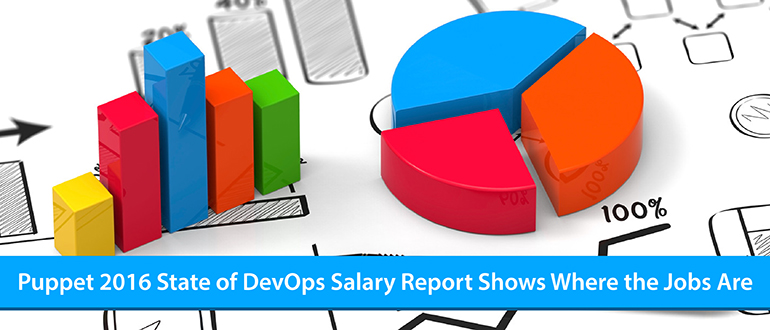
    Puppet 2016 State of DevOps Salary Report: Where the Jobs Are

    Puppet has released its 2016 State of DevOps Salary Report,. The report is based on the over 4,600 responses to its State of DevOps survey by IT professionals all over the world. This year’s report answers the question every politician would like to be able to answer: Where are those good jobs? The answer is easy, the good jobs are in IT. And good news for those in the United States: The highest salaries are in the United States, followed by Australia, New Zealand and Canada. Western Europe is a little behind that pack, and Asia Pacific behind that.

    IT salary

    In addition to the fat salary for IT workers, the United States pays the highest salary to IT managers also. In a nod to the income inequality issue that we have heard so much about in this U.S. election season, the gap between workers and managers was wider in the United States than it was in other areas. The difference in salary between managers and workers in the United States is illustrated from the report here:

    managers workers

    Other good news for U.S.-based IT pros is that both workers’ and managers’ salaries increased in 2016. In case you are interested in how Puppet divided workers from managers, it was done by title:

    job titles

    The good news wasn’t only for U.S. workers, though. It seems IT workers the world over are being pretty well-paid. In an era where so many ask, “Where are the good jobs?” the answer more than ever is IT. The disruption caused by the digital revolution is truly resulting in those with digital skills becoming the haves and those without those skills being the have-nots.

    nigelIn addition to IT workers in general being well-compensated, IT workers in certain industries actually tend to be better paid than IT workers in other industries, noted Nigel Kirsten, CIO of Puppet. It would seem if your employer is in the technology, media/entertainment, retail/consumer/e-commerce or finance vertical, you stand a better chance of making a higher salary.

    Additionally, Kirsten noted  that if you work for a larger organization (more than 10,000 servers), you generally have a better chance at earning near the top belt of compensation. Also, more good news for the DevOps team, the more mature the DevOps practices at an organization, the higher the compensation tends to be. Both of these metrics point to the fact that larger organizations with mature DevOps practices value the investment made in not only infrastructure but also people.

    One dark spot on the report is that, once again due to the overwhelming majority of respondents being male (94+ percent), we really don’t have enough data to see if gender pay equality exists in the IT and/or DevOps world. I look forward to the day that the number of female respondents increases and we have more insight into this important metric.

    In the meantime, this is just a quick take on the report. I encourage you to go download the report and read it for yourself. You can even see how your own salary compares.

  • DevOps Chat: Mark Nunnikhoven, Trend Micro on Hybrid Cloud

    DevOps Chat: Mark Nunnikhoven, Trend Micro on Hybrid Cloud

    DevOps.com sits down with Mark Nunnikhoven, VP Cloud Research at Trend Micro. We discuss hybrid cloud, hybrid cloud security, DevSecOps and more. Mark is very involved in research on the latest threats and trends in cloud security. This is a great interview that I think you will find very interesting.

    As usual, the transcript of our conversation follows:

    Alan Shimel: Hi, this is Alan Shimel, DevOps.com, here for another DevOps chat, and I’m joined today by Mark Nunnikhoven of Trend Micro. Mark, welcome to DevOps Chat.

    Nunnikhoven: Thanks for having me, Alan.

    Shimel:  I hope I didn’t mangle your name too bad, did I?

    Nunnikhoven: No, it was perfect. It’s a tricky one. It looks really menacing, but ends up being relatively simple after you’ve heard it a few hundred times, so –

    Shimel: Absolutely, very good. So, Mark, I asked you to join us today—I think we had done a webinar and talked a bit offline about, you know, some of the challenges around securing hybrid cloud and, you know, versus obviously people moving stuff to the cloud, people still have stuff in their data center, and what’s good for one may not necessarily be good for the other, but what’s good for both might be an entirely different thing. And I wanted to just spend a little bit of time with you talking about the challenges of securing the hybrid cloud.

    Nunnikhoven: Yeah, it’s definitely an interesting topic that I don’t think gets enough attention, so I’m glad we can have this chat.

    Shimel: Yep. Before we jump into it, though, Mark, I’d be remiss if I didn’t give you a chance to just let people know, I did mention you’re with Trend Micro, but what is your role there?

    Nunnikhoven: Yeah, I’m the vice president in charge of cloud research. So I look at how organizations are tackling security in the cloud, in hybrid environments for, you know, traditional servers and workloads, containers, serverless, sort of anything that’s breaking new ground. It’s a lot of fun and there’s a lot of really interesting stuff happening.

    Shimel: Great. So, Mark, you know, I think I started us off by saying there’s people who are making solutions for the cloud, there’s people making solutions for the data center, the ARM RAM. And what’s good for one is not necessarily good for the other, and then, of course, most of the world is living in some sort of hybrid environment.

    Nunnikhoven: Yeah.

    Shimel: What do we do?

    Nunnikhoven: [Laughs] That’s a great question, ’cause, you know, I’ve seen—working with organizations around the world, I’ve seen sort of all of the possible scenarios, I think at least the major ones that people kind of come to thinking might work, and they sort of range from we’re going to force data center processes and controls into the cloud, which is a recipe for disaster. You know, they’re very different environments, to the opposite, of we’re gonna take everything that’s working in the cloud and we’re gonna force it on the data center, to, you know, we’re gonna run two completely different environments in completely different ways, and essentially double the workload. None of those is really satisfactory. Sort of the best route forward tends to be looking at what’s working in the cloud and trying to push a lot of those concepts into the data center. But you still need to make adjustments for the reality that the data center is very, you know, sort of slow and very high level of rigor and very formulaic, and, you know, very well-established. So you do need to make adjustments, but, you know, the goal is to get one way of doing things with allowances for the difference in both environments.

    Shimel: Yep. And Mark, as you said, that may be the goal, but, you know, from day one, you obviously—you need a plan to get there. And can you maybe share with our audience a little bit, where do you see the logical steps, if you will, to getting there?

    Nunnikhoven: Yeah, and I think that’s a really good way to phrase it, you know, because we can all—we all love the architecture Powerpoints and you go the events and you get real excited about what the eventual design and implementation will look like. But getting there can be really ugly and really messy. I think the biggest thing, and it’s unfortunately the thing that people tend to forget about, is looking at not just the security, but the operations processes and controls that you’re using today, and why you’re using them. And I think that’s the big piece that people miss, is, you know, why am I using something like an intrusion prevention system, or why am I using anti-malware or why do I have this change review board for any sort of operational change I want to make. And once you start to dig into the why you do these things, you realize that the implementation can change, as long as you’re still meeting that why.

    So, you know, we put intrusion prevention in place so that we make sure that any time we open up traffic to this server, that we verified it is actually secure web traffic like we’re expecting. Once you know that’s the reason, then you can look and say in my data center, that makes sense to have a big perimeter appliance doing that job, whereas in the cloud, it makes more sense to have something running on the host, doing that same job. So you’re still getting the same answer to why. It’s just the how is different in each environment. So it’s—you’ve got to dig into those, and it starts to clarify what you’re doing.

    Shimel: Got it. Mark, what are we seeing—I mean, what—obviously at Trend, you’re probably talking with a lot of customers. Are they coming from the cloud down with their solution? In other words, buying a cloud solution and building—or from the data center up, if you will?

    Nunnikhoven: A lot of the time we’re seeing the data center up, simply because it’ll be one team within a larger organization. So we’re talking mainly, you know, traditional enterprise and large governments. And it’ll be one team that’s gone and said we’re gonna push everything and build it new in the cloud, and when they start to kick off that process, they start to get a lot of existing policy and existing culture enforced on them. So they’ll get, you know, specifically the security. They’ll get people saying, well, you need this, you need to make sure that, you know, you go across these boundaries in your design, you’re networking a certain way. So they start to try to take those same designs, which are great in the data center, but horrible in the cloud, and they try to push those into the cloud, and they usually end up failing. And then about six months afterwards realize that they need to take a new approach, because it is a completely different environment.

    Shimel: Got it. And, you know what, Mark, I’m a firm believer that at least for the foreseeable future, five, 10 years, hybrid cloud is the—is the dominant, right, the dominant usage pattern that we’ll see from people. Is this yours as well?

    Nunnikhoven: Yeah, 100 percent. And for me, it’s simple economics. As much as you want to be in the cloud, if that’s the case, if bought in even, you know, you’ll see it at the major events from the big cloud providers. They’ll pull up big enterprises who are—their CEO or the CIO is, you know, yelling from the top of their lungs that they’re gonna be all in on the cloud. Even in those scenarios, they’re still going to take 12 to 18 months to move out of their data centers.

    But the reality is most enterprises have already made a multimillion dollar investment in technology that’s working. It might not be working as fast as they want, but you can’t walk away from that. The cost savings in the cloud, if they’re there, are not that significant that you’re gonna leave millions on the table. So the reality is, you know, for a standard data center life cycle, so like you said, a five to seven year term, you’re gonna be dealing with two environments. And it’s not just that it’s two environments, it’s two environments that are completely different. It’s very much apples and oranges. So you do need a different approach.

    Shimel: Got it. And, Mark, I don’t want to put you on the spot, but what Trend Micro specifically, what kind of solutions are you guys, you know, working with customers on?

    Nunnikhoven: Yeah, so one of our big push, and we’ll just hit it real brief, because we don’t want it to be a sales pitch at all, it’s just we have a platform called Deep Security, and we built it with the principle of trying to put security as close to the data and application as possible. And because of that, we’ve been able to adapt it for multiple cloud use, for data center use, for the hybrid scenario quite well, because we’ve taken a lot of the principles that work in the cloud and made it so that you can leverage them where it makes sense in the data center. So a lot of automation, a lot of programmability, and a lot of intelligence in the products so you don’t have to worry about the nitty-gritty of dealing with security day to day, unless it’s really urgent and requires you to intervene.

    Shimel: Excellent. And, I mean, Trend is obviously not the only one doing this, Mark. When we talk about cloud too, I wanted to ask you this, public versus private clouds, where are you seeing this kind of—you know, are we—you know, to me, a private cloud is—goes hand in hand with hybrid, right? But there are people who are doing public cloud and data center, and that’s hybrid as well.

    Nunnikhoven: Yeah, and I find for me, you know, private was a real big push back from a lot of the incumbent data center vendors, and, you know, we’ve kind of gotten out of that hype phase and into the reality of it. And I tend to see what a private cloud is, is somebody who’s taken the data center and adapted a lot of the cloud processes and the ideas behind a public cloud and implemented them within their data center, which can be a really good thing. So you can get on-demand resources, so you just query in API instead of sending out a ticket and getting a bunch of people to do work. You know, getting that accountability, getting that accessibility and that visibility that we’re used to in the public cloud, getting that in the data center.

    So I think the ideal hybrid scenario is leveraging private cloud/public cloud. A lot of people aren’t there with their data center, because implementing change takes a long time. There’s a lot of cultural change, a lot of tooling change. So you’ll see them with sort of more the traditional data center approach. But if they want to be successful over the next few years, they need to start pushing more of those private cloud ideas internally, because that will help them have one set of processes and tools across both the public and the private cloud.

    Shimel: Makes sense, makes sense. And Mark, what about people, though, who just say, you know what, I’m—I’m biting the bullet, I’m just gonna do cloud, you know, or I’m just gonna do data center. You know, first of all, nothing is forever, obviously, right? You could say that today, but things change. Is the Trend Micro solution, specifically, let’s say, is it one that will work with one, but that scales to the other? Or, in other words, how do we stay out of dead ends?

    Nunnikhoven: Yeah, and specifically from us, this is something we’ve been dealing with with our customers over the last few years, because we’ve got customers who are 99 percent in the cloud and 1 percent in a data center somewhere, and the exact opposite. And it really—you know, every culture and enterprise is unique in what their blend and their mix of those environments is. So having the tool be agnostic to that is really important. So, you know, we’ll scale from protecting one system, to protecting 100,000 systems, with the same platform, very, very easily.

    And I think there are a lot of projects out there, you know, not just commercial offerings from Trend Micro, but we’re seeing this a lot in the operational monitoring space. So, you know, things like Ryman or Logstaff, which are two great open source projects to help you correlate data, they work equally well in the cloud as they do in the data center, and I think that’s really a big win for people, is that you need to put the assets in the environment that makes the most sense, but you should be able to use modern tools in both. And that’s a real big, important point for people to take away, is that you want to be—even if you’re in a traditional sort of slowing evolving data center environment, you want to be making sure that you’re leveraging some of the great advances we’ve made in security and in operational tools.

    Shimel: Excellent, excellent. Mark, we’re coming near the end of our time, as this always seems to go quick. But let’s talk a little bit about the research that you’ve been doing, and just give our audience maybe a little insight. What are you kind of researching now? What do you find really interesting?

    Nunnikhoven: Yeah, the biggest area I’m focusing on right now is the rise of what’s been deemed the serverless architecture. So obviously sort of a poor choice of names. There are servers somewhere. But it’s the idea of leveraging a function as a service as something like Microsoft du jour functions or AWS Lambda, where you’ve just got code that you input that runs in a sandbox on someone else’s system and you don’t have to worry about any of that. So scaling and operational tasks are kind of out the door, but these are heavily leveraging SaaS services and you’re sort of picking the best aspects of multiple providers, and stitching it together into one big application. And there’s a lot of really interesting advantages for the business there, because you’re focusing purely on delivering value to your users.

    But from a security perspective, now you’ve got multiple parties and systems that you have to trust, that have to work together, that have to share security controls, and then that is normally only one application in a suite of others. So you’ve got serverless applications, you’ve got applications that are running on containers, and then traditional applications. So I’ve been looking at not just the serverless, but how you do you address all of these in a consistent manner, so that you can apply security to the data where it’s being processed.

    Shimel: Excellent. Mark, we are butting up against time here, but one last question, and it’s one I frequently ask our guests here on DevOps Chat. If you had to recommend one book to our audience to read, not necessarily the last book you read or anything like that, but one book they should read, what’s your recommendation?

    Nunnikhoven: Yeah, that’s always a tough question. I love reading, so I’m always reading three or four books at a time. And, you know, it’s a safe assumption that this audience has already read “The Phoenix Project.” If they haven’t, they should. My latest favorite in this space is called “The Art of Monitoring.” It’s by James Turnbull, and it’s a look at how to implement metrics and measurements around running applications, regardless of where they are. So it talks about logging, it talks about real-time alerting, and it’s a really great approach, in that, you know, it’s always looking at results. So not just collecting data for data’s sake, but it sort of walks you through how all of this stuff should roll up to give your teams some actionable insight on how your application is doing. It’s a really great book.

    Shimel: Got it, interesting. Well, Mark, thank you so much for being this episode’s guest, of DevOps Chat. We’d like to maybe have you back on sometime and talk to us about more of the research you’re doing. Continued success to you and Trend Micro, and just thanks again. This is Alan Shimel, for DevOps Chat, and thanks for joining us. Until next time.