Category: Features

  • Announcing DevOps Connect: DevSecOps Days Virtual Summit

    Announcing DevOps Connect: DevSecOps Days Virtual Summit

    We just wrapped up our fifth annual DevSecOps Days @ RSA Conference 2019, featuring an exceptional lineup of speakers and a variety of informative sessions, providing an unparalleled experience for all. If you couldn’t make it to San Francisco for RSAC or missed any sessions, we’ll be hosting a virtual version of DevSecOps Days @ RSAC Tuesday, April 2.

    You’ll hear stories from DevSecOps practitioners discussing how they made the cultural transformation from legacy development and deployment processes to integrated systems that include security as a part of the process—not as an overseer or bottleneck to secure application development.

    Similar to the environment we created for the DevOps Experience and Predict 2019 virtual events, DevOps Connect: DevSecOps Days Virtual Summit will feature a virtual environment with a conference lobby, presentation theater, expo hall and more. DevOps Connect: DevSecOps Days Virtual Summit is more than a series of YouTube live presentations; it is a true conference experience, from the comfort of your desk.

    Join John Willis, Chenxi Wang, Shannon Lietz, James Wickett and other industry luminaries for a deep dive into the world of DevSecOps. Register now to attend live Tuesday, April 2. Registration is FREE, but space is limited. Reserve your spot now!

    [su_button url=”https://devopsconnectdevsecops.com/#join-us” target=”blank” background=”#DC2E2A” size=”5″ center=”yes”]SAVE YOUR VIRTUAL SPOT[/su_button]


    [su_divider]

    [su_button url=”https://devopsconnectdevsecops.com/#join-us” target=”blank” background=”#DC2E2A” size=”5″ center=”yes”]SAVE YOUR VIRTUAL SPOT[/su_button]
    [su_divider]

    MediaOps is the company behind technical communities DevOps.com, Container Journal, Security Boulevard and DevOps TV, and events including DevOps Experience, Predict 2019 and, now, DevOps Connect: DevSecOps Days. Our virtual events take place in the industry’s first truly immersive, virtual reality conference environment. More than a series of Google Hangouts, DevOps Connect: DevSecOps Days is a true virtual conference, replete with theaters for each of the keynotes and presentations, a conference lobby to chat and socialize, and a real virtual expo floor with virtual exhibitor stands equipped with video, downloads and even swag for attendees.

    Follow us on Twitter at @devopsdotcom and @securityblvd for event updates. Use the hashtag #devsecopsdays and let us know if you are going!

    — saleem

  • Got DevOps Skills? A Look at the Upskilling: Enterprise DevOps Skills Report

    Got DevOps Skills? A Look at the Upskilling: Enterprise DevOps Skills Report

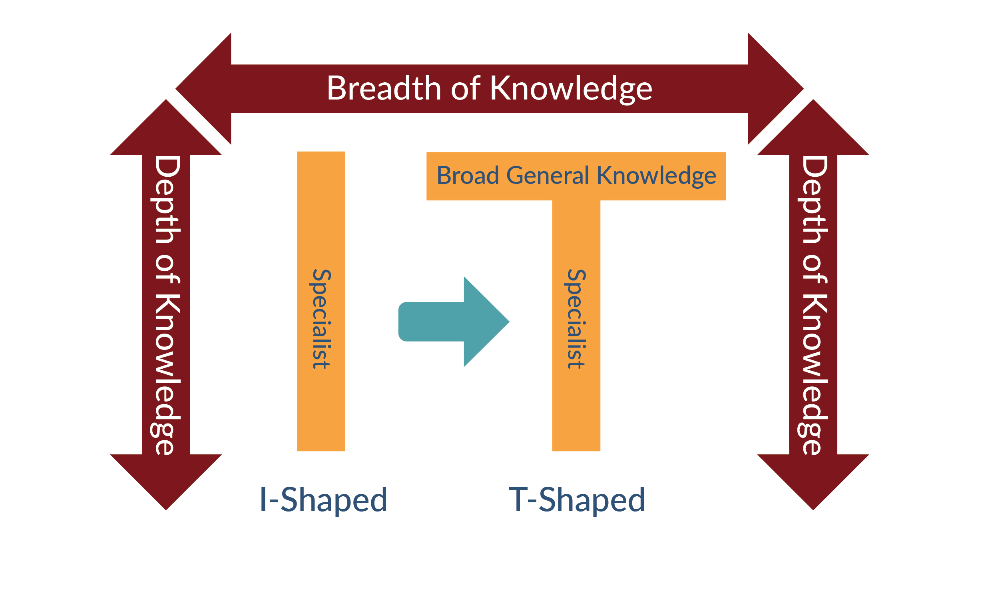
    IT recruiting is at an all-time high and organizations want T-shaped professionals with cross-functional skill sets to join their teams. While “T” represents an individual’s core competency, and the top of the T represents a broad range of related knowledge, there has been little clarity on which skills are the most important across a wide spectrum of possibilities—until now.

    DevOps Institute launched the Upskilling: Enterprise DevOps Skills survey in 2018 to focus on the human element of skilling. The feedback from more than 1,600 individual responses echoed the notion that regardless of vertical, organizational size, geography or role, DevOps practitioners need data-backed skilling statistics. As the focus within the enterprise, DevOps community shifts from “What is DevOps?” to “How do we do DevOps,” this demand is more crucial than ever. After all, “how to” requires “know-how” and “know how” requires a new set of skills. But which skills?

    According to DevOps Institute’s Upskilling: Enterprise DevOps Skills Report:

    • Soft skills and technical skills are equally important
    • IT operations knowledge received the most “must-have” votes as a functional skill in DevOps
    • Cloud and analytical knowledge are the top technical skills
    • DevOps Engineer emerged as the most popular job title (see below for figure N=812)
    N=812

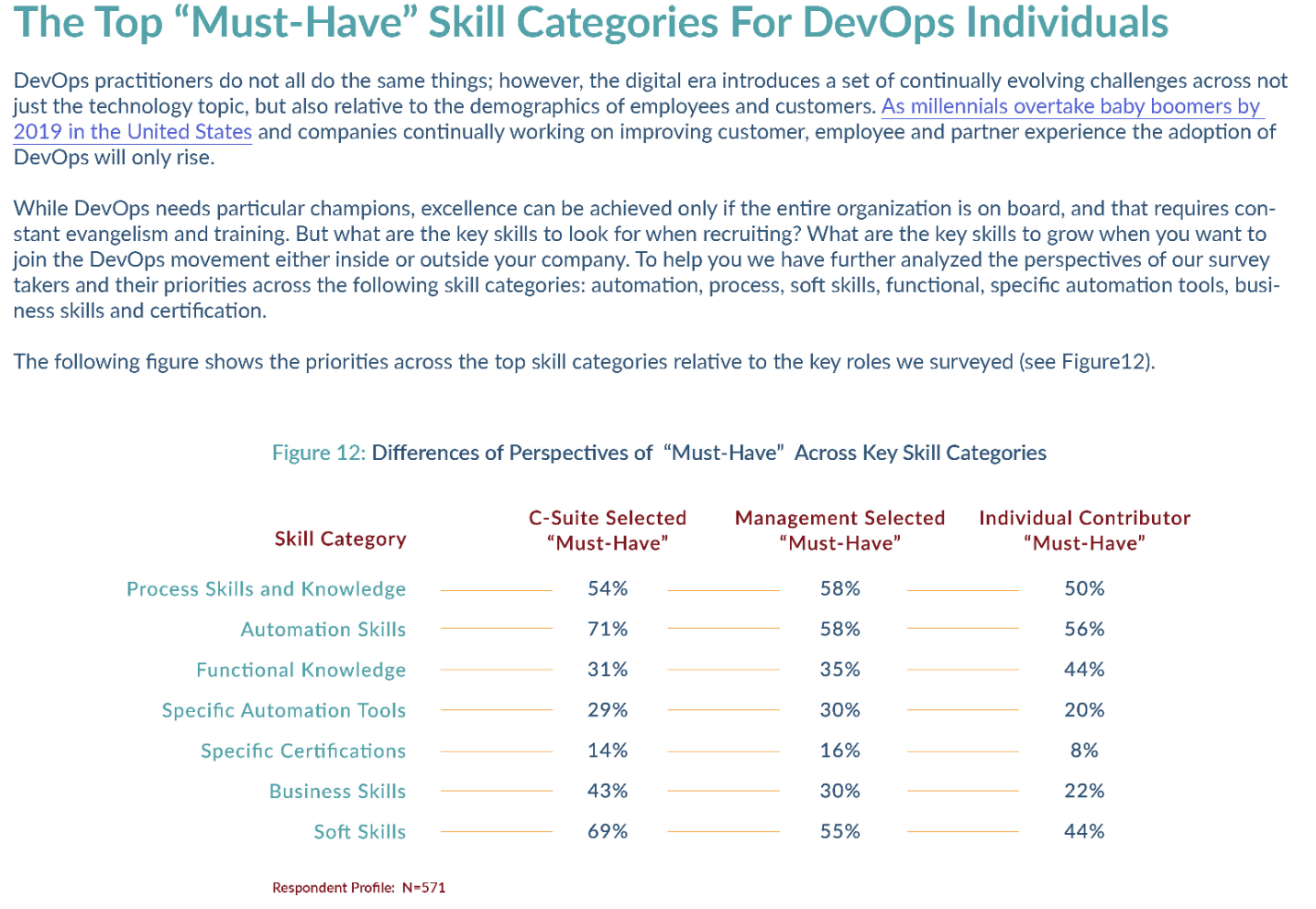
    The report was developed in partnership with veteran research analyst Eveline Oehrlich, formerly of Forrester Research. This comprehensive data provides indications of which functional, process, technical and automation skills are “must-have,” “nice to have” and “not important.”

    This is particularly significant for IT professionals who are confused about where to focus their personal skills transformations in their journey toward the “T.”

    Should developers work on upskilling their testing, automation, process and/or security skills? Should operations professionals learn to code, test or explore more about machine learning and AI? What about project management and systems administration? The Upskilling: Enterprise DevOps Skills Report can be used as a snapshot of critical enterprise skills that are important to successful digital transformation.

    The Upskilling: Enterprise DevOps Skills Report was released March 4 and is now available for download. On behalf of Platinum Sponsor Electric Cloud, Gold Sponsor CloudBees and Silver Sponsor Lenovo, industry influencers and international DevOps community, we hope this data will help shrink the skills gap and support the transformational goals of both individuals and organizations. We’re already looking forward to the launch of DevOps Institute’s Upskilling: Enterprise DevOps Skills Survey 2020 to continue meeting the demand for ever-evolving skilling trends in the DevOps community—stay tuned!

    — Jayne Groll

  • ITIL V4 Foundation Embraces the Agile Manifesto with Teamwork as a Core Value

    ITIL V4 Foundation Embraces the Agile Manifesto with Teamwork as a Core Value

    The Feb. 28 release of the ITIL Foundation ITIL 4 Edition book is proof positive that other service management frameworks have impressed the folks who brought the latest iteration of ITIL to fruition.

    ITIL V4 proves to be significantly different than previous generations of ITIL and embraces many of the core values found in frameworks including Lean, Agile and DevOps. Ideologies such as embracing value, fostering collaboration and adopting what ITIL V4 specifies as a four-dimension model bring a holistic approach to service management. The four dimensions are classified as people, products, partners and processes.

    Perhaps the biggest challenge in creating ITIL V4 was moving from traditional process-led delivery advocated in ITIL V3, to a best practices approach of focusing on co-creating value collaboratively between the organization and stakeholders. A change that potentially impacts ITSM, development, operations, business relationships and governance.

    “We worked with 12 lead architects, 61 authors and reviewers and hundreds of practitioners from the wider IT industry,” said Mark Basham, CEO at AXELOS, the organization responsible for ITIL. “In addition, our ITIL Development Group has more than 2,000 members from all over the world. This huge collaboration has now produced a framework that will support practitioners and organizations, to meet the challenges that come with the Fourth Industrial Revolution.”

    At first blush, ITIL V4 seems to reiterate what many other frameworks already espouse. However, ITIL V4 does bring some other ideologies into play.

    “One big change with ITIL V4 is the focus on value, where value is more than just a desired outcome but also something that is co-created by all involved. That ideology fuels collaboration and breaks down silos. The shift to focus more on the customer experience demonstrates achieving value, establishing the value chain as a foundation,” said Nancy Van Elsacker Louisnord, President of TOPdesk USA, an Orlando, Florida-based developer of service management software. “ITIL V4 actively embraces some great concepts out of Agile and DevOps, exemplified by the guiding principle of progress iteratively with feedback. The ITIL4 service value chain looks very similar to what we see in DevOps and actively encourages an iterative approach.”

    However, with ITIL V4 seeming to borrow from other ideologies, one may wonder how much value remains in the ITIL framework.

    “Partners and suppliers have been added as a fourth dimension, next to organizations and people, processes and value streams, and information and technology. It is an addition that accounts for the reality of increased outsourcing, and the challenges that come with that,” said Van Elsacker Louisnord. “The dimensions play an important role in the 34 ITIL practices that have replaced ITIL V3’s 26 processes. While in essence they haven’t changed much, ITIL V4 takes those four dimensions into account in every practice, making practices much more practical than the processes of the past,”

    While many questions still remain around ITIL V4, the writing is on the wall that Agile ideologies are becoming the norm, and DevOps-orientated development brings forth certain advantages. ITIL V4 must co-exist with other frameworks to bring value into best practices and adaptable frameworks. More importantly, ITIL V4 is being set up as a framework that can enhance other ideologies, while helping to preserve the investment that hundreds of thousands of IT professionals have made in ITIL.  

    — Frank Ohlhorst

  • DevOps Chat: Customer Experience and DevOps with Cyara’s Alok Kulkarni

    DevOps Chat: Customer Experience and DevOps with Cyara’s Alok Kulkarni

    In this DevOps Chat we speak with Cyara CEO and co-founder, Alok Kulkarni, about how DevOps is helping in the customer experience arena. Cyara has carved out a leadership role in bringing DevOps to CX. Alok is a delight to speak with and very wired into this space.

    As usual, the streaming audio is immediately below, followed by the transcript of our conversation.


    Transcript

    Alan Shimel: Hey, everyone, it’s Alan Shimel, DevOps.com, and you’re listening to another DevOps Chat. Today’s DevOps Chat features Alok Kulkarni, CEO and Co-founder of Cyara. Alok, welcome to DevOps Chat.

    Alok Kulkarni: Hey, Alan. Great to be here.

    Shimel: It’s our pleasure to have you here. So, Alok, let’s—before we jump right into what I wanted to talk about today, I think the first thing we should do is a little level set. Maybe we have some folks who are familiar with Cyara, maybe we have some folks who are not. Why don’t you give us kind of a quick background on Cyara?

    Kulkarni: Sure, Alan. So, Cyara is a customer experience assurance platform, which allows customers to accelerate their CX development right from the design through to testing and all the way through to customer experience monitoring for customers’ journeys end to end.

    And so, what’s different about us is, we support the entire software development life cycle from the design through the functional integration testing right through to user acceptance testing, including load testing and production monitoring. And, in the CX world, we’re able to do this from an end customer perspective across all the different channels that the customer might be interacting with the organization. So, that’s just a brief summary of what we do.

    Shimel: Sure. And you are the Co-founder and CEO.

    Kulkarni: Mm-hmm.

    Shimel: And just, while we’re here—

    Kulkarni: Yes, and—

    Shimel: —give us a little bit of your own personal journey. How did you come to be the co-founder and CEO at Cyara?

    Kulkarni: Sorry, go ahead.

    Shimel: Oh, I’m sorry. I was going to say, if you can give us a little bit of your own personal journey, how did you come to be the CEO and Co-founder of Cyara?

    Kulkarni: Oh, great question, Alan. Sorry, I lost you there for a bit. I was working at another software company, which is currently the leader in customer experience management technology, and one of the things I found in those days—this was in the late 2000s—was, every time we put the technology in production, the customers, the end customers used to deal with this new technology and the enterprises would be sitting there with white knuckles hoping and praying that it would all work—because there was no platform in those days which would enable them to test and monitor the technology that they were putting in for the customers from the outside in. So, essentially, it was like playing Russian roulette.

    So, I felt, being an architect at this company and managing the solutions engineering group at this technology company called Genesys that, there had to be a better way. And one of the—the idea came to me when we were rolling out a large implementation for an Australian government organization when it failed. I thought that there must be a better way of doing this.

    So, hence, I felt—imagine if there was a cloud-based platform that was technology agnostic which enabled enterprises to just use and simulate customers from the outside in to be able to test and monitor, not only the infrastructure, but the applications from an end to end customer journey perspective. It would really take the risk out of deploying new and innovative solutions in the market. And so, that’s how it all happened. So, I got together with my buddies and we built Cyara.

    Shimel: Excellent. So, you know, in so many ways, there’s so much DevOps there, if you will, Alok. And first of all, the idea of—and we see this in security, we’ve seen it with other forms of QA—the idea of waiting ‘til after something is deployed to see if it works or not, you know, that white knuckle moment? Why?

    Kulkarni: Mm-hmm.

    Shimel: I mean, why, in this day and age, do companies still want to do stuff like that, right? And this is, especially when we talk about sort of the modern software factory and CI/CD pipelines and so forth, right? We shouldn’t let software out there that hasn’t been fully vetted and tested. Why would we let software and things in the wild, where we haven’t already tested what our customer response, and our customer experiences are going to be and whether they will work?

    It just seems like such a no-brainer. Why do you think it took so long for people to come to this realization?

    Kulkarni: So, I think that’s a great question, Alan. And, you know, when we were sitting there noodling on whether we should start this, I remember going to my co-founder, Bonny, and asking him, “Hey”—because he wasn’t from the industry, and when we came up with this idea, he goes, “Surely, there’s somebody doing this.” Because it’s exactly what you said—it’s a no-brainer. And I said, “No, there’s actually no one doing this.”

    And I think the reason for that is, one is, I don’t think people in the—if you’re not in the industry, you don’t even know that this is a problem, that’s one. Second thing is, even if you were in the industry, it is so complex. I mean, there are so many different moving parts, so many technologies. Then you have enterprise processes and systems and systems integrators and so forth.

    So, by the time you’ve put that whole, all those components together, it becomes very difficult to build something simple that would solve these problems. So, when we did it, it just took off. And now, like you say, I think customers are realizing that there is a technology or a solution out there that can help them. So, we’ve had a tremendous, I guess, following of customers who actually just continue to expand what they do with Cyara and we’re signing new customers on as we go along.

    So, just this last quarter, we signed about 25 Fortune 500 companies to our platform. So, I think it’s catching on, and now, what we’re seeing is the next wave, like you mentioned, this whole DevOps wave that’s really taking firm hold in the way that more and more organizations are putting out a software or capability. And I think in the CX world, that’s changing as well. So, I think, we’re also creating awareness that you can bring DevOps to CX and although the tool set might be a little different, you can actually do it. So, we’ve had a tremendous amount of traction in the market with that.

    Alan Shimel: Absolutely. You know, Alok, it talks to something else that we’ve seen in DevOps. When we first started DevOps.com on March 11th of 2014, I think it was, so it’s almost five years now—the whole, “What is DevOps?” argument was raging. And there was a large percentage of the community that had a very orthodox view of DevOps, that if it wasn’t purely about software development and deployment in terms of operations and APM, it wasn’t DevOps, right? That’s what—there was a very narrow definition of DevOps.

    We’ve seen that expand, right, to what I call DevXOps now.

    Kulkarni: Mm-hmm.

    Shimel: We’ve seen DevSecOps, we’ve seen DevBusOps, we’ve seen DevSalesOps. It’s really taking that DevOps mindset that DevOps can do and applying it to everything.

    So, really, we’re almost seeing here DevCXOps, right, if you will.

    Kulkarni: Yeah, totally. Yeah, I think we are in that era now of DevCXOps, just like you mentioned. Because, just like software organizations were putting out new capabilities in a rapid manner, I think customers were expecting customer facing technologies, and the way they’ve been—the way that they’re interacting with organizations to change rapidly as well. Because everyone’s time poor, they need the answers as soon as something goes wrong or if they want to buy something, they’re impatient, because we all have things to do and we’re on 24/7.

    So, it’s imperative for companies providing customer experience to keep up with that. And I think DevOps provides a great framework to do that, and it’s aligned so, as you say, if you’re already in DevOps and the digital world, you can bring it to the CX world. And I think it’s really catching on.

    Shimel: I don’t disagree. I think another thing, Alok, and you hit on it there, is customer expectations. You know, one of the sort of forgotten heroes or the forgotten catalyst behind all of the DevOps kind of movements is what really—people don’t go fast just to go fast. Well, maybe some do, right? There are speed freaks, right? [Laughter]

    But, you know, people who adopt agile DevOps and these sorts of frameworks and methodologies do so to be more responsive to customers. And that’s really—and it’s nitty-gritty. That’s what it’s about. Because that’s why companies do things, to serve their customers better. And that’s really the guiding principle behind CX as well, right? How do I respond to customers better, especially in a world where customers demand more? They want 24/7 support and response, and they want it right away, and they want it now and they want it to work, right? There’s a low tolerance if your cellphone coverage is not good, or your internet—as we spoke about—your Internet at 30,000 feet on a plane is not working, and people get really upset about that now. And in so many other ways, customer demands are driving this. Correct?

    Kulkarni: Yeah, totally. And you know, what’s sad is, we’re fickle. You know, we’ve been conditioned to now have choice. So, if we don’t like the service a particular company is offering, you know, we switch, and switching is so easy, because it’s very easy to find another provider who provides a similar service and offering and then if they have a better customer experience, you think when you actually have that moment of need where you actually need help and they’re providing it to you promptly and they’re resolving your issues quickly and they’re doing it how you want to be treated, maybe it’s a late night chat or a phone call because it’s super urgent or it’s complex. Or maybe it’s like, “I don’t want to talk to anyone today, but I need the information for my support, because one of these technologies that I’ve got isn’t working, so I need a knowledge base that I can refer to.”

    Any of these customer-facing technologies play a very important part in customer loyalty and thereby, shareholder value for the company that they’re dealing with.

    Shimel: Agreed, agreed. So, Alok, if you don’t mind, I want to talk a little Cyara—I’m sure you don’t mind. [Laughter]

    Kulkarni: [Laughter]

    Shimel: So, do you offer this as more of a Platform as a Service or as a SaaS based offering?

    Kulkarni: Yeah, it’s a SaaS-based offering, so we have a cloud infrastructure environment which spans, which goes across the globe. Just last year, we placed 4.4 billion call seconds’ worth of synthetic interactions to assure customer experience around the world, and some of the largest brands of the world use it.

    So, some customers, they use our platform to provide the whole design experience—like, the design, the customer experience in Cyara is able to, as a result, get a full automation and regression test suite that they can run as part of their DevOps factory, and then we have a real time customer experience monitoring platform.

    So, for example, if you put something out in production, our platform actually is able to generate synthetic customer interactions from the outside in. So, we can actually emulate, Alan, contacting an organization on your behalf and actually see what experience you’re going to get, whether your interactions or your calls connected on time, whether the web chat gave you the right responses, whether the screen froze or not, and you can do this all in real time.

    So, customers have a direct feedback loop that they can implement. So, as soon as something goes into production and it doesn’t work, before a real customer is able to have a poor experience, we’re able to detect it early on and the customers can then roll back the technology that they had implemented and then roll the previous last known good version out so that they maintain the sanctity of the customer experience.

    So, it just—to me, that just goes hand in hand with the whole DevOps paradigm.

    Shimel: I agree. It certainly does. So, Alok, if I ask you to kind of peer into your crystal ball of the future, where do you see this going now?

    Kulkarni: So, as you mentioned, Alan, there’s a lot of companies out there who are not even aware that they can apply the whole DevOps—they can bring CX to DevOps and, as you call it, DevCXOps, and make it happen. So, I feel, over the next two years, we’re going to see a tremendous wave of customers adopting this framework, because they’ve already done it on the digital side and the CX side tends to be—I think they’re in an adjacent area and I think they are moving to this new model.

    So, we’re going to see a lot of customers offering it, and I think we’re going to see a lot of new, innovative technologies coming out with integrated solutions for that. So, I think for Cyara, we want to support our customers as they go on this journey. So, we’re integrating with a number of platforms out there that enable the whole CX DevOps pipeline scenario. For example, we’ve just integrated with Splunk, we’ve integrated with ServiceNow. So, in Cyara, you can actually get real time incident notification of any technology that you’re implementing and automatically create service requests so that you’re able to keep ahead of the whole customer experience pipeline.

    And the other thing that we’re doing is also investing heavily on the design aspect of it. So, we’re working with companies like Amazon and so forth to offer a platform that is able to take customers that are moving to the cloud or moving to cloud contact centers, which is becoming, which is a new wave that’s still catching on and enable them to essentially drive this whole assurance through to all their customers.

    Shimel: Excellent, excellent, excellent. Well, Alok, as we—I think I told you before we started, the time goes really quick. We only have a few minutes left. I wanted, also, I’d like to finish up with kind of wrapping this whole thing back into the DevOps, back into what Cyara is seeing from customers.

    Companies I’ve been involved in, and I’ve founded a few, you know, we had sort of a customer support, a customer help team. It was separate from developers, it was separate from Ops. It was part of the engineering team, but it was almost a red-headed stepchild within that engineering/IT team. Is that still the case? Is that a problem? Is that something Cyara runs into when you’re talking to folks? What’s the story?

    Kulkarni: So, I think you, again, Alan, are right up there with it. So, I think one of the decisions organizations that we deal with are grappling with is, do they make engineers who understand software and make them CX developers, or do they make CX developers who have real code domain expertise and bring them onto the DevOps world?

    And I think that’s a question a lot of companies are asking themselves—like, do we need to really understand this space from top to bottom, or do we get developers? Is it easier for developers to learn this versus the other way around?

    And I think that’s currently in the experimentation stage. So, a lot of companies who have tried the old model feel that it’s just very hard to change the mindset of the old engineering folks to—you know, who’ve been traditionally used to waterfall and doing large scale implementations and using systems integrated to put those out to really just come onto this whole new, you know, go fast, break things mentality versus getting those guys to understand CX.

    So, I think there are two horses running right now, and I think we’ll see the results of that in the next year or two. But what I am seeing is a lot of companies trying to get their developers onto the CX world, because they’re finding that that seems like a much easier path.

    Shimel: I don’t disagree with you. Crazy. Interesting times.

    Kulkarni: Yeah.

    Shimel: Anyway, Alok, I know we’re doing some other, you’ve published some more—well, not you, but Cyara has published some nice articles on DevOps.com lately, we’ve done some other activities.

    Where else can people find out more information, though, about Cyara?

    Kulkarni: Well, they can obviously come to our website, so Cyara.com, that’s C-Y-A-R-A dot com. And I think we have, we’ve built a huge library of resources thanks to our fantastic team that we have at Cyara, and they can also—I think over there, there’s a whole library of collateral that they can view. We’ve got a YouTube channel that they can subscribe to.

    And we also have Cyara Academy. So, as part of that, they can go in and if they want to actually get trained on Cyara, we offer that on demand as well. And you don’t—I think there are some courses where you don’t have to pay. So, I think you can, if you’re new to this space, I think it’s a great place to get scaled up, because I think this is a very exciting space. Because, as you’ve said, Alan, every company, to be successful, needs to really deliver a superior customer experience to their end customers and I think it’s just the core of any fundamental for any company to get this right.

    So, come on over to Cyara.com and get yourself educated.

    Shimel: Cool. Well, Alok Kulkarni, CEO and Co-founder of Cyara, thanks for being our guest on this interview, on this episode of DevOps Chat, and we hope to have you back on again soon.

    Kulkarni: Thanks, Alan. Would love to come back.

    Shimel: Alrighty. Hey, this is Alan Shimel for DevOps.com, Security Boulevard, Container Journal. You’ve just listened to another DevOps Chat. Have a great day, everyone.

    — Alan Shimel

  • Full-Time Employment in the Age of Automation

    Full-Time Employment in the Age of Automation

    Back in 1930, the economist John Maynard Keynes wrote a short essay, “Economic Possibilities for our Grandchildren,” in which he predicted that in a hundred years the 15-hour work week will be commonplace. Keynes made this assertion based on two factors: first, the increase in capital due to extraordinary yields from the compound interest that was made possible by increased foreign (global) investment; second, the growth of technological achievement made necessary by the competitive forces of capitalism and made possible by the availability of excess capital.

    Keynes pointed out that these events are recent in terms of the entirety of human history, taking place over the last 500 years. Before that time, things were stagnant. Gold reserves remained static until the opening of the New World and technology, save for a few episodic breakthroughs, was pretty much unchanged. For example, the way cloth was made during the time of Joan of Arc, around 1400 AD, was not that different than the way it was made when the Roman emperor Hadrian had a wall built across northern England in 100 AD.

    But, the growing availability of money and technology changed everything. By 1920, the more affluent in the population wore factory-manufactured clothing bought in a store. Those of lesser means might still be making clothes at home, but the cloth from which the garment was made came from a factory.

    Mass-market capitalism powered by technological innovation increased human productivity on a scale unique in the human experience. Abundance on a global scale seemed a real possibility within a few generations. According to Keynes,

    “If capital increases, say, 2 percent per annum, the capital equipment of the world will have increased by a half in 20 years, and seven and a half times in a hundred years. Think of this in terms of material things—houses, transport, and the like.”

    Yet, today most people work 40 hours a week, if not more. Considering that Keynes was essentially a quant who lived and breathed data, how could he get it so wrong?

    My thinking is not so much that Keynes got it wrong, but that we’re having a hard time accepting that he might have gotten it right.

    Allow me to elaborate.

    The Facade of Productivity

    I have a theory: For the average contributor-employee in a medium- to large-size corporation (with 500 employees and more), of all the tasks he or she performs during a 40-hour week, only about half—20 hours’ worth—actually add value to the enterprise. The rest is organizational overhead. Thus, there is a good argument to be made that when you do the math, what we can call real full-time employment is closer to Keynes’s prediction of the 15-hour work week than not. The remaining time, which I call “organizational overhead,” is really just a facade of productivity.

    This theory occurred to me a while back, when I was sitting in a sprint planning meeting observing a project manager and tech-leads do task assignments. The first thing the project manager did was to determine how much time each member of the project team had available to work on the project’s tasks. The agreed-upon number was 20 hours a week.

    The 20-hours a week number struck me as strange. All members of the project team were completely dedicated to the project. They had no side work. The project was their one and only focus. What were they doing with the other 20 hours?

    I asked the project manager and he answered, “Well, they have to do things like answer emails, go to meetings and sometimes there’s some firefighting to be done.”

    Oh.

    The Amazing Ability to Absorb the Cost of Organizational Overhead

    I wish I could say that the project manager’s response was unique. But, in my experience, it’s not. I’ve been in more than one company in which meetings, email and firefighting occupy at least half of a full-time employee’s work week. And, I’ve got to tell you that, except in the rarest instance of mission-critical firefighting, most of these situations have marginal productive value.

    Granted, my theory is based on experiences that are anecdotal. The actual numbers might prove me wrong. Obviously, a thorough, quantitative study is needed. Still, whether it’s five, 10, 20 or even 35 hours a week, what’s amazing is not that employees spend a lot of time in activities that have questionable productive value, but rather, that businesses can actually operate profitably despite these ongoing time-sinks. Why? Because of automation. Machines and software are allowing people to do more work in less time—and it’s not only confined to IT.

    The Dirty Little Secret of Working on an Assembly Line

    Doubling up has always been the dirty little secret of automotive factory work. Ben Hamper revealed the details of technique in his 1986 book, “Rivethead: Tales from the Assembly Line.” Here’s how it works: Imagine that you and I work in a GM plant and do jobs at the same location on an assembly line—say, putting headlights and taillights in a car. Your job is to put in the headlights; my job is to put in the taillights. One day I notice that I can probably put the headlights and taillights in a car in the same amount of time it takes two of us to do the tasks separately. So, I propose a deal to you: I’ll do your job and my job for four hours a day in exchange for you doing the same for me. This way we can both work half time for full-time pay. We might have to pay the line foreman a small bribe to look the other way, but what the heck? The benefits are obvious, so we do it. Win-win, as the saying goes.

    How can we pull this off? Simple: as stated earlier, automation.

    Without the technology of the assembly line, we just couldn’t double up. The car needs to be brought to us for us to increase productivity to the point where one person can do the work of two. The automation of the assembly line effectively reduced our work week while maintaining our productivity, just as Keynes predicted.

    As you can see, the 15-hour work week is quite possible—and, in many cases, quite real. It’s just that the facade of productivity, which exists in larger companies, hides its existence. But, what about the smaller companies such as construction companies, law firms, small manufacturers, dental offices and software startups that employ fewer than 100 people? These types of companies cannot afford a lot of non-productive activity. How do these companies get to the 15-hour work week? Is it possible?

    My answer is yes, but the world that will need to exist to make the 15-hour work week possible will look dramatically different than the one we have today. What will that world look like? Allow me to illustrate using my neighborhood cafe, the C&M, as an example.

    The Real Implications of the 15-Hour Work Week

    My favorite neighborhood cafe is the C&M. It’s a hangout sort of place with good food, good coffee and Wi-Fi. The C&M is usually staffed by two employees during its business hours—7 a.m. to 5 p.m., seven days a week. Between them, they take orders as well as make the food and deliver it to the tables.

    Let’s do the math. Let’s figure that the actual working day at the C&M is 12 hours—10 hours of operation time and two hours of setup and cleanup. That comes out to 84 hours a week. Thus, excluding the owners’ time, the number of employee hours needed to run the C&M is 168. (two employees at 84 hours a week.) This comes out to around four people required to staff the business using the current 40-hour work week model, again excluding the owner’s time.

    Now, let’s say the business is quite profitable and the owner can afford to pay employees $20 an hour, plus health insurance. Adding in payroll tax and workman’s compensation (more than $5 an hour) plus the cost of health insurance ($400 a month, for illustration purposes), the weekly cost of each employee working 40 hours is $1,100, which translates into a total weekly labor cost for the C&M of $4,400.

    So far, so good.

    This time, let’s interpret the C&M labor situation in terms of the 15-hour work week. To cover the 168 hours per week that the C&M is operational, at a 15-hour work week per employee, the C&M needs to employee 11 people—actually, it’s 11.2 employees, but I rounded down. So, under Keynes prediction, if each employee is entitled to the established full-time compensation of $1,100 as calculated earlier, the weekly payroll for the C&M goes from $4,400 a week to $12,100—an almost three times increase, which is not an affordable number. Even though the number of employees has gone up, the odds are that the actual sales will remain the same. Instead of having to employ four people producing $14,000 a week in sales—$2,000 a day over seven days, again for illustration purposes—now the owner of the C&M will be employing 11 people to produce the same amount. Bankruptcy is imminent.

    Clearly, the C&M cannot tolerate 11 people working 15 hours a week for a full-time wage under current conditions. So much for the 15-hour work week. Well, not so fast. Let’s reimagine the scenario from a different angle: Suppose that the number of employees stays at four, but instead of working 40 hours a week, each employee works 15. What could we add to the mix to make this scenario possible? Give up? OK, I’ll tell you: robots.

    Imagine that instead of having two people on hand to set up the cafe, take orders, make the food, bring it over to tables, bus the table and then clean up at the end of the day, we had one person on hand to do what we’ll call human essential work. All the other work gets done by robots. Then, the typical interaction looks like this: Customers enter orders directly into an iPad, the robotic coffee maker gets the order and makes the double espresso, a robot in the kitchen makes the food, with the intermittent help of a human when necessary, and a robot delivers the food to the table. The one human on hand interacts with customers and picks up the slack work the robot can’t do. You can think of the scenario as the restaurant equivalent of a driverless Uber ride.

    Is such a world possible? Yes. In fact, it’s happening as you read this article. There’s already a chain of waiterless sushi restaurants in Japan. As the technology drops in price, more restaurants will make the transition.

    The 15-hour work week could indeed become a real possibility provided that two conditions exist: affordable robotic technology with a high degree of manual dexterity is available, and the employer is willing to pay the higher wages necessary to support the model.

    In the past, workers such as Ben Hamper used their ingenuity to take advantage of the reduction in labor that automation made possible. Sadly, such efforts were clandestine and deceitful. All that GM needed to do to realize a better return on labor was to speed up the assembly line. Yet, when you think about it, back then GM wasn’t doing that badly when Hamper was doubling up. 1984 was a record-setting year in sales, despite his shenanigans. Speeding up the line would undoubtedly increase GM’s bottom line. But, would it double Hamper’s take home? Probably not. (Author’s Note:  GM’s sales dropped 26 percent in 1986, but profits were still a healthy $1.06 billion.)

    So here are two questions to contemplate: As companies, large and small, adopt robotics to increase productivity, will they indeed share the benefits of the increased productivity with the average worker so he or she can enjoy a 15-hour work week? And then, should the 15-hour work week indeed become standard, what will the average person do with all this newfound leisure? As the saying goes, idle hands make fretful minds. According to Keynes:

    “Yet there is no country and no people, I think, who can look forward to the age of leisure and of abundance without a dread. For we have been trained too long to strive and not to enjoy. It is a fearful problem for the ordinary person, with no special talents, to occupy himself, especially if he no longer has roots in the soil or in custom or in the beloved conventions of a traditional society.”

    For those of you that think about such things, I will leave up to you to answer these questions. As for me, I can’t wait for the robots to take over so I can go back to my studies, full-time.

    — Bob Reselman

  • IoT Future-Proofing for the Long Haul

    IoT Future-Proofing for the Long Haul

    Think about this: The IoT application your DevOps team is developing right now, if successful at scale, will likely be the longest-living application in your shop. It may even outlive the tenure of many of your team members with your company. Is IoT future-proofing possible over a life cycle of 10 years or more? Yes, with some insight for the long haul borrowed from industrial and defense computing experience.

    That may sound counterintuitive for DevOps because those industries aren’t exactly known for agile processes. They’re designed around minimizing change and containing risk in mission-critical situations. IoT technology is evolving rapidly and it’s difficult to say what things may look like in a year or two, much less 10. What IoT applications have in common with industrial and defense systems is that they are often complex. Your operational technology (OT) people probably appreciate how complex their existing production environments have been. IoT applications add elements of wireless connectivity, cloud architecture, real-time performance, end-to-end security and algorithmic sophistication.

    At-scale IoT applications will require mastery of complexity, and lessons learned can help. The objective is not to avoid change but rather to “build the airplane while flying.” The core DevOps concept of continuous application release and testing needs to extend beyond just the application code. Teams will need to be detail oriented, looking at device configurations, interoperability, data integrity and how analytic insights evolve as data accumulates.

    Device Configurations

    Buying an enterprise server usually means selecting a commodity: Pick a processor model and frequency, memory size, number of Ethernet and USB ports, storage interfaces and packaging. In the cloud, selections in elastic instances are even easier. As long as the box fits and runs the desired operating system, the details of what’s inside aren’t that important. If you have to buy another one in two or three years, there are likely higher performance choices available.

    In long-lifecycle computing for IoT applications, boxes aren’t commodities. Real-time performance drives differences in processor and board architecture. If you have to buy another one in two or three years, that could be a problem. Vendors often offer industrial and defense customers revision control services, ranging from notification of changes to extended availability of specific configurations. Assuring supply sometimes means a lifetime purchase of components, perhaps as bonded inventory for a customer.

    Interoperability

    Even simple IoT devices, such as wireless sensors, can present a problem on a 10-year scale. Connectivity specifications evolve, with both major changes and minor revisions. Cellular standards reach sunset as mobile subscribers leave them behind. Vendor support for older gear is often given reluctantly, frequently expensive and sometimes non-existent unless an upgrade is executed.

    Choosing interoperable frameworks with robust ecosystems will be critical for success in the long haul. Teams should be prepared with a “plan B” if a vendor is acquired and stops offering a specific configuration, or if they cease operations altogether. Devices with over-the-air (OTA) programming help keep pace with specification changes and alleviate security concerns as they arise.

    Data Integrity

    Teams won’t be able to just stop the IoT plane and work on it. Data collected on day 1 will be just as valuable as data collected on day 3650, if it’s handled correctly through IoT future-proofing tactics. Often, IoT devices connect to networks easily. The real test of an IoT application comes when data starts flowing, perhaps from thousands of devices. Is the data from an authorized device? Is all the data in the correct format? Is it time-stamped properly? Is it checked for errors and missing frames?

    Presumably, when an IoT application succeeds, the temptation to scale quickly sets in. Suppose a new group of sensors is added with the same class of information in a slightly different format. The system should abstract formats and sanitize data at the edge, so all data reaching the cloud is ready for algorithmic processing. For example, JSON is one tool that can help with abstraction. Edge computing may also use generative models to reduce data transmitted to the cloud, forwarding only out-of-bounds conditions for further analysis.

    Analytic Insights

    At the onset of an IoT project, teams have an idea of what they have set out to accomplish. Inevitably, as projects mature new insights come out of analytics. The architecture may not be optimized to deliver those insights in real-time, and changes may be necessary to speed up delivery of algorithmic results. Workflow optimization is an ongoing process for IoT teams. This is the ultimate instance of rebuilding the plane while in flight, extracting more value from an in-place system.

    The Ethos of IoT Future-Proofing

    IoT future-proofing is possible by embracing both the longevity and the complexity of the application. Shifting your team ethos from maintaining a static configuration to developing a living application architecture, helps overcome events certain to happen over a 10-year life cycle and beyond.

    — Don Dingee

  • SoulCycle Flexes Its Muscles with DevOps and CI/CD

    SoulCycle Flexes Its Muscles with DevOps and CI/CD

    When SoulCycle wanted to improve application development and deployment, including improving services for customers across its 80-plus indoor cycling centers in the United States and Canada, the company turned to Mark Sost, a veteran developer and engineer who worked at several media companies, including Hearst.

    Over the last two-plus years, Sost, who now holds the title of senior director of engineering at SoulCycle, has built-up the company’s engineering and DevOps teams, increasing the headcount from eight or nine developers to about 40 employees now.

    The first major project was revamping a legacy, LAMP-based stack used to support applications to focus more on a modern platform that could take advantage of DevOps methodologies, as well as continuous integration and continuous delivery practices (CI/CD).

    Sost and his team dubbed this new platform Podium. However, Podium is more than a development platform, Sost explained.

    “Podium became the ethos and the methodology, as well as the architecture and application stack for re-platforming Soul’s technology stack in total,” Sost said in a telephone interview. “We moved from that monolithic to more of a service-oriented architecture. As such, we started to break out functionality on multiple applications.”

    The re-engineering also meant investing in new infrastructure, as well as other cloud-based technologies. This includes a multi-cloud approach.

    While most of the legacy applications have now been moved to Amazon Web Services, SoulCycle also uses Google Cloud Platform for Podium and all new developments. Sost also takes advantage of Kubernetes and Docker for container orchestrations, as well as investments in other managed services.

    Other tools in the DevOps arsenal include Jenkins to run unit tests; DataDog and StackDriver for monitoring and analytics for workflows; combing Travis CI, Cloud Builder and GCR for CI; and technology from startup Harness, which provides CD-as-a-service. Sost called Harness the “last-mile” tool needed for application deployment.

    “For Harness, that’s CD for us,” Sost said. “That’s continuous delivery to our various Podium environments. We’re leveraging it for delivery to all our Podium environments. Everywhere from UAC (user account control) during the code review cycle to QA after merge, to production, load test and everywhere in-between.”

    This revamped approach to application development now means that the SoulCycle engineering team has created approximately 30 different apps over the last 24 months, this includes internal apps used within the company environment, and ultimately to customers using the facilities and equipment.

    Additionally, Podium helps create a more unified architecture to help ensure that the entire team—whether it’s DevOps, QA or the production team—can paint a 360-degree view of the problem that needs to be solved and what the implications are for the business once the solution is put into place.

    This is what Sost and his team call “Podium principles.”

    “When we say that we’re building things with Podium principles in mind, we’re talking about the fact that everything is version-controlled,” Sost said. “We have full test coverage. We have everything in terms of Kubernetes manifests to infrastructure automation written down and version control checks it as part of source code. That applications are conforming to more of that 12-factor methodology and that we’re really focused really heavily on developer empowerment.

    “I think for us, that really is a shift that Podium has introduced; a move from writing the code as an application developer and then throwing it over a wall to an operations person—a QA person—to test it and deliver it somewhere,” Sost added. “Instead, we provide a developer the tools and the patterns of principles to go about controlling more of their application development life cycle all the way through to delivery.”

    The results have helped improve the overall SoulCycle experience for customers, which includes:

    • Reducing deployment time by approximately 80 percent.
    • Instead of one hour, deployments now take one developer 10 to 15 minutes.
    • QA verification has been reduced by approximately 80 percent.
    • It now takes three QA engineers one hour to verify, compared to three to six hours previously.

    At the same time, Sost believes that the Podium approach gives developers more control over their projects and lets them focus on writing good code that creates apps people want to use.

    “It’s more, ‘Now, I know what’s involved with getting my application to people,’” Sost said. “Because at the end of the day, engineers are just concerned with writing things that people want to use. … This is how we’re going to give you more control of the code and applications that you’re writing, so that you can see meaningful results quicker, without having to wait for someone.”

    What’s next for Sost and his team at SoulCycle? The answer: Machine learning and a bit of automation to the DevOps process.

    Here, SoulCycle is using Harness tools to log more data and infrastructure monitoring into the platform, which allows the algorithm to learn more about the various development projects. This can make the code better and eliminate errors that come with constant development and deployment.

    “We’re letting it get smarter over time around how it can detect anomalies and understand whether our code was successful because there are going to be times where things slip through unit testing or slip through integration tests and there are even going to be times where they slip through load tests, where things like 99 percent are just not going to cut it,” Sost said.

    — Scott Ferguson

  • How Mainframes Live On

    How Mainframes Live On

    TL/DR: Highly controlled change is sometimes the best answer.

    For much of my career, I’ve worked in mainframe shops. I have never worked on a mainframe team, but I have worked closely with them. I’m in Northeast Wisconsin, and at one point we had the highest per-capita number of mainframes in the world, so pretty much anyone from this area can say the same. They were the “stable core” of the system for which I was the “new shiny”—and at times, that was painful.

    If you’re an established enterprise, even after years of trying to eliminate the mainframe, you probably still have one. They don’t go away so easily because, despite frustrations with rate of change, they do host core systems in established organizations and are reliable. I have seen similar in client server systems that are core to the business.

    We are reaching a point where there are some great products out there to help modernize the mainframe and/or split up client/server applications. Some of them have been around a while (Linux) and are coming into wider adoption, some of them are building on that bit of more familiar interface and many are simply making the UI more familiar to developers like me that only ever developed in a mainframe terminal for college, if at all.

    One of the main reasons why mainframes and future iteration’s applications are “sticky” is because they, and the systems they host, are generally reliable. No matter what you think of the timeline for updates, the data coming out of the mainframe and more controlled distributed applications is considered accurate in most organizations, over most other sources.

    To be clear, there are groups like this from each successive wave of computing. The client/server app that replaced your mainframe customer information system has learned over time that a fault in their system impacts the core of the business, for example.

    The goal is to increase the rate of change, without undermining the reliability. You hear a lot about throw-away instances and “fail fast,” but dropping your billing system isn’t really an option, so these need to be tempered with the knowledge of what failure implies in core systems.

    Make the change, do the modernization, but listen to lessons learned on core systems. Take into account that your informational website being down is a serious problem for marketing, but the billing system being down is a disaster for the company. There is a degree of difference, and the approach should be less about continuous deployment and more about stable deployment. Yes, it can be a scale, and you can start the motion from one to the other slowly to make sure you’re covering your bases.

    In short, assess the risk levels of these systems before deciding how to proceed. This is pretty much common-sense advice—but better to read it and not need it, than to find out when corporate revenues are impacted.

    I worked at one shop where a certain core application was using technology that was a couple of generations old and no longer supported. The pool of available developers was shrinking, but it was an important application. This type of thing is where modernization is critical; having someone say, “We don’t touch that,” is no longer acceptable. That story ends in disaster when the system fails, and no one knows how to troubleshoot—let alone fix—it.

    As with so many things, the balancing act is up to you; determine your organization’s level of risk acceptance, then determine the impacts of this application being unavailable and proceed from there.

    Each step of mainframe development is a little different from what developers coming out of college expect, but there are new tools and mechanisms available of which these developers can take advantage.

    — Don Macvittie

  • DevOps Chat: Repos and Nexus Firewall Access, with Sonatype

    DevOps Chat: Repos and Nexus Firewall Access, with Sonatype

    There are really only two repositories of any scale for software components today: the Nexus repo managed by Sonatype and the Artifactory artifact repo managed by JFrog. Up until now they were separate and apart, and working with one was independent of another.

    In a big move toward keeping DevOps open and secure, the Sonatype people have released a plugin that will allow their Nexus Firewall to work with Artifactory as well as Nexus.

    This means that users of both repos can now use the Nexus firewall to make sure that components or artifacts they download are in compliance with the policies they have set up. They can make sure there are no known vulnerabilities to the version users are downloading to use. This is really a big deal and kudos to Sonatype.

    In this DevOps Chat we speak with Wayne Jackson, CEO of Sonatype, and Brian Fox, CTO and co-founder of Sonatype, about what this means for the DevOps community.

    Transcript

    Alan Shimel: Hey, everyone. It’s Alan Shimel, DevOps.com, and you’re listening to another DevOps Chat. Today’s DevOps Chat is breaking some big news from our friends at Sonatype. I’m really honored and happy to be joined by Sonatype Wayne Jackson and Sonatype CF – CTO, Brian Fox. I hope I didn’t mess that up, guys. Wayne, Brian, welcome.

    Brian Fox: Thanks.

    Jackson: Thank you, Alan. Great to be with you and great to be speaking again.

    Shimel: Yeah. Well, Wayne, you and I go back just a couple years.

    Jackson: [Laughs]

    Shimel: Let’s not go and do a history thing. Let’s get right to the breaking news today, and that is kind of a major addition to the Sonatype – I know it’s a firewall. Do you still call it Nexus Firewall or is there a different name for it now?

    Jackson: Yes, we – yeah, that’s correct.

    Shimel: It is the Nexus Firewall. So before we talk about what the major addition is, let’s lay a little groundwork here. What is the Nexus Firewall? Brian, you’re the CTO, let’s give that one to you.

    Fox: Alright, sure. Nexus Firewall is a set of capabilities that allow us to do analysis of components as you pull them into your supply chain through your repository and be able to match that against your policies to enforce things like architecture, quality, license, et cetera, and so specifically it’s intended to be able to stop components from coming into your supply chain when they’re known to be against your policy right up front. So you can stop developers from pulling in a component that has a known vulnerability or pulling in a component that has a incompatible license, those types of things. So that’s the role Firewall plays in the overall portfolio.

    Shimel: Perfect. And, you know, let’s be clear; that – you know, a Nexus Firewall, if it’s in place the Equifax breach never happens for all intents and purposes.

    Fox: Well, that might – what it doesn’t do – you know, it’s not gonna go back and take out the things you’re already input.

    Shimel: You’ve already put in, you’re right.

    Fox: Right. Certainly. If – you know, we still see lots of cases – I think we’ve done some of the studies recently that show organizations are still downloading the same thing that got Equifax attacked, right?

    Shimel: Absolutely.

    Fox: It’s the same version of Strut. So, Firewall would definitely stop that behavior, no doubt, and be able to prevent it from further propagating through your supply chain.

    Shimel: And just a little shout out, Equifax is now a Nexus – a Sonatype Nexus customer, correct?

    Fox: Yeah, that’s correct.

    Jackson: Yes, that’s correct.

    Shimel: So hope – well, at least it’ll prevent the next one, hopefully. So – but guys, so we understand what Nexus Firewall is now, and again, to put in context the importance of today’s announcement, Nexus Firewall worked when you were pulling components out of the Nexus repository up until now. Am I right or am I off base here, guys?

    Jackson: No, that’s correct.

    Shimel: And so the big news today is you’re expanding beyond the Nexus repository to offer protection from artifacts and code and so forth from other repositories.

    Jackson: That’s right. It’s – you know, it’s an acknowledgement, and it may be the first one in this category, that just acknowledges that the DevOps world is heterogenous. You know, there are bunches of vendors and, you know, people within organizations make different decisions and we just acknowledge the need to provide universal protection.

    Shimel: Absolutely. So Wayne, work with me here. It’s the Nexus repository, and with this new release out today you guys are also announcing support and protection for the Artifactory repository, correct?

    Jackson: That’s correct.

    Shimel: And –

    Jackson: And between those two, you know, I’m not sure what the coverage is but it’s gotta be in the 90th percentile of implemented repositories.

    Shimel: I would agree with you. I think between Artifactory and Nexus it’s gotta be I would say high 90’s even, right? We’re not talking 91 or 92 percent. I think it’s probably way up there, and it’s certainly in the billions when you look at the amount of whether it be code or components or artifacts that are contained between the two of them. And Wayne, you hit on it before about the heterogenous nature of today’s DevOps world. It really is; it’s become Artifactory and Nexus as the two big ones.

    But there’s another aspect to the heterogenous nature of today’s DevOps world and that is this whole notion of the software development life cycle, managing the software pipeline, the modern software factory; different companies are calling it different things but it all refers to kind of the way that software is being both written and assembled in – by, you know, modern IT departments today. Why don’t you guys expand on that a little bit.

    Jackson: Yeah, I – it’s been fascinating to watch. As you know, I came from the network security world before Sonatype and had no grasp of just how much software was being written. As I’m sure you know, you know, one of the assets that we manage in the ecosystem is this thing called Maven Central, and last year we served 142 billion download requests, and so – and that’s just in the Java ecosystem and, you know, other ecosystems like NPM are just as big.

    Shimel: Yeah.

    Jackson: And so as we started looking at the patterns in these download requests we started to see this weird disconnect. You know, the disclosure of a vulnerability had almost no impact on usage patterns, and that led us to thinking about, you know, why that might be and how we might think about solving these problems more systematically, and it dawned on us that we had a massive supply chain problem. You know, where the producers of things didn’t have a very effective mechanism for communicating to the consumers of those things because there were just millions and millions of projects that had to be monitored. And so, you know, we started looking at the works of Edwards Deming, who was the guy that transformed Toyota from being a textile manufacturer to the world’s most efficient automobile producer, and it really wasn’t all that complicated. You know, you have fewer, better suppliers, you use the highest quality parts, maintain transparency throughout the system, and don’t pass defects downstream.

    If you can do those four things, lo and behold, [laughs] producing cars becomes a lot easier. And, you know, we concluded that those exact same principles applied perfectly to software where, you know, to your point, you know, now all of a sudden these software development functions, especially in the more modern organizations, look like a software factory, and so let’s use fewer, better projects, let’s use the versions of those projects that don’t have security defects, that have the kind of license that matches our  distribution model and, you know, let’s build a model where we know [laughs] what’s in the system. And if along the software factory assembly line we discover that there’s an issue, stop it there. You know, don’t pass it downstream.

    So anyway, so it’s a model – you know, I’m a little bit of a car guy so it [laughs] certainly works for me, but it feels like a model that’s right.

    Shimel: I agree. It absolutely does. And even before you mentioned Deming, and of course it’s obvious, I was thinking third-party suppliers just like we do see in the automobile industry. But what’s interesting is as you referenced, the sheer magnitude of the numbers here – you know, 142 billion – think about what that means. I mean it’s just an incredible, incredible amount of downloads of usage and everything else and, you know, it doesn’t take many bad apples to spoil the party for everyone, obviously. You know what’s interesting though, guys? Again, getting back to the DevOps community, the DevOps market today, Sonatype is very much – you know, who you are and what – it seems to me anyway – you know who you are, what you are, where you play and how you fit into this.

    And I think that’s in contrast to – you know, we’re in a little bit of a time of upheaval in the DevOps spaces as the market matures and vendors are jostling and trying to – I think some of them might, you know, even be going through an awkward teenage phase, you know, where they’re trying to figure out who they are and what they’re gonna be when they grow up. You know, what – Wayne, you’re the CEO there – what’s the vision for Sonatype? Are you kind of comfortable in your own skin now and what is that role?

    Jackson: Yeah. I think we are comfortable in our skin. I think this embrace of software supply chain management is who we are, it’s who we’re going to be, it’s sort of a unique position to take in the DevOps category, and it allows us to play very nicely with the vendors that are all a part of the assembly line, you know, whether it’s Artifactory or CloudBees or any of the other vendors. And so being able to produce information that gets translated into knowledge that, you know, automates decision-making with regard to supply chain integrity, I think is a good spot for us.

    Shimel: I agree. I mean and not only is a good spot I think it’s a pivotal role to play at this – you know, as we see the continued maturation of the market and, you know, it’s all wrapped around the digital transformation and everything going on. Brian, you know, your background, you were an early chair of the Maven Project. You’ve been in this opensource, you know, world for some time, and Wayne did too coming from the Sourcefire Snort folks, but what’s your take as we see this, you know, maturation? I mean at some level it’s gotta be – I would imagine it’s gotta be encouraging to see cross – like, you know, being able to protect across different repositories, whether it be Maven and Java or Artifacts or what have you, right? It’s gotta feel like we’re making progress. What do you think?

    Fox: Yeah, I think so. I mean our approach since we kind of went down this path, what, 2012 or so is to take an approach that sits above all of the tools, because we recognize from the early days when we were doing a lot of Maven training and consulting and we had the privilege I guess to go to companies and see lots of horrifying processes and all the ways in which attempts to make this better inadvertently made things worse, and we recognize that it requires a sort of across-the-life cycle approach, which means you can’t solve the problem just by adding features to, you know, the repository or the CI. And frankly, given that we were building Nexus Repo Pro back then – I mean we still are, but that was our main product back then – adding it as features on top of the Repo would’ve been the most natural thing for us to do, but we understood through all of that learning that that wasn’t going to be sufficient.

    It required integration to the Repo and to the CI and to the build and to the release automation tools, et cetera, et cetera, right, to be able to most effectively nuance the process of the components that flow through that, because you may choose to respond to a policy violation differently when something is about to actually be pushed into production versus something that’s just happening in your – you know, on every commit CI build. And so for that reason, being able to integrate into all of these tools, including all of the different repos, is just natural. It’s a natural evolution of the approach we’ve been taking the whole time.

    Shimel: Got it. So, I guess the next question is now that we have – you know, between the two repositories we’ve got high 90 percent of the market – how do we get 90 percent coverage with this Firewall product, right? I think we’d all sleep better. You know, what is the key, guys, to getting more people to realize this is kind of a no-brainer that they need to get done here, right? I mean what do you think is preventing us from really seeing this?

    Fox: Culture. Culture and history. I think there’s a history of application security tools specifically that, you know, are prone to false-positives just by the way they worked and led – and a history of bad approaches, like I was talking about before, that tried to force bad tools onto development that ultimately led to rebellion or disuse and gear grinding, and so in some ways the security tribe I think has become a little bit afraid to engage development in a lot of organizations, right? So they very much try to work at the end of the process, try to produce lists. We know that those things tend to get ignored, that they don’t usually have a profound effect on what’s happening, and so the organizations that are really successful are the ones that, you know, can set all of that history aside and still work together in a DevSecOps type of way and, you know, look at the problem holistically and understand that, yeah, actually it makes sense. If we can stop the bad things from coming into the process to start with we don’t have to chase them out later.

    The security guys don’t have to track it in the list and the Dev guys don’t have to go rework it, right? And so, you know, that’s kind of the approach that we’ve been trying to take, that all of these different constituents have an important job to play in the success of a business and it works best when [laughs] they’re all working together, not working against each other and throwing grenades over the walls.

    Shimel: Absolutely.

    Fox: And so really, you know, the biggest hurdle to adoption in most places just simply is that culture and the history of disdain and things like that.

    Shimel: Yeah, I agree, Brian. And guys, I’m gonna tell you something. Here’s a private theory that I’ve been working on and I’m gonna be speaking about it in the months ahead. You know, we’ve worked really hard – Sonatype more than most any other vendor I can think of – to advance the cause of DevSecOps. You know, Derek and Mark on your team and myself have been putting on DevSecOps events at RSA for the last five years now, and we do it in Singapore at RSA and we go all over the world with this DevSecOps thing. And recently, in the last couple months, I’m starting to see sort of a bifurcation in how security is dealing with DevSecOps, right?

    I’m seeing some companies that are embracing the Dev sides of things, and let’s call that DevSec. They’re working with developers to make the code more secure and make sure that pre deployment and everything is tested, everything is secure, and we release really tight, good quality, right? Security is synonymous with quality, and let’s call that DevSec. Then there’s another group of vendors, Brian, that are dead into what you’re talking about, right? They’re almost afraid, intimidated, or just fed up with dealing with developers, and they’re really focusing on the post deployment aspect of things here, right, and let’s call that SecOps, because they want to work more with the Ops folks, post deployment, you know, monitoring and that kind of thing.

    And I’m not saying that there’s not a reason to do that or it’s not right to do that – it absolutely is – but when we start looking at it as DevSec and SecOps, we’re committing the same mistakes that we did to begin with and we’re losing that it is DevSecOps for a reason. It’s Dev and Ops and Sec all working together. We can’t say, “Oh, we’re gonna work with the Ops guys but not the Dev guys or vice versa.” It’s gotta be everyone’s in it to win it. And I –

    Fox: Completely agree.

    Shimel: But I’m – yeah – but I’m seeing security vendors now kind of, you know, taking sides here on this. I’ve recently done a few podcasts – and some of them are new companies that are launching or coming out of stealth and RSA, and they’re growing this distinction that they’re SecOps, not DevSecOps, or they’re DevSec, not Dev – and I think it’s a huge mistake, a huge mistake.

    Fox: I think that’s largely led by the constituent. If you go and talk to the security guys, that’s what they’re gonna tell you that they want, right? It’s part of that history.

    Shimel: Yeah.

    Fox: You know, so if you allow yourselves to be pulled directly in the direction of what people want based on their perceived understanding of just how things work and that’s the way it’s always gonna be, that’s I think where you end up, so you have to buck that trend a little bit and say, “Guys, it doesn’t have to be this way. It can be better.” But we have to work together to do it, right, and we have to think about things a little bit differently. You know, and I have many conversations – you know, it’s happening more and more as AppSec and OPSEC is becoming more generally aware of the opensource component, you know, risk. They’re starting to come at the problem, but unfortunately they’re just trying to add more data to their existing process, and I have to remind those guys all the time that developers are picking new components all the time, they’re picking new versions of those components all the time.

    They’re not only doing it because you handed them a list of vulnerable components or a list of CVEs and said, “Fix it or else,” right? So wouldn’t it be nice if you had a process and a set of tools that could support them in that behavior so they don’t come on your list later? [Laughs] Right? And a lot of times that is like a shocking realization to that tribe, right, and that’s that culture that I was talking about. It’s a big challenge.

    Shimel: Agreed. And look, our work is not done, right? That’s what that means to me. We still have more work to do evangelizing DevSecOps and making sure people under – take a whole holistic aspect to it, and it goes back, Wayne, to what you were talking about in terms of the pipeline and the software, you know, automation and pipeline kind of thing, is it’s not bifurcated at the pre deployment versus post deployment juncture or junction. It – DevSecOps is about the whole thing from end to end.

    Jackson: Yeah, the organizations that can think about this holistically are just bound to be more effective and more efficient and, you know, to your point about evangelism, I mean one of the things that we’re going to see, and I think we are seeing, is that the most highly-performing organizations are the ones that are getting it.

    Shimel: Yeah.

    Jackson: They’re the ones that are gonna be leveraging software to more effectively differentiate their business. [Laughs] And at some point, unless you want to lose, you’re gonna have to start thinking about the ways that these, you know, forward-thinking, advanced organizations are doing what they do to make themselves better every day.

    Shimel: Absolutely. And you’ll have winners and losers, and look, that’s capitalism and that’s the market dynamics at play, right? You can adapt or die or not, right? I mean it’s up to you. Guys, we’ve spent a lot of time talking, you know, about this at a macro level. Brian, if you don’t mind, I’d like to get a little geeky on you and ask if you can explain to our audience at a nuts and bolts level really what’s going on with the Nexus Firewall.

    It’s software, right? It’s not an appliance, per se. Where does it sit, how does it intersect, how do you set policies in it? You know what I’m saying? Let’s give our audience a little bit of a…

    Fox: So our Nexus platform is kind of composed of maybe three parts. At the core is a piece of software that you run on prem or in your cloud that we call the IQ Server, and this is the thing were you define your policies, it’s the database of all of the components and which applications they’re used in, the dashboarding, the reporting; you know, all of that type of stuff occurs within the IQ Server. The IQ Server works with services that we have in our cloud to provide the real-time information around the components and the security and the licensing and all that type of stuff, right? So that’s a real-time feed, it’s not a data dump that you have to download periodically.

    And then there’s all of the plugins, the plugins that go into all of the places I mentioned before; your build, your IDE, your CI, your repository, your automation tools, et cetera, right? And so what we’re talking about here is we’ve added a new plugin that plugs into JFrog Artifactory. So when a component is being proxied from an external repo, such as Maven Central, the plugin will do the analysis of the thing being requested, it will understand what it is, work with the IQ Server to understand if it’s in compliance with the policy or not, and the depending on how the policy is configured it can either allow it, it can quarantine it, or it can just outright block it, right? So that’s the same capability that we’ve had for a couple of years now inside of the Nexus repository, so it replicates that functionality for our JFrog users.

    Shimel: Fantastic. Wayne, how are we going to market with this?

    Jackson: I get that question asked to me a fair bit, and we have a very multifaceted go-to-market model. You know, we still have folks that are very senior out in key regions that are evangelizing, because this is still an immature market, but increasingly as the market’s maturing are starting to lead with product and product capabilities in our marketing function. So, a mixed model, but one that we think aligns with where the market is in terms of its maturity, you know, that will change over time.

    Shimel: Understood. Guys, we’re almost out of time. If it’s okay I wanted to return back to the DevOps market in general. Wayne, you know, you and I kind of saw the security industry mushroom, right, from let’s say early 2000’s through even 2008, ’09, ’10, you know? I – and we now have both – and have both seen the DevOps market mushroom, you know, from 2013, ’14 to today. It’s only been four or five years. And, you know, we touched on it earlier with companies trying to kind of jostle for where they are, what they do and how they fit into this brave new world. You know, put on your visionary hat, if you will. Where’s this going? Where is it – you know, is there a logical sort of conjunction of security in the DevOps? And if so, what does that mean for the broader market? What do you think?

    Jackson: I disagree with you a little bit in that – with regard to DevOps having mushroomed. I think we in the industry kind of feel like it has because now all of the sudden people are starting to use our words back at us, but I think in terms of, you know, DevSecOps being a mainstream thing that’s just a part of how people work is still a bit away, and I think, you know, the work that you’re doing, I think the work that we’re doing and other vendors in this space is still enormously critical because even organizations that aspire to DevSecOps still need help. It’s not an easy thing to embrace and implement, as you know, and so there’s still some work to do, which I think is cool.

    Shimel: Yeah. Well, it keeps me going every day and gets me up. And you’re right, you know, we tend to forget that we live in a bubble. When you’re a hammer, everything looks like a nail, right?

    Jackson: [Laughs] Right.

    Shimel: When you’re talking DevSecOps all the time people tend not to look at you and say, “What are you talking about?” So, you know, we kind of breathe our own exhaust, if you will. But there is, there’s a lot of work to be done, even – forget DevSecOps – even in the basic DevOps level, right? When you – a lot of companies have dabbled in DevOps but how many are truly end-to-end DevOps, right, and that number I’m gonna guess is well – is below 20 percent, probably closer to 10 percent.

    Jackson: I think you’re right, I think you’re right.

    Shimel: Yep. So our work is still in front of us. But hey, you know what? It wouldn’t be fun if it wasn’t, right? I mean that’s what keeps us –

    Jackson: [Laughs]

    Shimel: Anyway, guys, when is this new plugin for Nexus Firewall available?

    Jackson: More or less now.

    Shimel: Okay.

    Jackson: I think the official release date is March 1, but yeah, happy to show it to anyone who’s curious to see and very proud of the technology.

    Shimel: Absolutely. And they can get more information at Sonatype.com?

    Jackson: That’s right.

    Shimel: Fantastic. Wayne Jackson, Brian Fox, CEO and CTO, cofounder of Sonatype, respectively. Thanks for being our guests on this episode of DevOps Chat.

    Wayne Jackson: Thank you. It’s been our pleasure.

    Fox: Thanks for having us.

    Shimel: Always a pleasure. Always a great time, guys. Okay, this is Alan Shimel for DevOps.com. You’ve just listened to another DevOps Chat. Have a great day, everyone.


    [End of Audio]

    — Alan Shimel

  • Smashing the (DevOps) Stack for Fun and Profit

    Smashing the (DevOps) Stack for Fun and Profit

    Most organizations that I deal with have a similar story for the promulgation of DevOps in their data center. The story is similar for bringing in most new technology and techniques: A team that usually does a new project without any attachments—relatively small compared to projects at the center of the business—adopted DevOps from the start. A smaller (by far) number shoehorned DevOps into an existing project as a first taste. Some decided to go “all-in” and “convert” IT to DevOps. This is a painful method; I can’t say I recommend it. I suspect my friends at those organizations wouldn’t recommend it, either.

    When I say “DevOps” in this sense, I am talking more about process and procedure changes, even cultural changes, rather than tools. My experience is that most companies that have been around longer than the last spring shower started adopting the tools of DevOps before they started looking at ways to streamline the process. And that isn’t a terrible thing at all. It doesn’t matter what marketing spin is used to sell the product; if it makes your life better or allows you to react faster, implementing it is worth consideration. I just wanted to be clear what we’re talking about here.

    Those companies that started small generally grew small, also. It is a big deal to move that 20-year-old codebase with a ton of processes that touches everything into DevOps when compared to saying, “New projects will use DevOps.” This, too, is in line with what we’ve always done. Iterative replacement has always been the case, where the large, important systems are concerned. In a couple of industries I am familiar with, I’d even argue that those large, important systems weren’t completely upgraded to Customer Information Control System (CICS), so don’t hold your breath on seeing them completely upgraded to DevOps. But that is a different blog.

    Once a critical mass has been hit, these shops start referring to themselves as a “DevOps shop” or “DevOps first shop.” This is the point I want to talk about today (though it took me a bit to get here).

    You’ve got a bunch of apps or a couple of application portfolios that are now running under DevOps. In most organizations, the tool sets are not a perfect match. Indeed, in some organizations the DevOps toolchains look like they were assembled on opposite day. Teams tend to be more standardized, but even team composition varies from project to project, as do communications.

    This is the next point of inflection in DevOps growth. You have it in your grasp to jump again, from amazing to truly amazing.

    Time to smash the DevOps stack.

    Get the teams together, build a list of each system used at each step in the process for each app, each manual intervention, each communications channel—essentially each difference between DevOps teams—and start to look for synergy. If one team is using ChatOps, check out what benefits they perceive from doing so and if ChatOps fits all teams. Does one team have a standard process to roll from continuous delivery to continuous deployment? Check it out. If you have several disparate DevOps teams, it is almost guaranteed that one team will handle DevSecOps better than the others. Take a look at what/how they’re doing and promulgate it to less security-intensive projects as needed.

    Basically, build the corporate process/toolchain from what is successful. That sounds like simple advice, but it isn’t. Teams often love their tools and processes, and are certain their choices are better than others. It takes work to get to a common understanding and there are always exceptions in a complex environment: “Well, yes that works, but for our app, we have this thing over here that makes it not possible/feasible/affordable.” It requires extra work, but that’s always true. Because the environment is complex and has been for a long time, these issues have always existed; you’re just dealing with them with new processes.

    Keep kicking it! Keeping the virtual lights on is as important as keeping the physical lights on in today’s environment. Unless your company is listed in “haveibeenpwned” emails, or your website has been suffering catastrophic outages, you are kicking it.

    — Don Macvittie