Category: Enterprise DevOps

  • Old Software Never Dies – But What is it Really Worth?

    Old Software Never Dies – But What is it Really Worth?

    I’ve been thinking about the news from last week that OpenText acquired Micro Focus for what seems to be $6 billion in cash. Mike Vizard did a nice write-up on the news with his take on it here on devopsy.kinsta.cloud (and if you’re interested in the security industry implications, Techstrong Research’s Mike Rothman talked about that, too). While I don’t flat-out disagree with Mike Vizard’s opinions, I do have a slightly different view.

    To me, this is part of a trend we have been seeing from some of the largest tech companies who are sitting on or have access to loads of dry-powder cash. In tougher economic times, cash is king and it is not unusual for the large companies to come in and pick up other companies and lines of business, usually on the cheap. 

    For instance, Broadcom’s acquisition of VMware (though I don’t know that you could call $61 billion cheap). It seems, at first blush, the Micro Focus deal would seem to fit the same kind of bill. I don’t think people believe OpenText overpaid based on these numbers:

    • Total purchase price is 2.2x Micro Focus’ pro forma TTM revenues
    • Total purchase price is 6.3x Micro Focus’ pro forma TTM adjusted EBITDA

    However, I think there’s more here than meets the eye. By OpenText’s CEO’s own admission, it is going to take at least eight quarters (two years) to integrate the Micro Focus portfolio into OpenText’s cloud delivery model.  

    In the meantime, Micro Focus has struggled to maintain profitability and previously announced a $300 million cost-cutting program which will continue with the acquisition. Additionally, the company is saying they will cut another $100 million in costs on top of that; so, a total of $400 million in cuts. 

    Where are the cuts coming from? It’s not like Micro Focus’ broad portfolio of software products are revolutionary new technology—quite the opposite, in fact. Micro Focus, through various acquisitions over the years, has largely scooped up mature product lines from large technology brands that unloaded unwanted or non-strategic software lines-of-business. Of course, the HP/HPE deal was a whole different animal, but the result was not much different. 

    Some mature software came under Micro Focus’ control and Micro Focus has done a decent job of keeping those lines of business turning out what cash they can. They haven’t really “reinvigorated” that software, but have been running out the cycle. Now, OpenText says moving it to their cloud service over the next eight quarters is going to turn things around. I’m skeptical, to say the least.

    I think it will be old software that will be two years older and delivered via the cloud. What must be done goes beyond just putting that software in the cloud—they have to commit to truly relaunching it. Move it to cloud-native architecture; kill some of the older product lines that are near end-of-life and, frankly, which should have been put out to pasture some time ago. Build on the brand equity, sure, but launch some new software.

    At the end of the day, $6 billion is a lot of money—but more money than that has been wasted buying old software in the past. Without a much bolder plan from OpenText, just mumbling about digital transformation and cloud will not be enough to make the Micro Focus portfolio worth anything close to the amount of money they paid for it.

    Like Mike Vizard—and, I am sure, many OpenText investors and Micro Focus users—I will be looking for signs that OpenText are not settling for a lift-and-shift with the old Micro Focus software wrapped in the cloud. It is going to take more than that for this deal to pay dividends. 

    I am not saying it can’t be done. When this deal closes, OpenText will be a software powerhouse with a broad set of customers. Finding new software and services to sell to those customers is the key to this deal.

  • Everything is DevOps

    Everything is DevOps

    It’s funny how we in IT tend to be absolutists, shoving everything into the current bucket. XML was going to eliminate programming—even though it wasn’t even particularly good at data representation. NoCode was going to eliminate programming (yeah, that’s a theme, I’ll skip the other 50 or so ‘going to end programming’ cycles we’ve been through), AI will eliminate IT, you must have a mobile app, even if no one will ever use it, my OS/browser/language is better than yours and will win—you get the idea.

    We’re currently coming to the end of the “Everything is DevOps” phase. DevOps is a great methodology that helped solve several intractable IT problems but, like everything, marketing and a ton of smart people that want to be “right” have taken it too far. Or have they?

    The thing with DevOps is that contrary to what those who try to make a separate market out of DevSecOps or SRE try to tell you, it was designed to literally encompass all of human IT activity. We can excuse the DevSecOps crowd, since DevOps’ roots had a definite “Security is an unimportant bottleneck” feel to it. The SRE crowd, on the other hand, appears to be another case of “my silo is special”. Or, better yet, a stompy marketer saying “We’re late to the DevOps game! Let’s invent something just like it, claim we do it more broadly and give it our own name!”

    Let’s look at what each does, for those of you who are skeptical. 1) break down silos. Check. 2) Monitor everything. Check. 3) Use monitoring results to improve product performance and stability. Check. 4) Design and implement products and product features. Check. There’s more, but you get the idea.

    Do you know what all of this ignores? You.

    One of the issues that our absolutism brings about is that marketers get to dictate what is important. Sometimes that is what enterprise IT needs. Far too often it is what the marketer is paid to dictate.

    I don’t care if you call it DevOps or SRE, I care that your organization feels like it is getting its money’s worth out of IT—something, I might add, that most organizations did not feel prior to DevOps. At least most of the ones I dealt with. I even had a job where they created a whole new department and hired me to run it to “get around those people in IT.” I spent as much time educating business leaders about not duplicating entire groups like storage services and InfoSec as I did building and deploying new products. So avoiding that kind of issue is near and dear to my heart. And we’re more ‘there’ than we have ever been.

    I do care about whether you call it DevSecOps or not. It should not be different. Shifting security left is the appropriate solution to the double-edged sword of security staffing shortages and increased adversary capabilities. So if your developers are getting secure coding feedback in their IDE or each time a build is kicked off, great! But call it DevOps. Say it is part of the DevOps process. Same with configuration reviews like cloud configuration management—it’s just part of the DevOps process, not a security step to be thought of differently.

    I could go on, but hopefully I’ve spurred your imagination a bit and don’t need to.

    You rock. Streamline your thinking to streamline your processes, ignore absolutism and call it macaroni for all it matters. Just keep doing what needs doing—at the most convenient place to do it. And keep developing, deploying and monitoring the systems that keep the company running.


  • MLOps Vs. DevOps: What’s the Difference?

    MLOps Vs. DevOps: What’s the Difference?

    Machine learning operations, or MLOps for short, is a key aspect of machine learning (ML) engineering that focuses on simplifying and accelerating the process of delivering ML models to production and maintaining and monitoring them. MLOps involves collaboration between different teams including data scientists, DevOps engineers, IT specialists and others.

    MLOps can help organizations create and improve the quality of their AI and machine learning solutions. Adopting MLOps allows machine learning engineers and data scientists to collaborate to improve model performance by implementing continuous integration and continuous deployment (CI/CD) practices. It accelerates the ML model development process by incorporating the appropriate monitoring, governance, and validation of ML models.

    What Is DevOps?

    DevOps combines the concepts of development and operations to describe a collaborative approach to performing the tasks usually associated with separate application development and IT operations teams. DevOps, in its broadest sense, is a philosophy that encourages improved communication and cooperation between these (and other) teams within an organization. 

    In its narrowest sense, DevOps refers to adopting practices that enable the deployment and maintenance of iterative application development, automation, and programmable infrastructure. It also includes changes in the workplace culture, like trust-building and bonding between developers, system administrators and other team members. DevOps aligns technology with business objectives and can transform the software delivery chain, job functions, services, tools and best practices.

    MLOps Vs. DevOps: Key Differences

    Here are some of the main differences between MLOps and traditional DevOps.

    Development

    The concept of development refers to different things in each model, with a slightly different CI/CD pipeline.

    DevOps:

    • Usually, the code creates an interface or application. 
    • The code is wrapped into an executable or artifact before being deployed and tested with a set of checks. 
    • Ideally, this automated cycle will continue until the final product is ready.

    MLOps:

    • The code enables the team to build or train machine learning models. 
    • The output artifacts include serialized files that can receive data inputs to generate inferences. 
    • Validation involves checking the trained model’s performance based on the test data.
    • This cycle should also continue until the model reaches a specified performance threshold.

    Version Control

    DevOps:

    • Version control typically only tracks changes to code and artifacts.
    • There are few metrics to track.

    MLOps: 

    • MLOps pipelines usually have more factors to track. Building and training an ML model involves an iterative experimentation cycle, requiring tracking of various metrics and components for each experiment (essential for later audits). 
    • Additional components to track include training datasets, model building code and model artifacts. 
    • Metrics include hyperparameters and model performance indicators, such as error rates.

    Reusability

    DevOps:

    • DevOps pipelines focus on repeatable processes.
    • Teams can mix and match processes without following a specific workflow.

    MLOps: 

    • MLOps pipelines repeatedly apply the same workflows. The common framework across projects helps improve consistency and allows teams to progress faster because they start with familiar processes. 
    • Project templates offer structure, enabling customization to address the unique requirements of each use case.
    • Uses centralized data management to consolidate the organization’s data to accelerate the discovery and training processes. Common approaches to centralization include a single source of truth and data warehouses.  

    Continuous Monitoring

    Monitoring is essential for both DevOps and MLOps, but for slightly different reasons.

    DevOps:

    • Site reliability engineering (SRE) has been trending over the past few years, emphasizing the need for monitoring software from development through to production deployment. 
    • The software does not degrade in the way an ML model does. 

    MLOps:

    • Machine learning models can degrade quickly, requiring constant monitoring and updating.
    • Conditions in the production environment affect the model’s accuracy. After deployment to production, the model starts generating predictions based on new data from the real world. This data is constantly changing and adapting, reducing model performance. 
    • MLOps ensures that algorithms remain production-ready by incorporating procedures to facilitate continuous monitoring and model retraining.

    Infrastructure

    DevOps and MLOps both rely heavily on cloud technology, but have different operational requirements.

    DevOps relies on infrastructure such as:

    • Infrastructure-as-code (IaC)
    • Build servers
    • CI/CD automation tools

    MLOps relies on infrastructure such as:

    • Deep learning and machine learning frameworks
    • Cloud storage for large datasets
    • GPUs for deep learning and computationally-intensive ML models

    DevOps and MLOps Trends

    Here are some of the major trends driving the development of DevOps and MLOps.

    GitOps

    A new evolution of the DevOps workflow, GitOps is a new paradigm for controlling and automating infrastructure. A Kubernetes-oriented paradigm enables developers and operations teams to manage Kubernetes clusters and deliver containerized applications using Git. Implementing Git workflows for operations and development teams allows developers to leverage Git pull requests to manage software deployments and infrastructure.

    GitOps incorporates existing development tools to manage cloud-native and cluster-based applications with CI/CD. It automatically deploys, monitors, and maintains cloud-native applications using a Git repository as the single source of truth.

    GitOps is a way to implement and maintain clusters in Kubernetes. Continuous delivery and deployment allow developers to build, test, and deploy software faster through incremental releases. Kubernetes continuous integration and runtime pipelines must be able to read and write files, update container repositories, and load containers from Git. GitOps helps businesses manage their infrastructure with version control, real-time monitoring, and alerting of configuration changes.

    Synthetic Data

    Synthetic data is any information generated artificially instead of collected from real events. Algorithms generate synthetic data for use as a replacement for operational and production test datasets. Synthetic datasets are also useful for validating mathematical models and training machine learning models.

    Benefits of synthetic data include:

    • Minimizing the constraints associated with using sensitive and regulated data.
    • Customizing data to specific requirements and conditions not available in real-world data.
    • Generating data for testing software quality and performance for DevOps teams.

    Codeless Machine Learning and AI

    Machine learning often involves computer code to set up and process model training, but this is not always the case. Codeless machine learning is a programming approach that eliminates the need for ML applications to go through time-consuming processes.

    Codeless ML eliminates the need for experts to develop system software. It is also simpler and cheaper to deploy and implement. Using drag-and-drop input during machine learning processes can simplify training efforts in the following ways:

    • Evaluating results.
    • Dragging and dropping training data.
    • Creating predictive reports.
    • Using plain-text queries.

    Codeless ML gives developers easy access to machine learning applications, but it is no substitute for an advanced, nuanced project. This approach is suitable for small businesses that lack the capital to maintain an in-house data science team.

    TinyML 

    TinyML is a new approach to machine learning and AI model development. It involves running models on devices with hardware restraints, such as microcontrollers powering smart vehicles, refrigerators and electric meters. This strategy is the best fit for these use cases because it speeds up the algorithm—there is no need for the data to go back and forth to a server. It is especially important on large servers and can speed up the entire ML development process.

    Running TinyML programs on an IoT edge device has many benefits:

    • Lower energy consumption.
    • Reduced latency.
    • User privacy guarantees.
    • Reduced bandwidth requirements.

    Using TinyML offers greater privacy because the computation process is entirely local. It consumes less power and bandwidth, resulting in lower latency because it doesn’t require sending data to a central location for processing. Industries that are taking advantage of this innovation include agriculture and healthcare. They typically use IoT devices embedded with a TinyML algorithm to monitor and predict real-world events using collected data.

    Conclusion

    In this article I covered the key differences between MLOps and DevOps:

    • Development—DevOps pipelines focus on developing a new version of a software product, while MLOps focuses on delivering a working machine learning model.
    • Version control—DevOps is mainly concerned with tracking binaries and software artifacts, while MLOps tracks additional factors like hyperparameters and model performance.
    • Reusability—DevOps and MLOps both strive to create reusable processes and pipelines, but use different strategies to achieve repeatability. 
    • Continuous monitoring—Monitoring is important to DevOps, but even more important in MLOps because models degrade in performance due to model and data drift.

    Finally, I covered a few key trends that will transform DevOps and MLOps in the near future. I hope this will be useful as you discover your place in the new and exciting development ecosystem.

  • Open Standards Are Key For Realizing Observability

    Open Standards Are Key For Realizing Observability

    Observability has quickly become a major focus of enterprise DevOps. Yet tool sprawl and complexity can hold some observability initiatives back. The 2022 CNCF Microsurvey on observability trends found that 23% of organizations use between 10 and 15 tools for monitoring, metrics and gathering logging and tracing data. A full 50% also noted that engineers and teams using multiple tools presented a top challenge to observability.

    I recently met with Dotan Horovits, principal developer advocate for Logz.io, to get his take on improving how modern development teams handle observability. According to Horovits, open standards and open source projects are the principal drivers to realizing interoperable observability industry-wide. Below, we’ll consider the issues facing observability and introduce OpenTelemetry, a CNCF project quickly gaining traction to unify telemetry data from various sources.

    Open Standards For The Win

    Although proprietary monitoring agents have a lot of intelligence, they inherently use tight coupling between telemetry generation and the backend storage analytics, said Horovits. This can cause vendor lock-in and lead to formatting variations in telemetry data between toolsets. “The open standards have the power to converge our industry to prevent vendor lock-in, even the playing field, and allow us to get any telemetry for any source,” said Horovits.

    Without an open standard, supporting the evolving suite of technologies at the heart of modern polyglot software stacks is challenging. Organizations constantly add to their tech stack, from SQL to NoSQL, Kafka, API gateways and serverless cloud services, and these modules produce varying data formatted in unique styles. What’s more, companies are typically using more than one cloud vendor, further necessitating the need for a decoupled method to represent multi-cloud metrics. “As soon as your IT stack becomes this complex, there is a need to aggregate all telemetry into one unified observability standard,” explained Horovits.

    Introducing OpenTelemetry

    OpenTelemetry is described as a “high-quality, ubiquitous and portable telemetry to enable effective observability.” Using OpenTelemetry (sometimes abbreviated as OTel), engineers can generate, collect and export metrics, logs and traces. OpenTelemetry works with many popular libraries and is completely vendor-neutral and supported by a rising number of tools in the space. OpenTelemetry was accepted to CNCF on May 17, 2019, and is an incubating project.

    The OpenTelemetry registry boasts hundreds of libraries and plugins to export and transform telemetry data from many different environments, from legacy to contemporary sources. By decoupling the data collection and export process, OpenTelemetry is “one agent to rule them all,” Horovits explained. Of course, he added, vendors who adopt OpenTelemetry may still provide their own logic behind it.

    The Benefits of More Open Telemetry Data

    At the time of writing, live public repository data shows OpenTelemetry is the second-most active CNCF project, behind Kubernetes. So, why is the observability community so excited about OpenTelemetry? Well, for one, the interoperability it affords could equate to efficiency and time savings. “OpenTelemetry gives you the freedom to integrate throughout the stack,” stated Horovits. Part of this is because its open source roots make it a force multiplier. “You can never achieve such vast coverage with closed source as you would with a wide-open community,” Horovits said.

    Arguably, an open telemetry toolset has also become necessary due to the sheer complexity of cloud-native architectures. Most organizations are shifting to a distributed microservices architecture supported by a dynamic, elastic container-based infrastructure. In this world, a single service might span multiple clusters. Therefore, engineers might need to consider clusters, pods, nodes and namespaces when filtering for data.

    In this complex reality, there are many dimensions, multiplying what needs to be monitored. And in general, traditional monitoring systems become ineffective at this level. Tool sprawl and lack of consolidation are problems that arise when trying to cater to many environments simultaneously. Thus, a unified, decoupled observability platform makes a lot of sense.

    Future of OpenTelemetry

    We’ve seen vast adoption from cloud vendors and solution providers around OpenTelemetry. And, the project has been moving swiftly—OpenTelemetry has had a distributed tracing specification released for about a year. The project almost has a release candidate for metrics and one for logs is in the works, said Horovits.

    Beyond that, one feature that Horovits is excited about is continuous profiling, which could help users continuously analyze a function and track usage trends across instances. Another exciting potential development is eBPF. Since it’s language-independent and runs at the kernel level, eBPF could extract observability signals without requiring application-specific hooks or integrations. This could increase support for more environments.

    For more information, you can visit the OpenTelemetry site to peruse the documentation or read up on the feature roadmap for OpenTelemetry. Horovits also gave this helpful presentation on OpenTelemetry at KubeCon 2022.

  • Orgs Struggle to Get App Modernization Right

    Orgs Struggle to Get App Modernization Right

    A survey published today found 93% of IT leader respondents admitted that application modernization efforts are either extremely or somewhat challenging.

    The survey, which polled 150 IT leaders at organizations with at least 1,000 employees, was conducted by Asperitas, an IT services provider. The survey found the primary issues respondents identified were identifying the right tools and technologies (30%) followed by finding staff with the right experience (20%), choosing the right external partner (18%), getting users trained on new systems (17%) and securing the support of management (11%).

    More than three-quarters of respondents (78%) said the top priority for organizations taking on application modernization should be “getting it right.”

    The definition of application modernization is, like many things, in the eye of the beholder. One-third of respondents defined modernization as the use of cloud-based infrastructure while 32% said it was moving legacy systems to the cloud. Another 22% defined it as using cloud-based tools.

    More than half of respondents (54%) said employing microservices meant that they were modernizing, while 59% said the use of any cloud-native services indicates as much.

    Scott Wheeler, practice lead at Asperitas, said that while there are a lot of definitions of application modernization, it’s clear that the lift-and-shift era of moving applications to the cloud is coming to an end. Organizations are instead preferring to build and deploy applications using a wide range of cloud-native platforms and platform-as-a-service (PaaS) environments they don’t have to manage.

    The challenge is many of these applications are being built and deployed on multiple clouds. More than a quarter (27%) said the biggest multi-cloud challenge was securing applications, followed closely by integration with on-premises systems and other cloud platforms (26%). Another 20% identified ensuring portability between platforms as the biggest challenge.

    A total of 80% also noted upskilling of internal staff and making improvements to antiquated processes were extremely important to application modernization. In fact, one of the major issues that organizations still need to address is the degree to which “bad DevOps” practices are being applied to modern application environments, said Wheeler. Much of that issue stems from the simple fact that many IT teams still don’t know how to effectively manage cloud computing platforms, he added.

    Well over a third (36%) said that a key application modernization best practice was giving yourself ample time to complete the project while an equal percentage identified avoiding shortcuts, distractions and/or partners that over-promise. Another 34% said the most important lesson was choosing the best tool for the job, while nearly a quarter (24%) identified waiting too long to modernize a system that’s clearly in need of modernization.

    A full 100% of respondents said application modernization was very or somewhat important to their business, with 45% reporting the applications they had chosen to modernize were critical. A little more than a quarter (28%) also noted modernization has enabled them to innovate faster and scale more rapidly, while 25% said it could improve end user productivity and 11% said it might make their company more attractive to employees and customers.

    Regardless of the motivation for modernizing applications, just about every organization is engaged in these efforts to varying degrees. The issue doesn’t seem to be the willingness to start these projects as much as it is making sure they are completed quickly enough to be relevant to the business.

  • Who Controls Your Build Process?

    Who Controls Your Build Process?

    We have come a long way in a short time in IT, and are currently in a ‘digestive’ state, where we take a bit of a break and prepare for the next wave of changes. Okay, not really a break, just a change in what we’re looking at.

    In the old days, CPU, memory speed, network throughput and disk access times would be in constant flux; one would be the server performance bottleneck and, when that was resolved, another would be the bottleneck. We’re in that kind of relationship right now. The majority of organizations are now using DevOps and our focus is currently on DevSecOps along with multi-cloud. Along the way, by unwritten consent, vendors have started calling Kubernetes “cloud.” This is totally amusing to me as a pundit, because Kubernetes is really a “cloud killer.”

    All public clouds are based upon the premise that they will have massive lock-in. And Kubernetes breaks that premise—unless an organization uses a cloud vendor’s customized version of Kubernetes; then they have other issues. No, I’m not blind, I am well aware that there are other reasons that cloud lock-in occurs, but there is a difference between “We chose this bit of custom functionality, well aware it locked us into our chosen vendor,” and “The act of using this vendor locks us in.” Multi-cloud and repatriation are things that would not be popular enough to talk about if not for tools like Kubernetes.

    So the next bit, IMO, is that once cloud portability is an established fact at most organizations, we’ll circle back to another iteration of build management. Many organizations are still on CI/CD iteration 1.0 and using Jenkins to manage their build process. While companies like GitLab and Atlassian have taken a bite out of the Jenkins-as-build-management phenomenon, they are also solid lock-ins through value add, and both of these vendors (plus most others in wave 2.0 of DevOps-centric build management) are heavily invested in the cloud. While the ability to build in the cloud is a very good thing, the requirement that a tool which is central to your toolchain be run from the cloud is not.

    That means we’ll be circling back to visit this issue again. And probably sooner rather than later. There is no denying that budgets are going to decrease for the bulk of us in the coming months, and I have no idea when they’ll rebound. That means that recurring expenses—like mandatory monthly subscription fees—will take a hit in B2B the same as they are in B2C. Don’t shy away from those assessments. Actually look objectively at your monthly payment plans and determine the ROI of each subscription your organization uses. Years ago, organizations centralized and reduced the number of development tool subscriptions they managed; this is just a continuation of that process in modern times. Spend your organization’s money where it will reap the most rewards instead of “where we always have.”

    You also want to make sure that you trust the company in charge of your builds, and that you believe they are stable. Over the years, we’ve seen several examples of companies that appeared stable when they were not; actually making the assessment is important.

    You’re building and maintaining the systems that keep the organization online and productive. Don’t hesitate to cut the fat. And don’t hesitate to maintain control. If the tool and its lock-in are forcing the org to work in ways that don’t fit the culture, look at alternatives.

    In short: Keep your options open. We know that money will be tighter in the near future, so let’s be sure we’re set up for that and retaining control of our build process. And keep rocking it.

  • Lock Down Your Toolchain

    Lock Down Your Toolchain

    We have done amazing things with Agile and DevOps, increasing IT responsiveness to levels that most people would not have believed and our business counterparts only dreamed of even a decade ago. Think about it—we can check in a single source file and kick off a chain of events that involves half a dozen or a dozen software tools that collectively shepherd an entire application through the development process to deployment. Through all of that, only deployment might require human interaction, depending upon corporate policy. In many places, even deployment does not require a person. Just development.

    We didn’t get to this point by moving slowly, and sadly, we did not get to this point by acting in a security-first manner. Thanks to the security-toxic mentality that DevOps was born in, we have had to go back and try to bolt on security where it was ignored initially. But we’ve largely managed that process. We have tools that handle privileges, monitor connections, scan source, look for vulnerabilities in support software, even scan entire container definitions before the build.

    Know what most of you still don’t have? A truly secure toolchain. This is bad policy. A knowledgeable attacker is going to go after one of the aggregate locations. Places like container management servers that give them access to a lot of resources. Or the toolchain, which gives them access to every bit of software the organization develops. If an attacker wants to do code injection without detection, the toolchain in charge of builds and deploys is it.

    And yet, for ease of use and keeping up with iterations, many of you have credentials for the toolchain stored in easily accessible places so that whichever tool is running the show has access to credentials for each piece of the toolchain. I wish I could say “No one keeps that data in flat files anymore,” But alas, I cannot.

    One of the reasons it is not sufficiently secured is that build toolchains fall somewhere between Dev security and Ops security. That means our teams that came from a development background are not focused on security for the build chain, and our teams/team members that came from an ops background are not focused on the toolchain selected and often initially deployed by developers.

    Which brings me to my recommendation. Put security professionals on the toolchain to verify it is locked down at every step. There are a lot of places for the toolchain to be insecure, not just poorly stored credentials. And the toolchain touches all of IT’s crown jewels.  So make sure it isn’t wide open. If your organization doesn’t have dedicated security staff, bring in consultants to review the toolchain and make recommendations. There are some great security teams for hire out there that will be happy to lend a hand.

    And keep rocking it. Your teams are building and deploying at a rate never seen before—even if DevOps is “slow” at your org, it is still likely faster than its predecessors—for doing anything. So keep working miracles, and lock down your castle’s the inner keep.

  • Oracle’s Free Managed Service Integrates With Microsoft Azure

    Oracle’s Free Managed Service Integrates With Microsoft Azure

    Oracle today extended its alliance with Microsoft to include a managed service that makes it simpler for IT organizations to embrace hybrid cloud computing. Oracle Database Service for Microsoft Azure integrates Windows applications with Oracle databases running on Oracle Cloud Infrastructure.

    Leo Leung, vice president of products and strategy for Oracle, said the managed service is an extension of an existing capability that was rolled out in 2019. However, many IT organizations found it too difficult to provision hybrid cloud computing environments themselves. The managed service makes it easier to access Oracle databases across a high-speed network spanning 11 global regions, Leung said.

    There is no charge for the Oracle Database Service for Microsoft Azure, the Oracle Interconnect for Microsoft Azure, data egress or ingress when moving data between OCI and Azure, said Leung. Organizations will pay only for the other Azure or Oracle services they consume.

    DevOps teams have often spent significant amounts of time trying to integrate diverse cloud computing environments. Now, with just a few clicks, Oracle is making it possible to connect Azure subscriptions to OCI. The service automatically configures OCI and Azure environments, federates Azure Active Directory identities and enables monitoring with Azure Application Insights.

    Oracle and Microsoft, of course, are locked in a fierce database contest as Microsoft looks to drive adoption of SQL Server as an alternative to the Oracle relational database. However, there are many organizations that today run Oracle databases on Windows servers in on-premises IT environments. Oracle is looking to make it easier to migrate those environments to the cloud with minimal disruption, noted Leung.

    Theoretically, organizations are embracing multi-cloud computing to ensure they don’t find themselves locked into a single provider. The challenge is that each cloud computing environment has its own set of management tools that need to be mastered. As organizations add additional clouds, the actual total cost of IT rises as more specialists are brought on board to manage those environments. Oracle’s approach addresses that issue by enabling IT teams to manage Oracle databases via a single pane of glass that resides on the Azure cloud, said Leung.

    Oracle has been trying to gain market share in the cloud by reducing the total cost of cloud services. A free managed service for integrating Azure cloud with OCI also reduces the incentive any existing Oracle customer might have to replace Oracle databases as they migrate to the cloud.

    It’s not clear how far the Oracle service will advance hybrid and multi-cloud computing, but it does set a new benchmark for what IT organizations should expect. The days when cloud service providers largely ignored each other are coming to an end. In this day and age, IT teams should not have to devote resources to integrating low-level APIs simply because cloud service providers don’t want to acknowledge the fact that application workloads are routinely deployed on multiple clouds.

  • Filter the Firehose

    Filter the Firehose

    We are tired. Information overload is a problem in the modern world. We hear instantly about events we never would have known about otherwise, or that we would have learned about months after the fact. Today, moments after an event, we have thousands of “professionals” analyzing it for us, a millions-strong army of amateurs telling us they know everything about it and a legion of bots telling us what to think about the event. No matter what the event is. Often “the event” isn’t even newsworthy, and yet the process feeds on itself.

    We in IT have it worse. We have a flood of security and application events constantly flooding in and so much data that we call it a ‘data lake.’ More like a data ocean at some organizations. We’re tired. They call it by various names—alert fatigue, data overload, event flood, “the firehose.”

    No matter what it’s called, it’s a big problem. And if it is not effectively managed, we will make mistakes. Particularly in security—but also across IT—we cannot afford to allow the flood to distract us or burn us out.

    Look into AI. The amount of data, alerts, information, metrics, logs, traces, etc. that we are accumulating—and the rate at which we are doing so—is growing faster than humans can reasonably keep up with—even if there were no staffing constraints. Don’t hesitate any longer; don’t assume you or a vendor NOC are managing this well enough with only eyeballs. AI solutions have matured enough to reliably sift through at least the top layer(s) of noise, reducing the burden without increasing risk. In fact, given the increasing possibility of human error as volumes increase, probably with less risk.

    Ask vendors about it; talk to your security vendors about their offerings. A huge number of security vendors have NOCs now that they would love to have you subscribe to. Many of them are highly automated and use AI. Data vendors are behind a bit in this regard (for a lot of reasons) but they are catching up. Not too long ago, the vast majority of work done to normalize disparate datasets was done via trial and error. AI and scripts written from massive experience are lightening that load, at least.

    So check it out. Find ways to make things manageable again. We all know things are slipping through the cracks as the volume of items reported and the number of locations they are reported from increases. Don’t wait until you have another emergency; look into the options and get something running.

    For those of you already using AI/ML, unless you implemented it very recently, you’ll probably want to validate what you’re using, at what level and how much the AI/ML solution is helping, and tweak or replace. This space is moving too fast for “set it and forget it” today. Maybe in a few years, we can.

    With the rare exception of something I use every day and think you might benefit from, I adhere to a policy of not recommending products here, so I can’t point you in the right direction other than to say that your vendors (data, SIEM and security) can offer solutions and/or suggestions. That, and “You shouldn’t wait” are my suggestions.

    And keep rocking it. Part of that data/log/alerting growth is all the apps and infrastructure you have helped put in and that are critical to the organization. So protect it with every tool available—and use that free time to work more miracles.

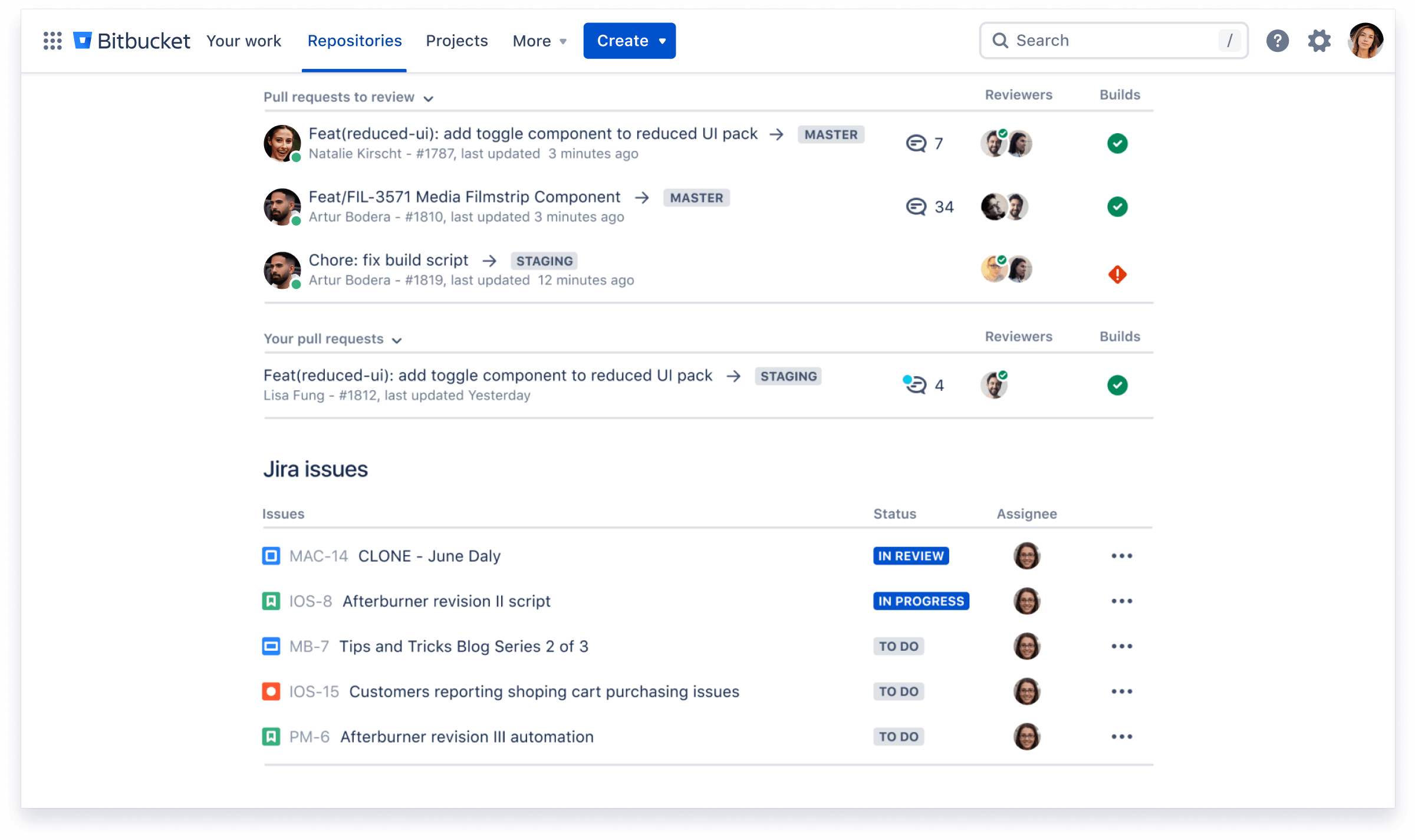
  • Atlassian Bitbucket CI/CD Cloud Service Aims for the Enterprise

    Atlassian Bitbucket CI/CD Cloud Service Aims for the Enterprise

    Atlassian today outlined its strategy to increase the appeal of the Bitbucket continuous integration/continuous delivery (CI/CD) cloud service among enterprise IT organizations. Atlassian said it plans to focus on four core pillars: Performance, management, extensibility and security and compliance, starting with an update scheduled for the third quarter.

    Dan Tao, head of engineering for Bitbucket Cloud and Compass at Atlassian, said the overall goal is to make it simpler to use the Bitbucket Cloud service running on the Amazon Web Services (AWS) cloud at scale as organizations increase the rate at which they build and deploy software.

    Atlassian is still supporting the Bitbucket Server and Data Center editions of the platform, but it’s apparent more organizations are shifting software development to the cloud, he noted. Atlassian is now moving to not only simplify migrations to the cloud by, for example, providing a Bitbucket Cloud Migration Assistant tool, but it is also moving to ensure applications can be developed at scale.

    Achieving that goal includes making use of a more advanced diff algorithm that is four times faster in larger DevOps environments, he added.

    Other planned enhancements include the ability to execute CI/CD workflows via Bitbucket pipelines, the ability to reuse multi-step pipelines across repositories, tighter administration integration with other Atlassian applications, the ability to encrypt data at rest and integration with the Snyk tool for discovering vulnerabilities in software to improve security.

    Finally, the Bitbucket Cloud service will also soon support Bitbucket Mesh, a distributed storage capability that is already employed in Bitbucket Data Center.

    Overall, Atlassian sees the migration to the cloud as a means to not only make DevOps workflows more accessible to a wider range of organizations, but also give organizations that have already invested in DevOps the opportunity to streamline those processes, said Tao.

    Many DevOps teams today maintain complex platforms with custom integrations that they need to maintain and support. Atlassian provides DevOps teams the option to either employ an integrated platform or use connectors it has created as part of the Atlassian Open DevOps framework to make it simpler for teams to use whatever mix of tools they prefer, he added. In either case, the total cost of maintaining a DevOps environment can be significantly reduced, said Tao.

    It’s not clear to what degree organizations that have already invested in DevOps are considering replacing their existing CI/CD platforms. However, as the pressure to accelerate the rate at which software is built and deployed steadily increases, the pressure to further automate DevOps workflows also builds. At the same time, DevOps teams are now being asked to integrate security gateways that require additional custom integrations within legacy platforms that they would need to support alongside existing integrations.

    At the very least, more organizations than ever are weighing their DevOps options. The issue, of course, is that the total cost of switching out DevOps platforms is not inconsequential given the current dependency on existing workflows.