Category: DevSecOps

  • Log4j: Is There Such a Thing as ‘Too Much’ Open Source?

    Log4j: Is There Such a Thing as ‘Too Much’ Open Source?

    The Log4j vulnerability got me thinking: Is there such a thing as too much open source?

    Before anyone immediately fires off a flaming email, rage tweet or scathing blog post, hear me out for a moment. If you know me, you know that I am an open source fanatic. I’ve been asked many times, “Should we use open source software and, if so, how much?” My response was (and still is) that open source software is a massive source of innovation and I can promise you, whether or not you use it, know that your competitors certainly are!

    I could go on and on extolling the virtues of open source and how it enabled the cloud, reshaped software architectures, created new product categories and gave us valuable tools like telemetry and increased visibility into cloud-native apps, infrastructure and beyond.

    When I first heard about the Log4j vulnerability on December 9, like many others, I quickly informed the tech leaders, engineers and SREs in my network about the serious potential risks such a zero-day vulnerability in the widely-used Log4j tool represented. In one way—probably the only way—the Log4j exploit shared a very important characteristic with the SolarWinds supply chain attack of late 2020: The widespread distribution and ubiquitous use of the software across applications, systems and organizations. Arguably, Log4j is used much more widely.

    This similarity raised questions I hadn’t fully considered in the context of such widely used software. Can we use too much open source software? Is Log4j too prevalent in its use and, therefore, a single point of failure? How bad would the Log4j situation be if a fix wasn’t immediately available or if one wasn’t forthcoming?

    The answer I kept coming back to is a resounding ‘no’. I still don’t think there’s such a thing as using too much (insert any open source project name) software. Log4j—and so many other open source software projects—are massively beneficial to us, and we virtually couldn’t function without these systems, tools and solutions in today’s age of ubiquitous software.

    What the current Log4j vulnerability, recent software supply chain attacks and other cybersecurity incidents with widespread impact highlight is our need to quickly respond to security incidents and take remediation steps anywhere they are found in the software stack. And that includes open source software. High-impact security vulnerabilities can occur anywhere across the numerous software stacks and services we use, though they have even greater impact when they occur in widely-used infrastructure, reusable components and microservices.

    In a world of infrastructure-as-code (IaC), it’s no longer a matter of patching a particular set of routers or servers. Unfortunately, much of the software stack is not containerized or built using smaller, easily replaceable containers and microservices—at least not yet. Our mindset and processes going forward from this incident must change, and we have to be prepared to respond to and remediate vulnerabilities both horizontally and vertically across the software stack. In certain circumstances, we have to do this on a large scale.

    As is common with active open source projects, Log4j contributors responded quickly with a readily available fix. The real answer to my original question above is that few are as prepared to respond to an important security vulnerability as those incredible, hard-working, active and engaged open source software developers.

  • Log4j Puts Effective IT Operations at Center Stage

    Log4j Puts Effective IT Operations at Center Stage

    News of the Apache Log4j vulnerability exploit is striking fear into the hearts of both software makers and users. Log4j is the most popular Java logging service used today, with over 400,000 GitHub downloads and has been embedded in most internet services and products from companies all over the world, including Apple, Amazon, Cloudflare, Steam, Tesla, Twitter and Baidu, just to name a few.

    Exploiting this vulnerability is simple and allows threat actors to control Java-based web servers and launch remote code execution (RCE) attacks. New variations of the original exploit are being introduced rapidly—over 60 in less than 24 hours. The attack surface grows by the minute. Good credential management and advanced authentication will not help as this exploit is pre-authentication, which means an attacker doesn’t need to authenticate to your web applications to attack. Your web server is vulnerable.

    The good news is your organization likely has a team of seasoned IT operations pros that can help protect against the worst of Log4j’s devastation.

    How IT Operations Can Protect Against Log4j Vulnerabilities

    Step One: Find Log4j Wherever it Exists

    You need to investigate every internet-facing application, website and system that you own or use. This includes self-hosted installations of vendor products and cloud-based services. Focus on systems that are internet-facing that contain sensitive data. Once you’ve completed assessing your hosted apps and vendor systems, move on to endpoint applications. Java-based apps like WebEx, Minecraft, Citrix and many more.

    Step Two: Patch, Patch, Patch

    Patch in the same order as above: Internet-facing applications, websites and systems. If no patch is yet available for your apps and systems, uninstall.

    The pandemic has forced many endpoints into workers’ home environments, which creates extra challenges for patching those endpoints and keeping them compliant. Operations teams can’t rely on work-from-home folks to patch their own systems, even if they’re given clear instructions. Many of them will just ignore those directions, so you need to adopt systems that enforce continuous compliance.

    Step Three: IT Operations is Essential

    Communicate with your senior leaders. They should be in the know about this one! Senior leadership needs to position their IT operations teams among their most vital employees. Don’t think this is going to go away any time soon—we’re just starting to get a glimpse of what is being tried out there in the wild. Buckle up. 


  • U.S. Govt. CX EO | Mozilla Revenue | Log4j Latest

    U.S. Govt. CX EO | Mozilla Revenue | Log4j Latest

    Welcome to The Long View—where we peruse the news of the week and strip it to the essentials. Let’s work out what really matters.

    This week: Improving U.S. government CX, how much money Mozilla makes, and the latest on the Log4j/Log4Shell débâcle.

    EO: “Transforming Federal Customer Experience”

    First up this week: The Biden–Harris administration makes an executive order directing its Federal agencies to make 36 specific customer experience (CX) improvement commitments. Much of this involves using technology to improve what DevOps teams would call UX—but government doesn’t like the language of “users.”

    Analysis: Customer-centricity FTW

    Remarkably, a lot of interaction with government still involves paper forms. But this EO shouldn’t merely be about putting existing processes online. Work also needs to be done to solve the underlying complexity and fragmentation of services: Focusing on CX is a helpful frame.

    Brett Samuels: Biden to sign order to streamline government services

    [The] executive order [is] intended to cut back on the bureaucracy around government services for the public such as renewing passports, applying for loans or changing names. [It] affects 36 “customer experience improvement commitments” across 17 federal agencies, [targeting] travel, retirement, business, health and updating personal information.
    …
    For example … to renew their passports online rather than dealing with print forms. [It] will create a single portal for … student loan debt, and small-business owners will have a more streamlined process for … loans, grants and certifications.
    …
    Survivors of natural disasters will also no longer be required to complete forms with several agencies when applying for assistance … and they will be able to file smartphone photos and use virtual inspections when filing claims. [That] could be critical as natural disasters become increasingly devastating, as evidenced by the tornadoes that ravaged Kentucky over the weekend, killing dozens of people and destroying communities.


    Is this a technology problem? Yes, in part—but it’s also a government problem, argues Jennifer Pahlka:

    Surely laws like the 21st Century IDEA Act … which required agencies to … “eliminate or consolidate websites or web pages that are duplicative or overlapping … and ensure that each website or digital service is designed around user needs,” made life easier for the customers of those agencies? What’s that you say? You’re not sure you’ve noticed that? Turns out you’re not alone.
    …
    An EO is one of the many mechanisms our government has at its disposal for what I like to call “magic words.” [But there’s a] gap between magic words and the changes they are supposed to compel. [Failures] happen at such a staggering scale they have become entirely expected.
    …
    We tend to assign the blame … to government technology [but] at some point, you can only improve the customer experience by addressing [underlying] complexity. … Most of the Kafka-esque nightmares people get stuck in happen because each service sees only the burden they impose, and not [what] the customer experiences.


    If, like me, you’re inherently cynical about government efficiency, you’d expect this effort to be a huge failure. But let’s not be too cynical: Warning of “the hazards of selection bias,” here’s ShanghaiBill:

    In the olden days, I took half a day off work to go to DMV and renew my DL. Now I can do it online in 5 minutes. … I pay my property tax online. I renew my business licenses online. I incorporated online.


    $500 Million per Year—But for How Long?

    The Mozilla Foundation has unveiled its revenue forecasts for this year. As in previous years, Mozilla makes the lion’s share of its cash from Google—by making it the default search engine. But there are new revenue sources.

    Analysis: And not a moment too soon

    The future of the browser market should be a strategic focus for DevOps teams. Mozilla’s Googley cash cow might not last. It’s often assumed the maker of Chrome keeps Mozilla alive so it can point to Firefox as “competition.” But with Microsoft’s browser Edging up the usage charts, that might no longer be true.

    Frederic Lardinois: Mozilla expects to generate more than $500M in revenue

    For 2021, the organization forecasts revenue of more than $500 million. What’s maybe most important, though, is that Mozilla’s new products like its Mozilla VPN service, Firefox Relay Premium, Pocket and other commercial initiatives are slowly but surely starting to pay off.
    …
    But for all intents and purposes, Mozilla remains fully dependent on Google for the time being. Diversifying its revenue sources is really the only way for Mozilla to decrease its reliance on a search deal with a company that is both a competitor, thanks to its dominant Chrome browser, and is increasingly out of alignment with Mozilla’s overall philosophy.
    …
    There is a window here for a non-Chrome browser, with users increasingly skeptical about Google’s motivations and Microsoft’s Edge team making a few missteps in recent months. Yet at the same time, Mozilla’s efforts to bring sponsored suggestions and ads to Firefox haven’t necessarily endeared the organization to its own users either.


    Why is Google funding its competitor? u/SerAaron:

    Google is Mozilla’s biggest donor. … It’s basically to avoid any monopoly allegations—so they can point to Firefox and say “look, we have competition”.

    Mozilla takes their money, sure, but … they don’t sell data, and they aren’t beholden to Google.


    But don’t count on that cash continuing to flow, says Maelwryth:

    That money is probably under threat now with Edge going for the market. Why give Mozilla hundreds of millions to show competition when you have actual competition from Microsoft?


    Log4j/Log4Shell Seems Worse Every Time We Look

    The list of popular DevOps tools vulnerable to Log4Shell grows by the hour. Merely finding your exploitable services can be an impossible task—let alone patching them.

    Analysis: Defense in depth is key

    Searching for and patching your vulnerable code is not enough. You’re also going to need to shore up your network defenses, by auditing internet-visible services and by tightening your application firewall rules. And—ironically—keep a close eye on your logs for signs of attempted exploits and IoCs.

    Steven J. Vaughan-Nichols: We Are in So Much Trouble

    Log4j is used a lot. And, when I say a lot, I mean it’s used in hundreds of applications [including] Druid, Dubbo, Flink, Flume, Hadoop, Kafka, Solr, Spark, Struts, Apple iCloud, … LogStash, GrayLog2, … Steam, Twitter, and … VMware.
    …
    Log4Shell is both easy to exploit and can be used to grab complete control of vulnerable servers. … Even as you’re reading this, odds are decent you’re being attacked. [But] even if you patch it in your systems, it’s all too likely to be hiding in other applications.
    …
    Log4Shell may be the worst security problem in a generation. … This is going to be a long, hard ride.


    Hyperbole? Even December 25 isn’t close enough for government work. Catalin Cimpanu:

    The US Cybersecurity and Infrastructure Security Agency has told federal civilian agencies to patch systems affected by the Log4Shell vulnerability by Christmas Eve. … Federal agencies have ten days … to test which of their internal apps and servers utilize the Log4j Java library, check if systems are vulnerable to the Log4Shell exploit, and patch affected servers.
    …
    Despite being a recent vulnerability, it is already considered one of the worst security flaws ever discovered, primarily due to its near-ubiquitous use among enterprise software makers, its simple and easy-to-use exploit, and the ability to hijack systems remotely. … Days after being disclosed, the vulnerability has been massively abused. … The first attacks were seen on December 1.


    There’s always another shoe. Here’s Teri Robinson:

    Maybe Log4j vulnerabilities are like rats—for every one that’s visible, multiple others scurry beneath the surface. … Apache said the fix addressing “CVE-2021-44228 in Apache Log4j 2.15.0 was incomplete in certain non-default configurations,” according to … CVE 2021-45046.


    The Moral of the Story: In the end, the love you take is equal to the love you make.


    You have been reading The Long View by Richi Jennings. You can contact him at @RiCHi or tlv@richi.uk.

    Image: Bernd Dittrich (via Unsplash)

  • Overcoming Challenges to Automating DevSecOps

    Overcoming Challenges to Automating DevSecOps

    In the last few years, DevSecOps has been widely adopted among organizations looking to get proactive with their security. Traditionally, development teams would continuously implement and deploy new applications into the enterprise and security was an additional bolt-on at the end. 

    However, as the threat posed by cybercrime has increased, organizations have been ‘shifting left’ with their security and weaving it into the beginning of the development life cycle. 

    This offers significantly increased security benefits and means software vulnerabilities can be identified and remediated before they are exposed to the enterprise. The one drawback is around the additional time this takes. As a result, many organizations are also looking to automate their DevSecOps processes. 

    Automation is a critical feature of DevSecOps as it improves efficiency, cuts costs and can streamline operations. However, to get the most out of DevSecOps automation so it delivers real value to the organization, there are several challenges that must be considered first. But what are these challenges and how can they be overcome?

    How to Approach DevOps Security Automation

    When you first move to security automation, you’ll find some security tasks that can easily be automated and others that are harder to fit in. DevSecOps teams will need to use many tools to cover all their bases, but no one wants teams checking lots of different tool outputs. Making it easier to see what’s going on and where risk lies by consolidating security tools and results in a central platform is the way to go. This makes life easier by giving a single pane of glass. Everyone generally agrees that DevOps teams must adopt cybersecurity best practices, but testing takes time. Development teams don’t have time to learn, use and check lots of security tools on top of their existing workload. Automated solutions get to work without any real need for maintenance or management. These solutions trigger tools to work at the right time depending on the outcomes found without any manual input needed. This gives you and your team valuable time back to focus on other important matters.

    Fitting DevSecOps Into Secure CI/CD Pipelines

    The goal of CI/CD pipelines is fast delivery of build and release steps, typically through automation. A key goal of DevSecOps is to alert someone to a new problem as early in that automated process as possible. You need to develop solutions that don’t overwhelm CI/CD pipelines, yet allow flexibility for differing tech stacks, security tools and environments. What you need to ask is, have the latest changes caused any new and important security issues that should be reported before going live?

    Doing DevSecOps Without Constant CI/CD Changes

    Trying to manually run security tools on your entire application source code each day can be time-consuming and hinder your ability to keep up with daily changes. For security checks to keep pace with code delivery in a CI/CD environment, security automation is a must. Security products need to integrate into the development pipeline and enable both the development and security team to work together instead of just throwing things over the fence to each other. 

    Focusing on Issues Raised for Faster Remediation

    All the artificial intelligence and machine learning (AI/ML) in the world isn’t going to remove non-issues better than a manual triage, so here we recommend being resigned to getting stuck. Treat the first run of a set of security tools as a normal security test. Expect hundreds of issues and be prepared to go through them and mark the false positives, duplicates and issues that just aren’t important right now. But do this with the expectation that you’re creating a baseline against which your future pipeline scans can be measured so you’re only alerted to new important issues. By automatically managing and recording the lists of real issues existing in every DevSecOps pipeline run, we can then concentrate on the differences. These new issues need to be flagged and then made easily visible and actionable for all teams.

    Running Multiple Security Tools in CI/CD

    DevSecOps includes setting up many automated security tools to cover the many types of security issues that need to be checked for. Many organizations run multiple security tools. However, as the number of security tools grows and the DevSecOps processes become more complex, many companies then realize the hardest challenge is to make sense of all of the test results within a short period of time. For some companies, this task of bringing together the results from all of these tools is a full-time job, and one ripe for automation. 

    Triaging Security Issues

    False positives and nonsense issues are consistent problems for using security tools. Removing these gives better results and increases the chances that development teams will have a better relationship with DevSecOps processes. Organizations should build a list of issues that don’t need to be actioned and also use automated security tools to flag new issues and differentiate them from the previous backlog of issues. Automating the ‘best fixes’ across all issues also speeds up fix times, while reducing the workload on security teams. 

    Mapping Security to Development Processes

    Dev and DevOps teams are under pressure to get pipelines running smoothly and don’t want security slowing things down or complicating it. By automating security testing in such a way that it can easily handle changes in repos and containers, organizations can overcome this challenge without compromising security. 

    Risk Prioritization

    DevSecOps will increase the number of issues found as well as the speed with which they should be handled. In reality, only a small number of issues will pose a massive risk to the business. Being able to pinpoint the really big issues in real-time helps security know the big risks are being covered and allows developers to focus on the real issues, not lots of small bugs. You can also intelligently determine the changes in risk for quick and automated decisions in the CI/CD pipeline without slowing down the development team.

  • Stacklet Embeds Collaboration in Compliance-as-Code Platform

    Stacklet Embeds Collaboration in Compliance-as-Code Platform

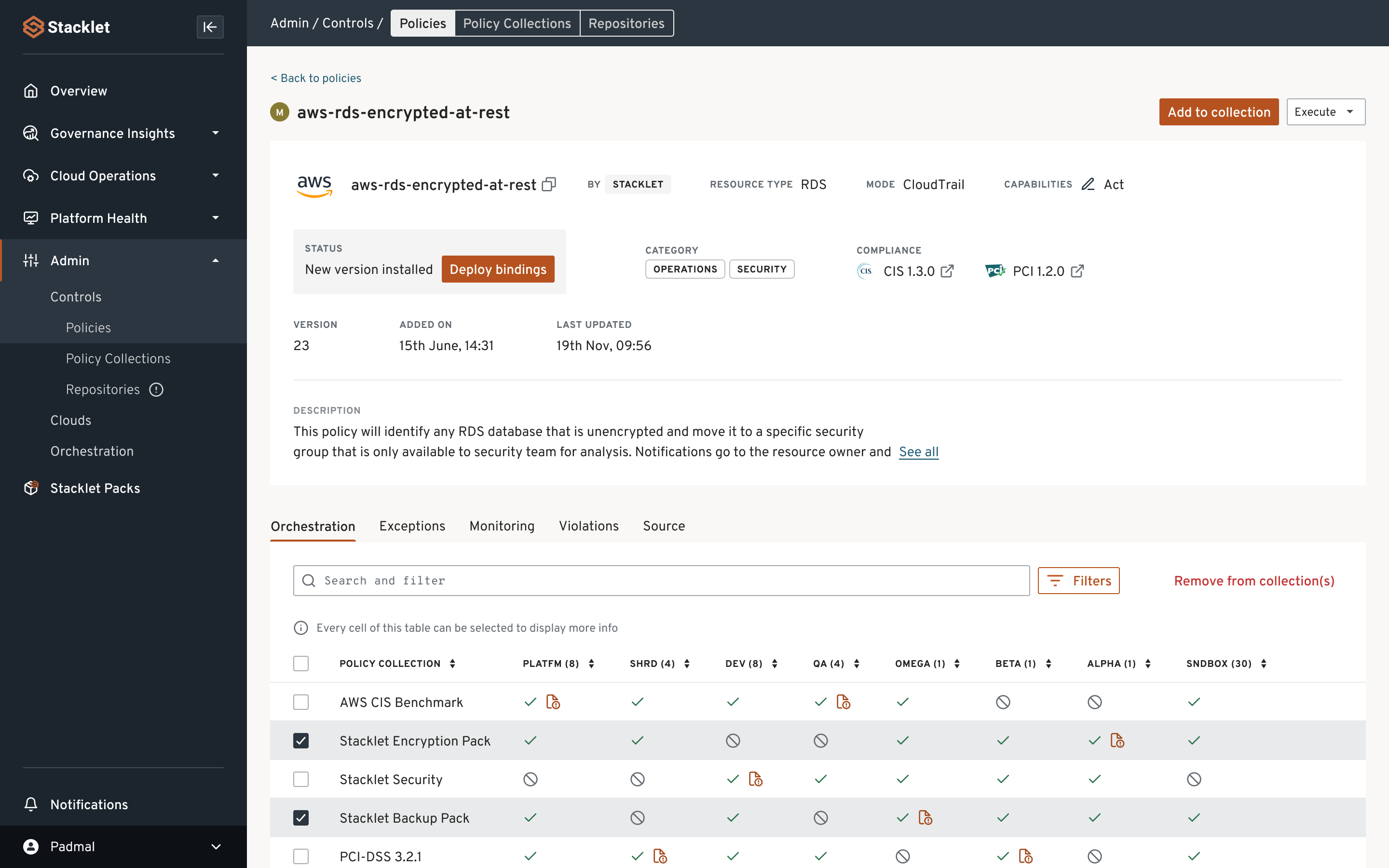
    Stacklet has added collaboration capabilities to its security and compliance platform that automatically groups related notifications, routes them to the right stakeholders and integrates with existing workflows and collaboration tools.

    The Stacklet platform is based on Cloud Custodian, an open source project that provides access to a domain-specific language that enables an IT team to employ YAML files to manage compliance-as-code.

    Stacklet CEO Travis Stanfield said that approach makes it simpler for organizations that have embraced DevSecOps best practices to comply with a wide range of mandates by shifting responsibility for achieving compliance further left toward DevOps teams.

    The latest version of the Stacklet Platform adds communications capabilities that leverage cloud resource configuration and policy metadata to automatically route notifications and escalations. Customizable notification templates add context for teams to collaborate either via email or integrations with Slack, Microsoft Teams and Symphony instant messaging. The Stacklet Platform can also trigger external workflows in tools such as Jira and ServiceNow to track issue resolution and generate reports.

    Ultimately, the goal is to make it simpler for IT teams to prioritize their compliance remediation efforts by keeping everyone involved continuously updated, said Stanfield.

    The number of compliance and security issues that organizations are experiencing in cloud computing environments is especially problematic. Developers often employ infrastructure-as-code (IaC) tools to provision cloud infrastructure. Unfortunately, they typically lack security and compliance expertise, which then results in large numbers of misconfigurations.

    The Stacklet platform is designed to give DevOps teams a way to prevent compliance and security issues using a compliance-as-code framework that spans multiple cloud platforms rather than requiring DevOps teams to employ a different set of compliance tools for each cloud platform on which applications are deployed.

    It’s not clear yet how far left responsibility for compliance will shift. In theory, organizations could avoid penalties if compliance issues are addressed before an application is deployed in a production environment. However, the teams that manage compliance in larger enterprises today are even further removed from DevOps teams than their cybersecurity counterparts. It may be several years before the cultural divide between these teams is bridged. In the meantime, many DevOps teams are taking it upon themselves to manage compliance as code to prevent unexpected issues from arising at the last minute before deployment.

    Overall, the goal is to enable DevOps teams to enforce compliance policies without slowing down the rate at which applications are built and deployed. The hope is that the adoption of compliance-as-code and DevSecOps best practices will address that issue. In fact, as the pace at which applications are deployed continues to accelerate to support digital business transformation initiatives, the number of potential compliance issues steadily increases. More troubling still, the greater the number of compliance issues there are, the more likely it becomes that cybercriminals will find a vulnerability to exploit.

  • Securing the Software Supply Chain with Behavioral Analysis

    Securing the Software Supply Chain with Behavioral Analysis

    Lately, software supply chains find themselves in a very interesting and uncomfortable position—the industry spotlight—and not in a good way. While significant and costly breaches such as  SolarWinds or Kaseya make front-page news, supply chain attack tactics (e.g. typosquatting or dependency confusion) that target package managers such as npm, PyPI or WinGet can poison downstream applications or compromise developer credentials.  

    The software engineering community has been steadily increasing its use of third-party and open source solutions to help create new offerings. In fact, over the last five years, there has been a 259% increase in the use of open source.

    One reason for this is the simple fact that creating new applications takes time and can strain budgets that are already tight. With open source code, software engineers gain fast access to pre-existing code that’s already demonstrated a proven ability to address the very unique challenge they are looking to solve. By removing the need to reinvent the wheel, the development timeframe is accelerated, the costs are lowered and teams are freed to focus on the creation of new and unique features that the customers demand.

    At this point, turning to third-party code may seem like a no-brainer. However, it can also open the door to potential risks. This is especially true with engineers who, rather than checking software to ensure it is secure and compliant, take the providers’ assurances as gospel. 

    They are not alone. Other groups will try to conduct their initial due diligence at the onset if that’s possible. Soon after they then ease into a “set it and forget it” approach, where they fail to update the code over time. As a result, while the code may appear secure initially, vulnerabilities can emerge over time, and if the software is not continually updated, bad actors can leverage an unprotected window of opportunity. In fact, according to Enterprise Security Group’s “Modern Application Development Security” eBook, 48% of organizations regularly push vulnerable code. The same research also found that 60 percent of organizations have had production application vulnerabilities exploited.

    Organizations conduct static application security testing (SAST) and dynamic application security testing (DAST) to assess pre-production code vulnerabilities. They will also scan with AV before releasing software, examine signing certificates, and code quality. Yet, despite these efforts, they remain challenged by gaps in security processes and the ability to sufficiently inspect large, complex and multi-layered software packages. What’s missing is the ability to conduct in-depth analysis to pinpoint behavioral differences between compiled software versions.  

    Malicious tampering can often involve changing how the software interacts with the system on which it is deployed.  Differential behavior analysis highlighted below makes it easier to detect those unusual changes. For example, having an application suddenly add a pre-install script that downloads files via certutil is highly unusual. If the addition was planned, reasons for the change would be well documented and it would be associated with a significant new feature. For this type of change to happen in any other scenario is suspicious and deserves further investigation before the software is released. In this case, such action would have caught ua-parser-js developer’s account compromise.

    supply chain

    With the software supply chain at risk and with shared code the new normal, what’s needed is software assurance. 

    Software assurance allows teams to inspect every application layer within an installation package for the presence of software tampering, malware and other indicators of software supply chain attacks.   

    Begin the software assurance process with the deep inspection step through recursive package decomposition. The resulting software bill of materials (SBOM) becomes so much more than a build manifest (a list of components that should be in the final build). It becomes the means to determine exactly which components have unacceptable build quality or those that contain unwanted software behaviors. This enables developers to verify the code they are working with and take appropriate action to protect their customers and partners from the majority of software risks. These assessments include:

    • Software grading: The software package and every included component can be graded based on the types and severity of security issues found. Using a grading system makes it easy for software buyers to gauge the level of risk posed by a software package and determine whether additional deployment measures can be taken to mitigate those risks. For developers, component grading makes it easier to prioritize their remediation efforts and aids in the selection of higher-quality third-party components.  
    • Application hardening: Activating specific build or compiler options can mitigate vulnerabilities and protect applications against attack—but only if they are implemented correctly. Assessing whether these mitigations are correctly implemented ensures that these protection mechanisms will work as expected. 
    • Binary behavior analysis: This allows teams to fully understand how each software component interacts with the system on which it will run. The ability to understand third-party component behaviors, even when developers have no access to the source code, delivers a more comprehensive understanding of supply chain risks. Checking for unusual software behaviors or unexpected behavioral changes between one version and the next is often the only way to identify software tampering by a malicious actor. The ability to have this final check before distribution enables software developers to validate that the software being released is trustworthy.

    For companies that are using software to create business value or producing software that is mission-critical for their customers, turning a blind eye or making software assurance assumptions can no longer be tolerated. In today’s climate where increasingly sophisticated threats loom, inspecting software and monitoring updates for signs of tampering, malicious or unwanted additions is essential and must become a part of standard software development practice. 

  • DevSecOps for Databases: Data Masking, Cloud Backup, WAF and More

    DevSecOps for Databases: Data Masking, Cloud Backup, WAF and More

    DevSecOps is everywhere. More and more organizations realize that the traditional separation between DevOps and security is wasteful and dangerous. As a result, they are rushing to integrate security into all their software development processes. 

    Adding security to containerized applications, cloud resources and other parts of modern DevOps infrastructure is already well understood. But what about databases? Databases were always—and remain—a critical system component and a prime target for attackers. Here, I’ll review the basics of modern database security and show you how to create a continuous security process for databases in a DevSecOps organization.

    What is DevSecOps?

    DevSecOps incorporates security practices into the DevOps methodology. DevSecOps promotes a ‘security-as-code’ approach via the partnership between release engineers and security teams. Similar to DevOps, the DevSecOps approach focuses on creating innovative solutions for complex software development processes. Teams complete this within the framework of an agile approach.  

    DevSecOps aims to close the gap between security and IT teams while ensuring the speedy and safe delivery of code. Organizations replace the siloed development method with a new approach that promotes the shared responsibility of security tasks during the delivery process. 

    In DevSecOps, two supposedly opposite aims—delivery speed and secure code—are united into one effective process. 

    Database Security Basics

    The term “database security” is an umbrella term used to describe all of the tools created to develop and preserve database availability, integrity and confidentiality. A key responsibility for any DBA is to ensure that the information stored in databases is always secure.

    The goal of database security is to protect:

    • Database management systems
    • Applications that access database information
    • Datastores within databases
    • Hardware servers
    • Virtual database servers, such as cloud-based servers
    • Network access points

    It is critical to strike a balance between security and usability. While you must prioritize data security, information needs to be accessible to offer value to the organization. The more access you provide to the information retained in a database, the more vulnerable the information is. However, an overly secure database is neither practical nor functional.   

    A good way to achieve a balance between accessibility and security is to create meaningful security protocols, create tiered levels of information access and invest in a robust database security and activity monitoring tooling. 

    Common Threats and Challenges

    Here are some of the most common types of database attacks:

    • Insider threats—These involve privileged users misusing their access credentials. An insider could be a negligent employee who unwittingly exposes the database to attack, a malicious insider who abuses the database on purpose or an outside infiltrator who steals credentials to breach the database. The risk of a breach increases as more employees hold privileged access credentials.
    • Injection attacks—These involve inserting arbitrary attack strings into the database queries that HTTP headers or web applications serve. These attacks can be SQL or NoSQL. Secure coding practices and regular vulnerability tests should help protect you against injection attacks.
    • Database software vulnerability exploits—Database software providers regularly release security patches for vulnerabilities in their software. However, if you don’t apply the patches quickly, you prolong your exposure and run the risk that hackers will exploit vulnerabilities in your database. 
    • Backup attacks—If you don’t protect your backup data with sufficient controls, you expose your database to an attack on your backups. 

    The following challenges can exacerbate these threats:

    • Large volumes of data—Organizations must adequately manage increasingly large volumes of data using scalable tools and practices.
    • Sprawling infrastructure sprawl—Organizations are increasingly shifting to hybrid and multi-cloud environments, making their networks more complex and security harder to manage. 
    • Evolving regulations—With the global regulatory landscape changing and growing more complex, it is increasingly challenging to maintain compliance.
    • Skill shortage—The demand for cybersecurity personnel far outstrips supply, and this shortage is only likely to increase in the future. 

    4 Techniques for Continuous Database Security With DevSecOps

    A DevSecOps approach calls for continuous database security during all stages of database development and usage. Let’s explore a few techniques for achieving continuous security.

    Data Masking

    Data masking technology lets you create a structurally similar, anonymized version of an organization’s data. You can use this data for user training or software testing. The aim is to safeguard the real data while using a functional substitute for use cases in which the actual data is not needed.  

    In data masking, you keep the format of the data the same. You only change the values of the data. You can alter the data in various ways including character shuffling, encryption and word or character substitution. Whichever method you choose, you have to modify the value in some way that makes reverse engineering or detection impossible. 

    Use data masking when presenting data to users (whether inside or outside the organization) who don’t need to access the data as part of their role. You should apply data masking to all sensitive information before displaying it in public forums. 

    Use Web Application and Database Firewalls

    Protect your database server from security threats using a firewall that stops access to traffic as a default. The only traffic permitted should come from particular web servers or applications that require access to the information. The firewall must also prevent your database from establishing outbound connections unless they are specifically needed. 

    Protecting the database using a firewall is not enough. You should also deploy a web application firewall (WAF). That’s because SQL injection attacks, which target web applications, can be employed to delete or exfiltrate data from the database. A database firewall may not stop this from occurring if attacks are initiated from an application that is a permitted source of traffic. However, a web application firewall likely will stop attacks of this nature because it can analyze traffic at the application layer and identify malicious query patterns.

    Cloud Backup

    Database backup solutions help organizations safeguard their data with backup database copies in the event of user error, physical hardware failure, data corruption or ransomware attacks. Organizations can ensure their information is always accessible by using database backup tools, even if their central database fails or is compromised. 

    Cloud backup services allow you to send a database copy to an off-site, secondary location for safekeeping if there is a disaster or failure. A third-party service provider typically hosts the secondary data storage systems and servers. This provider bills the backup customer based on capacity used or storage space, number of users, data transmission bandwidth, number of times the information is accessed or the number of servers. 

    Using cloud data backup can help you improve data protection without overwhelming IT staff. This labor-saving advantage could be significant and may even offset some of the added costs connected with cloud backup, including data transmission costs. 

    Secure Database User Access

    You must strive to limit the number of individuals with access to the database to the extreme minimum. Administrators should only have minimal privileges—those they require to carry out their job and only when they require access. 

    For small organizations, this might be difficult to achieve because employees have multiple roles, and there may be only one or two database administrators. However, you should at least manage permissions using roles or groups rather than granting access directly.  

    If you have a large organization, you must think about automating access management via access management software. Access management software can give authorized users a provisional password with the privileges they require every time they want access to the database. This software also logs the activities conducted during that time and stops administrators from sharing their passwords. 

    It is critical to lock down any form of password sharing—this is a common practice by administrators and database users, but it makes accountability and effective database security nearly impossible. 

    In addition, you should follow standard account security procedures: 

    • Enforce the use of strong passwords
    • Store, encrypt and salt password hashes
    • Lock accounts after three or four login retries
    • Deactivate accounts when employees leave or switch to different roles

    DevSecOps and Database Security

    In this article, I explained the basics of DevSecOps and database security, covered the primary threats facing database systems in a modern IT environment and provided four ways you can implement continuous security for databases:

    • Data masking—All modern RDBMS systems offer data masking mechanisms that can reduce the impact of compromised accounts.
    • Using WAFs and database firewalls—Firewalls provide excellent runtime protection and visibility for application-layer attacks.
    • Cloud backup—Backing up databases in the cloud is a continuous process that can enhance availability and reduce the impact of ransomware attacks.
    • Secure database user access—Using least-privilege principles can dramatically reduce the threat surface of a database.

    I hope this will be useful as you extend your DevSecOps practices to critical database systems in your environment.

  • AWS re:Invent Roundup: Private 5G | Graviton3 ARM Chips | DevOps Guru++

    AWS re:Invent Roundup: Private 5G | Graviton3 ARM Chips | DevOps Guru++

    Welcome to The Long View—where we peruse the news of the week and strip it to the essentials. Let’s work out what really matters.

    This week: Three things that caught my eye from Amazon Web Services’ re:Invent 2021 conference: Private 5G, Graviton3 chips, and something called DevOps Guru for RDS (yes, really).

    Private NRaaS vs. Wi-Fi

    First up this week: AWS Private 5G is a new turnkey service, offering local private cellular data infrastructure, for places where Wi-Fi just doesn’t cut it. Despite the name, it offers a 4G/LTE fallback to 5G/NR. Because it’s AWS, the hardware is free—you just pay for usage.

    Analysis: Combine with an Outpost for a sharper edge

    Wi-Fi is unreliable and low powered. 5G over the 3.5 GHz “citizens’ band” seems like a great alternative (just don’t tell the lunatic fringe of the anti-5G brigade).

    And, of course, AWS makes it easy to buy—Amazon ships you all the private radio gubbins for “free” and just bills you based on capacity and usage. It’s automatically configured and remotely maintained. You just take your internet connection and plug it in.

    Aisha Malik: Amazon launches preview of new AWS Private 5G managed service

    “AWS Private 5G” … is a new service that aims to make it easy to deploy and manage your own private network. … AWS CEO Adam Selipsky said that with AWS Private 5G, you can set up and scale a private mobile network in days instead of months.
    …
    There are no upfront fees or per-device costs: … Customers pay only for the network capacity and throughput they request. [It] scales capacity on-demand.
    …
    AWS Private 5G is available in preview in the United States.


    And this is better than Wi-Fi how, exactly? Ballu counts the ways:

    Industrial area coverage: Where you need 50 Wi-Fi radio units, you can provide service with 3–4 p4G/p5G radios.
    …
    Hazardous areas: Where you can’t provide the networking at all the corners or areas, one p5G radio blast area (esp with beam technology) can.
    …
    Packet loss: Less packet loss compared to Wi-Fi (believe me, it’s a big deal in the Industrial world)
    …
    Compatibility: What’s a negative for 5G modems (not many devices are available), is positive to some extent. Once investment is made with 5G modems, the devices can be on the road too.


    Unsurprisingly, Brian Roemmele feels vindicated:

    Precisely as I wrote about in 2017 to great ridicule from an analyst at a famous VC firm: Amazon is becoming a phone company.
    …
    From the Sidewalk Network to the Kuiper satellite system to local 5G. The network is no longer just “dumb pipes.”


    Graviton3: AWS ARM SoC is PDQ

    Graviton3 is the latest version of Amazon’s ARM server chip. It looks like it’s based on a 5nm process implementing the latest ARMv9 ISA. AWS is making the usual claims about it being much faster than the previous generation, but it also has new security features.

    Analysis: Cool chips

    AWS is deadly serious about low-power, high-performance compute. Amazon is just one licensee that would be distressed to have Nvidia owning Arm.

    As I said last week—and the week before that—ARM chips are an increasing fixture in the datacenter, especially ones that value “performance per Watt.” Other IaaS providers might bleat about how they’re reducing the energy used to cool their data centers, but surely it’s a better plan to start with less waste heat.

    Maria Deutscher: AWS debuts new compute-intensive and AI instances powered by custom chips

    AWS’ new Amazon EC2 C7g instances target compute-intensive workloads such as analytics tools and scientific modeling software. The C7g series is based on the AWS Graviton3 chip, the third iteration of the cloud giant’s internally-designed processor.
    …
    Companies that plan to use C7g instances for machine learning workloads can expect an up to threefold performance jump in AI performance. The speed jump is partly the result of the processor’s support for bfloat16, a specialized data format [that] enables applications to process floating point numbers faster and using less memory than FP32, the data format historically used for the task.
    …
    For cryptographic tasks, Graviton3 delivers as much as double the performance of the Graviton2. … The chip introduces a feature called pointer authentication to reduce the risk of cyberattacks.


    Tim Anderson has been sifting through the re:Invent announcements:

    Top of the list perhaps is Graviton3, the next generation of AWS’s homemade [ARM] server processors. These chips will be used in new C7g instances previewed offering DDR5 memory (50 percent more bandwidth than DDR4) and up to 25 per cent better compute performance compared to instances powered by Graviton2.
    …
    Adam Selipsky gave his first Re:Invent keynote as AWS CEO. [He] said Graviton uses “up to 60 per cent less energy.” … Graviton matters because it is among those leading a charge to get more [ARM] microprocessors into data center and cloud infrastructure, and because if it’s more energy and cost efficient to operate, it’s critical to Amazon’s bottom line, sorry, today’s environmental concerns.


    And is that pointer-authentication feature useful? Yes, very, says spijdar:

    Very useful. … If the performance is good, this is a nice extra layer that makes return-oriented programming more difficult. Combined with NX bits, it really raises the difficulty in developing/using many types of exploits (it’s not impossible to bypass … but there’s no perfect security).


    DevOps Guru Adds RDS Support

    DevOps Guru for RDS is the latest upgrade for AWS’s oddly-named smart monitoring features.

    Analysis: Silly name; useful tool

    Laplace and Gauss were right: Your DevOps team aren’t all rockstars. “Average” ops staff are in the majority. So extending AWS’s monitoring automation to your database instances should be a positive step.

    But that branding: Can anyone take it seriously?

    Stephanie Condon: AWS brings more automation to database management

    The new Amazon DevOps Guru for RDS automatically can find and fix database issues … helping developers using Aurora detect, diagnose and resolve database performance issues. [It] can help remediate a range of issues, such as over-utilization of host resources, database bottlenecks, or misbehavior of SQL queries.
    …
    Last year, AWS introduced DevOps Guru, a service that uses machine learning to automatically detect and alert customers of application issues. … Amazon DevOps Guru for RDS builds on that
    …
    Users can view [issues] in the DevOps Guru console or via notifications from Amazon EventBridge or Amazon Simple Notification Service (SNS).


    Sounds interesting, says u/random_dent:

    I thought the DevOps Guru for RDS sounded interesting. You need to enable performance metrics first, which have their own charges, but it still looks not too expensive, plus three months free-tier, so we may try it out.

    We’ve had some odd issues with RDS performance that are too inconsistent to lock down. It would be interesting to see if this could give us some insight.


    But that name! Here’s Thomas LaRock—@SQLRockstar:

    I’m old enough to remember when DevOps Guru for RDS was just called “database performance monitoring.”


    And @shmick is young enough to say it like this:

    such a cringe name


    The Moral of the Story: Misfortune tests the sincerity of friends


    You have been reading The Long View by Richi Jennings. You can contact him at @RiCHi or tlv@richi.uk.

    Image: Andrew Svk (via Unsplash)

  • Does Your Organization Need a Data Diet?

    Does Your Organization Need a Data Diet?

    The scenario is all-too-familiar: There’s a security breach, and afterward, the affected organization asks what it must do to better protect its data.

    But what if that organization never collected and stored that sensitive information in the first place? Often, the best defense against an embarrassing and costly breach is to collect only data that is essential to an entity’s mission.

    Some who work in computer privacy circles refer to this as “going on a data diet.” They know the temptation is great for organizations to bulk up on data of all kinds. After all, storage costs are low. With the move to the cloud, an organization doesn’t even need to invest in hardware and upkeep to store the information it collects. So why not grab whatever data a customer or client is willing to provide?

    Because we live in a time when the only sensible approach to computer security is to wonder when your entity might be breached—not if. That’s why it pays to not only go on a data diet, but to adopt a regimen for keeping your organization’s databases lean and, as a result, your customer relationships healthy. 

    Too often, companies collect data just because there’s a chance it might be useful or they think it’s harmless. I’ve seen this play out firsthand. Sales departments seek any small edge they can find; who knows what small shard of data might prove useful in the pursuit of potential customers? The same is often true of an organization’s marketing unit, whose people are working hard to reach a broader audience for their product or message. If information flows freely from the potential and current customers, they collect it in pursuit of any leg up in the competition for people’s attention.

    But there are costs to an organization beyond the price tag of data storage. That includes reputational risk and exposure to lawsuits and the distractions these and other problems bring. More info might seem better—until hackers have broken into a system and the head of an organization is forced to explain why that data was gathered in the first place.

    Weaponizing Seemingly Harmless Data

    It was not that long ago that there seemed to be two distinct types of data: In one bucket there was personally identifiable information (PII) such as a name, address, phone number and email address and critical financial information like bank account and credit card numbers. Throw in personal health information (PHI) and other obviously sensitive information; everyone knew this sort of data must be zealously safeguarded.

    The second bucket was everything else: The seemingly extraneous bits we all leave behind living in a digital world such as what time you visited a website, the language you choose for a website, what products you viewed. Think of it as a mop bucket—messy if spilled, but not vital to corporate security.

    But those distinctions have blurred in recent years. An individual piece of data might seem innocuous, but not when combined with other sets of data that do not fall under the definition of PII as set out by law. What makes Big Data so promising to an organization’s sales and marketing teams is also what makes it potentially dangerous to collect: The connections that a clever algorithm and today’s awesome computing power can deliver crawling through vast data stores. If you link information that is personally sensitive (a person’s tastes or habits or activities) but not technically PII, it can be weaponized to harm individuals.

    As an example, think of the tracking data offered by people’s cell phones. If a person leaves the same street address at around 8:30 every morning and makes the same drive back and forth, it’s quickly obvious where someone lives and where they work. Given other open records, a hacker with dark motives can find our commuter’s name and other information. It’s not a big jump to connect this information to crimes like theft or even stalking and blackmail.

    Adopting a New Data Discipline

    Given the risks, forward-looking organizations are now adopting privacy programs that force their teams to ask the hard questions before collecting information. For these privacy practitioners, any time someone internally proposes that a new piece of data be grabbed or used in a new way, a conversation ensues about its usefulness and the validity of collecting it.

    Maybe the policy is conducted through an internal privacy committee that meets to debate its appropriateness. Maybe it’s a rigorous process that means checks and balances throughout an organization. But whatever the method, only data that can be justified as fundamental to an organization’s operation is collected.

    Another idea gaining popularity among those focused on privacy concerns: A process for jettisoning old data. (An example: Does an organization need to know a person’s last several addresses or just the current one where they can be reached?)  Under such a data diet, all information that an organization continues to store beyond its immediate use requires a specific justification.

    After all, the information you don’t have is the easiest to protect.

  • Fugue Marries Compliance-as-Code Tool to AWS Well-Architected Framework

    Fugue Marries Compliance-as-Code Tool to AWS Well-Architected Framework

    Fugue has infused the best practices defined by Amazon Web Services (AWS) within its software-as-a-service (SaaS) offering for provisioning infrastructure using its infrastructure-as-code (IaC) platform.

    Fugue CEO Josh Stella said that IT teams can now evaluate templates for provisioning AWS infrastructure that were created using AWS CloudFormation or Terraform tools to ensure they comply with the AWS Well-Architected Framework.

    The AWS Well-Architected Framework spans five pillars that AWS has defined for designing and operating reliable, secure, efficient and cost-effective systems in the cloud. AWS has defined a set of best practices for each pillar and rewards organizations for following those by making available additional cloud credits. The goal is to improve overall cloud security by providing guidance that ultimately reduces the number of misconfigurations so that cybercriminals can’t discover and exploit them.

    The Fugue platform complements that effort because it is based on Open Policy Agent (OPA), a general-purpose engine for managing compliance-as-code that is being advanced under the auspices of the Cloud Native Computing Foundation (CNCF). Fugue extended OPA by creating Regula, an open source tool that evaluates IaC files for potential security and compliance violations. Fugue then created a SaaS platform that makes extensive use of the AWS Lambda serverless computing platform to make it easier to enforce compliance policies.

    Those policies include turnkey coverage for specifications such as SOC 2, NIST 800-53, GDPR, PCI, HIPAA, ISO 27001, CSA CCM, CIS Controls, CIS Docker and CIS Foundations Benchmarks for AWS, Microsoft Azure, Google Cloud and Kubernetes.

    Stella said Fugue has now incorporated the technical aspects of the AWS Well-Architected Framework. However, it’s still up to each IT team to navigate the cultural aspects of the shared responsibility model of compliance and security that cloud service providers like AWS follow.

    Unfortunately, developers that employ IaC tools to provision cloud infrastructure often make some faulty assumptions about the level of security maintained by the cloud service provider. The result is often a raft of security and compliance issues that arise mainly because most developers don’t have a lot of domain knowledge expertise in either area.

    It’s not clear how many organizations have adopted the AWS Well-Architected Framework, but as various tools make it easier to implement these best practices defined by AWS the more secure and efficient cloud computing environments should become. In fact, in many cases, those tools are being embedded within a larger set of DevSecOps best practices that are being implemented across multiple clouds.

    Stella said he doubted there will ever be any standardization when it comes to security and compliance frameworks that could be applied to multiple clouds; however, it’s clear that cloud service providers are at least making available frameworks that borrow concepts from one another.

    Regardless of the approach, the overall state of cloud security and compliance will continue to improve as more guardrails are automatically implemented. The issue then becomes not only finding a way to ensure that cloud infrastructure is secure when deployed and also determining how much of the infrastructure being relied on today is less secure than it should be.