Category: DevSecOps

  • Scribe Security Unveils Pair of Tools to Secure Software Supply Chains

    Scribe Security Unveils Pair of Tools to Secure Software Supply Chains

    Scribe Security today unveiled a Scribe Integrity tool that scans software artifacts to make sure they comply with IT organizations’ security policies before they are integrated into an application.

    The Scribe Integrity tool authenticates open source and proprietary source code before it is uploaded into a build. It assumes that all artifacts are “guilty” until they can prove their innocence, said Rubi Arbel, CEO of Scribe Security. That approach makes it possible to ensure the integrity of the overall software supply chain is maintained in a way that doesn’t adversely impact the productivity of developers, he added.

    In addition, the company launched GitGat, an open source policy-as-code tool based on Open Policy Agent (OPA) agent software that enables DevOps teams to periodically run reports that surface insights into the security posture of code residing in GitHub repositories.

    Arbel said that, in time, GitGat’s reach will be extended to add support for additional continuous integration/continuous delivery (CI/CD) platforms.
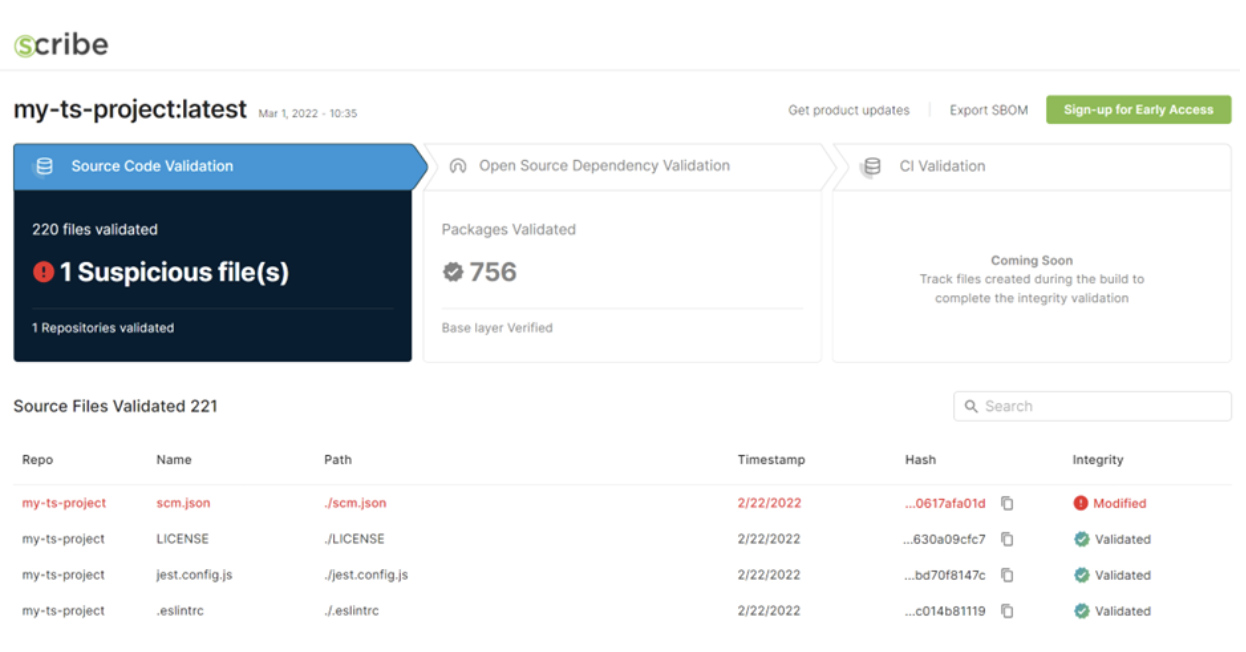
    The first release of Scribe Integrity addresses Node.js code and the npm package manager with support for additional types of code planned.

    The Scribe Integrity tool also identifies all dependencies to enable DevOps teams to generate an accurate software bill of materials (SBOM) as each software artifact is included in the application, he noted. That’s critical because it enables developers, IT operations and cybersecurity teams to simultaneously see what artifacts, including containers, make up an application, noted Arbel. In the future, the company plans to make available a Scribe Hub that will make it easier to share insights into those software artifacts, he added.

    A series of high-profile security breaches clearly demonstrated cybercriminals’ skill at injecting malware into software artifacts and compromise any application that incorporates that artifact into an application. That malware can then be activated at some later date to potentially compromise any number of downstream applications.

    Those incidents resulted in a greater appreciation for DevSecOps best practices to maintain the integrity of software supply chains. The issue that DevOps teams are trying to address is how to build more secure applications without slowing down the rate at which those applications are built and deployed. As such, DevOps teams are adding tools to the application development process that make it easier for developers to scan code before it is included in an application and verify the integrity of any software component that becomes part of a DevOps workflow.

    It’s unknown how long it may be before the adoption of DevSecOps best practices has a meaningful impact on application security. However, waiting to focus on security until after an application has been deployed is way too late. Cybercriminals today can discover flaws and misconfigurations in applications in a matter of minutes. As more applications are deployed, developers can find themselves spending more of their time fixing vulnerabilities than they do writing new code. A new approach to building applications that are secure from the ground up is clearly required.

  • Styra Unfurls Cloud Service for Implementing Compliance-as-Code

    Styra Unfurls Cloud Service for Implementing Compliance-as-Code

    Styra, Inc. today launched an authorization service based on the Open Policy Agent (OPA) software that can be invoked via an application programming interface (API).

    Torin Sandall, vice president of open source for Styra, said the Styra Run cloud service will make it much simpler to embed enterprise-grade authorization capabilities within applications. Today, developers spend too much time building, maintaining and operating their own authorization platforms to manage permissions across multiple applications.

    In addition to enabling developers to access pre-built OPA logic, Sandall noted the service also offloads storage and global replication of end-user permissions data to a cloud service.

    The service itself currently runs on Amazon Web Services (AWS), but Styra plans to make the service available on other cloud platforms in the future, he added.

    OPA makes use of a general-purpose policy enforcement engine that developers can embed within applications using the Rego language. OPA is now being advanced under the auspices of the Cloud Native Computing Foundation (CNCF) and is gaining traction among cloud-native application developers. OPA provides a means to enforce compliance-as-code across a wide range of microservices that now routinely access a wide range of distributed data.

    However, Styra Run should make OPA more accessible to a wider range of organizations, especially those that are looking to shift responsibility for security and compliance further left toward developers as part of a set of DevSecOps processes, noted Sandall. Developers that don’t have a lot of compliance expertise can now rely on a cloud service that enables them to focus more of their time and effort on writing code, he added.

    The arrival of Styra Run also comes at a time when more organizations are reviewing their software supply chain processes in the wake of a series of high-profile security breaches. It’s not clear to what degree compliance and cybersecurity teams have developed an appreciation for OPA, but as more organizations embrace compliance-as-code, the pressure on those teams should decrease as those applications are inherently more secure than legacy applications.

    There will, of course, be some developers that prefer to embed OPA into applications themselves, but a cloud service accessed via API will be the path of least resistance for most developers building software-as-a-service (SaaS) applications, said Sandall. The issue may simply be making developers aware that another low-latency option exists; one that doesn’t require them to deeply master the Rego programming language for the sole purpose of achieving compliance, he added.

    Regardless of approach, the general expectation going forward is that applications will more easily be able to meet a wide range of compliance mandates without requiring IT teams to deploy and maintain dedicated compliance infrastructure. As such, there may soon come a day when any application that doesn’t use some type of compliance-as-code framework will simply be rejected out of hand.

  • The Other Reasons for Password Management

    The Other Reasons for Password Management

    I try not to write about ongoing work—if it is important enough to blog about then it is important enough to write about in the work product, and blog about something else. But every once in a great while, the need overrides my simple rule. After all, zealous adherence to rules is not really a thing we do well in IT.

    I hit a couple of those while doing work on password management for a client. I mentioned a couple of important issues in the work product, but one was mentioned with the caveat that it was not something profound while the other was evident and necessary but with solutions other than password managers that could handle it. I didn’t belabor either point.

    The wider market, though—those who either haven’t yet addressed password management or those that are just now starting to delve into it as a corporate solution—probably don’t realize that these are two issues that an enterprise requires and that DevOps needs.

    The less obvious is the enterprise requirement. There is a lot of buzz out there about changes in the perimeter driving changes in perimeter security (if perimeter security is going to have any meaning, anyway). But the underlying change factor is not so much our perimeter going out to embrace items on the larger internet, but the growth of that internet. Yes, our perimeter extended to cloud or service providers (or multi-clouds or more than one service provider), but the enabling technologies making the internet and the web also extend our perimeter in less visible ways.

    Right now, in your organization, there are hundreds of unacknowledged accounts at your business partners. These accounts should be known, but they’re hiding in plain sight. Accounts exist for places that provide small things—the type of stuff that used to be paid for with petty cash. The store where marketing buys the one-off items, or the emergency backup account for when office supplies run out in accounting—accounts like that. Password management protects these accounts automatically (assuming it’s being used, anyway). There’s not much your organization can do to protect those accounts from being attacked on the server side—those are not your servers, after all—but password management would protect them from the user side by enforcing things like strength policies and change frequency rules.

    The more obvious but underrated one is secrets management. Most password management vendors do secrets management today, sharing in the password protection technology already implemented in the core product. And if you are a DevOps shop that is even a little bit automated, you need secrets management. Secrets management could be done elsewhere (and often is), but most organizations are using things like hardcoded credentials and API keys instead.

    My rare forceful statement: “If you are hardcoding credentials, API keys, SSL certs or other secrets, stop it. Stop it now. You’re DevOps, not ‘Here are the keys to the kingdom’-Ops.” Password management can do this for you without hardcoding. So can other products, but you get two solutions in one if you use your password manager for secrets management, too. A password management product that offers secrets management with both API and command line access is huge for DevOps. To use the product in any given DevOps scenario, one of those two will address the scenario.

    As always, keep kicking it. You are running the face of the company. Whether sales, marketing, PR or whatever, when people go to interact with the company (be they employees, partners or customers), it is almost always the systems you run that they’re working with. Also, remember to protect your baby. Password management is not a product-centric thing, but push for central implementation with secrets management. Drive faster with password management, deploy more with secrets management and worry less with both. I don’t generally plug myself, but I’ll come close because it might be relevant to you—if you’re interested, there is more about password management out there under my name, including my take on who you should consider.

  • Rezilion Launches Vulnerability Prioritization Platform

    Rezilion Launches Vulnerability Prioritization Platform

    Rezilion today announced general availability of a platform that enables DevOps teams to better prioritize remediation efforts by identifying which vulnerabilities both run in memory and actually impact a class or function that can be executed.

    Liran Tancman, Rezilion CEO, said the biggest DevSecOps challenge organizations face today is that the bulk of vulnerabilities that developers are tasked with remediating don’t constitute a significant cybersecurity threat.

    Rezilion has created a searchable proprietary next-generation vulnerability database (NGVDB) that identifies which issues impact specific classes and functions. That capability enables DevOps teams to de-prioritize close to 95% of software vulnerabilities, said Tancman.

    In addition, the Rezilion platform will surface remediation suggestions that lower the amount of disruption and/or cost, he said. A fully-automated remediation capability, for example, will automatically upgrade and test vulnerable software components and packages within a continuous integration (CI) pipeline that were found to be exploitable. In the longer term, Rezilion is also working toward surfacing remediation suggestions that might be addressed using an alternative to patching, said Tancman.

    The Rezlion platform is also integrated with IT service management platforms such as ServiceNow and project management tools such as Jira to make it easier to address vulnerabilities as part of existing workflows, he added.

    Most developers today are simply overwhelmed by the number of vulnerabilities that cybersecurity teams routinely ask them to patch, noted Tancman. The goal should be to enable developers to focus their limited time and effort on remediating the vulnerabilities that truly matter to ensure application security, he said.

    In addition, developers need to have more confidence in the fact that the patch they are being asked to make won’t break their existing applications, added Tancman.

    Vulnerability prioritization is, of course, at the heart of the long-standing divide that exists between DevOps and cybersecurity professionals. Spreadsheets filled with long lists of vulnerabilities are regularly created, but there is usually no context provided in terms of how severe a threat any given vulnerability poses. As a result, developers would allocate a small portion of their time to applying patches that are prioritized based on intuition and level of complexity rather than severity.

    Naturally, developers are going to allocate most of their time to creating new applications and features. For any DevSecOps initiative to succeed, it’s critical to ensure optimal use of the time allocated to remediation. Cybersecurity teams will continue to compile lists of vulnerabilities, but that list can now be triaged in a way that causes the least amount of friction.

    In the wake of a series of high-profile security breaches, there is now more focus than ever on securing software supply chains. The challenge is to find a way to better secure applications both before and after they are deployed in a production environment. There will always be vulnerabilities that are discovered after an application has been deployed. However, just because a vulnerability exists, that doesn’t mean it’s exploitable. The trouble with application security today is that, all too often, remediation efforts turn out to be a waste of time.

  • GitGuardian Tightens Integration With GitHub to Secure Secrets

    GitGuardian Tightens Integration With GitHub to Secure Secrets

    GitGuardian has expanded its ability to secure code repositories by providing deeper integration with GitHub.

    Ziad Ghalleb, product marketing manager for GitGuardian, said the results of security scans are now provided in the context of pull requests alongside suggestions for remediating issues.

    The company also expanded developer onboarding options by adding an application programming interface (API) key provisioning mechanism integrated with its command line interface (CLI) in addition to making it easier to configure that CLI.

    Finally, GitGuardian extended support for role-based access controls (RBAC) to its platform so that team members can be assigned different permissions levels for incidents based on their role.

    GitGuardian makes it possible to scan source code to detect API keys, passwords, certificates, encryption keys and other sensitive data in a code repository in real-time. Developers building an application often make secrets easily accessible as plain text for the sake of convenience. However, when those applications are deployed in a production environment, developers often forget to delete these secrets. Cybercriminals know to scan for these secrets to make compromising an application environment easier.

    A recent GitGuardian report found a typical company with 400 developers would discover 1,050 unique hardcoded secrets when scanning its entire codebase. Each secret had 13 different occurrences, which meant the effort required to remediate those associated vulnerabilities would be considerable, the report noted.

    Secrets management is, of course, getting more attention as more organizations review their software supply chain processes in the wake of a series of high-profile security breaches. GitGuardian makes it simpler to achieve that goal within the context of a set of DevSecOps best practices by integrating with GitHub with a single click, said Ghalleb.

    It’s still early days as far as adoption of DevSecOps best practices is concerned, but it’s clear more responsibility for application security is being shifted left toward developers. The challenge is many developers still lack the tools required to make sure applications are secure before they are deployed in production environments.

    Naturally, the earlier an application security issue is resolved the less costly it is to fix. The problem with secrets management is cybersecurity teams are usually a lot more focused on discovering vulnerabilities than looking for instances of poorly secured credentials. Once an application is deployed in a production environment, it may be months before anyone discovers there is an issue—if it’s discovered at all. In fact, the number of existing applications running in production environments that have secrets management issues could be staggering.

    One way or another, it’s only a matter of time before more of those issues are surfaced. In the meantime, DevOps teams can reduce the number of applications that might have this issue by making it easier to discover secrets within applications before they are deployed in production environments. After all, the only thing worse than a secret being discovered by a cybersecurity team is having one uncovered by cybercriminals that use it to wreak havoc.

  • This DevSecOps Thing Is Real After All

    This DevSecOps Thing Is Real After All

    Whether you made it to San Francisco, California last month for RSA Conference or not, you don’t want to miss Tuesday’s DevOps Connect: DevSecOps Virtual Summit.

    On Tuesday, July 12, 2022, we are presenting a virtual broadcast of the sessions from our recent DevOps Connect: DevSecOps event at RSA Conference in June 2022. All of the great sessions will be available as well as some bonus sessions that didn’t make it to RSAC.  

    For me, this event was extremely gratifying because it served as validation that I wasn’t crazy all those years ago. When I started devopsy.kinsta.cloud in 2014, I did so because I thought it would be great for security—back then it felt as though I was a lone voice crying out in the wilderness! Now, here we are in 2022 and DevSecOps is real. It is accepted, it is sought-after and it is changing the way software is developed, deployed and managed.

    When I put on the first DevSecOps event at RSA Conference seven years ago, it was a bit controversial. The idea of bringing together the security community with the DevOps tribe was like what I imagine peace treaty negotiations between two warring parties would be. The security folks said no one else cared about security. The DevOps people, like many other IT pros, claimed the security folks were just people who said no to all their initiatives. The lack of trust ran deep. But we kept at it—and while the situation is far from perfect today, so much progress has been made.

    This year’s event featured our best speaker lineup yet. Jim Zemlin, executive director of The Linux Foundation, kicked off the event by talking about open source and security—software supply chain, SBOMs and security, oh my!  Continuing the open source and security trend, CNCF executive director Priyanka Sharma presented a great session discussing cloud-native and DevSecOps.

    And you won’t want to miss two of my favorite sessions. The first involves my friend John Willis asking, “What would Deming do?” in his session at 11:30 a.m. ET. Given the current state of world affairs and the software and security market, what would Edward Deming, the patron saint of DevOps, say and do? John is a bit of a Deming expert himself, so his insights are spot on, I think. And second, Carolyn Wong (who is a superstar) talks at 12:00 p.m. ET in her session about pentesting at scale, pentesting-as-a-service and DevSecOps.

    But wait—there’s more! Chenxi Wang has a powerful session, delivered off the cuff, about the current state of DevSecOps, software supply chain security, investing and more; that’s at 9:55 a.m. ET.

    We’ll also feature two amazing panels: One is made up of the authors of a recent book, Reinventing Cybersecurity. The other features folks from Intel, Mitre, NIST and the U.S. Senate talking about security compliance with an emphasis on software supply chain security and SBOMs (see a pattern here yet?).

    And that’s just the tip of the iceberg—there is even more from this year’s event that you don’t want to miss. So, head on over and register—it’s free. Many of the speakers will be online, live, during their presentations to answer questions, network and offer their guidance. There are also exhibits and sponsor booths and other fun stuff like a yoga class and a DJ spinning great tunes.

    This DevSecOps stuff is real and you will learn a lot from these sessions. We can’t wait to see you there!

    While you’re at it, check out our upcoming CloudNativeDay Virtual Summit August 10, 2022, which is shaping up to be a great event, as well!

  • Dev Job Phisher Steals $540M | Patch OpenSSL NOW | Systemd Dev Joins Microsoft

    Dev Job Phisher Steals $540M | Patch OpenSSL NOW | Systemd Dev Joins Microsoft

    Welcome to The Long View—where we peruse the news of the week and strip it to the essentials. Let’s work out what really matters.

    This week: Spear-phishing causes $540 million loss, a high severity bug in OpenSSL might be “worse than Heartbleed,” and Lennart Poettering is now working for Microsoft. (more…)

  • Turning Off DevSecOps Noise for Functional Fidelity

    Turning Off DevSecOps Noise for Functional Fidelity

    Analyzing the DevOps and DevSecOps software marketplace demonstrates the high demand for tools and platforms that reduce false positives. As businesses and organizations adopt a rigorous, disciplined software development life cycle and ascribe to strict compliance frameworks, they quickly realize that automated tools can generate a substantial amount of noise, in the form of false positives, that pollute their efforts to maintain a lean and focused operation.

    True Positive Vs. False Positive Vulnerabilities

    Static application security testing (SAST) is fundamentally about using pattern recognition to identify vulnerabilities in code. The more aggressive the scan rules, the more likely a snippet of code will be flagged as a vulnerability; in other words, a “true positive” finding. Automated scanning is fundamental to effective DevSecOps. But if the scanning is too aggressive, it may generate findings that aren’t actual problems; in other words, false positive findings 

    You want your scan to return true positive findings—actual vulnerabilities that can be fixed and remediated. A false positive is a finding that isn’t actually a vulnerability. The ideal tool catches all the true positive vulnerabilities and returns a minimal number of false positives.

    Many platforms give their users granular control over which rules run and are applied to their code. This first layer of control is similar to allowing your team to tune their scans to focus only on certain frequencies while ignoring others. Often, this is used to increase the speed with which a platform might complete a scan. It can also be used to tune out “noisy” rules. It’s perfectly legitimate to use controls like these, but it’s important to recognize that those completed scans aren’t comprehensive.

    Speeding Up Can Slow You Down

    Positive findings, whether they are true or false, take more time and resources to evaluate and remediate. Investing resources to remediate true positives is worthwhile. It would be ideal if they had been caught earlier in the process, but catching a vulnerability before it hits production is the entire reason you are doing DevSecOps in the first place! False positives may not require actual remediation, but reviewing them and then manually confirming their false nature is directly counterproductive to the reasons an organization adopted automated SAST in the first place.

    SAST Plus DAST Keeps You Ahead

    The gold standard for effective security testing is to pair SAST with dynamic application security testing (DAST), sometimes also called interactive application security testing (IAST). This process will correlate the positive findings from the SAST scans and test them using simulated data in an emulated runtime environment. 

    DAST/IAST actually tests each bit of code that looks problematic because of a particular pattern and then tests whether the code is actually vulnerable. DAST provides an automated, testable, repeatable and provable method to test those positive findings for trueness and falseness. If you are only doing SAST scanning, then the noise-to-signal ratio from your platform is governed strictly by the intelligence embedded into their pattern-matching code. Depending on the quality of the tool being used, your actual mileage may vary.

    DevSecOps Is the Right Path

    Businesses and organizations clearly understand the problem of potential vulnerabilities. Guarding against a security breach is critically important to protecting proprietary information and the privacy of their customers. DevSecOps is clearly the right path to take to reach that goal. However, it is critically important that the vehicle(s) these teams use to get there (in this case, SAST and DAST/IAST) have built-in functionality to focus their efforts on real problems and not waste it on phantom issues.

  • Why Your DevSecOps Initiative Will Fail

    Why Your DevSecOps Initiative Will Fail

    When you’ve been in and around the security industry for long enough, you get used to the industry hype machine turning a cool innovation into, uh, meh. This hype cycle starts at the RSA conference each year, and folks like me look for new hot stuff on the show floor. For perhaps only the second time in 25 years, I wasn’t at the show in person, but it seems that DevSecOps was the preferred bandwagon on which every vendor jumped. Sigh.

    I’m not sure whether it’s my increasing age or this business that has made me cynical, but here we are.

    To be clear, from a customer’s perspective, there is great value in the concept of DevSecOps, as evidenced by the upcoming DevOps Connect: DevSecOps @ RSAC 2022 virtual event. Having these (sometimes) mortal enemies working together toward a common goal is great, in theory. But alas, in practice (and similar to what happened when DevOps hit the scene), it’s easier said (or displayed in a vendor booth) than done.

    Thus, I’ve come to a sobering conclusion: Your DevSecOps initiative will fail.

    Most organizations will talk a good game for a while and they may even try some stuff, buy some kit, send folks to training and the like. But in the end, despite all these efforts, you guessed it—they will still fail.

    Is this a foregone conclusion for every organization? Well, no. But this isn’t my first rodeo, and I’m pretty sure this one will end like the others—in failure.

    But let’s say you want it to be different this time. Really, you do. And you are willing to take some actions to give yourself a chance at success. If that’s the case, here are a couple of tips to increase your chances, however small.

    Culture

    First and foremost, DevSecOps is not a thing. It’s not a set of tools (no matter what the vendors tell you); you don’t buy it on a VAR line card. DevSecOps (like DevOps) is a cultural shift. Your teams need to work together. They need to collaborate. They need to have shared incentives. And they need to experience the consequences of not playing nicely in the sandbox.

    Cultural shifts are hard. People don’t like to change. They resist. They undermine. They sabotage. It all sounds nefarious, but they do. So unless you can change your culture, you’ve got no shot.

    Shift Left

    Another one of these security-marketing-terms-run-wild is shift left. It means you want to integrate security testing directly into the development process as early as possible. You should be running security checks in the developer’s IDE to ensure they don’t violate security policy (like hardcoding API keys in their source, for example) before they even commit the code.

    You must also integrate security testing into the CI/CD pipeline(s). Thus, you need tooling that works with your preferred pipeline.

    Security Champions

    Security testing will create angst for your developers. They will have false positives. They will have to fix things that they probably don’t understand. It will cause them to miss delivery dates. Of course, they should build it right the first time, but in their mind, they’ll see it as the security folks causing delays.

    The developers will be annoyed, and you’ve got to manage that annoyance—or have senior management quash any rebellions, but that’s not a long-term solution.

    On the other hand, you could establish a security champions program, which anoints (and trains) developers on each team to “represent” security within the development team. They help educate the developers on the tools and secure coding. They diffuse irritation when something goes wrong.

    A strong security champions program is one of the leading indicators of DevSecOps success.

    Break the Build

    Finally, the security team must have the juice to break the build if a critical issue is found during the deployment. We talk about this with many organizations and they nod their heads. But they are lying to me and to themselves. When it comes down to it, someone on the dev team calls someone in senior management and, all of a sudden, that critical issue is now an alert, not a failed deployment.

    Not being able to stop a build will kill your DevSecOps program. It’s like when a quality control issue forces someone to stop the assembly line. If you don’t stop the line, faulty products can result. In a security context, that means some critical vulnerabilities will be much more expensive to fix later.

    So, there you have it. If you can evolve your culture, integrate security testing into your toolchain, empower security champions and empower your team to stop a deployment, you’ve got a chance at a successful DevSecOps program.

    Unfortunately, you probably can’t do these things, and you’ll likely fail. In that case, I have some lovely property by a waterfall I’d like to sell you.

  • Rust in Linux 5.20 | Deepfake Hiring Fraud | IBM WFH ‘New Normal’

    Rust in Linux 5.20 | Deepfake Hiring Fraud | IBM WFH ‘New Normal’

    Welcome to The Long View—where we peruse the news of the week and strip it to the essentials. Let’s work out what really matters.

    This week: Linus says next release will support Rust, FBI warns scammers are getting hired in deepfake interviews, and 80% of IBM staff stay at home. (more…)