
Leveraging DevOps Dojos and Centers of Excellence (CoE) A DevOps Dojo is the place where DevOps teams come together for hands-on training in a collaborative, risk-free learning environment. DevOps Dojos and CoEs can improve automation and software development processes and enable teams to deliver higher-quality products. DevOps Dojos and CoEs create a knowledge and learning hub that boosts teamwork, improves communication and leads to the implementation of better processes and tools. Whether you are starting your career as a DevOps engineer or you are a seasoned professional, a DevOps CoE or a DevOps Dojo can help expand your knowledge, enhance your existing skills and help your organization maximize the potential of DevOps. In this episode, hosts Alan Shimel and Mitch Ashley are joined by Larry Maccharone (Contrast Security) and Shaaron Alvares (Salesforce) to discuss the benefits of DevOps Dojos and CoEs and offer insight on how to build your own DevOps Dojo.
Category: DevOps Unbound
-

SBOMSs for DevOps: EP 26
Software Supply Chain and SBOMs for DevOps – Bad actors are constantly looking for ways to gain access to networks, steal data and corrupt systems. As supply chain attacks continue to be one of the most persuasive threats that companies face, organizations across all industries have been increasingly adopting the Software Bill of Materials (SBOM) to identify vulnerabilities in their software and enable a rapid response.
Hosts Alan Shimel and Mitch Ashley are joined by Tracy Ragan (DeployHub), Caroline Wong (Cobalt) and Stephen Hendrick (Linux Foundation) to discuss how to mitigate software supply chain risks and how SBOMs play an integral role in securing the supply chain.
-

Apple Outage Outrage | Linux Random Redo | Okta Hacked (or Not)
Welcome to
The Long View—where we peruse the news of the week and strip it to the essentials. Let’s work out what really matters.
This week: Why Apple services were down, Linux gets a huge RNG overhaul, and we wonder if Okta was hacked again. (more…)
-

EP 25: Compliance Synergy
“DevOps and Compliance Synergy: Reality or Fiction?”Achieving compliance might be challenging when embracing DevOps due to the rapid pace of development. However, the agility and automation associated with DevOps might actually simplify compliance. When integrating compliance into the SDLC, DevOps teams may have to use different tools or slightly modify part of their processes to adapt to specific requirements. In this episode, Sonya Lowrance (Tricentis), Anna Murray (Rocket Software), Dan Kirsch (Techstrong Research), and Tim Johnson (Cloudbees) join hosts Alan Shimel and Mitch Ashley to discuss how to effectively integrate compliance as part of your DevOps process and the challenges that come with it. Is it possible to deliver high-quality software at the speed of DevOps whilst ensuring security compliance?
-

EP 24: Cloud Performance Testing
The purpose of cloud performance testing is to identify and eliminate performance bottlenecks that might occur within an application. Performance testing allows DevOps teams to check the speed, scalability and stability of the apps to ensure that everything is working as planned under the designated workload. In this episode of DevOps Unbound, Kristen Webb (Tricentis), Donald Lutz (Taos) and Andreas Grabner (Dynatrace) join hosts Alan Shimel and Mitch Ashley to discuss the key benefits of performance testing in the cloud and what to consider when building a cloud performance testing strategy. Join the experts to find out what you can do to ensure that your apps are running smoothly and remain available during critical times. The video is below followed by a transcript of the conversation.
Alan Shimel: Hey, everyone. It’s Alan Shimel, CEO of Techstrong Group, and you’re watching another Devops Unbound. For those of you who may be new to our audience, Devops Unbound is a biweekly video series sponsored by our very good friends at Tricentis. And we explore a wide range of topics around devops and devops-related technologies, practices, processes and people. As I said, we do this biweekly. It’s every other week, for those who’re a little challenged, and then around once every month we also have a live – what we call roundtable format of Devops Unbound, where we’ll have usually a little bit of larger panel. But we have a really large panel in that we opened it up to a live audience, and you and everyone joining are invited to participate in the roundtable by interacting with the panel and our host, asking questions, giving us your thoughts, and it really becomes sort of a group-hall/town-hall kind of meeting. When it goes right, it’s great, with wide levels of participation.
Actually, this is a really good point today, good time to bring this up. Today’s panel version of Devops Unbound is on a holistic approach to performance testing. But the upcoming or the next live roundtable, and I’m gonna have more information on that later in the show, is later this month, on February 24th, which is a Thursday, and it’s gonna feature a performance testing in the cloud. I’ll give you the actual title in just a bit. But once of our panel members here, Kristen, is going to be there, as well as some other great guests. You can sign up for that on devopsy.kinsta.cloud. If go to Upcoming Webinars and check it out, it’s February 24th. And as I said, I’ll bring more information on that in a little bit.
But for now, let’s talk about holistic approach to performance testing. And in doing so, I think the right place to start is with our audience. I’ve already kinda preannounced Kristen, so I’m gonna ask her to go first, if it’s okay. Hey, Kristen, welcome to Devops Unbound. Please introduce yourself to the audience.
Kristen Webb: Sure. Thanks, Alan. Kristen Webb here. I’m the director of product marketing at Tricentis. Currently running the product line around neo-loader performance and load-testing solution. I have about 20-something years in technology. I’ve lost count. I’ve worked for a long time on the product-development side, so I remember back when we were testing large software releases at Macromedia and Adobe and trying to get our products out on time as part of a broader release and making sure there was no watermelons, what we used to call the performance bottlenecks at the end of our three-week mean time between failure testing. So performance testing is near and dear to my heart, as is all application development, background, and excited to be here.
Alan Shimel: Absolutely. Macromedia, that’s a name I haven’t heard in so long. It used to be such a big part of my workplace. And I just totally blanked on it until you mentioned it. But it brought back good memories, so that’s a good thing. Yep, a smile to my face. Next up I wanna introduce you to Andreas. We call him Andy. It’s Grabner, yes, Andreas?
Andy Grabner: It is, but feel free to pronounce it the way you like, as long as you call me Andy. I always make the joke if you call me Andreas, then I typically did something wrong or rude, because my mom calls me Andreas if I did something not appropriate.
Alan Shimel: I get it. Our youngest son is Bradley, and everyone calls him Brad, and you say Bradley, and he kinda – he knows he’s in trouble. But, anyway, Andy, welcome. Introduce yourself to the audience, if you don’t mind.
Andy Grabner: Yeah, thank you. So my first start in performance engineering was, I think, pretty much 20 or 21 years ago maybe now. I was working at Segway Software. I was a performance tester on a performance-testing tool called Performer, still around. But I remember those days, and it was a large load-testing project, and I – with my first kind of customer gig that I did. And I also remember that my performance engagement was scheduled for one week, took exactly ten minutes, because we broke the system with two virtual users, and the virtual user was my left finger and my right finger hitting the Refresh button on two different keyboards. And I really quickly learned that performance testing, while we always think about the magic 10,000 – millions of virtual users, sometimes it’s as simple as just hitting Refresh quite a lot on your website.
Over the years I’ve morphed from a performance engineer. Now I’m working at Dynatrace for the last 14 years, actually, in the observability space, and I’m a self-proclaimed devops activist. I really like the idea behind devops, and I try to use channels like yours and my own channels to really advocate for what devops allows organizations to do in terms of tooling transformation, people transformation, process transformation. And I’m very glad to be here.
Alan Shimel: Excellent. Thank you, and welcome, Andy. Thanks for being here. Our third panel member today is someone I’ve had the pleasure of knowing – I don’t know, Donald. It’s gotta be 20 years, 19 years.
Donald Lutz: It’s 20 years. Yeah, it’s too long.
Alan Shimel: Twenty years. On our original team at Still Secure, what became Still Secure, with Mitchell and I – but he is a developer-testing person extraordinaire. I’ll let him introduce himself. I don’t want to embarrass him, our friend, Donald Lutz. Hey, Donald. Welcome.
Donald Lutz: Welcome. My name’s Donald Lutz. I’ve been doing software architecture for probably about 30 years. I’ve been focused on how to do development right, how to use design patterns correctly. The past ten years I’ve really dropped in the cloud. Right now I’m the senior cloud and software architect at Taos. We are a public cloud company. IBM just acquired us. Sullivan rated us number one for public cloud. We also are on the Gartner Magic Quadrant. So I’m sort of spending a lotta time helping us productize our consulting offering. So the whole idea of testing and how to do performance testing right and chaos engineering, those are really near and dear to my heart. And how do you use the right design patterns in your code to avoid all these performance issues?
Alan Shimel: Well, an ounce of prevention is worth a pound of cure, as they say, right? And we’ll get to it. Our last member, though, is my cohost and friend, Mitchell Ashley. I’m gonna let Mitch introduce himself, though. Mitch, take it.
Mitch Ashley: Oh, good to be here with everybody. Thanks for making me follow some really pretty tough people to follow. Oh, my gosh. And, by the way, Macromedia, Dreamweaver, Authorware, remember all that good stuff? And I’ve known Donald – tack on another ten years. So it’s a small world. No, I’m CTO with Techstrong Group working with Alan, and I also am principal with our analyst firm, Techstrong Research. So, great to be here, and I think we could fill up our whole session with war stories about performance testing, Andy. Maybe we’ll save that for another day, right? But good to have everybody here, and thanks to the audience for joining us.
Alan Shimel: Thank you, Mitchell. Just real quickly, I think back to performance testing at Still Secure, Mitch, if you remember. It broke our budget, ’cause we didn’t have all the virtual – you weren’t able to do it from one machine then. I tried to go out to a place that had enough to do a load of –
Mitch Ashley: You kept Dell busy.
Alan Shimel: – Jesus. Man, was that crazy. Anyway, though, let’s jump in. In my mind, one of the most overused words I hear in tech is the word holistic. So let’s jump on that. When we talk about a holistic approach to performance testing, is it really holistic, or are we talking about, “Hey, what’s a great approach to performance testing?” How should we be doing performance testing?
Kristen Webb: I can take that to start. So building on what Andy was saying earlier about his two fingers being the load test to start, I think what we mean by holistic or just in – the sound approach to performance testing is starting with the code, starting with the APIs, starting at one user and making sure before you check your code in or your API in, your micro-services in that you’re – does this code work for one user?
And then as you go through your development process and you start to build the components of your application and you integrate those components, you start to hit those components with maybe 100 or so users. And you’re getting feedback along the way so that by the time you have an application integrated within your whole system that mimics preproduction, by then you’re able to hit the load at hundreds of thousands, potentially. But you already had feedback along the way, feedback loops to say, “What’s performing? What’s not? What do I have to fix along the way so that by the time you get to the really high load, you have fixed a lot of the issues?” And what you’re fixing at the end is, “What do I need to tweak within my system to make sure this application or API is gonna perform?” So that’s one part of holistic, or we need to think of a better word, maybe.
The word I tend to use is standardization, is – you need to cover all your bases along the pipeline, but you also need to make sure you’re covering all your protocols and all your use cases. So having a standardized approach for everything from API to monolith like we just talked about, but also what’re all the protocols you’re covering from HTTP to JavaScript to SAP and Citrix? So having an approach that works for all the protocols and across all those use cases, whether it’s from the protocol perspective or even the browser, ’cause those are two different types of performance tests but and also one that’s –the third thing I think about in terms of standardization is the skill set for the people who are going to be doing the performance testing.
So you wanna be able to not only have your center of excellence be able to performance-test, but as you move to devops, you want to be able to have a more distributed model for who can participate in the performance-testing process and create more of a self-service approach so that a lot of times – if they can access a browser, they can run a performance test. They can share results. And that encompasses having the approaches both for performance testers who want to build within CI pipelines with an as-code approach or a CLI or for the groups that want to use more of a no-code approach with a GUI tool. So those are the three things that I would say mean – what we mean when we think about holistic.
Alan Shimel: Love it. Thoughts on that, team, panel? Agree, disagree? You wanna add?
Andy Grabner: I wanna add something. Again, I’m not a native speaker, so maybe the word holistic means also something different to me. But I wanna add one thing and then add a second thing. But the 1st thing, what you said, Kristen, is I think in the beginning you said developers need to understand actually how their code is doing with 1 user and 5 and 10 and 20 users. I think what we’re talking about here is people understand where are the breaking point and where are the scalability issues, because I think if you are building new code, however small or big it is, if you put it under different sets of load – I mean, you don’t have to go to the millions of users, but if you look at it at 10, 100 and 1,000, you immediately know where are your connectivity issues between your components and issues scaling the load, where things may break apart and where don’t they scale, because obviously we can’t throw a lot of hardware on a problem and we somehow get performance but at a certain cost. So I think it’s very important, as you said, from the beginning on make developers understand where are – where they may have some bad architectural decisions that will later on cost them a lot of money in order to scale this. I think that’s one thing.
But for me, holistic also means not only looking at it in development and starting early, but for me holistic means I first need to understand what are my real performance goals. If I’m developing a new feature, a new app, I should sit down with whoever comes up with the idea and trying to get their thought on what do you expect from my software? How should it run under certain load? It’s like our nonfunctional requirements in production. And then really take this and then break it down into, what does this mean for me as a developer? To give an example, if we’re building a new mobile app, and let’s say there’s a feature to log in, how long do we expect the login to take? Let’s say a second. Okay, if it is a second under 10,000 users, what does this mean for me as the developer that implements 2 or 3 APIs in the backend?
So I think the term of a performance budget is something that I also hear and have heard over the years. So if you break down performance as we agree on with the business, if we have performance goals, and then we can break it down into more technical goals to individual teams. Then we, I think, take a holistic approach, because then everybody can really work on their component and really always make sure that their component is working and operating within the context of their performance budget that they have so that there’s a higher chance that in the end, when all the components are put together in production they’re actually meeting our business and our performance requirements in production. So I think these are kind of the two things, right, that I wanted to add.
Donald Lutz: Yeah, I’d like to add one thing. The thing I think about a lot is ’cause I’ve been building a lotta micro-services over the past ten years, and thinking about synchronous versus asynchronous communication and how that plays out, because if you have too many APIs, you have to use things like circuit breakers. There’re a lot of things that can affect that. So if you start looking at things like Kafka, where do I split my workload so it’s asynchronous? How does that work? What patterns do we put in there? That makes a big difference, because most developers are always thinking synchronous, and I find that to be a real difficult issue, because you know what? We could put this in the background. When you look at Amazon, just ’cause you place an order doesn’t mean that actually went in and got billed against your card immediately. That whole synchronicity concept has to be embedded in the concept of performance.
Andy Grabner: Yeah, true. Yeah, it’s also a nice decoupling of components, right? I mean, that’s the event-driven model, as you call it, right? You put a queue in the middle, but it’s basically an event-driven architecture and very important piece. And because the event-driven architecture also allows you to better test and also performance-test components in isolation and then also come up with beta capacity-planning models, right, because you know how many events fall out of the first component, when you put a certain load on it, it means, how do we need to size the queues or wherever it ends up, and then what do we need on the other end to work on the queues? I mean, that’s a very good point.
Mitch Ashley: Maybe that’s why holistic is being overused, Alan. The topic has not only evolved. I think it’s grown, because I remember one of my first experiences working with Donald was on ISS and TP Gateway server, a third-party product, and he was new to me, and he knew how to tune it. We called it tuning then, right, but the load, the capacity, the scalability, and we’ve added onto that customer experience or user experience goals, metrics. How long does it take to log in, that kind of thing, with the experience to get back a response on a mobile device versus on a Web browser, whatever that might be? What’s our API performance goals to partners and third-party services, things like that? So I think that’s made the world a little bit more complex, maybe a lot more complex to deal with. But it also has brought us closer to what the end result is we’re trying to accomplish with whatever system or software is. Deliver this service or make this function happen for whatever it might be. Kinda help us also think across the system horizontally and vertically of what we’re trying to deliver.
Alan Shimel: Yep. I think there’s another element, though, that I’m interested in your all thoughts on. When I think back to over my career how performance testing has changed, what’ve been the big factors? Well, I think as Andy referenced, early on, man, it was hardware-dependent, right, because, I mean, if you wanted to scale performance testing, you had to be able to test it on the hardware that was running. And that got expensive quickly, and not only expensive for the actual cost of the equipment but from a people perspective. Right? And then the virtualization of performance testing, wow, what a godsend. We can just have Andy here working with, as he said, his left and his right index finger, and that was enough to break his – the app he was testing or the software he was testing at the time.
And then I think with devops and dev testing and so forth, the idea of automating our performance testing, right, being able to shift it left into – further left into our development process, right, making – ’cause it used to be you did all your coding, and that took one month of your three-month cycle, and now two months of that three-month cycle were your testing cycles, right? And, man, by shifting left, I really cut that out a bunch. All of these profound changes, right, in performance testing – as we sit here today, can we say that there really is a best practices, holistic or not, approach to performance testing? And where’s the people part of it, right? There’s always people, process and technology. What’s the people part of that? Kristen, would you mind kicking it off, or –
Kristen Webb: So, I think there is some approaches that are best practices-ish, and one of the first steps is really understanding where your priorities are in your applications and where the risky areas are, because you can’t test everything. So you need to really prioritize what to test first and where the issues are most likely gonna come up. And, two, after you do that, it’s about establishing what your SLOs are, your service-level objections – objectives, sorry – and understanding, what do you need to hit within what level of virtual users hitting that, within what response times, and what you want that end user experience to be like. And building those SLOs within the pipeline so that when you’re running the test in a continuous manner, you’re able to say, “This didn’t hit the SLO when we ran it against XYZ load,” and you send that back, and you have actions based on that result to fail the build, for example, send a ticket to Jira so that it’s integrated within your already-existing development process is a good way to go about it.
And then also taking in production feedback is a good part of this, too, to make sure that you’re understanding what’s actually going on within production, and is – are my tests mimicking the real-world experience that my users are having under what load conditions and making sure you’re updating your Kubernetes environments to match that level of code. Do you need a new cluster based on that information that you’re getting from either APM tools like Dynatrace or other monitoring tools like Prometheus or Microsoft Monitoring. And bring that observability data back into the test definitions and updating them continuously to make sure you’re keeping up as things change, because in reality things do change. I mean, we have seasonality, or we have new marketing campaigns that may be a business that went digital. Now they need to keep up with their spikes in load. So you wanna be able to stay ahead of that instead of reacting.
Alan Shimel: Agreed. Panel, thoughts?
Donald Lutz: The telemetry idea has become – really the past two years I’ve been doing a lot of open telemetry so we can know what’s happening at every point. We put it in L. We put it in Datadog. We put it all over the place, but also the whole Kubernetes cluster thing, how do you monitor it correctly? What’s the right thing? There’re a lotta tools that I’ve used, but there’s – the whole Kubernetes things opens up a larger can of worms because of the way the control loop works in Kubernetes. So you have to kinda figure out how do you wanna deploy them? What do the environments look like? What’s the appropriate load-testing there? That’s why I’ve got into a lot of chaos engineering, breaking things in production, seeing what happens. I just turned this service off. It doesn’t talk to Slack anymore. Where’s all those messages going? Did we notice this not working? That whole idea I think is really valuable. Surprisingly, it makes developers very neurotic. They don’t like it a lot, because you’re basically saying – it’s sorta like doing improv, because we’re just gonna do it and turn stuff off, and they’re like, “Well, I think it works.” So it’s sort of a very strange response.
Alan Shimel: It is. Andy, you’re at Dynatrace, right? This is kinda right up your alley there of what you guys do.
Andy Grabner: Exactly, yeah. And so to add what you already said, both of you already said, on a very mature scale, I think of people at IC, they just go always straight into production and maybe using canaries or future flags and just deploy their new codes and then expose it to, let’s say, a small percentage of users. And I’m saying about the very mature, this is what we would love obviously more people to do, but the reality is just a small number of organizations can really do it. But it’s the ideal scenario. You deploy. Then you use your telemetry to figure out, did that code change now? Does it actually behave better or worse than what’s maybe currently out there?
What I wanna add I think also what Kristen said. I think what we need to do is we need to get closer to the developers from the beginning. I know that’s different terms, and I’m just throwing one more term out there, performance-driven development, because I think we’ve taught engineers – and I’m an engineer by trade as well, right? We’ve taught them over the last 10, 20 years to do test-driven development, where you write your unit tests and functional tests to cover functionality. I think we should also educate them to do performance-driven development, which means you are – as you write your new micro-service that exposes five APIs, then write your API test that you can run once or can run continuously or with multiple virtual users to actually generate some load. And I think, too, they’ve become much more developer-friendly. Kristen, again, pointing to you, I know you have a great product where you actually allow developers to define their stuff as code, right? And code could be something like JavaScript, whatever it is. But I think as the tools have matured and we are making it easier and more natural for developers to also write these types of tests, I think we will also get more at option. I think that is very important, because we always talk about shifting left. It’s a great term, but shifting left in the end, if you think about it, if you take everything and shift everything left, we put all the burden on the developers. And I think this is nothing that is sustainable. Therefore, we need to make it as easy as possible also for developers to do all the things that we ask them to do.
So that means we need to give them tools that are natural to them in their habitat, which means in their ID, right? They need to be able to check in code, and as part of their commit process, they then will automatically not only get feedback on code coverage and functional coverage but also, “Hey, your code change now has slowed down your performance by 20 percent. Are you aware of this, or are you consuming 50 percent more memory? And, by the way, then bringing Donald, what you said also, learning from production – then you can correlate that with your production data and said, “Hey, your service runs in production with a certain amount of instances, and if you are making this code change, it means you have 50 percent more memory consumption. Are you aware of the additional costs?” So there’s a lot of things I think that we need to do, but it starts with really enabling developers just to do more in their natural kind of environment that they’re in, yeah.
Kristen Webb: I’m gonna build on what you’re saying, Andy, because I wanna make sure I’m clear about what I mean about shifting left, and I do think it is bringing it to the developer but as a service. So I think of it as building out a self-service rather than putting the onus on the developer to build the performance testing within the pipeline. So if it’s automated in the pipeline that they’re operating within, then it’s really up to the performance engineer to build out – and the automation engineer to build out that testing platform for them so that really they’re just kind of functioning, like you said, within their IVEs and within their – whatever they’re using to check in.
And, really, they’re just getting the feedback once they do so that they know how to act in the moment about how their code’s performing for that one user to start. And then later, as they get further on, they get more information about an increase in load to a few hundred, maybe, once they have, like you said, a micro-service that might expose more APIs. And once you’re distributing your code like that, how is it going to impact other code, and how is other impact code and endpoints going to impact the new code that you introduce, so really kind of delivering that, and that’s what I was talking about earlier in terms of creating a self-service approach so that more people can participate in a process, but the performance engineers are still the masterminds behind building that.
Mitch Ashley: I have a question for the panel. I’m curious. How do you think about this aspect of it? It may be for me a better word than holistic is systemic, and I’m thinking about how all parts fit together to contribute to the performance you’re delivering, as well as other things. It’s not just testing our app and our app code. It’s testing the whole stack, vertically and variations of that, different environments that it might run in. And a lot of it’s not our code. Donald was talking about Kubernetes, just as one great example. Is that part of what we mean by holistic as well?
Donald Lutz: I think so. To me, one of the things I think about the holistic problem is that you get all these CICD pipelines built, but you don’t have a gitops process that keeps the platform aligned. You’re working on that, so fundamentally you don’t have the cluster. You’re not doing infrastructure as code where the cluster is effectively as you need. Therefore, when developers deploy code through their – runs all the tests, but fundamentally part of the cluster didn’t get – so I’ve been thinking a lot lately in my current position, how do we get across our whole organization, gitops deployed in all elements of our groups so we’re using that effectively with everything else we do, ’cause that is the one piece that is happening. Argo CD’s a great example. It works really well, but just getting that to happen and realizing you’re building a platform is also a thing that people need to think about.
Alan Shimel: Agreed, agreed. You know what? I just wanted to throw another log on the fire. So, cloud. Game-changer? Makes no difference? Easier? Harder? Donald, you’re kinda the voice of the developer here, as well as IT. What do you think? And cloud, you work with a public cloud provider. What do you –
Donald Lutz: Yeah, I mean, public cloud is what we focused on fundamentally. That’s what we’re doing for all our customers, and cloud is simpler but more complex at the same time, ’cause they’re – fundamentally companies are used to having their various people within their data center. And when you move to the cloud, it’s upsetting. They have to figure out how to move all the workloads, but it’s also – one of the things that cloud gives that I’ve been thinking a lot about is if you can work with all three public clouds, you start increasing your reliability in everything, but how do you contain the costs so I can run this in GCP, this in Azure, this in AWS? Companies wanna go there, but they’re sort of always going, “How do I do that? Why do we do that? What do all these terms mean, and how do you sorta get the various executives to understand, ’cause we’re trying to sell them on sorta the advisory services. This is why you should do this. This is how you get your devops working. This is all these things. This is what you should do with open-shift.” It’s a really complicated soup, because they feel like it’s sort of like what happens to a lot of industry. They’ve outsourced it to all these people, and what’re all these people doing? Are they really making a Pinto, or are they making a fancy car? What are they doing?
Kristen Webb: I mean, I’m curious, Donald, how you guys do performance testing for the public. But I will say that cloud is a game-changer in a lotta ways, because it’s not eliminating risk, right? It’s just moving it from one place to another. It’s shifting it from on-prem. to the cloud and also introducing new risk that – new considerations that didn’t have to be made before. And with auto-scaling systems, sometimes people assume that moving to cloud means that implicitly they don’t have to worry about performance anymore because of auto-scaling.
And the concern there is that when you’re in the cloud, you’re really bumping up against a lot more services. And you can also run into noisy neighbors and a lot of different scenarios that will introduce bottlenecks from distributed systems. I mean, you could have your SaaS application located in France, your hardware located in China and your middleware in a third location. And you need to make sure that a hybrid system like that is gonna perform, and it can be assumed that it would, just because it’s the cloud. And you really need to make sure that your – whether you’re migrating apps or re-platforming ’em that you have a baseline of performance tests that you know you’re measuring against to make sure that you don’t regress when you move to the cloud and that you’re able to test those again once you do move there.
Donald Lutz: And I have another thought I’d like to add to that, ’cause I’ve sorta done it. You run all your services in – pick it AWS, Azure or GCP. And then there’s the other thing where you say, “Well, I wanna run all my services in Kubernetes in all three public clouds. I don’t really wanna consume the services directly from the provider. There’s some new, cool APIs that’re out there, where I just wanna consume it in Kubernetes. So you’ve changed the idea that your hybrid is really Kubernetes, wherever it runs. So then you’re not really consuming it in the public cloud; you’re consuming the services through the cluster. So that also changes the whole discussion.
Andy Grabner: Maybe what I wanna quickly add – and my first response to your question, Alan, was it doesn’t matter, because it – or it shouldn’t matter, the same with cloud native. When we talk about cloud native, cloud native doesn’t mean your cloud-native apps have to run in the cloud. Cloud native really means how you architect your apps, and they can essentially run anywhere, right? So it’s not where. Cloud native doesn’t define where it runs but how the system runs. And this is why I think, also to Kristen’s point, you don’t get, let’s say, performance for free, or you cannot sign up for performance as a service or for resiliency as a service just by checking a box on your favorite cloud provider, and then all of a sudden you have magic happening. But you still need to factor all of these decisions into your architectural decisions that you make, and you have to do the proper testing in the end. I also think that the cloud was great, because all of a sudden we got a lot of services that we could build upon and really focus on. It’s a business value that we could generate, because we didn’t have to invest time in, I don’t know, maintaining a database and certain stuff like this, because somebody took care of it.
So I think overall, the cloud was a great thing. From a testing perspective, to add one more thing – and I think also, Kristen, you said it again, if you have to make smart decisions where your software runs, because you always need to have in mind where your end users are, where your consuming services are, because that also means you need to test from those locations, because you may now have different latency. You may have different costs out of a certain data center, out of a certain through provider. I think these are some of the additional considerations, but in general for performance testing and scalability testing, in theory it shouldn’t matter whether my application that I’ve architecture well runs in one cloud, in three clouds or on premise. That’s kind of my answer. It shouldn’t.
Mitch Ashley: Alan, too, I think one of the, I think, real game-changers about the cloud is just access to resources. And in the organization, when you do it internally, the two greatest bottlenecks are acquisition of hardware and firewall rules, to be straight about it. And you can kinda control your own environment, whether it be resources or security, whatever it might be. But that flexibility gives you more – not just more options. You can rethink how you can automate how you set up an environment, “Let’s configure it this way,” your permutations, or, “We’re thinking about changing it in some specific way,” and you can automate how you test that. So it seems that it gives you a lot more flexibility. Sometimes flexibility means complexity, too, but that to me was one of the biggest game-changers of moving to the cloud.
Kristen Webb: Yeah, I mean, with hardware being the most expensive part of performance testing and – like you said, it’s difficult and time-consuming to go through IT to procure resources, to get them provisioned, to make sure you can access them at the right time and there’s no conflicts. So what you’re talking about, really, is more the app development, app testing within a cloud CI system, which is a whole other level, in addition to application deployment in the cloud. And that’s really exploding, too, and it does minimize – with neo-load SaaS, you can get up and start it and run a performance test within five minutes now, because it’s a fully managed service using AWS and Google, and we do that for you. So it is a game-changer in that way, too.
But also, this is where I do disagree with Andy a little bit. Wherever your app is, it has to perform. It has to run well, but the cloud does introduce more risk, because – well, first of all, it’s shifting the risk from on prem. to cloud, but it’s also – you’re going to hit a lot more services now, particularly where you have a new architecture, where it’s a modernized architecture, and it could be a – what are they calling it, a microlift now? So more services are gonna be affecting you in that architecture. It could be really unrelated, and when you have that kind of a distributed system, you might not know where the bottleneck is coming from.
Alan Shimel: I mean, I think the cloud does introduce more complexity, if you will, but there’s – I mean, look. The advantages of cloud I think far outweigh the disadvantages of cloud, right? I think that there’s chips on both sides of that scale. But you know what? I mentioned in the beginning that in addition to this prerecorded Devops Unbound episode February 24th – we do have the live roundtable for our audience. So I’d like to invite everyone that’s watching this, if you wanna learn more about what to consider in building a cloud performance-testing strategy, we do have this live roundtable. We have folks from Dynatrace and Tricentis and more joining us on February 24th. The roundtable, funny enough, is called “Strategies for Performance Testing in the Cloud,” and if you go to devopsy.kinsta.cloud under the webinar section, you can sign up for this webinar right there. We’re calling it a webinar. It’s a live roundtable. You will have a chance to have your questions answered, to speak to the panel members directly via chat, and help you with your strategy. So don’t miss that, February 24th, just a few weeks from now.
We’re running low on time. I’d like to throw one other kinda question out at the three of you for our audience’s benefit, right? Right, okay, you convinced me. I need a holistic approach to performance testing. Other than listening to the three or the five of us on here today, can you point me to some good places, if I’m in the audience, where I can go find out more about this, where I can get smart quick? Donald, we let Kristen lead off everything, so if it’s okay, I’m gonna ask you to go first on this one.
Donald Lutz: All right. Well, I mean, there’s a couple books I like that aren’t necessarily about performance testing, but one of them, it’s – I always forget the name. It’s over there, Building Micro-services by Sam Newman. It’s a really good book about – it’s a second edition came out. There’s another one that came out by the guys at – oh, God, I can’t think of where they were, but to me that’s a great reference, because it covers everything from culture to how you build your micro-services, how to performance-test it. I like a lotta written things. There’re various videos that’re out there. There’s a couple that Martin Fowler – that talk about this in particular. So those’re kinda the things off the top of my head.
Alan Shimel: So I think Sam Newman, like Martin, were with ThoughtWorks, if I’m not mistaken.
Donald Lutz: Yeah, he’s independent now. He went off on his own, and now he consults.
Alan Shimel: Yeah, yeah, they did leave. I remember. Yep. Andy, how ’bout you?
Andy Grabner: Yeah. So I would say, and this is a little commercial on what we do on the side of Dynatrace, we have a holistic approach to SLOs, to service-level objectives, with our CNCF Project Kaptn, spelled K-A-P-T-N. It’s a CNCF project, and what we do there, we are providing events-driven orchestration to actually embed performance engineering as part of your delivery process but also as part of your operational processes. And there’s a great integration also with Neutis, with neo-load, so that means we actually provide a framework on top of Kubernetes to enable developers to simply check in their code, and then Kaptn is orchestrating the deployment, the testing like triggering and neo-load test and then automatically evaluating your SLOs and then pushing it forward all the way into production but always evaluating SLOs, so always evaluating your performance criteria, your resiliency criteria, your business criteria. So if there’s one thing, check out Kaptn, our CNCF project, because I think it will definitely contribute towards having a more holistic approach to performance engineering.
Alan Shimel: Thanks, Andy. Kristen, I saved you for last.
Kristen Webb: Thanks. So a couple things. One is we have a performance advisory council that is run through Tricentis, but really it’s not about product as much as it’s about approaches, and it organizes all the performance experts from around the world, including – Andy, I think you participated in it a lot. And Henrik, who is gonna be joining me on the webinar later in the month, used to run those performance advisory councils, and he’s at Dynatrace now. So he’s a great resource as well.
But we have a site for the performance advisory council, where you can see all the recordings of experts around the world telling their stories about what they found worked for them and what their learnings were and how they integrated with various development processes. In addition to that, on Tricentis.com/neoload there is a ton of information about the problems that neo-load is addressing and how we’re addressing ’em, the integrations we have across traditional tech stacks and the devops tech stack and how we work with Dynatrace to help shift right and bring that production feedback, along with all the monitoring tools for that observability we have. And we also have a trial that’s available to learn more.
Alan Shimel: I love it. Hey, Kristen, thanks very much. Again, just to reemphasize, Kristen mentioned it, February 24th, “Strategies for Performance Testing in the Cloud” with some really great, smart people, including Kristen. Check it out on devopsy.kinsta.cloud. You can register, and you do need to register to attend that live roundtable, though. Hey, Mitchell, I’m gonna let you take it home.
Mitch Ashley: Well, thanks, Alan. I was just reflecting and really absorbing what our panelists had to say today, and the thing I take away is I’m impressed with the sophistication of how we think about – and the sophistication of the people who work in testing now. Long gone are the days of testers are people who didn’t like to code, right, who were developers that didn’t like being developers. We’ve got some extremely brilliant thought leadership happening in testing, whether it be in the products that’re being created, people that’re trying to solve both complex problems and sometimes fun ones, too. So it was kind of a renaissance for testing time for me. It’s a great time to be a tester. It’s a great time to be a QA person and a software engineer working with test. So it’s a fantastic topic, and I hope people will check out the resources that everybody suggested.
Alan Shimel: You’re right. It is. Is it an old Irish proverb, “May you live in interesting times,” or something like that? It’s great times to be a tester. Anyway, Donald, Andy, Kristen, thank you so much for being on our panel today. Mitchell, as always, thank you. To our audience, thank you. We hope you found this interesting, and if you did, again, I’ll beat the drum one more time: February 24th, “Strategies for Performance Testing in the Cloud.” Sign up for it. Don’t miss it. I think it’s gonna be a great one. But until then, this is Alan Shimel for Devops Unbound. Many thanks to our sponsor, Tricentis. Thanks to all of you for watching in, and we’ll see you soon on another Devops Unbound.
-

EP 23: Bringing Chaos to DevOps
“Bringing Chaos to DevOps” – Chaos engineering has become a critical part of DevOps to help build better and more effective applications. It is the process of intentionally injecting harm into a computing system to test how the system responds to unexpected disruptions in order to improve its resilience. Bringing chaos to DevOps helps teams to embrace failure and prepare for worst-case scenarios.
In this new episode of DevOps Unbound, host Mitch Ashley is joined by Tammy Butow (Statype) and Paul Bruce (Tricentis) to discuss the principles and best practices of chaos engineering, and how to effectively implement chaos testing to ensure resiliency.
-

EP 22: DevOps Got Me Through It
“DevOps Got Me Through It” – Organizations all around the world went through an overnight digital transformation due to a worldwide pandemic and the shift to remote work. The businesses that embraced DevOps methodologies were able to pivot much faster with their digital strategy, allowing them to drive innovation, speed and adaptability, while providing greater value to their customers.
DevOps has helped businesses thrive during these uncertain times by bringing an agile mindset, tooling and processes, and fostering a collaborative culture that helps teams move faster while delivering high-quality software.
The bottomline is that we couldn’t have survived the impact of the pandemic and wouldn’t have been able to successfully speed up digital transformation without DevOps. Hosts Alan Shimel and Mitch Ashley are joined by Tracy Ragan (DeployHub), Brian Dawson (Linux Foundation) and Stephen Chin (JFrog) as they discuss how DevOps has helped their organizations grow and why DevOps is so essential for business. -
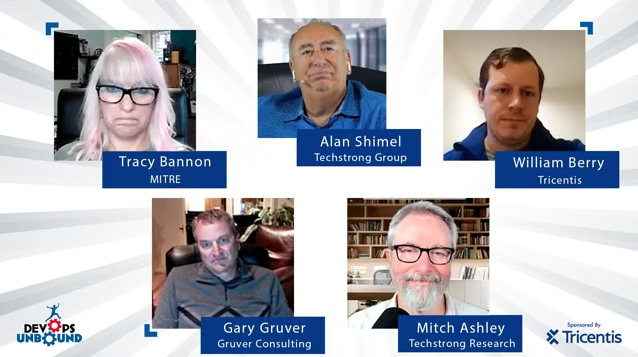
EP 21: Leading a DevOps Transformation – Lessons Learned
Alan: Hey everyone. Welcome to another edition of Devops Unbound. Devops Unbound is a biweekly video series featuring relevant topics in devops. We go wherever we think develops is going and what we need to shine a light on. Devops Unbound is sponsored by our good friends at Tricentis and we thank them for their sponsorship. In addition to the biweekly Devops Unbound show of which you’re going to watch one right now hopefully every month or so we also do a devops live roundtable with an expanded panel that’s live and open to the general public for questions as well. This episode of course is a recorded one, not a live roundtable. But if you go to Devops Unbound on or devopsy.kinsta.cloud you can see the schedule if you’d like to perhaps attend a live roundtable in the future.
But with that out of the way let me jump into this episode’s topic, leading a devops transformations, lessons learned. And I couldn’t think of a better panel to have us do this. For me devops, leading a devops transformation has always been kind of synonymous with my friend Gary Groover who wrote a book leading the transformation which early on in my in devopsy.kinsta.cloud when we first launched was a big staple of what we were preaching then. Gary, welcome to Devops Unbound. Maybe a little introduction about you, your company and your background.
Gary: Great to be here. I’m Gary Groover. I led several large transformations. Probably the most one you’ve heard of most is the one at HP where we transformed and got a two to three X improvement in productivity. I’ve written four books in this space and I spend my time now trying to do everything I possibly can to help organizations transform how they do software development because it had such an impact on me and the businesses that I was part of.
Alan: Fantastic. Ok. Next is a woman who is also no stranger to devops transformations herself, a lot of them in the government and government contractor world where she lives a lot now. It’s Tracey Banon. Hi Tracey.
Tracy: Hey. Hi there. Thank you for the invite. My background is as a software architect and engineer so I’ve been living devops for a long time because I needed to get software into the hands of the end users and I needed to do it efficiently. Part of that required us to get that transformational thinking going. So I do spend time like Gary does in the middle of my client and my sponsor’s spaces helping them to understand, really talking straight with them about the differences that they’re going – the different thought mental model that they have to bring forward ‘cause it’s not easy. But I know we’re going to get into that today. Really excited. I work currently with the Mitre Corporation. They’re a federally funded research and development. And what that means is that I don’t compete with industry. Congress chartered us specifically to provide the expert leadership to the government to help them move in the right direction. So a little bit different perspective. Really happy to be here.
Alan: Thank you Tracy. Last but not least is William Berry. Hey William. Welcome to Devops Unbound and maybe a little introduction.
William: Yeah. Absolutely. Thanks Allen. It’s great to be here and great to be here with this panel. So I’m Will Berry. I lead our business engagement at Tricentis. I help our customers with aligning our initiative or their initiatives to continuous testing so that they’re able to derisk that aspect of delivery, be able to make those timeframes deliver faster and being able to achieve those goals that they have set forth.
Alan: Great. And thank you for joining us. So guys the topic is devops transformation. When I first started devopsy.kinsta.cloud I was excited to see all these companies undergoing devops transformation and I really relished talking to as many practitioners, representatives of other, of organizations as I could to see patterns, to see what was emerging as what was the best way to do this. Right? ‘Cause there was the cultural aspects and the tools and the people and the processes. Right? But what was the best way to bring it together? And also remember when I started devopsy.kinsta.cloud there was this silly in retrospect silly argument of whether devops was something just for startups and Silicon Valley unicorns or as Gene Kim would say was it just for horses as well, right, the enterprise. Were large enterprises able to adopt a devops kind of mindset.
And there were believe it or not – Gary I’m sure you remember this. There were fights raging on the Twitter sphere and the blogger sphere about was devops an enterprise thing. To me I always thought so and the consensus was yeah, of course. Stage two was ok, so all these companies started saying ok, we’re going to do a devops transformation. And you know what? A lot of them didn’t get the results they were expecting and there was this loser tech. Devops stuff don’t work. So Gary I’m going to ask you to kick it off. I’ve given a little historical perspective. Do you think I’m crazy? Is that –
Gary: No.
Alan: Or your thoughts?
Gary: No. But the debate that I’ve had with Gene over years is if you’ve got a large system of people that need to work together the things that you’re going to do are different than you do with a small team.
Tracy: Exactly.
Gary: And a lot of the debate that I get in with Gene is Gene saying no, no. This is how the small teams do it so now we need to make the large teams do it like the small teams do it. And that just doesn’t work and fundamentally I think that’s why a lot of devops things struggled and failed.
Tracy: But small companies don’t necessarily succeed either because – so first of all it’s not about doing devops. Allen you’ve heard me say this before. I get so peeved when people say we need to do devops. They’ll bring me in and say help us. We need to do devops. We need to start to transform so we can do devops. And I’ll push back and I’ll say why. What exactly are you trying to accomplish? Right. Let’s get back to brass tacks. Let’s have a reason that we’re doing something and then we’ll track towards it. We’ll adopt the principles that are appropriate for you. But I’ve seen small organizations fail because it is pursuant to your context. And I think that’s where you’re going Gary.
You’ve got to know the context of that organization. You’ve got to understand what its business objectives are, its engineering objectives are and its people. And then you figure out which pattern might apply to them because it’s not going to be – there’s no lather, rinse, repeat recipe. There’s not a singular playbook for this. And that unfortunately is what everybody is looking for. They’re looking for that playbook. I just – I need the checklist of what I need to do. Can you give me a book ‘cause I’ll just follow that?
Mitch: Tracey I’ve seen many an organization where they will spin off a group sort of a skunk work project like back in the ‘40s and ‘50s, right with the X1 things. And those can work. They can work as a start but oftentimes they become a thing themselves and then they hit the corporate the white corpuscles, right, that come out and attack the foreign object. So I think it’s all in the context of the organization. If you’re savvy about what makes an organization tick. We’re all about data.
We’re all about measurement. We’re all about whatever it is, finance, whatever it might be and know how they adopt change or don’t. You’ve got to sort of build in the psychology of ok, great. How do things get adopted here? How do people get on board? And it’s never easy but it can be a lot harder if you sort of walk in with the bright shiny knight and sword and we’re the new savior of the day and poof, you’re the first one to get skewered and taken out to the back.
William: Yeah. And I think you hit it. I mean it’s an organizational mindset and you can kind of see it today. I mean you can see the responsiveness of what companies do in the market and what their competitors do. And you can see who has that mindset and who doesn’t based on whether or not I release like a new phone type strategy. Can T-Mobile respond? Can AT&T respond? And who responds the quickest to be able to address that?
Tracy: I was having a conversation yesterday with a fellow by the name of Steven Spear. He’s a professor at MIT Sloan. He’s done a lot of –
Mitch: Yeah. I know him well.
Tracy: Had a lot of really good thought leadership. And we were talking about the cultural overlay and how that makes a difference because we keep looking for that recipe. We keep not understanding what the culture is. Now I don’t push for culture change. I never push for culture change because if you came into my house and said you need to change your culture the first thing I’m going to do is put my hand up and say no, I don’t. But I am into culture building and culture understanding because we build a culture together. So the cultural part means a lot. And I’ll go back to what Mitch said about context, understanding the context, the cultural context of that organization.
When you think about government specifically that’s where I’m living a lot right now especially on the DOD side of the house. They are in a zero defect like low risk tolerance. Right? They need to make sure that it’s right the first time. Well that adds another level of complexity to the mix. So yeah, I want to go fast but how fast is appropriate? I want to adopt these principles and how many of those principles do I apply that allow me to get there in a cyber secure safe way. Right? How do I make sure the missile hits the target? How do I make sure that the plane is flying the right way? I mean Willian you brought up about the continuous testing and what Tricentis does in that realm. It’s interesting that the transformation has to include testing in a way that it hasn’t done. And it’s not just that automated unit test. Just automate the unit tests and we’ll be fine. Get some high code coverage. Hey. Hit 90 percent code coverage. It’s not that, right? There’s a bigger, broader set of this.
And I want to bring myself back though. Something that you all said earlier is that it matters the understanding the context of the organization matters. But where do you start? So if you’re walking in the very first time to meet somebody new Gary how do you approach counseling – I’ll use that term, counseling a new organization that you’re meeting whether they’ve been in the government space, whether they are international, whether they are a small US startup. Where do you start with that exchange of knowledge to figure out how to help them?
Gary: I tend to start by trying to understand what their problem is and trying to figure out what they’re doing. If I can get the leaders to engage not just in empowering the team and getting out of the way but really trying to take the time to understand how their current processes work and work with them to try to figure out how to make the waste in their current processes visible and then spend the time to let them pick the ideas that they think will help the most. I don’t ever go in and do devops.
I think that’s the most – I think it’s the most disservice we’ve done to the industry. It went to – it’s kind of like trying the automobile industry trying to copy Toyota in the ‘80s. Eventually they figured out that wasn’t working and it was stupid. The software industry stuck trying to copy what worked for other people instead of trying to create a culture of continuous improvement and letting the organization pick the ideas that they will champion, the ideas that they will embrace and the ideas that they will invest in making those improvements. And if we can’t get the leaders to do that you’re never going to see the organization transform.
Alan: So let me comment on that. You can’t change human nature. And there are certain – in the technology industry we emulate success. We emulate – if you succeed, right? How many business plans did we see seven, eight, nine years ago that said I want to be the Uber of? Right? I want to be the Uber of testing. I want to be the Uber of name a business model. Because what Uber did, I want to be the Uber of. I want to be the Twitter of. Right? In the technology industries this is what VCs whip out their checkbooks for. Right? And so you’re going to get that. I don’t know how you avoid that.
Gary: But if you go into one of Tracey’s clients that’s developing a missile launch type system and you go let me tell you what Netflix did and how they made it work and how they had these teams they are going to check out. Never mind checking out. They’re going to dig their heels in so hard that they’re going to shoot down any idea that you ever had and you’re never going to make a bit of progress.
Mitch: You become the new missile target I think.
Tracy: Well hold on. It’s actually in between.
Mitch: Ok.
Tracy: There are. So Gary is right. Depending on the audience some of them will just, they’ll get ashen. They’ll look down and then they’ll put their hand up and they’ll say go away. But there is a growing body of folks who have come into this they’ve grown up as those developers. They’ve been hitting up against this and they are now becoming those leaders. So there is an amazing undercurrent that’s out there and I’m getting to work with them firsthand. They are looking for that air cover so to speak. Right? They are looking for those most – they want to go the whole way up to the Pentagon. They want to go to congress. They want people weighing in.
And here’s where it tracks back to the problem that you talked about Allen. We’re not talking straight and we’re not getting the messages out that it’s not about copy catting but it’s about learning from. If we go into it and say I don’t want to use the Netflix model. I don’t want to use the Uber model. I want to look at it and I want to be informed by it. And I was to juxtapose it against my unique context. That’s where we help to get real success, incremental improvement. But we also have to come back to learning fast, failing small, failing cheap is ok. That’s a mindset shift regardless of to the industry. We always say fail fast but people react to that so say learn fast but fail small. And if you can start to fail small, surface it, allow it to be seen, allow there to be transparency into the failure, discuss it openly. That in my mind and in my observation that’s actually transformational in nature because people start to look at that and glom onto it.
Now Mitch you mentioned something which is when you spin off this group and you say ok. You guys go be that new devops group. Can you guys go establish how devops work and you guys be a pilot project. The problem is when they succeed and come back and try to scale it. Well they’ve been partitioned off as though they’re a dot com. Right? They’re over here. They do this amazingness. And what they did isn’t necessarily scalable as is. And there’s another failure point that happens because now you’re in an organization, an enterprise that’s got a unicorn team that did great things. How do I scale that? Well I don’t just pick it up and copy it. Now I have to look at how information flows, how I go about teamification when I have lots of different folks coming from different consultancies and contractors. Not all software is written by developers and by organizational resources that are owned by one company. It’s actually getting to be kind of rare.
William: So I mean that’s it. That’s what I see as the biggest challenge a lot of times when it comes to speed is the management layer is ready for it. The management teams they want to be able to do it but the executive layer still operates in a very project based initiative based thought process. And so you see this like this was supposed to play into this larger role of how I roll out devops across my enterprise so I went to this team and I did this. But it was still in this big initiative.
It wasn’t allowing teams to fail fast. It wasn’t creating that environment where these managers can really dive into what they know and figure it out and drive it and then have somebody else consolidate all that at the same time, that larger level. We’re still very much when we sit in a board room we talk years and we talk plans and we execute against in that manner. We don’t always necessarily break it into these tidbits that we need to be able to empower our managers.
Gary: And it’s a big bang transformation. And I’ve spent a lot more time recently looking at organizational change management. And they say one of the biggest barriers to people adopting new ways of doing things is risk. Any risk and when you do these big bang transformation there’s huge risk and that’s a barrier. If you do a bunch of incremental large, small changes and you create a culture of continuous improvement that’s a smaller risk. It’s reversible. It’s kind of like Tracey says. You can fail or learn quick and you can adjust and you can learn along the way. And I think what we’re missing is we’re trying to tell people what to do.
And I’ve done this whole shift to teaching people the principles and the approaches of making their process visible, letting them pick things that they’ll champion and they’ll make work and doing it in small incremental bits that they’ll get excited and they can reverse and they can learn and adjust. And it seems to be getting a lot more success in terms of teaching people how to analyze their processes and letting them pick instead of telling them what to do and seeing them resist the changes.
Mitch: And Gary I think we have made this repeated mistake over and over every time we introduce a change. It’s about telling people that they’re wrong and what they’ve been doing is wrong and it’s bad. And people have learned through some hard knocks of the folks that come in and do that, they come and go. Right? The last person that did that got fired, right, ‘cause they ran up against this or their project failed or whatever. And so it’s more about like let’s take the things that we do really well and let’s figure out how to do those even better. And as you were talking about let’s find the places where we’re either creating waste or there’s a bottleneck there. Give people a common problem to work on, not a common enemy, you, the change agent. You’re the person with the arrows in your back. Right? You’re running away from the last change project.
But I think that’s – and it’s always the shiny object, right, the next great thing that’s going to solve all our problems. Well if we just went all to Cloud native. If we just all went to devops. If we just all went to agile. It’s never that simple. It’s how do we take the ideas that this has and adopt it in our way and our style and to match what our objectives are. Because as soon as you create computing objectives like the skunk works team is this to show everybody they’re wrong and this is the right way to do it. Well poof. You’ve automatically, you’ve failed already before you even get out of the gate.
William: Yeah. And I think there’s a bit of a misnomer in the term devops because as soon as we say dev we lean towards developers and we think oh it’s a coding initiative. But really in business we’re all capable of developing something whether we’re developing a strategy or initiative or some way that we’re going to take our business to market. You’re doing something that would create a change in your organization. So then it’s about how do I make sure that that change is quality and how do I measure the impact of that change and so that I can know that I fail fast? Because that’s what I see is that we sometimes get too far into well it’s more about the initiative and not about the measures and we have to have them both together. And we have to have this be a mentality that everybody is developing something for the organization.
Tracy: There’s so much fodder with what you just said. I was jotting down a couple of different things. I wish I loved the term devops anymore. I don’t anymore because it’s another label. It’s an overloaded term. You’re right that we are hyper focused on dev. We leave the ops out of this. Yes, I know we’re focusing on this and we’re getting smart about ops. But we put so much pressure on the developers to go fast. Right? That’s what people say. Developers have to go faster. We’ve been so hyper focused on enabling that to happen and that doesn’t help transformation. And so then we say well, what we’ll do is we’ll give you a maturity model which if you have a maturity model then you can just figure out how devops-able you are. How devopsy are you because I’ve got a maturity model? So hater on the models. I do agree that it’s great to have a metric or a measurement that matters as long as you know how to change it. Right? You know what it means and you don’t weaponize it.
And a buddy of mine, _____. You guys know him. He’ll talk about the weaponizing of metrics. But I want to come back to something that you all said about not trying to change a culture but rather helping them to grow that culture by teaching them. One of the things that I’m running into is depending on the organization the individuals have muscle memory. And I’m talking incredible muscle memory. So I’m finding that if I have that same pod and I don’t insert some additional change agents, just mix up the group a little bit, I can’t get the change that I want.
And there have been some interesting studies about exactly that in the organizational change management area. If you have a group of ten people and you say ok guys, suddenly we’re all going to start behaving differently because somebody has come in and they’ve given us help and they’ve given us some guidance. What’s the likelihood that that nine or ten person group suddenly manifests without amazing amount of coaching and rigor and over the shoulder help.
But imagine or maybe you’ve been in that position where somebody joins. Somebody new joins and they have an energy and they have a different perspective and they have a diverse way of coming at it. Well then transformation starts. It’s no different than a blended family. Family unit as it is. You bring somebody new in. Somebody marries in and they have a different way of cooking and they have a different way of talking and they have a different way of doing something. Then suddenly its catching on and its becoming part of the fabric of that family. I see devops transformation as kind of putting some additional spice in. We’ve got to have the scaffolding around it. We have to have that education that’s out there.
But we’ve got to have those catalysts, those humans that bring that energy to help propagate and to help the people around them, the developer who really gets it, that quality engineer who is really excited about things, the leader, right, who is out there, able to fail publicly about something that they’ve done and really foot stomp when their team fails about how great it was that they’re moving forward quickly to resolve that. So Gary I’d be interested in your thoughts on especially on I saw you grimace when I said maturity model. Interested to see what your thoughts are about measuring transformation. How do we start to measure transformation?
Gary: So I’ve gotten to the point where I’m like you. I’ve quit using the word devops. It’s not that the principles don’t work and aren’t effective. But it’s just so balled up in a wrapped up image that I think in a lot of cases it’s doing almost more harm than good. Two, I’ve gotten to the point where I don’t want to measure whether a team is doing devops and I don’t want to do this ‘cause that assumes everybody is going on the same path. What I’ve tried to do is we’re trying to make organizations more productive and more effective and we’re trying to get them to improve on a continuous basis. And we can’t really measure throughput and some of the different things.
But what I think I’ve gotten really good at doing is measuring the waste that slows down organizations. And so we make the waste visible. We teach people how to make their process visible, how to make the waste visible. And then we give them key metrics that show when I made this change I removed this waste and inefficiencies. As much as I fought the certification thing I’m finally on board. I tried to emulate what was done in the manufacturing where you’ve got a white belt where you get a basic knowledge but to get a green belt or black belt you’ve got to do an improvement project. And in that improvement project what I’m trying to do is motivate people to make a change, make an improvement. And when you do that I’m trying to quantify the waste that they’ve removed from the organizations.
And most of the improvements that I’ve seen so far they’re removing like $50,000.00 – $60,000.00 of annual waste a year in the improvement project. And they’re able to go to the company and the organization and say look at the waste that I removed. Can I go do another one? And people are going yeah, yeah, yeah. Let’s go do another one. That made sense. Let’s go do some more of those. And we’re creating that culture of little changes one by one. And if I can get the executives to engage the magnitude of the improvements that they’re going after are just orders of magnitude higher because they’re in a position to have a higher impact on the organization just because of where they sit and how they work across teams.
Tracy: The surfacing of waste is so important. One of the air force groups that I’m working with, massive PMO or should I say massive joint – it’s actually a JAPO, a joint PMO with six massive PMOs underneath it. And we strategically went through and we did I call it rapid value streaming. It’s not lean six sigma official value stream mapping. But it was getting together and we had to be remote but using mural and talking through their processes at a very high level just to surface it. It was about two 90 minute sessions, just enough that people were like huh, look at that and allowing their own stories to hit them in the face in a very open and engaging way. We didn’t want to indite anybody but it was having them tell that story together and it was surprising just that three hours how much that meant. And we did that with each one of these PMOs. How much they learned from that to help them directionally.
Now there’s a lot of other massive challenges with acquisition and policy and other things that they have to deal with. But your point of identify where the waste was. Seeing something go into an inbox as an attachment, a Word doc attachment and knowing that it was sitting there for 18 to 25 days because there weren’t enough humans to even look in the inbox. Those are some of the things that you don’t even think about as impacting a value stream or the delivery of a flow. There’s so many amazing twists and turns that you get into. Gary do you – and I guess I should ask everybody. Are you, when you’re looking to identify waste what are some of the techniques that you’re using to identify waste?
Gary: I tend to map the deployment pipeline. And some people will call it value stream mapping. But value stream mapping assumes you’re doing one thing at a time. But in software when you get into the build release process you’re doing it as a group.
Tracy: Yeah.
Gary: Right? And so I think there’s a lot of errors that a lot of people make when they value stream map that don’t highlight the types of things that slow software organizations down. So I do value stream mapping kind of but I map the deployment pipeline and I kind of put some metrics on the requirements process. And I use that to make it visible. If you can do what you did and get the executives to take the time to understand their processes and make it visible you’re like orders of magnitude ahead of anybody else who is going to do this type of stuff. To me it’s so important that if I’ve got a company that’s willing to do a prototype and they can get the executives to sit down and go through my training I’ll give them the white belt training in a way just so that they can get a line and see it.
And I had an organization come in the other day that Brian Fenster sent me to them and they came up and they sort of said we’re thinking about surveying our culture and doing a cultural survey as the start of our devops. It’s like what do you want to do? I finally stopped. I said here. Take this free training and go off and do it. And they had three executives go off and do it and they came back together and said I can’t believe how well it aligned our thinking. We had this disconnect and we were all seeing it from our own personal view. And as we took this training it aligned our thinking. If you can get the executives to do that I think you’re going to be – the probability of success for seeing results is going to be orders of magnitude higher.
And I’m at this point of the career where yeah, I do it for a living. But I’m trying to help as many people as I possibly can. And I worked with David Farley to help with the technical side. And we’re trying to figure out how do we – now that we’re in this point in our career if we can digitize our knowledge we can help a lot more people. We can help them more cheaply and they can go off and do these things. And then they can do it for themselves and if they do it for themselves they’ll embrace their ideas and make their ideas successful.
Tracy: Right. Teach a man to fish. Teach a man to fish.
Mitch: I’m curious. Let me throw a little wrinkle in this. This sounds like a very kind of well thought out methodical process and I think a lot of it is. What about organizations that are under great threat? We have a lot of companies who their supply chain is a total mess. Right? And they’re scrambling to get new suppliers in place, new transportation if you’re up on that part of it. There’s a lot of organizations who are dealing with either market threats, just even operational threats. And so they can’t do back and let’s look at the next piece of waste. Or maybe that is a method –
Tracy: I was going to say I think we’re talking about exactly the same thing Mitch.
Mitch: How do you do that when you know what’s hitting the wall and you’ve got to like make something happen right now? At least that’s what management’s going to come to you and say. We might not have jobs tomorrow. Go fix this.
William: Yeah. I think it goes to what Gary is saying. Like look at your release pipeline. And what I see a lot of is this idea of what I call an avocado release which is you have all these people do this work and then it gets to this decision about whether we go or no go and people hold onto it like an avocado. They’re like is it ready, is it read, is it ready, oh it went bad. We’ve got to get it out there. And you don’t have this confidence in your organization and that’s where a lot of this waste comes in to make that decision, to have that go, no go to be something that’s almost automated to a sense of here’s the report. Here’s the impact. Make the decision and move. And that’s where these companies are struggling from supply chain perspective. If I’m going to hire a new vendor and I have to get 10 – 12 sign offs and it takes two months those transportation vendors are in high demand right now so by the time I get my signatures on paper they might be gone.
Mitch: They’re gone. They’re busy.
Tracy: But at the end of the day doesn’t it all track back to identifying what your set of whys are? You’ve got an imperative. You’ve got to solve it. It’s not going to be lather, rinse, repeat for everybody. If you have a supply chain issue, software supply chain or firm goods it doesn’t matter. If that is your issue and your challenge then you’re going to gaze at that and you’re going to turn it fast and you’re going to say what’s the waste. Right? To Gary’s point looking at that it might not be a devops pipeline. But if I’m looking at how fast it takes to get information in to me, how fast does it take for us to sign that off, we’re going to apply the same type of thinking Mitch so I don’t see that imperative as being any different than the software is failing in production or I can’t get a new user onto it. It’s another risk or challenge and it gets prioritized at the top of the list and all eyes are on that to solve it together.
Gary something that you and William both said really resonates with me and it comes back to that education piece. I’m at that same point where my goal is to share experience stories, get the information out there so that people are educated. When the taxonomy is not shared, when we don’t have a common lexicon. I mean why do certifications matter? Well the reason the certifications matter often is so we’re speaking the same language. Why sometimes will I look for particular certifications? Not that I know that the person can actually do the particular type of task coding but at least I know they know the words.
And in there I think that there’s merit in us thinking about getting to those lexicons, common lexicons that what is devops – oh I’m not even getting down in that path. But if we can in our own sphere of influence get to some more common terminology, augment that with the right types of education so that people can consume this and they can get on a level playing field we’re going to see continued growth and transformation. That’s at the end of the day and that’s what we’re trying to do.
Gary: And I want to go back to a little bit what Mitch said. I think that the habit that the executives get into is I’ve got this burning fire and I’m just going to beat up the teams and I’m going to beat the teams until they work harder. I had a group of executives go through this training and the senior vice president stepped back and said I had no idea of what people were dealing with on a day to day basis was getting in their way of delivering. And if they don’t have any idea of what’s getting in the way of the organization delivering they’re going to continue to focus in on we’ve got to put this fire out. We’ve got to put this fire out. We’ve got to put this. And so a big part is getting them to step back and get visibility to the things that are slowing them down.
And if they’re driving the dev team like crazy they continue to create more stuff and they’re doing manual testing they’re got an unsustainable process because dev writes 100 lines of code and test has to test 100 lines of code. That’s iteration one. Iteration two you’ve got 100 more lines of code and then QA has to test 200 lines. Right? It just doesn’t work. Right? You’ve got to get past that. But if they don’t see that and they don’t have appreciation for what the teams are going though and what’s slowing the organization down, they’re going to do nothing but what you said Mitch which was beat on what the business is beating on to get delivered. And the key is how do we get these executives to slow down and take the time to understand what’s getting in the way of getting what they really want.
Mitch: There’s nothing like a crisis to get people to rally around at times. Now if it’s manufactured crisis and it’s the 52nd crisis this year of the week that’s only what you’re describing too. I think one of the things whether it’s a crisis or not when you can rally people around a set of challenges, set of problems. We’re really ok. Our objective, let me give you a real example. I’ve gone through two transformations both involving Cloud and devops and they were both because the conditions had changed and what we were targeting, what we were shooting for wasn’t the same target anymore. And one of them was we had moved to a much more cash sensitive company, changed the structure of the company. So we couldn’t invest in hardware, etcetera.
And so we said ok, this isn’t really 100 percent true but let’s pretend for a moment we don’t have cash. I mean we don’t have money to go buy lots of hardware and we want to figure out could we leverage the Cloud. And it wasn’t a gun to our head but it was a let’s do that scenario and figure out what we do or we need to change how we’re developing software because while we have a monolith application there’s part of it that we really would like to be able to change more quickly and iterate on and do some services around. So you can use and sometimes it is a gun to your head. Everybody is going to be working from home next Monday so figure it out. But you can use those kind of rallying cries to say ok, this is the problem we want to work on. What could we do?
Tracy: Well it’s pushed by circumstances or pulled by a drain. Right? Like carrot or stick, circumstance or drain. Tracking back to something Gary said and Mitch that you brought up the education part of this is important. There’s a group of us that go across industry, government, academia who have been meeting and talking about how do we very rapidly expose the leaders to a day in the life in their organization because it’s not going to be lather, rinse, repeat. And Gary I know you have some really incredible training and education that are coming up that you’ve been working on with Dave. And I’m excited to see if that’s something that I can leverage in this space.
But that is becoming one of our rallying cries is exposure. Simply walk a mile in the moccasins. They don’t have to do hands on all day development but I want them to see what it’s like to get those, their priorities changed. You have a sprint but now you’re telling me that I have to change up everything that I’m doing. You’re forcing me to go faster and faster and you’re only worried about my velocity and my burn down and you’re not thinking about sustainability. You’re not thinking about the quality of – you’ve not thinking about the fact that you want me to dev sec ops and I’m a hobbyist. I haven’t been trained as a cyber expert. I don’t know secure coding standards.
I mean there’s a lot that we’re putting onto them and we need to educate those leaders, a day in the life. I think a day in the life the other way might be helpful as well. So how do the developers, how do the design teams, how do folks who are delivering, how do they understand the stresses, the pressures and the strategies that the leaders have to undertake? Because I think that there’s both sides of it need a little bit of that cross understanding. But it is going to have to start with the leaders who have the bigger stick and making sure that they understand.
Alan: By the way so Tracey I don’t think it’s just two sides. This was a technique I forgot who I heard it from with people who do devops consultations and consulting which is have someone from the ops side spend a week as a dev, have someone as a dev go over to the cyber team for a couple days. Right? Have a leader do the managers role or have the leader do a non-leader role. Have the single contributor do – like empathy. Right? It’s one of the cornerstones of whether you want to call it devops or not. It’s one of the cornerstones here was empathy. And can you – I don’t know if you could really empathize until you’ve walked a mile as Tracey said in those moccasins.
And I think it goes across all of these kind of – I don’t want to use the word silos but all these kinds of roles that we’re talking about because I think you need empathy for respect and you’ve got to respect what every single person, human on that team does. I grabbed the last word ‘cause it’s my prerogative. We’re way over time guys but I didn’t want to stop you. Shocking. Anyway Tracey, Gary, William thank you so much for being our guest panel on this Devops Unbound. We probably cold have done three shows today and still not covered everything. But it was a great show. Mitchell I’ll give you the last word if you want to wrap it up and we’ll sign off.
Mitch: Well I just am in awe of the wisdom and experience that everyone on the panel is bringing to this and there’s a lot of good lessons here. If I walked away with one nugget it’s stop for just a moment and think. Take in, let’s take in what we’re doing and make sure we’re focusing on the right things or make sure that we’re learning what we can do to work on the next set of right things. And I think that’s if I had to summarize in a just general way I think that’s a lot of what William, Gary and Tracy have said today. So thank you all for that very much.
Alan: Ok. We’ll be back in two weeks with another Devops Unbound episode. Until then good luck. Be well. Thanks for joining us. Have a great day everyone. Bye bye.
[Music plays]
[End of Audio]
-

EP 20: DevOps for Low-Code – Friend or Foe?
Low-code development has become increasingly popular since the onset of the COVID-19 pandemic in 2020. Low-code technologies allow organizations to build and customize fully responsive, easy-to-deploy applications with little to no coding. It accelerates digital transformation and empowers citizens developers. In this episode of DevOps Unbound, hosts Alan Shimel and Mitch Ashley are joined by Derya Sousa (Kianda), Andrew Manby (HCL) and Brian van den Brink (Valori) to discuss the benefits of low code and how it is transforming software development. The video is below and a transcript of the conversation follows.
Alan Shimel: Hey, everyone, welcome to another episode of DevOps Unbound. DevOps Unbound is a biweekly panel session on all things DevOps, of all things—hence the name, DevOps Unbound. It is sponsored by our good friends at Tricentis, and many thanks to Tricentis for sponsoring DevOps Unbound.
For those of you who are catching DevOps Unbound for the first time, in addition to our biweekly panel sessions like this, which are pre-recorded, we also do a monthly live roundtable open to the audience, and you are one of the guests at the roundtable where you get to ask questions and steer the panel discussion yourself. So, if you go to DevOpsUnbound.com or check it out on Digital Anarchist, TechStrongGroup.com, or devopsy.kinsta.cloud, you’ll be able to see the schedule and maybe join in one of our live roundtables.
Today, though, is one of our pre-recorded panels—and what a panel we have. Our topic today is low code/no code and many of its aspects and flavors, if you will.
But before we jump into that, I want to introduce you to our panel today—and I thought we lost one there for a second, but we’re okay. Let me first introduce you to Brian van den Brink. Brian, welcome to DevOps Unbound.
Brian van den Brink: Thank you, Alan. Yeah, I’m Brian, I work for Valori, it’s a company in the Netherlands. We completely focus on testing, so we don’t have any developers, it’s really all about testing for us, and I worked there for about eight years now. I started, really, as a tester of test automation, et cetera, but then I also noticed in the assignments I did that it was also important to learn something about requirements, how do you get them ready to be tested.
So, I focused also a few years on business analysis to get going and know what I need for testing, up until, I think, approximately five years ago when I came into contact with OutSystems, and really focusing now on testing solutions specifically for the OutSystems platform and seeing how can you use a low code platform in your benefit as a tester. And yeah, it really opened a lot of opportunities for me, I think, but also for testers, like, how can you work with low code and use it for your testing strategy, so.
Alan Shimel: Excellent, and thank you very much, Brian. Next, let me introduce you to Derya Sousa, and I’ve been trying all through our prelim to get it right, I hope I did, but if not, say it correctly, but please introduce yourself. Okay, three time’s the charm. I’m sorry—go ahead.
Derya Sousa: It’s great to be here on this panel today. Thank you so much for having me, first of all. So, I’m Derya Sousa, I’m the Co-founder and COO of a company called Kianda Technologies, based in Ireland, helping companies across the globe. Kianda is a no code/low code application development platform, and we are the enablers of digital transformation and accelerators of digital transformation for companies.
My background is in IT. I worked as a developer IT consultant across different companies, industries during my career, and I came across the fact of how difficult it is to deliver digital solutions for companies. That’s how the idea of Kianda was born in mid-2016, with the vision of helping people regardless of their technical skills to create the technology they need.
Alan Shimel: Okay, thank you. Thank you for what you’re doing and thank you for joining us today. Our next panel member is Andrew—excuse me, it’s Andrew Manby, correct? Andrew, if you wouldn’t mind introducing yourself?
Andrew Manby: Sure. My name’s Andrew Manby. I head up Product Management for our Digital Solutions Portfolio here at HCL Software. You know, in our portfolio, we have both professional developer low code platforms and also citizen developer low code platforms.
A little bit about me, I’ve been involved in multiple successful software products. Some of them you may know about, a product called DataStage, which we created back in a former company that really, along with Informatica, lit the imagination of the data integration market and have also been involved in other market spaces as well, including bringing thought leadership to IBM around big data analytics.
Alan Shimel: Excellent. And then, last but not least, not necessary a panel member, but a panel member, but he’s also my Co-host for DevOps Unbound, it’s TechStrong Group CTO and TechStrong Research Principal and Co-founder, Mitchell Ashley. Hey, Mitch, how are you?
Mitch Ashley: Hey, Alan, always good to be doing a panel together and for the folks on the panel I know, good to see you again. Folks that I’ve met for the first time, like our audience—good to have you all here. I know we’ll have a great discussion.
Alan Shimel: Absolutely. Thanks. So, guys and gal, let me kick this off. As I was talking about before we went live, I almost view the low code/no code discussion with a BC, Before COVID, time frame, right? Much like ADBC, we have DC and then pre-COVID. I think—and Derya, you’re living proof of this. Low code/no code was alive and well prior to COVID, right? You started in 2016. Low code/no code’s been around, obviously, much longer than that.
But certainly, with the onset of COVID and the pandemic, never have we seen a need to do more, faster, to get apps out better, to expand the base of people who can develop like we have this past going on almost two years now, right, year and a half—well, more than a year and a half, two years. And so, we’ve seen sort of a rapid development in the state of low code/no code.
And Derya, I don’t mean to pick on you, but I’m gonna ask you to kinda kick us off, here. I gotta assume that this is what you’ve seen at your company in particular over the last year and a half to two years.
Derya Sousa: I think to start with, I could tell you, when we founded Kianda, when we would say low code/no code platform, our audience would say, “What do you mean?” Now, we came to a stage that anyone we talk to understands now, most of the people we are talking to, they understand what we do because of this trend and the movement that’s happening with the help of the unfortunate event of the pandemic. But low code/no code was always here, solutions that we had. It started long, long—years ago. You know, we were using Excel sheets, we were using Access, we were using WordPress back then to create our website. So, they are, I think, the initial solutions that we started to use.
But it came to a stage that the surge of the remote working, the surge of the digitalization needs that are growing really dramatically now in the last two years, it’s going into more enterprises, it’s going into more organization level. And what we are seeing, this is a problem that’s not a new problem. Currently, only 0.5 percent of the work population is capable of coding.
So, what was happening before was, you know, business users, anyone working in organizations, they were in need for technical solutions, and they were always waiting for IT teams to go in and create these systems for them. But it’s changing now, there is more inclusivity in creating technologies, empowering people, regardless of them knowing how to code or not. It’s giving an amazing world of opportunities for people who were not able to be part of it, be actively part of digital transformation are now becoming what we call citizen developers to create these technology companies, organizations are in need. And of course, we live in a digital first world now with everything that’s going on around us. Any company who doesn’t try to benefit leverage from these technologies that are rapid application development are gonna stay, unfortunately, behind when it comes to competitive advantages and improving or creating that economical value for the organizations.
Alan Shimel: Agreed. Folks on my panel—thoughts, follow on to that?
Andrew Manby: Yeah, I have a few thoughts. So, you know, as Mitch and I have discussed a couple of times, right—for me, low code or sort of no code has been around for a long period of time. In fact, my father-in-law was programming in dBase, you know, many years ago, right? [Laughter]
Alan Shimel: That’s another name I haven’t heard in a while.
Andrew Manby: Yeah, okay, let’s get Delphi, FoxPro, all of those things out on the table. Let’s do it.
Mitch Ashley: I think I met your father-in-law, so. [Laughter] [Cross talk] dBase.
Andrew Manby: [Laughter] Yeah. So, all of these things have been around for a long period of time, right? And if technology has taught us anything is, they evolve to serve a particular need and that’s because the business was trying to accomplish a particular outcome, right? So, they built something, they’ve effectively had it deployed.
Now, what’s happened now is, you know, we have a lot more tech savvy people in the workforce and, you know, IT is taking a little bit more of a proactive approach. They want a bit more governance, they want a bit more standardization, they also want to be assured of the security and governance of what the business buys, and I think this generation of low code and also no code tools, which I think are two separate things, by the way—
Alan Shimel: Absolutely.
Andrew Manby: – help us to do that. And so, you know, I don’t think it’s new. You know, what’s actually interesting—and I hope we’re gonna get to this, Alan—is the type of things that we’re seeing that people are building with these individual products.
So, I think it was always there beforehand. I think a lot of organizations like, for instance, we have one major airline and there’s a couple of hundred people who are business users building applications on it, right? But typically, you know, to be clear, a lot of them are employee-facing, and they fill the gap between some of those traditional enterprise applications or maybe to some of those SaaS franchises that we often hear about now to get the job done, right? So, I think it was alive and well before, and I think it’s continuing.
Alan Shimel: Absolutely, it’s continuing, but I think it’s changing. And Brian, I think you might serve as a poster child.
Brian van den Brink: I think, actually, if you look a few years ago, like maybe four or five years ago, a lot of companies were maybe starting to work with, for example, health systems with low code platforms, using them as smaller apps, basically, in their organization.
For example, you know, logging hours of your work, whatever, and then starting to grow, like—hey, we can really get to a product really fast, and then other departments of the organization see, hey, they realized an app in a few months, and it’s interesting to maybe expand on it. And then you see, like, a center of excellence within a company start to build apps, and then it grows bigger, and now, I think, currently more and more organizations actually use low code for their core applications as well. So, actually, the most important processes are also done with low code nowadays, and it’s growing like that, because they see the benefits, I guess. And when I see—
Alan Shimel: Well, why shouldn’t they?
Brian van den Brink: – yeah. And what I see in my work as well is that, if you work in a high code environment, it might be difficult for a tester or for a business analyst to say, “Hey, this is how it works” and dive into the product, you know, dive into the code, then you need these technical skills. But I think with low code, it’s easier, for example, for a tester to say, “Is this really what we meant with this piece of software?” and you can really get the dialogue going with your developer, even with your product owner, for example, to see, is it really doing what we want it to do, and how can we improve it, for example? And that’s so much easier in a low code environment, I think, than in a high code environment.
Mitch Ashley: You know, Alan, there’s some—Accelerated Strategies, now TechStrong Research did some research earlier this year on low code/no code and there were some interesting trends in that. And I think part of it was driven by, Derya was talking about the effect of the pandemic; you were, as well. That rose software to prominence in terms of business strategy must-have capabilities. And along with that, sort of low code/no code was sort of viewed by IT as something that happened outside of IT, we don’t really care about it, the business units are doing something, whatever, to it is a mainstream platform.
And I’m not saying it wasn’t before, but I think the embracing of low code/no code as a strategy, I think that improved over the last 18 months, and you can also see it by the need to access data, what information people need to get to, because no application is truly an island. They eventually have to get security, they eventually have to get to data and other systems and the fact that, Andrew, you talk about citizen developers and professional developers both as IT viewing those as legitimate creators of applications.
Are you seeing that trend as well? That certainly bore out in our research.
Andrew Manby: Yeah, so, we have some of our own survey that’s coming out very shortly that we did with Forrester. You know, we actually found that, from a business decision making perspective for the people surveyed, 80 percent of them said that low code was one of the top three IT priorities for the organization, right?
Mitch Ashley: Mm-hmm.
Andrew Manby: You know, 77 percent of the respondents actually said that, you know, agility and velocity were the two most important things to their business in achieving that.
So yeah, I think companies are realizing that. I do think that there’s a couple of other different phenomena, and I think, Mitch, you and I have talked about this when we’ve had a separate conversation. I do think there are the organically grown stuff that Brian was talking about, which is, you know, you provide a citizen development tool, you establish a center of excellence, right, and then you sort of start draining the desire of the organization to fill the gap with building these applications.
But I think there’s also—and maybe you touched on it, Brian—you know, organizations are taking also a top down type approach, right? And they’re saying, what are the important digital touch points I have in my organization and, given the advent of COVID, what do I need to be able to fill the gap or continue my business, right? So, if I’m a retailer, through the early part of COVID, one of the biggest challenges I had was, how do I handle, you know, touchless commerce? How do I pick up the deliveries and still allow my retail department to function, right?
Or say, for instance, I’m a tax office, right, and all of a sudden, you know, the tax function, there’s no people in the office, and what we want people to do is start filing an abeyance request to delay the delivery of the taxes—how are you gonna do that? Or, you know, families are looking for special support, family services support, right? So, those types of things have suddenly become very, very important and low code, whether it was built by the IT organization or it was built by the business has really helped to fill the void. Sometimes, there have been brand new things, and sometimes they’re just really about adapting the business to the new reality.
Alan Shimel: Absolutely. Let me weigh in, here. You know, I think prior to the pandemic, there is a long history of low code as I think, Andrew, you pointed out, right, though it may not have been called low code then. But prior to the pandemic, low code/no code was around, but a lot of people viewed it as, “Look, if I’ve gotta get something done simply, it’s Minecraft, you know, for adults.” It’s easy, you know, for simple—as I think, Brian, you mentioned, it’s good if I wanna track my hours or something like that. It’s a glorified spreadsheet.
And then I think what we’ve seen with the pandemic is, in my mind, we’ve seen three branches of low code/no code, and I think, Andrew and Mitchell, you both mentioned it. One is no code, and I gotta be really honest with you—I got a problem with that. I have the same problem with no code that I have with no ops. I think that’s pure marketing, and I don’t know what you can truly, truly do with just no code. And we can talk about that, feel free when I’m done if you guys wanna jump.
Andrew Manby: I’m just thinking about your Excel spreadsheet, right?
Alan Shimel: Uh huh.
Andrew Manby: You know, Excel is no code until you type in that formula.
Alan Shimel: Right, and then all of a sudden, you better—take it from me, I’m illiterate on Excel formulas, so I know there’s code there.
Mitch Ashley: Because you put in an expression, you’re now coding, right?
Andrew Manby: Yeah, exactly. [Laughter]
Alan Shimel: But when we look at quote-unquote low code, here is the big takeaway with COVID for me is, we have low code for developer teams—and Brian, I’m gonna include testers in there, because testers were already scripting and doing some coding in order to write their test.
So, we have low code for development teams—DevOps teams, whatever you wanna call them, developers—and then we have low code for the quote-unquote citizen developer. These are people who traditionally didn’t do any development other than maybe spreadsheets. And, you know, lo and behold, the business analyst, the person over in Sales or Marketing or in HR, they now have the capability of not having to wait or go through that whole IT process driven formula, but they could use some paint by numbers and relatively easily build a very functional application. Don’t equate citizen developer with simple app. There’s some sophisticated stuff we can do now.
Brian van den Brink: Alan, I wanted to react to that is that, indeed, the citizen developers, but also the IT development teams working with low code.
Alan Shimel: Yep.
Brian van den Brink: But what I do see is that more and more companies choose low code to basically restructure their, how do you say, legacy applications, you know, rebuild it or rethink their software. And I think it’s really crucial to still have—maybe you can work with citizen developers as part of, okay, what are the business requirements we need and how are we gonna implement it, et cetera. But it’s super important, I think, to still have your development skills on par with what you need. Because even with low code, maybe it’s easier to make something, but you still need the same kind of skill set that the developer would have to know how do I structure things, you know, how do I set up my architecture around it. Those kinds of things are still development skills, maybe without coding, but it’s still development skills, I think.
And that’s why I think you always need maybe a senior developer, whatever, in your team to be able to handle those kinds of questions and then supported, I think, of course, by juniors or citizen developers even, but the development skills that you need to build an application are still very much necessary, I think.
Alan Shimel: Agreed. Derya, it looks like you wanted to—
Derya Sousa: I would like to add something, a point to what you said, Alan, to your definitions. So, there are solutions in the market that low code solutions, they generate code for a developer to go in and speed up this process of delivery and make the changes as they receive them.
Alan Shimel: Yeah.
Derya Sousa: There are solutions like what we provide. We don’t generate code, so we call ourselves as our customers call a true no code platform. However, we allow developers to go in and create widgets, create rules and actions that can help them bring that end to end business application to life. And I think that’s important, because there is a good bit of differentiation between them, and from our experience, we work with IT teams as well as Business Departments.
Alan Shimel: Yeah.
Derya Sousa: But we start with IT Departments, because they’ve seen the benefits they can get—
Alan Shimel: The strength, the power.
Derya Sousa: – by using a platform like this—exactly, filling the gaps that they might have. And now, even since the pandemic, we are talking to more public entities for—public hospitals, for example, for government agencies. Even them, they tend to be slower to catch up with innovation and technologies. Even them are looking at low code/no code systems, how they can use their legacy systems, which they’ve been using maybe two decades, but they had no idea how, actually, they could bring a user-friendly interface on top of these systems.
So, that’s where, I think, solutions like rapid application development solutions that come into place and bring a lot of benefits to organizations.
Andrew Manby: Yeah, I would agree that certainly, you know, some of those you think are traditional sort of holdouts, right, typically on the laggards in the adoption curve are certainly doing that. You know, we’ve seen that in state government, we’ve seen that in large tax authorities. We’ve also seen that in the District of Columbia Motor Vehicle Registry. But I think also one of the things that I want to make sure that we add to the conversation, I sort of touched on it is, you know, I think organizations, I’m just thinking about actually the first private distribution only utility in North America is the Vermont Electric Company. And they, a lot of companies want to go through additional transformation, right? I know we’ve all heard that term, right? But they really set out a plan for a number of years to sort of think about how they could not only replace some of the legacy, but really sort of think about, you know, shifting the cheese on what does it mean to digitize the processes that they actually do.
So, I think, for some of the organizations, you know, they’re not only thinking about—okay, how do I put a new front end on an existing system where, you know, it’s been particularly inflexible. But I think also, a lot of them are a lot more, you know, thinking about how do I, you know, move the cheese? So, in the case of the D.C. DMV, how do I, for instance, say, “I don’t want to have people go into a motor vehicle registry to register their vehicle, right? I don’t need them to go into a public office to pay a parking fine or a speeding ticket—what if we just actually changed our processes and put it on one of these things, right?
So, I think a lot of organizations out there are actually thinking about low code in that way, and I think that’s where the conversation shifts from being an IT way and an enabler to also being—alright, you know, the CMO, the COO has a seat at the table and she is saying, “Look, how can we improve the engagement with our customers where our traditional ways of engagement with them have change significantly?” And I see probably equal amounts of companies coming to us and saying, “I’d like to do this,” right? You know, “I want to change the way people buy tires for their cars,” right?
Mitch Ashley: You know, in thinking about this, it seems that sometimes the terms we create don’t always serve us well, right?
Andrew Manby: Right, right.
Mitch Ashley: And, you know, visual programming is what we would’ve called low code maybe 5 or 10 years ago and you know, is a macro low code or no code? And actually, I don’t really care, it’s a macro, it’s just like—you know, is Python a scripting language or a programming language? I really don’t care. It sort of doesn’t matter. I think the end result is, you know, you talked about, Derya, the rapid application development, and I don’t mean the RAD term, but creating applications quickly and expanding the universe of people who can do that across the business is all good. I mean, it’s to the benefit, to the end of the business. And we can create a mess for ourselves, or we can do it well, in a way that it works together.
But I think, hopefully, we get to a point in a year or two where we don’t think about low code/no code, right, it’s just—it’s another way of, it’s an application platform for creating apps. And anybody can do it, because it’s—I mean, whether it’s no code, I don’t care if Trello’s a no code or a low code. I don’t care if Zapier is a low code or a no code, you know, just to pick a few commonly used things. I think we’re about the result we wanna get.
Andrew Manby: Yeah, I agree, Mitch. I mean, I think at the end of the day, you know, we obviously know that technology goes in cycles. You know, certainly, in our portfolio, we have low code that we would sell to a customer for doing that specific task, right, and those are broad sort of use cases.
But, you know, low code or that sort of no code citizen developer construct exists in our digital experience platform and it also exists in some technology we have specifically for the DevOps process, which is a low code version way of them to help orchestrate what they do in the DevOps process. And you think to yourself—well, are they a commercial low code tool? Well, no, but they’re bringing the, enshrining the value of a no code/low code tool to a specific challenge.
You know, maybe that will be the way that this market will evolve over time, but definitely, I would say that where we are right now is, it’s permeating into lots of different places, right? You know, does that mean that, say, is Monday a no code tool? But probably what makes it stickier is the fact that it has some no code type capabilities to it, right? And maybe that’s okay, right, for customizing certain types of applications.
Mitch Ashley: Well, it ventures into the whole workflow space, right? I mean, you know, Atlassian now is positioning themselves as a competitor to Monday and others as a workflow tool, and you could say that’s low code or no code, too. So, it’s really, when we talk about that as a segment of the market, it really is much bigger than just what we might narrowly define as low code.
Alan Shimel: Yeah. So, to me, the definition goes back to something Brian was talking about earlier, and that is—what’s the involvement of IT, right? Even with this citizen developer thing, I see it bifurcating. There are some cases where traditional IT teams are calling in a non-traditional IT person to help with the building, architecting, sizing of an app. And that non-traditional IT person benefits from the team being, using low code/no code tools, right? So, that’s one scenario with the IT Department’s involvement.
Then there’s sort of a shadow low code/no code development kinda operation without IT, right? Where—hey, man, it takes too long, I don’t wanna go through the whole change management process and the architecting, I just need this quickly. And I got the tool to do it and it’s cheap and it’s SaaS an it’s boom, boom, boom and I’m done. “Hey, where’d that come from?” “Eh, I built it.” “You built it?” “Yeah, I built it.” Right? And that’s powerful. I’m not gonna—let’s not kid ourselves. That’s a powerful enabler in an organization when the IT person says, “Hey, wait a second, where’d you get that?” “I built that.” Right?
How do those two jibe? And I think that’s really where the friction, where the rubber meets the road, and what is low code, what is no code, who does it? I think the delineation is, is IT involved or not? And, you know, Derya, you were saying most of your engagements are going through the IT Department. Brian, you seem to be on the IT Department is involved side of the house as well. Andrew, I’ve heard you go both ways here a little bit. But, to me, that’s the key sort of indicator.
Andrew Manby: Well, and Alan, can I ask you a question, then, right?
Alan Shimel: Sure.
Andrew Manby: You know, I tend to think about low code for citizen developers to be a bit like a sandbox, right? You know, I live—where I live, there’s a zoo a mile away, right, and there’s an area there and a kids’ playground, there’s a tent and there’s a sandbox underneath it, right? And it makes it very easy for the family to sit down and observe their kids, right?
So, you know, I think the way that no code is developing from an IT perspective, it’s trust but verify. Can I see what they’re doing? If they get into trouble, I can help them out, or as Derya said, you know, if there’s something that they need, right, maybe they need a specific widget to do a payment or they need something to deliver a package or they need some very specific type of math problem and they build an algorithm in the math lab and they want to bring it in, that’s when IT does that, but also, again, it’s that oversight and governance, right? Trust but verify, but you know, who’s using the application? What data do they have access to? Are they doing Select Star from HR executive salaries, right? Is someone curating those data sources for them so they can do no harm in their developments?
So, I think that’s the place where citizen development is going. I think that’s where organizations want to invest, that’s where they’ll put the COEs. I think the days of, say, my father-in-law building something in dBase will go away from an IT perspective.
Alan Shimel: So, let me use your sandbox analogy. I’ll put forth the proposition to you that most parents, a lot of mommies, take their kids to the sandbox and leave them there because it’s a relatively safe environment and they can concentrate on other things, maybe doing some of their own work or speaking to the other moms or what have you, and they consider it a safe environment to leave their kids, and they only keep half an eye on them versus, you know, being on swings or something. Same thing, here.
Andrew Manby: Exactly, Alan. So, I think, for me, you hit the nail on the head, right? If it’s about IT backlog, you’ve effectively given one strategy to halve or reduce your IT backlog because, with your supervision, right, the moms can go off and do something else which they focus on which really requires their skills.
Alan Shimel: Mm-hmm.
Andrew Manby: But then, you know, as citizen developers in the sandbox, I can get what I need done for the business faster. Isn’t it like a division of—
Alan Shimel: Well, let’s go try it.
Andrew Manby: – a division of labor?
Alan Shimel: It is sort of a division of labor because we’re not talking about kids in sandboxes. But when you have testers doing low code/no code, you know, building quick, being able to testing faster, better—that, to me, is a very different low code/no code use, right? That’s a—
Brian van den Brink: What we often see, for example, with Tricentis, Tricentis is a low code testing tool, and I think it’s important as a company if, for example, I choose low code development for my core applications. Then also, you have to probably think about what does that mean for the other roles within the IT Department like, do we have to think about then, also, a low code testing tool that fits our development platform, for example? Often, I think what I still see happening is that we choose low code for several reasons and the decisions that help that. Also, you can rely on—okay, that’s the same decisions we need for our test tooling, for example. And I think what’s important is that I think what the low code opens is that you can work with a low code platform and use those capabilities for a testing perspective as well.
So, for example, if I test a process, it takes a lot of time to go through all the screens and to test a workflow, for example. And I’m testing a workflow and there’s all kinds of data I need to test specific outcomes of that workflow, try to find solutions in your platform to basically mock that data or to set that data up through a faster way than to going through all those screens, maybe you can use an API or you can leverage something out of the platform to make that faster. And I think that’s where low code testing comes in place is that it’s easier to shift left towards a developer and discuss those kinds of things. Like—okay, we have a requirement we want from this business perspective, what do we need to build that as a developer and what do we need as a tester to test that more efficiently? And I think that’s where the thing comes together is that if we discuss that within a team and then it’s really an IT thing, what do we need from a technology perspective to make everybody’s life easier, basically?
And I think low code, companies use low code, for example, because they have a challenge in finding the technical people to be able to build their apps. And we have similar challenges in testing that it’s difficult to find the technical people to build the technical scripts. So, there, I think we need to make sure, as a company, that you match these challenges in the same way that—okay, low code platforms probably also need low code testers, because you have, you know, you make those decisions for a reason, I guess. And that’s what I see in my work.
Yeah, it opens a lot of opportunities as a tester to be more efficient in your work and to make sure that you keep up the pace with your developers. Because low code development is a lot faster than traditional development, and if you don’t change as a tester as well, you will always be, like, a bottleneck in the process, because you’re not as fast anymore. And then that’s why you need to think of smarter solutions as well.
Alan Shimel: Derya, low code apps need low code testers?
Derya Sousa: Sorry?
Alan Shimel: Brian said something that if you have low code apps, it makes sense to have low code testers.
Derya Sousa: Low code testers—yeah, yeah, absolutely. Just to add to the original conversation about governance and security, I would like to maybe add a couple of points there. I think, again, the solution to what you mentioned, Alan, there is—yes, we deal with IT Departments and, you know, business users are being exposed to these solutions, low code/no code solutions—where is the security, who has access to what, and how we can implement governance. And it sounds like a broad concept, but you know, any organization would need to implement governance, you know, how they operate, what is moss, what is a shoot, what is a can for them to do and now to do things.
And the same approach should be implemented when it comes to employing this type of low code/no code solutions. So, just because the platform is like a LEGO building block or sandbox, as you mentioned, it doesn’t mean that we should forget about everything, it’s too exciting, let’s build whatever we need and, you know, roll it out quickly. I think the same approach as the company would have had in their change management, change control, governance, they all should be now considered the same way for low code/no code approaches, whether it’s IT building it or whether it’s business users building it.
And what we usually see that’s working is when IT and Business Departments work together. So, IT creates some kind of a controlled environment for these non-IT users to go in and create solutions while IT is shadowing them or supervising them, giving them tools they need. But at the end, it’s all a controlled environment where, I’m really the biggest fan of giving people free, innovative solutions that they can freely innovate and create solutions they need, but this should not come without a plan. So, a low code/no code system should not be implemented without a plan.
So, that’s why we are seeing sometimes a struggle that companies go through, because they see the opportunities, they start with one solution and they want to implement so many more in a couple of months’ period, and it can be challenging if there is no plan. It can be challenging if there is no strategy, overarching strategy that looks to different kind of aspects of how to implement such a rapid application development system, yeah.
Brian van den Brink: Yeah, when we have—
Andrew Manby: I probably disagree, because I think there’s different modalities. I would say a lot of citizen developer low code is an either they develop it to prototype it and then hand it to IT once they’ve actually proven it, sometimes they’re there for a period of time so it’s literally like a pop-up booth or a food truck. You know, it arrives, it serves it purpose, and then it’s torn down, right? So, I don’t think you can necessarily have IT be involved in all of them.
I mean, certainly, you have some sort of, you know, diamond team to do that, but I don’t think it all happens like that. I think there’s different ways that, yeah, some of it is definitely planned out through IT and Business to deliver something. Sometimes it’s a cross functional team and it’s driven by the business. But I think part of the attraction of low code, and we mustn’t forget about it is, it’s that organic nature and the empowerment of the people in the business to get their job done.
And sometimes, you know, back to Alan’s point, it’s—you know, you don’t wanna get slowed down by what IT’s doing and as vendors, if we do our job correctly, we give them that safe space to be able to do that, right? Trust but verify.
Brian van den Brink: I think it’s important to—I think, indeed, what it opens, and I agree there is, it allows you to prototype things from a business perspective, but I think what’s important then in the next space is that that prototype is not to go in our production environment, basically. So, you know, you have to make sure that sometimes what we say is that, if you look at old spaghetti code, with low code, it’s easy to make, like, fast-cooking spaghetti, basically. Because, you know, you can make your mistakes faster because it allows you to create things faster, as well.
So, I think, indeed, you start with a prototype, you verify the basic concept, and then at some point, if you really wanna structurally have a core application out of it, it has to go through architecture principles and things like that. But I think that’s what Derya also means, maybe, with the plan is that, once it goes to that, after that first phase, it really goes into that planning phase and how are we gonna structurally broaden this application, for example?
Derya Sousa: Absolutely. Just to add there, so, the applications we build, we deliver, or our customers are delivering are core applications, core business applications, and I don’t see them working well in terms of security and governance if they are just let and there’s no plan or there’s no cooperation with IT teams.
So, from my experience, I’ve seen this and there are, really critical solutions are being built with low code/no code systems, and they are connecting to critical data as well, and especially with security in mind, that we all have to have nowadays. I don’t see this getting to the highest potential without IT being involved.
Andrew Manby: Yeah, I will agree about that, but I would argue, continue to argue that there are a lot of things that need to be put in production in a safe space that have been curated by IT that we just allow the business to run with, right? That’s just the nature of the beast, right?
Alan Shimel: Absolutely
Andrew Manby: And to be honest, I don’t know why you would want to change that.
Alan Shimel: Well, this is a great conversation, but we’re out of time, we’re over time. But, you know, obviously, if you couldn’t tell at home listening to this, there’s a lot more we could—we could’ve spent all day talking and still not cover it all. Maybe we’ll have to re-run it and bring it back for another low code/no code episode, soon.
But we’re gonna need to wrap up this episode of DevOps Unbound. Brian, Andrew, Derya—thank you so much for joining in and contributing to this panel, it was great. Mitchell, as always—good job, man, you know? You’re doing this—
Mitch Ashley: Enjoyed listening to the panel as well as participating. It’s a great group.
Alan Shimel: Absolutely. Many thanks to Tricentis for sponsoring DevOps Unbound. We’ll be back in two weeks with a fresh topic related to DevOps. Hope to see you there and have you join us, but for now, this is Alan Shimel for DevOps Unbound. Have a great day, everyone.
[End of Audio]
-

EP 19: How AI/ML are Used in DevOps Today
Artificial intelligence (AI) and machine learning (ML) help improve the performance of DevOps teams by automating repetitive tasks and eliminating inefficiencies across the SDLC. By using AI, teams can test, code and check software faster and more efficiently. In this episode of DevOps Unbound, Brian Dawson, Judith Hurwitz, Alan Shimel and Mitch Ashley discuss how AI and ML are transforming DevOps and what new use cases await AI and ML in 2021 and beyond. The video is below, followed by a transcript of the conversation.
[Intro Music]
Alan Shimel: Hey, everyone. I’m Alan Shimel, CEO of MediaOps, devopsy.kinsta.cloud, Container Journal, Security Boulevard, and you’re watching DevOps Unbound. DevOps Unbound is sponsored by our friends at Tricentis, so many thanks to them. And DevOps Unbound is a biweekly show where we cover topics of interest to the DevOps audience.
I am the host. My cohost is our CTO and CEO of Accelerated Strategies Group, my friend Mitchell Ashley. Mitchell, welcome.
Mitch Ashley: Thank you. Good to be here as always, and with this illustrious panel.
Shimel: Absolutely. And an illustrious panel it is. We have two panel members joining Mitchell and I today. Let me introduce you to both of them. They’re both great folks in their own right and I’m going to let them introduce themselves.
Let’s start with our friend Judith Hurwitz. Judith, welcome to DevOps Unbound.
Judith Hurwitz: Thank you so much, Alan. It’s a pleasure and an honor to be here.
Shimel: It’s our pleasure.
Hurwitz: So I’m Judith Hurwitz. I’m the coauthor of 10 books. Have been in the industry for 30-plus years. Focus on everything from DevOps, security, manageability in cloud, hybrid cloud, and really looking at how you take technology to transform organization. It’s a complex topic, not easy, but it’s what we’re in the middle of.
Shimel: Absolutely. Then last but certainly not least, our friend Brian Dawson. Hey, Brian. Welcome.
Brian Dawson: Hey, Alan. Thank you. Good to be on with you again. To tell the audience a bit about myself, as I’ve told you before, Alan, I’ve been in software development and delivery for about 30 years. I consider myself a technologist. And even prior to focusing on DevOps I’ve had a focus on optimizing software development and delivery.
Excited to talk about AI. I kind of dabbled and dipped my toes in the space in my time that I spent at the company that is now PlayStation. Things have come a long way since. And during that time, I’ve spent the past 10 years of my career focused on identifying, applying, and spreading DevOps practices, so I’m excited to discuss the two together here with this group.
Shimel: Absolutely. Brian, I’m not sure if you mentioned your present position with the Linux Foundation.
Dawson: I did not actually, because also this organization I’m at today has a big footprint in the AI and ML space. So today I’m with the Linux Foundation. I oversee our developer relations and ecosystem development. And of note, within that is the LF AI & Data Foundation, which houses a number of impactful projects in this space.
Shimel: Thank you. I just thought the folks at LF would welcome that, a little plug for them.
Dawson: Well I appreciate it, thank you.
Shimel: Yep. Alright. So the topic for today’s DevOps Unbound is artificial intelligence and machine learning. How can they help improve performance of DevOps teams? In other words, what’s their role in the DevOps world? Right? And let me preface our conversation by giving you sort of my view of it. DevOps for many people was all about automation.
What can we automate? Let’s automate everything we can. Automate, automate, automate. And obviously in discussions around automation topics such as artificial intelligence and machine learning you would tend to think help with automation, and therefore anything that helps with automation is good for DevOps. And I should also say that we lump AI and ML together like they’re Siamese twins joined at the hip, and they’re not necessarily cojoined.
You can have AI without ML and you can have ML without AI. At least I think so. I’d be interested in your thoughts. But has it lived up to the hype? Will it ever live up to the hype? Was the hype unfounded? Was it unrealistic?
What role has AI and/or ML to this point played on DevOps and what will it play going forward? I think that’s our topic today. Any one of you, if you want to kick it off with your own feelings or respond, go right ahead.
Dawson: Well I’d like to jump in as a troublemaker early on and say I challenge Alan that DevOps is really about automation as kind of the basis for the tie-in. If we look at it, DevOps is really a set of cultural practices and tenets that align DevOps and other software delivery stakeholders around the shared objective of delivering quality software reliably, rapidly, and repeatedly. Now the reliably, rapidly, and repeatedly component absolutely lends itself to some of the benefits that we could mine from AI, but I actually think it’s a great opportunity. If we don’t say DevOps equals automation equals AI, or rather we say DevOps equals a culture aligned around a shared objective and how can AI and ML help support those shared objectives.
Hurwitz: I think you make a great point, Brian. I think one of the most important issues, and you mentioned culture. We have been for, what, 50 years through this development and operations perspective on how we get things done, and the promise of AI is, okay, I can push a button and it will take care of everything, and this promise has been there for, what, 20 years. The reality is it’s just not that simple. There are definitely things that we are doing today and we’re seeing evolve that is definitely helping the developers and the operational professionals.
For example, if you have repeatable functions that happen all of the time, that, for example, if you press a button and a certain task should happen you can probably use a model and collecting massive amounts of data to do that automatically. And that’s a very good use of AI. We’ll work today – they call it MLOps or AIOps, and there’s a good reason why that’s what we’re focused on today, is because you’re looking for predictable patterns and predictable anomalies so you can avoid making stupid mistakes that, oh my god, why did I do that? I knew what the right answer was.
But AI is not a panacea. And I think if we look back even two or three years ago, you had companies that all were saying, “Okay, we have automated, we’ve put AI into DevOps, and all you have to do is press a button and all of your problems are over.” That’s just not reality.
Ashley: There’s the marketing AI and ML and then there’s real AI and ML. Marketing meaning everybody gloms onto the term and uses it in, let’s say, a case statement or an if statement in people’s logic and their software. Yeah, I started doing some work in AI in ’80s and ’90s programming in LISP and PROLOG and doing some corporate education in that area, some expert systems with triage, things like that. So I dabbled in a little bit there and then I was exposed to more recently about five or six years ago, worked with a gentleman named Dr. Bernard _____ who’s one of the experts in the field. And I asked him, “Help me understand why has machine learning taken off as a service.”
He described it as a subset of AI, so that was his model anyway. What he told me really made sense and it kind of helps me understand where can we apply machine learning, and being kind of the most popular part of AI. He said machine learning takes massive amounts of data, and the fact that we have the cloud and all these applications creating data, a lot of the data exhaust, now people are going back and mining that data. So Judith, in your writing, in your books about data analysis and leading up to AI, machine learning is great for that because you can have supervised or unsupervised algorithms, supervised meaning that’s a cat, that’s a cat, that’s not a cat, or unsupervised which is just going to pour through the data and start to look for those patterns and trends and anomalies that you were talking ab out, Judith.
So when people talk about using AI or ML, in our industry I always think about where’s there’s lots of data and can we leverage it in some impactful way? So as I look at products or technologies that claim they’re doing that, that’s at least one sort of criteria to sort of ferret out. Is it real there? Is there something real there? Or is it more spin and fluff to help us – you know, we all have case statements in our spot, right?
Shimel: Absolutely. Actually, Brian, it looked like you were going to say something. I didn’t want to jump on you.
Dawson: Alan, of course I have a lot to say, but nothing in particular. Since I’m off mute, I’ll say I absolutely agree with Mitch and Judith and underscore the points that they made.
Shimel: Yep. You know what? I want to take a moment though and explore. Brian, you disagreed; DevOps isn’t about automation. And I get the whole cultural aspects of DevOps and all of that, but certainly automating as a way to be more efficient, to get more done faster, I think is part and parcel of the DevOps mindset.
Dawson: Yeah. And if I may, without waiting to see where you wanted to go with that, I’d say it is absolutely important, but there’s a line Jez Humble would use in talking about CD. And frankly, I think the book that Dave Farley, Jez Humble and team wrote around continuous delivery is undercelebrated and under referenced. And in talking about that, one of the things he said is continuous delivery, and I’m going to say by extension some aspect of DevOps, don’t require any tools. I can do continuous delivery with a Bash script. The catch is is it’s not the most efficient in pursuit of effective collaboration, of delivery velocity so you can iterate.
And as we’ve talked about in this past established, that controlled feedback loop, that requires things like automation to achieve those goals. Right? I just think sometimes when we talk about what we see going on with AI and ML and those terms we overload a principle or practice with expectations that aren’t core to it, and I worry a bit about that so I wanted to call it out. And sorry, Alan, I don’t know if that’s where you wanted to go with the commentary.
Shimel: No, no, no. I want to go wherever you want to go, Brian.
Dawson: Okay. [Laughs]
Shimel: This is a collective. Judith, what about – I’m sorry, go ahead.
Hurwitz: Oh, yeah. So Alan, I think one of the key issues is the whole area of continuous delivery. In previous generations, you would build an application and it would live pretty much as it was written, could be for 10 years. Today, applications are constantly having to be revised because customers change, partners change, the sources of data change. So unless you have the ability to constantly update and change and modify, you lose out. One of the values of using automation and using AI and machine learning models with lots of data is to support the ability to do this.
You don’t have enough hands and enough brains to anticipate where problems may occur because you’ve changed things. How many times have we seen problems occur because somebody has added a new service to their environment and somebody forgot to change a configuration file? Now that’s not something that you need a massive brain to be able to do, but people get busy and they forget to do simple things.
Ashley: I think, Judith, that’s a really good point, because I wanted to ask you about this in the software creation process. Given things are so dynamic now and constantly changing, understanding just the environment, the infrastructure-as-code all the way up through the application and how much all of that is changing, it seems like stepping in for humans in certain conditions in that environment is a great application of AI. For someone to synthesize all the factors that might go into where a problem exists or what might be causing a problem seems to be where some of those algorithms might be helpful. Do you agree with that? Has that been your experience of what people are thinking about for AI?
Hurwitz: Yeah, definitely. I think what we’re seeing is this is where sort of the human factor comes in. You set it up so that if the printer is turned off don’t send me an alarm, fast, emergency, there’s a problem with the printer. We all have gotten used to that. But when there are problems that you’ve never seen before, that you don’t have data on and the model doesn’t take into account, then the AIOps or MLOps then gives you a message there’s something strange going on. I don’t know how to fix it.
What do you want to do here? And so over time when that appears again, well now you had data this occurred once before. Maybe it was an anomaly twice. But then when you have enough data and enough experience over time then you build that into the model, so the next time that occurs you make a fix. On the other hand, you don’t want the system to say, “Oh, I know what that is,” make a fix, when it turns out no, no, no, you don’t understand the context of what’s going on here. And just because there’s a correlation doesn’t mean that there’s a cause for that.
Shimel: That’s a good point.
Ashley: It’s not always about automating a response to it, right? Everyone in the security world are very cautious or skeptical about those things happening, blocking legitimate traffic. In the financial world that’s a huge issue that we run into. So you point out a good scenario, whereas we see repetitive patterns over time and that can help machine learning algorithms now understand, okay, that’s what that pattern looks like. So you can identify what it is next time instead of it’s just an anomaly.
Dawson: Yeah, it’s interesting, Mitch, that you say that. And going back to the starting topic about AI and ML not really achieving its promise yet, and as you called out getting data as an issue, it’s not necessarily applicable to every space. You need a level of determinism and predictable patterns that you can learn from and build on. And I have for a long time been excited that when we look at CI and CD, when we look at, Alan, the automated workflow of software development and delivery, or even if it’s not automated kind of the standard, there’s a couple of things that you do have.
You’re doing builds, sometimes thousands a day, builds and deployment, getting that out into prop. You could be generating a ton of data. And also in its nature, you’re striving to achieve a level of consistency and repeatability in how you deliver software. And I’ll say I’m not an expert to the level some of the people on this episode are, but I get at a very top level get really excited about the opportunity for AI and ML to help better CI and CD and align with the principles of DevOps. What I see it really helping is reducing cognitive load so developers can focus on coding, innovating, and solving problems while helping ensure that quality and stability that’s difficult to maintain while you’re moving fast.
So just thought I’d call out, and I am curious to see when vendors and others really start to do like what our friend Kohsuke has done with Launchable, and really apply AI and ML to the left-hand side or Dev side of the process to reduce the load and ensure quality and stability.
Shimel: Guys, we’re all lumping AI and ML, AI and ML, AI and ML. Does it have to be AI and ML? In my experience, a lot of what we call AI and ML is a lot more on the ML than it is on the AI. Right? So it is fair to call it truly AI? Is it really ML? And maybe ML is for today and AI is a tomorrow thing. I don’t know.
Hurwitz: So I think there’s definitely a problem of nomenclature here. What we’re really dealing with primarily now is models and modeling data and creating models from data. That’s the reality of today. I think that there is a lot of misuse of the term AI. There have been some absolutely wild predictions. I can’t remember the name of the computer scientist who predicted that he would be able to replicate the human brain –
Ashley: Marvin Minsky.
Hurwitz: – with AI. No, this was past Minsky.
Ashley: Oh, was it after? Okay.
Hurwitz: Yeah. This was like in the last five years.
Ashley: Oh, okay, okay.
Hurwitz: So over time, you’re always going to be dealing with models. You’re never going to get rid of the models. AI is sort of the next – models are a subset of what you eventually achieve with AI. But AI is really a concept that will probably take decades to evolve, and I think one of the problems we have right now is where you have vendors, and I’ve talked to hundreds of them over the years, where they say, “We have an AI application,” because it’s a hot buzz word.
And you can look back and in the history over the last 30 to 40 years and see whatever the hot topic is all of the vendors say we do that. So I think that that’s one of the problems that businesses are facing right now. What is the difference? What does it really do? How does it make your company better? How do you use this technology to be prepared for change?
Ashley: I think that’s a good way to break it down, Judith, too, because early days of AI were about emulating human thinking. We’re still long from – I’m not sure – all my intelligence is artificial, by the way. I acquired all of it. I don’t think I was born with any of it. But that was kind of where it started, and then AI became about expert systems largely. And then algorithmic learning, machine learning algorithms, was really where I think most of the activity is today because of that prevalence of data.
It seems like most organizations are faced with sort of one of three strategies. What do we look for from our vendors and how they may use AI in a meaningful way or machine learning in a meaningful way that’s going to help my business? Do I build models myself from the data, like you were talking about, Judith, to apply to like a financial analysis kind of situation? More of an expert system. Or do I use machine learning algorithms in my own software to do interesting and valuable things that my software can do? And maybe you play in all three of those or a subset of those, but that seems to be the question I think most individuals or organizations are at.
We’re not at a place where we can go build models, but we’re looking for these capabilities either in our own code or in third party products.
Hurwitz: So I heard an interesting story from one of my clients a few years ago, maybe five years ago. He had a client that was very gung-ho about AI. So he went out and he hired five data scientists, paid them $1 million each, gave them their own space, and left them alone. These are the smartest people on the planet. Came back in six months.
He didn’t want to bother them, they’re so smart. Alright. What have you found out? Have you written this application? And they said, “Well, we’ve been discussing this for six months and we have determined that algorithm we’re going to use.” The point is that they worked in isolation, they thought they were the smartest people on the planet, they did not talk to people on the business side about what business problems they had, they didn’t talk to the people who understand corporate data, they didn’t ask them what data do you actually have, what data do you need, they didn’t talk to people who knew the business strategy or the business processes that were in place or needed to change.
So it really is a team sport, and I like Brian’s discussion in the beginning about culture because it really is about sort of hybrid organizations where you have leaders that know a little bit about all of these areas and then a team that’s brought together that can work across these areas.
Shimel: Fair.
Dawson: Judith, can I ask do you have any recommendations for DevOps teams on how to evaluate or investigate where ML is a solution? And I ask this based on observation – we’ll see if we agree – that oftentimes people are looking for a problem to apply the solution to as opposed to for ML as a solution to a problem they’ve identified. I’m just curious if you –
Hurwitz: I violently agree with you. So I think a lot of times people get so enamored with new technology that they look at it as a way to solve all problems. And for a DevOps team I think we’re finally getting to the stage where there’s really reality in DevOps. It’s not the developers who are saying, “That’s not my problem; the operations people have to make this work.” There’s really beginning to be this collaboration between development and operations, and this shift left is definitely becoming real.
So that’s definitely true, but for these teams to be successful they have to have a holistic view of where is your business going? What do they actually need? Why have they come to you and say we’ve go to do something? Is it just because it would be cool to do something and spend money or is there a real rationale behind this that they need? What’s the pain that’s out there that they can solve.
So they have to start with that. They have to start not only collaborating between developers and the operations team but with the business leaders, with the people who understand all of the data, people who understand security. So all of this comes together in very much a holistic pattern.
Shimel: Fair. Fair. Hey, guys, we’re way past halfway through here and I wanted to kind of turn our conversation to the future. We’ve had a discussion on sort of the history of AI and ML and lessons learned, et cetera, but when we look forward, Brian, you mentioned the Linux Foundation has, I don’t know if it’s a daughter foundation or a subgroup dedicated to AI and like technologies. What do we see when we look sort of near-term future? Forget, yes, one day we’ll mimic human brain patterns. Who knows if we’ll be alive by then. But near term, what do you see? What is Linux Foundation planning for?
Dawson: Well, so looking forward, and it’s funny because you brought me in and I started to think about dream the impossible dream of what’s going to happen in the future, I will call out and will mention again I said at the start the Linux Foundation is a parent foundation of what we call a Linux Foundation open source project that hosts other projects. So LF AI & Data, you can call it a sub foundation of Linux Foundation because they host, I believe at this point, 12 graduated projects with about 20 to 30 projects in incubation. So we’re talking 30 to 50 projects under the LF AI & Data umbrella that are all working on various aspects of shared efforts, multiple large commercial organizations as well as standards bodies coming together to drive the future of AI and ML.
What I do see coming out of LF AI & Data Foundation in the short term is standards and foundational implementations, i.e. moving sort of beyond the rudimentary discovery around AI, building packaged or gray box implementations that everybody agrees and collaborates on, which I think will help unlock the less initiated, less expert vendors to begin to deliver truly AI-based differentiating capabilities. So to put that in short, because it was a lot of words, is I think it’s about establishing a foundation for us to start to build on and accelerate our progress within the AI and data space applied to DevOps.
Hurwitz: And so Brian, I think that you’re 100 percent right, and that’s when commercialization really happens is when we have those standards and when everybody agrees to use those foundational services. I think the challenges that we face are how to get the commercial vendors who don’t necessarily want to – they want to give lip service to these standards but they really want you to only use their version of the quote/unquote standard so that customers never leave. So it’s that stickiness factor that they are looking for. So I think it’s a hard journey.
Dawson: Yeah. Well I think, Judith, you actually nailed the reason the Linux Foundation exists frankly, and if we look at Kubernetes as a model, it was hard pressed. Google could’ve easily said, “We’re not going to hand this over to the Linux Foundation. We’re going to dominate this space. We are going to be the modern cloud OS.” But they understood for it to gain traction, for it to grow and truly offer benefit industrywide, they had to hand it over to the Linux Foundation to grow and manage.
They had to bring in Microsoft, they had to bring in Amazon to play in that space. And I see LF AI & Data serving that same role, what I tend to call in some language unlocking innovation, or as our tagline is, decentralized innovation. I would beg to say that that is – we didn’t call that out directly, but that’s one of the challenges that we’re seeing in the AI and data space. If there’s not short-term monetization we’re not going to do it, and if there is then we want to own it. So can we create an impartial playing field for everybody to come in and innovate together, and then build commercial solutions off of that.
Hurwitz: Yeah, it’s a challenge. It really is. I think Kubernetes is a great example. I think data in some ways is more complicated because data is really the crunch.
Dawson: Yeah. Well I know everybody wants to own it. Everybody wants to own the data.
Shimel: No doubt about it.
Ashley: There’s also discussion about AI needs to become an engineering discipline as opposed to this sort of edge specialty. It doesn’t mean that it necessarily is going to be applying everywhere, but I think how we apply AI to certain kinds of problems. It seems to me the two most ripe areas are that highly complex environment. So with more and more infrastructure that’s automated, more things have gone to digital, how do you manage the infrastructure or manage the triage problem solving? And then of course the other areas, people will find _____, continue to find _____ where AI can be applied to gain competitive advantage in a certain domain or space.
And it seems like that’s the trajectory we’re on for quite a while. I don’t think it’s ever going to be AI takes over everything and it’s the thing that replaces DevOps or whatever. But it seems to me kind of a tool. Sorry. Go ahead, Judith.
Hurwitz: No, what I was going to say is very interesting. If you look at healthcare, for example, if you look at the spectrum from I can automate certain DevOps functions that are repeatable, where I can identify patterns, and as I collect more data I can automate more things, you have something like healthcare, which in terms of orders of magnitude of complexity are just huge. And what I’m seeing is a lot of the vendors who think that I’m going to tackle healthcare with AI and we’re going to own the industry, a lot of them are getting out of the business because right now it’s just too hard and it will be too hard for quite a while.
Ashley: That’s true. The medical industry in many ways [laughs] is a hard nut to crack.
Dawson: Yeah. If I may start to dream a little and chime in based on something you said, Mitch, I do see that in the near term we are at a point where we talk about modern software development and delivery, the rapid pace with which we’re delivering change. We’re building on inventions and progress made over decades. Library reuse is very heavy. We are getting to a point where as we build more complex systems we have to figure out how can we outsource sort of maintenance and management, for want of a better word, to use it kind of grossly to solutions like ML?
How can ML help us continue to improve, grow, and build on what we’ve done but manage the scale and complexity? And I think we’ll move from some standardization, foundational blocks, we’ll apply more ML in both the operations and development space to help manage that complexity to maintain stability, but then I also eventually see the next stage being now how do we apply ML and surface it to a developer at the time of a commit? Here’s the expected outcome of this change is, to help provide guardrails to the developer, the end state – or I wouldn’t even say the end state.
I think we’d agree existentially there’s never an end state. We’re at a point where we don’t even have explicit CI/CD pipelines. We can commit code to a repository, the language can be inferred, we can give cues or signals to infer where we want it deployed, how we want it deployed, and I actually see ML and to an extent layers of AI just figuring out what to do with code at rest. So if you flash forward in 10 years and we’re truly applying these to technologies at scale in the cloud, I’d just change a line of code.
That change automatically is delivered to production and AI and ML is helping us do that. So that’s sort of my dream. I don’t hit compile, I don’t hit build, I don’t build out stages and workflows. I just change code and that’s running in a system somewhere.
Hurwitz: So don’t you also want to have the ability to say before you say – you look at what’s happening, and don’t you want to sort of at least at this stage say are you sure you want to do that? Are you sure you want to delete that pile?
Dawson: Yes.
Hurwitz: So until we get to the point – because you have to be able to trust that the system is smart enough to understand if I make this change what cause will that unleash? Because we’re not dealing with a perfect world in DevOps by a long shot.
Dawson: Yeah. I do want that. I want protection. I want it to know where the vulnerabilities are and warn me, and I do think, Judith, that would be a prerequisite into this deploying code at rest or truly applying Dev AI.
Shimel: Fair enough. Hey, guys, we are just about out of time. I think this was a great discussion. If there’s one thing I could take out of it though is that the crystal ball remains cloudy in terms of how this is all going to play out, and we’re going to have to wait for it to kind of come into focus. But it certainly will be an important part of software development, of operations going forward, and it’s an increasingly important part. But for now though we’re –
Ashley: I think the crystal ball is a Magic 8 Ball. Ask again later.
[Laughter]
Shimel: Right, ask again – that’s a good one, Mitch. But for now, we’re going to call an end to this episode of DevOps Unbound. Again, thanks very much to Tricentis for their sponsorship. Thank you so much, Judith, thank you so much, Brian, for appearing here and we hope to see you on a future episode. Mitch, as always, great job riding shotgun with me.
Ashley: Good to partner with you. Absolutely.
Shimel: Absolutely. But this is it for this episode of DevOps Unbound. This is Alan Shimel. Have a great day, and we hope to see you soon on another DevOps Unbound as well as don’t forget every month we do a live roundtable open to you, our audience, with questions. So stay tuned for that as well. Take care, everyone. Bye-bye.
[Outro Music]
[End of Audio]