Category: DevOps and Open Technologies

Editorial Calendar for February 2016

  • Solving the Speed Paradox With Open Source PaaS

    Solving the Speed Paradox With Open Source PaaS

    The number of DevOps tools keeps growing, as does the number of cloud resources and options to manage those resources. On EC2 alone, AWS offers nearly 400 instance types across storage, networking and operating systems. Complicating this further is that users can choose from machines located in 24 regions and 77 availability zones.

    This proliferation is driving a ‘speed paradox’ wherein the faster you grow the more fragmented and complex your ecosystem becomes which, in turn, slows everything down. Most DevOps teams struggle to keep up with the demand for more environments from developers.

    The Speed Paradox

    The Rise of the Internal Developer Platform (IDP)

    One intriguing solution to the speed paradox is the internal developer platform (IDP). As its name suggests, an IDP provides a single place where developers can find all the resources needed to run their environments. An IDP allows developers to speed development processes by offering improvements in:

    • Efficiency – Simplifying access to development and testing infrastructure through a self-service experience;
    • Consistency – Providing a consistent way to consume infrastructure resources across teams; and
    • Visibility – Providing a single place to see all the pipelines, workflows and states associated with each environment.

    Gartner sums it nicely: “Product teams often struggle due to disparate tools and disjointed workflows as they accelerate digital transformation. Software engineering leaders leading platform teams must establish internal, self-service developer portals to enable consistency and scale cloud, agile and DevOps initiatives.”

    Lessons From the ‘PaaS-t’

    The idea of a developer platform isn’t new. Previous-generation PaaS—Google App Engine, Heroku Cloud Foundry, for instance—provided a simple interface to write applications by abstracting cloud resources. But early PaaS failed, perhaps mostly due to the long tail of developer needs. Back in 2013, I observed: 

    “Every Access project will eventually fail because, while 80% of what the user wants is fast and easy to create and the next 10% is possible with difficulty, ultimately the last 10% is impossible because you can’t get far enough underneath the built-in abstractions and users always want 100% of what they want.”

    You can sum up the failures of early PaaS in three points:

    • Too opinionated: It is hard (impossible?) to control the way the platforms run their infrastructure resources. You’re dependent on the platform vendor for customization.
    • Limited to simple web applications and language choices: Modern SaaS applications are complex and include backend services that don’t fit that architecture.
    • Maturity: Early PaaS attempted to abstract cloud when it was a young, moving target.

    What’s Changed?

    With early PaaS, we traded simplicity for flexibility. Finding the right balance between the two is the heart of the challenge. Kubernetes and Docker, as well as IaC tools like Terraform, Cloud Formation and Azure ARM are a great substrate: They provide a consistent framework to manage applications across a wide range of infrastructure resources among clouds. Maturity and adoption of these tools reduces barriers to build a developer platform. This opens the opportunity to create a custom platform for each organization, allowing teams to control how their platform fits into their organization’s environments. It also offers balance between simplicity and flexibility, because each organization can choose where to draw the line—and even redraw that line without being dependent on an external vendor.

    The next-generation platform 

    Enter Backstage

    Backstage is an open source IDP project led by Spotify. Its three main parts are:

    • Service Definition—Based on the Kubernetes template format, it provides a service descriptor that fits into a range of services: monitoring, CI/CD and Git repositories
    • Backstage service catalog—Basically a web application with a database backend providing a single point of access to manage resources
    • Integrated tooling via plugins —A marketplace of integrated resources

    Here’s how an IDP based on Backstage can look:

    An example of an internal development platform based on backstage

    We can use Backstage to organize all development services and resources such as our squad KPI, the development pipeline, API and Git repositories, all in one place.

    Turning Backstage Into a Full-Blown PaaS

    One of the missing pieces in Backstage is infrastructure provisioning. Adding it turns Backstage into something closer to a full-blown PaaS. Cloudify provides a remote execution engine that integrates with a variety of infrastructure resources and allows users to organize them into a self-service development or production environment. The integration of Cloudify into Backstage includes synchronizing the development environments into the Backstage service catalog and allowing self-provisioning of those services through the Backstage portal or through GitOps.

    Integrating Cloudify as a remote execution engine to Backstage 

    You can watch a demo or get more information on the integration from the Cloudify Backstage Git repo.

    The End of ‘Growth At Any Cost’

    Last year, Sarah Wang and Marti Cassado analyzed the impact of cloud spending on hypergrowth companies. As tech companies trade away efficiency in pursuit of velocity, they face a non-sustainable growth model where cloud costs surpass 50% of total revenue. Wang and Cassado’s analysis illustrates how this condition directly impacts a company’s profitability—and valuation.

    In today’s market upheaval, it’s even easier to see how a “growth at any cost” policy is unsustainable. Today, DevOps teams have to find ways to support growth while controlling costs. This forces organizations to better control how development teams use cloud infrastructure. 

    IDPs can become a major tool in this effort. Unsurprisingly they’re becoming the next hot DevOps trend. Backstage provides a great framework and ecosystem to shorten the time a team needs to build its own internal platform and Cloudify provides the open, remote execution engine with a single place to organize infrastructure resources into a self-service environment. The integration turns Backstage into a full-blown PaaS.

    The current Cloudify-Backstage integration is only an MVP release. Next, we’ll deepen the integration, providing more monitoring within the Backstage portal. Here, you can find more information on our open source contribution to Backstage and offer feedback.

    An Open Source Solution to the Speed Paradox 

    The “speed paradox”—where the faster you grow the more fragmented and complex your ecosystem becomes, which in turn slows everything down—need not grind our DevOps agility goals into the ground. By using open source Cloudify integrated into the Backstage project, DevOps teams can avoid becoming the new bottleneck in software development agility goals. 


  • Architecting an Auth System for Applications

    Architecting an Auth System for Applications

    Applications today use many login and authentication methods and workflows. Here, I’ll share the most relevant and proven authentication workflows, which you can use as a basis for architecting and designing an authentication system for traditional web applications, single-page applications and native mobile applications.

    Authentication Workflows for Traditional Web Applications

    Traditional web applications load a web page and provide user functionality using a message-based model where a browser makes an HTTP request to a web server based on the URL in the address bar. The server responds to this request with HTML, CSS and JavaScript and then displays a resource in the browser. Along with traditional web apps, new web apps often still provide functionality in this manner.

    When a user submits a form or clicks a link or button, the browser sends a new HTTP request to the web server and changes the URL in the address bar. The server again responds by returning HTML, CSS and JavaScript and then displaying a resource in the browser.

    Browsers support only two HTTP methods for traditional web apps: GET and POST. GET is used to request data from a specified resource and POST is used to send data to a server to create or update a resource.

    Below are several workflows you can use for traditional web app login and authentication. Note that the application backend is the backend of the application (not the identity provider, or IdP) and native login form is a form built directly into the application instead of an external login form.

    Native login form to the application backend using …

    JWTs and refresh tokens stored in cookies

    Sessions

    Sessions plus refresh tokens stored in cookies

    OAuth 2 authorization code grant using …

    JWTs and refresh tokens stored in cookies (RECOMMENDED)

    Sessions (RECOMMENDED)

    Sessions plus refresh tokens stored in cookies

    OAuth 2 resource owner password credentials grant using …

    JWTs and refresh tokens stored in cookies

    Sessions

    Sessions plus refresh tokens stored in cookies

    Authentication Workflows for Single-Page Applications

    A single-page web app (SPA, pronounced as “spa” or “S-P-A”) runs entirely in the browser after loading the HTML, CSS and JavaScript source code from a web page. After retrieving the HTML, CSS and JavaScript that make up the application, the browser invokes a JavaScript framework that bootstraps and then renders the application.

    SPAs call APIs to handle user interactions and input. For example, if a user clicks a link or submits a form, the SPA might render a different page or form.

    APIs are invoked using XMLHttpRequest, a built-in browser object that can make HTTP requests in JavaScript. When the server responds, the JavaScript running in the browser updates the data dynamically without performing a  full page refresh.

    SPAs use a single request and response model. Since the browser uses XMLHttpRequest, it can support GET and POST, as well as other standard HTTP methods, such as PUT and DELETE. (PUT is used to replace all current representations of the specified resource and DELETE is used to, well, delete the specified resource.) The HTTP method chosen tells the server how to handle the request.

    Here are some workflows you can use for SPA login and authentication.

    Native login form to the application backend using …

    JWTs and refresh tokens stored in cookies

    Sessions

    Sessions plus refresh tokens stored in cookies

    Native login form to FusionAuth using …

    JWTs stored in local storage and refresh tokens stored in cookies

    JWTs and refresh tokens stored in cookies

    JWTs and refresh tokens stored in cookies

    OAuth 2 authorization code grant using …

    JWTs and refresh tokens stored in cookies (RECOMMENDED)

    Sessions (RECOMMENDED)

    Sessions plus refresh tokens stored in cookies

    OAuth 2 implicit grant using …

    JWTs stored in cookies

    JWTs stored in local storage

    Sessions

    OAuth 2 resource owner password credentials grant using …

    JWTs and refresh tokens stored in cookies

    Sessions

    Sessions plus refresh tokens stored in cookies

    When using OAuth for SPAs, note that the browser navigates away from the SPA to the OAuth provider. Once the OAuth workflow is complete, the browser is sent back to the SPA page where it quickly restarts the SPA with cached assets.

    Authentication Workflows for Native Mobile Applications

    Native mobile applications are usually installed on a mobile device or any smart device through an online marketplace like App Store and Google Play Store. Clicking the application icon on the device launches the device operating system, which starts the application and its user interface.

    Almost all native applications call APIs on the server to handle user interactions and input, such as button clicks and form submissions. Native applications often use libraries designed to directly access all of the classes, objects, functions and methods of the source code to communicate quickly with APIs and simplify API calls.

    auth mobile

    Here are a few workflows you can use for native mobile application login and authentication:

    Native login form to the application backend using JWTs and refresh tokens

    Native login form to FusionAuth using JWTs and refresh tokens (RECOMMENDED)

    OAuth 2 resource owner password credentials grant using JWTs and refresh tokens

    Note that native mobile applications can also use the OAuth authorization code grant to exchange an authorization code for an access token. This workflow works with many IdPs and is essentially the same as described in the preceding traditional web application and single-page application sections. The main difference is that the native application pulls the JWT and refresh tokens from the web view at the end of the OAuth workflow.

    Authentication System Best Practices

    The workflows listed above should give you a baseline for following authentication system best practices and architecting a sound login and authentication system for your applications. While these examples use FusionAuth as the IdP, any IdP can be used. Most IdPs are capable of a wide variety of login and authentication workflows, and the examples here are not meant to be exhaustive.

    As you’re designing an authentication system for traditional web applications, single-page applications or native mobile applications, keep in mind that some IdP login workflows can pose serious security risks. As with all things having to do with digital identities and user and data security, it’s important to choose both your IdP and your authentication workflow wisely.

  • Eclipse Foundation Opens Marketplace for OpenJDK Binaries

    Eclipse Foundation Opens Marketplace for OpenJDK Binaries

    The Eclipse Foundation this week opened an Adoptium Marketplace through which DevOps teams can access Java binaries based on the OpenJDK specification. OpenJDK was created based on the Java standard edition (SE) of the programming language and virtual machine.

    Mike Milinkovich, executive director of the Eclipse Foundation, said the goal is to make it easier for IT teams to access open source binaries via a vendor-neutral marketplace that complies with the Java SE Technology Compatibility Kit (TCK) that was created to make sure runtimes based on OpenJDK conform to the original Java specification.

    The marketplace has been set up in collaboration with the Adoptium Working Group that was set up by the Eclipse Foundation to govern OpenJDK, an open source implementation of the Java SE originally created at Sun Microsystems and later acquired by Oracle.

    Members of The Adoptium Working Group include Alibaba Cloud, Azul, Huawei, IBM, iJUG, Karakun AG, Microsoft, New Relic and Red Hat. That group created an Eclipse AQAvit project to test binaries for compliance with the Java SE TCK specification.

    OpenJDK is a reference implementation used by multiple vendors to create their own binaries, which are only guaranteed to be compatible with the standard until the next update arrives; updates are released approximately every six months. The Eclipse Adoptium project will make it simpler for developer teams to identify which binaries are compatible with specific implementations of OpenJDK. Ultimately, the goal is to encourage developers to build applications using frameworks that make use of new OpenJDK features as they are added to the platform versus continuing to rely on older binaries.

    Java remains the dominant language for developers working in enterprise IT organizations. Over the last few years, however, OpenJDK has gained traction as organizations adopted an open source implementation of the specification that enabled providers of application development frameworks to reduce licensing costs.

    It’s not clear at what rate enterprise IT organizations are replacing proprietary editions of Java with OpenJDK. However, during an economic downturn, more organizations tend to rely on open source software. Many organizations are also now looking to build microservices-based applications using Java frameworks based on OpenJDK runtimes.

    It’s obviously taken quite a bit of time for the OpenJDK community to put together a vendor-neutral marketplace. In the meantime, a wide range of other programming languages gained traction in the enterprise. There is still a lot of dependency on Java for building backend applications and services, but it’s more common than ever to see frontends that access those backend applications and services being built using, for example, a framework based on JavaScript.

    Java, of course, isn’t going away any time soon. The sheer number of enterprise developers that rely on it to build applications will ensure its continued longevity. The important thing to note, however, is that as more open source platforms are employed, the pace at which the overall community will innovate should continue to accelerate.

  • JFrog Aims to Push DevOps to the Edge

    JFrog Aims to Push DevOps to the Edge

    At its swampUP event, JFrog launched a JFrog Connect platform for updating, managing, monitoring and securing remote Linux and internet of things (IoT) devices.

    The JFrog Connect platform is based on a lightweight agent JFrog gained last year with the acquisition of Upswift and that has now been integrated with the JFrog Artifactory repository. DevOps teams can now use a low-code tool to build flow logic that is integrated with a Git repository in addition to triggering a rollback to ensure a device returns to its previous known software state when necessary.

    DevOps teams will also be able to connect to a wide range of Linux-based IoT devices from anywhere in the world and then manage and monitor them in real-time by name, description or tags.

    JFrog CTO Yoav Landman said in the near future, DevOps teams will find themselves building and deploying applications that will not only be deployed on fleets of endpoints at the network edge, but also will be continuously updated.

    Historically, those endpoints have been managed mainly by operations technology (OT) teams, but it will soon be up to DevOps teams to automate the management of those platforms down to an individual container using the lightweight agent created by Upswift, he said.

    The number of application workloads being deployed on edge computing platforms is rising sharply as organizations seek to process and analyze data closer to the point where it is being created and consumed. In fact, that shift is at the core of digital business transformation initiatives that depend on edge computing platforms and devices running, for example, IoT applications that process data in near-real-time.

    The challenge today is in many cases organizations lack the ability to consistently deploy software on edge computing platforms, which results in the creation of a hodgepodge of homegrown tools to manually deploy software on edge computing platforms. There is a clear need to raise the DevOps bar to address edge computing requirements, said Landman.

    It’s too early to say just how much software will be deployed on the edge, but there may come a day when there is more software at the edge than there is in the cloud. In the meantime, the line between edge computing and cloud computing continues to blur. Many more DevOps teams will soon find themselves managing thousands of distributed endpoints from a central cloud.

    In the meantime, DevOps teams should expect to find themselves working more closely with OT teams that generally have a significantly different culture. Many of those OT teams are just now coming to terms with the implications of connecting endpoints to the internet. The need to continuously update the software on those platforms is not typically the first issue that comes to mind for them. Today much of the software running on edge computing platforms is rarely updated. In the future, however, that software is likely to be updated at a rate that many OT teams are not ready to envision much less manage.

  • Go Language is Popular? | VMware Sells to Broadcom? | Unlimited PTO?

    Go Language is Popular? | VMware Sells to Broadcom? | Unlimited PTO?

    Welcome to The Long View—where we peruse the news of the week and strip it to the essentials. Let’s work out what really matters.

    This week: Golang goes from zero to hero, will Broadcom buy VMware? And limitless vacation is still a Thing. (more…)

  • JFrog Launches Blockchain Project to Secure Open Source Software

    JFrog Launches Blockchain Project to Secure Open Source Software

    At its swampUP event, JFrog today launched Project Pyrsia, an open source project that uses a blockchain platform and Sigstore Cosign and Notary V2 cryptographic signature software to secure software packages. In addition to JFrog, other contributors to the project include Docker, Inc., DeployHub, Futureway and Oracle.

    Stephen Chin, vice president of developer relations for JFrog, said Project Pyrsia will enable organizations to establish a chain of provenance for open source software components stored in a secure network of repositories.

    In effect, Project Pyrsia is making use of decentralized Web3 technologies to secure the open source supply chain, noted Chin. That approach to validating the integrity of software components using a blockchain platform will ensure that any software component being employed by developers has not been compromised, he added.

    Ultimately, the goal is to contribute Project Pyrsia to the Open Source Security Foundation (OpenSSF), an arm of the Linux Foundation that, as a consortium, is looking to coordinate efforts to better secure open source software. JFrog’s own research efforts identified more than 20 different open source software supply chain attacks, with two of those involving zero-day threats for which there was no immediate software patch available. Cybercriminals are targeting open source projects because any malware that gets included will later show up in any number of downstream applications. Their ultimate goal is to activate that malware at a time of their choosing.

    Securing open source software became a more urgent issue following the discovery last year of the zero-day Log4Shell vulnerability that impacted Java applications. Many developers routinely reuse open source software, but many of those projects are maintained by a small number of programmers that voluntarily contribute their time and effort to build components that others are free to use. Like any other developer, the amount of security expertise those individuals have is limited; the onus for making sure that software is secure falls on the organizations that decide to deploy it. The trouble is, many developers assume that software is more secure than it really is. Initiatives like Project Pyrsia are part of a larger effort to make it simpler for maintainers to secure open source software.

    It’s not clear whether security concerns are prompting organizations to review the amount of open source software they consume. Most organizations are more dependent on open source software than they realize, because most packaged applications will include open source components. Whenever a zero-day vulnerability is discovered, organizations can spend months looking for all the instances of an open source component that might be vulnerable.

    In theory, increased focus on open source software should lead to greater adoption of DevSecOps best practices that reduce the number of vulnerabilities in production environments. In the meantime, more scrutiny of open source software components is necessary, considering that they are employed by almost every organization.

  • WhiteSource Becomes Mend, Launches Automated Remediation Platform

    WhiteSource Becomes Mend, Launches Automated Remediation Platform

    WhiteSource rechristened itself Mend today and launched a remediation platform that automatically resolves security issues for application developers.

    Rami Sass, co-founder and CEO of Mend, said now the company is going beyond just identifying vulnerabilities in open source software using software composition analysis (SCA) tools and is also fixing them. The overall goal is to make it simpler for developers to address security issues without taking time away from writing code or slowing down the rate at which applications are developed, he added.

    To further that effort, Mend also announced today it is making available a plug-in for JFrog Artifactory that enables Mend Supply Chain Defender, formerly WhiteSource Diffend, to enable detection of malicious open source code. Last year the company acquired Diffend followed by the acquisition of two startup providers of static analysis security testing (SAST) tools.

    Collectively, those applications enabled the company to build the Mend Application Security Platform, a software-as-a-service (SaaS) offering that combines SCA and SAST tools to create an automated remediation framework that can be applied to both open source and proprietary code residing in a repository.

    Mend claimed it added more than 350 customers in the last year to bring its total to more than 1,000 organizations. Most recently, the company raised an additional $75 million in financing to continue investing in a platform specifically designed to address application security issues. In the wake of a series of high-profile security breaches involving software supply chains, Sass noted there is now a much greater appreciation for securing applications and that demand for application security solutions is growing. That demand, in turn, is fueling a wave of consolidation that is, in part, enabled by the convergence of application security tools made available via a SaaS platform, he added.

    Historically, much of the focus on application security focused on discovering vulnerabilities that developers are asked to patch. The issue is that developers are being asked to patch the same modules repeatedly. The Mend Application Security Platform keeps track of what modules have been successfully updated to give developers higher confidence in the updates being applied, said Sass.

    Those recommendations are not being surfaced using machine learning algorithms but rather by the data analytics capabilities that have been added to the company’s portfolio of tools over time, he noted.

    While there may never be such a thing as perfect security it’s apparent that most application security issues can be traced back to relatively common mistakes that developers routinely make. The more those issues are surfaced within a developer workflow, the less dependent organizations will need to be on embedding guardrails within DevSecOps workflows to prevent vulnerabilities from finding their way into production environment. The Mend Application Security Platform doesn’t eliminate the need for those guardrails as much as it reduces the sheer volume of security issues that might otherwise need to be addressed.

    It may be a while before these more advanced developer security tools achieve that result, but it’s clear from how quickly advances are being made that such tools should have a material impact on the overall state of application security.

  • Could Buying VMware Bring Broadcom Hybrid Cloud Bona Fides?

    Could Buying VMware Bring Broadcom Hybrid Cloud Bona Fides?

    Rumors are swirling that Broadcom wants to buy its way into the growing hybrid cloud market by acquiring VMware. The deal won’t come cheap—after news of the potential deal surfaced, VMware’s market cap soared to around $50 billion. Yes, billion with a ‘B’.

    As interest rates increase and investors reevaluate many of the lofty software company valuations, I expect to hear many more acquisition rumors. During this time of uncertainty, cash-flush vendors are going to be on the hunt for software vendors that can provide a technology platform, have large partner ecosystems and that also produce reliable revenue.

    Why the Acquisition Makes Sense for Broadcom

    Broadcom has a nice, solid business producing semiconductors for smartphone makers as well as storage and networking devices used in large data centers. However, like many hardware companies, the business has been desperately trying to break into the software industry. Why? There’s a semiconductor shortage and the company is in the right market at the right time. However, the company’s leadership knows that market conditions change. Software margins are significantly higher than hardware deals, and R&D and manufacturing costs for semiconductors are notoriously high.

    VMware has grown to become a large cloud technology platform, not just a virtualization offering. If Broadcom is able to successfully close on this deal, it will instantly own one of the largest cloud software platforms in the industry. In addition to acquiring large enterprise customers, the VMware partner ecosystem is important. For example, I believe that the NVIDIA partnership will be a profitable one for VMware. The two companies have been working together to create a platform to support AI-based applications for the data center, cloud and at the edge.

    In a time when some cloud businesses are experiencing wild fluctuations because of their lack of profitability, the VMware business model is solid. However, these fundamentals are also why the company is ripe for acquisition. In its fiscal year 2022, the company reported $12.85 billion in revenue and $6.33 billion in subscription and SaaS licensing revenue. Free cash flow for fiscal year 2022 was nearly $4 billion.

    Let’s quickly contrast VMware to the cloud data warehouse Snowflake (NYSE: SNOW). Snowflake’s market capitalization is around $40 billion and within the last year was well over $120 billion. Meanwhile, the company’s revenue is around $1.2 billion and it is struggling to find a path to profitability. If you were hunting to acquire a software business during a time when financial indicators are flashing red, which business model would you prefer?

    Broadcom’s Strategy: Become a Software Company

    I mentioned that Broadcom is desperate to gain relevance in the software industry. Why do I say this? The company’s recent acquisitions showed a clear pattern emerging—Broadcom has been trying to acquire its way into software.

    In 2018 the company acquired CA Technologies for nearly $19 billion. The following year, Broadcom acquired Symantec’s enterprise cybersecurity business for $10.7 billion. In addition, there were rumors that Broadcom was planning to acquire SAS Institute, the privately held analytics vendor, for somewhere around $15 billion to $20 billion. Those talks fell through when the SAS Institute’s aging co-founders and majority stakeholders announced a plan to go public in 2024.

    This M&A strategy might seem strange to many, but Broadcom originally tried growing through the acquisition of companies similar to itself. In 2018, the company made an offer of $117 billion to acquire chip producer Qualcomm. Broadcom later withdrew the bid when it became clear that the Trump administration pushed hard to prevent the deal, citing national security concerns.

    Although this latest deal would face governmental review and the Biden administration previously voiced concerns over tech mega-mergers and monopolies, we have not seen the administration prevent similar deals.

    The Path Won’t be Easy: Three Strategies for Success

    The market is full of cautionary tales of software vendors that were acquired only to be slowly destroyed. A successful acquisition would require Broadcom to tread lightly and maintain the elements that have made VMware the company that it is today. Below are three priorities that Broadcom should focus on if the deal is completed.

    Keep VMware independent: It is critical that VMware does not show favoritism toward one chip maker. VMware’s largest customers use chips from Intel as well as other manufacturers. If Broadcom tries to steer VMware toward its own chips exclusively, the backlash could quickly undercut the value of the acquisition. In addition, it’s my belief that the hybrid and multi-cloud models are here to stay (rather than a single cloud approach). Customers expect vendors to work with each other and are reluctant to accept single stack proprietary approaches. 

    Find innovative DNA and facilitate business unit collaboration opportunities: Hock Tan, Broadcom’s CEO, is very well respected in the industry; however, the company is not known for software innovation. Although I expect VMware to remain a standalone business unit (similar to CA’s current position within Broadcom’s ecosystem), it will be important to foster innovation. Broadcom should accelerate VMware investments, like Project Monterey and the NVIDIA partnership, while looking for new investment opportunities. Perhaps Broadcom could provide VMware with custom chips to help accelerate Project Monterey, but this sort of line-of-business collaborative innovation hasn’t been the model for Broadcom’s other software acquisitions. It should be.

    Nurture the partnership network: The next phase for the VMware partner ecosystem will require partners to understand the company’s vision for the future. What will the acquisition mean for partners? Will they have access to more solution selling that combines VMware and Broadcom technologies? How can existing Broadcom partners join the VMware partnership ecosystem? That will be another big question.

    It will be extremely interesting to see how this plays out. We’ll definitely be keeping an eye on this potential merger of two heavyweights!

  • Datadog Adds Support for OpenTelemetry Protocol

    Datadog Adds Support for OpenTelemetry Protocol

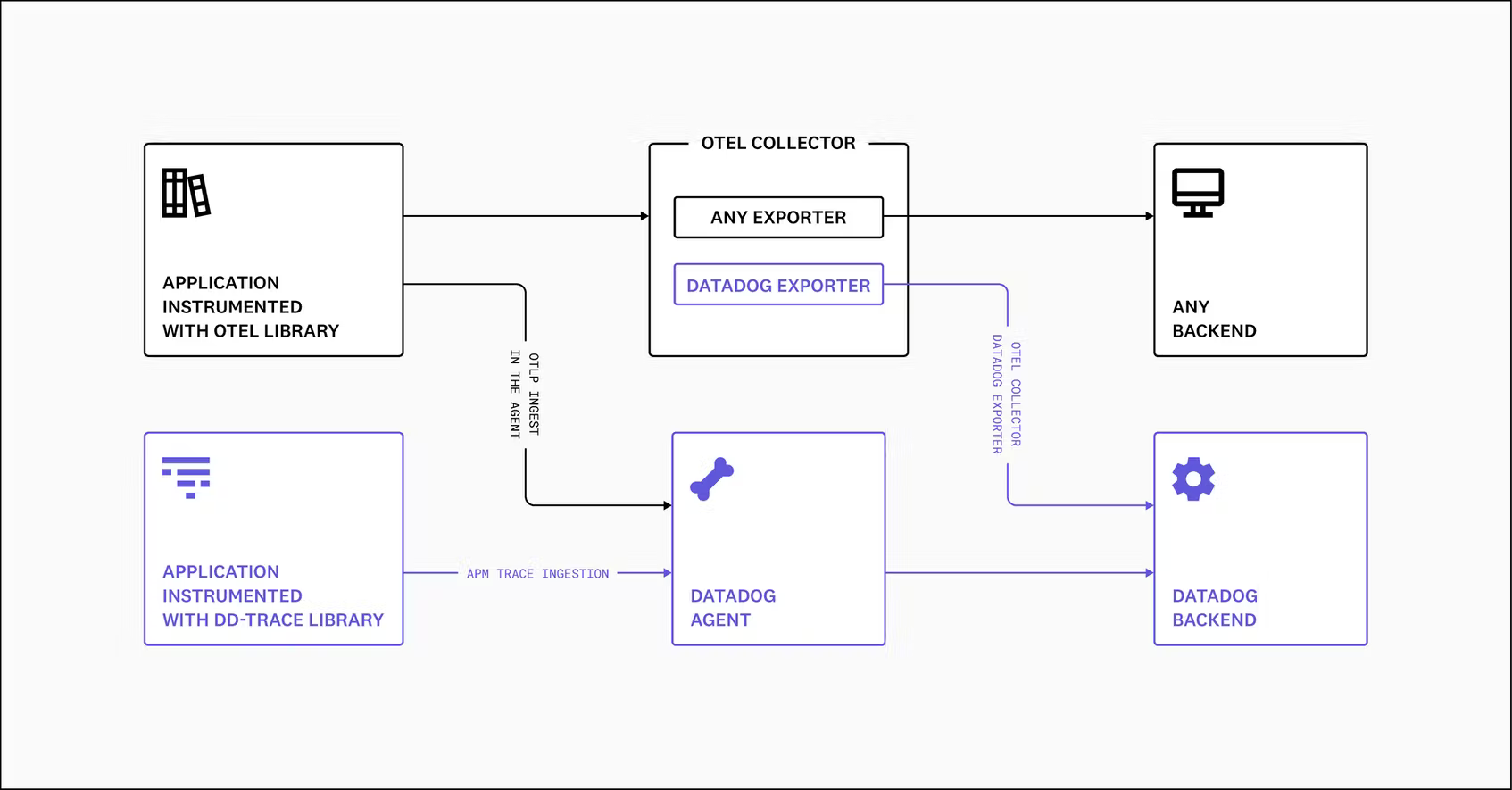
    At the KubeCon + CloudNativeCon Europe 2022 event, Datadog announced it made support for the OpenTelemetry Protocol (OTLP) generally available in the agent software it provides to instrument applications.

    Ilan Rabinovitch, senior vice president of product and community at Datadog, said that capability eliminates the need to install a separate OpenTelemetry collector to aggregate metrics, logs and traces from applications instrumented using the open source OpenTelemetry libraries being advanced under the auspices of the Cloud Native Computing Foundation (CNCF).

    The Datadog Agent can already collect application profiles, network data and infrastructure metrics via more than 500 integrations provided by Datadog. OpenTelemetry extends that capability with a set of application programming interfaces (APIs) and a wire protocol for instrumenting applications.

    Datadog is the latest in a series of providers of observability platforms that added support for the OpenTelemetry project that continues to gain momentum. The goal is to make it less costly to instrument applications using open source agent software that surfaces a consistent set of interfaces. Previously, each observability platform provider developed their own agent software that DevOps teams would need to install. Datadog is making a case for agent software that, in addition to collecting data from existing applications, is now compatible with the OLTP protocol created by contributors to the OpenTelemetry project.

    The issue that DevOps teams will need to come to terms with is that while OpenTelemetry agent software is free, many of them have already installed proprietary agent software to instrument applications. That agent software can often provide additional context that is not yet available in OpenTelemetry. History, however, shows that, in time, open source projects with larger numbers of contributors will outpace the ability of any single vendor to innovate.

    One way or another, DevOps teams will be instrumenting more applications as more microservices-based applications are deployed. The dependencies that exist between microservices make it too difficult to manage an application environment without additional instrumentation. The goal within many DevOps teams is to eventually replace the hodgepodge of monitoring tools that track a limited set of pre-defined metrics with an observability platform that not only aggregates metrics but enables DevOps teams to launch queries and surface IT issues before they become a major issue. In some instances, the rationalization of monitoring tools will help justify the acquisition of an observability platform.

    Observability, of course, is one of the core tenets of any set of DevOps best practices. Achieving it, however, has always been a challenge. Rabinovitch said an observability platform that regularly surfaces critical IT issues without requiring DevOps teams to launch queries to search for anomalies will eventually win the battle for observability supremacy.

    In the meantime, there is already no shortage of observability platforms. The challenge will be determining which one enables the highest level of instrumentation at the most reasonable cost.

  • Continuous Delivery Foundation Adds Interoperability Project

    Continuous Delivery Foundation Adds Interoperability Project

    At a CDEventscon event this week, the Continuous Delivery Foundation (CDF) announced it is hosting a CDEvents project through which it hopes to create a vendor-neutral specification for defining the format of event data across multiple services, platforms and systems.

    Andrea Frittoli, open source developer advocate at IBM, co-creator of the CDEvents project and member of the CDF technical oversight committee, said the open source consortium is launching this initiative to foster interoperability across continuous delivery (CD) platforms. In the context of the CDF, that mission spans both continuous integration and continuous deployment platforms that are subsets of CD.

    CDEvents itself is based on an existing CloudEvent specification created by the Serverless Working Group within the Cloud Native Computing Foundation (CNCF). As part of the effort, the CDF has already built a proof-of-concept implementation that enables Tekton pipelines and Keptn orchestration tools for managing application life cycles to communicate over a common event protocol.

    Collecting metrics from multiple DevOps platforms is a challenge because there is no standard for sharing event data. Analytics providers and value stream management platforms that collect metrics need to create connectors for each platform they support. CDEvents would provide a standard interface for collecting metrics from any developer tool or platform. That data would also make it easier to visualize workflows that describe artifacts and their metadata, he added.

    That lack of a common way to describe events means developers not only must constantly re-learn how to consume events, it also limits the potential for libraries, tooling and infrastructure to facilitate the delivery of event data across environments ranging from routers and tracing systems to software development kits (SDKs).

    Naturally, it may be a while before this continuous delivery specification results in increased interoperability across DevOps environments, but the need for one across what has become a patchwork of fragmented tools and platforms is self-evident. Many organizations are already investing in an assortment of analytics tools in the hopes of improving the rate at which applications can be developed and deployed. In too many instances, DevOps teams have inadvertently created bottlenecks that slow down the rate of development. The challenge is that, as new tools and platforms are added to a DevOps workflow, they are not likely to be able to share data with those applications until a connector is created.

    Not everyone, of course, is a fan of having more metrics. The goal should be to coach teams on how to become more efficient rather than implementing a set of draconian mandates. Arguably, such mandates are only going to drive away developers that are trying to strike a balance between coding as an art form and application development as a craft.

    Nevertheless, as organizations better appreciate the critical role software plays in driving business processes, the greater the desire to measure the pace and efficacy of their application development efforts—to justify the levels of investment in software development they are making.