Category: Doin’ DevOps

  • A Year in Review: Top Developer Tools Trends in 2015

    A Year in Review: Top Developer Tools Trends in 2015

    The ability to ship software quickly is now a competitive advantage for every business. As a result, continuous delivery, distributed microservices, containers and asynchronous computing have become the norm.

    With these changes, come new complexities, markets and dev tool players. It’s clear that the biggest levers for business success rely on developer productivity. Great developer tools have a dramatic impact on how quickly and how well software is built.

    Heavybit’s community of developer-focused entrepreneurs, advisors and investors reflect on the major trends of 2015:

    1. Continuous Delivery is Mainstream. “Continuous delivery is starting to become the norm, rather than just the bleeding edge,” says Edith Harbaugh, CEO and co-founder at LaunchDarkly. “Even huge corporations are adopting a release of once daily where they used to be once every three years. They are seeing a corresponding increase in developer productivity and user value.”
    2. Packaged Applications Replaced by SaaS. “In 2015 we’re finally getting the tools we need to orchestrate, monitor, and maintain service-oriented architectures with lots of small, independently controlled moving parts.” Says Ben Sigelman, co-creator of Google’s Dapper distributed tracing system, “The forthcoming architectural decomposition is going to turn software development on its head. Subsystems that used to be integrated as packaged applications will now be integrated as services, and the entire developer toolchain will need to adjust accordingly.”
    3. All Companies Become Software Companies. “Executive teams finally appreciate DevOps as they transition to becoming software organizations. Their competitive advantage is defined by their ability to write better software faster than their competitors,” says Lenny Pruss, Principal at Redpoint Ventures. “Consequently, DevOps and continuous delivery practices are transitioning from being nebulous concepts to actual initiatives that are being put into practice. Almost every organization I’ve talked to is actively re-evaluating how they deploy.”
    4. Modular development is here to stay. Says Bessemer Venture Partners’ Ethan Kurzweil, “Services like npm that facilitate the sharing and deployment of code modules will usher in a new era of collaboration among developers.”
    5. Revenue Traction in Dev Sales. “For anyone selling developer tools, there is a big question of monetization,” says Ian Saunders, CTO and co-founder at BillForward. “These sort of tools were sold as large license deals. The issue with this is that there was friction to upgrade, and a massive push to re-sell product rather than reinvesting in existing product. This area of pricing has seen a lot of traction, allowing developer tool companies to sell their tools in a more modern way.”
    6. Infrastructure as code is all the buzz. “By having your infrastructure as code, it’s far easier to automate builds and deploys and manage change,” says Neil Mansilla, VP of developer relations at Runscope. “The first AutomaCon, an Infrastructure as Code conference, showed that many developers were interested in adopting infrastructure as code but hadn’t put it into production yet, so the trend will likely grow as more developers and companies learn to adopt and implement it.”
    7. Container Category as an Ecosystem. Noah Zoschke, CTO and co-founder at Convox adds, “Everyone is working on building new tools and services for this container future (i.e. Weave container networking and visualization). AWS Lambda looks like a potentially huge breakthrough, eliminating everything about servers and providing ‘magic containers’ that spin up on demand to events.”
    8. Automation no longer requires a Heavyweight PaaS. “Containers are enforcing a uniformity of interface that will allow the types of automation that previously required a heavyweight PaaS, and therefore are opening up new niches and product categories,” says Cliff Moon, CEO and co-founder at Opsee.
    9. Data and Analytics Management Evolves. Says Justin Johnson, VP of developer advocacy at Keen IO. “The conversation is rapidly changing in the data analytics space — from how to aggregate data and make it available for the business to consume, to how to create a robust and fluid data pipeline.”
    10. Distributed Tools Require Greater Visibility. “Developers usually like to build their own tools, but first-in-class dev tool providers remind us that we have better things to do than build outside of our core competency,” says Hiro Yoshikawa, CEO and co-founder at Treasure Data. “As developers increase the number of tools they use, the need for integration and visibility increases. Businesses must integrate data sources (web, mobile, IoT, SaaS) and target systems (databases, CRM, visualization tools, notification systems). As a result, there’s a rise in new tools trying to solve this problem in the data and analytics space.”
    11. Dev to production parity remains challenging. Says Tal Weiss, CEO and co-founder at Takipi, “With continuous integration, you get to deliver features faster and see your code making an immediate impact. The problem is that a fast changing production environment amplifies vulnerabilities. No matter how much time and effort goes into testing and staging environments, your code is really only truly tested in production. This is a problem domain that attracts lots of interest as the answer lies with better tooling.”
    12. Continuous Integration Demands Continuous QA. “Companies who are implementing CI are hitting a bottleneck when it comes to QA. They’ve begun to realize that multiple daily releases require continuous QA practices and tools.” says Fred Stevens-Smith, CEO and co-founder at Rainforest QA.
  • A Force Awakens

    A Force Awakens

    A Force Awakens
    “Star Wars is an Agile software development methodology…Star Wars values rigidity, Spam, fragility, immobility, viscosity, Spam, needless repetition, Spam, and opacity above all other virtues…” – http://bit.ly/1YqhGQG


    Here are some other ROELBOB’s you might like

    RoelBob150x120


    W Edwards Deming Finds His Roots

    The Pink Slip

    Another Pink Slip


    Hot off the Press – Other great devopsy.kinsta.cloud content

    HotPress

    DevOpsSec: 1 in 16 Chances

    CIOs Must Fight for Relevance in Face of Tech Storms

    — ROELBOB

  • The Limits of Project Management

    The Limits of Project Management

    Limits of Project Management


    Here are some other ROELBOB’s you might like

    RoelBob150x120


    W Edwards Deming Finds His Roots

    The Pink Slip

    Another Pink Slip


    Hot off the Press – Other great devopsy.kinsta.cloud content

    HotPress

    DevOpsSec: 1 in 16 Chances

    CIOs Must Fight for Relevance in Face of Tech Storms

    — ROELBOB

  • Wix requires visibility, and insights are the key

    Wix requires visibility, and insights are the key

    One of the key tenants of the DevOps principle is that your environment has to be prepared for anything. If your shiny modern delivery chain does not support the adoption of new DevOps tools, or does not help you learn, and iterate, then it will ultimately fall into the same category of solutions as Waterfall, and will be on a clear path to Legacy.

    (more…)

  • Clarity of Purpose

    Clarity of Purpose

    going-into-sales


    Here are some other ROELBOB’s you might like

    RoelBob150x120


    W Edwards Deming Finds His Roots

    The Pink Slip

    Another Pink Slip


    Hot off the Press – Other great devopsy.kinsta.cloud content

    HotPress

    DevOpsSec: 1 in 16 Chances

    CIOs Must Fight for Relevance in Face of Tech Storms


    — ROELBOB

  • Win – Win

    Win – Win

    Women in Tech


    Here are some other ROELBOB’s you might like

    RoelBob150x120


    A Unit Testing Dillema 

    The Pink Slip

    Another Pink Slip


    Hot off the Press – Other great devopsy.kinsta.cloud content

    HotPress

    DevOpsSec: 1 in 16 Chances

    CIOs Must Fight for Relevance in Face of Tech Storms


    Upcoming devopsy.kinsta.cloud Events

    Events

    Webinar: SecDevOps: The Marriage of SecOps and DevOps

    — ROELBOB

  • Culture, Behavior and Unconventional Strategy Plays a Major Role in Secure App Development

    Culture, Behavior and Unconventional Strategy Plays a Major Role in Secure App Development

    In today’s fast-paced environment, security often plays second fiddle to deadlines. That means software development doesn’t typically get considered when building secure applications, rather it’s the innovations that can be quickly implemented which take center stage. Unfortunately, ranking short term tactical gain over long term vision is undeniably flawed. Doing so ignores the fact that attacks are more sophisticated than ever before, and applications that have security holes have become a key focal point for those attackers because once a vulnerable application is discovered it becomes easier to compromise a wide set of users at once. But change requires more than drastic measures. It requires an unconventional strategy to adjust culture and behaviors throughout the organization.

    Although the tools and practices to build secure, defect-tested software are maturing, most organizations find internal hurdles to be more daunting. Organizational impediments including process, differing software development approaches, and short-term business drivers – like the need to update apps to reflect the latest must-have features and platform support – make it more difficult to effect meaningful change. Those interested in leading secure development initiatives within their organizations face myriad challenges.

    Step out of your comfort zone to influence culture, process and strategy change

    Often, folks who find themselves in the position to step up to the plate and change culture did not initially plan to do so. The developer who is chosen to lead the charge and establish a process that ensures applications are securely built is extraordinarily smart and devoutly technical. In order to begin changing the world, he or she will need to utilize approaches outside of their comfort zone. Success will rely on the acknowledgement that a full frontal assault on the status quo will not do. Instead, hearts and minds must be won. The skill sets that propel developers’ careers forward must take a back seat to the forces of leadership and persuasion, not coercion, which will ultimately affect the cultural shift in an organization’s application development mindset.

    To effectively change the way organizations build software, an enterprise-wide initiative is required – one that accounts for organizational culture at each step. By taking a step-by-step approach, implementing a successful software security initiative does not have to be so daunting. Five proven best practices include taking a disciplined approach by characterizing the landscape, securing champions, defining standards and strategy, executing, and then sustaining the effort. These steps, as outlined below, will help ensure that your corporate-wide efforts to secure applications are as productive as possible.

    Characterize the Landscape – Understand the task ahead and craft a realistic strategy for adoption within your organization. Whether that be identifying your organization’s compliance framework and cultural norms, to artifacts of the software security and what software development lifecycles you have in place. Being able to characterize your existing landscape allows you to fill the gap between policy and practice.

    Secure Champions – Focus explicitly on the fact that you will need clear support of executive sponsors and other key influencers in the organization in order to be successful. While senior leaders may not understand or care about the minutia of software vulnerabilities, they will appreciate the business impact of a data breach with far-reaching cost, reputation or legal repercussions.

    Define Standards and Strategy – You will only have one opportunity to successfully roll out a secure development initiative, meaning you cannot overlook this step. Conduct a risk assessment of applications owned by your organization to identify the most vulnerable applications to provide some qualitative ranking for decision-making. Having a baseline set of practices and procedures that are well thought out, realistically implemented, and reflect what is realistic in your organization is absolutely critical.

    Execution – So you’ve done your homework, secured supporters throughout the chain of command and in the field, and laid out your strategy and goals. Now comes the hard part – bringing the issue of software security to the forefront through innovative awareness campaigns. Remember, it will be important to show quick wins, highlight positive behaviors, and do it over and over again; ratcheting up expectations and software security with each iteration.

    Sustainment – This follows the successful execution of your software security initiative campaign, which can take between one and two years. To ensure your campaign stays fresh and does not lose momentum, a regular, disciplined update of the regulatory framework must occur. In addition, staying knowledgeable about what is occurring within your organization to determine whether there are new technology risk areas emerging in critical.

    Creating a software security initiative is difficult by any measure. From organizational culture or politics to the status quo bias towards meeting deadlines for new features and functionality, there is no limit to the amount of hurdles that need to be overcome. But by demonstrating the importance of looking long term from a security standpoint and winning the hearts and minds of everyone that plays a role, success can be achieved. Organizations that focus only on the tasks ahead of them do not change the world. Long term vision is critical for organizations that endeavor to strategically move, grow and change the status quo.

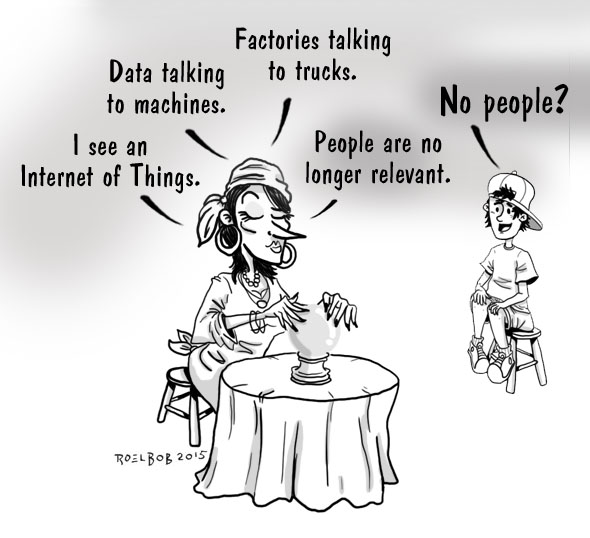
  • The Internet of Things

    The Internet of Things

    Internet of Things


    Here are some other ROELBOB’s you might like

    RoelBob150x120


    A Unit Testing Dillema 

    The Pink Slip

    Another Pink Slip


    Hot off the Press – Other great devopsy.kinsta.cloud content

    HotPress

    Successful technology leaders will embrace the citizen developer

    Your DevOps subculture


    Upcoming devopsy.kinsta.cloud Events

    Events

    DevOps Connect: cdSummit SoCal

    Security automation for DevOps

    — ROELBOB