Category: DevOps Culture

  • What Makes Digital Transformation a Success?

    What Makes Digital Transformation a Success?

    Despite more than $5 trillion having been spent on digital transformation efforts, survey after survey shows that successful digital transformations are far and few in-between. By many estimates, more than 50% of digital transformation efforts failed in recent years.

    While a recent survey conducted by Hanover Research and commissioned by AHEAD, the State of Enterprise Digital Transformation, found that 93% of enterprises are undergoing some digital transformation as they seek to cut costs (77%) and improve customer experience (71%). The survey found 42% of enterprises struggling to reach success as their efforts fall behind or stall.

    This survey found many challenges, both demanding and typical among enterprise digital transformation efforts, including hurdles created by legacy systems (36%) and technical debt (24%). With that in mind, it’s no shock that 67% cited infrastructure as a critical part of their digital transformation efforts.

    Additionally, the survey found that improving operational efficiency and cost-cutting are motivators in 77% of digital efforts. Those needs beat improving the customer experience, at 71% of enterprises.

    When it comes to results, this survey found more optimistic results. According to the survey, 58% of those surveyed said their digital transformation projects are on target or even ahead of schedule, with only 42% citing faltering progress.

    The State of Enterprise Digital Transformation survey found six core factors of success:

    1. Dedicated Leadership: The survey found that 83% of digital transformations that are on track or ahead of schedule are led by a CIO, CEO, CDO or CTO. As digital transformation touches every part of an enterprise, the company-wide buy-in is critical. While 27% of organizations have a CIO leading their transformations, only 8% of organizations have a chief digital officer leading the transformation efforts. Chief technology officers are leading the efforts at 16% of organizations.
    2. All-In Approach: Transformations that are on track are 30% more likely to be structured as full-scale change initiatives. Because digital operations are often so interconnected, piecemeal and partial transformations can often be siloed and result in limited impact on the factors driving the transformation.
    3. Defined Digital Roadmap: Ninety-two percent of transformations that are on target or ahead of schedule have a defined strategy and roadmap that includes IT infrastructure and operations.
    4. Alignment Between Infrastructure and Apps: Enterprises powered by an integrated DevOps approach are 43% more likely to see success in digital transformation efforts. To avoid bottlenecks, enterprises should audit DevOps functions before undergoing digital transformation.
    5. Platform Mindset: Businesses that include IT infrastructure as a big part of their digital transformation are 36% more likely to have a successful transformation. As the backbone of a digital change initiative, an enterprise’s infrastructure determines how far the transformation will go and its limits.
    6. Commitment to Intelligent Operations: Companies that monitor IT performance in real-time and remediate issues quickly are 24% more likely to undergo a successful digital transformation. Further, the survey found that enterprises are more likely to see success in digital transformation if they have confidence in their abilities to perform highly in areas of automation, monitoring, hybrid cloud models and integrated security.

    Last year, in Digital Transformation: Coming from Behind, we cited research from the consultancy McKinsey & Company found that less than one-third of transformations are successful. While this survey from AHEAD finds more optimistic outcomes, most previous surveys and our interviews with transformers echoed AHEAD’s survey findings, with the need for leadership, dedication to platforms, defined strategy and proper alignment all being essential to success.

    The State of Enterprise Digital Transformation survey was conducted by Hanover Research through September and October 2019. The survey is based on the responses of 293 IT decision-makers with a direct influence on IT spend at companies based in the U.S., and with more than 1,000 employees.

    — George V. Hulme

  • Collaboration Over Competition: How Companies Benefit from Open Innovation

    Collaboration Over Competition: How Companies Benefit from Open Innovation

    More and more technology companies are adopting open innovation initiatives. This is largely due to the realization of the benefits of working with outside experts to gain external perspectives and insights. This situation wherein an organization thinks beyond its internal resources for innovation and collaborates with external resources is known as open innovation. Open innovation is an opportunity for the company to utilize those external ideas and use them to develop innovative products and services. It may seem simple, but there is more to the collaboration process than just brainstorming.

    Open innovation is not easy, but the benefits are well worth the effort. Large technology organizations can establish a competitive advantage by partnering with promising startups. The startups benefit from this partnership by gaining access to venture capital resources, networking opportunities and the opportunity to reach a broader customer base, typically tied to a large company.

    Larger companies that typically change at a glacial pace can learn from their small yet evolving partners. Startup founders who are new to an industry can form valuable relationships and gain mentors with seasoned veterans.

    Overcoming Obstacles

    Technology organizations, large and small, should be prepared to make some changes in order to benefit from an open innovation environment. Indoctrinating an attitude of information sharing can be difficult in companies that have historically kept their intellectual property under wraps, and in many companies, even developing a collaborative environment across various departments can be an uphill battle.

    Breaking down barriers and overcoming this predisposition toward secrets is the only way to cultivate a collaborative environment. Ultimately, this effort begins in the boardroom. Once a large company has executive buy-in, the idea will begin to trickle from the top down, and over time it will take hold.

    The following steps will serve as important guidelines to tackle obstacles and sustain this synergy.

    Create Ecosystems Around Intellectual Property

    It is common for both parties to feel the need to protect their intellectual property, but that closed mindset defeats the purpose of an open innovation initiative. To overcome this obstacle, it is critical to emphasize the greater value and benefits that come from an open innovation ecosystem. All parties must realize that sharing their intellectual property into the ecosystem can accelerate the pace of innovation.

    Several companies have demonstrated the value of this approach. Tesla, for instance, made the decision to open source its patents a few years ago, recognizing that the company couldn’t make electric cars fast enough to slow the global carbon crisis. Elon Musk also pointed out that patents represented a small protection indeed against a determined competitor, and he thought the decision to open source would strengthen the company’s position.

    Assess Your Partners

    Adding a collaborator to your open network should not be a decision that is made lightly. The organization should be patient and cautious when selecting a potential partner. Weigh each company’s skills and capabilities and consider any disadvantages as well. Just because a partner is not perfect does not mean it is not the best choice, but knowing its weaknesses will help you address them before they become a problem.

    An organization should be assessing several prospective partners. Establish processes that ensure each potential collaborator is examined fairly, but critically so that the end goal to identify the companies that will not be a good fit is achieved. This practice is not just for your benefit alone—an unproductive collaboration can incur in heavy costs and wasted time to all parties involved.

    Adjust Business Models as Necessary

    Business models are designed to maximize benefits and minimize risks, but they should allow for some flexibility. In the real world, changes arise frequently, and business models must adapt. For instance, many partnerships established around open innovation initially began between two companies. Over time, it is a reasonable expectation to anticipate other players be added to the mix.

    A multi-dimensional ecosystem demands a different business model than a version that is two-dimensional because it may involve a different set of risks. It also has a more complex intellectual property pipeline where contributions and evolutions are more difficult to track and manage. As long as each partner is prepared to adjust business models, these changes can be effectively addressed.

    Foster a Collaborative Culture

    For the vast majority of companies, open innovation is not an organic process. Even within an organization, some departments tend to be closed off about their projects or even sharing information outside the company. An attitude of open innovation comes from internal change, and people are naturally resistant to change. To encourage a culture-shift, start from the top down.

    Support from leadership is critical for developing a culture that is compatible with open innovation. It is also important to identify the soft skills that a team needs to accomplish its goals. Open innovation itself is a skill that can be taught—problems arise when company executives expect it to be a trait that employees are inherently born with.

    There are numerous benefits of open innovation. Technology companies can produce more ideas in a shorter span of time mutually benefiting all businesses involved. There is an opportunity to create markets that did not exist prior to the development of the initiative.

    Of course, obstacles are also inevitable and more so because sharing valuable intellectual property outside the confines of a research and development department is always looked down upon. People, and business models, are naturally resistant to the significant change that comes with the open innovation approach. Whether a company can overcome these obstacles and see the many advantages is a matter of determination and a desire to adopt company-wide changes so that there is innovation across the organization.

    — K.R. Sanjiv

  • The Fallacy of Move Fast and Break Things

    The Fallacy of Move Fast and Break Things

    Ever since Mark Zuckerburg uttered the phrase “move fast and break things,” it has become the motto of many development teams. Companies wanting to be the next unicorn decided this must be the way to operate. The race was on to release more, ship faster, never stop. If moving slowly and methodically wasn’t working, doing more had to be the key to success.

    These companies would cherry-pick statistics from reports such as the Accelerate: State of DevOps Report. The 2019 report showed elite companies have 46 times more frequent code deployments than low-performing teams and a 2,555 times faster lead time to move from code commit to deploy to support their initiatives to move faster.

    The problem is moving fast doesn’t work across industries or for all teams. To effectively move fast, you need processes in place to support the velocity. The consequences of moving too fast and not being able to fix things when they break are high. 

    How We Got Here

    What has gotten us to the point where we are moving too fast? In short, we have. How do you feel when it takes months or a week for a PR to be resolved compared to hours or days?  As consumers and end-users of software, our expectations are continually rising. We have to ship quickly because that is what we as consumers expect. As customers, we are pushing companies, which in turn push their employees to meet the increasing expectations.

    What are the consequences when you try to move fast and not just break things, but fail? 

    • It takes longer to resolve incidents.
    • You lose customer confidence and sales.
    • Employees burnout and you have a high turnover rate.

    Let’s go back to the stats from the Accelerate: State of DevOps Report. Yes, elite teams ship faster. But, their changes are 1/7 as likely to fail and they recover from incidents 2,604 times faster than low-performing teams. It’s not just about moving fast and breaking things; it is about having the right systems and processes in place to support this way of working.

    Setting Yourself Up for Success

    You need two things to effectively move fast: a culture of psychological safety and smart investments in tooling. Employees need to feel empowered to speak up if things are moving too fast, if they are concerned about why a feature is being built and to identify gaps in the processes. They need to feel they won’t be blamed when something breaks. Building this requires empathy, open communication and teamwork.  This psychological safety is the foundation of being able to move quickly and quickly recover when things break. 

    Next up is selecting the right tooling and processes. Invest in tools that make things easier. Tools should be useful, usable and change the underlying problems, not create more. 

    Think about the tools in place to quickly resolve incidents when something fails:

    • Observability and monitoring tools to identify and notify when things go wrong.
    • Incident management tools to route, track and escalate issues.
    • Feature management tools to enable circuit breakers and load shedding to turn off features quickly. 

    The culture and tools are part of the equation; the final piece is having the right processes in place to effectively use the tools and support the people. 

    What are some processes you can implement to enable safety at speed?

    You should attempt to move fast, you should try to break things—but only when you have the right protections and processes in place. Using a combination of the right tools and processes, you can deliver more value faster without sacrificing quality or your employees’ health.

    — Dawn Parzych

  • How Integration Can Keep Up with Digital Demands

    How Integration Can Keep Up with Digital Demands

    Integration holds the key to accelerating innovation, but in many organizations, business systems and application integrations haven’t kept up with the demands of digital. Data still exists in a siloed blend of on-premises systems and unconnected cloud applications, and IoT has added another layer of complexity into the mix.

    Understanding the three trends below, and how to leverage them, will help organizations continue to drive innovation for years to come.

    The Rise of the Integration of Things

    It’s no secret that the adoption of IoT is increasing, generating massive amounts of data from devices and sensors. As the number of devices increases in response to the explosive growth of IoT, the amount of data increases exponentially. This explosion of devices–and its associated data–is driving the need to leverage that data for the benefit of the business, such as improved customer experience, cost and downtime reductions or efficiency and productivity gains.

    Integration is the key piece that will enable businesses to get control of this data and put it to work. Without the right integration tools, it’s only possible to leverage IoT at specific levels. Essentially, integration provides the ability to connect the data from IoT devices and enterprise applications, orchestrate workflow and enrich IoT data with contextual information from other systems for better decision-making.

    Organizations can even use integration to link IoT platforms together for a comprehensive view of data, analytics and actions–making it easier and quicker to analyze, draw conclusions from and determine how to use the data. On top of this, they can also create complex and sophisticated responses when something goes wrong by leveraging automated integration workflows.

    As we continue to connect our devices, the Integration of Things will be as important as the Internet of Things.

    Blurred Lines Between Application Development and Integration

    For cloud applications to survive and thrive, they require built-in integration with other apps and data sources. Otherwise, users are constantly switching contexts from one tool to another when trying to complete a task, and content is scattered across the organization in multiple applications and departments. Because of this, the lines between application development and integration will blur as apps are compelled to have integration embedded under the covers.

    There will be many benefits to this. First, organizations will easily create and deploy integrations directly within their products, fully baked into the user experience. These in-app integrations to third-party sources will unlock additional capabilities for users, empowering them to do more.

    Second, building integrations without the right tools and specialized integration know-how requires a lot of work. Embedded integration eases the pain of monitoring API changes and documentations so that maintenance is smoother and cheaper.

    Finally, business services can involve complex interactions with cloud apps and data that require ordering, have dependencies or may even need to be reversible on demand. Organizations can handle these sophisticated jobs by leveraging advanced integration orchestration to manage app interaction–meaning that instead of using manual code for complex data mapping, they can create a visual drag-and-drop data flow. 

    AI Powers Smarter APIs

    Businesses have already been leveraging intelligent automation to improve operations, drive innovation and personalize the customer experience. As we head into the new decade, API management will harness the power of AI with innovative ways of protecting and controlling APIs and the applications they serve.

    Service mesh, an increasingly popular way of discovering and observing services in distributed networks, will evolve into app mesh, an application-aware model of monitoring, managing and securing your APIs. API policies will be able to reconfigure dynamically based on traffic, security threats and identified patterns. Additional layers of defense will come from bots deployed in an organization’s network to constantly monitor behavior and these bots will use machine learning to improve automated threat responses for APIs.

    The integration landscape is changing, but understanding how to harness these trends will ensure organizations are well-equipped to take advantage of evolving technologies for innovation.

    — Ann Marie Bond

  • SauceCon 2020 Speaker Profile: Dylan Lacey

    SauceCon 2020 Speaker Profile: Dylan Lacey

    This is the third in a series of articles highlighting speakers at SauceCon 2020. SauceCon brings together the global community of Sauce Labs users and continuous testing experts to learn from each other and level up their automated testing and continuous delivery skills. This year’s event will be held April 27-29 in Austin, Texas, and DevOps.com will be there, broadcasting live.

    Software engineer Dylan Lacey works on the Sauce Labs support team, helping customers solve problems and troubleshoot integrations and test failures. And, as an avid home cook, he loves creating and transforming ingredients.

    One area of testing where he sees a need for transformation relates to test naming.

    “Working in support means that not only do I see a ton of tests, I get to see a ton of malfunctioning tests,” said Dylan. “Many customers are surprised to learn how much they stand to gain by better identifying and managing tests.”

    Dylan explains why this is important.

    “There are so many badly named tests that affect so many customers,” explained Dylan. “Test names with massively redundant data. Test names with no identifying information. Tests without names. Tests with super long names. I’ve seen it at every size of enterprise and every level of test complexity, and it causes customer frustration every time.”

    At SauceCon 2020, Dylan will attack this issue head-on with his session entitled “What’s in a Name? Metadata for Fun and Profit.” Attendees will come away equipped with practical information about what makes great test names, skills to think more critically about test failures and suggestions for using Tags, Build IDs and custom data to help them organize and share tests.

    “Even if attendees leave feeling guilty about their metadata, I hope they’ll be equipped and excited to fix it,” said Dylan.

    When he’s not working, Dylan has an impressive list of hobbies and leisure activities. He loves cooking, has a tragic amount of cookbooks and even cooks live on Twitch twice a week. He also keeps bees, makes his own mead and cheese, writes short stories and is an amateur leather worker.

    You can hear from Dylan and more than 30 other expert speakers at SauceCon 2020, the fourth annual Sauce Labs user conference. To see a full list of presentations or to register, visit the SauceCon website.

    — Rebecca Cramer

  • Positioning Compliance as a Differentiator

    Positioning Compliance as a Differentiator

    As the threat landscape has become more perilous and complex, regulators have imposed a wide array of mandates designed to protect sensitive personal information. For most organizations, compliance is seen as the cost of doing business. However, if executed strategically it can not only improve a company’s overall security posture but shortens sales cycles and open the business to new markets.

    In order to turn compliance from a check-the-box line item into a valued business initiative, businesses need to identify all global, local and industry regulations that apply to their business and, also, strategically implement the processes and technologies that keep them compliant. Whether you’re targeting specific industry verticals or going after international customers, entering new markets requires continuous education about the latest in compliance and regulatory standards as they relate to data privacy and security.

    A good way to get started is to put together a roadmap for how you will get, and stay, compliant with the regulations relevant to your business. What follows is an outline of such roadmap.

    Start with the Basics

    When you’re building a house, a foundation is the key to a safe structure. This holds true for building a compliance roadmap for an IT infrastructure.

    The first step is to ensure the infrastructure is configured in accordance with Center for Internet Security (CIS) benchmarks. If operating in Amazon Web Services (AWS), ensure all AWS best practices are met. Setting this foundation will help meet basic security and compliance requirements and will simplify the compliance journey from the very start.

    Once the foundation has been set, it’s then time for the compliance, IT and security teams to determine which regulations apply to their business. This is the backbone of the compliance roadmap. The good news is that many of these regulations overlap so businesses can complete requirements for multiple regulations at the same time.

    First Stop: SOC 2

    As a component of the American Institute of CPAs Service Organization Control reporting platform, SOC 2’s goal is to ensure that internal IT systems are configured for maximum security, emphasizing the privacy of customer data. It’s specifically designed for service providers storing customer data in the cloud, and this means it’s becoming increasingly relevant as companies continue their cloud migrations. SOC 2 goes beyond a simple technical audit though, requiring businesses to establish and follow stringent security policies and procedures that encompass the security, availability, processing integrity and confidentiality of any data stored in the cloud.

    In order to achieve SOC 2 compliance, the organization first will need to establish an understanding of what normal looks like in their environment. It’s critical to baseline typical activity in order to be able to monitor for anomalies. This enables detailed audit trails that allow for deep, contextual insight into root cause, allowing organizations to remediate issues and thus keep up with SOC 2 requirements.

    The Roadmap Focal Point: GDPR

    The General Data Protection Regulation (GDPR) brought compliance into the mainstream. When GDPR passed, it established strict regulations for how organizations with European customers must handle customer data. The regulation is so broad, stringent and complicated that it has motivated many tech companies to create new job titles to ensure compliance.

    However, while there have been strict compliance regulations before, it’s the high financial stakes attached to GDPR that set it apart. A business can be fined up to 4% of its global revenue if it’s found to be non-compliant. Very few organizations can afford to take that kind of hit which is why so many make it the centerpiece to their compliance strategy.

    The privacy implications of GDPR are extensive but one of the most important and challenging requirements is the data breach notification. Organizations must notify authorities or specific data subjects within 72 hours of a breach. Most organizations are unable to locate sensitive consumer information within their environment, making this requirement near impossible. However, if the organization bakes data controls into its systems and enacts continuous monitoring and real-time intrusion detection, it not only becomes achievable but improves internal processes. 

    Go Broad with Certification Add-Ons

    Once you’ve done the basics, like SOC 2 and GDPR, organizations can then begin looking for compliance regulations that they can actually use as business differentiators. ISO/IEC 27001, for example, is a standard that SaaS organizations often use to demonstrate an aptitude for managing information security risks. The regulation formally specifies an Information Security Management System, a suite of activities concerning the management of information risks and lays out an overarching management framework to identify, analyze and address risks. Certification requires a host of documentation, including a clear information security policy, a risk assessment process and evidence of information security monitoring and measurement. The standard spans industry type, organization size and market, so it applies to just about any company.

    Compliance can be a powerful differentiator and business driver that inspires trust and confidence amongst prospects, customers and external partners. Although the above standards and regulations require extensive resources, non-compliance can result in fines and other punishment that can cripple a company. It’s important to remember that these compliance standards and regulations may have to be revisited, but once put into place and assigned to a dedicated compliance team, the once daunting task pays for itself.

    — Lindsey Hardy

  • Report Finds Faster DevOps Adoption in Retail

    Report Finds Faster DevOps Adoption in Retail

    Conventional wisdom holds that when it comes to any IT advancement, technology companies lead the way followed by the financial service sector. However, Puppet has made available an industry scorecard based on the company’s 8th annual “State of DevOps” survey that suggests that when it comes to DevOps adoption, it’s the retail sector that is now the most advanced.

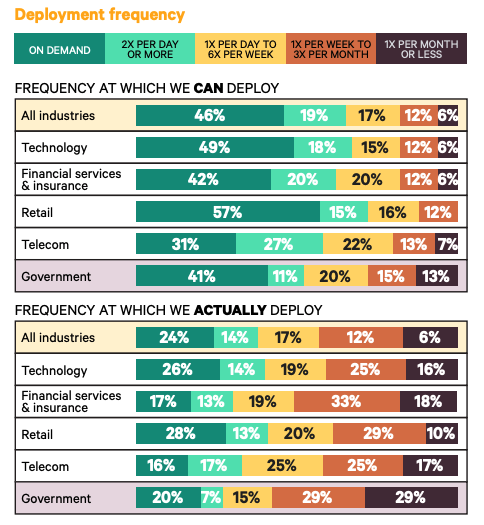
    The survey finds 28% of respondents working in the retail sector said they are deploying on-demand, while 57% said they can deploy on-demand. That compares to 26% doing so in the technology sector and 49% that are capable. In contrast, only 17% of the respondents working in the financial services/insurance sector said they are deploying on-demand, versus 42% who said they are capable.

    DevOps adoptionThe retail sector is also able to resolve critical vulnerabilities the fastest, with 53% reporting they can remediate a vulnerability in less than one day. However, the retail sector also ranks dead last in terms of reported “significant” or “full” security integration (32%).

    Alanna Brown, director of product marketing at Puppet, said the retail sector is embracing DevOps more aggressively largely because of the increased focus on digital transformation. Companies are differentiating themselves more by the quality of the application experience, she said.

    It’s also fair to note that application environments in the financial/life insurance sector tend to be more complex, she noted.

    Of course, DevOps expertise of any one organization in an industry sector is likely to vary widely. However, the Puppet survey makes it clear that the adoption of DevOps is becoming broader.

    In fact, in terms of year-over-year growth, the survey finds the media/telecommunications sector has made the second most progress after retail. The percentage of highly evolved telecom organizations increased by nine points from 8% to 17%. The number of organizations that scored in the low category dropped to 5% from 13%. A large proportion of telecom organizations are embedding a designated security expert in teams while maintaining a centralized security function (41%). However, in terms of DevOps adoption, only 16% said they do deploy on-demand, while 31% said they can. At that rate, that’s even slower than government agencies. A fifth of government agencies (20%) said they deploy on-demand, while 41% said they can. However, only 3% said they are able to remediate vulnerabilities in less than one hour and 24% are able to remediate in less than one day.

    Brown noted that while there is still a lot of room for improvement across all vertical industry sectors, when it comes to DevSecOps there is a definite shift to the left occurring. Many development teams are now designating a cybersecurity expert that advises the rest of the team on security issues versus waiting to engage with a cybersecurity expert from within the central IT organization who has little to no programming expertise.

    It may still be a while before DevOps is adopted pervasively across all vertical industry sectors. In the meantime, however, it’s clear that DevOps progress is finally starting to accelerate.

    — Mike Vizard

  • Multi-Cloud Adoption to Better Enable the Developer Workforce

    Multi-Cloud Adoption to Better Enable the Developer Workforce

    Over the past decade, we started to see a broader shift toward the use of multiple cloud providers by the enterprise. The need to reduce risk, optimize cloud usage, manage costs and the push to open source and cloud vendor-agnostic technologies are providing more options for developers, which will likely lead to an even steeper increase in multi-cloud usage.

    In 2019, we saw the acquisition of Red Hat by IBM, the largest software company acquisition in IT history, to support both cloud and open source software. This acquisition, and others such as Salesforce/Tableau and Google/Looker, suggest that the trend will continue moving forward. In addition to support from mergers and acquisitions, multi-cloud within companies and use by developers will continue to rise.

    Multi-Cloud to Better Enable the Developer Workforce to Keep Up with Competition

    Multi-cloud architecture allows companies to distribute, move and optimize workloads across multiple cloud environments, decreasing the risks and costs associated with running workloads on only a single cloud environment and allowing one to select the best mix of capabilities for the desired use cases. These benefits make the single cloud option far less popular, and results in more interest in multi-cloud deployments.

    This choice is important–to keep up with the competition, digital businesses across the globe need to make better decisions and deliver faster, smarter actions. They must capture and integrate data in real time from wherever it is located, govern these data assets and augment the intelligence of their business through deep analytical insights. These actions must support both the technical and business levels of the enterprise, and developers must be armed with the right tools to enable these capabilities. A multi-cloud strategy ensures that this is possible, and offers the greatest degree of flexibility and choice when it comes to building solutions.

    To further support this shift, it is important to provide developers with the flexibility to choose best-of-breed solutions in order to streamline their processes. Limiting developers to one cloud vendor can restrict them from using the best tool for the job and result in suboptimal cloud deployments. But with a multi-cloud approach, developers can create their own individualized arsenal. Executives, who expect the best from their developers, have to pursue a multi-cloud strategy in order to get the most reliable and fastest results for their business. 

    Industry Insights for Mature DevOps Teams 

    Last year, IBM released research that showed that 85% of the companies surveyed were already multi-cloud adopters. Approximately 39% of those companies have implemented DevOps processes, and 41% have a multi-cloud management strategy. Clearly, multi-cloud is important to the strategy of an organization. 

    As pointed out, in order to be successful with a multi-cloud strategy, one of the key issues for developers to tackle is the creation of strong, automated DevOps processes. These processes must bring structure to a multi-cloud computing ecosystem. According to 2019 research from GitLab, overall DevOps adoption is on the rise, and teams that have successfully implemented a mature DevOps program are seeing major improvements in their workflow. In addition to speed, mature DevOps teams are almost 1.5 times more likely to feel innovative and are three times more likely to discover security vulnerabilities earlier in the pipeline.

    Future of Multi-Cloud Adoption and Impact

    Moving forward, we will see more companies adopt multi-cloud strategies and developers will be among the groups that are most impacted by this approach. For developers, multi-cloud adoption involves matching the business case for certain problem sets to the appropriate cloud providers so the expected ROI can be achieved with the right technology blend. 

    Developers need the right tools to develop, test, support, manage and monitor the deployed solutions consistently across cloud providers. Over time, it may also be necessary to move the solutions from one vendor to another as the requirements, business landscape and cost justifications change. Thus, developers must work within the organization to evaluate and choose the relevant features from each vendor, augment as necessary with external tools and regularly monitor industry trends and capabilities to transition if needed. This is the flexibility that a multi-cloud approach brings, but it must be balanced with the strategy, business and financial needs of the organization.

    The cloud will continue to be a strong technology focus area for enterprises and developers across the globe. Cloud adoption strategies will continue to broaden and shift toward multi-cloud as needed, allowing developers to streamline their processes, select the best tool for the job and create more value for their company as a whole.

    — Nelson Petracek

  • SRE Is the Most Innovative Approach to ITSM Since ITIL

    SRE Is the Most Innovative Approach to ITSM Since ITIL

    For over a decade, ITIL has been the leading ITSM framework adopted by enterprises across the globe. So, what is driving a rapidly increasing interest in Site Reliability Engineering (SRE) as a service management alternative?

    In its own words, Google refers to SRE as its approach to service management: “The SRE team is responsible for the availability, latency, performance, efficiency, change management, monitoring, emergency response and capacity planning.”

    In traditional ITSM terms, the role of the SRE is responsible for service level, change, availability, event, incident, problem, capacity, performance, infrastructure and platform management. While the operational practice areas may be similar, there are significant differences in how the practices are approached.

    ITIL4 Framework Compared to SRE

    Released in 2019, the newest update to ITIL4 remains a complex governance model with four dimensions, seven guiding principles, a Service Value System and 34 processes (now renamed as practices). While ITIL4 pays homage to Agile and DevOps, there is little depth in the publications released to date—to be fair, several other publications in the series are in queue  for gradual release. The framework spans just about every aspect of software delivery and operations and seemingly is trying to be the single source of truth in both principle and practice for IT management.

    SRE Is More Closely Aligned to Agile and DevOps

    By comparison, SRE focuses specifically on the reliability and resilience of complex production system operations. As an engineering discipline, SRE more closely aligns with the Agile and DevOps patterns that are being adopted by product development teams including continuous integration, testing, delivery and deployment. SREs bring the wisdom of production into the teams thereby breaking down many of the silo walls that have impeded IT for so long.

    As a service management alternative, SRE also updates traditional ITSM activities with innovative and self-organizing concepts such as management to service level objectives, error budgets, toil reduction, release engineering, monitoring/observability and embracing risk as neutral approaches to service management. The core SRE book provides practical and actionable guidance for Site Reliability Engineers on managing incidents, learning from failure, testing for reliability, load balancing, handling different types of emergencies, software engineering and capacity planning. Related publications such as the Site Reliability Engineering Workbook and Seeking SRE provide additional insight.

    Most importantly, a Site Reliability Engineer is an actual hireable job with a defined role, set of responsibilities and skills. SREs and SRE teams are encouraged to be creative, accountable and must spend 50% of their time reducing toil by engineering automation in order to make tomorrow better than today. Like Agile and DevOps, SRE supports self-regulation with policies and consequences. In fact, some consider SRE to be the third piece of the Develop (Agile), Deploy (DevOps), Operate (SRE) feedback loop.

    What This Means for the “Humans of DevOps” in Operations and ITSM

    SRE is breathing new life and opening new career paths for operations and ITSM professionals who a few years ago were battling against the mantra of “NoOps.” According to Linkedin’s 2020 Emerging Jobs Report, SRE is the fifth fastest-growing job role with 34% growth.

    Services will always need to be managed. However, competing in a digital age requires new ways of working and thinking with speed and quality as key metrics. Agility must be instilled across the value stream spectrum in order to increase flow and deliver an exemplary customer experience. Your organization may not be as complex as Google’s, but the principles and practices of SRE are applicable to all environments.

    You can read the Site Reliability Engineering and Site Reliability Engineering Workbook publications for free from Google. For those wanting to learn more about the practices and patterns associated with SRE, DevOps Institute recently released its Site Reliability Foundation certification with accredited training being offered globally by its Global Registered Education Partner network. Either way, if you are an operations or ITSM professional, I would highly recommend learning more about SRE. It is the future of ITSM as we cross the digital divide.

    — Jayne Groll

  • Implementing DevOps Goes Beyond Technology

    Implementing DevOps Goes Beyond Technology

    The implementation of DevOps is primarily toward a change of process. All you need is to break down the feed store and bring in the competing individual inducements to acquire the actual benefits from DevOps. Regarding the change of process, it will either be embraced by those who are making the change and succeed, or it will get rejected and eventually fail.

    The hardest part of successful DevOps is not the implementation of technology but much beyond it. It is understood that without technology, you can hardly enforce the DevOps culture. The technology side is all about automation, focusing on the infrastructure in the form of codes and establishing the pipeline process.

    A survey found that among more than 2,000 of the IT industry executives, 54% of the respondents believed they had no access to self-service infrastructure; instead, they take some ticket-based approach toward infrastructure delivery. This also impacts productivity and increases time to market. The survey noted that only 23% of the experts said that infrastructures could be delivered in less than 24 hours. However, some 33% said it takes up to a month to give, while 26% responded it takes one month or more to do so. 

    Speaking in terms of technological perspective, we’re well aware of the fact that DevOps targets to achieve complete automation and integration, but practical implementation is not entirely possible. Establishing new aspects has been a great struggle, even if it is related to replace specific traditional methods with some new ones.

    Mentioned below are the best answer to why implementing DevOps goes beyond technology. Let’s discuss them one by one. 

    Lack of Proper Vision

    Without having a proper definition of the issue or solution, it becomes challenging to form a vision. Therefore, when experts become familiar with the process, they begin to follow a specific path to manage things in the correct order. Even though at some point they become stuck in the circle, too.

    With time, it becomes difficult to get out of this vague circle, be more responsive to current situations and discover new methods for betterment all at the same time.

    Without having a proper plan, it becomes not tricky but merely impossible to achieve some productive output. The lack of vision makes it challenging for the project owners to design a clear-cut plan when it comes to deciding milestones and deliverables.

    The industry experts find it a bit risky because there are honestly few people who possess skills and expertise in this domain when compared to the number of tools present in the market. This also gives rise to confusion, which ultimately leads to an increase in the risk factor.

    Cultural Defies

    Another significant challenge is the removal of traditional methods and to adopt new ones. Undoubtedly, people are more comfortable when they follow conventional techniques as long as the outcome is useful toward the end of the day.

    However, if the outcome is not what you’ve desired, or if you start realizing that your job requires various manual interventions, then it would be good to understand that this can hinder your overall productivity and leads to adverse effects in the long term.

    Absence of Tool Knowledge

    Previously, DevOps has introduced the principles of continuous deployment, testing and collaborative reporting. But, since most of the people prefer to continue working with traditional tools, adapting to the functionalities of the latest tools becomes a difficult job. This happens more when it comes to getting a hold on the changes made to the architecture based on cloud and on-premises during the entire process.

    Lack of tool knowledge leads to organizations making poor choices of tools.

    Risk Analysis

    It is challenging to alter old methods and techniques and get them replaced by the latest ones. While implementing DevOps, when it comes to risk analysis, business experts design their dashboards by scaling hundreds of different reports. It is based on calculations and most of the time, it is quite easy to start but hard to climb. It happens when things are being put into action. The workers face troubles in keeping up with the pace. Therefore, adopting the latest methodology involves risks to a significant extent.

    Ways to Minimize These Challenges

    After doing research, I have come up with six best ways to minimize these issues and increase your chances of DevOps success. Let’s discuss them.

    Boost Up Productivity

    As mentioned above, no proper vision is a severe issue, and it also leads to poor and low levels of productivity. With new IT services coming in the market, people will understand the need for shaping their vision. It is crucial because only then they’ll be able to compete in the marketplace. DevOps comes with specific tools ranging from automation to monitoring. These tools can boost up the functions of an organization. An organization can unlock benefits from these automated tools so their developers can have a lighter load. This reduces time on deployment and by default, errors and mistakes are reduced too, which results in more productivity.

    Encourage Diversity

    DevOps successfully brings people together from different backgrounds and with different skillsets, and it delivers the results when this diversity is embraced. Having diversity in a DevOps team leads to higher productivity. This is extremely important with the rise of full-stack developers and the need for every individual to possess a variety of skills.

    Learn From Mistakes

    In the slow-moving model of working, people get afraid to accept they’ve made a mistake or even share any lessons they’ve learned while committing an error because it’ll directly affect their career. In the DevOps world, it is believed that by sharing those experiences, you are encouraging innovation. DevOps often calls for identifying mistakes and ask everyone to consider it as a learning opportunity, instead of an issue to be blamed. The perfect approach is to embrace mistakes and make improvements.

    Review Security Practices

    Security is essential in DevOps implementation. If the developers fail to enforce proper security practices, then they’re solely responsible for the effects afterward. By implementing automated tools or software security services early in the development cycle, teams can test the code throughout their software development process. Also, developers must ensure the presence of security elements while they deliver software timely.

    Focus On the Usage of New Tools 

    The introduction of new tools has speed up the adoption rate of DevOps, and now it has become vital to ensure that these tools are correctly integrated within the existing infrastructure and meet all the security levels. But, much focus should be on the team rather than on devices because workers are the essential faction in the shift of DevOps.

    Educating and Training the Staff

    This area needs serious attention. It is crucial to conduct weekly seminars and training sessions to educate the employers on new methods and tools they might be using in the development process and prepare them for new challenges. This will not just boost up worker’s knowledge but will also foster DevOps success.

    Final Thoughts

    Successful DevOps implementation is not an overnight project. The entire process requires advocacy, time, effort and strong leadership in a way that is compatible with your organization’s goals and objectives. Prepare yourself for achieving DevOps success by overcoming the challenges and hurdles that were made by the people that came before you.

    — Farwa Sajjad