Category: DevOps Culture

  • Rails 7 FTW | WFH is SOP | 586M Passwords Dumped

    Rails 7 FTW | WFH is SOP | 586M Passwords Dumped

    Welcome to The Long View—where we peruse the news of the week and strip it to the essentials. Let’s work out what really matters.

    This week: Ruby on Rails 7.0 is go, working from home is still de rigueur, and HIBP gets far, far bigger.

    DHH is Excited

    First up this week: Ruby on Rails version 7.0 is now in production. It promises less bloat, better security and even more developer efficiency.

    Analysis: Last chance for greatness

    Talk to devs about Ruby on Rails and you’ll hear a wide range of opinion—all the way from “obsolete memory hog” to “productivity secret weapon.” But its important promise seems to be to encourage devs to use better design patterns.

    Paul Krill: Ruby on Rails 7 rejiggers JavaScript support

    Ruby on Rails 7, the latest version of the web application framework, is now available as a production release. … It gives developers a “no-Node” approach to front-end development while still providing access to NPM packages and modern JavaScript.
    …
    Most Rails applications will not require Node.js, given the new defaults. … Other improvements:
    …
    Encrypted attributes have been added to Active Record, enabling applications to offer at-work encryption in addition to traditional at-rest and in-transit. … With asynchronous query loading, two unrelated queries can be run concurrently. … The Spring application preloader is no longer on by default, as faster computers have made it unnecessary.


    Let’s hear from Rails creator David Heinemeier Hansson—AKA DHH:

    Seven is … the culmination of years of progress on five different fronts at once. … The part that really excites me … is how much closer it brings us to the ideal of The One Person Framework. A toolkit so powerful that it allows a single individual to create modern applications upon which [to] build a competitive business.
    …
    It’s been well over twenty years for me now, and a big release like this still makes me giddy. … What a glorious time to be working in web development.


    What a whatnow? Here’s bb_matt:

    I don’t pretend … it’s a “glorious time to be working in web development,” except for one important aspect: … Experienced programmers coming over from software development and starting to make amends [with] strong typing, robust CI/CD, a focus on TDD, a focus on domain modeling.
    …
    99% is still total **** though—but then again, so is most software.


    Home Working Ain’t Gone Away

    A month ago, my long-suffering editor permitted me to write, “WTH? We Wanna WFH.” And survey after survey says tech workers work better at home. After the last 21 months, there’s simply no denying it.

    Analysis: Genie out of bottle—no going back

    If you’re under the misapprehension that DevOps is somehow “special” and your workers will be glad to return—think again. Find a way to make it work, or work will stop—and your business will die.

    Steven J. Vaughan-Nichols: How to lure employees back to the office? You can’t. Not now. Not ever.

    Months have gone by, and the great resignation keeps rolling along. … People don’t want to catch COVID-19 [but] bosses still think they can force skilled workers to return to offices. … That’s not going to happen.
    …
    The problem? Many executives and owners haven’t gotten the clue yet. [But] any doubts you may have about people not doing a good job unless you’re looking over their shoulders should have vanished by now. … The monthly academic WFH research.com survey has found almost six out of 10 workers reported being more productive working from home. … In the Dice State of Remote Work report … 53% of technologists listed greater productivity as one of the main benefits.
    …
    It’s simple: It works better for them and for your company. … Anyone who’s been paying attention … must agree. You can either go along with the flow, or you can fight it and first lose your staffers and then your company


    So what do DevOps managers think? One of them is kozikow:

    100% remote is not great either. … When there was a long period of 100% remote during Covid, there were some issues. … We developed a policy that Mondays are required, Wednesday are encouraged, rest is work from home. … It was shared decision of the team.
    …
    I think that most people who are strongly against hybrid work just have to live in a miserable place like SF. … It’s unfortunate that so many software companies are in the Bay Area.


    But you couldn’t pay some people enough to go back—people such as this Anonymous Coward:

    No way in hell they’d ever be willing to pay me … to come back into an office. … No having to go out in ****ed up weather, no fighting traffic and … dangerous drivers, plus I get all that commuting time back.
    …
    And I don’t have to put up with Linda cooking fish in the microwave.


    Have I Been Pwned? There’s a 38% Higher Chance

    This week saw a huge bump in the size of Troy Hunt’s already-massive database of stolen credentials. In case you’ve not seen it, HaveIBeenPwned.com is an amazing free service that lets apps securely check a user’s password isn’t already used elsewhere on a compromised site.

    Analysis: Build the API into your auth flow ASAP

    The UK’s equivalent to the FBI has donated a huge trove of credentials—after deduping, it’s added more than 225 million new passwords to the database. Frankly, if you still allow your users to rely on any of the 847 million passwords in HIBP, it would be negligent.

    Simon Sharwood: National Crime Agency finds 225 million previously unexposed passwords

    Troy Hunt, of Have I Been Pwned (HIBP) fame, yesterday announced … the NCA shared 585,570,857 [creds] with HIBP, and Hunt said 225,665,425 … he hasn’t seen before in the 613 million credentials HIBP already stored. [HIBP] lets anyone conduct a secure search of stolen passwords to check if their credentials have been exposed.
    …
    The NCA’s statement to Hunt did not reveal the source of the password trove [but said they] “were able to identify a huge amount of … passwords in a compromised cloud storage facility. … It became clear that these credentials were an accumulation of breached datasets known and unknown.”
    …
    [The] release brings the total Pwned Passwords count to 847,223,402, a 38 percent increase.


    How’s this relevant to DevOps? Troy Hunt explains:

    In the last month, there were 1,260,000,000 occasions where a service somewhere checked a password against … HIBP’s Pwned Password API. … There are all sorts of amazing Pwned Passwords use cases out there. For example … checking their customers’ passwords on every registration, login or password change to see if it’s previously been breached.
    …
    The UK’s National Crime Agency has done some wonderful work over the years to combat cybercrime. … Today’s release is about turning on the firehose of new passwords and making them immediately available to everyone for free. Having this open to the community, owned by the community and supported by the FBI and NCA is an enormously pleasing result.


    Time for a metaphorical thought experiment. LenKagetsu obliges:

    You were told by a reliable source that an unknown person … posted a high-res image of … your house key … on the internet. Would you change the locks?


    The Moral of the Story: Never switch horses in midstream


    You have been reading The Long View by Richi Jennings. You can contact him at @RiCHi or tlv@richi.uk.

    Image: David Emrich (via Unsplash)

  • Bridging the AppSec and DevOps Disconnect

    Bridging the AppSec and DevOps Disconnect

    Research estimates that cybercrime is going to cost the world $10.5 trillion annually by 2025, so it is no surprise that cybersecurity has become a top priority for business leaders. 

    Today, security teams are striving to harden their systems against cyberattacks and improve their resilience through more employee security training, incident response programs and the implementation of technology to monitor and detect threats. 

    Many organizations are also adopting a shift left security strategy, where security is being addressed earlier in the application development life cycle. These organizations are realizing that finding security issues in their software after it’s released is much riskier and more costly. After all, the longer a bug is in the wild, the longer an attacker has to find and exploit it. By implementing a shift left security strategy, the window of opportunity for an attacker decreases or can be completely removed if a security issue is addressed in the development stages, while also offering organizations significant security benefits and cost savings. 

    Shifting left is a security testing strategy where DevOps and security teams work in tandem to identify and address vulnerabilities during early development stages. This process significantly improves security as it means vulnerabilities are identified and mitigated before they are introduced to the enterprise environment.

    However, one of the biggest challenges organizations face when adopting a shift left security strategy (DevSecOps) is encouraging security teams and DevOps teams to work together.

    Encouraging AppSec and DevOps Collaboration

    Until recently, DevOps teams and AppSec teams were completely siloed. DevOps teams worked on accelerating the speed at which applications are released into the enterprise; application security teams only got involved in the later stages. However, this process has caused security concerns, particularly as more organizations move to agile development. 

    When security teams eventually got their hands on new applications and updates, security flaws were inevitably found that caused delays and friction with DevOps teams. 

    However, as organizations begin to embrace DevSecOps and shift left strategies, these two previously siloed teams are being forced to work together more closely. So, how can the friction be reduced and the disconnect bridged?

    Culturally, some ingrained attitudes and behaviors challenge the success of any DevSecOps efforts. Security teams have seen DevOps processes accelerate the speed at which software is delivered, but without security considerations, while DevOps teams experienced security slowing down processes and giving inconsistent results and feedback on security issues. Each party has their own manager to please; their own set of metrics that they’re measured against and a priority list as long as their arms already. Both teams follow different processes and, crucially, use different tools. DevOps can’t get around the security tool complexity and lack of integration with their existing toolset and security teams have no control over the CI pipeline to best implement security assurance.

    One of the best ways to overcome this friction is through better technology, process and culture that enables collaboration between teams. First, DevOps teams do care about security, but it might be lower on their priority list. Security teams must understand that DevOps teams care about code, quality and efficiency. They are not security experts and just because an organization is shifting left doesn’t mean they need to become one. Instead, organizations should implement tools for DevOps where security checks can be easily embedded.

    So, what can organizations do to improve the collaboration between AppSec and DevOps teams to achieve DevSecOps?

    DevSecOps is a culture and it requires a shift in thinking. Security teams and DevOps teams need to understand each other’s priorities and understand that by working together they are improving the overall security of the organization and decreasing the risk of cyberattacks. Does the DevOps team understand the potential risks a vulnerability could have on the organization overall? If not, security teams need to educate them.  

    Security automation tools offer great support when organizations are moving to DevSecOps, as they allow bugs and vulnerabilities to be flagged automatically as applications are being developed. This will allow them to be addressed before services go live; however, because they generate frequent alerts, this could add to DevOps’ already busy workloads. By deploying tools which can be synced with CI/CD pipelines and provide custom advisories so DevOps teams can address bugs themselves without having to ask AppSec teams, this can significantly speed up the process, reduce friction and ease workloads.

  • Log4j: It’s All About the Supply Chain, Baby!

    Log4j: It’s All About the Supply Chain, Baby!

    In 2021, the security story in DevOps and DevSecOps has been the supply chain. So, it’s only fitting that we are currently experiencing the mother of all supply chain issues with the Log4j Log4Shell RCE vulnerability to close out the year.

    I won’t waste your time rehashing what Log4j is, why it’s so dangerous and warning you to test all of your own and third-party apps to make sure you’re insulated against this. I will say, though, that I don’t think Log4j is a bug—I think it is a defect in design. Worse, as we are seeing, there are multiple defects in design. All of you Java haters out there—back in the box. Java is no worse or better than any other language that we regularly use to build applications.

    So, what exactly is so special about supply chain security? Why do DevSecOps teams, developers and our security incident management teams have to interpret this as a warning and stay at the top of their game from now on? It’s simple. In the age of SaaSOps; in a world where we Frankenstein applications by cobbling and stitching together numerous third-party components (some open source, some not), we are increasingly reliant on code, even in our own applications, that we did not write. We probably didn’t test it, either. We rely more than ever on the “community” and on unknown third-party suppliers. It has always been a leap of faith with these apps and components, and this year some of those chickens have come home to roost.

    The White House executive order on improving the nation’s cybersecurity calls for a software bill of materials (SBOM) for applications; that is, as they say at the tables in Las Vegas, a fine start, but we need more. If we really had a BOM included with the apps we use (and that includes SaaS apps), how many of you are actually going to read it and act on that information? And besides including all these components in a BOM, what further obligations do suppliers have to ensure that they are replacing and updating vulnerable code?

    This issue becomes increasingly acute with open source. My partner and colleague Mitchell Ashley recently asked if too much open source was a bad thing. I don’t know if I would go that far; the more the better, as far as I am concerned. But we do need better monitoring and management of the open source code that’s out there. More testing before it goes GA, maybe? Yeah, the Cadillac open source projects might have the money and time to do that, maybe, but take Log4j as a perfect example: It’s two guys maintaining it in their free time and trying to do right by the community. How can they possibly keep up?

    I used to think that the answer was in the repos. My friends at Sonatype had a component firewall that would not let you download an old or vulnerable version of code without warning. That was fine if you were downloading it for the first time. But if it was already embedded—then what? Can we scan for older components in an app? My friends at JFrog can do something similar and more with Xray. And Sonatype’s Nexus platform also allows current and prospective users to scan older apps for vulnerabilities—including scanning for Log4j, absolutely free. But is that enough?

    All of these questions involve open source components. What about third-party SaaS apps? Often, we don’t even know what components or code are in those SaaS apps. Again, it is a leap of faith we are making when using them. 

    These supply chain security issues are a problem that we are just beginning to grasp. And while 2021 has been the year the stuff hit the fan and Log4j may be remembered as the biggest of the first, I, for one, am afraid to think about what else is coming. 

    I do know that the only way to tackle this and any future supply chain issues is if developers, DevSecOps, DevOps, SREs and our security incident response teams all work together. Just like most security issues, supply chain security is all of our responsibility.  I hope Log4j hasn’t bitten you too hard, and that you are on top of your exposure. But let’s start thinking about the next one and how we can better prepare for it.

  • When, How and Why to Build a Developer Relations Team

    When, How and Why to Build a Developer Relations Team

    The developer role is changing. More and more often they are being rightfully viewed as key stakeholders who aid in setting company direction in this product-led world that we live in. For many technology vendors, earning the trust of developers is critical to their short-term and long-term success, but this presents a challenge. Developers have more than a full plate of work and traditional marketing tactics can fail to gain their attention. A new, more authentic approach was needed. This has led to the emergence of developer relations (DevRel), a term that can mean a lot of different things to different people.

    I view the role of DevRel as being responsible for creating good mutual relationships between a technology company, its product and external developers. Mature DevRel programs typically sit at the intersection of the marketing, engineering and product teams, as it is common to have developers in each of those groups. As such, DevRel teams consist of a unique group of people who fall somewhere in between the developer world and the marketing world. However, DevRel isn’t a one-size-fits-all idea. For early-stage startups, the makeup of a DevRel team tends to be more organic.

    When Should an Early-Stage Company Build a DevRel Team?

    Creating a DevRel team too early can be a mistake for many early-stage companies. It can be exciting for an early-stage company to want to invest in DevRel from the get-go, but the truth is, putting together this team too early (and before knowing if the product is even a fit in the market) can be money wasted. Developers have long memories, and bringing a flawed or unfinished product to them could create long-term damage to your brand.

    You need to first prove your worth in the market and experience growth before investing in DevRel. This way, you can ensure that your hypothesis was correct and your products have proven value. Once you’ve proven your hypothesis and have tested your products thoroughly, the next step is establishing short-term and long-term goals for the DevRel team you want to create. Know your market and have a plan of execution ready.

    What Does an Early DevRel Team Look Like?

    In the early stages of Algolia, for example, our DevRel team wasn’t even a formal DevRel team. It was a blend of DevRel and customer support. Our first priority was to create the best possible developer experience (DX). We, as developers, took the initiative to interact with the market. We were personally engaging with people that signed up with the service to offer our help.

    When your customers are developers, they can find it frustrating to speak to those who don’t understand code; therefore, it can be helpful to embrace a developer-to-developer connection when handling one-on-one support. This is invaluable for helping understand customers’ pain points and iterate very quickly with regards to the product. Imagine hearing about a bug and being able to fix it near-real-time!

    The advice I would give to anyone starting an early DevRel team is that your first evangelists should always be your core developers—they know your product inside and out. However, make sure that your core developers are using your product—”Eat your own dog food!” This is a very good way to make sure that your core developers have empathy with external developers. In fact, even today we ask core developers to do support a couple of days per month. As we approached the 150-employee mark, only then did we create a fully dedicated DevRel team. It was only then that we could expand into specialized skill sets to push activities at a larger scale.

    How to Engage Your Own Developers to Be Evangelists

    Once a strong developer experience is established, DevRel should focus on maximizing inbound activity, not specifically revenue. This can be in the form of free users, trials, student interest, etc. It’s a long-term growth investment. Trying to treat DevRel as a sales strategy and having the goal of impacting revenue is a recipe for failure. You want the developers on your DevRel team to be authentic. They aren’t salespeople; they shouldn’t be salespeople and if they try to be salespeople, it won’t be authentic.

    Your developers don’t necessarily need to be overly social or extroverted to embrace DevRel, either—that’s a common myth. They can stay true to themselves and genuinely try to help in ways that play to their strengths. Providing content is a great example of this. Have developers complete documentation for the features they build. View documentation as a core part of the product. For too many people, documentation is an afterthought when, in fact, it is one of the most important aspects of a product. Documentation can then be used as a jumping-off point for other content—blogs, whitepapers, etc.

    That said, if your developers are genuinely interested in the more social aspects of DevRel, offer public speaking and training tools for them. Developers with these skills can become the face of the company on webinars and panel discussions, attend events on the company’s behalf and more.

    The best DevRel programs understand the developer community, what types of tech they are using and then go where developers are to make connections. DevRel should amplify what the developer community is doing by showcasing use cases and solutions to problems. It should give a voice to your community of users by being the glue between developers and product teams.

    Why Do Companies Need DevRel?

    The API economy is making the role of developers and DevRel even more important than it already was. The competition for the attention of developers is already fierce; it is only going to increase as more organizations recognize that developers need a seat at the table when strategic decisions are made.

    Many companies are going to view DevRel programs through the traditional marketing lens with big-budget bets made on general awareness that isn’t personalized. This is going to fail. Instead, companies that have an authentic and measurable DevRel program in place, built around making meaningful connections, will be the most successful. Early-stage companies that embrace this thinking will gain an edge on larger competitors that are stuck in the old school way of thinking. 

  • Extending GitOps to the Enterprise

    Extending GitOps to the Enterprise

    GitOps is a relatively new term, but it continues to gain momentum as more organizations embrace the paradigm. In DevOps, GitOps lands on the software engineering side of the development and operations continuum. Even though GitOps is more likely to be adopted by smaller organizations, larger enterprises can successfully implement GitOps with just a few tweaks to the overarching framework.

    Let’s start at the beginning. Wouldn’t it be great if we could combine DevOps and GitOps approaches and use the Git distributed version control system as the ultimate source of truth? Then, when there’s a dispute over the correct state, people know where to go for the correct version.


    In GitOps, the system’s desired configuration is stored in a revision control system such as Git. Any difference between the desired state stored in Git and the system’s actual state indicates to DevOps teams that not all changes have been deployed. These changes can be reviewed and approved through standard revision control processes such as pull requests (PRs). When a PR is approved and merged to the main branch, an operator software process is responsible for changing the system’s current state to the desired state based on the configuration in Git.

    GitOps doesn’t require a particular set of tools, but the tools must:

    1. Operate according to the desired system state stored in Git.
    2. Detect differences between the desired and actual states.
    3. Perform required operations on the infrastructure to synchronize the actual and desired states. 

    In an ideal implementation of GitOps, manual changes to the system are not permitted and all changes to configuration must be made to files stored in Git. The infrastructure and operations engineers’ roles in a GitOps model shift from performing infrastructure changes and application deployments to developing and maintaining GitOps automation and helping teams review and approve changes through Git. 

    GitOps is great for non-critical environments, but enterprises are less likely to adopt GitOps due to a number of challenges facing GitOps users.

    Challenges with GitOps

    GitOps is applicable only to a subset of the software development life cycle (SDLC). This is important because GitOps tools are sometimes marketed as a one-size-fits-all solution that will solve all release problems—this is simply not true. First, GitOps requires that your deployment artifacts are already there. This means that tasks such as

    • Compiling code
    • Running unit/integration tests
    • Security scanning
    • Static analysis

    are not a concern of GitOps tools and are assumed to already be in place. GitOps also doesn’t address promotion of releases between environments.

    Auditability

    A default GitOps process is not fully auditable because of force push. Force push essentially allows users to remove any unwanted blocks of commits from Git history on the central repository.

    Business Approvals

    PRs are a typical approval model used in GitOps. Developers make changes, create PRs and then an approver may accept that PR. This would be recorded and a change would be deployed. A PR-based approval model assumes peers are already using Git and are familiar with PRs. 

    Generally this works great until we need to include business approvals. Business personnel may not be familiar with Git or PRs. If a team needs business approvals, they have to build a process on top of GitOps. This drastically increases lead time. 

    Governance 

    GitOps is dependent on a pure PR-approval based model, one in which the PR approver is responsible for reviews. After a PR is approved, there is no way to enforce enterprise policy rules. Enterprises need to control what end users can do on specific clusters to ensure those clusters are in compliance with policies to meet governance, legal requirements or enforce best practices.

    An Enterprise Approach to GitOps

    However, there are ways to solve this problem at the enterprise level.

    Alerting on Drift Detection 

    Enterprise customers get alerted whenever there is a drift in their repository and, based on that, customers can choose to approve or reject the drift. If rejected, the merged PR should be reverted to the previous state to ensure that Git is in sync with the desired state of the cluster.

    Use a Pipeline for Promotion of Releases Between Environments

    To promote an artifact between environments, users would have the ability to use a pipeline with deployment stages, performance monitoring and log analysis/approvals. 


    Let’s say the developer commits the source code and the GitOps deployment happens in the QA environment. The PR can be automatically approved upon meeting the policy standards set by the company. Then it can be pushed to a production environment.

    Governance 

    There are many reasons why developers and platform engineers integrate policy-as-code into their current GitOps processes. For one, this strategy helps to accelerate application development and deployment because it helps solve many of the change management hurdles that slow development pipelines.

    On the development side, policy-as-code helps app developers understand and abide by the company’s configuration, security and compliance policies. For example, a developer may not remember—or may have no reason to know—when deploying a load balancer onto Kubernetes in AWS is or is not sanctioned. Policy-as-code solves this problem automatically.

    The ability to run policies during GitOps deployments and adhere to those policies as a part of the deployment and upon any violations—alert, audit, notify and automatically roll back the changes from Git to the previous successful compliant state so that Git remains in sync with the cluster.

    GitOps + AIOps

    There is a notion that once GitOps is in place, everything will work seamlessly with no problems. Not so much; it is important to continually monitor deployment state to ensure everything stays as it should. That is where AIOps comes into picture.

    GitOps enables DevOps and development teams to see any manifest change, infrastructure change or artifact change. Post-deployment, the GitOps operator can instantly understand the changes in the service health, see what caused those changes and automate the process of investigating them using AIOps. If any severe anomalies are found, the operator can determine the current state of the system and, should anything differ, revert to the previous compliant Git commit. 

  • Stacklet Embeds Collaboration in Compliance-as-Code Platform

    Stacklet Embeds Collaboration in Compliance-as-Code Platform

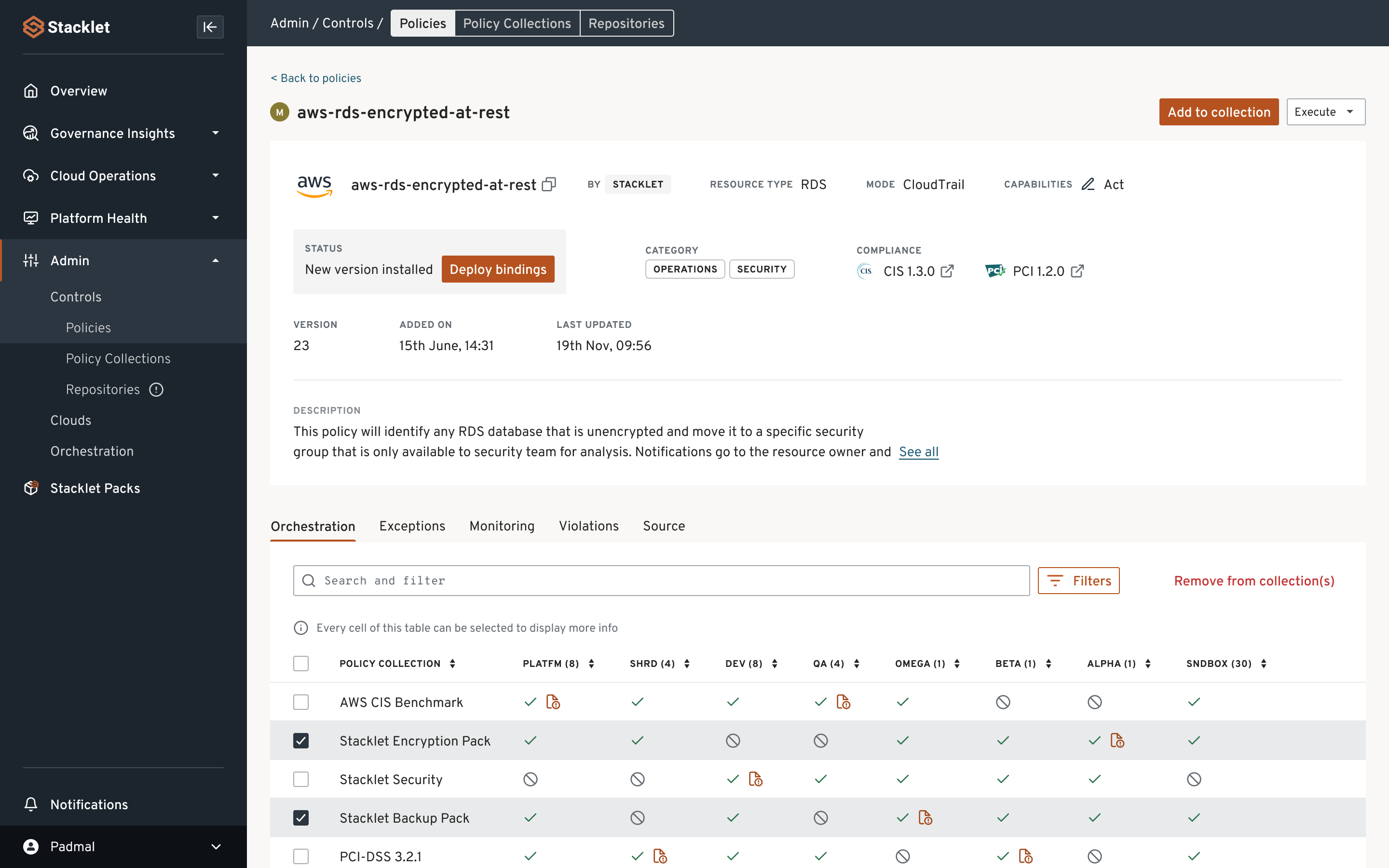
    Stacklet has added collaboration capabilities to its security and compliance platform that automatically groups related notifications, routes them to the right stakeholders and integrates with existing workflows and collaboration tools.

    The Stacklet platform is based on Cloud Custodian, an open source project that provides access to a domain-specific language that enables an IT team to employ YAML files to manage compliance-as-code.

    Stacklet CEO Travis Stanfield said that approach makes it simpler for organizations that have embraced DevSecOps best practices to comply with a wide range of mandates by shifting responsibility for achieving compliance further left toward DevOps teams.

    The latest version of the Stacklet Platform adds communications capabilities that leverage cloud resource configuration and policy metadata to automatically route notifications and escalations. Customizable notification templates add context for teams to collaborate either via email or integrations with Slack, Microsoft Teams and Symphony instant messaging. The Stacklet Platform can also trigger external workflows in tools such as Jira and ServiceNow to track issue resolution and generate reports.

    Ultimately, the goal is to make it simpler for IT teams to prioritize their compliance remediation efforts by keeping everyone involved continuously updated, said Stanfield.

    The number of compliance and security issues that organizations are experiencing in cloud computing environments is especially problematic. Developers often employ infrastructure-as-code (IaC) tools to provision cloud infrastructure. Unfortunately, they typically lack security and compliance expertise, which then results in large numbers of misconfigurations.

    The Stacklet platform is designed to give DevOps teams a way to prevent compliance and security issues using a compliance-as-code framework that spans multiple cloud platforms rather than requiring DevOps teams to employ a different set of compliance tools for each cloud platform on which applications are deployed.

    It’s not clear yet how far left responsibility for compliance will shift. In theory, organizations could avoid penalties if compliance issues are addressed before an application is deployed in a production environment. However, the teams that manage compliance in larger enterprises today are even further removed from DevOps teams than their cybersecurity counterparts. It may be several years before the cultural divide between these teams is bridged. In the meantime, many DevOps teams are taking it upon themselves to manage compliance as code to prevent unexpected issues from arising at the last minute before deployment.

    Overall, the goal is to enable DevOps teams to enforce compliance policies without slowing down the rate at which applications are built and deployed. The hope is that the adoption of compliance-as-code and DevSecOps best practices will address that issue. In fact, as the pace at which applications are deployed continues to accelerate to support digital business transformation initiatives, the number of potential compliance issues steadily increases. More troubling still, the greater the number of compliance issues there are, the more likely it becomes that cybercriminals will find a vulnerability to exploit.

  • Reflections: A DevOps Christmas Carol

    Reflections: A DevOps Christmas Carol

    “Marley was dead, to begin with.” So begins my DevOps Christmas Carol. In this reflection, I am visited by the ghosts of DevOps past, present and future. I hope that, after hearing my story, you will have a better understanding of where DevOps is going based upon where it came from and where it is now.

    The Ghost of DevOps Past

    The ghost of DevOps past took me back to Las Vegas, 2012. I shared a bottle (or two) of wine with Gene Kim, Gene was talking about a manuscript for a book he was working on based on The Goal by Eliyahu Goldratt. It was a digital story of resource constraints and the way forward based on something called DevOps. I was fascinated by this new way of thinking about development and operations while musing about what a great thing that could be for security, which was my thing then. A whole new world opened up to me as I met and learned about the work of people like Patrick Dubois, John Willis, Jez Humble, Damon Edwards and more.

    I was taken to Boulder, Colorado where Foundry Group and Techstars were putting on a symposium to make sure their portfolio companies were smart about DevOps. The CTO of Rally software did a presentation on Agile and DevOps and, again, it was like looking at the IT world from a whole new vantage point. It was after speaking to some of my friends, Rajat Bhargava and Brad Feld, that the idea for what became DevOps.com was born.

    What a golden time that was. DevOps was an elusive thing. No manifesto, no official definition. Some people said it was mythical and not real. Others said it was just for startups born in the cloud. Still others said it was just for large enterprises. DevOps, it seemed, could be everywhere and nowhere, all at once.

    Looking back, it was an exhilarating time, with philosophical arguments vigorously debated. And over the weeks, months and years that followed, the idea of DevOps became a real thing, the benefits it provided revealed themselves and a set of best practices emerged. My partners at the DevOps Institute and I tried to capture these emerging best practices and build courseware and certifications around them. Oh, my—what a sh*tstorm that created. The idea of being certified in DevOps was scoffed at, derided, spit on and ridiculed. But that, too, eventually passed. Looking back at this part of my trip, I realized that while it all seemed idealistic and exciting and despite the ups and downs and bumpy road, we were always moving forward.

    The Ghost of DevOps Present

    Next, the ghost of DevOps present visited me. In this dream, DevOps had begun to blend into the woodwork. For the most part, it was an accepted way of developing and operating software. Many principles such as CI/CD, continuous testing, SRE and DevSecOps were mainstream. While not 100% fully adopted, the majority of organizations used some DevOps patterns in their business.

    It had become so mundane, in fact, that people began to ask, “Has DevOps hit the wall?” “Has DevOps passed its peak?” and “What’s next for DevOps?” While this may sound ominous, it is actually par for the course in the adoption cycles of new technologies. As certain as the Gartner hype cycle, technology that has settled into the stack seems to be the way of things. So as much as the ghost of DevOps present tried to frighten me, I was unafraid. Adoption was proceeding just as expected. It was firmly entrenched as part of digital transformation initiatives. Cloud-native and DevSecOps also were becoming more and more accepted.

    The Ghost of DevOps Future

    Next, I was visited by the ghost of DevOps future. She showed me a glimpse of what the future held. In this future version, SREs worked side-by-side with DevOps teams. There was a smooth handoff at the time of deployment ensuring that apps behaved the way they were intended. Automated feedback loops allowed developers to incorporate lessons learned into future versions. 

    Low-code/no-code solutions designed for developers allowed for even faster, automated deployments. AI-enabled applications let testing keep pace with development, more automation enabled even faster deployments. 

    AI also made observability more than just a spectator sport. Actionable intelligence that was wisely acted upon was the norm in this future. Of course, security was still an issue. There were even more regulations and compliance requirements. The bad guys were as notorious as ever. It seems even a DevOps future where security was everyone’s responsibility could not fully solve our security issues. But, overall, progress had been made.

    DevOps teams were deploying directly from Git onto cloud-native stacks that started with Kubernetes but didn’t end there. There were service meshes and APIs connecting everything. Serverless platforms were offered by most vendors. Overall, no one wanted to be locked into one cloud provider and picked the right cloud for each project. Indeed, DevOps in the future seemed on the verge of recognizing and achieving many of its aspirations.

    I awoke and felt good about everything that was happening with DevOps. In the words of Tiny Tim from that other Christmas carol, “God bless us, every one!”

  • 5 Ways Low-Code Accelerates Digital Transformation

    5 Ways Low-Code Accelerates Digital Transformation

    Organizations traditionally have struggled with build-versus-buy decisions when digitizing their internal operations and processes. While the build option offered the benefit of using internal teams or outsourcing to external vendors who could satisfy requirements, the downsides are a long wait, higher costs and the constant change and maintenance applications require. On the other hand, buying solutions off-the-shelf meant that the costs were lower but the businesses would have to change or adapt to already-crafted solutions; not all businesses could adhere to a one-size-fits-all solution. 

    This challenge often resulted in only the highest-priority and big-budget applications or tools seeing the light of day while others were put on the back burner—even if those back-burnered tools could have improved productivity and user experience.

    Enter low-code platforms. The adjacent skill phenomenon enables users with similar fundamental experience but in different niches—think web developers and designers—that, when provided with a drag-and-drop tool can supplement their experience to move up the value chain and become full-stack developers.

    In a similar way, low-code platforms enable backend engineers to use drag-and-drop tools to build UI and business logic quickly. This translates into full-stack skills and makes frontend engineers redundant for internal tooling. With low-code and no-code tools, backend engineers can create dashboards, CRUD apps, transactional systems, processes and workflows built on top of existing data sources like databases, connected via APIs, housed in third-party tools etc. These solutions can easily be created and deployed in a matter of hours instead of weeks or months or, worse, back-burnered and doomed to never see the light of day. 

    How Does Low-Code Accelerate Digital Transformation?

    Given that most businesses are struggling to find the right tech talent, they need to explore new approaches to meet the demands associated with digital transformation. Low-code helps by making coding less burdensome and reducing the time and resources spent in building digital solutions. Anyone can develop apps regardless of their technical expertise and, therefore, contribute to the acceleration of digital transformation. 

    Here’s a look at how low-code solutions are accelerating digital transformation.

    Accelerating Visual Development  

    Low-code platforms can reduce turnaround time for building new apps by 90%—from well over six months to under four weeks.

    Developers and non-developers alike can use drag-and-drop functionality to build frontend applications on the fly. A major capability low-code platforms provide is the ability to build functional prototypes of possible solutions and test them quickly. Low-code platforms help unlock innovation by giving low-code platforms to business users who know and understand operational challenges best. Business users can create functional prototypes and iterate toward fully functional applications.

    How? Visual drag-and-drop interfaces, ready connections to data sources and APIs, point-and-click workflow designers and baked-in security. By taking away much of the boilerplate, most low-code app development projects are delivered with little to no coding required in a short time. 

    Along with a catalog of pre-built components and pre-configured modules, component reusability is another advantage of using low-code tools. Using standard UI components such as menu bars, buttons, form sections, etc. allows a user to take advantage of pre-built UI components and merge them into a full-fledged application.

    Democratizing App Development

    Gartner found that the demand for business-related apps is five times higher than the available IT capacity.

    That means the talent gap is one of the biggest hurdles to digital transformation. By turning a large number of semi-technical employees into citizen developers, companies can empower teams to create high-quality digital solutions for everyday operations while still meeting IT security regulations and addressing cybersecurity concerns. Low-code offers an intuitive user interface to design applications, websites, workflows and automation recipes. Some of the more refined low-code platforms also support backend integrations; meaning users can connect their digital solution to multiple data sources and produce unified web portals. 

    So, in addition to increasing the development resources, citizen developers can also help to accelerate business value. While they create business apps, the more complicated digital issues can be managed by the IT department. 

    Easy Data Integration

    Customization is the best way to extract the maximum value from existing systems. 

    Tools built using low-code technology are highly customizable and scalable. Low-code platforms enable the rapid creation of purpose-specific applications, which, via API connectors or building middle layers, can be “stitched” together with legacy applications to create end-to-end products. With easy-to-use API and database integrations, this allows teams to integrate with any pre-existing enterprise software such as ERP, CRM, custom applications and databases and extract the richness from their core legacy investments. 

    Reduced Costs and Scalability

    Many enterprises have project backlogs that cost them billions of dollars in opportunities. Because they can’t find the right talent or software to address business opportunities fast enough or give them priority over other tasks. Low-code can help reduce backlogs by helping your development team get more done in less time.

    Low-code development turns application elements like pre-built UI components, integrations and custom logic into visual building blocks that are easy to copy and repeat. Ready connections to multiple data sources allow users to easily connect to data from different business functions and scale the application. 

    A low-code approach simplifies the work required to scale and maintain apps across the entire enterprise or for millions of customers. The developer can build something once and implement it everywhere in minutes. Easy cloud deployment makes it easy to extend the application from one geographic location to another.

    Eases Application Life Cycle Management 

    The main aim is to produce flexible, cost-effective and rapid applications that are adaptive to enhancements and less complex in terms of maintenance. Low-code development accelerates application delivery by enabling users to deploy applications in just a few clicks, without relying on DevOps or engineering teams. 

    Depending on the platform, all the stages of the application life cycle—development, deployment, monitoring, maintenance, updates—can be performed from a single point in real-time, ensuring security, compliance and version control.

    The maintenance phase of software is vital to be able to quickly change what already has been developed to guarantee that the app continues to serve the purpose the business requires. The essence of low-code is that, as the name suggests, there is less code; therefore, there is little code to maintain.  

    The Future of Low-Code and Digital Transformation 

    All kinds of organizations across all industries are seeking new ways to meet challenges and increase business performance as a result of digital transformation. Introducing low-code/no-code enables businesses to be bolder and more experimental when executing on their ideas. This is digital innovation in action.

    Businesses are already leveraging low-code to get ahead of their competitors by increasing business agility and improving efficiency. This technology is giving IT teams the potential to also get rid of old silos between business departments. 

    Low-code has been helping enterprises overcome the lack of access to relevant resources to meet their business needs. By speeding time-to-market for digital products, low-code helps businesses respond to market dynamics faster while being more efficient. 

    Every organization should take advantage of these opportunities and adopt a low-code platform for accelerating productivity and achieving faster results, apps and tools. In the words of Chris Wanstrath, CEO of GitHub, “The future of coding is no coding at all.”

  • CI/CD Is Still All About Open Source

    CI/CD Is Still All About Open Source

    One of the lessons I’ve learned in my years at the helm of DevOps.com is that the heart of DevOps is CI/CD. And at the heart of CI/CD is open source. While the names have been changed to protect the innocent (and the obsolete), these lessons are as true today as they ever were. CI/CD is still all about open source.

    When we first started DevOps.com, folks said that DevOps was just a symptom; CI/CD was the cure. For many of you, that cure was delivered via open source—probably using Jenkins. Jenkins, which itself was a fork of the open source Hudson project, was created by Kohsuke Kawaguchi.

    Jenkins was a CI tool at heart and later morphed into a CI/CD tool. Many people think that this fork in the road may have hurt the continued evolution of continuous delivery in the long term. But that is an argument for another DevOps.com article (or maybe even a panel discussion at an upcoming DevOps live event).

    Regardless of where you stand on that issue, as an open source project, it is hard to argue with the success of Jenkins. Driving a lot of that success is the Jenkins plug-in architecture. There are literally thousands of plugins that allow Jenkins to work with just about anything. That is the engine that powered Jenkins, yes; but its secret superpower was and is open source.

    That said, Jenkins has grown a bit long in the tooth over the years. It’s not that it doesn’t do what it always did, it’s that what we do and how we do it has changed. Microservices, Kubernetes and even cloud have changed the very fabric of the tapestry in front of which Jenkins sits. The open source community that supports Jenkins should receive enormous credit here: It has tried mightily to keep up with the many changes. 

    Jenkins X sought to bring Jenkins to Kubernetes, for instance. But ultimately, nothing lasts forever and, as it says in the Bible, “For everything there is a season, and a time for every purpose under heaven: A time to be born, and a time to die.” Now, I am not saying Jenkins is dying, but I think its time as the leader of the pack is behind it.

    The good news is there are a host of new CI/CD tools that have risen to fill the vacuum left by Jenkins. Some of them are entirely open source; some are based on open source. Solutions such as Buildkite, Harness, Codefresh, GitLab, GitHub, CircleCI, JFrog and Tekton to name but a few. 

    Another major development has been the rise of GitOps. Weaveworks has led the way in adoption, not to mention coining of the term GitOps itself, but clearly, they are not alone. What these solutions all have in common, though, is open source.

    I used to think it was sort of a chicken-or-the-egg question when it came to CI/CD and open source. But I realize now that it is not. I firmly believe that, if not for open source, CI/CD would not be the force it is today. Make no mistake, it is truly a force. CI/CD has become the dominant method for software development.

    Of course, you could say “Why stop at CI/CD? Open source has become the dominant software development foundation in observability, OS, cloud and so much more!” Yes, I agree—we are living in the open source age. This rising tide may in fact lift all boats, including CI/CD.

    This wave is forcing all vendors to either go entirely open source or at least support open source. What’s more, for the foreseeable future, I don’t see that changing. Open source has also wrought other changes in the market. How software tools, including CI/CD, are distributed and consumed. Who is hiring enterprise software salespeople anymore? Doing large POCs? No, open source has resulted in getting software into the hands of developers and DevOps teams directly and delivering delight. If your product works, they buy it. If it doesn’t work, they won’t, either—and they will let you know, too!

    This meritocracy is another benefit of open source and is helping to speed the development of better, next-gen CI/CD tools in the market. And at the end of the day, we are all better off for that.

  • API Sprawl a Looming Threat to Digital Economy

    API Sprawl a Looming Threat to Digital Economy

    New estimates say the total number of public and private APIs in use is approaching a whopping 200 million. APIs are becoming increasingly crucial to the global digital economy. They are the backbone of many digital platforms and drive the composable enterprise model. But this ubiquity presents sprawl issues.

    F5 recently released a study that examines the conditions of the API economy at large. Authored by Rajesh Narayanan and Mike Wiley of F5, the paper, Continual API Sprawl: Challenges and Opportunities in an API Driven Economy, articulates the state of API sprawl and the conditions behind its arrival.

    According to Narayanan and Wiley, “If data is the new oil, then APIs will become the new plastic.” This looming reality will require a continuous approach to API management to avoid further polluting the digital ecosystem.

    Below, I’ll review the report’s main takeaways to see what has given rise to API sprawl and consider how IT leaders should respond.

    State of API Growth

    APIs have evolved as a standard mechanism for businesses and services to connect and share value. And, as more companies begin to rely on them, the API economy is becoming big business—83% of organizations today consider API integration a critical part of their business strategy, according to the 2020 Cloud Elements State of API Integration Report.

    There is a proliferation of API styles. Thousands of public productized APIs exist, but more private and partner APIs are in use. Technically speaking, APIs come in many different forms—they may be web-based, browser-based or embedded into devices. The report also identifies single-purpose APIs and those that aggregate multiple data providers.

    API use cases are pervasive, from hotel bookings to weather, stock tickers, transportation, IoT, DevOps workflows and many other areas. “API-powered apps have permeated every aspect of our lives,” said the report. Yet, typical market estimates are usually quite conservative when sizing up this market, said F5. According to F5’s aggressive calculations, we will be approaching 1.7 billion active APIs by 2030.

    APIs present a high value from startup use cases to enterprise applications. However, a downside is that this growth is leading to sprawl, said Narayanan and Wiley.

    API sprawl is the term used to describe both the exponentially large number of APIs being created and the physical spread of the distributed infrastructure locations where the APIs are deployed.

    Factors Driving API Sprawl

    Sheer growth. Sources predict the number of developers will grow to 45 million by 2030. SlashData also estimates that 30% of developers already use APIs. As the number of APIs on the market moves into the millions, managing growth poses a significant challenge, especially without proper governance and best practices.

    Lack of standards. “The lack of a common shared model contributes to API sprawl,” the report said. API design standards do exist, yet guidelines often leave room for nuances between services. Standards have also emerged around specific industries, like financial data exchange (FDX). While helpful for a single sector, this doesn’t advance multiple industries simultaneously. A lack of standardization leads to differing versioning approaches and integration challenges.

    New development approaches. Integration requirements are forcing many new APIs to unite disparate business apps. The microservices architecture trend is also adding to sprawl, as “APIs are both northbound to interfaces via microservices and horizontally between microservices.”

    Continuous software development. Continuous development, paired with the need to connect business units with bespoke requirements, could produce multiple versions of the same API. This quickly leads to maintenance difficulties, out-of-date documentation and broken clients. The report also cites rising data creation and “everything-as-a-service” trends as harbingers of an API sprawl.

    Various computing evolutions. New computing trends are also prompting a sprawl, says the report. Business units may be operating on different on-premises or cloud environments. When this hybrid situation occurs, APIs could get dispersed over many locations and become difficult to track. Specific connections may be created to cater to new environments like edge computing and IoT devices, further increasing sprawl.

    Problems With API Sprawl

    A digital economy reliant on APIs also relies on the underlying stability and availability of these services. Yet, “APIs have a shelf life and become unsupported if ignored by the developers,” the paper acknowledged. It could be hard to maintain service reliability for APIs sprawled across a distributed cloud. In addition to reliability issues, there are many other possible repercussions of an API sprawl.

    For one, management and operation at scale become difficult. Not all APIs are based on a specification, like OpenAPI. This means that API documentation may not be as streamlined and accessible, thus hurting discoverability and onboarding. “A simple means to connect these APIs may not be possible with conventional or legacy networking approaches,” the report added.

    As developers are top consumers of APIs, a sprawl could negatively impact their integration experience. Maintaining a swelling library of API dependencies can be cumbersome. Plus, APIs are prone to evolve and version over time and when endpoints are altered without advance notice, it leads to broken clients. Even small changes in API functionality can have a huge impact since all observable API behaviors will become relied upon, whether documented or not. (This is known as Hyrum’s Law).

    But the security ramifications of API sprawl are perhaps the most troubling. A whopping 91% of enterprises experienced an API security incident in 2020. Malicious API traffic also rose by a staggering 300% in mid-2021, Salt Labs found. Increased API use will undoubtedly cause more frequent attacks.

    “Unmanaged API sprawl is a security breach waiting to happen,” said the report. APIs typically adopt API keys for authentication and authorization, but this method is prone to misuse. Credentials are often exposed or misconfigured. Bad actors can use APIs to steal loads of data and computing power. As a result, sprawl is undermining trust in API connections and responses.

    Mitigating The Sprawl

    With the growth of the API economy slated to reach the billion mark in the next ten years, figuring out secure, stable inter-cluster communication will become more critical. According to F5, existing solutions (gateways, ingress controllers, service mesh and forward and reverse proxies) are not an adequate response.

    “We believe the solution should hence involve an intermediary (proxy) device focused on solving inter-cluster connectivity, security and integration challenges.” The writers call this solution API Gateway 2.0, which they describe as a bi-directional application-level proxy. The technology exists to implement such middleware and perhaps it could help companies address sprawl issues.

    Outside of Narayanan’s and Wiley’s recommendations, there are plenty of actions API owners can take to avoid adding to the sprawl. Here are a few:

    • Treat the API as a product
    • Improve developer experience
    • Use spec-driven development
    • Ensure up-to-date documentation and code libraries
    • Use consistent endpoint naming
    • Set clear guidelines for versioning and deprecation
    • Go beyond API keys with OAuth and OpenID Connect

    For more context, check out Continual API Sprawl: Challenges and Opportunities in an API Driven Economy for free without an email gate here.