Category: DataOps

  • There’s no One-Size-Fits-All Data Mobility Strategy

    There’s no One-Size-Fits-All Data Mobility Strategy

    Whether you’re a Fortune 500 enterprise or a fledgling startup, there’s one thing every business can expect to confront: Change. This is resoundingly true when it comes to data management. Even greenfield operations will, sooner rather than later, need to change how and where they leverage their data. After all, every business—including those launched with the most cutting-edge technology—is built on a series of choices and compromises. As technologies and business priorities change, so should your data mobility strategy.

    In a world of ever-changing variables, what’s the right data mobility strategy? There is no one-size-fits-all solution. It does, however, help to start with a solid foundation on which to build your strategy.

    With the right platform that allows for flexibility and change, it’s time to build the structural framework for your data mobility strategy. When creating the framework for your data mobility strategy, there are a few considerations to keep in mind, including your desired use of on-premise storage, your hybrid cloud strategy and “supercomputing” capabilities, and the storage area network (SAN) needed based on your organization’s needs. Let’s review what they might mean for you:

    Developing a Hybrid Cloud Strategy

    The reality is that the hybrid cloud is now achievable for most organizations. According to Flexera’s 2023 State of the Cloud Report, 72% of organizations have embraced a hybrid cloud strategy. Your data mobility strategy should reflect that.

    With a proper hybrid cloud environment, the user experience should be seamless regardless of where your data exists, whether that’s on-premise, in a private cloud, or in the public cloud. As the potential for more dynamic resource allocation grows, your data mobility strategy inherently becomes more critical. Data mobility, in effect, now equates to computing mobility.

    Leveraging the “Supercomputer” in the Cloud

    Data mobility becomes even more imperative as entities gain more opportunities to take advantage of “supercomputing” capabilities.

    The computing power that exists in the cloud now is tremendous, and thanks to modern dynamic cloud pricing, even smaller organizations can tap into it. According to one estimate, the cloud-based high-performance computing market should reach $55 billion by 2030, growing at a CAGR of 7% from 2023 to 2030.

    So for example, if you’re a FinTech startup, you could pay by the minute to leverage high-performance computing capabilities to test your trading algorithm. Previously, these powerful capabilities were only available to the biggest customers — think NASA — and came with astronomical costs.

    On-Premise Solutions Aren’t Going Away

    Even as cloud services and capabilities become more accessible and more valuable, on-premise operations aren’t going to disappear. Customers have all kinds of reasons for keeping data on-premise, whether it’s for compliance purposes, costs or the desire to leverage existing infrastructure. Certain workloads, meanwhile, simply don’t make as much sense on the cloud.

    The reality is that even the most compelling alternatives couldn’t eliminate on-premise operations, because business ecosystems and industries evolve organically. Think about it: Many businesses still use landlines, and workers still use desktop computers. Nearly half a century after marketers first coined the term the “paperless office,” it took a full-blown pandemic to push our collaboration tools to the point where we are finally, basically, paperless.

    Fiber Channel and iSCSI

    When it comes to data mobility, how does an organization decide whether to adopt fiber, iSCSI or both? As organizations manage workloads that require low latency and other networking capabilities, they’re going to be investing heavily in this area.

    Traditionally, a significant amount of data management is fiber-channel-based. With iSCSI, an organization doesn’t need to invest in separate physical infrastructure, such as switches or cables. Moreover, iSCSI has become more attractive to entities moving workloads to the cloud. A whole range of products, from Pure Storage, NetApp and even cloud platforms like Microsoft Azure, offer iSCSI-based storage in the cloud. Your data mobility strategy should consider how to move from fiber channel to iSCSI and back again.

    Change is the Only Constant

    Ultimately, no one can predict all of the major technological innovations that will impact their business down the road. To stay nimble, you need a data mobility strategy that you can execute with the team you have — whether their primary expertise is in storage, networking or elsewhere. This can be especially challenging in large organizations, with teams that have to meticulously plan their projects and stay accountable for their budgets. Now more than ever, it’s important to have a solid foundation on which to build a strategy that fits your needs.

  • Oracle Bill is 5x Client’s Budget ¦ Toyota Out of Space

    Oracle Bill is 5x Client’s Budget ¦ Toyota Out of Space

    Welcome to The Long View—where we peruse the news of the week and strip it to the essentials. Let’s work out what really matters.

    This week: Birmingham looks like the Detroit of the UK—is it Oracle’s fault?
    Plus: Was Toyota’s factory failure caused by running out of disk space? (more…)

  • 80% of Bosses ‘Regret’ Stopping WFH ¦ PSA: Disable STS!

    80% of Bosses ‘Regret’ Stopping WFH ¦ PSA: Disable STS!

    Welcome to The Long View—where we peruse the news of the week and strip it to the essentials. Let’s work out what really matters.

    This week: Rethinking return-to-office mandates and a ridiculous, ancient Windows bug. (more…)

  • Latest Redis Update Streamlines Management of Platform

    Latest Redis Update Streamlines Management of Platform

    Redis made a unified release of its namesake data store available today for consistent deployment across all supported platforms. Previously, the pace at which upgrades were made was staggered across different offerings only as they became available.

    At the same time, Redis is moving to unify client libraries used to access its open source data store by working directly with the community maintainers of the five most popular client libraries—Jedis (Java), node-redis (NodeJS), redis-py (Python), NRedisStack (.Net), and Go-Redis (Go).

    Other capabilities added to version 7.2 of the platform include support for auto-tiering, to more easily migrate less frequently accessed data to less expensive storage devices. This is managed via an enhanced interface for the Redis cluster management and data integration tools, available in preview. Both make it possible to consume data in real-time from another data source, such as a SQL database. Developers can also take advantage of triggers and functions to build those types of applications.

    Redis is also previewing a search tool for vector data used to create generative artificial intelligence (AI) applications. Rather than employing a separate vector database to build these applications, the Redis platform supports this data type to enable generative AI applications to run alongside other classes of applications accessing the same data.

    Redis CEO Rowan Trollope said collectively these efforts will help DevOps teams reduce costs and streamline the management of upgrades to the platform and updates to applications accessing it.

    Most organizations initially adopt Redis to provide a layer of cache using a data store that runs in-memory. However, as more applications are developed many organizations wind up using Redis as their primary database for applications that require a lot of interactivity, noted Trollope.

    While developers primarily make that architectural decision, the overall management of the Redis data store falls to DevOps teams that will now find it easier to streamline workflows across multiple instances of Redis running in the cloud, or on a Kubernetes cluster, added Trollope.

    Of course, in some cases, organizations still rely on database administrators and data engineers to manage those workflows, but as DevOps continues to evolve, more instances of data stores are being incorporated into workflows managed by a DevOps team. The ultimate goal should be to align DevOps and DataOps best practices to increase the productivity of developers and data science teams building generative AI applications using vector data to customize an existing large language model (LLM).

    Regardless of the motivation, what’s clear is the volume of data that needs to run in-memory continues to increase substantially. As that shift continues to occur, more latency-sensitive applications are being deployed. Maintaining the performance of those applications across a highly distributed enterprise environment with multiple service dependencies requires a level of DevOps expertise that is still difficult to find and retain.

  • Using Observability to Create a Smart Data-Driven Culture

    Using Observability to Create a Smart Data-Driven Culture

    The first words that come to mind when talking about smart technologies are often artificial intelligence, machine learning and automation. While these smart technologies play a crucial role in smart-driven cultures, they are not the sole factor in making workplaces “smart.” Organizations that have a smart-driven culture, or data-driven culture, also promote innovation. An innovative organization actively encourages creativity, exploration and the pursuit of new ideas, continuously developing and implementing groundbreaking solutions, products and processes. Innovative companies with a culture of learning and growth are often seen as desirable employers and have high employee retention rates, attracting top talent.

    Let’s go over the benefits of a smart-driven culture and how an observability platform can help your company become data-driven in five steps.

    Why is Smart-Driven Culture Important

    You can increase efficiency and productivity among your employees by fostering a smart-driven culture. Smart technologies are able to automate repetitive tasks and streamline processes, which helps free up workers’ time and focus on other issues instead.

    A data-driven culture can also drastically improve decision-making on a company level. Your organization will begin to strategize and act on objective insights rather than guesswork or assumptions. Through collecting, analyzing and interpreting data, you will not only be able to make informed decisions but also know how to optimize processes and mitigate risks.

    Use data to better understand your customers’ preferences and improve your products to meet their demands more effectively. For example, leverage smart technologies and create high-tech touchpoints to tailor each of your customer’s experiences. A culture that encourages continuous learning, experimentation and adaptation is ready to navigate market shifts, changing customer needs and emerging technologies.

    How to Create a Data-Driven Culture in Five Steps

    According to the 2023 Data Analytics Survey conducted by New Vantage Partners, 79.8% of data leaders identified people, business processes and organizational alignment as the principal challenge to becoming data-driven. These folks cited cultural issues, including organizational receptivity to change, communication and organizational alignment, as the greatest obstacles to realizing business value.

    One way to overcome these challenges is by harnessing the power of observability, building data literacy and organizational transformation. Observability refers to the practice of gaining real-time insights into systems, applications, and processes through the collection and analysis of relevant data. Real-time insights will enable your organization to make data-driven decisions, understand your customers better and quickly identify areas of optimization to improve your products.

    These characteristics are fundamental to smart-driven companies, enabling them to stay competitive and drive innovation in the market. Take the following five steps to ensure you’re maximizing the potential of observability and paving the way toward becoming a smart-driven organization:

    1. Define Clear Goals

    Start by defining what a smart-driven culture means for your company. Write down clear outcomes that you want to achieve with a new culture, and identify the specific areas where observability can make a significant impact on your team.

    Focus on areas where real-time insights derived from observability can generate substantial business value. Set SMART (specific, measurable, achievable, relevant and time-bound) goals that can be tracked over time. For example, you could aim to reduce website loading time by 20% in the next two months in order to increase customer conversion.

    2. Implement Robust Observability Tools

    Evaluate and choose observability tools that align with your organization’s specific needs and goals. Look for tools that offer features such as real-time monitoring, log management, distributed tracing, advanced analytics and visualization capabilities.

    Consider factors like scalability, ease of use, integration with existing systems, and the ability to handle diverse data sources. Remember that the availability of accurate and timely insights promotes a culture that values data and encourages performance for achieving business objectives.

    Ask your IT department to help set up your observability tools to gather the relevant data. For our previous example goal of improving website loading times, this will mean gathering real-time data on website performance, such as server response times, page load speeds, and user interactions.

    3. Promote Data Literacy

    Your observability tools are of little help if no one understands how to use and derive helpful insights from the data you gather. Educate all of your employees on good data practices and the role of analytics in decision-making.

    Provide training and support on the data tools you have chosen and encourage your employees to understand, interpret and utilize data effectively in their day-to-day work. For instance, in meetings, you can ask for data points to back up business decisions.

    4. Encourage Collaboration and Knowledge Sharing

    Creating cross-functional teams and encouraging collaboration among different departments, such as IT, operations and analytics, is crucial for the successful implementation of observability practices.

    Taking an interdisciplinary approach allows for a better understanding of the systems and data within the organization. This can lead to the identification of optimization opportunities, help break data silos and practice collective problem-solving as a result.

    5. Iterate and Improve

    Embrace a culture of experimentation and continuous improvement by using observability data to identify areas for optimization and innovation. Encourage teams to test hypotheses, implement changes and measure the impact, fostering a cycle of learning and refinement. Track progress against the goals you set at the beginning and adjust your trajectory if needed.

    Coming back to our goal to improve website loading time. Now that your interdisciplinary team implemented some changes and reduced the loading times, you can assess the impact on user experience and business metrics, such as bounce rates, conversion rates and customer satisfaction.

    Becoming a smart-driven organization will grant you a great competitive advantage. You will make better and faster decisions, employ the best talent, maximize their productivity, and provide an enhanced experience for your customers.

  • Mezmo Simplifies Management of DevOps Telemetry Data

    Mezmo Simplifies Management of DevOps Telemetry Data

    Mezmo has added additional capabilities to streamline the flow of telemetry data within DevOps workflows as part of an effort to make it simpler to surface insights and reduce the total cost of observability.

    The company has also added integrations with more data sources to the Telemetry Pipeline platform, along with controls that make it simpler to optimize data storage and usage. For example, an Events-to-Metrics Processor capability identifies and extracts metrics from logs to make them easier for third-party tools to consume.

    Mezmo CEO Tucker Callaway said these additions collectively make it simpler to surface insights that will make DevOps workflows more efficient. Previously, the company added capabilities such as rollback and redeploy, sequential parsing, error history management and data sample management to enable DevOps teams to manage telemetry data more efficiently.

    In effect, Mezmo is making it easier to apply engineering best practices to the massive amounts of telemetry data generated across DevOps workflows, he noted.

    No one knows for certain if all that data will require the addition of data engineers to DevOps teams, but as DevOps continues to evolve, it’s clear there is a need to cost-effectively manage data at scale. DevOps teams that embrace observability are quickly discovering that storing logs, traces and metrics for an extended amount of time can quickly become cost prohibitive. Naturally, there’s a lot more sensitivity to those costs during challenging economic times.

    In theory, of course, various forms of artificial intelligence should automate data engineering best practices, but in the meantime, there simply isn’t enough data engineering expertise available. The need for a platform to optimize the flow of telemetry data across DevOps workflows is becoming more acute.

    It’s not clear how quickly DevOps teams are embracing observability, but it’s clear that relying on predefined metrics to monitor IT environments is no longer sufficient. DevOps teams need to be able to query telemetry data to, for example, identify bottlenecks created by dependencies between microservices. Resolving those issues can’t be slowed down by a lack of data to query. Most problems can usually be traced back to a recent update to an application, but there are always going to be some issues that require access to historical data. That historical data should be quickly and easily available, especially since application downtime directly equates to lost revenue for many organizations.

    Observability, regardless of cost, is rapidly becoming a requirement for DevOps teams’ success as application environments become more complex in the cloud-native era. Dependencies between the microservices that make up those applications are too difficult to track and analyze without the aid of an observability platform. The challenge is not every observability platform provider is equally concerned about how much it costs to store all that data. Striking the right balance between the amount of telemetry data collected and the cost of storing it has become a much larger concern.

  • Datadog Updates Aim to Improve Logging, Testing Efficiency

    Datadog Updates Aim to Improve Logging, Testing Efficiency

    At its recent DASH 2023 conference, Datadog revealed Flex Logs and Intelligent Test Runner, two major new capabilities aimed at improving logging and testing efficiency for engineering teams.

    Omri Sass, director of product management at Datadog, said Flex Logs introduces a new middle tier of log storage between real-time querying and cold archives. As Sass explained, this provides a cheaper option for retaining logs beyond the typical two weeks for occasional analytics and investigations. By decoupling storage from compute for reading logs, teams can independently scale each based on their needs. This enables retaining rich log data for months or years to uncover long-term trends, he said.

    In addition, Sass noted that Flex Logs helps address common log analysis limitations around storage costs and rehydrating archives. The feature better aligns log pricing with specific use cases beyond just troubleshooting. According to Sass, this evolution in log storage tiers will likely shift more logs from legacy on-premises systems to its cloud platform.

    The second capability, Intelligent Test Runner, leverages observability signals to optimize CI test suites. As Sass explained, comprehensive test automation in CI pipelines often increases deployment times and flakes. Intelligent Test Runner inspects code changes to determine associated tests, ignoring irrelevant ones, which helps avoid long wait times for minor changes just to exercise unaffected areas.

    By tapping into existing telemetry around code commits, test health and runtimes, the feature adapts testing to each code modification. Sass explained that observability data has matured enough to enable real-time optimization like this. The end result is faster CI validation, so engineering teams can ship updates more rapidly.

    Sass highlighted how Flex Logs and Intelligent Test Runner are Datadog’s attempts to address real pain points developers face around managing log data life cycles and CI speed bumps. Sass said he believes this combination of depth in core disciplines like logs and application performance monitoring (APM), along with expanding into adjacent developer workflows, is key to solving these issues through innovation.

    Looking to the future, the observability space continues to evolve rapidly as emerging technologies and practices expand monitoring beyond traditional IT infrastructure. Companies handling modern workloads expect their observability platform to provide comprehensive visibility as development toolchains and architectures grow more complex, with the next generation of observability likely incorporating advanced analytics, automation and AI to help engineers tame systems at ever-increasing scale and speed. 

  • Data Management: Cloud Technology or Data Centers?

    Data Management: Cloud Technology or Data Centers?

    Traditionally, larger enterprises have relied on in-house server hardware equipment for their data management needs, optimized to run high-performing applications with a certain degree of assured security and reliability. 

    However, the high costs and technical expertise required to manage these solutions effectively often render them inaccessible to startups and emerging businesses. But, as the old saying goes, necessity is the mother of invention. 

    With the growing demand for cost-effective, efficient data management solutions, the tech industry has witnessed the advent of cloud technology and data center colocation rental services. These alternatives pave the way for startups and small businesses to handle large volumes of data without straining their budgets.

    This article will compare and contrast cloud technology and data center services to help business leaders make well-informed decisions about their data management needs and the solutions that can help them.

    Understanding Data Center Colocation Services

    Data center colocation services offer an enticing solution for companies that require robust data management capabilities without incurring high capital expenditure for securing storage hardware, along with storing and powering them. 

    Essentially, this solution is like renting a space for your data in a specialized facility. These data centers provide a secure environment with the necessary power, cooling, and physical security for your server, storage, and networking equipment.

    In opting for colocation services, companies can leverage state-of-the-art data center infrastructure without the burden of high upfront costs and ongoing maintenance responsibilities associated with owning a private data center. This also allows businesses to focus more on their core competencies rather than the intricacies of data center management.

    However, data centers come with their own set of unique challenges. For instance, they often require a certain degree of technical expertise on the part of the business to manage their servers. This means hiring or training staff to handle server management, increasing the overall cost of this solution.

    Additionally, data centers’ effectiveness can sometimes be influenced by physical proximity. The closer your operations are to the data center, the better the performance can be. This geographical factor can pose problems for businesses operating in multiple locations or managing data across different data centers.

    The Power of Cloud Technology

    In contrast to relying on data centers, cloud technology offers businesses of all kinds and sizes immense scalability and flexibility in terms of data management solutions. 

    As a service that delivers computing infrastructure, software, or storage as a service via a network connection, typically the Internet, cloud technology eliminates the need for physical proximity to servers. It is quickly scalable, both upwards and downwards, as per business needs, ensuring that you only pay for what you use.

    Moreover, the ability of cloud technology to integrate various services can simplify business operations and enhance customer engagement. For instance, many businesses are now offering cloud-based text-to-pay systems that allow customers to pay from any device, providing ease of transaction while simultaneously gathering customer data in the cloud.

    Cloud services can also provide robust disaster recovery and business continuity solutions. However, businesses often cite concerns about data security and privacy in the cloud. Although most cloud service providers implement best-in-class security protocols, the very nature of the cloud—being an off-premises solution—necessitates a high level of trust in the provider.

    AI and Data Management Solutions

    If your business relies heavily on AI applications, you must understand how your data management solution supports this need. AI requires high-quality, well-managed data to function effectively. Here, cloud technology often presents an edge over traditional data centers.

    Many cloud service providers offer built-in tools and services designed to better facilitate AI implementation, including pre-trained machine learning models and AI platforms as a service. These resources can dramatically reduce the time, costs, and complexity that come with implementing AI, particularly for small to mid-sized businesses without extensive in-house AI expertise.

    On the other hand, while data centers might not have these built-in tools, they offer robust performance capabilities for AI workloads and often provide more control over the data, which is vital for sensitive AI applications.

    Keep in mind you can turn to other server-based solutions for storing data as well. For example, if your application relies on a significant amount of PDF content to store data and function effectively, hosting those files on a server such as a server-side PDF SDK will allow you to process those documents on the server via an API. This will then allow you to autoamte your document processing and convert large volumes of your PDF files. 

    Web Hosting Requirements

    Your current web hosting requirements can also significantly impact the choice between data center services and cloud technology. Shared hosting services may be sufficient for businesses with low-traffic websites or applications, and if you don’t need to store a lot of data, but as your traffic increases and the website grows, so do your hosting requirements. 

    Cloud hosting solutions offer excellent scalability, allowing your website to grow with your business. As traffic surges, cloud servers can easily handle the increase, maintaining website performance and user experience.

    Conversely, with a dedicated data center, you’re generally limited to the capacity of the server you rent. To increase your capacity, you may need to physically upgrade the hardware, a process that can result in downtime and potential loss of revenue.

    Considering Cost Implications

    The overall cost of your chosen solution will be a key factor when deciding between data center colocation services and cloud technology. Each service has unique cost structures that can vary between providers, and understanding these can significantly impact your company’s financial health and resource allocation.

    With data center colocation services, the costs are generally more predictable. You pay a fixed amount based on your rented server space and the bandwidth you use. This stability can be advantageous for budgeting purposes, especially for businesses with steady data usage and processing needs. However, you may also incur additional expenses for any necessary hardware upgrades, maintenance, or increased bandwidth usage.

    What’s more, there’s the indirect cost of employing or training staff to manage the servers, plus the potential costs of transportation to and from the data center, particularly for businesses not located near their rented server space. These costs can add up and should be factored into the total cost of operating within a data center.

    Cloud services, conversely, operate on a pay-as-you-go model. This solution can be much more cost-effective for businesses with shifting data needs since you can readily scale up or down based on demand, ultimately only paying for the resources you actually use.

    Choosing the Right Path for Your Organization

    Unfortunately, there’s no one-size-fits-all solution for effective data management. Each business has unique needs, requirements, and considerations that necessitate a carefully tailored approach. When choosing between cloud technology and data center colocation services, business leaders must carefully consider several key factors to determine the right solution for them.

    If scalability, flexibility, and AI integration rank high in your data management strategy, cloud technology presents an excellent solution with its on-demand resources and array of built-in tools. On the other hand, data center colocation services provide robust performance capabilities, greater control over data, and predictable costs—features that may appeal to businesses with more consistent data management needs.

    Understanding your current web hosting requirements and the potential cost implications of each solution are also crucial elements to consider in your decision-making process. The demand for efficient, secure, and cost-effective data management solutions will only continue to grow as data storage needs expand rapidly.

  • Datadog Adds Additional Generative AI Capabilities to Platform

    Datadog Adds Additional Generative AI Capabilities to Platform

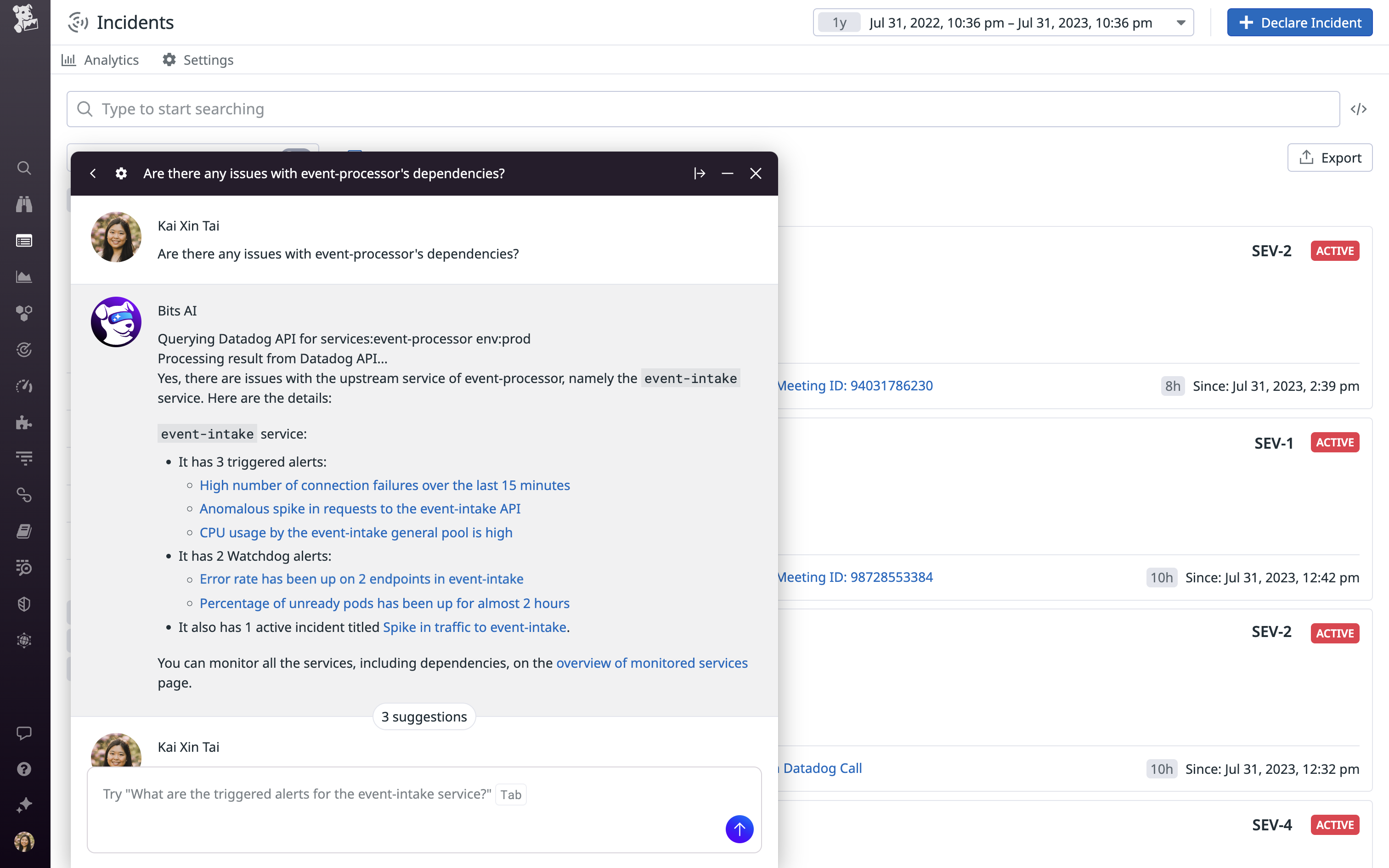
    At its DASH 2023 conference, Datadog today launched Bits, a digital assistant that uses generative artificial intelligence (AI) from OpenAI’s ChatGPT platform to provide real-time recommendations to resolve issues surfaced by the company’s observability platform.

    At the same time, the company announced it is extending the reach of that platform to enable IT organizations to monitor the large language models (LLMs) many are now embedding within custom applications.

    Datadog also released an LLM Observability platform in beta, which brings together data from applications, models and various integrations to help engineers discover and resolve AI issues in applications such as performance degradations, drift and hallucinations in real-time.

    Those extensions complement an existing ability to monitor the usage patterns of application programming interfaces (APIs) making calls to the OpenAI ChatGPT platform.

    Yrieix Garnier, vice president of product at Datadog, said the generative AI capabilities in beta are enabled by data the company used to extend the core capabilities of OpenAI’s ChatGPT platform.

    Bits AI learns from both customer data and other sources to answer queries via a natural language interface that makes the Datadog platform more accessible to a much wider range of IT professionals, noted Garnier.

    The overall goal is to reduce the mean-time-to-resolution for issues by, for example, explaining errors and suggesting code fixes that can be easily shared with developers via a Slack communication channel.

    Those capabilities extend the functionality of the machine learning algorithms that Datadog has already embedded within its platform, noted Garnier.

    While the generative AI capabilities added to the core Datadog platform will make DevOps teams more efficient, it’s not quite clear what role those teams will play in monitoring LLMs created by data science teams. In theory, DevOps teams should be responsible for optimizing the performance of any element of an application, but most DevOps engineers today don’t tend to have much experience with LLMs that are created by data science teams.

    At the very least, however, DevOps engineers should be able to share the root cause of an issue that is adversely affecting those LLMs with those data science teams.

    It’s not clear how quickly LLMs will be incorporated into applications, but most DevOps teams should expect them to soon be pervasive. In effect, Datadog is now providing DevOps teams with the AI tools they will need to effectively monitor applications infused with AI capabilities. The issue is not so much whether DevOps teams will be taking advantage of AI to better manage application environments but how quickly. Given the overall level of complexity DevOps teams regularly encounter, few are likely to want to take on that challenge without some level of AI augmentation.

    The challenge is determining exactly what DevOps tasks might be best handled by a machine that enables software engineers to focus on more complex issues they previously didn’t have the time to address.

  • Overture Maps’ Challenge to Google ¦ Frontier Model Forum’s AI Safety Shtick

    Overture Maps’ Challenge to Google ¦ Frontier Model Forum’s AI Safety Shtick

    Welcome to The Long View—where we peruse the news of the week and strip it to the essentials. Let’s work out what really matters.

    This week: A big-tech consortium goes toe-to-toe with Google Maps, and a big-tech consortium tries to fool AI regulators. (more…)