Category: Continuous Delivery

Continuous delivery is a software engineering discipline that allows organizations to consistently develop and release quality software at a rapid pace. It is achieved by automating the software development lifecycle, enabling tasks such as development, testing and release to occur concurrently and continuously.

  • Google Looks to Secure Software Supply Chains

    Google Looks to Secure Software Supply Chains

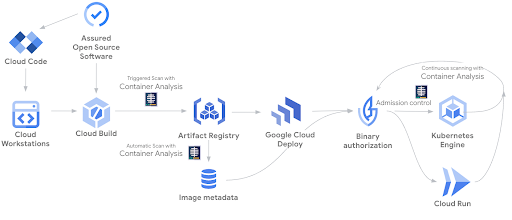
    At the Google Cloud Next ’22 conference, Google today launched a managed Software Delivery Shield (SDS) service to enable DevOps team to store, manage and secure the build artifacts in Artifact Registry. At its core, SDS is based on a trust-based policy engine to establish, maintain and verify a chain of trust across the software supply chain.

    In addition, Google has updated its container analysis tool to include vulnerability scanning for Maven and Go containers along with preview support for non-containerized Maven packages.

    The managed Software Delivery Shield service spans a range of Google runtimes environments, including Google Kubernetes Engine (GKE), Cloud Code, Cloud Build, Cloud Deploy, Artifact Registry and Binary Authorization. Cloud Build also now officially supports Supply chain Levels for Software Artifacts (SLSA) Level 3 best practices by default in addition to generating authenticated and non-falsifiable build provenance for both containerized applications and non-containerized Maven and Python packages.

    GKE, in preview now, provides detailed assessments, assigns severity ratings and surfaces the security posture of the clusters and workloads, including insights into operating system vulnerabilities, workload configurations and other actionable insights. Log data can now also be captured while security event information can be routed to, for example, a security information and event management (SIEM) platform.

    The Google Cloud Run serverless platform can also, in preview, display software supply chain security insights such as SLSA build-level compliance, build provenance and vulnerabilities found in running services.

    At the same time, Google is also making available in preview Cloud Workstations, which provide fully managed secure development environments on Google Cloud that can be accessed via a browser. Built-in security capabilities include virtual private cloud (VPC) controls, no local storage of source code, private ingress/egress, forced image updates and identity access management (IAM) policies.

    Finally, the Cloud Code plug-in for integrated development environments (IDEs) now includes a preview of Source Protect to give developers real-time security feedback in the form of vulnerability dependencies and license reporting as they write code.

    Collectively, Google claimed it now provides more than 250 curated packages across Java and Python with verified provenance. It also automatically generates a software bill of materials (SBOM) to create an inventory of all components and dependencies.

    Historically, cloud service providers have been advocating a shared responsibility approach to cloud security that required organizations to not only secure their applications but also the way cloud infrastructure is provisioned. The challenge is developers generally provision cloud infrastructure themselves even though they generally have limited cybersecurity expertise. Too many developers assume the underlying cloud infrastructure is more secure than it actually is.

    Now, cloud service providers are extending the security services they provide at a time when organizations are making security a bigger factor in determining where to build and deploy applications.

    Sunil Putti, vice president and general manager for Google Cloud Platform, said Google is attempting to make cybersecurity invisible to developers in the sense that guardrails will automatically be embedded within the platform.

    The issue is that cloud computing environments are becoming more complex as new classes of cloud-native applications are deployed alongside legacy monolithic applications. Complexity, as always, is the enemy of cybersecurity.

  • 5 Ways to Transform DataOps With Human-in-the-Loop Automation

    5 Ways to Transform DataOps With Human-in-the-Loop Automation

    We are in the middle of a data renaissance. Today, it’s not just about data instrumentation but also learning how to make DataOps a real business advantage for the entire organization. Data has become an inextricable part of products, used to enhance the quality of user experiences. Reliable access to data and the integrity of that data is imperative to drive innovation and business success.

    But just like any process, problems will arise. There will be pipelines that break or data that isn’t instrumented properly. The question then becomes, how can teams more quickly identify problems and continually improve? How can the journey toward data integrity become one of iteration and improvement?

    DataOps teams are by no means strangers to automation—automated CI/CD pipelines and infrastructure-as-code (IaC) are a huge part of their skill set. But there are some components of automation that are less pervasive throughout DataOps, ones that can help promote data integrity and encourage a culture of improvement. 

    It all starts with a different approach to automation—a human-in-the-loop (HITL) approach. Human-in-the-loop automation enables parts of a process to be fully automated while enabling humans to step in at critical points to take action, make decisions and decide the path forward.

    Here are five ways to use human-in-the-loop automation to drive continuous improvement and achieve optimal data integrity.

    Create Better, Earlier Interruption of Problems

    As is life, inevitably things break, issues arise and teams need to step in to remediate. The goal should be to enable better interruption of these problems when they do occur—identifying issues earlier and bringing the right stakeholders together more easily and swiftly.

    HITL automation can help teams not just identify issues earlier but kickstart the incident response and coordinate across teams and stakeholders. Ideally, automated workflows can be triggered from an incoming signal; for instance, from an observability tool like DataDog or BigPanda. An incident response could be started automatically, triggering further automation—like creating tickets, starting a Zoom meeting, creating a Slack channel and bringing together the right team members. 

    By instantly bringing the right people together, the team can investigate collaboratively and more quickly understand the state of the issue. HITL automation should then enable teams to run further scripts to take action and remediate as needed.

    Bake Improvement Into the Process Through Self-Documenting Workflow

    Many companies today are asking, “How do we make sure that we have that full integrated loop, down to the collection point?” Communication between teams is critical to this endeavor. But even before teams can collaborate on improvements, they need to understand the current state of their data so that if, for instance, a team finds that a report isn’t providing what’s needed, there’s a really clean way to get that communication back to the DataOps team to improve the instrumentation in the first place.

    HITL automation can bake improvement into DataOps workflows by automatically documenting every human and machine action throughout a process. Because it’s connected through APIs to all a team’s tools and services, a self-documenting workflow slurps up every action and creates an audit trail. This audit trail is the basis by which teams can more accurately understand not just the integrity of their data, but also how teams are implementing and running processes.

    Bring Human Data to the Forefront of Improvement

    DataOps teams play a big role in making sure the right data is being collected. However, a lot of people are still using systems that are very manual. They may have a good understanding of their log and monitoring data but still don’t have a good sense of the human data around their organization—what processes and workflows people are running.

    Understanding how humans run processes is just as important as understanding technology problems. The self-documenting workflow described above should include documentation of human data, from manually-run scripts to Slack or Teams conversations and, ideally, even auto-update tickets so even maintaining a system of record becomes less manual. Only by looking at the full picture—of human and machine data together—can teams find areas of improvement in their automation, communication and workflows.

    Take an Incremental Approach

    Don’t let “perfect” be the enemy of “done”. Every great transformation I’ve seen started with a small team, a great mandate, and strong support from the executive team. Adding tons of new technology and hiring more people may not be the silver bullet teams need.

    Instead, teams should look at the expertise they have in-house first—the people, technology and processes. Then, begin by taking an incremental approach. HITL promotes incremental, approachable automation by enabling teams to first codify institutional knowledge, analyze, learn and then begin to automate pieces in small batches.

    Diving head-first into a fully automated approach can leave teams in a worse state than nothing at all. Automation is a journey—we learn by doing, by recording human and machine data and then, using insights as our guide, begin to find real value in small doses of automation. These small steps can make a huge impact and, over time, add up to substantial business value.

    Buy for Industry Standards and Build for the Gaps

    As I mentioned above, teams should first start by evaluating their current resources. What skill sets and technology do they already have and how can they use those resources to achieve their data goals? At the same time, many teams starting their automation journey face challenges—lack of development resources, scripts that live on one person’s machine, difficulty bringing all the human and machine data together into a recorded timeline.

    To help data teams effectively and reliably implement HITL automation, investment into an off-the-shelf platform can help bridge the gaps teams and organizations have. Platforms should enable automation through low-code interfaces while providing code-level customization. This combination enables teams to buy for industry standards while building for the gaps—not managing the platform means development resources can be focused on expanding and improving automation.

    Platforms should enable teams to easily connect to APIs and adapt to custom APIs. The continuous change of DevOps processes and tooling coexist with rapidly changing APIs. Therefore, the most promising automation platforms must manage the complexity of APIs, enabling users to focus on the intent, not the mechanics of custom APIs. Automation technologies should seamlessly handle identity, authentication, pagination and caching. 

    Find Leverage With HITL Automation and Drive Business Impact

    As data becomes increasingly ingrained in product life cycles and user experience, automation holds the key to faster innovation, product quality and enhanced reliability. Creating a culture of continuous improvement and implementing technology like HITL automation that promotes data integrity throughout the product life cycle is where I’ve seen the greatest leverage for organizations. 


    To hear more about cloud-native topics, join the Cloud Native Computing Foundation and the cloud-native community at KubeCon+CloudNativeCon North America 2022 – October 24-28, 2022.

  • Microservices Explained: Not Your Father’s SOA

    Microservices Explained: Not Your Father’s SOA

    Microservices are frequently referred to as a variant or derivative of service-oriented architecture (SOA), if not essentially the same thing. While there are similarities and both are designed around the concept of services, that’s where the similarities end. Each was created around a different set of principles and intended to address different problems.

    Microservices architecture is built around key concepts that, when applied, not only differentiate it from other architectures but deliver advantages that accelerate software delivery and help to scale large, complex applications. To deliver on the promise of cloud-native, microservices must be loosely coupled so that, ultimately, they are independently deployable. Any microservice can be updated and deployed—just that containerized microservice—without requiring changes to other microservice(s). Loosely coupled microservices mean they are not sharing databases or maintaining state, for example.

    How big should a microservice be? Or, in other words, how much should it do? The answers range from ‘a single thing’ to ‘a small set of related code with high cohesion’. Another factor is that getting too granular can overrun a microservices-based application with large numbers of microservices, increasing complexity and making triage through observability and tracing very challenging.

    Scaling microservices-based apps is another important factor. Autonomous microservices can be replicated and scaled for performance and workload using container orchestration tools such as Kubernetes.

    Microservice communications are achieved through well-thought-out APIs created around the business or operational capabilities the microservice provides to anyone or anything engaging through the API. The API, and data provided through the API, are often referred to as ‘technology-independent.’ It’s probably better stated that microservice APIs are built using approaches like RESTful and GraphQL over networks that are not tied to any one specific operating environment, technology or programming language. JSON, YAML and XML similarly represent data that is transferable across technologies.

    The following diagram of a media application demonstrates the principles of microservices architecture. Microservices for scheduling media, digital rights management, tracking impressions and adding new ad insertions are loosely coupled, autonomous and have well-defined API interfaces. Each microservice can be changed, enhanced and deployed rapidly and independently of other microservices.
    Microservices SOA

    Service-oriented Architecture, or SOA, emerged to solve a very different problem; the overwhelming size and complexity of monolithic applications. Monolithic applications have very large codebases that often don’t do a good job of compartmentalizing functional or business logic. This makes changes to the codebase challenging even to developers who know much of the codebase well.

    Services in SOA were often used to gather a collection of similar business logic together and then share them as a service with other parts of the application, as needed. Technologies like message buses are used to make requests of a service and operate as traffic managers for requests across multiple services and other parts of the application. While reusability was a critical design consideration, SOA services were still quite large, and deploying services at high velocity was not an important design consideration. SOA services often take considerable time to code and test the service including interdependencies across other parts of the application before deploying as part of a larger software release.

    One important note: There are benefits and drawbacks to microservices and SOA architectures; neither is ‘better’ than the other. Which architecture to use when mainly depends on the purpose of the application you are building. For larger, more complex enterprise application environments that require integration with many other applications, you might choose SOA. That’s a better fit than for smaller applications that don’t require middleware elements for managing the requests within the app or between other applications. Microservices, on the other hand, are better-suited for smaller and well-partitioned web-based systems. They are becoming the standard for today’s cloud-native applications, and also are a great fit for developing a mobile or web application because they give developers more control.

  • Allstacks Adds Alert Capability to VSM Platform

    Allstacks Adds Alert Capability to VSM Platform

    Allstacks has added an alert capability to its software-as-a-service (SaaS) value stream management platform that automatically notifies DevOps teams when software project goals and deadlines are likely to be missed.

    The core Allstacks platform employs machine learning algorithms and artificial intelligence (AI) models to keep track of pull requests, commits and card changes via a set of dashboards that are designed to be accessible to anyone in an organization.

    The Allstacks Alerts capability makes it possible to notify those stakeholders via email or Slack any time a specific indicator, such as a pull request, has been open for four days, which would suggest risks of delays have increased. Support for Microsoft Teams will be added early next year.

    Adam Dahlgren, senior vice president of product for Allstacks, said the goal is to leverage the advanced analytics built into the platform to surface thoughtful observability insights versus simply firing off a series of generic alerts that lack any context.

    Value stream management (VSM) platforms such as Allstacks automatically take technical metrics collected via DevOps tools and correlate them to key performance indicators (KPIs) defined by business leaders. The concept of value stream management traces its lineage back to lean manufacturing methods, which called for each step of a manufacturing process to be continuously measured. As software development has evolved from being a craft to a highly-automated process using DevOps best practices, an appreciation for the value of monitoring the impact of missed software development deadlines on the business has grown as organizations realize how dependent they are on software.

    In fact, many organizations are discovering there is a clear disconnect between their business goals and software development processes. Business leaders are especially anxious to understand how a software development project delay might impact future revenue projections at a time when economic conditions are the most uncertain they’ve been in recent memory.

    VSM platforms also make it possible to track KPIs spanning multiple software development projects; the hope is that doing so will make it easier to see where resources should be reassigned as various bottlenecks are encountered. In the long term, Allstacks is also working toward adding scenario planning tools to make it easier for IT and business leaders to model “what-if” scenarios, added Dahlgren.

    It’s not clear how much organizations are willing to invest in VSM platforms, but the need for them is becoming more acute. The challenge many organizations still face is making sure they have the tools in place to collect the appropriate technical metrics. A SaaS-based platform should make it simpler to achieve that goal and to apply algorithms to what can quickly become a large corpus of data.

    Of course, it’s still early days as far as the adoption of VSM platforms are concerned. But there’s no doubt the divide between application development teams and the rest of the business is continuing to narrow. Less clear is to what degree that increased visibility will lead to a higher degree of empathy between dev teams and the business.

  • Endor Labs Applies Graph Analysis to Secure Software Supply Chains

    Endor Labs Applies Graph Analysis to Secure Software Supply Chains

    Endor Labs exited stealth mode today to launch a platform that applies graph analysis to identify the depth of dependencies that exist within an application.

    Fresh from raising $25 million in funding, Endor Labs CEO Varun Badhwar said the Dependency Lifecycle Management Platform makes it simpler for organizations to manage dependencies within applications that can involve tens of thousands of components.

    Existing software composition analysis (SCA) tools are not able to as accurately identify the dependencies between software components because they generate too many false positives, he added.

    To address that problem, the Dependency Lifecycle Management Platform provides the equivalent of a credit risk score for each component employed with an application environment, said Badhwar.

    Designed to run out-of-band within a continuous integration process, the Dependency Lifecycle Management Platform is currently being made available via a private beta program.

    On average, bout 80% of an application is made up of open source components that developers downloaded from a repository. The challenge is that many of those components have known vulnerabilities. The Dependency Lifecycle Management Platform makes it simpler to both identify those vulnerabilities during the build process and find components that might be impacted by a newly discovered zero-day vulnerability, said Badhwar.

    Overall, the Dependency Lifecycle Management Platform improves the productivity of both application development and cybersecurity teams by streamlining vulnerability management, he added.

    Having a full understanding of their dependency graph also lets customers generate and analyze accurate software bills of materials (SBOMs) as applications are dynamically updated, noted Badhwar.

    In the wake of a series of high-profile breaches, there has been increased focus on software supply chains. The challenge is most developers don’t have a lot of cybersecurity expertise and, even when provided with tools to identify vulnerabilities, there are simply too many alerts generated. In the absence of any context, most of those alerts simply wind up being ignored. In the meantime, the rate at which new applications are being deployed and updated isn’t slowing down, especially as more organizations embrace cloud-native applications that make it easier to rip and replace software components.

    It’s going to take years for organizations to implement DevSecOps best practices to teach developers how to build more secure applications, but that journey needs to begin with tools that make it simpler for developers to address issues before applications are deployed. The best way to combat application vulnerabilities is to make sure they don’t manifest themselves in code in the first place. Based on the number of vulnerabilities that continue to find their way into application environments, it’s apparent that the current processes being used to build applications are fundamentally broken.

    At this juncture, it will take years to fix the application development and deployment process, but as more secure applications eventually replace millions of insecure applications the overall security posture of organizations will steadily improve. The issue now is finding ways to achieve that goal before another known vulnerability leads to another major security crisis.

  • Protecting CI/CD Pipelines to Secure the Software Supply Chain

    Protecting CI/CD Pipelines to Secure the Software Supply Chain

    Cloud-native applications have become increasingly complex. Composed of an infrastructure stack of mash-up code, hundreds of open source and commercial components, services and APIs, today’s software supply chain is fraught with security risks. At the same time, the ability to manage existing application requirements while building innovation and taking on new areas of responsibility like security is stretching DevOps teams beyond their capacity. The concern for the number of connected and exploitable weaknesses across the software supply chain are now requiring organizations to take a proactive approach to protect their continuous integration and continuous delivery (CI/CD) systems, as they have become a target through which attackers infiltrate multiple production systems. But meeting this requirement is no easy feat as it often requires organizations to choose between how much security to enforce in the build cycle while quantifying their risk to build and deploy quickly. 

    A recent survey revealed that nearly all (97%) of an organization’s assets—and security issues—are now in the cloud. And yet, only 29% of an organization’s assets are associated with cloud-specific policies. Addressing this gap requires organizations to have a proactive approach to protect their technology infrastructure, especially securing the artery of their software supply chain: The CI/CD pipeline. By embracing new security and compliance strategies within their governance approach, organizations can better protect their CI/CD pipeline and cloud applications. 

    There is a growing shift toward programmable infrastructure and infrastructure-as-code (IaC) practices to build out infrastructure and manage configuration files. But with this practice comes the increased risk of exposing application credentials, API keys, encryption keys and digital certificates. Tools supporting the CI/CD pipeline have now become the artery of cloud applications, and it’s becoming more challenging to store, transmit and audit data securely. In addition, when CI/CD tools interact with other systems in the DevOps environment, it increases the risk of exposure for configuration files. A compromise in the build system, for example, can be used to get access to production systems that can result in the exposure of sensitive information or the injection of malicious code, corrupting the entire CI/CD pipeline and thus the software supply chain. 

    A recent Unit 42 Cloud Threat report revealed that overly permissive credentials created added risk opportunities in the CI/CD pipeline. The study found that 63% of IaC templates contained misconfigurations and 91% of container images contained high or critical security vulnerabilities. To address this, organizations need to catch security problems in the build process before cloud workloads are provisioned. During the SolarWinds compromise, for instance, attackers used custom malware designed for the company’s build cycle to observe each step. The sophistication of the intrusion in this attack during the software build process is a key lesson for DevOps and DevSecOps professionals and revealed how security needs to be approached. 

    One way to address this is by being able to identify CI pipeline misconfigurations, which can improve security in the software supply chain. Because CI pipelines are configured in the code, the same policy-as-code approach can be used to identify IaC misconfigurations or open source vulnerabilities to surface CI/CD weaknesses. DevOps and developer teams can keep configurations accessible to just a small group who are building for production release. By establishing enforceable permissions to the pipeline, there is better control over who can commit code changes to the repositories, create containers and deploy code to different environments. 

    Strong chains of trust throughout the build cycle are not commonplace today. But as organizations look at ways to strengthen their risk posture by shifting left, security and DevOps teams can work toward proactively hardening pipelines with the right CI/CD tools and frameworks and push the industry toward a more secure software supply chain. 

  • Linux 6.0 is Faster, Cooler | Debian Goes Proprietary | Google Africa Region

    Linux 6.0 is Faster, Cooler | Debian Goes Proprietary | Google Africa Region

    Welcome to The Long View—where we peruse the news of the week and strip it to the essentials. Let’s work out what really matters.

    This week: Linux 6.0 promoted to Stable, Debian 12 will include closed-source binaries, and Google Cloud opens its first Africa region. (more…)

  • Is DevOps Dead? I Don’t Think So!

    Is DevOps Dead? I Don’t Think So!

    A lesson I have learned over my 30 years in the tech world is that technology and frameworks never truly die—they evolve and they grow. When I read a recent article proclaiming, “DevOps is dead!” and that we should all be embracing platform engineering, I had a chuckle.

    No, DevOps isn’t dead, and rumors of its demise have been greatly exaggerated. In fact, DevOps is more alive than ever and the truth is, it is going wherever software goes. When I went back and read the article again, I realized that it appeared on a website owned by a venture capital (VC) company and that the article itself was a sponsored post from a company promoting platform engineering. That’s a good reminder to take that article with a grain of salt. I also realized that the headline was meant to be controversial, if not downright clickbait.

    That said, I feel that the article demands a rebuttal. To be fair to the author of that article, I believe the point they were trying to make is that there is a major issue with DevOps—we have put too much on the developers’ plates, and that one more straw may break the proverbial camel’s back. Certainly, this is a valid point. We need to balance what we ask our developers to do in relation to the rest of the team. We see this with security in DevSecOps; we see it with testing and we certainly see it with operations. In fact, in many ways, the rise of the SRE has better defined the ops role thereby lessening the load on developers.

    I have no doubt that platform engineering will also lessen the load on developers and better define the role of a platform engineer. However, SRE did not kill DevOps and neither will platform engineering. At one time, it was very fashionable to talk about a full-stack developer. Today, many people think that the so-called full-stack developer is a myth and that role is not really what is needed in most organizations. The job of a developer, though, is never and will never be easy, even with the advent of AI/ML-generated code. The developer always has many plates spinning in the air at any given time. And to that point, the high levels of compensation they are paid is not unwarranted nor is it unearned.

    I look forward to seeing how the platform engineer role and platform engineering as a practice evolve and how they interact with SREs and DevOps teams as well as developers, security testers, etc., but I am fairly certain that no matter how the role evolves, it will not be the death knell for DevOps.

    As we proclaimed for our upcoming DevOps Experience event on November 16, 2022, it is going where no DevOps has gone before. We see DevOps-of-things; we see DevOps at the edge. We see distributed DevOps, too. DevOps has taken root in our software development life cycle and beyond. While the frameworks may change and evolve, DevOps changes and evolves with it.

    If you say DevOps is dead, I disagree. I say long live DevOps!

  • Game Developers: 5 Strategies for a Great User Experience

    Game Developers: 5 Strategies for a Great User Experience

    The gaming industry has exploded since the start of the COVID-19 pandemic. Many people turned to social and casual gaming to entertain themselves at home and interest is expected to continue to rise. According to PwC, the global gaming industry is forecast to increase revenue from $214 billion in 2021 to $321 billion by 2026. With a booming and competitive market, gaming companies must deliver a seamless experience to their end users. A recent survey found that 47% of gamers demanded fast performance, citing it as the most important aspect of gameplay. If users encounter poor performance such as glitchy graphics, crashes or freezes, long load times and in-game purchasing errors, they’ll move on—damaging the company’s brand and revenue. Companies need to have the right technology in place before things go wrong. Here are five strategies game developers must focus on to provide the best gaming experience for end users.

    1. Developers Should Increase Processing Speeds

    Gaming is a demanding application for developers. Instant response time—delivering processing speeds measured in milliseconds—is required for any gaming experience, even when there are substantial usage spikes. It can be a challenge as developers have to account for vast numbers of reads and writes against massive data volumes from millions of simultaneous players interacting in real time and sophisticated fraud detection rules.

    2. Personalize the User Experience

    Personalization helps a game attract a broader audience by offering in-game features that match their preferences. It is an essential way for game developers to retain and monetize their users. With so many different games available for users to play, engaging them for a long time will determine a game’s success. To offer this type of personalized experience, developers need to integrate data silos from different sources, where they continuously update all available historical data from their system of record with data streaming in from the digital edge.

    3. Scale Systems Horizontally

    Gaming applications need to store, access and retrieve enormous amounts of data, such as player profile information, game performance, statistics and rankings and session information, for millions of users. Developers need to be assured their system can scale out easily and quickly to handle any load at any time, without the need for coding or other manual processes. Relational databases aren’t the best fit for gaming as they are built to scale vertically. On the other hand, modern data platforms scale horizontally across servers, clusters, and data centers to ensure consistent and predictable performance.

    4. Prevent Gaming Fraud

    As companies seek ways to monetize gaming through microtransactions, where they offer in-game purchases for additional features, the threat of malicious activity increases. According to TransUnion’s 2022 Global Digital Fraud Report, the U.S. gaming industry had the largest percentage of annual fraud growth last year, increasing 60.3% from the previous year. With more players and financial transactions, companies must take their fraud prevention activities to the next level to ensure smooth and secure transactions. Developers need to continuously update the rules engines for their fraud detection systems. They can do this by processing huge amounts of streaming and historical data that they can feed into machine learning algorithms.

    5. Implement AI/ML Gaming Systems

    Gaming companies should turn to artificial intelligence (AI) and machine learning (ML) systems to improve the gaming experience for their players. The technology can power interesting enhancements to games. For example, it can be used to turn speech into text to document and report bad behavior or to support an in-game assistant that helps players based on their habits, preferences, and abilities. To provide these experiences, developers need to feed their AI/ML systems an unending amount of data to deliver better results.

    The stakes for gaming companies have never been higher. With the gaming market expected to reach three billion global users by 2023, companies must provide the best gaming experience to gain players and protect their reputations. Players demand flexibility, speed and reliable performance. That means delivering smooth gameplay with no hiccups.

  • Business Leaders Will Trade Speed for Security

    Business Leaders Will Trade Speed for Security

    A global survey of 600 C-level executives conducted by CloudBees found that when it comes to building software, more than three-quarters of respondents said it is more important to be secure and compliant than fast and compliant.

    As a result, more than three-quarters (77%) also noted their organization is implementing a shift left strategy for implementing security and compliance even though 58% recognized that those efforts created additional burdens for developers.

    Three-quarters of respondents also conceded that compliance (76%) and security (75%) challenges limited their company’s ability to innovate. Nevertheless, 83% said shift left is important for them as an organization despite the fact that 88% of executives said their software supply chain is secure or very secure. However, only 33% of respondents said their software supply chain is completely compliant.

    Not surprisingly, 86% are focusing on compliance more now than they were two years ago and, in the wake of a series of high-profile breaches of software supply chains, 82% are more concerned about attacks.

    CloudBees CEO Anuj Kapur said it’s clear there is a greater need to reduce security and compliance burdens for developers by putting guardrails in place that automate DevSecOps processes. The survey noted that only 22% of executives believed their software delivery supply chain is completely automated, while another 37% said it is close to being automated. Only 22% said their compliance process is completely automated, with 35% believing it is almost completely automated.

    Three in five (59%) executives said they have all, or mostly all, external tools for security and compliance issues and 29% said they have a mix of internal and external tools. Only 11% use mostly internal tools. A full 90% said their risk management team has the tools, knowledge and expertise to build and/or maintain a secure software supply chain.

    The real challenge, of course, is that while compliance issues are relatively static, new security issues arise all the time. Developers make mistakes or a new zero-day vulnerability is discovered after an application has been deployed in a production environment. It’s critical for organizations to embrace automation to enable developers to address those issues as part of a continuously automated update cycle, noted Kapur.

    As more responsibility for compliance and security is shifted left, the degree to which DevOps workflows will need to be adjusted will naturally vary by organization. However, the days when developers could ignore security issues during the application development process are all but over. The leadership of organizations of all sizes are making it clear they want to see a reduction in the number of security and compliance issues that arise in production environments.

    Ideally, efforts to build more secure and compliant applications would not slow down the rate at which applications are being built and deployed. However, the CloudBees survey made it clear that more executives are willing to prioritize security and compliance over speed of application development. The issue is how to strike a balance between what are clearly two competing priorities.