Category: API

  • How to Prevent Zombie APIs

    How to Prevent Zombie APIs

    There is a growing reliance on web APIs. A full 92% of organizations plan to increase their investments into APIs over the next year, the 2023 Postman State of the API Report found. APIs are powering everything from internal microservices strategies to partner strategies and fully-fledged products.

    Yet, this newfound API sprawl has consequences; a looming threat that might rise from the grave to haunt you …

    I’m talking, of course, about zombie APIs. Zombie APIs are endpoints that are no longer maintained yet are still active. They may be unused endpoints, old features never officially deprecated or forgotten development or testing environments. Regardless, zombie APIs are a type of technical debt that could pose a legitimate threat if left to rot.

    The sudden growth of APIs, along with immature inventory management and a lack of internal communication, can contribute to creating countless shadowy endpoints. Below, I’ll review some of the issues that zombie APIs might cause and consider some actionable steps DevOps teams can take to prevent them.

    Understanding Zombie API Risks

    Forgotten APIs can cause a number of issues. For example, suppose an insecure testing environment was accidentally left exposed to the public. An attacker using automated endpoint scanning could find authentication and authorization holes to exploit, potentially exfiltrating sensitive data.

    It’s also a bad idea to let any piece of technology go unmaintained, given the daily influx of new exploits and vulnerabilities. This point is accentuated by the connected nature of APIs, which may plug into a vast network of databases and allow both read and write privileges to the backend infrastructure.

    Insecure APIs can cause a business both economic harm and damage reputation. Just consider the high number of API-related data breaches in recent years, which occurred at companies like Optus, Dropbox, Twitter and Zendesk. It’s even estimated that somewhere between $12 billion to $23 billion was lost in 2022 due to compromises in web APIs.

    Zombie APIs are an easy target for these sorts of cyberattacks because they tend to have insecure designs that are easier to crack. They also tend to use immature monitoring systems, which means hackers can act under the radar more easily than with actively used endpoints.

    Tips to Avoid Zombie APIs

    Keep an Active Inventory of APIs

    As they say, you can’t secure what you don’t know about. In fact, OWASP lists improper inventory management as one of the ten top API security risks. Therefore, proper inventory management is a good first step to avoiding zombie APIs. Scan your service portfolio for forgotten endpoints, catalog them and update the catalog regularly.

    It’s also a good practice to thoroughly document your services to aid in internal discoverability. If possible, adopting specification-first practices can also ensure the documentation and implementation are based on a single source of truth, thus avoiding mismatched versions and documentation drift.

    “The key to preventing zombie APIs is visibility,” said Jeremy Snyder, CEO, FireTail. “Many organizations lack ongoing, up-to-date inventories of all the APIs that are running in either production or staging environments.”

    Use Proper Versioning and Life Cycle Strategies

    Another method to reduce the chance of zombie APIs is to adopt mature API life cycle management practices. The chosen API versioning strategy should be clearly defined and codified. And versioning changes should be clearly communicated to all stakeholders.

    On that note, it’s just as important to plan out a sunsetting, retirement and deprecation strategy from the onset. Then, remove deprecated services when they have reached their end of life! This is not a glamorous task, but it should be baked into someone’s assignments.

    “Good cyber hygiene is an often overlooked strategy,” explained Snyder. “A second requirement is to have a policy around versioning and how many versions of an API can exist at any given moment. For instance, that policy may state that only the latest version can exist or the latest plus the previous. However, this relies on having visibility in order to maintain compliance.”

    Other areas of proper life cycle management include employing governance around development and deployment and utilizing automated testing in continuous deployment (CI/CD) pipelines. Both of these could help set policies and security requirements, which should also bolster API safety.

    Share Knowledge of Internal and Third-Party Services

    Tribal knowledge is the antithesis of DevOps culture. As such, it’s a good practice to de-silo and share internal knowledge of API-powered services to limit the propagation of rogue endpoints. This could be done through private network repositories or even an internal Postman Collection or Workspace.

    “Internal processes like organizational coordination and communication are critical,” added Snyder. “If teams don’t tell each other about new APIs being developed and launched into production, security teams can’t assess or audit them. Conversely, if app teams don’t know about network infrastructure resources designed to cover various API security aspects, developers don’t know what security controls need to be baked into the API code.”

    Visibility is Required to Avoid Zombie APIs

    A recent CISO survey revealed that API security was the number one concern for CISOs. For many reasons, web APIs are still low-hanging fruit for attackers. This is underscored by the 400% spike in malicious API attack traffic recorded by Salt Labs earlier this year.

    Many of these attacks, we’ve also learned, are occurring over authenticated APIs. This shows that greater accountability and visibility are required to begin to stem the tide of API-related security incidents.

    To reach an adequate level of visibility, leaders should consider adopting tooling that helps determine if there are outdated APIs or APIs with multiple live versions, said Snyder. “These tools should help display what security live APIs have and provide recommendations around how to fix them, if not providing the necessary code or modules to secure the APIs directly.”

  • Overture Maps’ Challenge to Google ¦ Frontier Model Forum’s AI Safety Shtick

    Overture Maps’ Challenge to Google ¦ Frontier Model Forum’s AI Safety Shtick

    Welcome to The Long View—where we peruse the news of the week and strip it to the essentials. Let’s work out what really matters.

    This week: A big-tech consortium goes toe-to-toe with Google Maps, and a big-tech consortium tries to fool AI regulators. (more…)

  • AI ‘is Getting Worse’ ¦ AI ‘Will Lose India Jobs’ (Probably Isn’t ¦ Probably Won’t)

    AI ‘is Getting Worse’ ¦ AI ‘Will Lose India Jobs’ (Probably Isn’t ¦ Probably Won’t)

    Welcome to The Long View—where we peruse the news of the week and strip it to the essentials. Let’s work out what really matters.

    This week, a conundrum: On the one hand, researchers say ChatGPT is losing the plot; and on the other, we hear outsourced coding jobs in India will be replaced by AI. (more…)

  • Google Announces Availability of iPaaS Service

    Google Announces Availability of iPaaS Service

    Google today made available an integration platform-as-a-service (iPaaS) capable of invoking a range of methods to integrate applications.

    Initially developed for the Apigee application programming interface (API) management platform Google acquired in 2016, the Application Integration service can now, for example, also consume a publish and subscribe event or an event driven through a Salesforce platform.

    Amit Zavery, vice president and general manager for Google Platform, said the Application Integration service provides IT organizations with all the benefits of an iPaaS without requiring them to stand up and manage an integration platform themselves.

    The Google Application Integration service also provides access to a Visual Integration Designer tool that can be used to build workflows using a low-code tool. In total, there are now more than 75 connectors that can be used to integrate multiple Google Cloud services and third-party platforms that can run in either a cloud or on-premises IT environment, said Zavery.

    In general, visual tools are transforming how integrations are created and expanded within organizations, noted Zavery. Rather than using lower-level procedural code, a visual tool enables developers to employ low-code to create integrations. That makes it simpler to collaborate with business users that can now more easily participate in developing workflows.

    In fact, in some cases, business users, otherwise known as citizen developers, have enough technical acumen to create their own workflows using low-code tools.

    There are, naturally, going to be plenty of complex integration challenges that will require procedural code, but the bulk of the integrations required today are not especially complex.

    Regardless of who creates the integration, the number of them being employed across an enterprise organization continues to increase as more digital business transformation initiatives are launched. Developers are not going to be able to keep pace with the demand for those integrations if they rely solely on procedural code. The only way to effectively reduce the backlog for integrations is to rely more on visual tools to construct them. In most cases, the integration being created is relatively trivial. The only reason it wasn’t created sooner is there are not enough developers available to complete that task using procedural code.

    There are, of course, no shortage of iPaaS options available. As more workloads are deployed in the cloud, Google is betting the center of gravity for integration will shift toward the places where modern microservices-based workloads are deployed to reduce overall latency.

    It’s not clear whether organizations still view integration as an afterthought versus employing an integration platform around which all applications revolve. That latter approach tends to reduce the total cost of integration when compared to using multiple point products that are not managed via single framework, noted Zavery.

    Ultimately, IT teams that adopt an iPaaS are able to focus more on higher-value IT tasks. The issue is determining which integration projects really require professional developers with lots of integration expertise and which, via a low-code tool, can be handled by almost any developer.

  • Postman Acquires Akita Software to Gain API Observability

    Postman Acquires Akita Software to Gain API Observability

    Postman today announced it has acquired Akita Software to gain access to a platform for monitoring and observing application programming interfaces (APIs).

    The first integration of the respective products offered by both companies will arrive in beta this fall.

    Postman CEO Abhinav Asthana said the acquisition of Akita Software will make it much simpler for organizations to discover what APIs are being employed across an enterprise. A recent Postman survey found that 28% of developers are now deploying APIs at least once per week.

    The Akita Software platform will make it simpler for organizations to discover both rogue APIs that have been created by a shadow IT project and zombie APIs that have been inadvertently left exposed long after they are needed.

    Akita Software’s CEO Jean Yang said the integration with Postman’s API management platform will provide a rich source of data that can be used to add artificial intelligence (AI) capabilities to Akita’s API observability platform. For example, generative AI capabilities should make it simpler to create summaries in natural language that explain the calls an API is making to specific data sources.

    In addition, the combined company will be in a better position to enable organizations to better secure their APIs after deployment by surfacing anomalous behavior indicative of an API that is being used to exfiltrate data, she added.

    The merger with Postman will, in effect, enable the combined entity to provide a complete ecosystem for managing APIs, noted Yang.

    Most APIs are used primarily to interconnect internal-facing applications and systems, with a subset used to integrate partners. Only a relatively small percentage of APIs are externally facing in the sense that they expose data to the internet. Many organizations, however, fail to appreciate how quickly an internally facing API can become externally facing over the course of its life cycle. As such, IT teams need tools and platforms that can manage and secure APIs as they evolve.

    As APIs continue to play a crucial role in advancing business goals, there is a clear need for increased visibility as the types of APIs employed also continue to expand. Most APIs in use today are based on the REST format, but there are also APIs based on GraphQL, event-driven architecture and various messaging platforms. None of these newer APIs will supplant REST APIs any time soon. Rather, they are being applied to drive additional processes alongside REST APIs.

    In the longer term, it’s not clear how many APIs will be managed by the developers that created them versus a centralized DevOps team. However, the more APIs that are deployed in a production environment, the less feasible it becomes for developers to manage their life cycle. The challenge is making sure there is some type of structured workflow in place that, at the very least, makes everyone involved in the process aware that a new API has been created and deployed.

  • State of API Report Highlights Productization and Generative AI

    State of API Report Highlights Productization and Generative AI

    In today’s software landscape, an API-first strategy is increasingly popular. It’s the bedrock of how applications are built and connected. APIs help promote internal tech reusability, helping developers do more with less. Due to this increasing API reliance, maintaining quality control is increasingly important for internal and partner integrations and ensuring the reliability and security of these connections remains a top priority.

    Due to the rising API ubiquity, nearly half of the total development energy is spent working with APIs. And to continually improve these interfaces, taking a product mindset is proving helpful. In fact, 60% of API developers now view their APIs as products. Generative AI has also shown incredible promise and is now being used in tandem with traditional tools to increase API code quality.

    Postman recently released its fifth annual State of the API Report. The 2023 edition, which surveyed thousands of developers and API professionals, found subtle changes in tooling preferences and styles. It also sheds light on the ongoing API productization movement and API developers’ use of generative AI. Below, I’ll focus on these two key areas and review the report for its other key takeaways.

    API Productization is Hot

    The majority of API developers now view their API as a product, and this figure rises to 68% in large companies. A full 65% of respondents said their API generates revenue, too. This news is significant, as it demonstrates the industry is maturing its view of APIs. They are no longer offshoot developer toys but fully functional services contributing to overall business growth.

    But how much growth? Well, of those monetizing APIs, 43% now say APIs generate a quarter of company revenue. For some companies, APIs generated more than 75% of total revenue! There also appears to be a parallel between API revenue generation and large companies.

    Do you view your APIs as products? Most developers say "yes."
    Do you view your APIs as products? Most developers say yes.

    Other industry reports unearthed similar API productization potential. Rapid’s 2022 State of APIs report found that 42.6% of organizations are now monetizing APIs. And investment into API-first products remains strong even amidst a broader contracted tech investment climate. These findings come as social media giants like Reddit and Twitter attempt to monetize their APIs.

    That said, for 28% of companies, API revenue still equates to less than 10% of total revenue. APIs still don’t get the lion’s share, perhaps because they’re packaged with an existing platform or because of the many other indirect ways APIs might benefit the business. Furthermore, consumers are becoming more cost-conscious, as 60% cite pricing as a factor before integrating with an API. Still, the numbers are significant firsts for the burgeoning economy.

    Most API Developers are Using Generative AI

    Generative AI interfaces like ChatGPT and Bard have certainly taken the tech industry by storm due to their ability to generate code snippets, debug code and more. And for the first time, the State of the API Report spotlighted generative AI and its use within the API economy.

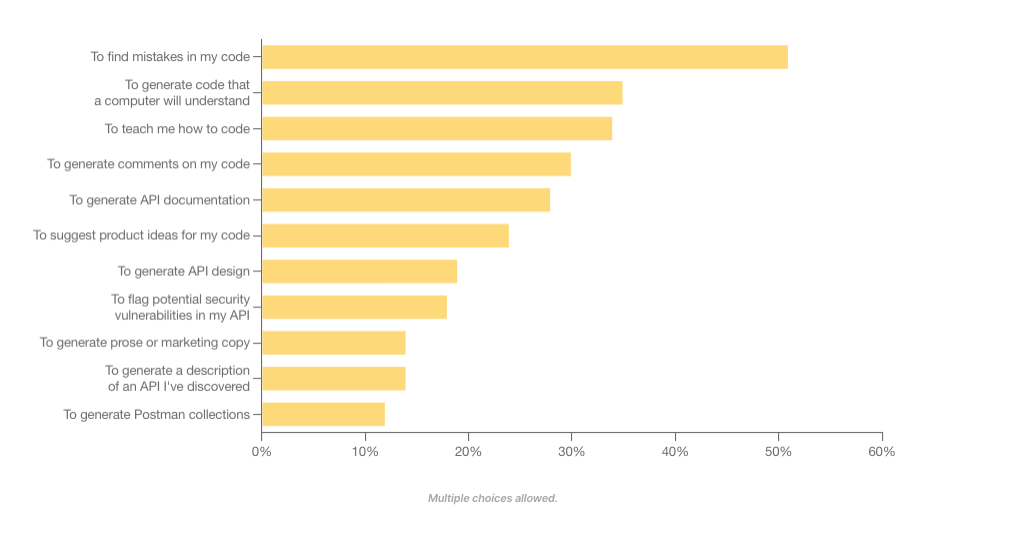
    Today, 60% of API professionals are using generative AI on the job. API engineers commonly use generative AI to find mistakes in code, generate machine-readable code and increase learnability around their programs. Some even use generative AI to suggest potential security flaws in their APIs.

    Compared with other app development endeavors, developers are by far most excited about building generative AI-powered applications in the year ahead. Yet, the efficiency gains are modest—many engineers forecast productivity improvements of 10% to 25%.

    How are API developers using generative AI in their work?
    How are API developers using generative AI in their work?

    Generative AI is set to accelerate many areas, including DevOps and API operations. Yet, contrary to some headlines, generative AI can’t automate all aspects of the software development life cycle. Rather, the technology is more likely to augment the API developer’s workflow than replace the need for seasoned professionals altogether.

    Other Key Takeaways

    Similar to last year’s report, integrating between internal applications, programs or systems remains a top concern for integrating an API or producing an API. The good news is that these integrations continue to increase in quality.

    The report found that deployment failures and times-to-recovery are improving on average. More than half (56%) of respondents said API security incidents occur less than once a year within their organization. This shouldn’t overshadow the significant impact API security breaches can have but signals that DevSecOps is beginning to respond to persistent API vulnerabilities.

    There are more API-first leaders than ever before. And API owners continue to evolve how their services are built and deployed. For example, REST is still by far the most common API style, used by 86% of developers. Webhooks made second place at 36%. However, GraphQL rose in usage, bumping SOAP into fourth position.

    SOAP slips on API architectural styles
    REST is still the dominant style, but GraphQL makes gains as SOAP slips.

    Other Quick API Factoids

    • More non-developers are becoming interested in APIs, as evidenced by 53% of survey takers being non-developers.
    • Most APIs are private—61% percent of businesses’ APIs are for internal use only.
    • After the technology group, business/IT services, financial services and health care are the most common sectors to adopt APIs.
    • Microservices is still the dominant architectural style of APIs, at 42%.
    • Performance, security and reliability are the top factors evaluated when integrating with a new API.
    • Improper authentication, authorization or access control is the most commonly cited API risk.
    • Common API tools include Postman, SwaggerHub, Datadog, SoapUI and Insomnia. Top gateway and API management platforms include AWS API Gateway, Azure API Management, Apigee and Kong.
    • JSON Schema is by far the most popular API specification.
    • The financial industry is a leader in API-first strategies—32% of respondents spend more than 20 hours a week working with APIs.
    • Most developers deploy APIs to production once a week to once a month.
    • When developers leave a company, their departure can cause outdated documentation, zombie APIs and a loss of institutional memory.

    API Obstacles Remain

    Looking to the future, investment in APIs is projected to climb. In fact, 92% of developers said their organization plans to invest the same or more time and resources into APIs in the coming year. Yet, some obstacles remain—a lack of documentation and poor service discoverability are still prominent roadblocks to API consumption. Furthermore, a lack of time and talent are major concerns that might stunt API development.

    The Postman State of API Report surveyed over 40,000 developers and API professionals, making it the largest study conducted on APIs to date. It should be noted that, given Postman’s specific focus in the market and its surveyed pool, figures may be skewed to represent increased API enthusiasm. For deeper insights, you can read the entire report here.

  • Threads: Twitter Killer or Ad-Infested Hellscape?

    Threads: Twitter Killer or Ad-Infested Hellscape?

    Welcome to The Long View—where we peruse the news of the week and strip it to the essentials. Let’s work out what really matters.

    This week: Meta launches its much-leaked Threads microblogging app. A spinoff from Instagram, it’s already reached 30 million signups at the time of writing—even before it’s available in the EU. But how is Meta’s DevOps team making it scale? (more…)

  • Noname Security Looks to Shift API Security Testing Left

    Noname Security Looks to Shift API Security Testing Left

    Noname Security today made generally available an update to a tool for testing application programming interface (API) security that promises to make it easier for DevOps teams to ensure APIs are secure.

    Filip Verloy, a field CTO for Noname Security, said Active Testing V2 is purposely designed to make it simpler to integrate API testing within a larger DevSecOps workflow.

    Version 2 of Active Testing, for example, provides additional integrations with continuous integration/continuous deployment (CI/CD) platforms along with automated API discovery tools.

    Other capabilities included in the latest release are tools to automate API response inspection, troubleshooting, classification and vulnerability discovery.

    Finally, Noname Security has also added support for GraphQL-based APIs alongside REST APIs.

    In total, there are now more than 160 API security tests that can be employed on an API testing tool that Noname Security developed to enable it to build Active Testing, said Verloy. In effect, Active Testing is an extension of that core API testing tool, he noted.

    The biggest issue DevSecOps teams encounter when testing API security is that most legacy tools are not designed to provide any visibility into the business logic used to construct APIs. As such, there is a need for API security tools that can be easily integrated within DevSecOps workflows to discover issues before APIs are exposed in a production environment, he noted.

    While a lot of progress has been made toward securing software supply chains, APIs have generally not received enough attention. Developers typically create APIs, but they don’t typically assume responsibility for managing and securing them. As the number of APIs within organizations continues to proliferate, there is a growing need to centralize API management and security.

    Historically, developers have assumed that cybersecurity teams were making sure APIs are secure. Cybersecurity teams, conversely, assumed that the developers that created APIs would be responsible for securing them. DevSecOps best practices make it possible to now extend responsibility for security further left toward developers in a way that enables cybersecurity teams to define the policies and controls that should be used, noted Verloy.

    It may a while before every organization masters the all the nuances of DevSecOps, but as pending legislation that requires organizations to better secure software supply chains becomes law it’s only a matter of time before organizations revisit API security—if they have not done so already.

    In the meantime, cybercriminals have already discovered that insecure APIs provide a convenient mechanism for exfiltrating data that they can then sell or hold for ransom. The number of rogue and zombie APIs that are unknown or that have been forgotten has become a major cybersecurity issue. Ideally, DevSecOps teams would not only test the security of APIs before they are deployed but would also address a significant amount of technical API security debt that has already accumulated.

    One way or another, API security is going to become a significant issue in the weeks and months ahead. The issue now is how to address it before it gets any worse.

  • Hasura Unfurls Data Delivery Network Based on GraphQL

    Hasura Unfurls Data Delivery Network Based on GraphQL

    At its HasuraCon 2023 conference today, Hasura launched a Data Delivery Network (DDN) based on a set of GraphQL application programming interfaces (APIs) that makes it simpler to integrate distributed sources of data.

    In addition, Hasura is adding Hasura Schema Registry to streamline API governance using graph technology, a MongoDB connector, a Native Data Collector (NDC) for REST APIs and support for the Open Domain Data Specification (OpenDDS), an open framework for modeling APIs originally developed for the travel industry.

    Finally, Hasura is adding support for Native Queries and Logical Models capabilities that convert SQL requests into API calls.

    The Hasura DDN leverages the GraphQL API to enable sub-second integrations across a network that, in concept, is similar to how a content delivery network (CDN) is constructed.

    Hasura CEO Tanmai Gopal said the goal is to enable sub-second integration of data at a global scale across a network with more than 100 regions. Developers can integrate their APIs in less than a second regardless of the number of data models connected. Metadata changes can also be used to create builds that can be independently tested and applied to projects to enable API version control and collaboration among development teams.

    The Hasura DDN is accessed via Hasura Cloud, an instance of a data integration platform that can be deployed on multiple clouds, including Microsoft Azure, and will soon be made available for private clouds managed by internal IT teams.

    GraphQL is gaining traction as an alternative to REST APIs for integrating data, but it’s more complex to implement and manage. The Hasura DDN extends the reach of a Hasura Cloud platform that provides a simpler method for adding GraphQL capabilities to an IT environment in a way the also conserves network bandwidth, noted Gopal.

    GraphQL is a query language for APIs and a runtime for fulfilling queries that provides a complete and digestible description of the data in an API. It can also be used to pull data from multiple sources because it uses a schema that defines the different types of data available. REST APIs, in contrast, can only fetch data from a single source. As such, many organizations that are trying to drive adoption of reusable digital services are relying on GraphQL.

    It’s not always clear who within an organization is assuming responsibility for managing the APIs that developers create, but as the number of APIs increases, DevOps teams, in many cases, are moving to centralize API management. In fact, the more data an organization creates, the greater the corresponding use of APIs to programmatically access that data becomes.

    Hasura is betting that as organizations reach a critical mass of API integration requirements, it will make more economic sense to rely on a purpose-built data integration platform accessed as a cloud service versus relying on a set of tools and platforms they need to configure and manage. Regardless of approach, the one thing that is certain is the number and types of APIs that need to be managed are rapidly exceeding the ability of IT teams to keep pace.

  • The Case For an API-First SCM

    The Case For an API-First SCM

    Somewhere around a decade ago, about the time DevOps really started to manifest, we began seeing technology companies—including some of the largest ones today—investing heavily in their APIs.  

    API-first companies managed to rapidly gain widespread adoption because of the benefits of being API-driven. Everything from automation and scalability to flexibility, performance, speed and monetization.  Once DevOps thinking made it increasingly clear that automation would solve problems like human error and increase performance and velocity, creating more machine-to-machine interaction became a critical factor in software delivery—because the problem in the technology world was not innovation, but rather integration.

    Twilio is a prime example. The company became famous for its API-driven approach to customer management and even had a famous Silicon Valley billboard trumpeting their success. They changed the game for customer communication for some of the largest companies in the industry, from Netflix to DoorDash to Coca-Cola, by making communication completely invisible to users. These APIs largely served developers by unifying communication on the backend and providing powerful customer-facing capabilities on the business side. But they’re not the only ones.

    API-first SCM

    API-driven companies managed to disrupt entire markets nobody imagined could be disrupted, such as Stripe for payment processing and Slack for immediate communication (their former head of developer relations, Amir Shevat, said that Slack’s developers were literally measured by their API’s active tokens). Companies that harnessed the power of their APIs saw unprecedented growth over the last decade due to the integration power they unleashed. 

    Today, there really is no self-respecting dev-first technology that doesn’t invest heavily in the robustness of its APIs. There are even entire companies today built around API integrations—from marketplaces like Rapid API to security companies like Akita Software to companies like Kong that focus solely on simplifying API gateways.

    The API-First Dev Tool Revolution

    The same transformation that disrupted various business industries is now beginning to take center stage in the technology and dev tools space. This is also part of the developer experience revolution that is the stimulus for all the nifty dev tools in the first place. As developers become the new decision-makers—masters of their own domain—and are no longer being forced to adopt and use technology someone else purchased for them, the experience of using these tools impacts their choice of whether or not to add these tools to their chain. This means that those creating the tools today need to deeply understand the developer’s workflow and optimize their products for this user persona.

    This very same evolution that typical tooling underwent is now impacting age-old tooling in the developer ecosystem—and developer pain and friction are starting to come to the forefront. This includes the need for better and more robust API capabilities, “as-code” (infrastructure-as-code, testing and security) tooling, low-code/no-code and code variations and much more.  

    It’s interesting to see that, even with the cloud-native and DevOps revolution, our most core developer tool—our source code management—hasn’t really changed much in the last 20 years. Git remains ubiquitous, but its design is optimized for developer workflows from two decades ago. It’s long past time for an API-first SCM, and there are a number of use cases that can benefit from better APIs.

    Evolution and Anatomy of APIs to be Git-Native

    Even with the most exciting innovations we’re seeing from Git SaaS tools like GitHub and GitLab—from Co-Pilot to Codespaces, pipelines and more—they’re only as strong as the technology they are built upon. As the world evolves, this fundamental weakness is proving to be a sort of kryptonite.  

    Despite Git being an old-school, monolithic tool with proprietary protocols, Git hosting providers like GitHub, GitLab and Bitbucket have invested a lot into making their services API-driven to cater to tool integration. True, each has its own API, which drove some players integrating with the service (especially in the early days) to integrate via an SDK rather than an API.

    GitHub itself provides a variety of APIs—from the simpler REST through the more elaborate GraphQL. These APIs provide you with the ability to do pretty much anything, but are somewhat cumbersome for some use cases. To deal with the core Git functionality, you are required to directly manipulate objects in the Git database.

    Code Deployment and GitOps

    As engineering organizations grow, the need for greater control of code and infrastructure resources has become a real pain—and this is where GitOps provided the methods and the tools to support automated policy management at scale. This automated policy and governance is largely enabled, machine to machine, via APIs, and many of its controls are built on code and configuration files that are hosted via Git (hence its name: Git Operations).

    When using this methodology, a configuration change is first committed to Git (as the single source of truth that will apply changes in all the relevant places). Only then does this trigger automatic processes to apply these changes universally. In some cases, these automatic processes have to commit files to Git via API.

    Another area where SCM APIs play a key role is versioning and release management.  DevOps teams need to manage the release of new versions of their applications, including creating release notes, tagging releases and creating release branches. These processes, which sometimes take place multiple times every day, include many steps and require accuracy—a comprehensive suite of efficient APIs is critical for such an operation.

    UX Customization

    Today, there’s a huge diversity of stakeholders in modern engineering processes, particularly in the context of game development, but this is also true in any kind of web-based or UI-based engineering, as well. Today, product and design are an integral part of engineering processes, but Git still remains the domain of developers.

    There are times when you’d like to have a unified interface for your asset management that pulls data from multiple APIs and sources—such as Git for source control and Google Drive for large files. The added benefit is to abstract and decouple the underlying technology from the user experience and interface so that users can be free to migrate and move between their technologies of choice. This is true whether at the SCM or the storage level without having to change the interface that the team is accustomed to.

    APIs that efficiently perform the full set of SCM functionality allow developers to use a single backend for managing code versions while still providing end users with the desired experience, regardless of what that might be.

    Versioning-as-a-Service

    SaaS products have made it significantly easier to manage and maintain our services through simple UIs and dashboards. However, this simplicity also has a tradeoff. Have you ever made a simple configuration or code change, quickly regretted doing so and then attempted to revert it via your SaaS console? In most SaaS apps that aren’t managed as code, this happens all the time—from Okta to Datadog and many others. Without the benefits of “as-code” and the version control that comes with it, reverting changes is nearly impossible.

    The most you can achieve is “undoing” a previous configuration—if you can still catch it with a CTRL+Z—simply because engineering didn’t bother (or did not have the resources) to implement versioning. Imagine if this could come as a service for all of your SaaS applications!

    For software developers, API-based version control will unlock the possibility of easily incorporating rich version control capabilities into their product—in the same way they can currently use other capabilities such as database, file storage, etc. 

    The World is Ready for an API-First SCM

    TL;DR: API-first models have delivered some of the greatest innovations that ‘dinosaur’ industries—from payments to communications—needed to move faster and do so securely. It is almost laughable that the technology industry has inherent limitations due to a core technology that has a legacy design. This should not be a technology limitation we should accept.  

    Our source code should be able to be controlled, manipulated and transformed via API to remove human toil from places it isn’t really needed and free people to focus on higher-order problems.  With the widespread adoption of generative AI and smarter machine overlords, we’ve discovered that there are many formerly manual tasks that we can offload to machines. Free SCM APIs to unlock the next generation of innovation—because soon there will be more machines than humans to manage them. APIs are the key to tapping into this power.