Author: TK Keanini

  • How to un-domesticate your network: DevOps!

    How to un-domesticate your network: DevOps!

    When I look at how compliance and regulations have affected network security over the years, I’m reminded of what dog breeder standards and regulations have done to dogs over the years. I’ll use this analogy to make the case that networks have become too domesticated to the point that they are not able to adapt and thrive when faced with their natural predators on the Internet. DevOps in my opinion is a way to undomesticate your network so that processes and technologies can deal with the threat in the most natural manner, striking the balance portrayed in complex ecosystems.

    cute2

    This entire thought process began when I was hanging out with my buddy Hugo. He is my one-year-old French Bulldog. We hang out a lot, and there are times when I think he telepathically helps me solve hard technical problems (but that is off topic). Anyway, if you know anything about French Bulldogs, you know they are mutants. They have been bred to the point where their breathing is compromised and they can overheat and die when it is too hot. They have common back and spinal diseases, and I can go on and on, but they essentially need humans at this point to keep them alive. I have to put a life vest on poor Hugo if we are near water because, while all dogs can swim, his head is so heavy that after a short while he will drown. Nonetheless, he is my sidekick in many ways, and we both lack vital characteristics of our ancestors who thrived in much more hostile environments.

    While I can go on and on talking about my buddy Hugo, the point I’m trying to make is that while standards like PCI help to raise the bar regarding online security measures, I have to stop and ask: security measures against whom? The level of innovation, change and adaptation that is taking place on the threat side of the equation is out pacing the rate at which security standards can be institutionalized and implemented. So your network may be cute and cuddly like my Hugo, and maybe even win a ribbon or two, but it would also not survive when faced with an advanced threat.

    When we trace the domesticated dog back tens of thousands of years, we arrive at the grey wolf. They traveled in packs, they faced threats on a daily basis, they thrived and adapted in a very hostile environment. DevOps takes us back to the time when the wolf finds its strength in the pack, and the pack finds it strength in the wolf when faced with conflict. Survival is very real and practical; there is no level of certification, checklists or deterministic process that must be followed. It is a delicate dance between attacker and defender, and like it or not, we are headed back in that direction.

    DevOps brings us the opportunity to constantly represent the changing threat in our everyday lives – such is the case with anything connected to the Internet. It is back to the wild, back to the days where a loss at the organism level meant evolution and resiliency at the species level. Our goals change from securing our networks to evolving our networks as this tempo of change raises the costs to the adversary. DevOps makes your network more expensive to attack!
  • Organizational Dysfunction: The original vulnerability

    Organizational Dysfunction: The original vulnerability

    During your teenage years, you may have figured out a way to get a ‘yes’ from your parents by playing off of the responsibility and knowledge gap between them…walking up to your mom and saying something like, “Hey Mom, Dad said he would drive me, can I go out tonight?” and then proceed to your dad and say something like, “Hey Dad, Mom said I can go out tonight and you need to drive me.” There is nothing cleverer than a determined teenager wanting to get his or her way. Such is the case of targeted attackers and the way they play one IT department’s responsibilities off another. This is the grey area where the organizational chart and separation of duty can introduce weaknesses exploited by the more advanced threats we face today.

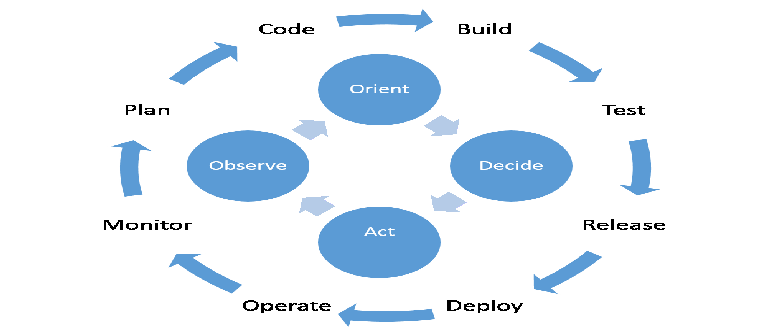
    You don’t have to look far into your organization to see this at work. The security team does its thing, networking engineers do their thing, and IT operations teams in general all have administrative realms that define functional boundaries as to what they can see and do. To borrow from Colonel John Boyd’s OODA loop, each team has its observation and orientation (OO) process for gaining operational visibility and making decisions, as well as specific decisions and actions (DA) they can execute within their administrative realm or set of capabilities to bring change to their organization. The weakness I’m highlighting in this post is when the decision and action appropriate for a set of observations, and the observations themselves, exist in two separate departments and can be exploited by the attacker.

    To exemplify the problem, let’s begin with the question: Is a distributed denial-of-service (DDoS) attack a security or a network engineering issue? The problem I see most often is that one department will have a precise view into network telemetry for early threat detection, but will not yet have the ability to mitigate or remediate the threat.

    Or how about the situation where credentials for one of your executives are harvested, and now the attacker need not trigger any security events at all in order to carry out an attack. In this situation, the attacker merely needs to log in and plan the next stage of the attack, roaming freely and without suspicion across your network because they are only generating networking traffic. The network team does not act because everything is still available, and the security team does not act because there is nothing being denied in access logs, no firewall violations, and nothing triggered on the IDS/IPS.

    Let me be clear in that I am not saying that everyone has to become an expert in everything; specialization is healthy, but only when it does not compromise communication! In the example of Mom and Dad being played by the teenager, if Mom and Dad had a better communication protocol, the teenager’s tactics would be thwarted. If you look at some of your operational procedures, and start to think like an attacker (or teenager again), I’m sure you will find at least half a dozen communication gaps that a clever attacker could exploit.

    This organizational dysfunction is going to require change that may appear to be radical because the systems that support it are so ingrained. Big analyst firms have defined their technology categories as law and they police them as if you were breaking the law if you dare to create something different – something more cross functional. Some best practices out there are, in my opinion, worst practices because they are so focused on the operational effectiveness of the department, and they leave out other departments or the active threat entirely. Lastly, even some prescriptive compliance requirements force organizations into strict separation of duties, but when implemented, create a broken OODA loop where the ‘OO’ does not connect with the ‘DA.’

    There is an opportunity for DevOps to completely recalibrate how we deliver a cross functional operational unit which is why I took the time to write this article for devopsy.kinsta.cloud.  Through the lens of Boyd’s OODA loop, you can already see the security ramifications because the tempo of DevOps allows the defense to loop at a faster rate than the adversary – the dominant strategy of the OODA Loop.

    I hope this post is a call to action for all you big thinkers. Get creative, get innovative, and do not be afraid to erase some lines and boundaries within your IT organization if it fosters a higher level of communication amongst your teams. Think of your organization like a great band playing live music. All of the performers play different instruments, yet they are listening to one another just as hard if not harder than they are producing sound. They improvise and adapt to one another; monitoring systems are put in place so they can have just enough of each sound in their own ear. This is what effective, cross-functional teams look like.  I’m just going to say it: DevOps is Rock and Roll!

    Oh, and hey, follow me on twitter: @tkeanini